Significant Cumulative Cryptosystem for Accessible Data
Distribution in Cloud Storage
S.Jhansi1, Ch.Sekhar2
#1. Student of M.Tech (CSE) and Department of Computer Science Engineering, Vignan’s Institute of Information
& Technology, Duvvada, Visakhapatnam, AP, India
#2. Assist.Prof, Department of Computer Science and Engineering, Vignan’s Institute of Information& Technology, Duvvada, Visakhapatnam, AP, India
Abstract—
A cryptosystem is pair of calculations that take a key and change over plaintext to ciphertext and back. Data circulation is fundamental usefulness in distributed storage. In this project the aggregate focus is on how privately, professionally and effectively the data offer with other in distributed storage. The master key holder can make fix size total key for variable alternatives of encoded content set in distributed storage, yet remaining documents from the set are classified .The total or combined key can suitably sent to others or put away in keen card with less secure stockpiling. Fitting security examination of this methodology is given in standard model. Open key patient-controlled encryption structure yet to be known. The prerequisites of data security at interims an enterprise have experienced real changes in last numerous decades. Before far reaching utilization of data procedure instrumentation the security of data felt to be profitable to a partnership was given essentially by physical and managerial means. Distributed storage is increasing quality as of late Cloud registering relies on upon sharing of assets to achieve lucidness and economies of scale simply like a utility (like the power matrix) over a system. misuse the distributed storage, clients store their data on the cloud while not the weight of data stockpiling and support and administrations and great applications from a common pool of configurable processing assets Cryptography is perhaps the preeminent important side of correspondences security and is transforming into continuously essential as a fundamental building square for portable PC security. As data sharing is an imperative common sense in distributed storage. Amid this work we tend to demonstrate that an approach to immovably, with proficiency and adaptably impart data to others in distributed storage. We tend to Portray new cryptosystem that turn out figure content of consistent size such decipherment rights are regularly delegated on them. We have the capacity to make them minimized as single key by collection of any arrangement of mystery key .this reduced key
helpfully sent others or are frequently store in an exceedingly extremely limited secure stockpiling. Our plan gives first proficient open key encryption plan for adaptable chain of command.
KEYWORDS: cloud storage, data sharing, key
aggregate encryption, intrusion detection, Public Key Encryption.
I. Introduction
Cloud computing is developing as an immense stage for positioning missing and sharing information. Interest for information upkeep and capacity is expanding in all fields, whether clients are from corporate, military, IT associations and so forth. Information security has turned into a vital sympathy toward cloud clients. Clients don't trust mists as far as classification. Mists are seriously utilized for sharing information. Cloud hosts can impart subset of their data to their companions and associates. While sharing information, security is a noteworthy concern. Customarily we trust outsider server for giving security. Solicitation is sent to the server for validation, hosts getting to mists are compelled to believe the outsider for their security. Be that as it may, there are shots of bamboozling, hacking and interruption assaults [1].
Accept that in a doctor's facility administration framework specialists and patients are getting to the cloud for sharing data about ailment and medicines. Specialist transfers data about his patient on the cloud, however he is not happy with the security guidelines of cloud. Thus, specialist chose to scramble all his information and afterward transfer records on the cloud. Following two days one of the patients asked for the data pertinent to him. As specialist has as of now scrambled information, the decoding key will be assigned to the patient. On the off chance that customary methodology is considered for assigning decoding key, three conditions are emerging:
2. All records are encoded with unmistakable or unique key. For this situation unmistakable decoding keys will be sent, which is for all intents and purposes wasteful, as information proprietor needs to send a no. Of unscrambling keys.
3. While designating the mystery keys there are shots of intruder’s assault. Some outsider may attempt to get vital data.
To overcome above obstacles while sharing the information, an answer is proposed in this paper. The proposed arrangement is to "Scramble all information with disparate encryption key and send just single unscrambling key. This single unscrambling key ought to have the capacity to decode different figure content. The promising element of unscrambling key is that, it is total of the whole decoding key yet it stays smaller in size as a solitary key [1]. The hosts included in correspondence ought to have the capacity to screen the security ruptures, thus an interruption location framework ought to be given". The unscrambling key is designated safely on a secured channel. Little size of decoding key is sought, as we can utilize it for advanced mobile phones, remote sensors, shrewd cards and so forth. This paper finds its application for healing center administration, military administrations and so forth. New registering ideal models continue rising. One prominent sample is that the distributed computing worldview, a substitution financial figuring model made achievable by the advances in systems administration innovation, wherever a buyer will influence an administration supplier's registering, stockpiling or systems administration framework. With the extraordinary exponential rate of data, there's Associate in nursing expanding interest for outsourcing data stockpiling to cloud administrations like Microsoft's Azure and Amazon's S3 they help inside of the vital administration of organization data. putting away data remotely to the cloud in an exceedingly adaptable ondemand way brings engaging advantages: help of the weight for capacity administration, all inclusive data access with independent topographical areas, and evasion of worth on equipment, programming, and work force systems of support and so forth .despite the fact that the bases at a lower place the cloud unit of estimation significantly more intense and solid than individualized computing gadgets, regardless they're confronting the expansive shift of each inward and outer dangers for data uprightness. Tests of blackouts and security ruptures of critical cloud administrations show up occasionally. Furthermore, there exist different inspirations for CSP (cloud administration supplier) to carry on unfaithfully towards the cloud clients with respect to the remaining of their
outsourced data. as a samples, CSP may recover capacity for financial reasons by disposing of data that has not been or isn't got to, or even shroud data. Considering data security, by the customary implies that it totally relies on the server to create the entrance administration alone once verification .it suggests that any stunning increment can uncover all data. As an aftereffect of its mutual environment, things turn out to be most exceedingly terrible. As data is access from any virtual machines (VMS) yet it lives on one physical machine. Data in an exceedingly target VM is additionally taken by instantiating another VM co-inhabitant with the objective one. Usually in study plans, TPA will check the supply of data for the benefit of proprietor however cloud server doesn't trust TPA. So we've a slant to take after differ theoretical methodology for good security .clients is required to figure their own data by utilizing their own particular key before transferring. Data sharing is Associate in nursing critical value in distributed storage. Sharing scrambled data successfully is type of intense undertaking. Plainly client will exchange scrambled data and decipher them, and offer with others; however approach damages worth of distributed storage. Discovering Associate in nursing practical and secure because of offer incomplete data in distributed storage isn't unimportant
II. RELATED STUDY
Encryption key strategy
An encryption plan which is initially proposed for briefly transmitting huge number of keys in telecast situation. The development is basic and we quickly survey its key inference handle here for a cement depiction of what are the alluring properties we need to attain to. The deduction of the key for an arrangement of classes (which is a subset of all conceivable ciphertext classes) is as takes after. A composite modulus is picked where p and q are two vast irregular primes. An expert mystery key is picked at arbitrary. Every class is connected with a particular prime. All these prime numbers can be placed in the general population framework parameter. A consistent size key for set can be produced. For the individuals who have been assigned the entrance rights for Sˈ can be created. In
symmetric-key encryption, On the other hand, offering of decoding force is not a worry in these plans.
IBE with compact key
Identity based encryption (IBE) is an open key encryption in which the general population key of a client can be set as an personality string of the client (e.g., an email address, portable number). There is a private key generator (PKG) in IBE which holds a expert master key and issues a master key to every client with deference to the client personality. The content supplier can take general society parameter and a client personality to scramble a message. The beneficiary can decode this ciphertext by his master key. To manufacture IBE with key conglomeration. In their plans, key accumulation is obliged as in all keys to be accumulated must originated from diverse identity divisions. While there are an exponential number of characters and subsequently master keys, just a polynomial number of them can be aggregated This altogether builds the expenses of putting away and transmitting cipher texts, which is illogical by and large, for example, imparted distributed storage. As another approach to do this is to apply hash capacity to the string indicating the class, and continue hashing over and again until a prime is acquired as the yield of the hash function we specified, our plans highlight steady ciphertext size, and their security holds in the standard model. In fluffy IBE one single minimized mystery key can decode cipher texts encoded under numerous personalities which are shut in a certain metric space, however not for a discretionary arrangement of characters furthermore, subsequently it doesn't coordinate with our concept of key to key.
III. SYMMETRIC-KEY ENCRYPTION WITH COMPACT KEY
Benalohetal. [2] presented an encryption scheme which is originally proposed for concisely transmitting large number of keys in broadcast scenario [3]. The construction is simple and we briefly review its key derivation process here for a concrete description of what are the desirable properties we want to achieve. The derivation of the key for a set of classes (which is a subset of all possible cipher text classes) is as follows. A composite modulus is chosen where p and q are two large random primes. A master secret key is chosen at random. Each class is associated with a distinct prime. All these prime numbers can be put in the public system parameter. A constant-size key for set can be generated. For those who have been delegated the access rights for Sˈ can be generated. However, it is designed for the symmetric-key setting instead. The content provider needs to get the corresponding
secret keys to encrypt data which is not suitable for many applications. Because method is used to generate a secret value rather than a pair of public/secret keys, it is unclear how to apply this idea for public-key encryption scheme. Finally, we note that there are schemes which try to reduce the key size for achieving authentication in symmetric-key encryption, e.g., [4]. However, sharing of decryption power is not a concern in these schemes.
IV. IBE WITH COMPACT KEY
Identity based encryption (IBE) (e.g., [5], [6], [7]) is an open key encryption in which the general key of a user can be set as an identity-string of the user (e.g., an email address, portable number). Here is a private key generator (PKG) in IBE which clutches a master-mystery key and issues a master-mystery key to every client concerning the client character. The substance supplier can take the public parameter and a client character to encode a message. The beneficiary can unscramble this ciphertext by his mystery key. Guoetal. tried to fabricate IBE with key accumulation. In their plans, key accumulation is compelled as in all keys to be totaled must come from typical identity divisions. Though there are an exponential number of personalities and therefore mystery keys, just a polynomial number of them can be combined. This fundamentally expands the expenses of putting away and transmitting figure writings, which is impractical by and large, for example, shared distributed storage. As Another approach to do this is to apply hash capacity to the string denoting the class, and continue hashing more than once until a prime is acquired as the yield of the hash function. [1] We specified, our schemes feature consistent ciphertext size, and their security holds in the standard model. In fluffy IBE [9], one single reduced mystery key can decrypt ciphertexts scrambled under numerous personalities which are close in a sure metric space, however not for a discretionary arrangement of identities and in this way it doesn't coordinate with our concept of key collection.
V. PROPOSED METHOD
A. Framework
used to create a total unscrambling key for an arrangement of figure content classes. These created keys can be securely transported to the representatives by utilization of secure instruments with appropriate efforts to establish safety stuck to. In the event that and just if the figure content's class list is encased in the single key, then every client with a total key can unscramble the given figure content gave through the utilization of Decrypt.
Calculation Used:
The proposed framework is the Blowfish calculation which was planned in 1993 by an awesome researcher Bruce Scheier as a quick, substitute to available encryption calculations like AES, 3DES and DES and so on. Blowfish calculation is hilter kilter piece encryption plan which give,
•Fast: Data encryption happens at a rate of 26 clock
cycles for every byte on 32-bit microchip.
•Compact: 5K of memory is more and enough to
execute proficiently.
•Simple: It makes utilization of XOR, expansion,
lookup table with 32-bit values.
•Secure: The key interval is variable, it can be in the
scope of 32~448 bits: default 128 bits key length.
•It is fitting for applications where the key does not adjust frequently, similar to correspondence join or a programmed record encrypter.
•It does not have a patent furthermore eminence free.
Description of Algorithm:
Blowfish calculation is a symmetric square figure calculation which encodes square information of 64-bits at once. This Calculation is basically isolated into two sections.
1. Key-Expansion 2. Data Encryption
1. Key Expansion: The key development procedure changes over a Key of 448 bits into various sub key exhibits making it to a size of 4168 bytes. Blowfish makes utilization of countless keys. These keys will be produced before to any information encryption or unscrambling.
The p-cluster comprises of 18, 32-bit sub keys:
P1,P2,… … .,P18
Four 32-bit S-Boxes comprises of 256 sections each:
S1,0, S1,1,… … ..S1,255 S2,0, S2,1,… … ..S2,255 S3,0, S3,1,… … ..S3,255
S4,0, S4,1,...S4,255
2. Data Encryption: Data encryption is having a
capacity to emphasize the capacity 16 times of system. Every different round comprises of a key-subordinate change and a key and information subordinate changeover. All operations performed are XORs and the increments on the 32-bit words. The just supplementary operations to the above
capacities are four recorded exhibit information lookup tables for each round.
Separate x into two 32-bit parts: xL, xR For i = 1to 16:
xL = XL XOR Pi xR = F(XL) XOR xR Swap XL and xR
Swap XL and xR (Undo the last swap.) xR = xR XOR P17
xL = xL XOR P18 Recombine xL and xR
1. Setup (Security level parameter, number of figure content classes): Setup guarantees that the proprietor of the information can build general society framework structure or parameter he make account on cloud. In the wake of entering the information, the aggregate of figure content classes n and a security level parameter 1, people in general framework parameter is given as yield, which for the most part skipped from the data of different calculations with the end goal of compactness.
2. KeyGen: It is for era of open or ace key mystery pair.
3. Encrypt (public key ,index, message):It run any individual who need to change over plaintext into figure content utilizing open and ace mystery key 4. Extract (master key, Set): Give information as expert mystery key and S records of diverse ciphertext class it produce yield total key. This is finished by executing concentrate by the information proprietor himself. The yield is shown as the total key spoke to by Ks, when the information is entered in the structure the set S of files identifying with the different classes and master secret key msk
5. Decrypt (Ks,S,i,C): When a deputy gets a total key Ks as showed by the past step, it can execute Decrypt. The decoded unique message m is shown on entering Ks, S, i, and C, if and just in
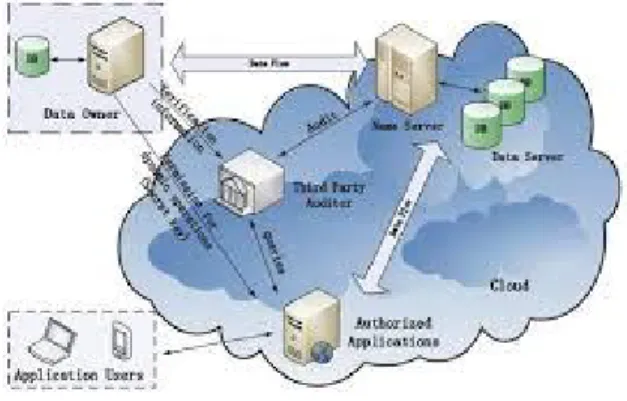
Fig. Proposed KAC for data sharing in cloud storage system
VI. System Mathematical Modeling
Where, I: Input O: Output F: Functions U: User
I= {U, IF, AU, ISM, DH} Where
U = User which require Data Security in Cloud Using Key Aggregate Cryptosystem.
IF = Input files on cloud for sharing with others. AU = Authenticated user login in to cloud by proving proper user id and password. ISM = Input secret messages which system explicitly wants to share with other instead of sharing all files.
DH: Diffie Hellman algorithm input value for Key Exchange on cloud to share files on cloud like prime
number etc…
O = {AK, DHSK, SF, CT, RFM}
Where below are the output generated from system processing;
AK = Key Aggregate Cryptosystem generates Aggregate Key for sharing files and Data Security in Cloud.
DHSK = Diffie Hellman secret key for exchanging aggregate key on cloud.
SF = Sharing of files on cloud with help of class identification function.
CT = System generate cipher text.
RFM = Finally receiver will receive files and display Received File Message.
U = {SD, FS, A, CA} Where
SV = System developer FS = Files Sender FR = Files Receiver A= Administrator
CA = Cloud Administrator F= {F1, F2, F3, F4, F5} Where
Function F1: To store the files on cloud for exchanging or sharing with other by providing data security.
Function F2: Sender sends files toward receiver by encrypting with the help of key aggregate cryptosystem (KAC) .
Function F3: To generate aggregate key of any set of secret keys and make them as compact as a single key.
Function F4: It uses Diffie-Hellman algorithm for exchanging secret key to ensures the confidentiality of the data on the cloud by using symmetric encryption.
Function F5: Receiver receives data files (ciphertext) and decrypts it only those having class identification tags.
Aggregate Key generation:
Fig.: Key assignment in Key Aggregate Cryptosystem
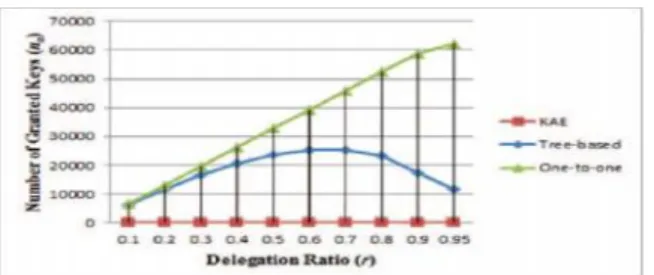
Consider, h: The height of the binary tree: there are total 2h cipher text classes, na: The number of keys to be assigned, N: The total number of keys in the
hierarchy, r: The delegation ratio: the ratio of the delegated ciphertext classes to the total classes.
If a user needs to classify his ciphertexts into more than n classes, he can register for additional key pairs (pk2, msk2), (pkl, mskl). Each class now is indexed by
a 2-level index in {(i, j) | <= i<=l, 1<= j<= n} and the number of classes is increased by n for each added key [9].
Diffie-Hellman Algorithm for Key Exchange mathematical framework:
Diffie–Hellman establishes a shared secret that can be used for secret communications while exchanging data over a public network. It exchange (D–H) is a specific method of securely exchanging cryptographic keys over a public channel.
For Example- The simplest and the original implementation of this protocol uses the multiplicative group of integers modulo p, where p is prime, and g is a primitive root modulo p. Here is an example of the protocol, with non-secret values in blue, and secret values in red.
1. Alice and Bob agree to use a prime number p = 23 and base g = 5 (which is a primitive root modulo23). 2. Alice chooses a secret integer a = 6, then sends Bob A = gamod p o A = 56mod 23 = 8
3. Bob chooses a secret integer b = 15, then sends Alice B = gbmod p o B = 515mod 23 = 19
4. Alice computes s = Bamod p o s = 196mod 23 = 2
5. Bob computes s = Abmod p o s = 815 mod 23 = 2
Alice and Bob now share a secret (the number 2).
VII.RESULT AND DISCUSSION
Our approaches change the compression issue F (F =n in our schemes) to be a tunable parameter, at the cost of O(n)-sized system parameter. cryptography is tired constant time, whereas coding is tired O(|S|) cluster multiplications (or purpose addition on elliptic curves) with 2 pairing operations, where S is that the set of cipher text classes decrypt able by the granted mixture key and |S| ≤ n. of course, key extraction
a replacement advance on the stratified key assignment (a ancient approach) that preserves areas providing the entireties of the key-holders share
similar edges is our approach of “compressing” secret
keys in public key cryptosystems. These public key cryptosystems manufacture cipher texts of constant size nominal economical delegation of secret writing rights for any set of cipher texts is possible. This not exclusively enhances user privacy and confidentiality of data in cloud storage, but it'll this by supporting the distribution or appointing of secret keys varied for diverse} cipher text classes and generating keys by numerous derivation of cipher text class properties of the information and its associated keys. This sums up the scope of our paper. As there is a limit attack selection the quantity the quantity} of cipher text classes beforehand & in addition to the exponential growth inside the quantity of cipher texts in cloud storage, there is a demand for reservation of cipher text classes for future use. As for potential modifications and enhancements to our current cause, in future, the parameter size area unit usually altered nominal it's freelance of the utmost style of cipher text classes. to boot, a specially designed cryptosystem, with the employment of an accurate security formula, as associate degree example, the Diffie-Hellman Key-Exchange methodology, which can then be imperviable, or at the foremost proof against outpouring at the aspect of economical key appointing, will confirm that one can transport same keys on mobile devices without fear of outpouring.
Fig. (A) Compression achieved by the tree-based approach for delegating different ratio of the classes
Fig. (B) Number of granted keys (na) required for different approaches in the case of 65536 classes of data
VIII.CONCLUSION
A new advance on the class-conscious key assignment (a ancient approach) that preserves areas
providing the entireties of the key-holders share
similar edges is our approach of “compressing” secret
keys publicly key cryptosystems. These public key cryptosystems manufacture cipher texts of constant size specified economical delegation of secret writing rights for any set of cipher texts is feasible. This not solely enhances user privacy and confidentiality of knowledge in cloud storage, however it will this by supporting the distribution or appointing of secret keys numerous for diverse} cipher text categories and generating keys by various derivation of cipher text category properties of the info and its associated keys. This sums up the scope of our paper.
As there's a limit attack variety the amount the quantity} of cipher text categories beforehand & let alone the exponential growth within the number of cipher texts in cloud storage, there's a requirement for reservation of cipher text categories for future use. As for potential modifications and enhancements to our current cause, in future, the parameter size are often altered specified it's freelance of the utmost variety of cipher text categories. to boot, a specially designed cryptosystem, with the utilization of a correct security algorithmic rule, as an example, the Diffie-Hellman Key-Exchange methodology, which may then be ladder-proof, or at the most proof against outpouring at the side of economical key appointing, can make sure that one will transport same keys on mobile devices without worrying of outpouring
REFERENCES
[1] key –Aggregate Cryptosystem for Scalable Data Sharing in Cloud Storage Cheng-Kang Chu, Sherman S. M. Chow, Wen-GueyTzeng, Jianying Zhou, and Robert H. Deng, Senior Member, IEEE [2] C Wang, S. S. M. Chow, Q. Wang, K. Ren, and W. Lou, “Privacy Preserving Public Auditing for
Secure Cloud Storage,” IEEE Trans.Computers, vol.
62, no. 2, pp. 362–375, 2013
[3] V. Goyal, O. Pandey, A. Sahai, and B. Waters,
“Attribute-Based
Encryption for Fine-Grained Access Control of Encrypted data, ”in Proceedings of the 13th ACM
Conference on Computer and Communications
Security (CCS ’06). ACM, 2006, pp. 89–98.
[4] M. J. Atallah, M. Blanton, N. Fazio, and K. B.
Frikken, “Dynamic and Efficient Key Management
for Access Hierarchies,” ACM Transactions on Information and System Security (TISSEC), vol. 12,no. 3, 2009.
[5] S. S. M. Chow, C.-K. Chu, X. Huang, J. Zhou, and R. H. Deng ,“Dynamic Secure Cloud Storage with Provenance,” in Cryptography and Security:
Birthday, ser. LNCS, vol. 6805. Springer, 2012, pp. 442–464.
[6] D. Boneh, C. Gentry, B. Lynn, and H. Shacham,
“Aggregate and Verifiably Encrypted Signatures from Bilinear Maps,” in Proceedings of Advances in Cryptology - EUROCRYPT ’03, ser. LNCS, vol. 2656. Springer, 2003, pp. 416–432.
[7] S. S. M. Chow, Y. J. He, L. C. K. Hui, and S.-M.
Yiu, “SPICE - Simple Privacy-Preserving
Identity-Management for Cloud Environment,” in Applied
Cryptography and Network Security – ACNS 2012, ser. LNCS, vol. 7341. Springer, 2012, pp. 526–543. [8] B. Wang, S. S. M. Chow, M. Li, and H. Li,
“Storing Shared Data on the Cloud via Security
-Mediator,” in International Conference on
Distributed Computing Systems - ICDCS 2013. IEEE, 2013.
[9] J. Benaloh, M. Chase, E. Horvitz, and K. Lauter,
“Patient Controlled Encryption: Ensuring Privacy of Electronic Medical Records,” in Proceedings of
ACM Workshop on Cloud Computing Security
(CCSW ’09). ACM, 2009, pp. 103–114.
BIOGRAPHY
S. Jhansi is currently pursuing her Mtech degree from Vignan’s
Institute of Information Technology, Visakhapatnam. Her areas of Interest are Cloud computing, Network Security.
CH.Sekhar is working as Asst Professor Vignan’s Institute of