AbstrAct
Background Regular physical activity is one of the modifiable risk factors for coronary heart disease (CHD). Persons with intellectual disability present with patterns of morbidity similar to the general population. Knowledge of the CHD risk factors and the changes a physical activity intervention may have on theses risk factors will facilitate future intervention programs.
Methods A cohort of 100 males and females between the ages of 21 and 73 years with ID living in a community group home in the North-West Province of South Africa was recruited. A CHD risk profile was compiled by means of a questionnaire and physical assessment (resting blood pressure, body-mass index, non-fasting glucose and cholesterol and cardiorespiratory fitness). After a 12-week physical activity intervention three days per week the baseline measurements were repeated.
Results The results indicated that 85% of the participants were inactive and 67% were overweight and obese. Hypertension (6.1%) and smoking (6.1%) was low in this population with ID. Glucose concentrations above the recommended cut-off values were observed in 28% of the participants and 23% of the participants presented with total cholesterol concentrations above normal. The physical activity intervention reduced inactivity to 50% and resulted in a significant increase in cardiorespiratory fitness and a decrease in percentage body fat in both males and females.
Conclusion Inactivity is a major risk factor in this population with ID living in a community group setting. The implementation of the physical activity intervention significantly reduced the risk factors for CHD.
INTroDuCTIoN
The mortality rate in intellectually disabled (ID) persons due to coronary heart disease is reported to be similar to that of the general population.1-3 A study by Beange
et al.4 indicated that the higher mortality rates in an
Australian population were due to the increased incidence of inactivity, obesity and hypertension compared to non-handicapped persons. Morbidity data from the uSA suggest that the main causes of death are cardiovascular disease and cancer.5 An improvement in health care has
however led to an increase in longevity in persons with an intellectual disability.6 In South Africa there is currently
Key words: physical activity, coronary heart disease, intellectually disabled
Changes in Coronary Heart Disease Risk Profile of
Adults with an Intellectual Disability Following
a Physical Activity Intervention
S.J. Moss PhD
no published research on the prevalence of chronic disease in persons with ID. Draheim et al.7 found that
active persons with ID possessed lower CVD risk factors, on average, than an inactive group of persons with ID.
The primary reason for the increase in coronary heart disease in persons with ID may be the high levels of physical inactivity.8-10 rimmer et al. (101995) have proposed that
persons with ID are more prone to hypokinetic diseases as a result of inactivity. Diseases such as Type II diabetes mellitus, osteoporoses, osteoarthroses and hypertension are also reported to have a high prevalence in ID persons.8
Studies investigating risk factors for coronary heart disease (CHD) in ID persons have indicated that obesity is also one of the major risk factors.11 The prevalence of obesity
in a large uSA cohort of older than 40 years of age was more than 55%.5 As is indicated in the literature, long
term obesity could result in eventual Type II diabetes, cardiovascular disease and premature mortality.12
The prevalence of hypertension as a risk factor for coronary heart disease, however, is similar in intellectual disabled and non-intellectual disabled persons.4
other factors such as smoking and elevated blood lipid levels are also risk factors for CHD. robertson et al.13 reported that the intellectually disabled tend to
smoke less than the average non-intellectually disabled population. researchers have previously alluded to atypical antipsychotics, clozapine and olanzapine to cause hyperglycaemia and hyperlipidaemia.14-16
risk factors for CHD in the general population are mostly managed by introducing regular physical activity and a healthy diet. The salutogenic benefits of regular physical activity on physiological changes are observed when physical activity is performed as prescribed by the American College of Sports Medicine.17 With ID persons
it is not always possible to achieve a regular physical activity program, as muscle weakness and hypotonia, increase in heart defects as well as circulatory and respiratory abnormalities are observed in these persons.18
The afore-mentioned are often the reasons for low physical activity levels reported for intellectually disabled persons. A decade ago Messent et al.19 found that adults
with ID in the uK were more sedentary than the general population. Draheim et al.20 however reported inactivity
in 51% of persons with ID, which was similar to that of the general population. Peterson et al.21 reported that
persons with ID achieved a similar number of steps per day as the general population when physical activity was objectively measured by means of a step counters in an population with ID.
The purpose of this study was to determine the coronary heart disease (CHD) risk profile of intellectually disabled adults residing in a care facility in Potchefstroom, South Africa and to determine the effect of a physical activity intervention on the CHD risk profile of the residents. The importance of this study is to present the caregivers with an indication of the CHD risk factors that are present in this specific population. The results will give an indication of the influence that a regular physical activity program may have on the CHD risk factors and the necessary action that needs to be taken to improve the quality of life of the ID residents.
MeTHoDS
Setting and participants
Amelia is a community setting in Potchefstroom, North-West Province of South Africa where persons with an intellectual disability are cared for. The residents live in three-bedroom apartments with a full-time caregiver for each apartment. During the day the residents are occupied with various hand crafts, and metal and wood work. All the residence of Amelia (N = 130) were asked to participate in the study. Informed consent was obtained from the subjects as well as from the registered nurse, who also serves as the legal guardian for the residents. one hundred of the residents gave consent to be tested, of which 47 were men and 53 women. The subjects were chronologically aged between 21 and 72 years, while intellectually aged between 4 to 12 years. The severity of the participant’s intellectual disability was determined prior to their acceptance in the care facility and was obtained from their medical files.
Procedure
A coronary risk profile questionnaire22 was completed
with the help of the registered nurse and the official medical files of the subjects. In order to complete the coronary risk profile, body composition, resting blood pressure and cardio-respiratory fitness were determined. Physical activity of the participants was determined by their reported physical activity habits as indicated by their full-time caregivers and sport coach. Participation in physical activities considered moderate to vigorous in intensity by the Ainsworth Compendium23 on a weekly
Ainsworth Compendium23 were categorised as inactive.
All the subjects that gave consent to be tested were familiarized with the testing procedure, which was performed in one of the empty apartments on the premises. Body mass (Seca® 700) to the nearest 0.1 kg and stature with a stadiometer to the nearest 0.1 cm were determined. Skinfolds were measured with a calibrated skinfold caliper (Harpenden®) by a level two accredited anthropometrist to the nearest 0.1 mm. The percentage body fat was then determined by means of the seven skin fold equation24
according to the guidelines of the International Society for the Advancement of Kinanthropometry (ISAK).25 Waist
and hip circumference was also determined according to the guidelines of ISAK25 with a non-elastic measuring
tape to the nearest 0.1 cm. The body composition measurements were followed by the non-fasting blood glucose and cholesterol measurements (Accutrend®, roche Diagnostics) that analysed a peripheral blood drop. After the subjects had relaxed for at least 5 minutes, a once off resting heart rate and blood pressure (Baumanometer®) were measured. Subjects were sub-maximally tested on a bicycle ergometer (Monark 828e, Sweden) to 70% of the age predicted maximal heart rate as determined by Karvonen’s formula17 to determine indirect cardiorespiratory fitness. Tests were performed after the subjects have been familiarised with the procedure on one previous occasion. The cardiorespiratory fitness test was performed according to the sub maximal adapted YMCA protocol.17 The protocol
required subjects to cycle at a speed of 50 rpm with a resistance of 25 watt for four minutes. The load (watt) was increased after every four minutes according to the heart rate attained at the end of the fourth minute by means of a polar hear rate monitor. Blood pressure and heart rate response was measured at the end of each four minute level. The incremental increase in resistance resulted in a target heart rate being reached after 12 minutes of cycling. The subjects then performed a 3 minute recovery stage with no resistance at 40 rpm. Subjects that presented with more than three risk factors for CHD according to the ACSM’s guidelines17 were monitored with an eKG
(Schiller, Switzerland) during the fitness test. A medical doctor was on standby during testing in the event of an incident. All baseline measurements were repeated after 12 weeks of the physical activity intervention.
Physical activity intervention
The physical activity intervention entailed a walking program three days a week for twelve weeks. A 400 m
circle route was measured on the residing grounds of the subjects, as it was a safe environment with a level walking surface. During the first 4 weeks the subjects walked for 20 minutes continuously. The walking time was increased with 5 minutes every four weeks up to 30 minutes of walking in the final four weeks. Stretches of the major muscle groups were performed after the walk. To determine the distance walked during each session, an elastic band was given to each subject when passing the start/finish line. This also served as motivation to continue walking and to increase the walking distance each time. After each intervention the number of elastics received by each subject was counted and converted to the distance walked in the time allocated. The number of elastic bands recorded for each subject also served as their compliance record. The compliance for this population was 47.7%.
Statistical analyses
Statistical analyses were performed with the SPSS 15.026. Descriptive statistics were performed on the baseline measurements to determine the baseline characteristics of all the variables that were determined. Independent t-tests were performed to determine significant differences between the males and females. Frequency analyses were performed to determine the distribution of the CHD risk factors of this population in total and for the various age groups. The influence of the intervention was analysed by means of dependent t-tests determining the percentage change that occurred from baseline to end, corrected for baseline values, for the males and females separately. Finally, to determine the levels of activity that were needed to elicit changes in the two most prevalent CHD risk factors, an one-way analysis of variance (ANoVA) was performed to compare changes in the measured variables of subjects with a < 50% compliance, 50 – 70% compliance and > 70% compliance with each other. The level of significance was set at p < 0.05.
reSulTS
Baseline
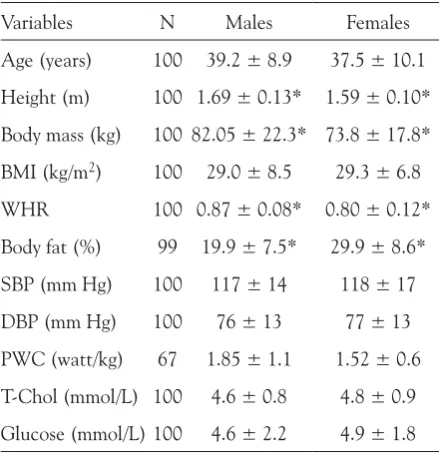
were significantly taller and heavier than the women, but the BMI of both genders did not differ significantly. The average BMI for both genders (men = 29.0; SD 8.5 kg/m2; women = 29.3; SD 6.8 kg/m2) was higher than the healthy norm (20 – 25 kg/m2) as indicated by the WHo (27 1998). The significant difference in the body fat percentage between the males and females, (men = 19.9; SD 7.5%; women = 29.9; SD 8.6%) indicated that the women had more subcutaneous fat than the men. At baseline the men also presented with a higher
fitness level (1.85; SD 1.1 watt/kg) than the women (1.52; SD 0.6 watt/kg), although the difference was not significant.
Table 1: Baseline characteristics of the determined variables (mean ± SD)
Variables N Males Females
Age (years) 100 39.2 ± 8.9 37.5 ± 10.1
Height (m) 100 1.69 ± 0.13* 1.59 ± 0.10* Body mass (kg) 100 82.05 ± 22.3* 73.8 ± 17.8* BMI (kg/m2) 100 29.0 ± 8.5 29.3 ± 6.8
WHr 100 0.87 ± 0.08* 0.80 ± 0.12*
Body fat (%) 99 19.9 ± 7.5* 29.9 ± 8.6*
SBP (mm Hg) 100 117 ± 14 118 ± 17
DBP (mm Hg) 100 76 ± 13 77 ± 13
PWC (watt/kg) 67 1.85 ± 1.1 1.52 ± 0.6 T-Chol (mmol/l) 100 4.6 ± 0.8 4.8 ± 0.9 Glucose (mmol/l) 100 4.6 ± 2.2 4.9 ± 1.8 BMI = Body mass index; WHr = Waist-hip ratio; SBP = Systolic blood pressure; DBP = Diastolic blood pressure; PWC = Physical work capacity; T-Chol = Total Cholesterol; * = significantly different p < 0.05
The most prevalent CHD risk factors (Figure 1) in this population of intellectually disabled persons were physical
inactivity (85%) as well as overweight and obesity (67%). More women were over weight and obese (70%) than males (64%), with both genders being similarly inactive. The high percentage of subjects with elevated average total cholesterol (23%) and glucose concentrations (28%) that were observed in this population could be as a result of non-fasting blood samples. risk factors that were less prevalent in this population were hypertension (6.1%), smoking (6%) and age (7.8%).
The distribution of the risk factors per age group (Figure 2 & 3) indicated that the most inactive persons were between the ages of 36 – 50 years with an equal number of male and female subjects being inactive. In the 20 – 35 years age group, the males were slightly more active than the females. In the overweight and obese subjects, the 36 – 50 years age group reported the highest percentage of overweight and obese persons, with the females being more overweight and obese than the males.
Figure 1: The distribution of CHD risk factors for males, females and the total group of intellectually disabled persons
Physical activity intervention
The changes in the CHD risk factors of the subjects during the physical activity intervention (Table 2 & Figure 4) indicated that statistically significant changes were only observed in the decrease of the percentage body fat (males = -8.0%; females = -18.7%) and in the increase in the fitness of the subjects (males = 12.4%; females = 12.4%) as measured with the physical work capacity test (PWC). These results indicated that the subjects
had increased their fat free mass, as percentage body fat decreased, while body mass did not decrease significantly.
Table 2: Changes in variables from baseline to end for the males and females with intellectual disability (mean ± SD)
Variables Males Females
Baseline end Baseline end
Age (years) 39.2 ± 8.9 37.5 ± 10.1
Height (m) 1.69 ± 0.13 1.59 ± 0.10
Body mass (kg) 82.05 ± 22.3 81.23 ± 22.53 73.8 ± 17.8 74.13 ± 17.15
BMI (kg/m2) 29.0 ± 8.5 25.91 ± 11.54 29.3 ± 6.8 26.56 ± 10.71
WHr 0.87 ± 0.08a 0.88 ± 0.07b 0.80 ± 0.12a 0.79 ± 0.09b
Body fat (%) 19.9 ± 7.5c 17.20 ± 6.52d 29.9 ± 8.6c 23.53 ± 7.3d
SBP (mm Hg) 117 ± 14 112 ± 14 118 ± 17 111 ± 15
DBP (mm Hg) 76 ± 13 72 ± 11 77 ± 13 70 ± 13
PWC (watt/kg) 1.85 ± 1.1 1.90 ± 0.73e 1.52 ± 0.6 1.45± 0.70e
T-Chol (mmol/l) 4.6 ± 0.8 4.8 ± 0.9
Glucose (mmol/l) 4.6 ± 2.2 4.9 ± 1.8
BMI = Body mass index; WHr = Waist-hip ratio; SBP = Systolic blood pressure; DBP = Diastolic blood pressure; PWC = Physical work capacity; T-Chol = Total Cholesterol; Similar symbols indicate significant difference p < 0.05
Figure 3: Percentage of intellectual disabled persons overweight and obese per age category
Figure 4: Percentage change (corrected for baseline) in CHD risk factors of the males and females respectively after a physical activity intervention * = p < 0.05 (significantly different)
The significant increase in the functional work capacity was expected, as the subjects were extremely sedentary before the intervention.
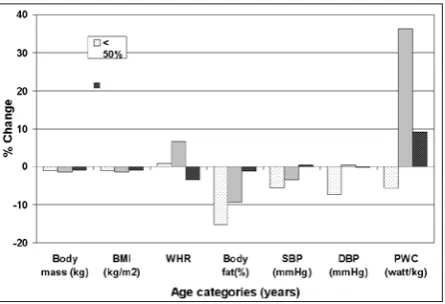
analyzed to determine if a threshold for the level of activity could be determined, through investigating changes observed in subjects with a difference in compliance to the physical activity intervention program. The subjects were divided into three categories for physical activity compliance: < 50%; 50 - 70% and > 70% (Figure 5). The results indicated that the subjects that complied less than 50% (n = 32) to the intervention, had the biggest decrease in percentage body fat (-15.3%). The subjects that complied to the physical activity intervention between 50 – 70% (n = 11) had the largest increase in fitness (36.3%). These results can be explained by the subjects that complied more than 70% (n = 21) to the intervention, were also mostly the subjects that were highly active at the beginning of the intervention. Cardiorespiratory fitness was already higher and a large improvement in these subjects are not expected. Predominantly sedentary persons could modify their risk factors for CHD with only a fifty percent increase in activity. The principle of: “the less you can do, the more you can improve” is well illustrated in these results.
quarter of the ID persons participating in regular activity as recommended for a healthy lifestyle. The remaining 15% that are active, are highly active as they participate in athletics, swimming and cricket for the intellectually disabled on a regular and structured basis.
The earlier onset of old age in individuals with an ID30,31 suggest that a faster decline in physical capacities are observed compared to the general population.31,32 of
the 100 subjects tested 27.3 % of the subjects that are inactive are between the ages of 20 and 35 years, while 66,4 % of the inactive subjects are between the ages of 35 and 50 years. It is known that levels of physical activity decrease with an increase in age. The results obtained from the different percentages of compliance to the physical activity intervention indicated that the cardio-respiratory fitness improved the most and significantly for the subjects that attended between 50 - 70% of the intervention program. This was also the situation for the change in percentage body fat. In the general population it is indicated that as soon as inactive subjects become moderately active, health benefits are obtained.17 The
subjects attending more than 70% of the intervention program, were the subjects that were already highly active and they reported less health benefits with regard to the parameters determined. These results are in support of the findings by Temple et al.33 that reported in a review
that persons with ID are highly sedentary.
overweight and obesity are the second most prevalent risk factor for CHD reported in this study, with more than two thirds of the subjects being overweight or obese. These are similar to results reported by Merriman et al.34 on a uK population stating that one third of the
subjects were overweight and another third of the subjects obese. These high levels of overweight and obesity in intellectually disabled persons were also reported be lea,35 Marshall et al.,36 and Braunschweig et al.37 Previous
studies have found obesity to be more common in subjects with mild and moderate opposed to severe ID.11,38 In
this study there were fewer subjects (30%) with severe ID. The high percentage of overweight and obesity may also be explained by the sedentary nature of the subjects’ daily vocation. The more disabled the subjects, the less physically active tasks are given to them.
Although the total levels of blood lipids and blood glucose are the risk factors that have a high prevalence in this population, it was impossible to obtain peripheril blood drops to analyse the post intervention cholesterol and glucose concentrations. The baseline concentrations were also non-fasting values.
Figure 5: Percentage change (corrected for baseline) in the CHD risk factors of the total group intellectually disabled persons for different physical activity intervention compliance (< 50%, 50-70% and > 70%). * = p < 0.05 (significantly different).
DISCuSSIoN
The prevalence of hypertension (6.1 %) and smoking (6%) was very low in this population. This resembles results presented by Merriman et al.34 2005) who also
reported a 6.1 % prevalence of hypertension with once off blood pressure measurements in a smaller sample size. About 10 % of the subjects were Down Syndromes that are known to have lower blood pressure.20
The prevalence of smoking was also low in this population, similar to that reported by rimmer et al.38 and
robertson et al.,13 but contrary to the result reported by
Merriman et al.34 The low prevalence might be explained
by the example set by the caregivers as only one of them smoke and possibly also because the subjects are limited with regard to money for supporting the smoking habit. Subjects have to visit a nearby grocery store to purchase cigarettes.
The changes that occurred in the CHD risk profile of the subject with ID due to a physical activity intervention significantly changes the two most prevalent risk factors, namely inactivity and overweight and obesity. Although the adherence to the intervention was low (47 %), physical inactivity was reduced with 50 % in the ID population as 50% of the subjects continued walking daily after the intervention was completed. The cardio-respiratory fitness of the subjects improved significantly for both males and females. These results support results obtained by Carmeli et al.39 where a walking program for
subjects with Down Syndrome increased walking distance and time significantly indicating an increase in fitness. A study by Anchuthengil et al.40 reported a 38% increase
in cardiovascular fitness after 12 weeks of a treadmill walking intervention in a sample size of 6 subjects. Fitness in subjects with ID was also significantly improved in a recent study with a Virtual reality Intervention program of six weeks.41
Although the BMI of both the males and females decreased, the significant decrease in the percentage body fat from baseline to end indicated that the intervention program had retained muscle mass while subcutaneous fat was decreased. Very little studies reported changes in body composition.42 Pommering et al.43 found no
significant changes in body composition after a 10 week aerobic exercise program.
Systolic and diastolic blood pressure also decreased slightly from baseline to end, but this was not a significant change. Cholesterol and glucose results are not reported, as the subjects were not willing to consent to peripheral blood sampling at the end of the
intervention period. one persons stopped smoking during the intervention.
As a result of this study, the governing body of this care facility has invested in the building of a gymnasium were the residents can participate in regular physical activity in a structured manner. All the residents are evaluated every six months to determine their progress. The results of the evaluation are used to compile a scientifically based exercise program that ensures that all the residents participate in training for one hour twice per week. This study has raised the awareness of regular physical activity in a population with intellectual disability. exercise is now compulsory for all residents and optional for caregivers.
CoNCluSIoN
This study on the risk for CHD of residents with intellectual disability and the influence of a physical activity intervention on the CHD risk factors revealed that inactivity and overweight/obesity are the two major health risk factors. The implementation of a physical activity program reduced inactivity with 50 % and also decreased the percentage body fat significantly in both males and females. Subjects participating in 50 – 70% of the intervention program reported the most comprehensive and significant increase in cardio-respiratory fitness and a decrease in percentage body fat. Further research is needed to determine the functional capacity and tasks of daily living in this population and how specific physical activity interventions can help a population with ID to be physically independent.
ACKNoWleDGeMeNTS
I would like to thank the governing body and residents of Amelia for supporting and participating in the study. I would also like to thank the graduate students of the School for Biokinetics, Recreation and Sport Science for their help during the intervention. Finally, I would like to acknowledge Madelein Smit for her support during the project.
SourCe oF FuNDING
reFereNCeS
1. Carter G. & Jancar J. Mortality in the mentally handicapped: a 50-year survey at the Stoke Park group of hospitals (1930-80). J Metal Disabil res, 1983, 27, 143-156.
2. Wells MB, Turner S, Martin DM. & roy A. Health gain through screening – coronary heart disease and stroke: developing primary health care services for people with intellectual disability. J Intellect Dev Disabil, 1997, 22, 251-263.
3. Janicki MP, Dalton AJ, Henderson CM. & Davidson PW. Mortality and morbidity among older adults with intellectual disability: health services considerations. Disabil rehabil, 1999, 21(5/6), 284-294. 4. Beange H, Mcelduff A. & Baker W. Medical disorders of adults
with mental retardation: a population study. Am J Ment retard, 1995, 99, 595-604.
5. Janicki MP, Davidson PW, Henderson CM, McCallion P, Taets JD, Forces lT, et al. Health characteristics and health services utilization in older adults with intellectual disability living in community residences. Journal of Intellectual Disability, 2002, 46(4), 287-298. 6. World Health organisation. Ageing and Intellectual disabilities
– Improving longevity and promoting healthy ageing: Summative report. World Health organisation, Geneva. 2000.
7. Draheim CC, Williams DP. & McCubbin J.A. Cardiovascular disease risk factors differences between Special olympians and Non-Special olympians. Adapt Phys Act Q, 2003, 20, 118-133. 8. Van der Ploeg HP., van der Beek AJ., van der Woude lHV. & van
Mechelen W. Physical Activity for People with a Disability: A Conceptual Model. Sports Med, 2004, 34(10), 639-649. 9. emerson e. underweight, obesity and exercise among adults with
intellectual disabilities in supported accommodation in Northern england. J Intell Disabil res, 2005, 49(2), 134-143.
10. rimmer JH, Braddock D. & Marks B. Health characteristics and behaviors of adults with mental retardation residing in three living arrangements. res Dev Disabil, 1995, 16,489-499.
11. Fox r. & rotatori A. Prevalence of obesity among mentally retarded adults. Am J Ment retard, 1982, 87, 228-230.
12. Katzmarzyk PT, Church TS, Janssen I, ross r. & Blair, SN. Metabolic syndrome, obesity, and mortality. Diabetes Care, 2005, 28 (2), 391-397.
13. robertson J, emerson e, Gregory N, Hatton C, Turner S, Kessissoglou S. & Hallam A. lifestyle related risk factors for poor health in residential settings for people with intellectual disabilities. res Dev Disabil, 2000, 21, 469-486.
14. Henderson D, Cagliero e, Gray C, Nasrallah r, Hayden D, Schoenfeld D. & Goff D. Clozapine, diabetes mellitus, weight gain, and lipid abnormalities: a five-year naturalistic study. Am J Psychiat, 2000, 157, 975-981.
15. Melkersson K, Hulting A. & Brismar K. elevated levels of insulin, leptin, and blood lipids in olanzapine-treated patients with schizophrenia or related psychoses. J Clin Psychiat, 2000, 61, 742-749.
16. Koro C, Fedder D, l’Italien G, Weiss S, Magder l, Kreyenbuhl J, revicki D. & Buchanan W. Assessment of independent effect of olanzapine and risperidone on risk of diabetes among patients with schizophrenia: population based nested case-control study. Brit Med J, 2002, 325, 243- 245.
17. Armstrong l, Balady GJ, Berry MJ, Davis Se, Davy BM, Davy KP, et al. American College of Sport Medicine: ACSM’s Guidelines for exercise testing and prescription. 7th ed. lippincott Williams & Wilkins, Philadelphia.2006.
18. Dodd KJ. & Shields N. A systematic review of the outcomes of cardiovascular exercise programs for people with Down syndrome. Arch Phys Med rehab, 2005, 86(10), 2051-2058.
19. Messent Pr, Cooke CB. & long J. Daily physical activity in adults with mild and moderate learning disabilities: is there enough?
Disabil rehabil, 1998a, 20, 424-427.
20. Draheim CC, Williams DP. & McCubbin JA. Prevalence of physical inactivity and recommended physical activity in community-based adults with mental retardation. Ment retard, 2002, 40, 436-444. 21. Peterson JJ, Janz KF. & lowe JB. Physical activity among adults
with intellectual disabilities living in community settings. Prev Med, 2008, 47, 101-106.
22. Bjürstrom lA. & Alexiou NG. A program of heart disease intervention for public employees. A five year report. J occup Med, 1978, 20(8), 521-531.
23. Ainsworth Be, Haskell Wl, leon AS, Jacobs Dr, Montoye HJ, Sallis JF. et al. Compendium of physical activities: Classification of energy cost of human activities. Med Sci Sport exer, 1993, 25, 71-83.
24. Jackson AS. & Pollock Ml. Practical assessment of body composition. Physician Sportsmed, 1985, 13(3), 76-90.
25. Marfell-Jones M, olds T, Stewart, A. et al. International standards for anthropometric assessment. International Society for the Advancement of Kinanthropometry (ISAK), 2001.
26. SPSS Inc., SPSS® 15.0 Windows release, Copyright© by SPSS Inc., Chicago, Ill. 2008.
27. World Health organisation (WHo). obesity. Preventing and managing the global epidemic. World Health organisation, Geneva, 1998.
28 Messent Pr. & Cooke C. Physical activity, exercise and health of adults with mild and moderate learning disabilities. Brit J learn Disab, 1998, 26, 17-22.
29. McGuire Be, Daly P. & Smyth F. lifestyle and health behaviours of adults with an intellectual disability. J Intell Disabil res, 2007, 51(7), 497-510.
30. Janicki MP, Ackerman l, & Jackson JW. State developmental disabilities/ageing plans and planning for an older developmentally disabled population. Ment retard, 1985, 23, 297 – 301. 31. Petitti KH. & Campbell KD. Mentally retarded individuals – A
population at risk? Med Sci Sport exer, 1991, 23, 586-593. 32. Fernhall B, Pitetti KH, rimmer J, McCubbin JA, rintala P, Millar
l, et al. Cardiorespiratory capacity of individuals with mental retardation including Down syndrome. Med Sci Sport exer, 1996, 28, 366 – 371.
33. Temple VA, Frey GC. & Stanish HI. Physical activity of adults with mental retardation: review and research needs. Am J Health Promot, 2004, 21(1), 2-12
34. Merriman S, Haw C, Kirk J. & Stubbs J. risk factors for coronary heart disease among inpatients who have mild intellectual disability and mental illness. J Intell Disabil res, 2005, 49(5), 309-316. 35. lea A. Assessment of body mass index for the residents of a
long-stay institution with learning disability. J Hum Nutr Diet, 1999, 12(2), 141.
36. Marshall D, McConkey r. & Moore G. obesity in people with intellectual disabilities: the impact of nurse-led health screenings and health promotion activities. J Adv Nurs, 2003, 41(2), 147-153. 37. Braunschweig Cl, Gomez S, Sheean P, Tomey KM, rimmer J. &
Heller T. Nutritional status and risk factors for chronic disease in urban-dwelling adults with Down syndrome. Am J Ment retard, 2004, 109(2), 186-193.
38. rimmer J, Braddock D. & Fujiura G. Prevalence of obesity in adults with mental retardation: implications for health promotion and disease prevention. Ment retard, 1993, 31, 105-110.
39. Carmeli e, Barchad S, Masharawi Y & Coleman r. Impact of a walking program in people with Down Syndrome. J Strength Cond res, 2004, 18(1), 180-184.
40. Anchuthengil JD, Nielsen DH, Schulenburg J, Hurst r. & Davis MJ. effects of an individualized treadmill exercise training program on cardiovascular fitness of adults with mental retardation. JoSPT, 1992, 16(5), 220-228.
of individuals with intellectual and developmental disability through a Virtual reality Intervention Program. res Dev Disabil, 2009, 30, 229-239.
42. Chanias AK, reid G. & Hoover Ml. exercise effects on health-related physical fitness of individuals with an intellectual disability:
A meta-analysis. Adapt Phys Act Q, 1998, 15, 119-140. 43. Pommering Tl, Brose JA, randolph e, Murray TF, Purdy rW,