OLYNTHIAKA
* 5.THE SECOND STOREY
S INCE at the most only two or three feet, and often only a few inches, of the walls
is preserved above the floor levels of the first storey of the Olynthian houses, a second storey can only be inferred from indirect evidence. Such evidence is not lacking. But even if it were, surely the natural assumption, unless strong evidence to the con- trary could be adduced, would be that urban houses such as the Olynthian would in general be built two storeys high. Later houses at Delos, Pompeii, and Herculaneum had extensive second storeys; Colophon had at least partial second storeys in the few houses excavated,1 and multiple storeys were common at a much earlier date in Crete, Egypt, and the Near East.
Yet in a recent sketch of the typical Olynthian house, with special reference to the houses discovered in 1938, Dr. George Mylonas speaks skeptically of the existence of a second storey: " we have some evidence which seems to indicate that the second story was not unknown to the Olynthian builders." 2 And of the House of Many Colors (F -ii 9), the finest house discovered in 1938 and, except for the lack of mosaics, one of the best from any of the four campaigns on the site, he says that " our particular house had enough room on the ground floor to provide for an average family in
accordance with the standards used in ancient Greece " (p. 397). Robinson hesitantly follows Mylonas in the publication of the house in Olynthus, XII (p. 204), a second storey in which he says is " rather doubtful."
The arguments for the existence of a second storey in the Olynthian houses have been presented in considerable detail in Olynthus, VIII, pp. 214-219, " The Second Storey," and pp. 267-280, " Stairways." In substance they are based on the frequent mention of a second storey in literary references of the Hellenic period; on the scarcity or even absence, in some of the best houses, of ground-floor rooms suitable for bed- rooms; and on the existence of solidly-built stairways in many houses excavated previous to 1938, regarded as certain in eighteen instances. Drobable in seven others.3
* An asterisk beside a house number in this paper indicates that a plan of the house will be found in Figure 1. The four preceding articles were published in Hesperia, XXII, 1953, pp. 196-207.
1 Hesperia, XIII, 1944, pp. 91-171.
2 Class. Jour., XXXV, 1940, pp. 389-402, especially p. 397. Dinsmnoor, in his Architecture of
Ancient Greece, 1950, p. 252, in speaking of 5th and 4th century Greek houses, remarks that " the house seems generally to have been of one storey." Since this statement in such an authoritative handbook is evidently based on Mylonas' article, it is evident that Mylonas' doubts need immediate consideration.
3 See list Olynthus, VIII, pp. 279 f. The stairways were certainly not intended to lead to roofs,
which were not flat but sloping and tiled.
American School of Classical Studies at Athens is collaborating with JSTOR to digitize, preserve, and extend access to
Hesperia
OLYNTHIAKA 321
Since neither Mylonas nor anyone else, so far as I am aware, has endeavored to refute these arguments it seems unnecessary to repeat them here. The present paper will merely attempt to supplement the previous account by a study of the houses excavated since the publication of Olynthus, VIII, and a restudy of some of the earlier houses.
More difficult to determine than the mere existence of a second storey is the extent of the second storey. On general grounds we may suppose that most of the first-floor rooms would be duplicated in the second, as most economical of space.4 But the fact that the stairway regularly is located in, or leads up to, the northern half of the house might be taken to suggest that only here was there a second storey. Yet this is a natural location for the stairs, if only because in the pastas-type house the gallery above the pastas was the means of communication for the various rooms of the second floor as the pastas was for the ground floor. However, it is very significant that in the Villa of Good Fortune, which was a pastas-peristyle house, the stairs were placed in the east portico and ascended to the south.5 Indeed we may fairly assume that normally when there were porticoes on the east, west, or south there were also second-storey rooms on these sides, since it is very unlikely that such porticoes were built only to provide additional sheltered cloisters on the ground floor; they seem rather to support galleries to provide communication for the second-storey rooms.6
Even in the case, however, of pastas-houses with no additional porticoes there are occasional hints to be found in the groundplan that a second storey existed in the southern part of the house (as well as in the northern).' For example in A 9*, which definitely had a stairway leading to a second storey over the northern half, the entrance room m (and no doubt n as well) must have had a room above, for otherwise the spur of wall on its west side would only have obstructed passage into the court; its purpose must have been to reduce the unsupported span of the west wall of the room above
muin.8 The similarly located but narrower entrance passage I of A 10* (also with stairs
' Cf. Lysias, On the Murder of Eratosthenies, 9, " OLKttOV 3ETt -LOt 8t7TXOVv, t'oa 'Xov Ta avo T6OZ Kaw."
As correctly shown in the model made by Sylvia Hahn, under the direction of Homer Thomnp- son, for the Royal Ontario Museum of Archaeology, closely following the small model which I made for the Olynthus, VIII publication; the misstatement in the preface to Olynthus, XII (p. xi) is due to a confusion between this stairway and the two-flight stairway in a house on the North Hill, A vi 5,* which is shown in my restoration in Olynthus, VIII, pl. 73.
6 A 2, A 3, A 4, A 6,* A v 6,* F -iii 9, and the House of the Comedian. Yet there could have
been no second-storey rooms on one or more sides in some instances, e. g. the south and east sides of F -iii 9 (Olynthus, XII, pl. 176).
7 Olynthus, VIII, p. 217.
8 Ibid., pl. 90.2. The cobblestones in this instance do not prove that m was open to the sky;
322 J. WALTER GRAHAM
to the north half ) was probably also covered by a second-storey room since the abrupt termination of the cobbling of the court along a clearly preserved line at the threshold of this room implies that it was not open to the sky, yet it would have been pointless merely to roof over an entrance-passage. That the same house had a second-storey room even over the small and almost isolated andron, i, on the west of the court, is suggested by the dressed stone base at its northeast corner, whose purpose must have been to carry a pillar supporting a jog of connecting flooring from the gallery to the room above i.9 The dressed stone bases on the wvest side of the entrance-passages of A 1* and A 6* tell the same story.10
At the entrance to B v 1* the two bases (only the south one is preserved) indicate too ponderous a construction merely to be intended to take the weight of the lower edge of the prothyron roof, which could have been amply supported laterally in the adobe walls; 11 the pillars set on these bases wvould be better adapted to carrying a stout lintel taking the weight of the wall of a second storey overhead.12 This certainly suggests that the southern series of rooms (including a kitchen, hij, with pillar- partition) had a complete second storey in spite of the north-to-south narrowness of the court, f, and its consequent overshadowing by high southern rooms.13
Even such a plain and somewhat irregular house as A iv 5* (excavated in 1938) seems to have had a second storey in the southern part of the house, for in addition to four bases along the front of the pastas, d,14 there are bases parallel to the east wall of gj and so near to it (abotut 0.80 m.) that they can only have been intended for the support of a narrow gallery to serve second-storey rooms above g and j; the first- floor portico would have been too shallow to be usefu.15 Two bases against the walls on the west and east sides of the court in A viii 8* are also difficult to explain in any other way.1
Dr. Mylonas' reluctance to accept the second storey as a common feature of the Olynthian house seems to have been encouraged by his experience in excavating some
9 Ibid., pl. 88.2.
10 Ibid., p1. 89.
On the prothyron (entrance-porch) see ibid., pp. 154-156. 12 Ibid., pl. 103. 1.
13 This would have been partly counteracted by the sharp slope of the hill from north to south
which, by putting the southern rooms at a lower level than the northern, permitted better penetration of the sun into the pastas (ibid., pp. 130-132).
14 Obviously the two squares of rubble masonry to the east of the two dressed stone bases (one
is said to measure " 48 m. long by 18 m. wide by' 0.37 m. high "-sic!) originally carried two more stone bases, for three bases are still in situ on similar rubble foundations in the same court; yet the text (Olynthus, XII, p. 68) conjectures that one formed " part of a wall." This use of a supporting rubble platform for stone bases is uncommon at Olynthus; it was evidently employed here to com- pensate partly for the sharp slope of the floor.
OLYNTHIAKA 323
thirty-five houses in 1938, more than a third of the total number so far excavated at the site. " In none of these," he wrote in a letter to me, "was any evidence found of a second storey in spite of very careful attention to the problem." Even if this were certain, however, it would perhaps be less surprising than might seem at first blush, for the number of houses from the excavations of 1938 of suitable quality and well enough preserved for us to expect to find a stairbase (the clearest evidence) in them is exceedingly few. But, in actuality, I believe that sufficient evidence does exist for stairways in four of the 1938 houses, and the indications that there was a second storey in two others (A iv 5*; A viii 8*) have just been cited. The evidence for the stairs will be presented in the following.
In F -iii 10* (" House of the Twin Erotes ") a block of stone having the char- acteristic proportions of an Olynthian stairbase was found lying about 0.15 m. from the west wall of the west portico, f. Robinson accepts it as a stairbase, but makes the impossible suggestion that it is the foot of a stairway passing through the outside wall of the house and along the north exterior side of the andron.17 Obviously the block was not in situ; 18 if it be simply shifted 90 so that its present south end is next to the
wall we obtain a perfectly possible position, similar to the stairways in A 3 and A 4.19
We reach the House of Many Colors, F -ii 9*. Mylonas thinks (see above) that there are sufficient rooms for an ancient Greek family on the ground floor, but is it not remarkable that in a house of such outstanding quality we can find no rooms likely to have been used as permanent bedrooms? An entrance-corridor, j; the court, i; pastas, e; open portico with cistern, I; two kitchen-complexes, ab and kgh; 20 a storeroom, m
(remains of four large pithoi were found in it); an andron with anteroom, df; and c with a cement floor and catch-basin, perhaps used for ordinary dining purposes, at any rate hardly a bedroom. Surely we must look for the bedrooms on the second floor. Yet no stone stairbase is preserved. Note, however, that in spite of the generally good preservation of the house, most of the altar and even all but one block of its dressed- stone base has disappeared, and remember that a stairbase makes highly desirable building-material. A more real difficulty is where to find room for a stairway!
Olynthian stairways are almost always single-flight runs and one side is built
17 Ibid., p. 231.
18 The photo, ibid., pl. 193.1, which presumably shows the base as it was found, indicates that
the plan (pl. 190) represents the block about a foot too far to the north.
19 Olynthus, VIII, pl. 89. This would be unnecessarily far from the main entrance of the house
if the entrance were really as argued in the text (Olynthus, XII, p. 226), on the analogy of the other houses on Ave. G, on the east. But the only two of these houses whose entrances are preserved are " 9 " houses (F -ii 9 * and F -iii 9), that is, houses in the northeast corner of a block, and on the principles explained in Olynthus, VIII (pp. 152 f.), they did have their entrance on the east. No. "10 " (and " 2 ") houses, however, normally have entrances directly into the court, as in A vi 2 and 10, and so in all likelihood in this house also (cf. Hesperia, XXII, 1953, p. 202 note 16).
20 Dr. Mylonas thinks rooms of ab type may have been bedrooms, but I argue against this in
324 J. WALTER GRAHAM
(as normally today) against a solid wall for support and economy of space. The court, a very common location, is in this house ruled out: there are no solid walls of sufficient length on any side.2' The pastas, the commonest site of all, is also out: its narrowness (less than 3 m.), the position of the doors into abc, and the lack of any traces on the well-preserved plaster in the west end of the room, are all against such a possibility. To place the stairway in a regular room would be out of line with normal Olynthian
practice.22
Our last resort, then, is the deep south portico. The plaster wall on its west side is preserved for some distance above the pavement and shows no trace of stairs, and the south outside doorway is rather too close.23 The position of the cistern eliminates the south side. Only the east remains, and here the wall exists only as a sub-pavement rubble foundation and so gives us no help. But there are two peculiarities which a stairway here will explain. The first is the position of the eastern-most of the four bases along the north side of the room facing on the court. Why was this base not set against the east wall as the westernmost base was set against the west wall? 24
And why was this base connected by a meter length of solid wall to the east wall of 1, instead of being free-standing ? If we restore a flight of stairs starting in the northeast corner of the room and ascending to the south along the east wall, we obtain reason- able answers to these questions: the wall is just long enough to protect the wooden stairs and their users from the rain driving in from the north,25 and the pillar on
21 The wall along the north side of the court was only solid at the bottom; see my article on the semi-enclosed portico, Hesperia, XXII, 1953, pp. 203-207.
22 We restore (see below p. 326) a stairway in Room h in A viii 2,* but this was a small room
reserved for the purpose, not a large room with stairs in it; moreover h seems to have been wide open at its east end to the court. There seems also to have been a stair in Room g of A vi 8, but this was in addition to one in the pastas; the room above g was probably separate from the rest of the house (Olynthus, VIII, pp. 112 f., pl. 97).
23 The text (Olynthus, XII, p. 203) is confused at this point (see also note 27), having been
evidently transcribed from two sets of field notes without proper collation. Thus we read (lines 13 f.) that "' on the west wall three sections, with intervals of 0.052 m. (sic) are clearly preserved"; and two lines further, that "this room has vertical incised lines at intervals of 0.52 m., on both west and south walls." The interval 0.52 m. is of course the correct value. Then we have a repeated description of what is evidently a door-sill for a door into the alley, described once correctly as a break in the wall about 1 m. wide beginning 1.04 m. east from the southwest corner of 1; but in the preceding sentence it is said to be " 0.50 m. west (sic!) from the southwest corner." There seems from the photos to be no reason for the remark that the opening " had been blocked up and plastered over," and the fact that the threshold was 0.18 m. above the pavement does not make a door unlikely. The door was obviously merely a "back door " (such as can be seen in some other block houses near one end of a block, as in A vii 1); the high threshold was designed to prevent water from the alley from flooding into the room.
24 Surely not to shorten the interaxial distance, which was hardly over 112 m.; in any event
a fifth pillar could have been inserted.
25 Since the wall could have taken the thrust of the wooden staircase there may have been no
OLYNTHIAKA 325
the base is in exactly the right position to take the weight of the northeast corner of the gallery flooring at the edge of the stairwell.26 The other puzzling feature in I is the base in situ against the south wall, ca. 1.10 m. from the southeast corner; 27 but
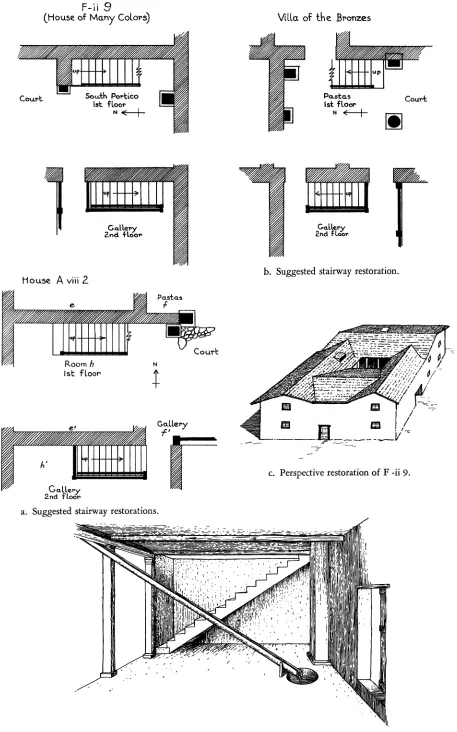
now its purpose too becomes clear: on it stood a pillar supporting the southwest corner of the stairwell. The run, nearly 312 m., is quite adequate, and its southward direction is paralleled in the Villa of Good Fortune.28 From the head of this stairway one could have passed through the room over I to the room over k, or through the rooms above mjf into the upper gallery above e. Figure 2 (a, c, and d) suggests a possible restoration.29
This is one more piece of evidence, to be added to those mentioned above, for the existence of a second storey over the southern rooms, including in this case even the central room on the south.
The interpretation just given for the base against the south wall in I of F -ii 9* provides the clue to explain the peculiar pair of bases against the north wall of the pastas, e, in the Villa of the Bronzes*.30 A stone of appropriate character for a stair- base in size, wear, and cuttings was found near the front entrance of this house but was rightly recognized not to be in situ.3" The reasonable suggestion was made that the stairs ran along the west wall of the court up to the gallery, but the position of the two bases in the pastas strongly suggests that the stairbase really lay originally at right angles to the east wall of the pastas just north of the easternmost of the four bases facing on the court. The stairs could just clear the top of the door into room while the base in the northeast corner 32 would support a small landing at the head of
the stairs (Fig. 2, b). The second base, which the text describes as " in line with the
26 As in A 9 *; cf. also A vii 4, A vii 6 (ibid., pls. 90.2, 99).
27 The text says 3 m. (Olynthus, XII, p. 203), but the position shown in the plan, pl. 158, is
corroborated by the photo, pl. 160.1; the base is described twice in the same paragraph (pp. 203, 204), first as 0.55 by 0.47 m., and secondly as 0.54 by 0.47 by 0.10 m.
28 W. A. McDonald, " Villa or Pandokeion " in Studies in Honor of D. M. Robinson I, p. 372,
notes the Villa of Good Fortune as the only instance of a stairway leading southward in the Olynthus houses, and thus suggesting a greater development of the second-storey southern rooms than usual. His suggestion that the Villa was a place of public entertainment is interesting and he makes the most of his admittedly slender evidence; however I can still see no strong reasons for believing it anything more than the house of a particularly well-to-do Olynthian.
29 The cistern shown in the restored drawing was apparently never completed, but there was
a cistern in a similar position in the pastas of B v 1*; the water must have been piped into it from the eaves in a trough resembling the one in our restoration (Fig. 2, d).
30 Olynthus, XII, pl. 202.
31 The measurements are given as 0.92 by 0.375 by 0.278 m. The cutting along one end on the
top surface would be for a stringboard; that along the back, for the bottom of a riser; ibid., p. 241.
32 The description in the text (ibid., p. 244) is obscure, but perhaps, as suggested, there was a
326 J. WALTER GRAHAM
second base from the east " (fronting the court)," would support the other end of a joist running from the base at the front of the pastas to the wall (near the door to c), the extra support being needed to help carry the weight of the open edge of the stairwell (perhaps nearly a meter farther east) and of the stairway. The analogy with the construction of a stairwell of A 10*, where all doubt as to the existence of a stair- way is removed by the presence of a stairbase in situ and of traces of a base for a landing,34 greatly strengthens such a restoration of the stairway of the Villa of the Bronzes.
Our restored plan (Fig. 2, b) makes one further suggestion, namely that the reason why the wall between f and i (Fig. 1 ), instead of being in line with the front of the pastas as commonly in houses of regular plan,35 is something over a meter farther north, is that in this way there could be an entrance into the room over i directly from the gallery. This was possible because there would have been ample headroom over the bottom of the stairs to permit the outer few feet of the gallery to continue right through to the east wall, which incidently would have the further merit of considerably strengthening the construction of the gallery at this end. Here we have, then, still one more examnple of evidence for a second storey over rooms in the southern half of the house, and here as in F -ii 9* one of the first-storey rooms below is a kitchen- complex. The importance of this point is brought out below (see pp. 339 f.).
On the basis of these stairway identifications we may venture with considerable confidence to still another in a house excavated in 1938, A viii 2*.36 In the northeast corner of h " is a dressed stone base neatly fitted into a notch made in the southwest corner of the westernmost pastas base. Clearly it is in situ, but can not belong to a portico. If, however, a stairway be restored along the north wall of h, beginning near its northwest corner, there is plenty of room for the run and for a broad landing between the pastas base and the east wall of the room over e (Fig. 2, a).38 The base
thus becomes explicable as intended for a pillar supporting the northeast corner of the landing; possibly there was also one, now lost, at its southeast corner. Such a position for a stairway is unusual and yet quite in accord with the regular principle, for it would have led directly to the gallery above the pastas. Perhaps, too, we can suggest why it was so placed. There were too many doors in the pastas to leave any room for
33 The photo, pl. 207.1, indicates that the text in this case is approximately correct, and that the plan (pl. 202) is inaccurate.
34 See Olynthus, VIII, pp. 275 f., fig. 28; perhaps there was also a short second flight turning
toward the west, as in A 10.* Cf. also the position of the stairway at the west end of the pastas in A vi 8 (ibid., pl. 97).
35 Cf. e. g. A vi 5,* A vii 4, A vii 6, etc. (ibid., pls. 97, 99).
36 Olynthus, XII, pp. 12-17.
37 The room is wrongly interpreted as an entranceway in ibid., p. 14; see Hesperia, XXII, 1953,
p. 202 note 16.
38 The landing is necessary, for otherwise one would have to step down sideways on to the top
OLYNTHIAKA 327
a stairway; and while it could have been put in the court, as in many houses, this was certainly not an ideal location, for both the wooden stairs and its users were exposed to the weather. Indeed we may see here a tendency, which became the rule in the Hel- lenistic houses at Delos, to put the stairway in a room of its own, the " cage." 3
Another possible stairway in the houses excavated in 1938 is in A viii 4.40 Two
blocks of stone, together a little under a meter in length and a little under half a meter in width project at right angles from the east wall of the pastas, f. The run would have to be in the neighborhood of 450 to clear the door into f, whose door we note was placed as far from the stairbase as possible. The pitch, though somewhat above the optimum of about 370, is found in Delian houses,41 and the position of the stair- bases in A 5 and A 6* is suggestive of staircases equally steep.42
We return now to three of the houses found in 1931 and 1934. House A vi 5* had a two-flight stairway in the court leading up to the gallery above the pastas.43 This could have served rooms over a, b, d, i, j, and h, but what of the room over f, cut off as it was by the flue over e? 4 The two re-used blocks of dressed stone in the south- east corner of f and the line of rubble foundation running west from them had always suggested a stairway to me, but in view of the existence of another stairway in the same house the possible interpretation of the construction as some kind of a cupboard base was hesitantly put forward.45 I was also dissuaded from the stairway interpre- tation by the fact that I could not see the re-used blocks as a stairbase; now I realize, on the analogy of the stairways discussed above, that the stairs (no doubt a very light and narrow set) would have run up from the west and posts supporting a landing at the head of the stairs were furnished a firm bedding on the re-used stone blocks. Per- haps better than anything else this example shows how the provision of second-storey space was not neglected, even at the cost of installing an extra stairway to utilize the space above a single room in the southern half of the house.6
Finally let us mention one further probable and one possible stairway in houses excavated in 1934. The first is in A v 6* where, against the wall of the east portico are two rectangular masses of rubble. Their situation and width are certainly strongly
89 Delos, VIII, p. 305.
40 Olynthus, XII, p. 23, pl. 14. 41 Olynthus, VIII, pp. 269-271. 42 Ibid., pl. 89.
43 Ibid., pp. 103-106, pls. 35, 98.
44 I have checked all other examples of the " oecus-unit," especially those with a pillar-partition
(implying a second storey), and find that in no other case would the flue make the room over the kitchen inaccessible. I was afraid there was another instance in F -ii 9 * until I discovered that the stairway led up to a room over the south portico instead of to the pastas (see above); this neat coincidence would seem not to be without significance.
45 Ibid., p. 105.
46 For two sets of stairs in the same house we may compare those in g and e of A vi 8, men-
328 J. WALTER GRAHAM
suggestive of a stairway running north to the gallery above the pastas.47 The second is A iv 9.* The light adobe wall forming a rectangle in the southeast corner of Room c may well have been the basis for the landing of a stairway whose first run ascended from the north and, turning at this landing, continued westward to a doorway, approximately above that from c into e, opening on the gallery above the pastas, e.48
Since the only evidence for the existence of a second storey depends in many houses 4 on the precarious survival of a stone stairbase, it is surely obvious that all
clues must often have been completely obliterated. Therefore, far from feeling any doubt because of this that the presence of second storeys was a common feature of the Olynthian house, we should rather consider it a matter for some surprise that at least some traces of a second storey should still be detectable in perhaps more than a third of the houses excavated on the site.
6.
THE KITCHEN-COMPLEX
In his penetrating and careful excursus to Olynthus, XII Dr. G. E. Mylonas uses the term " oecus-unit " for the complex of rooms in which the food was prepared and cooked (as well as various other household tasks performed) in the Olynthian house. But because " oecus " is already associated in modern archaeological termin- ology with the dominant, megaron-like room of the Priene house and with the andron of the Delos house, neither of which at all resembles the Olynthian complex (nor each other!), I shall keep to the more noncommittal term " kitchen-complex " in once again attacking the most perplexing problem of identification and reconstruction presented by the Olynthian houses.'
47 These rubble rectangular masses were so unlike the normal stairway base (though for the
landing compare that in A vi 5 *) that in the publication of the house I mentioned, only to reject it, the idea that they might be for a stairway (ibid., p. 93).
48 Ibid., pls. 92-93; it was suggested (p. 88) that the adobe rectangle might be the base for a
cupboard.
49As in A 3, A 4, A 6,* etc. (Olynthus, VIII, pl. 89).
6 j7 e m 0 c 2 c
<1 'stA 10
A~
/c' tIA9
*1 o~ u s A-_I
mXA mzA
v6
~~~~~~~~~~~~~~~~~~~~~~A vi oa .e ,
c5 8 A
L?[c
A
C~~~~~~~~~~~~~~~~~~~~~~~~~~~~~~~~~~~~~~~~~~~~~~~~~~~~~~~~I
ED ~ ~ ~ ~ ~ ~ V
I~~~~~~~~~~~~~~~~~~~~~~~~~~~~~~T
F ,'>' /0 (Tw,~ E~ror~) Vi/14 f 1
v
c.g~~~~~~~~~~~l ar orene wit not At; thetop
A t//;-<R ; W N c i d W~~~~~~~~~~~~~~~~~~~~~~~~~~~~~~~~~~~~~~~~~~~~~~~~~~~A -
S,f*X-zzZZzzzzz2z/ < ! <~~~~~~~~~~~~~~1
S~~~~~~~~~~~~~~~~~~~~~~~~~~~~~~~~~~~~~~~~~~~~~~~~~~~7 C X m C
isfD
t
?cll~~~~~~~~~~~~~~~~~ ' 9f
0fWg2"~77 Fj 0 3>
B v X 0 ~~T3
A~s^
oc_,;; fO f7>v/V fOfGS) g/A/a of t4^ 7iro~~~~NYe
C i.1 kthpaso orenOytushue tapoiaeyuiomsae
F-ti 9
(House of Many Colors)
CouLrt SN& PotC
House A viii 2
PaLstcLs
L-0 ~~~~~Couv~
Room h N
Ist fLoor
4
GoALer~
Sggltery
2 nd f loor
a. Suggested stairway restorations.
VdIca of the Bronzes
PoLstciLs Coutt
I st f Loor
GaLitery
2nd ftLoor
b. Suggested stairway restoration.
c. Perspective restoration of F -ii 9.
d. Restoration of stairway in F -ii 9 looking east.
l~~~~~~4
a. Plan of the 'ideal" Olynthian kitchen- complex: I. Main room with hearth.
II. Cooking area. III. Bathroom.
El
'
k t m
A 2 Kihken CornpLex
Avii 6 KaitCch CompleIc
b. Plans of kitchen-complexes.
- -? ' ~~~~~~/ /
C: ,~/ //
/
d. Sketch of flue-covering in old Swiss house.
n i ~~~~~~~L _i 0
e. Section of an old Swiss house with kitchen.
c. Plan and restoration of the kitchen-complex in the House of the Comedian.
p 0 p 0
IIJ1? |IIh J 5 1 IHlouse of the Comedian (G29= M15).
Aviii4 (Mi7)
> | I L 2l ~~Avi 4 (G 11= M 7t) Avi(I=1.
< E-ii 9, ghk (M 21). | Bvi2(G 26= M 13). 2 h
A4(G3:M2).ESH4(G28=Ml4). F-iiilO(M22). Aviii2,jkn CM 16).
B vi4 (M 19).Villa ofthe Bronzes(M 3 Bvi5(M20). AvO(G9 M5).
A2(G2 Ml). A6(G6). Avi 9(G16=MI0). Aviii 5.
< ~~~3 h <
Z1I~~~
A xiii
0O
(G
24)
LID~~
_
__...
~ ~~~~~3 B vi3
LJ 4h
_____f
Aiv9, k(G6 M3). A vi 7)klmno (M9).
I M 5
h
E Z < Avi6(Gl 13 M8). Avii6 (G20 M12).A v 9(G 8M4). B vii 2,jkl.
L
IL
1 5 LIISouth Vila (M24).6 h 1
Bob| | -| ~~~~A v 6 (G 7= F B2), A I (G I =M Bl). A viii 2.,cd.|
. v (G 25 M5). A.xi1(G 23MB4).
13
3
A vi 2A (G 10; N16).
AIv9,bc(G5S). Av; 5(G 12).
I
tX li
iA v9Ai. bcd(Gl.4), Bvil2(G 27). Villa of the Bronzes. ab| t 1 7 L 1 | ~~Villa Goodi Fortune(630). F-ii9,ab.
Avi-, cd (G 14 Bii A vi 10 (G 1 7).
E li] 1 v-ii A 2(G 18).
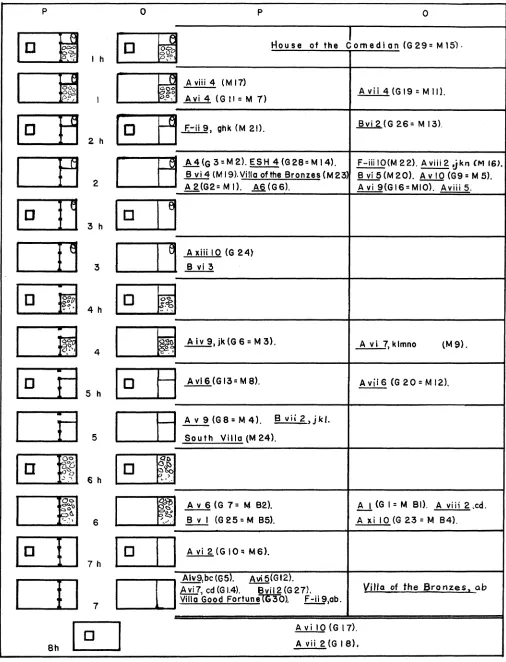
Fig. 4. Typological Table of Olynthian Kitchen-Complexes.
P - Partition-wall has pillar bases. 0 Partition-wall contains no pillar bases. h Hearth in large
room (I). "(G 29 -M 15)" means this kitchen-complex is #29 in the table in Olynthus, VIII, p. 198
OLYNTHIAKA 329
Mylonas' thorough study of the new evidence provided by the 1938 excavations 2
and his revaluation of the old in the light of this have corrected some of my conclusions about the kitchen-complex as presented in Olynthus, VIII.3 I now accept his demon- stration that area II (see Fig. 3, a) was normally (always?) accessible,4 auld that thle cooking was normally (always?) done there. But, amongst other points of disagree- ment, I do not agree in ruling out several kitchen-complexes (as interpreted in Olyn-
thus, VIII) of Type P7 (see chart, Fig. 4), which include the one in the very important " Villa of Good Fortune," our model Olynthian house.
In order to see clearly what are the distinguishing features of the kitchen- complex, let us begin with a list of eleven examples whose purpose is scarcely dis- putable since abundant remains of ashes were observed in II at the time of the excavation.5 Both Mylonas and I agree in accepting these eleven, as well, of course, as a large number of others.
HOUSE FEATURES REFERENCE
(the plans of those marked with an asterisk may be found in Fig. 1) A 2, cde 1, 2 3 4, , , 7. Olynthus, VIII, pl. 89.
*A iv 9, jk 1, 2, 3, , ,6, 7. , pl. 92.
*Av6,ef 1,2, , , ,6,7. , pl. 96.
*A viii 2, jkn 1, 2, 3, 4, , , . Olynthus, XII , pl. 6.
its own porch through a door in one end); only occasionally has a hearth; is regularly onle of the least well decorated rooms on the ground-floor; and shows no tendency to dominate the plan by an axial position on the north side of the court. Rather, as Mylonas says (Olynthus, XII, p. 387), it tends to shrink away from the front door (which is natural since the room was much used by the women), and its position varies widely since it depends, at least in part, on the location of the house entrance. In what sense the Olynthian room can be called the " main room of the house " it is difficult to see, although it was certainly one of the most used-by the women.
2 Mylonas was a member of the Olynthus staff at least part of the time at all four excavations,
and was field-director in 1938; I was present at the second and third campaigns (1931 and 1934), and my special responsibility was the houses and city-plan.
3Although Olynthus, VIII appeared with D. M. Robinson as co-author, I think he will allow me to assume the burden of responsibility for what was said there about the kitchen, if only because he now follows Mylonas in toto; the kitchen-complex theory was already adumbrated in my disser- tation (pp. 87-92) which was completed before I studied the added evidence of the houses excavated in 1934.
4 Contrary to my statement in Olynthus, VIII, pp. 192, 193. But surely there is no need to
restrict the term " kitchen " to II where the actual cooking was done;. the large room, I, where the preparation and serving of the food (as well, doubtless, as other household tasks) took place was also a " kitchen." Flence our term, " kitchen-complex," covers both rooms, and it may be extended for convenience to include the bathroom likewise.
s Eight of these eleven examples with preserved ashes were excavated in 1938 when attention was sharply focused on the problem; but the fill was so shallow over many houses on the top of the North Hill excavated in the first three campaigns that decisive evidence regarding the character of
330 J. WALTER GRAHAM
HOUSE FEATURES REFERENCE
A viii 4, cde 1, 2, 3, 4, , 6, 7. Olynthus, XII , pl. 14. B vi 4, gkk' 1, 2, 3, 4, , ,7. , pl. 104.
B vi 5, gij 1,2,3,4, 4 , , , pl. 106.
*F-ii 9, ghk 1, 2, 3, 4, 5, ,7. , pl. 158. *F -iii 10, abc 1, 2, 3, 4, , 6, . , pI. 190. *V. Bronzes, ijk 1, 2, 3, 4, , , 7. , pl. 202. S. Villa, jlm 1, 2, 3, , , , 7. , pl. 222. The numbers in this table indicate the possession of the following characteristics, all of which are graphically represented in an " ideal " example in Fig. 3, a:
1) A large bare-floored and bare-walled room commonly about 4.50 to 5.00 m. wide by 5.00 to 6.00 m. long, and referred to in the following discussion as I.
2) A space along one end of I about two meters wide,6 frequently not extending the full length of I, referred to as II.
3) A space divided off at one end of II, referred to as III.' 4) A bathtub in situ in III, or fragments of one.
5 ) A square stone hearth in I.
6) A floor of flat slabs of stone in II.
7) Bases (usually four) for pillars in the wall separating I from II-III.
As will be seen from this table the only characteristics in which all of these eleven examples agree are: 1) the size and general character of the large room, I; and 2) the approximate size of II. Any two adjacent rooms similar to I and II in size, relatively and absolutely, and similarly plainly finished, might fairly be suspected of being a kitchen-complex (e. g. A vi 8, cd),8 but some further indication, such as ashes in II, must be forthcoming in order to attain any certainty.
Ten out of the eleven examples in the above list have a small space walled off (III) at one end of II. In three of these ten (A2,9 A viii 4, Villa of the Bronzes*) a bathtub was found in situ; in three more (A viii 2*, B vi 5, F -iii 10*) a gap in the floor and fragments of a tub; and in B vi 4 and F -ii 9*, the fragments of a tub. In the remaining two a tub may once have existed and simply been carried off intact. A bathroom or tub was so frequently placed in this comfortably warm spot that the finding of one in situ should always prompt us to consider whether a kitchen-complex
6 Maximum ca. 2.40 m. (F -iii 10). The table in Olynthus, XII, p. 398 sometimes errs on the high side: #19, ca. 1.60 instead of 2.60 m. (the text, p. 121, gives 1.50 m.); #22, ca. 2.40 instead of 2.70 m.; B #1, 2.30 instead of 2.90 m.; the length of #19 is also given as 3.80 m. for 2.80 m.
7 I follow Mylonas' convenient terminology in the Excursus to Olynthus, XII. 8 Olynthus, VIII, pl. 97.
OLYNTHIAKA 331
is adjacent. Yet there are many cases where there is no reason to believe that the bath did form part of such a complex," so that the bath is clearly no decisive criterion; it may, however, serve as a clue.
In four instances the floor of II is covered with flat slabs of stone on which the fire wvas evidently made. Such large flat slabs are rarely found paving the floor of any rooms definitely not kitchens, though they are occasionally employed to protect the surface from water erosion (where cobblestones are normal), as in A vi 5, *h, and for portions of the court of A viii 5 and the Villa of the Bronzes*. This type of flooring may therefore be considered fairly reliable evidence when found in a room suitable in dimensions and in general character.
A stone hearth occurs in the above list only in F -ii 9*. Yet the fact that else- where such hearths are found only in rooms similar to I (though in one case definitely, and in one probably, without a II room)1" suggests that they also be reckoned a useful clue.12
Lastly there is the enigmatical pillar-partition, found in probably eight of the eleven cases listed above. Whether or not this feature occurred only in kitchen- complexes is the main point of dispute between Mylonas and myself, and must be considered further below. In four or five of these eight examples there is a low rubble wall between the bases separating II from I (at III there is normally a door), which clearly served as a foundation for an adobe wall, according to normal construction; 13
otherwise it would have had no function.
The distinctive character of this row of pillars, with or without an intervening adobe wall, and its frequent association with the kitchen demand an explanation; I cannot agree with Mylonas who seems to treat it as a merely incidental feature and offers no really satisfactory explanation for its presence. That its purpose was merely aesthetic is to me incredible for various reasons: the very substantial character of the pillars and their close spacing; " the fact that, as the remains indicate, the lower part of the wooden shafts was sometimes (always?) enclosed within the adobe wall; 16 and
10 For example: A 8, a; A 11, c; A v 4, b; A v 5, c; A vi 7, i; A vii 5, c; B ii 3; B vii 2, h; E.S.H. 4, i; and E.S.H. 6, a.
11 A vi 10, a, and A vii 2, a, respectively (Olynthus, VIII, pls. 97, 99).
12 References to similar Greek hearths have been noted in Olynthss, VIII, pp. 187 f. A similar
square hearth, apparently stone-curbed, occurs in the center of a room of a Norwegian house built about the end of the seventeenth century after Christ. A great horizontal beam is socketed in the wall, and from the end of this a chain and kettle is suspended over the hearth (Norwegian Archi- tecture throughout the Ages, 1950, p. 58; no author). Another house has a long firepit down the center of the room, like that in F -ii 9,* h, and a long pole suspended above the axis of this carries a series of kettles, each on a long chain (ibid., p. 70).
13 Olynthus, VIII, pp. 223 f. The upper surface of this rubble wall is sometimes higher than
the top of the bases and sometimes partially overlaps them (ibid., pl. 35.2 at " 4 "; nos. 10, 12, 14 in Table at p. 198).
14 See note 16.
332 J. WALTER GRAHAM
the fact that the decorative treatment of one wall of these normally bare, unplastered, and earth-floored rooms would have been completely out of character.
The purpose of these pillars must therefore have been functional, and the analogy of the exactly similar room-complexes with a continuous wall instead of the row of pillars (their identity may be readily seen by comparing our types P and 0 in the Table, Fig. 4) suggests that the row of pillars was an equivalent or substitute for a solid wall. Now one purpose of a solid adobe wall was of course simply to screen off one room from another on the ground floor; but four isolated pillars cannot " double" for such a purpose! Another purpose, in a two-storey house, was to support the weight of a similar adobe partition-wall directly above it in the second storey; 16 this does lead
to a reasonable-and, I believe, the only satisfactory-solution for our pillar rows. This explanation, however, has little or no possibility of being the correct one unless we can assume that every house with this pillar-partition had a second storey, and unless this second storey extended over the kitchen-complex. Naturally absolute proof either for or against such an assumption is impossible in houses whose walls are rarely preserved for more than a foot or two above the ground-floor level; but, after reconsidering the whole problem with the aid of the newly excavated houses, I feel even more confident than I did when studying the houses for the 1938 publi- cation that in many houses second storeys practically co-extensive with the first- storey rooms are not only possible but probable. The evidence has been discussed
above."7
If we grant the existence of this adobe wall in the second storey immediately over the pillar-partition, the almost inevitable inference is that there was no floor over II (-III). For it is ridiculous to suppose that the Olynthian builders would so frequently have gone to the trouble to construct such a row of pillars merely to permit the building of an adobe partition in the second storey whose only result would have been to create a narrow room, some five to eight feet wide, over II (-III). But a satisfactory reaison
d'etre for such a second-storey partition-wall, and therefore of the pillar row in the first storey below it, is provided if we suppose that it was needed to close off the room over I from an open well over II (-III).
Even if there were no explanation forthcoming from the remains to account for
16 Ibid., p. 217. The close setting of the pillars also indicates that the weight thus supported
must have been considerable, such as the weight of a solid adobe wall. The spacing of the pillars in the courts of the Olynthian houses, where they supported the weight of the upper gallery and its roof, is regularly about 2.25-2.50m. A single central pillar in the kitchen-complex would have resulted in an interaxial spacing of approximately the same as this, but only in A 2 (Fig. 3, b), A 6,* and A viii 4, does this seem to have been done. Otherwise there were normally two free- standing pillars and two contiguous with the walls, reducing the usual spacing to ca. 1.40-1.50m.
(ibid., p. 190). Indeed where the kitchen was unusually wide, three free-standing pillars might be inserted (those next the walls being omitted); by this means the spacing in E.S.H. 4 was reduced from ca. 1.80 to ca. 1.35 m., and in B vi 3 from ca. 1.63 to ca. 1.28 m.
OLYNTHIAKA 333
such an extension upward through the second storey of the area II (-III), I believe that we would be compelled, on the structural grounds just outlined, to accept it. But when we note that area II was used for cooking over an open fire, the solution that the vertical shaft thus created served as a flue to carry off the smoke is so obviously appropriate as to carry immediate conviction that the structural meaning of the pillar- partition has been correctly interpreted.
This interpretation, which was already worked out in Olynthus, VIII (pp. 193 f.), was based purely on a series of what I still conceive are logical and well-nigh inevitable deductions from the actual remains, without the help of analogous con- structions in houses of other periods. And indeed no analogies in ancient houses have yet come to my attention.18
An essentially similar solution of the problem was reached in the large flue over the kitchen which was a common feature of certain types of Swiss houses built several hundred years ago. The flue here is described as " consisting of a wooden hood covering nearly the entire kitchen " and passing up through the second storey in a conical form to emerge in a chimney-like opening through the roof (Fig. 3, e).'9 The
conical form is of course possible with wood construction, but not in the adobe brick used in the Olynthian house, and for the same reason there was no need of a series of posts to support the flue partition.
Another comparison to the Olynthian flues may be made with the familiar " light- wells " of the Minoan palaces.2" These were of course not, at least primarily, built to evacuate smoke but to provide light and air; but their construction in the form of narrow rectangular shafts passing up through the several storeys of the palace and opening on the various rooms through columned porticoes is essentially similar to that of the Olynthian flues. Even more similar, at least superficially, is the series of two columns between two pilasters set on a low wall in front of the narrow rectangular
18 The plan of two rooms (5, 6) in a " Villa Rustica" recently excavated at the Guidonia airport near Tivoli, belonging to the 1st or 2nd century after Christ, bears a striking superficial resemblance to the Olynthian kitchen-complex; but the dividing-wall is very narrow and the series of (5) rectangular gaps in it are only ca. 0.50 m. apart. I am much indebted to Professor Aurigemma for more detailed information about these rooms than appeared in the report (Not. d. Scavi, V-VI, 1944-5, pp. 39-51, fig. 2); he feels certain that the Guidonia rooms did not constitute a kitchen- complex, though he is not sure what the correct interpretation is. Another possible comparison was with Pompeii, for Mau says of the kitchen there (Pompeii, p. 274) that it was usually very high, and that the smoke went out through a window over the hearth, and perhaps at times also through openings in the roof; however, in response to my inquiry, Dr. Lawrence Richardson very courteously sent me a long account of his unpublished researches on the Pompeian kitchen, -from which it seems clear that Mau was mistaken and that there is no evidence of any similarity to the Olynthian arrangement.
19 Sturgis, History of Architecture, I, p. 536, s.v. chimney. And see below on the chimney
covering, note 78.
334 J. WALTER GRAHAM
area where the throne in the " Royal Villa " was placed; above this area Evans restores an open well extending up into the next storey.21
Although both the Swiss houses and the Minoan palaces are too remote in space and time from the Olynthian houses to postulate any continuity, yet their evidence is perhaps all the mnore pertinent since it suggests the obviousness of some such device for admitting light and air to, or smoke from, the ground-floor roonms of a multi- storeyed building.
The somewhat intricate line of reasoning outlined above has been necessary in order to show that the occurrence of the partition-wall in several of the above list of eleven certain kitchen-complexes is not coincidental, as Mylonas seems to believe, but that there is really an intimate association. His exact position on this problem of the partition-wall seems not to be fully stated in Olynthus, XII. He is reluctant to believe that two-storeyed houses were common (see above, p. 320) and assumes that in the majority of cases the smoke found its way out through perforated tiles (see below p. 345). But he concedes (pp. 380 f.) that " when the unit was placed in a two-storied house " the kitchen (II-III) was the full height of the two storeys, and his diagram (p. 381, fig. 10) shows the room over I separated from the flue by a solid wall and based ox a solid wall in the first storey. Again (p. 382) he grants that when there was an open square hearth in the main room (I) the smoke could have found its way out " through the pillared partion and the open space over the kitchen as postulated in the publication of 1938." He also agrees that " we may feel sure that the pillared par- tition was open above; that the rubble wall between the pillars,22 in other words, was carried only to a small height and did not reach the ceiling." But he nowhere speci- fically admits that the pillars had any particular function. Presumably he would agree that the pillar-partition would support the solid partition above in a two-storeyed house, yet his belief that the second storey was rare certainly implies that some, or possibly all, of the numerous pillar-partitions occurred in one-storeyed houses.23 Thus either the pillars have no discoverable purpose, if they occur only in one-storeyed houses; or if in both one- and two-storeyed, they do serve a functional purpose in the latter but not in the former. If Mylonas believes that the pillar-partition performed
21 A similar arrangement is found in the House of the Chancel Screen; for both see Palace of
Minos, II, ii, p. 394, figs. 225, 232, 234, 238. Very like this scheme in plan is a shrine of the Abu Temple at Tell Asmar about a millennium earlier (Seton Lloyd, Mesopotatmia, p. 102, fig. 5).
22 By " rubble wall " he presumably means the adobe wall based on a rubble foundation; the
top surface of this rubble is often well preserved and smooth like the other rubble foundations, and like them was surely the foundation for an adobe wall (Olynthus, VIII, p. 223).
21 Yet A 4 and A v 9 (Olynthus, VIII, pls. 89, 95) have stairbases in situ in such a position
OLYNTHIAKA 335
no function, or at least no discoverable function, he should first demonstrate that the functional explanation outlined above and in Olynthus, VIII is wrong.
Until he does so I think we must continue to believe that the pillar-partition was not a meaningless structure likely to be found almost anywhere in the house, but that it was intimately associated with the kitchen-complex; and therefore that although the existence of a pillar-partition cannot, on the basis of the structural explanation alone, be taken as proving the presence of a kitchen-complex, yet where it is combined with other characteristic features, such as " 1 " and " 2 " above, it should be rejected only for very serious reasons. We will return to this point later.
Our positively identified examples have therefore provided us with the following clues which should be useful in recognizing the kitchen-complex: 1) two plain rooms of the relative proportions described above; 2) a bathroom or tub at one end of II;
3) II paved partly or wholly with large flat slabs of stone; 4) a hearth in I; 5) the pillar-partition. On this basis we may draw up the table in Figure 4 of possible variations with all recognizable examples assigned to their types.
A few comments on special cases follow.
No example of what we may term the " ideal " type (Type Plh and Fig. 3, a) has yet been found, but the House of the Comedian perhaps provides an odd variation intermediate between Plh and Olh. This is such an interesting but unique variation that we shall study it separately below.
A viii 4 seems to be an example of P1 though Mylonas says of the partition-wall, "not preserved." 24 Yet, as may be seen in the photo, Olynthus, XII, pl. 16. 1, and in
the plan, pl. 14, there is a flat piece of stone at the end of the tongue-wall between II and III in exactly the same position as the well-cut base in A 2 of Type P2 (Fig. 3, b), and very likely also in A 6* (P2). Indeed these three examples indicate a minor variation in which a single pillar is made to do the work of the usual two free-standing pillars (above, p. 332 note 16). Ashes were found in A viii 4, e,25 though not men- tioned in Mylonas' Table.24
I classify F -ii 9*, ghk, as P2h rather than 02h in spite of Mylonas' remarks (Olynthus, XII, p. 375); one base is perfectly clear in pl. 164.2, and rough bases, as the others seem to have been, could have been evened up with a coat of clay.26 Indeed the text of Olynthus, XII (p. 199) speaks of the two western bases, " at either side of the entrance to the bathroom are pilaster bases." The text also states (loc. cit.) that "a very few small pieces of a bathtub were found," presumably in g; but Mylonas' Table in the Excursus (p. 398) is silent on this point.27
24 Olynthus, XII, p. 398, #17. 25 Ibid., p. 24.
26 Compare those in A iv 9,* jk (Olynthus, VIII, pl. 92) ; and see ibid., pp. 191, 196 f.
27 There is clearly an error in stating the height of the threshold from the court into II (h)
336 J. WALTER GRAHAM
A 6* (P2) is omitted from Mylonas' list. Room I was only partially excavated, but there is sufficient space for it if, as the remains certainly suggest, it extended to, or nearly to, the city-wall, as was clearly the case in A 1* (Olynthus, VIII, pl. 89). Moreover, at the end of the wall between II and III is a stone base, indicated in the large plan in Olynthus, II, fig. 182. Indeed the similarity between dec of A 2 (Fig. 3, b) and bca of A 6* is so striking as to render the identification of the kitchen- complex in A 6 extremely plausible.
In A viii 2*, jkn (02) the partition-wall is entirely missing, so that its exact type is uncertain. A vi 9 28 (02) has a cement floor in III but definitely no tub; there
is, however, an inset round basin like that found in other bathrooms with tubs (A vii 4, A 6*, and B vi 2). When A viii 5 (02) is properly oriented 29 dgh is seen to form
a nearly normal kitchen-complex pattern; d was doubtless entered through c from f. Ashes were found in g and tub fragments in h, which would seem to be entered through g.
Both A xiii 10 and B vi 3 (P3) have been omitted by Mylonas."0 Yet the only difference between P3 and P2 is that the bathtub is set in a definite room, often with cement or tile floor, in P2, while in P3 no traces remain of a floor or of a wall of separation between II and III. Ashes were noted in II in at least three examples of P2, making its identification certain; and ashes were actually found in the second example of our P3.8' The omission of A xiii 10 and B vi 3, if not accidental, would seem to be inconsistent.
The poorly preserved rooms, jkl, in the southeast corner of B vii 2 32 are probably
also to be reckoned as forming a kitchen-complex although there is already another (bc) in the same house (on this see below). For convenience we may classify it as P5, for although II at the east end of j is undivided, along the south side of j are two small rooms, kl, and a fragment of cement floor suggests that k is a bathroom. In addition to the usual line of four bases (one is missing at the north end) there is a single base in front of k.
A vii 6 (Fig. 3, b) is a variant of 05h. Rooms II and III have been placed along one side instead of at one end of I, and the extra width has allowed the insertion of a small additional room between II and III. III has a cement floor and a drain but no space for a tub. Mylonas found traces of burning on the foundations of k when he re-examined the remains in 1938. Probably the flue in the second storey included all the space over klm.3
28 Ibid., pl. 97.
29 Hesperia, XXII, 1953, pl. 64, b.
30 Olynthus, VIII, pl. 108, and Olynthus, XII, pl. 102, respectively.
3l Ibid., p. 117; the text mentions that tub-fragments were found in II-III, and cautiously sug- gests that its identification as an oecus-unit " seems to be probable."
32 Olynthus, VIII, pl. 103.2.
OLYNTHIAKA 337
A viii 2, *cd should perhaps also be considered a kitchen-complex (06) although that would make two in the same house (see below). The rooms are of appropriate proportions and character, and c has a floor paved with stone slabs; no burnt material was noted in excavating c but the fill must have been very shallow.34 Fragments of large storage-jars were found in d (I).`
Our 8h is not included by Mylonas as a kitchen-complex because it is not a "complex " but a single room with hearth; he does not, however, seem to be inclined to deny that it may have served a purpose similar to I, which it resembles in size and general character. He further notes that some, perhaps all, of the Olynthian square hearths 36 seem to contain only clean ashes when excavated, and the absence of debris,
such as bones, which we might expect if they had been used for cooking, suggests to him that such hearths were used principally, at any rate, for heating-for keeping the room in which the women of the household probably spent a large proportion of their time, especially in winter, warm. The Olynthian hearth was always placed in the middle of the room (I), where people could cluster around it, and from which it could distribute its heat better before being drawn up the flue. The fact that such hearths have now been found in conjunction with definite cooking-places in II in several instances 37 certainly strengthens Mylonas' contention.
We are thus reduced to Type 7 alone as the major area of controversy. Yet there are six important examples of P7 and one of 07 which I would list in this category but which Mylonas declines to recognize as kitchen-complexes. Almost all the best houses, especially those with androns, have such complexes, yet to omit the P7 group would leave A vi 5,* with a fine court and stairway and two androns (one is much the largest yet found at Olynthus), and the Villa of Good Fortune, by far the finest of the Olynthian houses, without a kitchen-complex.
- Is there really sufficient difference between P7 and all the preceding types to justify this discrimination against it? True, it has no hearth, but this is not an essen- tial feature at all-only six complexes have one. It has no bathroom or even tub remains (though the tub may have been carried off intact, like so much other material
34 Olynthus, XII, p. 15.
35The pipe from the court carrying drainage-water to the alley pursued a curiously erratic course; it deliberately avoided going through c, whether because any repairs to the pipe would have necessitated the lifting of the slabs of the flooring, or because it was feared that fire burning on the floor might crack the pipes. The notion that the pipe carried drinking-water from the drainage- alley ( !) to the middle of the court is impossible; the impression that the slope of the pipe was downward toward the court must be erroneous. If any such extraordinary situation was suspected, Robinson's statements in Olynthus, XII (p. 13) should have been supported by a series of careful level-readings at different points along the pipe-line made by a surveyor, as was done on the pipe- line draining from court to street in A iv 9 * by Travlos (Olynthus, VIII, pl. 92).
36 See list in ibid., p. 187, to which add F -ii 9,* found in 1938.
37 Most clearly in F -ii 9 * (P2h), but also in the House of the Comedian (Fig. 3, c) (POlh).