This study used latent profile analysis to cluster students into three groups with homogenous motivational profiles based on self-reported self-efficacy, task value and task anxiety measures obtained from 263 middle school students. The results demonstrated that there were distinct motivation profiles among students while engaging in a one-to-one computing environment for English learning, which resulted in differences on their performance. In general, this eLearning environment had a significant positive effect on students’ learning achievements regardless of various motivation profiles. But students with high self-efficacy, task value while low task anxiety performed better than those in other profiles. This study also suggested that task anxiety impeded students from benefiting from the one-to-one computing environment, but it could not significantly affect students’ learning outcomes. The profiling of student motivation orientations enhanced our understanding of the complex interactions of various motivational components and extended our existing knowledge in this emerging area of student learning. Besides, the findings inform future interventions in curriculum design and effective scaffoldings.
on e-Learning
Research Article
A latent profile analysis of students’ motivation of
engaging in one-to-one computing environment for
English learning
Shan Li
1,* and Juan Zheng
11Department of Educational and Counselling Psychology, Faculty of Education, McGill University, 845 Sherbooke St
W., Montreal, Quebec, Canada
Abstract
Keywords: one-to-one computing environment, latent profile analysis, self-efficacy, task value, task anxiety Received on 06 June 2018, accepted on 19 September 2018, published on 03 October 2018
Copyright © 2018 S. Li and J. Zheng, licensed to EAI. This is an open access article distributed under the terms of the Creative Commons Attribution licence (http://creativecommons.org/licenses/by/3.0/), which permits unlimited use, distribution and reproduction in any medium so long as the original work is properly cited.
doi: 10.4108/eai.25-9-2018.155574
*Corresponding author. Email:[email protected]
1. Introduction
Educational institutions and researchers nowadays have witnessed the extensive, dramatic use of various educational technologies in schools for promoting students’ learning performance, such as online communities, intelligent tutoring systems and individualized learning space. Specifically, the one-to-one computing environment gained great popularity in classroom settings due to the decreasing costs of laptops and the increasing availability of wireless connectivity [1]. The one-to-one computing environment, also known as one-to-one initiatives, was originally raised by Norris and his colleagues [2], for the purpose of descripting the phenomenon occurred in US education
attempts to examine the interactions between one-to-one computing environment, students’ motivation profiles, and their English-learning achievement. Thus, the purpose of this study is two-fold: (1) to verify the usefulness of one-to- one computing environment, and (2) to identify distinctive motivational profiles of students, as well as to examine how these different motivation profiles relate to their English learning achievement.
2. Theoretical Framework
2.1. One-to-one computing environment
While researchers claim that emerging and mature technologies are rapidly transforming our educational landscape in profound ways, educators and instructors ironically report only a small amount of time allocated for using computers in classrooms [4]. Some research pointed out that the disjunction between the dramatic advances in educational technology and the relatively inert amount of computer use results was partially due to low student-to- computer ratios [5][6]. Under this circumstance, the one-to- one computing environment, or one-to-one initiative, received much attention worldwide, and has long been a key area of concern among technology-based school innovations. Eminent examples include the programs of ‘One Laptop Per Child’ [7], ‘Up-Scaling creative classrooms in Europe’ [8] and ‘Bring You Own Device’ [9]. In the one-to-one computing environment, each student has a digital device (e.g. laptop, Tablet or smartphone) which allows them to participate in various online activities in a self-directed approach. Though the breadth and depth of technologies available today affords one-to-one computing environments much diversity for redesigning teaching and learning, these kinds of environments basically share two essential characteristics: (1) the 1:1 ratio of students to digital devices, and (2) digital devices should serve for instructional purposes [1][10]. The one-to-one computing environments have great potential in maximizing students’ learning performance, as the environments inspire new ways for students to engage with various kinds of content and activities in their own self-regulated learning experiences. But the one-to-one computing environment could also be disorienting, even disturbing for students if they have no confidence or feel pressure to deal with it for learning.
2.2. Students’ motivational profiles
Prior research has extensively examined the nature of students’ profiles of motivation orientations based on self- determination theory (SDT) [11] [12][13][14]. For example, Gillet and his colleagues identified six distinct motivation profiles based on the SDT [11], which included autonomous, moderately autonomous, strongly motivated, moderately unmotivated, poorly motivated, and controlled profiles. The study conducted by Wang, however, revealed four distinct motivational profiles based upon the
organismic integration theory, one of the sub-theories of SDT [13]. Considering the mixed results in profiling students using SDT and the diversity of students’ motivations, other profiling research that focused on students’ motivation orientations tried to recover hidden groups out from students’ intrinsic and extrinsic motivation [15][16], instrumental motivation [17], and academic self- concept [18]. For instance, Marcoulides et al. found that students could be clustered into three differential groups based on their academic intrinsic motivation: motivationally gifted, intermediate and at-risk [15]. However, few attempts have been made to profile students with multiple motivational components.
According to Printrich, multiple goal pursuit is important for students as various motivational components jointly affect their learning and performance [19]. Thus, Printrich and his colleagues developed a self-report instrument of the Motivated Strategies for Learning Questionnaire (MSLQ) to assess different aspects of students’ motivational orientations and learning strategies [20]. The MSLQ has been used in literally hundreds of educational research projects, and has recently gained renewed attention in measurement literature [21]. Specifically, the motivational section of the MSLQ assesses three different motivational components which consist of six subscales: expectancy (control beliefs, self-efficacy), value (intrinsic and extrinsic goal orientation, task value) and affect (test anxiety). For this study, the motivational subscale of self-efficacy in the expectancy category was chosen for profiling students. The term of self-efficacy describes students’ perceived beliefs about their abilities or competences to successfully accomplish a task [22]. It is a core motivational construct in social cognitive theory. It has also been unanimously verified that having significant effects on students’ learning achievements across various disciplines [23]. In addition, the construct of task value was also included in profiling students. According to Eccles [24], task value refers to an individual’s perceived importance or value of a specific task, which plays a crucial role in shaping his/her achievement-related decisions, actions and outcomes. At last, this study added affect states (i.e. task anxiety) in the motivation profiling. In one-to-one computing environment, previous studies have demonstrated the importance of taking task anxiety into account when explaining the variations of students’ learning achievements [10].
The present research extends the literature on students’ motivation profiles by (1) simultaneously considering different types of motivational components, i.e. self- efficacy, task value and task anxiety, rather than relying on a specific motivation theory; (2) linking students’ motivation profiles with a concrete learning environment, as well as with an observable outcome (i.e. students’ English-learning achievement). Specifically, three research questions were formulated for this study:
(ii) Did the one-to-one computing environment enhance the English-learning performance of students with different motivation profiles?
(iii) Were there any group differences on students’ English achievement among the profile types?
3. Method
3.1. Participants and procedure
The sample was comprised of 263 eighth grade students from a middle school of Shenzhen in southwest China. There were 155 female students (58.9%) and 108 male students (41.1%), with an average age of 15 (SD = .81). They volunteered to participate in this study. A one-to-one computing environment for English learning was first introduced to the participants. Then students were asked to accomplish a questionnaire pertaining to their perceived self-efficacy, task value and task anxiety towards this environment for supporting their English learning. The measures were conducted during regular school classes coordinated with help from the English teachers. Measurement of students’ prior level of English-learning performance was based on the score they got from an English test just before the initiation of this study. After that, the one-to-one computing environment was deployed in the English classes for approximate three months, during which no students dropped out. During the experiment, the English classes were given every weekday to the participants. Each English class lasted for an approximate duration of 40 minutes. Students spent relatively equivalent time on the app. Students’ English-learning performance was measured again through an English test at the end of the experiment. To minimize the influence of test difficulty on students’ performance, the pre-post English tests were designed by the school English-teaching committee as standardized tests, whose validity can be guaranteed to some extent.
3.2. The one-to-one computing environment
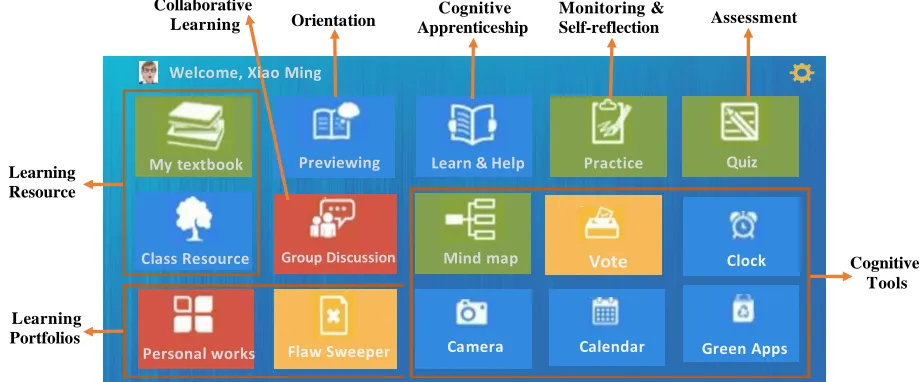
The main interface of the one-to-one computing environment was shown in Figure 1. This environment was also referred to as the electronic schoolbag (eSchoolbag) environment since it was originally proposed to lighten students’ heavy schoolbags. Specifically, the eSchoolbag is an individualized learning environment for students to regulate and manage their learning processes in classroom settings, which is usually equipped with learning resources and various cognitive/metacognitive tools [10] [25]. It also supports teachers’ real-time monitoring and control of students’ learning activities by logging on as an administrator. Teachers can upload and manage learning resource that later appears in the sections of My textbook and Class Resource of students’ interface. By using the Previewing function, students can obtain information pertaining to teaching/learning goals, unfamiliar vocabulary words, and potential learning difficulties. Thus, they can orientate their learning accordingly, e.g. making practical plans and managing their efforts on different learning contents. The one-to-one environment of the eSchoolbag also provides a cognitive-apprenticeship like environment, i.e. the function of Learn & Help. As students explore the learning contents in a self-regulated approach, they can get assistances from teachers along a learning trajectory towards performance excellence. The eSchoolbag also affords students a collaborative learning environment as it integrates the online Group Discussion whereby students can work collaboratively to solve complex tasks. The functions of Practice and Quiz enable students to assess their learning progresses at the time they need or want. They can also collect their mistakes that made in practices or quizzes into Flaw Sweeper, where they can review certain knowledge consciously. Moreover, the eSchoolbag provides various cognitive tools, such as Mind map and Calendar, to promote students’ cognitive monitoring and control of their learning activities.
Collaborative
Learning Orientation
Cognitive Apprenticeship
Monitoring &
Self-reflection Assessment
Welcome, Xiao Ming
Learning Resource
Learning Portfolios
My textbook Previewing Learn & Help Practice Quiz
Cognitive Tools
Figure 1 The interface of the one-to-one computing environment
Class Resource Group Discussion Mind map
Camera
Vote
Calendar
Clock
Green Apps
3.3. Instruments
Students’ self-efficacy, task value and task anxiety were measured by the means of a questionnaire whose items were adapted from the Motivated Strategies for Learning Questionnaire (MSLQ). The MSLQ was originally developed by Pintrich and his colleagues to assess students’ motivational orientations and their use of self- regulated learning strategies [20]. Based on a general social-cognitive model of motivation, the motivational scales in MSLQ consisted of three general motivational constructs [26]: expectancy-related motivational components (e.g. self-efficacy), value and affect (i.e. test anxiety), which were quite appropriate to this study. To be specific, self-efficacy scale involved five items regarding students’ perceived confidence about their ability to utilize the one-to-one computing environment for English learning. A sample item was “I am sure I can do well on the tasks in the one-to-one environment”. Task value was captured by six items, including “The one-to-one environment is very helpful for me to learn new knowledge” and “The one-to-one environment can improve my learning efficiency”. In terms of task anxiety, five items were used to measure this construct and a sample item was “I feel a lot of pressure when engaging in the one-to-one environment for English learning”. The items were presented using a 5-point Likert scale where 1 means ‘strongly disagree’ and 5 stands for ‘strongly agree’. The Cronbach’s coefficients of the subscales of self-efficacy, task value and task anxiety were analyzed to test their internal consistency. The reliability of the subscales of the questionnaire were .84, .88 and .87 respectively.
3.4. Data analysis
Latent profile analysis (LPA) is a statistic modeling technique that identifies taxonomies or classes of individuals based on their common characteristics [27], e.g. motivation orientations. LPA is similar to clustering techniques but more flexible as it aims to recover hidden groups from observed data based on explicit models [28]. Specifically, models are estimated for a successively increasing number of classes to find which model is the best fit to the data, while the probability of an individual that being categorized into best-fitting group is estimated simultaneously within each of the models [29]. In this study, Akaike’s information criteria (AIC) [30], Bayesian information criteria (BIC), sample size-adjusted Bayesian information criteria (Adjusted BIC), the Bootstrapped Likelihood Ratio Test (BLR) [31], and the Lo-Mendell- Rubin Adjusted Likelihood Ratio Test (LMR) [32] were used to determine the optimal number of classes. The AIC, BIC and adjusted BIC are descriptive goodness-of- fit indices wherein smaller values suggest better model fit. The p values generated for BLR and LMR indicate whether a k class solution (e.g. 4-class) fits better than a k-
1 class solution (e.g. 3-class). A significant p value indicates that the k-cluster model fits better than the k-1 clusters. In addition, the number of cases in each profile was also considered when estimating the fit of model to sample data, since the usefulness of the profiles could not be guaranteed if any profiles contain less than 5% of the respondents [33]. Moreover, we also examined the entropy value, an indication of clear delineation of clusters, for the purpose of evaluating the accuracy of classifications. Specifically, entropy values should be larger than 0.7 to suggest acceptable classification accuracy [34]. To estimate the aforementioned model parameters, LPA was conducted in Mplus 7.4 using the ML (maximum likelihood) estimation, since ML was most commonly used in previous studies [35]. Moreover, the profiling of samples should be theoretically sound. Therefore, the mean scores of each of the variables between profiles were inspected to assess the distinctiveness of the classes.
In the second phase of the analyses, we first examined the effect of the one-to-one computing environment (i.e. the eSchoolbag) on students’ performance regardless different motivation profiles. Then we tested for performance differences between profiles using a one- way analysis of covariance (ANCOVA). The independent variable was profile membership. The dependent variable was the students’ English achievement scores and the covariate was the students’ prior performance on the English pre-test.
4. Results
(1)Whether various motivational components can be used to organize students into groups with
homogenous profiles using latent profile analysis
Cluster 3
Task Anxiety Task Value
Cluster 2 Cluster 1
Self-efficacy 5
4.5
4
3.5
3
2.5
2
1.5
1
solution was optimal. The entropy value of the 3-cluster solution was .938, indicating that 93.8% of subjects were correctly classified, which was considered high.
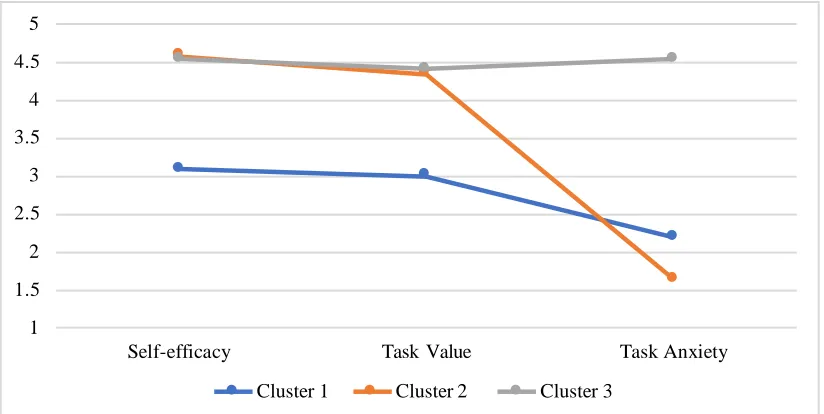
As shown in Figure 2, the three clusters represent distinct patterns of motivational orientations. The first cluster comprised of 25 students (9.5%) who reported low self-efficacy (M = 3.09), task value (M = 2.99), as well as low task anxiety (M = 2.19). We tentatively labelled this class the ‘low-low’ group as they were low on all three motivation subscales. Cluster 2 comprised 82.1% of the sample (N = 216) and we labelled this class the ‘high-low’ group as they were relatively high on self-efficacy (M = 4.57) and task value (M = 4.34) while were low on task anxiety (M = 1.64). Cluster 3 comprised 8.4% of the sample (N = 22). Contrary with the first cluster, this class reported relatively high self-efficacy (M = 4.54), task value (M = 4.41) and high task anxiety (M = 4.54).
Accordingly, this cluster profile was labelled the ‘high- high’ group.
(2)Did the one-to-one computing environment enhance the English-learning performance of students with different motivation profiles?
To examine the effect of the eSchoolbag environment on students’ performance, several paired T-tests were conducted to identify, for each of the three groups, if there were any significant differences before and after students engaging in this environment to support their English learning. The results indicated that the one-to-one computing environment significantly enhanced students’ performance for all three groups (see Table 2).
Table 1 Fit indices for different models with number of clusters ranging from 2 to 6.
Model AIC BIC Adjusted No. of free p p Entropy Smallest cluster freq. BIC parameters BLR LMR
2 clusters 1771 1807 1775 10 .000 .005 .965 25(.095)
3 clusters 1657 1707 1663 14 .000 .006 .938 22(.084)
4 clusters 1635 1700 1643 18 .000 .687 .884 14(.053)
5 clusters 1623 1702 1632 22 .000 .841 .884 9(.034)
6 clusters 1586 1679 1597 26 .000 .225 .935 1(.004)
Note: p BLR = p values for the Bootstrapped Likelihood Ratio test, p LMR = p values for the Lo-Mendell-Rubin adjusted likelihood ratio test.
Table 2 Performance differences before and after engaging in one-to-one environment
Group df M SD t p
low-low Pre-test
24
65.40 13.44
3.64 .001**
Post-test 75.32 9.69
high-low 215 14.30 .000**
Pre-test 80.94 14.14
Post-test 68.84 9.12
high-high Pre-test
21
70.02 15.35
2.45 .023*
Post-test 77.93 7.94
Note: **p < .01, *p< .05
(3)Were there any group differences on students’ English achievement among the profile types?
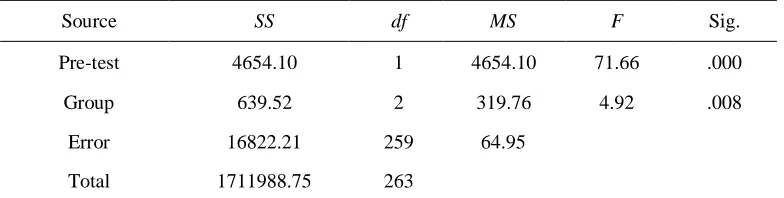
To answer the third research question, ANCOVA and post hoc follow-up tests were performed to examine how the various profile types differ in students’ English achievement while taking their prior level of English performance into consideration. A preliminary analysis evaluating the homogeneity-of-regression (slopes) assumption showed that the relationship between the covariate and the dependent variable did not differ significantly as a function of the independent variable, F (2, 260) = .124, p = .884, indicating the assumption of homogeneity of variance was not violated. The ANCOVA was significant, F (2, 259) = 4.92, p = .008 (See Table 3).
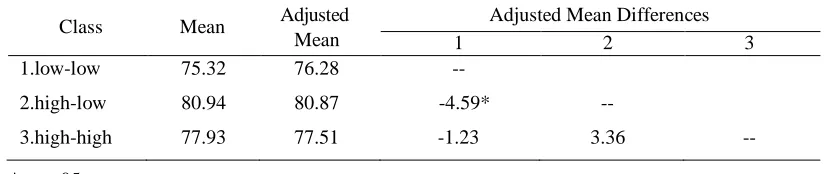
Post hoc tests were conducted to evaluate pairwise differences among the adjusted means of students’ English scores. The Bonferroni correction was conducted to control Type I error across the three pairwise comparisons. In general, the high-low group (i.e. participants with high self-efficacy and task value while with low task anxiety) obtained the highest English scores (M = 80.87) among the three groups. The high-high group (i.e. students with high self-efficacy and task value, but with high task anxiety) ranked the second (M = 77.51), performing better than the low-low group (M = 76.28). The results in Table 4 showed that students in the high- low group demonstrated significantly higher English
scores, controlling for the effect of their prior English performances, than those in the low-low group. However, there were no significant differences between high-low and high-high groups, as well as between low-low and high-high groups.
5. Discussion
The aim of this study was to identify distinctive motivational profiles of students and how these different motivation profiles related to students’ English-learning achievement. In general, this study identified three distinct types of students with differential motivation orientations using latent profile analysis. The students in the low-low profile reported low level of self-efficacy and task value, as well as low task anxiety (the means of these three variables ranged from 2.19 to 3.09). The largest profiles (n = 216, 82.1%), labelled high-low group, reported high self-efficacy and task value (average scores were 4.57, 4.34 respectively). Students in this group also had the lowest task anxiety (the mean was 1.64). The last profile, termed high-high profile, consisted of students who had high self-efficacy and task value, but had also high task anxiety (average scores ranged from 4.41 to 4.54).
Table 3 Analysis of Co-Variance for English Performance by Groups
Source SS df MS F Sig.
Pre-test 4654.10 1 4654.10 71.66 .000
Group 639.52 2 319.76 4.92 .008
Error 16822.21 259 64.95
Table 4 Pairwise Comparisons of English Achievement by Motivation Types
Class Mean Adjusted Adjusted Mean Differences
* p < .05
The profiling results were generally in line with previous research regarding the relations between different motivational components. Self-efficacy was usually positively associated with task value [36][37]. Students who valued the task tended to perceive higher self- efficacy. According to Lee, students try to avoid such a situation that they value a task high but with low self- efficacy on a specific task which may hurt their self- esteem [38]. One of our novel findings was the discovery of a low-low profile. Interestingly, this motivation profile appeared to represent those students who were indifferent to the one-to-one computing environment.
In terms of the effectiveness of the one-to-one computing environment on students’ English learning performance, this study found that the one-to-one computing environment had a significantly positive effect on students outcomes regardless of various motivation profiles, which was in accordance with previous findings [39][40][41]. Possible reasons may be included: first, the one-to-one computing environment enhanced class interactions between students and teachers; Second, this environment provided students an intelligent medium to manage their own self-regulated learning [10]; Third, students’ motivation gradually changed through this study. For example, it’s quite possible that students with low self-efficacy increasingly gained confidence as they engaged in this environment for English learning. More studies are needed to pinpoint how different internal and external factors lead to the improvement of students’ performance. But this study provides educational authorities and policy makers solid evidences that the one-to-one computing environment is beneficial for students learning, which also resonates with those reported in previous studies [25][42].
This study also found that motivation profiles leaded to variations of students’ English learning performance. In general, the high-low group (i.e. participants with high self-efficacy and task value while with low task anxiety) performed better than the other two groups. Specifically, the high-low group obtained significantly higher English- test scores than the students who reported low self- efficacy, task value and task anxiety, controlling for the effect of their prior English performance. However, no significant difference was found on students’ English performance between the high-low group and the high- high group (i.e. students with high self-efficacy and task value, but also with high task anxiety), suggesting that task anxiety did have a negative effect on students
learning outcomes but could not significantly influence their performance. These results also revealed that self- efficacy and task value were more powerful motivational components than the construct of task anxiety to predict students English learning achievements, which was in line with Zimmerman’s research who claimed that self- efficacy played a major role in students’ learning [43]. In a word, this study provides implications that educational institutions and parents should create conditions to improve students’ self-efficacy and task value, and to ease their task anxiety for maximizing students’ performance.
6. Conclusion
This study contributed to the body of eLearning-related studies by adopting a person-centered approach (i.e. latent profile analysis) to explore differences in students’ motivation orientations while they engaged in the one-to- one computing environment for English learning. The findings from this research demonstrated that there were distinct motivation profiles among students, which resulted in differences on their performance. In general, the one-to-one computing environment had a significant positive effect on students’ English learning outcomes regardless of various motivation profiles. But students with high self-efficacy, task value while low task anxiety performed better than those in other profiles. This study also suggested that task anxiety impeded students from benefiting from the one-to-one computing environment, but it could not significantly affect students’ learning outcomes.
There are some limitations to this study that should be noted. First of all, since the current study collected students’ self-report motivation orientations, future research should take multiple approaches of data collection into consideration, such as log files, interviews and peer evaluations; Second, as the profiling was based on students’ motivation that reported at the beginning of this study, it may not be optimal as how students’ motivations vary along with the time may reveal more interesting findings. Correspondingly, one possible extension to our analysis is to examine the variation of motivations using latent transition analysis; Third, though this study had demonstrated the usefulness of the one-to- one computing environment, more observations and explanations of which aspects of this environment promote students’ English learning are required.
Mean 1 2 3
1.low-low 75.32 76.28 --
2.high-low 80.94 80.87 -4.59* --
Reference
[1] W. R. Penue, “Implementation and effects of one-to- one computing initiatives: A research synthesis,” J. Res. Technol. Educ., vol. 38, no. 3, pp. 329–348, 2006. [2] C. Norrisand, E. Soloway, and T. Sullivan, “Examining
25 years of technology in U.S. education,” Commun. ACM, vol. 45, no. 8, 2002.
[3] T. Wang and D. Towey, “A rethinking of digital learning device projects,” in Proceedings of IEEE International Conference on Teaching, Assessment, and Learning for Engineering, TALE 2012, 2012.
[4] D. Bebell, M. Russell, and L. O’dwyer, “Measuring teachers’ technology uses: Why multiple-measures are more revealing,” J. Res. Technol. Educ., vol. 37, no. 1, pp. 45–63, 2004.
[5] A. Kitchenham, “One-to-One Computing and Teacher Transformation,” in Handbook of Research on Digital Information Technologies: Innovations, Methods, and Ethical, 2008, pp. 83–102.
[6] D. L. Lowther, F. A. Inan, J. D. Strahl, and S. M. Ross, “Do One-to-One Initiatives Bridge the Way to 21st Century Knowledge and Skills?,” J. Educ. Comput. Res., vol. 46, no. 1, pp. 1–30, 2012.
[7] K. L. Kraemer, J. Dedrick, and P. Sharma, “One Laptop Per Child: Vision vs . Reality,” Commun. ACM, vol. 52, no. 6, pp. 66–73, 2009.
[8] S. Bocconi, P. Kampylis, and Y. Punie, “Framing ICT- enabled Innovation for Learning: The case of one-to- one learning initiatives in Europe,” Eur. J. Educ., vol. 48, no. 1, pp. 113–130, 2013.
[9] G. Disterer and C. Kleiner, “BYOD Bring Your Own Device,” Procedia Technol., vol. 9, pp. 43–53, 2013. [10] S. Li and J. Zheng, “The effect of academic motivation
on students’ English learning achievement in the eSchoolbag-based learning environment,” Smart Learn. Environ., vol. 4, no. 3, 2017.
[11] N. Gillet, A. J. S. Morin, and J. Reeve, “Stability, change, and implications of students’ motivation profiles: A latent transition analysis,” Contemp. Educ. Psychol., vol. 51, pp. 222–239, 2017.
[12] J. Boiché and Y. Stephan, “Motivational profiles and achievement: A prospective study testing potential mediators,” Motiv. Emot., vol. 38, no. 1, pp. 79–92, 2014.
[13] C. K. J. Wang et al., “Latent profile analysis of
students’ motivation and outcomes in mathematics: an organismic integration theory perspective,” Heliyon, vol. 3, no. 5, 2017.
[14] J. C. K. Wang, A. J. S. Morin, R. M. Ryan, and W. C. Liu, “Students’ Motivational Profiles in the Physical Education Context,” J. Sport Exerc. Psychol., vol. 38, no. 6, pp. 612–630, 2016.
[15] G. A. Marcoulides, A. E. Gottfried, A. W. Gottfried, and P. H. Oliver, “A latent transition analysis of academic intrinsic motivation from childhood through adolescence,” Educ. Res. Eval., vol. 14, no. 5, pp. 411– 427, 2008.
[16] C. Geiser, M. A. Okun, and C. Grano, “Who is motivated to volunteer ? A latent profile analysis linking volunteer motivation to frequency of volunteering,” Psychol. Test Assess. Model., vol. 56, no. 1, pp. 3–24, 2014.
[17] L. K. Fryer, A. Van den Broeck, P. Ginns, and K. Nakao, “Understanding Students’ Instrumental Goals,
Motivation Deficits and Achievement: Through the Lens of a Latent Profile Analysis,” Psychol. Belg., vol. 56, no. 3, pp. 226–243, 2016.
[18] H. W. Marsh, O. Lüdtke, U. Trautwein, and A. J. S. Morin, “Classical latent profile analysis of academic self-concept dimensions: Synergy of person- and variable-centered approaches to theoretical models of self-concept,” Struct. Equ. Model., vol. 16, no. 2, pp. 191–225, 2009.
[19] P. R. Pintrich, “Multiple goals, multiple pathways: The role of goal orientation in learning and achievement,” J. Educ. Psychol., vol. 92, no. 3, pp. 544–555, 2000. [20] P. R. Pintrich, D. A. F. Smith, T. Garcia, and W. J.
Mckeachie, “Reliability and Predictive Validity of the Motivated Strategies for Learning Questionnaire (MSLQ),” Educ. Psychol. Meas., vol. 53, no. 3, pp. 801–813, 1993.
[21] J. C. Hilpert, J. Stempien, K. J. Van Der Hoeven Kraft, and J. Husman, “Evidence for the latent factor structure of the mslq: A new conceptualization of an established questionnaire,” SAGE Open, vol. 3, no. 4, 2013. [22] A. Bandura, “Perceived Self-Efficacy in Cognitive
Development and Functioning,” Educ. Psychol., vol. 28, no. 2, pp. 117–148, 1993.
[23] B. J. Zimmerman, “Self-Efficacy: An Essential Motive to Learn,” Contemp. Educ. Psychol., vol. 25, no. 1, pp. 82–91, 2000.
[24] J. S. Eccles, “Subjective task value and the Eccles et al. model of achievement-related choices,” Handb. competence Motiv., no. January, pp. 105–121, 2005. [25] J. Zheng, S. Li, and Y. Zheng, “Students’ Technology
Acceptance, Motivation and Self-Efficacy towards the eSchoolbag: An Exploratory Study,” Int. J. Infonomics, vol. 10, no. 3, pp. 1350–1358, 2017.
[26] P. R. Pintrich, D. A. F. Smith, T. Gracía, and W. J. McKeachie, “Motivated Strategies for Learning Questionnaire (MSLQ) Manual,” 2015.
[27] J. K. Vermunt and J. Magidson, “Latent class models for classification,” Comput. Stat. Data Anal., vol. 41, no. 3–4, pp. 531–537, 2003.
[28] C. S. Ding, “Latent Profile Analysis,” in Fundamentals of Applied Multidimensional Scaling for Educational and Psychological Research, Springer, 2018, pp. 135– 148.
[29] A. L. Hill, K. A. Degnan, S. D. Calkins, and S. P. Keane, “Profiles of externalizing behavior problems for boys and girls across preschool: The roles of emotion regulation and inattention,” Developmental Psychology, vol. 42, no. 5. pp. 913–928, 2006.
[30] H. Akaike, “A New Look at the Statistical Model Identification,” IEEE Trans. Automat. Contr., vol. 19, no. 6, pp. 716–723, 1974.
[31] D. McLachlan, G.J, Peel, Finite Mixture Models. New York, NY, 2000.
[32] H. Kasahara and K. Shimotsu, “Testing the Number of Components in Normal Mixture Regression Models,” J. Am. Stat. Assoc., vol. 110, no. 512, pp. 1632–1645, 2015.
[33] L. Stanley, F. W. Kellermanns, and T. M. Zellweger, “Latent Profile Analysis: Understanding Family Firm Profiles,” Fam. Bus. Rev., vol. 30, no. 1, pp. 84–102, 2017.
[34] T. Jung and K. A. Wickrama, “An introduction to latent class growth analysis and growth mixture modeling,”
[35] L. Muthén and B. Muthén, “Mplus User’s Guide. Seventh Edition.” Los Angeles, CA: Muthén & Muthén, 2012.
[36] Y. J. Joo, S. Joung, and J. Kim, “Structural
relationships among self-regulated learning, learning flow, satisfaction, and learning persistence in cyber universities,” Interact. Learn. Environ., vol. 22, no. 6, pp. 752–770, 2014.
[37] A. Wigfield, “Expectancy-value theory of achievement motivation: A developmental perspective,” Educ. Psychol. Rev., vol. 6, no. 1, pp. 49–78, 1994. [38] J. Lee, M. Bong, and S. il Kim, “Interaction between
task values and self-efficacy on maladaptive
achievement strategy use,” Educ. Psychol., vol. 34, no. 5, pp. 538–560, 2014.
[39] J. Zheng, S. Li, and Y. Zheng, “The Influence of Academic Performance on Students’ Perceptions of the e-Schoolbag,” in Canada International Conference on Education (CICE-2017), 2017, pp. 310–313.
[40] M. Ni et al., “A study of an e-schoolbag supporting
flipped classroom model for junior mathematics review class,” in Lecture Notes in Computer Science (including subseries Lecture Notes in Artificial Intelligence and Lecture Notes in Bioinformatics), 2015, vol. 9167, pp. 243–254.
[41] S. Li and J. Zheng, “The Relationship Between Self- efficacy and Self-regulated Learning in One-to-One Computing Environment: The Mediated Role of Task Values,” Asia-Pacific Educ. Res., pp. 1–9, Sep. 2018. [42] Y. Xie, N. Sun, X. Mei, Z. Kong, and L. F. Kwok,
“Research of English Oral Communication Ability Cultivating Model in Junior Middle School Based on E- Schoolbag,” in Proceedings - 2015 International Conference of Educational Innovation Through Technology, EITT 2015, 2016, pp. 247–252. [43] B. J. Zimmerman, “Motivational Sources and