Journal of Education Culture and Society No. 2_2018
229
Writing what is told
– on ethnographic narrative and text
Anna Gańko
Institute of Polish Culture, Warsaw University, Krakowskie PrzedmieĤcie 26/28 00-927 Warszawa
Email address: [email protected]
Abstract
Aim. The aim of this paper is to depict difÞ culties in presenting ethnographically collected narratives - recorded and transcribed as written texts. Multifaceted Þ eldwork experience when translated into a form required in academic work is unavoidably reduced. It loses a variety of aspects impossible to express just by written language required by academic discourse. Simultaneously written language inß uences and shapes pre-textual Þ eldwork experience.
Method. The study is a theoretical afterthought based on the Þ eldwork experience gained during research concerning modes of constructing reminiscent narratives in one of the Lower-Silesian villages in the years 2013-2016.
Results and Conclusions. The analysis shows the indispensable impact of the medium of written language in the process of gaining and presenting ethnographical knowledge. It presents its inß uence and limitations in the process of building Þ eldwork experience.
Key words. ethnography, pretextual, text, knowledge, Þ eldwork, experience
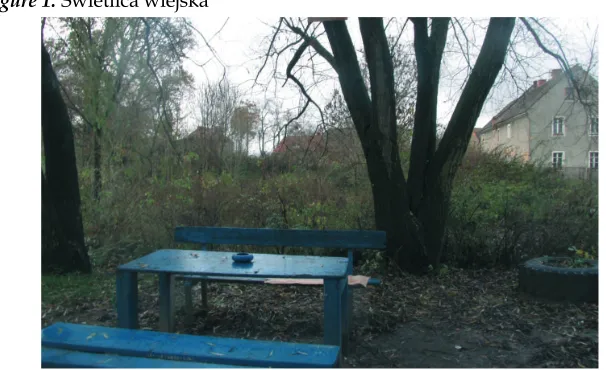
Figure 1.ģwietlica wiejska
Author: Anna Gaęko
Local Cultures and Societies
A group of men are gathering next to the only shop in the small village – one of many like this in Polish Lower-Silesia. The shop is set in the very centre of the village. From there they can have a view on the historical, partly devastated former German park and hardly visible ruins of the palace. Next to it one can see a small pond and comparatively big buildings which are a part of a former state collective farm. Men are sitting around a wooden, blue, painted table prepared specially for such occasions. Over their heads there’s a sign saying: “Ĥwietlica wiejska” (village club room). It’s a common place for informal and semi-formal meetings in the village and it’s a place where I intui-tively started my Þ eldwork some time ago. That was a place of my Þ rst inter-views and as I quickly realised some kind of meeting and information spot for inhabitants. It is impossible to visit a village and miss the site, as well as to be there and not to be noticed.
The men are drinking beer, talking loudly, laughing and japing out loud. I don’t know them and I don’t really want to talk to them at this very moment. I was Þ nishing my Þ eldwork – I’ve been coming there for the last three years to collect interviews and now I’m trying to put in the order the gathered informa-tion. I don’t really want new material – my ethnographic curiosity is in crisis now. I have a feeling that I did enough: I have made several interviews, col-lected material that seems to be redundant – stories and motives are repeatable and predictable. I have spent my last months away from here, listening to the recordings, making transcriptions, organizing gathered material. I don’t really want new interviews because I don’t expect to hear anything new. Especially from the group of giggly men.
They saw me – it’s a small village and everybody knows each other. You can easily recognize a stranger. They’re accosting me and I have got no choice – I reply with some little quip and come closer. Otherwise it would be discour-teous, which I obviously do not want. We start to talk. Even though I do not recognise any of their faces after a while I start to recognise their voices. I talked to them before – I can remember a story about a wife of the elderly man on my right, I know that the other man knows a lot about local history, another one some time ago helped me a lot with interviews here. It took me a moment to realise that in fact I know all of them. However not their faces – as it usually is – were crucial for me to identify them but their voices. I spend much more time listening to the recorded interviews than actually talking to them. Not their faces but the sound of their voices became for me a means of recognition and identiÞ cation.
Journal of Education Culture and Society No. 2_2018
biographic oral story. The main method of my research, as mentioned, were recorded interviews – all of them had the form of unhampered conversations. I didn’t have any list of questions I wanted to ask – just some main topics that interested me. Of course aside from recordings I was also making my Þ eld-notes including Þ rst observations, information about people I talked to, so that I would not confuse them after (as it obviously happened in the opening story), some recommendations, maps and drawings. But I never treated them – recordings and notes - as a substitute for my ethnographic experience. It was rather supposed to be a mark of it – some kind of product, epiphenomenon helping my memory when the Þ eldwork is over. But as the story above simply shows its role is much more important than being a support for my memory it also plays a signiÞ cant role in building ethnographic experience. Thus, it not only recalls but also in some way creates it.
The opening story shows in fact indissoluble combination of two factors shaping an ethnographic experience: physical and textual. The Þ rst one in the broadest sense is connected with sensual perception and physical being of the researcher – her participating in the Þ eld as well as bodily-grounded ways of understanding surrounding her environment. The second one is related to writ-ing, recognising Þ eldwork experience in text: organising and conceptualising it. It seems that to identify and differentiate those two factors is a trivial task: being in the Þ eld during the research is physical, the result of it – writing – is textual. However, the story presented above is an apparent evidence that this matter is not so simple as it seems in the beginning. Physical – textual relation cannot be separated so easily, they seem to inß uence each other in every stage of research experience.
One of the main and frequently raised problems appears when it comes to translating multifaceted Þ eldwork data into text fulÞ lling requirements of aca-demic discourse. Fieldwork experience, including that based on interviews, is much more than what can be written or recorded as well as a real conversation is more than just words. The foregoing story happened when I was about to Þ nish the project. I had not visited the village for months and I was supposed to start the writing process of my thesis based on that research and I was facing the problem: how to capture multifaceted ethnographic experience in an aca-demic written text? The problem might seem insigniÞ cant if construction of narratives is concerned. But even a narrative – especially an oral narrative – cannot be concerned without context of its origin.
If we consider the problem of an experience-text translation only as a matter of transforming non-textual experience into written form it is in fact trivialising the issue. In such approach materials collected during the research are some-thing done, Þ nished and given, whereas as such it is only the product of the whole experience – not experience itself, just the Þ nal part of it. The incomplete initial process that is commonly disregarded in the writing phase is crucial to understand the product because it is a constituent part of it.
Local Cultures and Societies
questions by the researcher and replying by the interlocutor. It is the Þ eld of negotiation. The interlocutor is not simply replying to asked questions, and also the researcher is not just asking questions she prepared. They both keep in their minds a whole spectrum of possibilities and when telling a simple story or asking simple question they are simultaneously deciding what kind of code they should use. In fact in simple conversation – as well as in the interview – there are not only two actors. It is necessary to take into consideration also participants’ conversational projections of themselves and of each other. In fact there is not only a researcher and interlocutor but also their expectations and assumptions: what the researcher thinks of herself (what she considers as truth about her) (1), how the researcher wants to present – how she wants to be perceived by her interlocutor (2), what is, according to her, the interlocutor’s opinion about her (what does she think that he thinks about her) (3), what he really thinks about her (4). The same possibilities can be indicated in relation to the other side of conversation: what the interlocutor thinks of himself (5), how he wants to be perceived (6), how he thinks he is perceived (7), what the researcher thinks in fact about him (8).
Such possibilities multiply when more than two people participate in the conversation. On the other hand, in most cases some of them must be identical. Otherwise any communication would be possible. These 8 levels of commu-nicational attitude is a set of possible roles that can be chosen to play created in account of mixture assumptions and expectations. Each of them can wield inß uence on the whole interaction and each of them is partly grounded beyond this particular conversational situation.
What is more none of them is attributed from the beginning to the end. Just like interlocutors are changing their roles giving replicas they also can change their attitude during the conversation. ConÞ guration is changing dynamically – sometimes if it is possible to attach some of the foregoing attitudes, it is just for a second. It can be seen as some kind of game between interlocutors. Not every role (character) is accessible for everyone. For me it used to be problem-atic to sidestep the role of a ‘nice student’. Because of that it happened that my serious questions were not taken seriously. That was the role that I was usually given, probably because of my young age and an informal appearance. But in the very beginning of every interview I had to choose the role I wanted to intro-duce as mine. There are many more possibilities than those presented in pop-ular texts considering ethnographic methodology (Hammersley & Atkinson, 2005). Sometimes my interlocutors were doing or saying things they expected I wanted to hear so that they could count on something from my side. This choosing, changing and adjusting roles and attitudes very often reminds us of the situation characterised in transactional theory (Berne, 1964).
Journal of Education Culture and Society No. 2_2018
manifest not only in material, tangible objects, but also in the some kind of reservoir of knowledge that is, or should be, accessible for all participants of the situation. It can be easily recognised as context, however it is much more than indirect conditions of conversation. Such context should include previ-ous stories that could inß uence presented statements. What is a simple, but very important fact in here – any of the statement is isolated, in fact each of them is a part of a never ending communication chain, to remind one of the most famous of Bachtin’s theories (Bachtin, 1986). Every statement is pre-ceded by numerous previous statements having impact on its shape, simul-taneously an actual statement can be the factor of setting the others. Each of the conversation participants is under the inß uence of his or her own com-municational background.
Being a part of that chain means not only some themes or motives pro-vided but also some modes of constructing the story and validating them. Harald Welzer argues that even biographical stories need a frame that is based on elements derived from stories heard or seen before (Welzer, 2009). In the researcher’s case that communicational background is based also on her previ-ous Þ eldwork experience – she learns to follow actors and events that can be found beyond visible material data by recognising “ethnographical events” in different Þ elds (Rakowski, 2018, p.17).
Individual approach, knowledge and story of both: researcher and interloc-utor, based on their generally taken experience, their interaction set in particu-lar surrounding, human, non-human, non-material actors – all these factors taken together are a kind of a labyrinth which the researcher needs to move in skilfully to understand what is happening around her.
The interview itself seen as a sequence of statements that can be transcribed is just a product of such multifaceted actions taken by all participants – its effect. Recording or any other kind of documentation is a reß ection of that product – some kind of semi-Þ nal state being the result of multiple simultane-ous processes. Although such – transcribed – conversation cannot be properly understood without those various factors creating it. One of the most impor-tant researcher tasks is to evolve an ability to aim her attentiveness at that ele-ments of her experience that are important and meaningful – evolve the ability to recognise and understand them (Rakowski, 2016). Such a process cannot be held in a different kind of way than being and participating in a Þ eld that is a matter of interest regardless of whether it is a place, event or community.
Local Cultures and Societies
The ability to recognise and understand phenomena perceived during the research does not have textual character. It gains its Þ rst para-textual shape in fragmentary Þ eldnotes that usually are some groups of impressions, unstruc-tured observations, possible conclusions and operational hypothesis. Such Þ eldnotes – commonly having a form of headnotes - are not the text yet. They do not have coherent structure and do not have a form of logical, linear dis-course. They are just a base to be used when the proper text is written.
Though their role is ambivalent already. On the one hand, they might be initial form of Þ eldwork experience conceptualisation. On the other hand, they are still part of that experience – they cannot be understood without the experi-ence which gives them necessary context.
What is more, Þ eldnotes (as well as recordings or photographs) are not simple reß ections of the Þ eldwork experience, as well as an academic essay is not a simple orderliness of a chaotic research material. They all are qualita-tively different. That is why Geertz’s thick description fails as a method of pre-senting Þ eldwork experience. According to Samudra’s “thick participation” (Samudra, 2008), Tomasz Rakowski proposes treating ethnographic research as a speciÞ c form of activity that can be seen as some kind of piece (by analogy of written text). In that case, this piece is some unwritten story of understand-ing, which can be recognised as a way of shaping what will Þ nally be written (Rakowski, 2018, p. 18).
Form of written text, especially the one fulÞ lling the conditions of an aca-demic discourse cannot Þ t the whole variety of experience and founded on its competence described above. Such form is a frame – it cannot contain anything that cannot be expressed by written language. Which means that it extracts the possibility to linguistically express part of an experience but by the same token rejecting or receding the rest of it. Thus putting ethnographic knowledge into this form must be connected with both an act of rejection of crucial parts of it and re-establishing it in a way possible to intersubjectively articulate. Para-digma of Writing Culture (Clifford & Marcus, 1986) indicated creating written representations of cultural realities as a literary-like practice. What is crucial in the perspective of the matter of this articles’ consideration is the fact that the researcher can never be excluded: as author in the stage of writing text, nor as a participant in the stage of creating the ethnographic Þ eld. She is never just an observer or collector and the Þ eld is never just waiting ready to tell.
Both researchers’ positions characterised above: pretextual – ability of understanding based on ethnographical experience built on participation and textual – consisting of writing, setting experience in the discourse, are only ostensibly disjunctive. In fact they stay in a bidirectional relation. One of them is obvious: pretextual experience establishes content of written text. More interesting is the second direction of that relation. It is especially apparent if research related to a narrative is concerned.
Journal of Education Culture and Society No. 2_2018
her task from the very beginning – she knows that her aim is not only partici-pate, recognise and understand, but also present it in a written form. Actually in an academic context only the former – as proof of the rest – is required. That means that the mode of attentiveness always assumes textual form. Even the term “pretextual ethnography” indicates primacy of written language over any other form of expression or communication.
In this perspective the Þ eld (in a way that it is supposed to be described in a text) is constituted in a process of the researcher’s cognition. Just like the Kantian aesthetic object (sensually perceived) it depends on the one who per-ceives it and her perceptive abilities (Kant, 2014). The researcher whose aim is to prepare a written report draws his attention in text-oriented manner.
Tomasz Rakowski when pointing out the researcher’s speciÞ c ability of discerning important issues among various elements of Þ eldwork experience presents it as a researcher’s acquisition of forming his attention as responsive to the Þ eld (Rakowski, 2016). Likewise Grzegorz Godlewski distinguishes two strategies in conducting a research: strategy of telescope and strategy of radar (Godlewski, 2016). The second one in contrary to the Þ rst doesn’t assume the theory – conditioning terms and methods – in the beginning of the work. It bases on posing general questions by the researcher and her attitude kept open for what might appear during her work.
The main point of both ideas described above is the researcher’s attention obeying Þ eldwork data – her ability to focus on what is important during the research. But it’s impossible to ignore the fact that there are also another aspects important for the researcher during the work – those connected with organis-ing its results into a written text. The researcher must be able to recognize what is important from the perspective of the explored issue as well as she must be capable of understanding it and presenting it in an academic context.
Which of those two aspects inß uences researcher’s attention during the Þ eldwork? Undoubtedly the Þ rst one. However, not solely. The text – the medium chosen to conceptualise Þ eldwork experience and modes of under-standing based on it cannot be neglected.
Researcher’s Þ eldwork participation is marked by awareness of the latter textualisation. Making recordings, taking photographs, notes collected not only for the researcher herself but also, or even mostly, as the basis for the written report. It means that observations are linguistically conceptualised and as such can be referred. Interviews are recorded so that they can be transcribed. Photos are taken to be explained. The role of such media is in fact paradoxical in this situation. The researcher uses it to make them textualised in the Þ nal form, but simultaneously to enable her to participate more freely without focusing on making notes and without being afraid of missing the most important facts. At the same time this free participation is overshadowed and somehow shaped by modes of attention by this medium.
Local Cultures and Societies
is impossible to avoid such procedures like data selection and organisation, generalisation, creating models, formulating laws, predicting processes that distinguish science from other modes of cognition. Main source of these pro-cedures is literacy, including textual approach (Godlewski, 2018, p. 67). How-ever, my point is that the inß uence of textual approach begins much earlier – it inß uences also researcher’s sensual perception, her physical participation in the Þ eld and her ethnographical double.
This is something that happened to me, when I realised that what I remem-bered most from the interviews were mostly stories and voices, something used when transcribing experience into text – excluding other factors like appearances.
Two factors of Þ eldwork experience: physical and textual cannot be opposed to each other. Researcher’s physical participation and knowledge based on Þ eldwork experience is necessary for writing text – it reaches much further than her presence in the Þ eld as well as textual impact begins much earlier than during the writing phase. This bidirectional relation rather than opposition is in fact indissoluble combination of two factors, which are always both present, even if in unequal proportion.
Jack Goody conducting research in northern Ghana brings out what changed in his ethnographic practise when he started to use the portable audio recorder (Goody, 2010). The Þ rst consequence was latitude mentioned above – he did not have to take notes and could focus on things going on around him. The second consequence was much more interesting: it enabled him to com-pare recordings. This simple fact become crucial for reß exion on ethnographic experience and its interpretation because it shows the distance the researcher can have from her own work. There is nothing overwhelming if only collected material and written report is concerned. But it’s much more important when it is applied to the experience itself. Thanks to that distance the researcher can later take under consideration her own role and presence in collected material and interpret it using pretextual knowledge. It this way she actually can divide herself in two persons: participant and researcher. This division takes place only at some meta-level, because being a participant she never stops being a researcher and being a researcher writing text she cannot forget being a partici-pant which gives her ability to understand and make a translation into linguis-tic form, which leads also to the ethical dimension of the whole process.
Journal of Education Culture and Society No. 2_2018
time data collected merely in recordings and notes were insufÞ cient to under-stand and explain my Þ eldwork-based knowledge, even though the main topic of that research was related to narratives – exclusively to what is told.
References
1. Amit, V. (2000). Introduction: Constructing the Field. In: V. Amit (ed.), Constructing the Field: Ethnographic Fieldwork in the Contemporary World. London: Routledge.
2. Bachtin, M. (1986). Speech Genres and Other Late Essays. Austin Tx: University of Texas Press.
3. Berne, E. (1964). Games people play. The psychology of Human Relationships. New York: Grove Press.
4. Clifford, J., & Marcus, G. (1986). Writing culture. The Poetics and Politics of Ethnography. Berke-ley-Los Angeles-London: University of California Press.
5. Godlewski, G. (2016). Luneta i radar. Szkice z antropologicznej teorii kultury [Telescope and radar. Studies of anthropological theory of culture]. Warszawa: Wydawnictwo UW.
6. Godlewski, G. (2018). Poza nachylenie tekstowe, w stronč doĤwiadczenia przedtekstowego. Wskazówki terapeutyczne [Beyond the Textual Bias, Towards Pretextual Experience: Thera-peutic Guidelines]. Teksty drugie2018 (1), 61-78.
7. Goody, J. (2010). Myth, Ritual and the Oral. Cambridge: Cambridge University Press.
8. Hammersley, M., & Atkinson P. (2005). Ethnography. Principles in practice. New York: Routledge. 9. Kant, I. (1914). Critique of Judgment. London: Macmillan.
10. Latour, B. (2007). Reassembling the Social - An Introduction to Actot-Network Theory. Oxford: Oxford University Press.
11. Rakowski, T. (2018). EtnograÞ a przedtekstowa. Fenomenologiczne korzenie interpretacji antropologicznej [Pretextual Ethnography: The Phenomenological Roots of Anthropological Interpretation]. Teksty drugie2018 (1), 16-39.
12. Rakowski, T. (2016). Hunters, Gatherers, and Practitioners of Powerlessness. An Ethnography of the Degraded in Postsocialist Poland. Oxford: Berghahn Books.
13. Samudra, J. K. (2008). Memory in our Body: Thick Participation and the translation of Kines-thetic Experience. American Ethnologist, 35 (4), 665-681.