GSJ: Volume 7, Issue 6
, June 2019, Online: ISSN 2320-9186
www.globalscientificjournal.com
L
ITERATURE
R
EVIEW OF
I
MPORTANCE OF
K
NOWLEDGE
M
ANAGEMENT TO
D
EVELOPING
N
ATIONS
DMJ Wickramasinghe
Faculty of Management Studies, Rajarata University of Sri Lanka, Mihintale, Sri Lanka
Abstract: Knowledge is very important for the economic growth of the country, develop meaningful relation between the industries and find new technologies by creating new ideas and formulating new theories. Developed countries use knowledge management for their educational development, economic development, health development, technology development and etc. Second category of nation is developing nations. A nations which have average income is much lower than in industrial nations. In this paper discussed how importance of knowledge Management to developing country.
Key words: Knowledge Management, importance, developing country
I. INTRODUCTION
In this developing world, the creation, accumulation and strategic use of knowledge will play a big role for survival, development and advancement in their economics and other. Knowledge Management involves people who create, carry, manipulate and use knowledge for the country development. (Malhan & Gulati, 2003) The Knowledge related activities are important for the economic development country. This knowledge is imparted by the all over the universities and this will process by all over the organizations. Finally knowledge will used by the society. Knowledge is nothing unless it is processed into an operation. Knowledge is very important for the economic growth of the country, develop meaningful relation between the industries and find new technologies by creating new ideas and formulating new theories.
In the rapidly changing world, human being are likely to become fastest and efficient as machines, therefore, they try to upgraded with new knowledge and skills through continuing education and training. Knowledge workers are supported to continuously innovate and improve new technologies and strategies. Lots of organizations are keep to adopt Knowledge Management strategies to achieve these advantages in developed countries such as Japan, US and EU decades ago. Knowledge Management applications within these countries have reached a mature level but, Knowledge Management implementations within developing countries are still at an early stage. (Peng, Li-HUa, & Moffett, 2007) Developed countries use knowledge management for their educational development, economic development, health development, technology development and etc.
1.1. DEVELOPING NATION
government (Rosenberg, 2017). Therefore there is a different between nation, country and state. There are 195 countries in the world today and from that 193 countries that are member states of the United Nations and 2 countries that are non-member (Rosenberg, 2017). Now we can categories nations in to two categories. Those are developing nations and developed nations. Developed nations means, countries with a highly developed economy, advanced industrial activity and infrastructure and a relatively low poverty rate (Kuepper, 2017). The United States of America, Canada, the United Kingdom, Germany, Japan, Italy and France are major developed counties and named those countries as Group of Seven. Second category of nation is developing nations. A nations which have average income is much lower than in industrial nations.
As a key different between developed and developing nations, is deemed to be developing or developed mainly on the basis of economics, per capital income, industrialization, literacy rate, living standards, etc. Such as developed nations has a highly developed economy and advanced technologies infrastructure than developing countries. Each other countries is running in a fast race to make its ration one of the most developed country in the world. As an example China, Japan and Korea are Asian nations but they are seen to lead the other nations in Asia. There are lots of reasons for some nations are developed, those are higher industrial productivity, Technical aspects, less population, efficient labor, higher education levels, active participation of citizens in improving their lot, stable government in power, effective laws (Shukla, 2009) and proper knowledge management. (Okunoye, Innola, & Karsten)
1.2. ISSUES OF DEVELOPING NATIONS
The ongoing process of globalization and liberalization along with the information technology revolution offers amazing opportunities but several challenging situations for developing countries. Many Developing countries are still grappling with the problems of providing access to education, health services, Economy, Technology, communication and political. The people in developing countries face linguistic, technological, attitudinal, social economic and geographical problems in having access to relevant knowledge. Many people with physical disabilities, low income, few educational qualifications or literacy levels, the unemployed older
people and those people living in rural areas usually have no access to ICT.
As technology issues we can identified lack of Budget to technology solutions, lack of hardware, lack of bandwidth and lack of IT literacy. In developing nations doesn’t allocate much of money for develop country technology issues from their budget. Because of that reason developing nations doesn’t have much of hardware and other equipment for develop their technology solutions. Agriculture and natural resource, manufacturing, engineering and construction issues, service issues, intellectual; activities involving education and research, high level decision makers in government are issues under Economy of developing nations. Identified some issues under education in developing nations, lack of agreement within and between developing countries about the content, structure and length of initial teacher training and the continuing professional development of teachers and the direction, quality and value of research and development in education is increasingly questioned.
Poor support by the authorities, the need to develop information technology solutions, lesser number of publications by professional working in health institutions, lack of technology involvement in Health Sector and lack of funding to develop IT infrastructure in Health sectors are issues in Health Services in developing nations. Now Communication is the major part of all over the world. Communication need to foster meaningful dialogue among different sectors of society, nurture a shared vision for the country’s future and support to learning, capability building and action. When countries have issues like lack of technology, lack of Knowledge sharing, lack of inefficient transfer of knowledge, lack of source familiarity or creditability, differences in meaning between sender and receiver, lack of common ground and biased language in communication it will mess up the development of the nations.
and avoid making similar mistake over and over again to obtain higher efficiency and effectiveness.
II. KNOWLEDGE MANAGEMENT
2.1. KNOWLEDGE
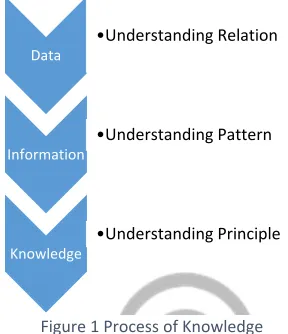
Before define Knowledge management, it is necessary to define knowledge. In oxford living dictionary defined knowledge is facts, information and skills acquired through experience or education; the theoretical or practical understanding of a subject. Relations existing between data and other relations
are capable to represent such data in the form of organized information. Patterns of relations of data and information and other patterns have the capacity to represent knowledge. (Wajidi & Asim, 2009)
2.2. CLASSIFICATION OF KNOWLEDGE
Two types of knowledge are usually defined, namely explicit and tacit knowledge. The former refer to codified knowledge, such as that found in documents, while the latter refers to non-codified and often personal/experience based knowledge. Explicit knowledge can be expressed in words and numbers and shared in the form of data, scientific formula and universal principles. Using a systematic and formal way, such knowledge can be communicated among the individuals. When knowledge is implicit, then it cannot be shared with others. (Wajidi & Asim, 2009) Tacit Knowledge is understanding, capabilities, skills and the experiences of individuals; often expressed in human actions in the form of thoughts, point of view, evaluation and advice; generated and acquired through past experiences, individuals and repositories. (Pathirage, Amaratunga, & Haigh, 2008)
2.3. KNOWLEDGE MANAGEMENT
(Grayson) defined Knowledge Management (KM) as a collection of systematic approaches to help information and knowledge flow to and between the right people at the right time. Because of that they can act more efficiently and effectively to create values. (Davenport, 1998) mentioned that KM is the process of capturing, distributing and effectively using Knowledge. Therefore finally we can define KM is the systematic management that knowledge assets for the purpose of creating value and meeting tactical and strategic requirements with initiatives, processes, strategies and systems that sustain and enhance the storage, assessment, sharing and creation of knowledge. Therefore KM implies a strong tie to national goals and strategy. Same as KM involves the management of knowledge that is useful for some purpose and which create values for nation.
The concept of KM was connect to companies and their operations. Today KM is considered a discipline which was created for the purpose of increasing the business performance of a company and Knowledge Management is just not another resource like labor, capital, but is the only important resource today. KM use for some operations such as Marketing, Business Globalizations, for increase competition level, Change technologies, for innovations, increase complexity of managerial surrounding and etc ( Lovreković & Sad, 2013).
2.4. KNOWLEDGE MANAGEMENT PROCESSES
KM is the planning, organizing, motivating and controlling of people, processes and systems in the organization to ensure that its knowledge related assets are improved and effectively employed. The processes of KM involve knowledge acquisition, creation, refinement, storage, transfer, sharing and utilization (King, 2009). (Igbinovia & Ikenwe, 2016) state that the processes of KM with Knowledge Acquisition and generation, Knowledge chapter, knowledge organization, knowledge storage, knowledge sharing and knowledge application and the goal of every KM processes is to create new knowledge and manage the old. The SECI model is a well-known conceptual model that first proposed by Nonaka and Takeuchi in 1995. It describe how explicit and tacit knowledge is generated, transferred and recreated. (Gourlay, 2003) The SECI model consists of four models of knowledge conversion.
Data
•Understanding Relation
Information
•Understanding Pattern
Knowledge
•Understanding Principle
Those are Socialization, externalization, combination and internalization.
Source: Kimiz Dalkir, (-). Knowledge management in theory and practice. 02. TMP. Cambridge. ISBN: 9780262015080.
2.5. WHY KM
KM has gained currency in recent times due to a wide variety of reasons. In marketing field, it is changing very speedily. Lots of organizations are required to differentiate their products in faster and lowest possible cost. Same as people try to make competition in the market with reducing their manpower. And organizations use new technologies and information management system with innovation and cultural change. Enable and encourage the sharing of ideas, collaboration and access to the latest information. KM enables individual to simulate innovation and the cultural changes needed to evolve the organizations. To do these things they have to manage their Knowledge effectively and efficiently. (Suresh; Colombi, 2016)
KM makes it easier to find the information or the people who hold the information we need. It increases efficiency and productivity and allows us to work better. KM help to people improve decision making processes. People can improve the quality and speed of decision making by accessing the knowledge of the entire organization when they need it (Colombi, 2016).
III. IMPORTANCE OF KNOWLEDGE MANAGEMENT TO DEVELOPING NATIONS
Current situation in the developing countries with managing of individual, organizational and social knowledge in their own countries. Many developing countries are still grappling with the problems of provide education, health services and drinking water facilities and same as Lots of peoples in developing countries is not use Information technology effectively. Therefore, they are not get much attention for Knowledge Management.
The Internet plays a huge role in KM activities, provides access to the worldwide wealth of information and also enables local information to be made available globally. (Malhan & Gulati, 2003) But in developing countries doesn’t have faster networks, higher level machines, more complex
software and more capable professionals for grow technologies. Peoples in the developing countries face lots of problems to access to relevant knowledge. Those problems are physical disabilities, low income, education qualifications and unemployed. And same as lots of peoples live in rural areas that not have ICT facilities. Therefore they cannot get knowledge about ICT and other new technologies (Malhan & Gulati, 2003). Therefore KM has a highly negative impact on nation performance with ICT. But Knowledge Management could contribute considerably to county effectiveness and efficiency with to minimize the knowledge gap between the every sector of the economy, stimulating economic growth ensuring with economic stability, to get an informed decision making across the knowledge community and avoid making similar mistakes over and over again to obtain higher efficiency and effectiveness.
When Countries using Knowledge Management practices, they can decrease gap between higher and lower educated people, maintaining of similar acquisition power to information that mean equality to acquire information related to laws, rules as well as ethics and social responsibilities. Knowledge Management will helps to minimize gaps between the communication skills and helps to improve sharing of stored information. KM practices can stimulating economic growth with creating knowledge economy through knowledge sharing across the nation equally, skilled workforce is an important foundation of sustainable economic growth. Enforcing to enhace infrastructure management though sharing of information collaboratively to ensure stimulate innovation in managerial context and enabling sustainable and responsible management of natural resources and appropriate responses to climate impacts.
knowledge at the time when it is needed, Reliable knowledge management environment will provide the decision making ground that the countries' needs empowering with more strategic ways and The collaboration brings diverse opinions, large numbers, varied experience required when important decision making in the country.
Next advantage of using knowledge management in developing countries is avoid making similar mistakes over and over again. Allows community to share lessons learned, not only about successes, but also about failures in. Best practices when facing to natural disaster such as 2004 Tsunami effects is the one example. Avoiding duplication of effort saves time and resources, keeps countries’ workforce morale up, and streamlines work, this will increases of efficiency enables courtiers sustainable growth.
(Slavkovic & Babic, 2013) states that Knowledge management can help nation’s organization strengthen their competitive position in the global market, which can result in reduced unemployment, reduced talent emigration, growth of gross domestic product, and reduction of the foreign trade deficit and improvement of knowledge management practices needs to be implemented at two levels. The first level refers to the companies themselves, which need to define knowledge management strategies and stimulate the development of processes related to knowledge creation, knowledge transfer, and knowledge embedding. The second level relates to the state, which needs to increase its investment in education, technology, and infrastructure, thus strengthening the elements necessary for constituting the knowledge-based economy, parallel with the process of economic transition. In this way additional conditions for the development of the knowledge management concept would be created.
IV. CONCLUSION
Knowledge management is the process of creating, sharing, using and managing the knowledge and information of an organization. It refers to a multidisciplinary approach to achieving organizational objectives by making the best use of knowledge. Two types of knowledge are usually defined, namely explicit and tacit knowledge. Many Developing countries are still grappling with the problems of providing access to education, health services, Economy, Technology, communication and political. The people in developing countries face
linguistic, technological, attitudinal, social economic and geographical problems in having access to relevant knowledge. When Countries using Knowledge Management practices, they can decrease gap between higher and lower educated people, maintaining of similar acquisition power to information that mean equality to acquire information related to laws, rules as well as ethics and social responsibilities and improve decision making processes.
REFERENCES
Bank, W. (2016). World Bank Country and Lending Groups.
Black, H., Garner, B., & McDaniel, B. (1999). Black's law dictionary (Vol. 196). St. Paul, MN: West Group.
Colombi, M. (2016, June 10). Top 5 Reasons Why Knowledge Management is Necessary.
Retrieved from
http://www.broadvision.com/blog/top-5-reasons-knowledge-management-necessary/
Davenport, T. H. (1998, April). Saving IT's Soul: Human Centered Information Management. It's All in our Heads. Inform, 12(08), 119-131.
Davis, H. B. (1967). Nationalism and Socialism: Marxist and Labor Theories of Nationalism to 1917. New York: Monthly Review Press.
Gourlay, S. (2003). The SECI model of knowledge creation: some empirical shortcoming.
Grayson, J. (n.d.). What is Knowledge Management?
APQC. Retrieved from
https://www.apqc.org/what-knowledge-management
Igbinovia, O. M., & Ikenwe, I. J. (2016). Knowledge Management: Processes and Systems. 2nd Annual Conference of Nigerian Library Association. Ebonyi State Chapter.
King, R. W. (2009). Knowledge Management and Organizational Learning. Annals of Information Systems 4. doi:10.1007/978-1-4419-0011-1_1
Lovreković, Z., & Sad, N. (2013). Why Knowledge Management? Online Journal of Applied Knowledge Management, 1(2).
Malhan, I. V., & Gulati, A. (2003). Knowledge Management Problems of Developing Countries, with special reference to India. Information Development, 19(03), 209.
Okunoye, A., Innola, E., & Karsten, H. (n.d.). Benchmarking Knowledge Management in Developing Countries: Case of Research Organizations in Nigeria, The Gambia, and Indi. (p. 3). Turku: Turku Center for Computer Science.
Pathirage, C., Amaratunga, D., & Haigh, R. (2008). The role of tacit knowledge in the construction industry: towards a definition. University of Salford Manchester. Retrieved from
This version is available at: http://usir.salfor d.ac.uk/9814/
Peng, J., Li-HUa, R., & Moffett, S. (2007). Trend of knowledge management in China: challenges and opportunities. Journal of Technology Management in China, 2(3), 198-211.
Rich, B. (2013). environmental impoverishment, and the crisis of development. Mortgaging the earth: The World Bank. Islank Press.
Rosenberg, M. (2017, October 04). The Difference Between a Country, State and Nation. Defining the Various Entities.
Rosenberg, M. (2017, November 22). The Number of Countries in the World. Retrieved from https://www.thoughtco.com/number-of-countries-in-the-world-1433445
Shukla, A. (2009, September 05). 10 Reasons why some Nations are Rich. Retrieved from http://www.paggu.com/business/world- economy/10-reasons-why-some-nations-are-rich/
Suresh, R. (n.d.). Knowledge management – An
Overview. Retrieved from
http://www.providersedge.com/docs/km_arti cles/km_an_overview.pdf