Original article
Dr Muhammad Ihtesham Khan(Corresponding Author) Assistant Professor
Department of Pathology Khyber Medical College, Peshawar - Pakistan
E-mail: [email protected] Contact: +92 - 335-9545329
Date Received: 18 September, 2018 Date Revised: 10 May, 2019 Date Accepted: 20 May, 2019
PATTERN OF BASIC HEMATOLOGICAL PARAMETERS IN
ACUTE AND CHRONIC LEUKEMIAS
Asif Hussain Munir, Muhammad Ihtesham Khan,
Department of Pathology, Khyber Medical College, Peshawar - Pakistan
ABSTRACT
Objective: To determine pattern of basic hematological parameters in leukemias, thus highlighting their diagnostic significance.
Material and method: This cross sectional descriptive study was done in Khyber Teaching Hospital , from January 2015 to July 2017. Cases of acute and chronic leukemias were included in the study by Non probability purposive sampling technique. Patients whose aspirates were inadequate were excluded from the study. Complete blood counts were done by Sysmex analyzer. CBC findings were recorded and results were drawn . Mean and standard deviation were used for quantitative data, while frequency and percentages were used for qualitative data .
Results: Out of 117 cases of Leukemia, 8 cases were excluded due to inadequacy of their aspirate sample. Remaining 109 cases were included in the study. Mean age of study sample was 49 ± 19 years . Changes in blood counts were as increased TLC (in 52%, 66.6%, 87.5%, and 66.6% cases of ALL, AML,CML and CLL respectively), and low hemoglobin level (in 82%, 97.4%, 87.5%, and 100% cases of ALL, AML, CML and CLL). The platelet count was low (in 88%, 92.3%, and 58% cases of ALL, AML and CLL), but high in CML (in 62.5% cases).
Conclusion: Anemia , raised white cell count and thrombocytopenia is characteristic in all leukemias, except chronic myeloid leukemia where platelet count is raised. Careful study of these parameters give idea about underlying leukemia. Keywords: Blood counts, Acute lymphoid leukemia, Acute myeloid leukemia, Chronic lymphocytic leukemia, Chronic myelogenous leukemia.
This article may be cited as: Munir AH, Khan MI. Pattern of basic hematological parameters in acute and chronic leukemias. J Med Sci 2019; 27: (2) 125-129.
INTRODUCTION
Leukemia is a white blood cell disorder involving the bone marrow 1. It is a malignant disorder of
hema-topoietic tissue that is associated with uncontrolled ab-normal proliferation of malignant white blood cells in the bone marrow 1,2. The malignant white blood cells cause
infiltration of the bone marrow stroma , accumulate there , spill into the circulation , and thus infiltrate other tissues of the body as well 2. The infiltration of the tumour cells
into the bone marrow causes the replacement of other normal hematopoietic cells like erythroid precursor cells and megakaryocytes by abnormal tumour cells referred to as blasts 2. This leads to decreased production of red
blood cells and platelets , manifesting as anemia and thrombocytopenia in patients of leukemia 1,2.
The incidence of leukemia is gradually
increas-ing in Pakistan as reported in several studies 2,3,4,5. In
Northern areas of Pakistan, leukemias are reported to be the second commonest cancer 5. Most cases of
leukemia commonly develop in the male population
3. Acute myeloid leukemia (AML) is common in adults,
while acute lymphoblastic leukemia (ALL) is common in children 3,6,7. Incidence of AML is 3–4 persons per
100,000 individuals8. The median age of diagnosis of
AML is reported to be around 70 years 8,9,10. The world
wide incidence of ALL is about 3 per 100,000 population
6 .The median age of ALL patients in Pakistan is 6 years 11,12 . The incidence of Chronic lymphocytic leukaemia
(CLL) is 1 - 5.5 per 100,000 population worldwide 13.
Leukemias are generally classified into two categories i.e acute leukemias and chronic leukemias 14. The acute
leukemias are then further classified into acute myeloid leukemia (AML) and acute lymphoblastic leukemia (ALL) 14. Chronic leukemias are further subclassified
into chronic lymphocytic leukemia (CLL) and chronic myeloid leukemia (CML) 15.World health organization
(WHO) classified acute leukemias on the basis of im -munophenotypes and cytogenetic studies 15.The WHO
include performing a complete blood count (CBC), pe-ripheral blood film examination ,and review of the bone marrow aspiration 16. More advanced investigations
include flow cytometry analysis and cytogenetic studies
16. Complete blood count is a simple first line test that
is advised by the clinician when suspecting leukemia
17. There are certain basic hematological parameters
in CBC , which include total leukocyte count (TLC), Hemoglobin (Hb) and platelet count . CBC report is almost always abnormal in leukemic patients ,and that too in a specific way . Therefore , the clinician should be aware of the way in which the basic hematological parameters change in leukemias . The pattern of CBC findings in leukemic patients reported in literature is raised white cell count , decreased hemoglobin and a decreased platelet count 17,18. No study has been done
so far to determine the changes in basic hematological parameters in all leukemias collectively in our setup . So the present study was done in order to determine pattern of changes in basic hematological parameters in all leukemias in our population .
MATERIAL AND METHODS
This Cross Sectional Descriptive study was done in Khyber Teaching Hospital , Peshawar, from January 2015 to July 2017. All patients referred to the Pathology department for bone marrow aspiration ,having blasts or atypical cells on blood smear or with suspicion of leukemia on history or examination were included in the study. Patients who were already on chemotherapy for treatment of leukemias and those whose aspirates were inadequate for comment were excluded from the study. Non probability purposive sampling technique was used .The complete blood counts were done by Sysmex hematology analyzer. Normal ranges for TLC, Hb and platelet count taken were 4-11x109/mm3,
11.5-13 gm/d L, and 150-400x109/mm3 respectively 24. Bone
marrow aspirate and biopsy was done in all patients. Samples were obtained from posterior superior iliac spine under local anesthesia. Slides were prepared , stained with Giemsa stain and examined under micro-scope by haematologists. To differentiate AML from ALL, slides were stained with myeloperoxidase stain .The diagnoses of leukemias was made . Variables included age and gender of patients, subtype of leukemia, and basic hematological parameters including hemoglobin level, total leukocyte count, and platelet counts . Data regarding these variables were recorded in proforma , analysed , and the results were drawn accordingly. Mean and standard deviation were used for quantitative data like age, while frequency and percentages were used for qualitative data like gender.
RESULTS
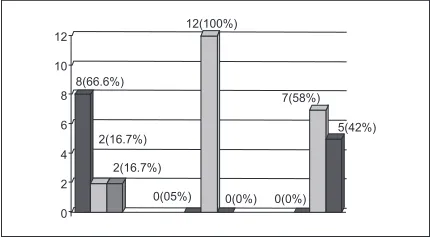
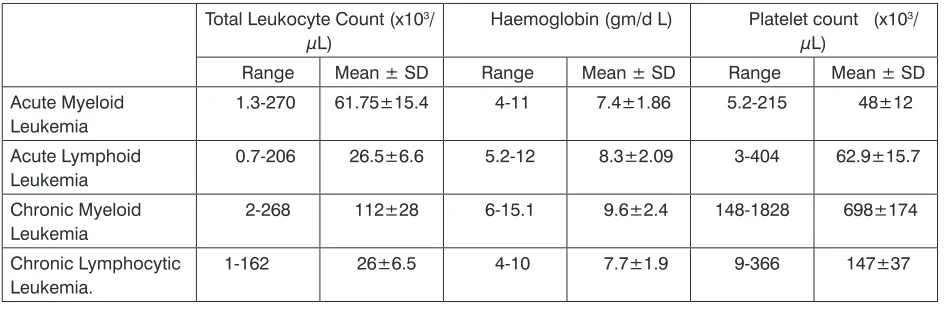
A total of 109 cases of acute and chronic leuke-mias were included in the study. About 61(56%) cases were males and 48(44%) cases were females. Male to female ratio was 1.27 :1. Changes in the hematological parameters in cases of leukemias are shown in Table 1 and figure 1-4.
Fig 1: Pattern of basic hematological parameters in 39 cases of acute myeloid leukemia
Fig 2: Pattern of basic hematological parameters in 50 cases of acute lymphoid leukemia
Fig 3: Pattern of basic hematological parameters in 8 cases of chronic myeloid leukemia
DISCUSSION
Leukemia is a hematological disorder that is prevalent worldwide. Mutations, ionizing radiations , exposure to chemicals like benzene and pesticides and infections are important risk factors for leukemia 19,20. On
the other hand, studies suggest that atopic conditions like allergy, asthma, hay fever, and maternal use of folate are associated with a reduced risk of developing leukemia21,22,23.
CBC is the first test done in patients suspected of having leukemia 17. CBC is the reflection of the chang
-es in the bone marrow caused by the leukemic cells . Findings in the CBC are so characteristic that a good physician can confidently narrow down his differential diagnoses to specific type of leukemia 17.Thus it is
important to recognize the changes in CBC early in order to do further confirmatory tests like bone marrow and flow cytometry 18. Early diagnosis leads to timely
treatment ,which in turn decreases the morbidity and mortality
The changes in the bone marrow due to leukemia are reflected in the CBC 17. Leukemic cells proliferate in
an uncontrolled manner in the bone marrow and replace normal hematopoietic cells 1,2.The excessive abnormal
leukocytes spill in to the peripheral blood , and this is manifested as increased TLC in CBC 17,18. Replacement
of marrow by the malignant cells causes decreased erythropoiesis, which is manifested as anemia or re-duced Hb on CBC 17,18,24. Anemia is a significant finding
in almost all leukemias whether acute or chronic, and has prognostic importance 24,25,26. Thrombocytopenia
or reduced platelet count is either due to bone marrow replacement by the blast cells or splenomegaly 25. It
is common finding in almost all leukemias 25,26. So the
CBC findings in leukemias correspond to underlying pathogenetic mechanism of leukemia. Acute lymphoid leukemia (ALL) is the commonest leukemia of all leu-kemias 17.In the present study ,the basic hematological
parameters in cases of ALL were as raised TLC, low Hb and low platelet (in 52%, 82% and 88% cases of ALL respectively) .This pattern is same as that reported in literature 24,28. Similar findings were reported in another
study done by Naeem S on ALL patiens in 2015 from Lahore ,i.e TLC was raised in 58% cases, Hb was low in 74% cases, but the low platelet count was seen only in 12% cases of all.
Rest of them have normal platelets 28. Similar find
-ings were reported from Iran by Moussavi F in 2014, who reported anemia and thrombocytopenia (in 89.7% cases each) in ALL patients , yet a raised TLC was seen only in 39% cases17. Similar findings were reported from Spain
by Perez JCJ in 2018 18. Thus , the constellation of raised
TLC, low Hb and low platelet count is a diagnostic clue that should prompt a physician to keep Acute leukemia in differential diagnoses and it should not be missed. Many cases of infections may show anemia and raised TLC, but in that case, platelet count is not decreased, as is in acute leukemias. So all the three hematological parameters i.e TLC, Hb , and platelet count should be considered to avoid missing the diagnostic clue.
Chronic myeloid leukemia (CML) is a chronic myeloproliferative disease common in adults 25. The
disease has three phases i.e chronic, accelerated and blast crises 25.In the present study , the changes in the
basic hematological parameters were found to show raised TLC (in 87.5% cases) and a low Hb (in 87.5% cases), just like other leukemias. But the platelet count was found to be raised rather than decreased. Similar findings were seen in a study done by Amer AH in 2017, reporting a raised TLC in total 100% cases of CML, anemia in 92% cases and a raised platelet count in 94.6 % cases of CML 25. Thus in CML , the CBC findings
are anemia , leukocytosis and thrombocytosis (rather than thrombocytopenia). The reason for raised platelet count in CML is that it is a myeloproliferative disorder. So, all the hematopoietic cells are proliferating and so Table 1: Hematological parameters in cases of acute and chronic leukemias (n=109)
Total Leukocyte Count (x103/
µL) Haemoglobin (gm/d L) Platelet count (x10
3/
µL)
Range Mean ± SD Range Mean ± SD Range Mean ± SD Acute Myeloid
Leukemia 1.3-270 61.75±15.4 4-11 7.4±1.86 5.2-215 48±12
Acute Lymphoid
Leukemia 0.7-206 26.5±6.6 5.2-12 8.3±2.09 3-404 62.9±15.7
Chronic Myeloid
Leukemia 2-268 112±28 6-15.1 9.6±2.4 148-1828 698±174
Chronic Lymphocytic
REFERENCES
1. Naeem R, Naeem S, Sharif A, Rafique H, Naveed A. Acute Myeloid leukemia. Professional Med J. 2017;24(09):1302-5.
2. Preethi CR. Clinico-hematological study of acutemy-eloid leukemias. Journal of Clinical and Diagnostic Research: JCDR. 2014;8(4):FC14.
3. Chang F, Shamsi TS, Waryah AM. Clinical and Hematological Profile of Acute Myeloid Leukemia (AML) Patients of Sindh. Journal of Hematology & Thromboembolic Diseases. 2016:4(2):23-9. 4. Rathee R, Vashist M, Kumar A, Singh S. Incidence
of Acute and Chronic forms of Leukemia in Haryana. International Journal of Pharmacy and Pharmaceu-tical Sciences ISSN-0975-1491. 2014;6(2):323-5. 5. Masood A, Masood K, Hussain M, Ali W, Riaz M,
Alauddin Z, et al. Thirty years cancer incidence data for Lahore, Pakistan: trends and patterns 1984-2014. Asian Pacific journal of cancer prevention: APJCP. 2018;19(3):709-17.
6. Grigoropoulos NF, Petter R, Van‘t Veer MB, Scott MA, Follows GA. Leukaemia update. Part 1: diagnosis and management. Bmj. 2013;346:f1660.
7. Zuckerman T, Rowe JM. Pathogenesis and prog-nostication in acute lymphoblastic leukemia. F1000prime reports. 2014;6:59.
8. Almaida M, Ramas F. Acute Myeloid leukemia in older adults. Leuk Res Rep.2016;6:1-7.
9. Juliusson G, Hough R. Leukemia. Prog tumor Res. 2016; 43(2):87-100.
10. Santoyo-Sánchez A, Ramos-Peñafiel CO, Saave-dra-González A, González-Almanza L, Martínez-To-var A, Olarte-Carrillo I, et al. The age and sex frequencies of patients with leukemia seen in two reference centers in the metropolitan area of Mexico City. Gaceta medica de Mexico. 2016;152(2):208-12. 11. Fadoo Z, Nisar I, Yousuf F, Lakhani LS, Ashraf S,
Imam U, et al. Clinical features and induction out-come of childhood acute lymphoblastic leukemia in a lower/middle income population: A multi-institu-tional report from Pakistan. Pediatric blood & cancer. 2015;62(10):1700-8.
12. Yasmeen N, Ashraf S. Childhood acute lymphoblas-tic leukaemia; epidemiology and clinicopathological features. JPMA. 2009;59(3):150-3.
13. Rafiq N, Iqbal T, Shahid M, Muhammad F. Hema-tological and biochemical parameters in Pakistani chronic lymphoblastic leukemia patients. Pak J Life Soc. Sci. (2014):12(1):16-19
14. Sharma M, Sachdeva MU, Bose P, Varma N, Varma S, Marwaha RK, et al. Haematological profile of pa-tients with mixed-phenotype acute leukaemia from a tertiary care centre of north India. The Indian journal of medical research. 2017;145(2):215-21.
15. Canaani J, Beohou E, Labopin M, Socie G, Huynh A, Volin L, et al. Impact of FAB classification on predicting outcome in acute myeloid leukemia, not are the megakaryocytes 25. The raised platelet count
in CML is therefore characteristically different from all other leukemias, where platelet counts is low 25,27. This
specific CBC picture along with clinical sign symptoms act as a diagnostic clue to diagnosis of CML. Clinicians should be aware of this particular finding.
Chronic Lymphocytic Leukemia (CLL) is a malig-nancy of B-lymphocytes 27. Anemia is a common finding
in CLL .It has a prognostic significance as it is asso -ciated with increased morbidity 27. There are multiple
reasons for development of anemia in CLL i.e marrow infiltration , anemia of chronic disease, nutritional defi -ciencies and immune mediated 27. In the present study ,
the prevalence of anemia was very high (in 100% cases) as compared to that 26.7% in study done by Zeeshan , and 15.1% in study done by Dhodhi 27,28.
Salawuet et al from Nigeria reported prevalence of anemia to be 74.4% in CLL patients in their study, which is somewhat close to that in the present study
29.Thrombocytopenia in CLL is a bad prognostic factor27.
In the present study , thrombocytopenia was seen in 58% cases of CLL .This is quite high rate as compared to that reported by Zeeshan in 2015 ,where about 21.7% cases of CLL had thrombocytopenia 27. A lower rate of
18% is reported in a study from Thailand 30.
So , most of patient in our setup present with bad prognostic factors i.e anemia and thrombocytopenia . Both these are markers of advanced disease 27.This
means that our patients have a high disease burden , and this may be due to late presentation to the clinician. So, the changes in the CBC findings can provide a diagnostic clue if tailored to the history, age of the pa-tient , and sign symptoms of the papa-tients17.Anemia and
thrombocytopenia in CLL has a prognostic significance , and hence gives clues about outcome of the disease in patient. Although , further evaluation like bone marrow biopsy and flow cytometry is done anyways to confirm the diagnoses of leukemia, yet the clues on CBC are equally significant and must not be missed.
LIMITATION
of the present study was that data was taken from single tertiary centre. Thus , the results may not be truly representative of whole population in our setup.
CONCLUSION
AUTHOR’S CONTRIBUTION
Following authors have made substantial contributions to the manuscript as under: Munir AH: Discussion, Result Compilation.
Khan MI: Main Author.
Authors agree to be accountable for all aspects of the work in ensuring that questions related to the accuracy or integrity of any part of the work are appropriately investigated and resolved.
CONFLICT OF INTEREST: Authors declare no conflict of interest GRANT SUPPORT AND FINANCIAL DISCLOSURE NIL
otherwise specified, patients undergoing allogeneic stem cell transplantation in CR 1: An analysis of 1690 patients from the acute leukemia working party of EBMT. Am J of hematol. 2017;92(4):344-50. 16. Bedu-Addo GC, Amoako YA, Bates I. The Role of
Bone Marrow Aspirate and Trephine Samples in Haematological Diagnoses in Patients Referred to a Teaching Hospital in Ghana. Ghana Med J.2013;47(2):74-8.
17. Moussavi F, Hosseini SN, Saket S , Derakhshanfar H. The First CBC in Diagnosis of childhood acute lymphoblastic leukemia. Int J Med Invest. 2014; 3(1); 9-12
18. Jaime-Pérez JC, García-Arellano G, Herrera-Garza JL, Marfil-Rivera LJ, Gómez-Almaguer D. Revisiting the complete blood count and clinical findings at diagnosis of childhood acute lymphoblastic leuke-mia: 10-year experience at a single center. Hematol, transfus cell ther. 2019;41(1):57-61.
19. Khan TM. Pattern of Leukaemia Patients Admitted in Ayub Teaching Hospital Abbottabad. J Ayub Med Coll Abbottabad. 2016;28(2):298-301.
20. Bailey HD, Fritschi L, Infante-Rivard C, Glass DC, Miligi L, Dockerty JD, et al. Parental occupational pesticide exposure and the risk of childhood leu-kemia in the offspring: findings from the childhood leukemia international consortium. International journal of cancer. 2014;135(9):2157-72.
21. Zhou Y, Zhang S, Li Z, Zhu J, Bi Y, Bai Y, et al. Ma-ternal benzene exposure during pregnancy and risk of childhood acute lymphoblastic leukemia: a meta-analysis of epidemiologic studies. PloS one. 2014;9(10):e110466.
22. Bailey HD, Fritschi L, Metayer C, Infante-Rivard C, Magnani C, Petridou E, et al. Parental occupational paint exposure and risk of childhood leukemia in the offspring: findings from the Childhood Leukemia
International Consortium. Cancer Causes & Control. 2014;25(10):1351-67.
23. Bailey HD, Metayer C, Milne E, Petridou ET, Infan-te-Rivard C, Spector LG, et al. Home paint expo-sures and risk of childhood acute lymphoblastic leukemia: findings from the Childhood Leukemia International Consortium. Cancer Causes & Control. 2015;26(9):1257-70.
24. Inoue S, Sah J, Onwuzurike N. A rapid increase in the normal white cell counts without blasts as the initial presentation of T-cell acute lymphoblastic leukaemia. Case Reports. 2013;2013:bcr2013200116.
25. Amer AH, Kumar N, Thakkar M. Changes in the Basic Haematological Parameters in Chronic Leukemia Patient (Myeloid and Lymphoid). IJIR.2017;3(7).728-34.
26. Naeem S, Bukhari MH. Antigen expression on blast cells and hematological parameters at presentation in acute lymphoblastic leukemia patients. J Coll Physicians Surg Pak. 2015;25(6):407-11.
27. Zeeshan R, Sultan S, Irfan SM, Kakar J, Hameed MA. Clinico-hematological profile of patients with B-chronic lymphoid leukemia in Pakistan. Asian Pac J Cancer Prev. 2015;16(2):793-6.
28. Dodhy MA, Zafar H, Aslam W. Chronic lymphocytic leukemia: an experience of a decade at a tertiary care hospital. Ann Pak Inst Med Sci. 2011;7(1):196-9. 29. Salawu L, Bolarinwa R, Durosinmi M. Chronic
lym-phocytic leukaemia: a-twenty-years experience and problems in Ile-Ife, South-Western Nigeria. African health sciences. 2010;10(2):187-92.