ISSN 2320-9186
GSJ© 2019 www.globalscientificjournal.com
GSJ: Volume 7, Issue 5, May 2019, Online: ISSN 2320-9186
www.globalscientificjournal.com
T
HE EFFECTIVENESS OF EMPLOYEE TRAINING AND DEVELOPMENT
PRO-GRAMS OF KITEX LTD
,
A
LUVA
By:- Aparna Anib
A
parna Anib, Final year M.com [finance and systems], Department of Commerce and Management,Amrita Vishwa Vidyapeetham, Amrita School of Arts and Science, Old NH17,
Edappally North, Amrita Nagar, Brahmasthanam, Kochi,
Kerala 682024.
KeyWords
Key words: Training , Job, Skills, Job, Task, New skills, training and development
programs.
ABSTRACT
Training is the process of increasing the knowledge and skills for doing a particular job. It is an organized procedure by which people learn knowledge and skill for a definite purpose. The purpose of training is basically to bridge the gap between job re-quirements and present competence of an employee. Training is aimed at improving the behaviour and performance of a per-son. It is a never ending or a continuous process. The study is an analysis on the Training and development program followed at Kitex Ltd and is carried out by interviewing 100 employees of Kitex Ltd. The main objectives of my study is to Find the effec-tiveness of employee training and development programs of Kitex Ltd. Training programs main objective is to improve the productivity of the company’s employees which in turn will improve the company’s profitability. Through training, the em-ployee skill levels are upgraded which will make the employees more productive. When an employee gets promoted from one level to next level, the skills required to do his/her job changes and training is essential in equipping the employee with the
ISSN 2320-9186
GSJ© 2019 www.globalscientificjournal.com
INTRODUCTION
A social unit of people that is structured to meet a need or to pursue collective goals. All organizations have a management structure that determines relationship between the different activities and the members and subdivides the assigns role, re-sponsibilities and authority to carry out different tasks. Organizations are open systems they affect and are affected by their environment.
Training and development is the field concerned with the organizational activities aimed at bettering the performance of indi-viduals and groups in organizational settings. It has been known by several names, including employee development, human resource development, and learning and development. Training and development ensures randomness in organizational set-ting is reduced , and learning or behavioral change take place in structured format.
An organization is set up with the purpose of achieving certain objectives. These objectives can be achieved only when organi-zation is utilizing its resource in the best possible manner. Most important asset of any organiorgani-zation is human resource. This is possible only through effective utilization of the human resource potential. The success of the organization depends on the quality and work effort of the personnel. Proper attention should be given to the people through recognition of their talents and development of their potential. Hence, training and development has become an important function of Human Resource Management.
Hence, training and development is vital as it contributes to the efficiency of the organization and improves the performance and prospects of employees. Assessing how far the training program has been worth while is the bottom-line of Human Re-source Development operations. Training evaluation is done to provide quality control over the design and delivery of training activities.
STATEMENT OF THE PROBLEM
Management development is aimed at preparing employees for future job with the organization or at solving organization wide problems concerning, acquiring or sharpening capabilities required performing various tasks and functions associated with their present or expected future roles. The motive behind this study is to understand and learn the impact of training and development programs on the employees of Kitex Ltd. training cannot be measured directly but the change in attitude and be-havior that occurs as a result of training. So employee assessment should be done training sessions by the management, to know the effectiveness of training given to the employees.
SIGNIFICANCE OF THE STUDY
The development of any organization depends on its employees. For organizational productivity training and development as-sumes great significance. Training aims at increasing the knowledge and skills of the employees whereas organizational devel-opment on the other hand refers to overall improvement of the organization such as its structure , objectives , policies and pro-cedures including managers and employees organizational development can be achieved by hiring the services of the profes-sionals and consultants. Training and development programs are often viewed as part of organizational development.
ISSN 2320-9186
GSJ© 2019 www.globalscientificjournal.com
OBJECTIVES OF THE STUDY
• Primary objective
To study the effectiveness of employee training and development programs of Kitex Ltd. , Kizhakkambalam , Aluva , Ernakulam Dist.
• Secondary objective
To study the employees perception towards training and development program.
To find out whether the training program help to increase productivity of Kitex Ltd.
STATEMENT OF HYPOTHESIS
1. There is no association between gender and satisfaction from training programs 2. There is no association between age and satisfaction from working environment
3. There is no significant relationship between educational qualifications and satisfaction in present salary
4. There is no significant relationship between educational qualification and improving productivity and quality from learning 5. There is no significant relationship between gender and performance after training
RESEARCH METHODOLOGY
Sampling Technique
The sampling technique used here is convenience sampling. The reason being, data collected from all of the employees in the company was impossible due to inaccessibility.
Sample Size
The sample size was 100 and the technique used is convenience sampling.
Population
The population for this study are the employees who have undergone the different training programs in Kitex Ltd.
Analysis
The data are presented through charts , Tables, percentage method , ANOVA and Correlation.
Period of study
The study was conducted for 2 months.
Method of data collection
ISSN 2320-9186
GSJ© 2019 www.globalscientificjournal.com
SCOPE OF THE STUDY
• The scope of this project is not too far stretching to the whole of Kitex ,rather it only covers the training activities con-ducted by Kitex for its workers.
• Project mainly deals with the present method of training given at Kitex industries during my tenure of the project Jan-uary- March 2019.
• This project covers training , training programmed and training evaluation excludes all other human resource activi-ties, conducted before and after training.
Apart from that it would provide me a great deal of exposure to interact with the high profile managers of the company.
LIMITATIONS OF THE STUDY
• Inherent limitation of sampling has affected the study.
• Employees hesitated to give information because of fear.
• Findings of the study are based on assumptions that the respondents are true and fair.
• There is no measure to check out whether the information’s are correct or not.
REVIEWOFLITERATURE
• EDWIN .B.FLIPPO ,“TRAINING IS THE ACT OF INCREASING THE KNOWLEDGE AND SKILLS OF AN EMPLOYEE FOR DOING A PARTICULAR JOB.”
• MICHALE .J.JUCIUS,“THE TERM TRAINING IS USED HERE TO INDICATE ONLY PROCESS BY WHICH THE APTITUDES, SKILLS AND ABILITIES OF EMPLOYEES TO
PERFORM SPECIFIC JOBS ARE INCREASED.”
• RICHARD P.CAPHOON,“THE FUNCTION OF TRAINING IS THE PROCESS OF AIDING EMPLOYEES TO GAIN EFFECTIVENESS IN THEIR PRESENT AND FUTURE
WORK.”
• THE NATIONAL INDUSTRIAL CONFERENCE BOARD,“MANAGEMENT OR EXECUTIVE DEVELOPMENT INCLUDES ALL THOSE ACTIVITIES AND PROGRAM
WHICH HAVE SUBSTANTIAL INFLUENCE ON CHANGING THE CAPACITY OF THE INDIVIDUAL TO PERFORM HIS PRESENT ASSIGNMENT BETTER AND IN SO
DO-ING ARE LIKELY TO INCREASE HIS POTENTIAL FOR FUTURE MANAGEMENT ASSIGNMENT.”
• O.Jeff Harris, Jr. Obseeves, “Training of any kind should have as its objective the redirection or improvement of behavior so that the performance of the trainee becomes more useful and productive for himself and for the organization of which he is part/ training normally concentrates on the improvements of either operative skills, interpersonal skills, decision making skills, or a combination of these”.
ISSN 2320-9186
GSJ© 2019 www.globalscientificjournal.com
• Paul Lewis, William .J.Rothwell,Lindamillar,Ahad,Osman-gani (2010). “This article says that ,the effective use of human re-source is seen as a prerequisite , and the training and development of employees as paramount.The growth of training and development as an academic subject reflects its growth in practice.
• Department of psychology and institute of molecular Biology ,University of Oregon , Eugene, OR 97403, and Sackler Institute for Development Psychobiology, Weill Medical collage of Cornell University , New York (2005).“This article test training ef-fects on different age group. They compared with different types of no training (control groups) in 4 years and 6 year old children and attention training (experimental groups).”
• Lane randule crocket California museum of science and industry, California museum foundation, 700 state drive ,los angels, California 90037, USA (2008).“This article identifies useful and feasible methods to meet these needs. Finally, it suggested that informal science learning is understood as a collective entity. Main focus is on learning activities and on methods.”
• L.B.oio and D.A.Olanivan (2008), “This article examines the impact of training and development on the performance of home economics teaching schools important. The study revealed among others that training and development a positive impact on the performance of home economics teachers.”
• Barid, Liayd,Girth Darrel ,Lunderson,John (2003) . “This article focuses on training and development strategies require re-modeling due to globalization and fast moving business. In order to enhance performance with less cost and development certain as peers of business, learning options framework has been identified.”
• Abelgadir.N. Abdel Hafiz Elbadri (2007), “In order to maintain competitiveness in the market, the organization need to adopt the training activities both internal and external. The emphasis accorded to such training activities was examined.30 polish companies were chosen to undertake the study of determining the training needs, development of programs and as-sessing the results. The outcome showed the neglect of ascertaining the need for training by majority companies. The com-panies were lacking in evaluating the outcome properly.”
• S.A. Mufied, Rafai Syed Nasreen(2003), “In this work tried to evaluate the perceptions of managerial as well as the non-managerial about the prevailing training and development program in J&K Tourism Development Corporation. The broad objective had interalia the main thrust on defining the need for training and development. The evaluation of perceived ide-as of employees towards training and development. The reide-asons or the ineffectiveness of the implementation of the Train-ing ad Development system and to design the methodologies to implement the TrainTrain-ing and Development program in a improved manner. The survey related to two sides viz. managerial and non-managerial staff training and development pro-gram should have an essential part to achieve the objective of the organization and its effectiveness.”
ISSN 2320-9186
GSJ© 2019 www.globalscientificjournal.com
Ireland. The study intealia identified the effect of training practices for employee retention, the efforts in initializing training programs, the training practices that are currently in use and the impact on retention of knowledge and soft skills. The out-come revealed that the training programs had a concrete and greater influence on the level of competency development and non-transfer of knowledge outside.”
• Ravindra K Jain and Richa Agrawal (2004), “In this study traced the necessity and purpose and significance of training in or-ganizations. It found out that all the organizations have got a very strong inclination towards training and development . the purpose of training was used as an agent for change in all perspectives of the organization and to maintain the competitive edge over the nearest rivals. The research revealed that though the training practices vary vastly from country to country, the same were insignificantly similar with in a specific country.”
• Subarna M. Tuladhar(2004), “This paper has traced the importance and necessity of training. The training throws open a lot of revenues for the trainees to explore training and their own effectiveness to strengthen the organizational effectiveness and its performance. The study concluded that the process of training is treated as a systematic, organized way of learning in the possible shortest time. The process of identifying the needs for training, planning of objectives of the organizations, designing the methodologies required for training, implementation of the training methods and assessing the effectiveness of training were generally identified as the five different parts of a systematic training approach.
• Michale Grapham(2005), “The main thrust of this research study was to explore the demand and scarcity of IT skills and the methods through which shortage of skills could be augmented through training processes. The learning process include the establishment of training requirements, assessment of the existing skills among employees and the eagerness of the em-ployees to attain high level of knowledge through constant learning. The study examined that all the organizations accept one thing in common. Upgradation of knowledge through on going process of IT skills learning , so that the skill shortage is reduced to the minimum.
• S. Narasimha Rao(2006), “The study indulged in a vastly misunderstood concept that is Human Resource in organizations. The study focused on training programs , practices in a select public sector undertakings and also to highlight the percep-tion of managers, in all levels about the training requirements , training practices, the effectiveness of such programs. The research that the managers agree that the training programs are absolutely necessary for the individual growth and devel-opment so that it can result increased productivity. The study concluded that the top management of the organizations se-lected for the study felt the relevance and importance of training and its impact on the functioning of the managerial peo-ple at all levels.
ISSN 2320-9186
GSJ© 2019 www.globalscientificjournal.com
needs assessment. The training needs assessment is based on organizational analysis (business safety resources) Person analysis (skills and attitudes required) and task analysis (identification of task and the required knowledge level to accom-plish the task.). The study highlights the heterogeneity of workers, their abilities and the method to assess the needs for training.”
ANALYSIS AND INTERPRETATION
TABLE:5.1
DISTRIBUTION OF RESPONSE BASED ON AGE
AGE Frequency Percentage
20-30 32 32
30-40 25 25
40-50 23 23
ABOVE 50 20 20
ISSN 2320-9186
GSJ© 2019 www.globalscientificjournal.com
SOURCE :PRIMARY DATA
INTERPRETATION:
FROM TABLE 5.1 IT IS CLEAR THAT 32%OF THE RESPONDENTS ARE OF THE AGE GROUP 20-30 YEARS FOLLOWED BY 25%OF THE RESPONDENTS OF THE AGE GROUP OF 30-40 YEARS FOLLOWED BY RESPONDENTS OF AGE GROUP 40-50 YEARS WHICH CONSTITUTE 23%OF THE POPULATION AND THE REMAINING
20% ARE OF THE AGE GROUP ABOVE 50 YEARS.
CHART:5.1
DISTRIBUTION OF RESPONSE BASED ON AGE
SOURCE :PRIMARY DATA
TABLE:5.2
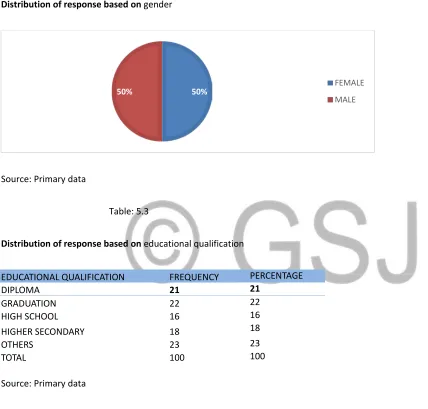
Distribution of response based on gender
GENDER FREQUENCY PERCENTAGE
FEMALE 50 50
MALE 50 50
TOTAL 100 100
Source :Primary data
32%
25% 23%
20%
ISSN 2320-9186
GSJ© 2019 www.globalscientificjournal.com
Interpretation
The population of the respondents are equally divided among the two sections Male and Female which constitute 50% each.
CHART: 5.2
Distribution of response based on gender
Source: Primary data
Table: 5.3
Distribution of response based on educational qualification
EDUCATIONAL QUALIFICATION FREQUENCY PERCENTAGE
DIPLOMA 21 21
GRADUATION 22 22
HIGH SCHOOL 16 16
HIGHER SECONDARY 18 18
OTHERS 23 23
TOTAL 100 100
Source: Primary data
Interpretation
Table 5.3 shows that 23% of the respondents have other qualifications educational qualification, followed by 22% of the respond-ents who are having diploma as educational qualification, followed by 21% of the respondrespond-ents who have diploma as their tion, followed by 18% who are having Higher Secondary and the remaining 16% are having high school as their educational qualifica-tion.
CHART: 5.3
50%
50% FEMALE
ISSN 2320-9186
GSJ© 2019 www.globalscientificjournal.com
Distribution of response based educational qualification
Source :Primary data
TABLE: 5.4
Distribution of response based on are you satisfied with the training program conducted in kitex ltd?
RESPONSES FREQUENCY PERCENTAGE
DISSATISFIED 3 3
HIGHLY DISSATISFIED 3 3
HIGHLY SATISFIED 36 36
NEUTRAL 15 15
SATISFIED 43 43
TOTAL 100 100
Source : Primary data
Interpretation
The study reveals that majority of the respondents are satisfied with the training program conducted at kitex Ltd. followed by 36% who are highly satisfied followed by 15% who are neutral and the remaining 6% are equally divided among Dissatisfied and highly dissatisfied.
CHART:5.4
Distribution of response based on are you satisfied with the training program conducted in kitex ltd?
21
22
16 18
23
ISSN 2320-9186
GSJ© 2019 www.globalscientificjournal.com
Source: Primary data
TABLE: 5.5
Distribution of response based onhow is the quality of training offered in the organization?
RESPONSES FREQUENCY PERCENTAGE
DISSATISFIED 8 8
HIGHLY DISSATISFIED 4 4
HIGHLY SATISFIED 40 40
NEUTRAL 11 11
SATISFIED 37 37
TOTAL 100 100
Source : Primary data
Interpretation
The study reveals that majority of the respondents are highly satisfied with the training program conducted at kitex Ltd.constituting to 40% followed by 37% who are satisfied followed by 11 % who are neutral, followed by 8% who are dissatisfied and the remaining 3% is highly dissatisfied .
CHART: 5.5
DISSATISFIED, 3
HIGHLY DISSATISFIED, 3
HIGHLY SATISFIED, 36
NEUTRAL, 15 SATISFIED, 43
ISSN 2320-9186
GSJ© 2019 www.globalscientificjournal.com
Distribution of response based on how is the quality of training offered in the organization?
Source : Primary data
TABLE:5.6
Distribution of response based on what type of training program have you attended? RESPONSES FREQUENCY PERCENTAGE
CLASS ROOM TRAINING 21 21 OFF THE JOB TRAINING 25 25 ON THE JOB TRAINING 54 54
TOTAL 100 1OO
Source : Primary data
Interpretation
The study reveals that majority of the respondents had attended ON THE JOB TRAINING constituting to 54% followed by 25% of them who had received OFF THE JOB TRAINING and the remaining 21% of them had received CLASS ROOM TRAINING.
CHART:5.6
Distribution of response based on what type of training program have you attended?
Source : Primary data
0 10 20 30 40 50
DISSATISFIED HIGHLY
DISSATISFIED HIGHLY SATISFIED NEUTRAL SATISFIED
21%
25% 54%
ISSN 2320-9186
GSJ© 2019 www.globalscientificjournal.com
TABLE:5.7
Distribution of response based on do you agree that the training program helps in improving technical skills? RESPONSES FREQUENCY PERCENTAGE
AGREE 44 44
DISAGREE 3 3
NEUTRAL 4 4
STRONGLY AGREE 47 47
STRONGLY DISAGREE 2 2
TOTAL 100 100
Source :Primary data
Interpretation
The study shows that 47%of the respondents strongly agree that training program helps to improve their technical skills followed by 44% who strongly agree followed by 4% of them who are neutral followed by 3% who disagree and the remaining 2%of them strong-ly disagree that training helps in improving technical skills.
CHART:5.7
Distribution of response based ondo you agree that the training program helps in improving technical skills?
Source :Primary data
0 5 10 15 20 25 30 35 40 45 50
AGREE DISAGREE NEUTRAL STRONGLY AGREE STRONGLY
ISSN 2320-9186
GSJ© 2019 www.globalscientificjournal.com
TABLE:5.8
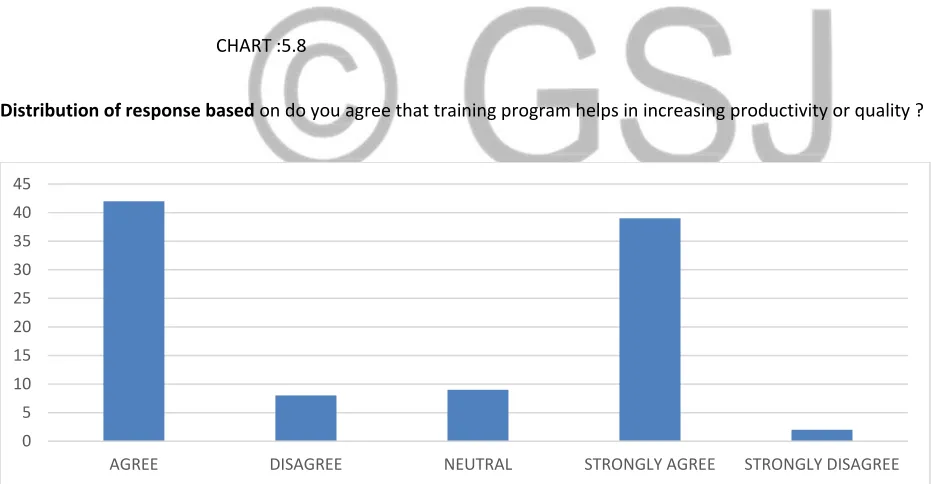
Distribution of response based on do you agree that the training program helps in increasing productivity or quality ?
RESPONSES FREQUENCY PERCENTAGE
AGREE 42 42
DISAGREE 8 8
NEUTRAL 9 9
STRONGLY AGREE 39 39
STRONGLY DISAGREE 2 2
Source: Primary data
Interpretation
Table 5.8 shows that 42% of the respondents agree that training program helps to increase productivity or quality followed by 39% who strongly agree, by 9% who are neutral, 8% of the respondents disagree and remaining 2% who strongly disagree that the train-ing program helps in increastrain-ing productivity or quality.
CHART :5.8
Distribution of response based on do you agree that training program helps in increasing productivity or quality ?
Source : Primary data
0 5 10 15 20 25 30 35 40 45
ISSN 2320-9186
GSJ© 2019 www.globalscientificjournal.com
TABLE:5.9
Distribution of response based on are you satisfied with the working environment in the organization?
RESPONSES FREQUENCY PERCENTAGE
DISSATISFIED 3 3
HIGHLY DISSATISFIED 4 4 HIGHLY SATISFIED 45 45
NEUTRAL 10 10
SATISFIED 38 38
TOTAL 100 100
Source: Primary data
Interpretation
The study shows that 45% of the respondents are highly satisfied with the working environment in the organization, 38% of them are satisfied, 10% of them are neutral, 4% of them highly dissatisfied and 3%of them dissatisfies with the working environment in the organization.
CHART:5.9
Distribution of response based on are you satisfied with the working environment in the organization?
Source :Primary data
TABLE:5.10
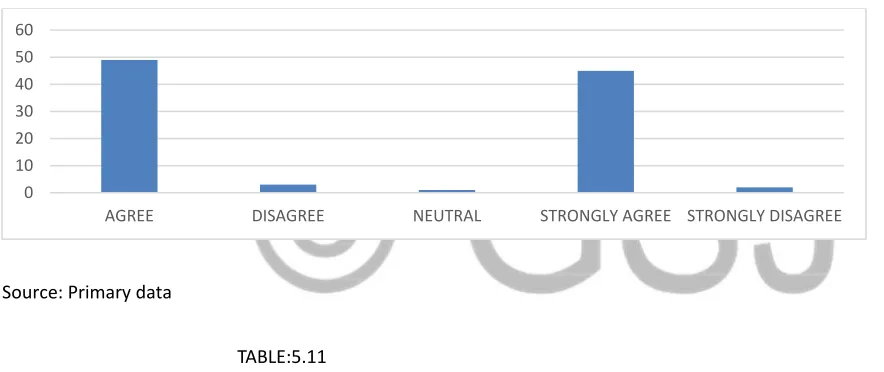
Distribution of response based on do you agree that the training program helps in improving communication skills?
RESPONSES FREQUENCY PERCENTAGE
AGREE 49 49
DISAGREE 3 3
NEUTRAL 1 1
3 4
45
10
38
0 20 40 60
ISSN 2320-9186
GSJ© 2019 www.globalscientificjournal.com
STRONGLY AGREE 45 45
STRONGLY DISAGREE 2 2
Source: Primary data
Interpretation
Table 5.10 reveals that 49% of the respondents agree that the training program has helped to improve their communication skills followed by 45% who strongly agree ,3% of them disagree , 2% of them strongly disagree and 1% of the respondent are neutral that the training program has helped to improve communication skills.
CHART:5.10
Distribution of response based on do you agree that the training program helps in improving communication skills?
Source: Primary data
TABLE:5.11
Distribution of response based on do you agree that after training, you can perform better? RESPONSES FREQUENCY PERCENTAGE
AGREE 48 48
DISAGREE 5 5
NEUTRAL 6 6
STRONGLY AGREE 37 37
STRONGLY DISAGREE 4 4
TOTAL 100 100
Source : Primary data
Interpretation
Table 5.11 shows that 48% of the respondents agree that after training, you can perform better, 37% of the respondents strongly agree, 6% of them neutral, 5% disagree and remaining 4% strongly disagree that after training, you can perform better.
0 10 20 30 40 50 60
ISSN 2320-9186
GSJ© 2019 www.globalscientificjournal.com
CHART:5.11
Distribution of response based on do you agree that after training, you can perform better?
Source: Primary data
TABLE:5.12
Distribution of response based on do you agree that relevant topics related to the program objectives are covered in training pro-gram?
RESPONSES FREQUENCY PERCENTAGE
AGREE 39 39
DISAGREE 6 6
NEUTRAL 5 5
STRONGLY AGREE 42 42
STRONGLY DISAGREE 8 8
TOTAL 100 100
Source :Primary data
Interpretation
The study reveals that 42% of the respondents strongly agree that relevant topics related to the program objectives are covered in training program, 39%of the respondents agree, 8% of them strongly disagree,6% of them disagree and remaining 5% of them are
48%
5% 6% 37%
4%
ISSN 2320-9186
GSJ© 2019 www.globalscientificjournal.com
neutral that relevant topics related to the program objectives are covered in training program.
CHART:5.12
Distribution of response based on do you agree that relevant topics related to the program objectives are covered in training pro-gram?
Source :Primary data
TABLE:5.13
Distribution of response based on do you think that right amount of time was spent on each topic covered in the training pro-gram?
RESPONSES FREQUENCY PERCENTAGE
AGREE 34 34
DISAGREE 6 6
NEUTRAL 6 6
STRONGLY AGREE 50 50
STRONGLY DISAGREE 4 4
TOTAL 100 100
Source: Primary data
Interpretation
The study revealed that 50% of the respondents strongly agree that right amount of time was spent on each topic covered in the training program, 34% agree, neutral and disagree are constituted equally with 6% each and the remaining 4% of the respondents
AGREE 39%
DISAGREE 6%
NEUTRAL 5%
STRONGLY AGREE 42%
STRONGLY DISAGREE
ISSN 2320-9186
GSJ© 2019 www.globalscientificjournal.com
strongly disagree that right amount of time was spent on each topic covered in the training program.
CHART:5.13
Distribution of response based on do you think that right amount of time was spent on each topic covered in the training pro-gram?
Source :Primary data
TABLE:5.14
Distribution of response based on are you satisfied with the present salary? RESPONSES FREQUENCY PERCENTAGE
DISSATISFIED 8 8
HIGHLY DISSATISFIED 7 7
HIGHLY SATISFIED 39 39
NEUTRAL 11 11
SATISFIED 35 35
TOTAL 100 100
Source :Primary data
Interpretation
The study showed that 39% of the respondent are highly satisfied with the present salary, 35% of them are satisfied, 11% of them are neutral, 8% of the dissatisfied and the remaining 7% are highly dissatisfied with the present salary.
CHART:5.14
Distribution of response based on are you satisfied with the present salary ?
34%
6% 6% 50%
4%
ISSN 2320-9186
GSJ© 2019 www.globalscientificjournal.com
Source :Primary data
TABLE:5.15
Distribution of response based on do you think that you have the confidence of accepting new tasks and responsibilities through training ?
RESPONSES FREQUENCY PERCENTAGE
AGREE 34 34
DISAGREE 3 3
NEUTRAL 3 3
STRONGLY AGREE 58 58 STRONGLY DISAGREE 2 2
TOTAL 100 100 Source :Primary data
Interpretation
The study reveals that 58% of the respondent strongly agree that they have the confidence of accepting new tasks and responsibili-ties through training, 34% agree, disagree and neutral are distributed equally and is constitutes by 3% each and the remaining 2% is being constituted by strongly disagree.
CHART:5.15
Distribution of response based on do you think that you have the confidence of accepting new tasks and responsibilities through training?
8% 7%
39% 11%
35%
ISSN 2320-9186
GSJ© 2019 www.globalscientificjournal.com
Source: Primary data
TABLE:5.16
Distribution of response based on do you feel that the topics covered are easy to understand ? RESPONSES FREQUENCY PERCENTAGE
AGREE 49 49
DISAGREE 6 6
NEUTRAL 5 5
STRONGLY AGREE 37 37
STRONGLY DISAGREE 3 3
TOTAL 100 100
Source: Primary data
Interpretation
The study reveals that 49% of the respondents agree that topics covered are easy to understand, 37% of them strongly agree, 6% disagree, 5% neutral and remaining 3% strongly disagree that topics covered are not easy to understand.
CHART:5.16
Distribution of response based on do you feel that topics covered are easy to understand?
0 10 20 30 40 50 60 70
AGREE DISAGREE NEUTRAL STRONGLY AGREE STRONGLY
DISAGREE
ISSN 2320-9186
GSJ© 2019 www.globalscientificjournal.com
Source: Primary data
TABLE:5.17
Distribution of response based on do you suggest any improvement or modification in the present training programs ? RESPONSES FREQUENCIES PERCENTAGE
LENGTHEN THE TRAINING PROGRAM 33 33
NO IMPROVEMENT REQUIRED 34 34
SHORTEN THE TRAINING PROGRAM 33 33
TOTAL 100 100
Source :Primary data
Interpretation
The study reveals that most of the respondents constituting to 34% suggest that no improvement required and the remaining 66% is divided equally among lengthen the training program and shorten the training program constituting 33% each.
CHART: 5.17
Distribution of response based on do you suggest any improvement or modification in the present training programs ?
0 10 20 30 40 50 60
ISSN 2320-9186
GSJ© 2019 www.globalscientificjournal.com
Source :Primary data
TESTING HYPOTHESIS
TABLE 5.18
Hypothesis 1: There is no association between gender and satisfaction from training programs.
Test applied: One way anova
ANOVA
Employee Satisfaction from Training Programmes
Sum of Squares Df Mean Square F Sig.
Between Groups .040 1 .040 .044 .835
Within Groups 89.600 98 .914
Total 89.640 99
Source :Primary data
Interpretation
The p value = .835 which is not less than .05, therefore not significant. Hence the null hypothesis cannot be rejected. Hence there is no association between gender and satisfaction from training programs.
TABLE 5.19
Hypothesis 2:There is no significant relationship between age and satisfaction from working environment Test applied: One way anova
ANOVA
Satisfaction from Working Environment
Sum of Squares Df Mean Square F Sig.
33%
34% 33%
LENGTHEN THE TRAINING PROGRAM
NO IMPROVEMENT REQUIRED
ISSN 2320-9186
GSJ© 2019 www.globalscientificjournal.com
Between Groups 6.852 3 2.284 2.351 .077
Within Groups 93.258 96 .971
Total 100.110 99
Source: Primary data
Interpretation
The p value = .077 which is not less than .05, therefore not significant. Hence the null hypothesis cannot be rejected. Hence there is no association between age and satisfaction from working environment.
TABLE 5.20
Hypothesis 3: There is no significant relationship between educational qualifications and satisfaction in present salary Test applied: Correlation
Correlations
Educational Qualification
Satisfaction in Present Salary
Educational Qualification
Pearson Correlation 1 .225*
Sig. (2-tailed) .024
N 100 100
Satisfaction in Present Salary
Pearson Correlation .225* 1
Sig. (2-tailed) .024
N 100 100
*. Correlation is significant at the 0.05 level (2-tailed). Source: Primary data
Interpretation
The p value = .024 which is less than .05, therefore significant. Hence the null hypothesis is rejected. Hence there is a significant rela-tionship between educational qualifications and satisfaction in present salary.
TABLE 5.21
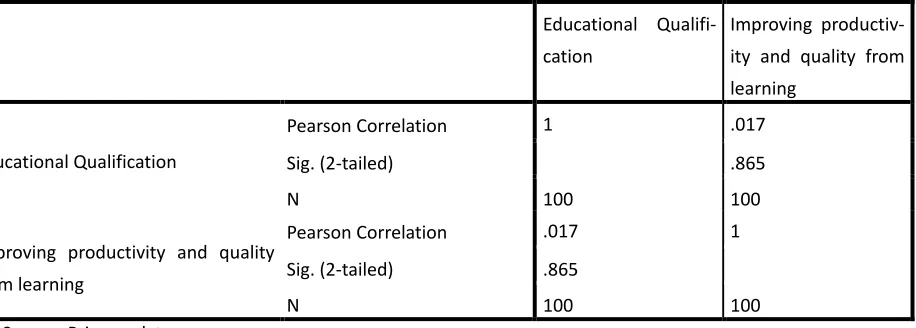
Hypothesis 4: There is no significant relationship between educational qualification and improving productivity and quality from learning
ISSN 2320-9186
GSJ© 2019 www.globalscientificjournal.com
Correlations
Educational Qualifi-cation
Improving productiv-ity and qualproductiv-ity from learning
Educational Qualification
Pearson Correlation 1 .017
Sig. (2-tailed) .865
N 100 100
Improving productivity and quality from learning
Pearson Correlation .017 1
Sig. (2-tailed) .865
N 100 100
Source :Primary data
Interpretation
The p value = .865 which is not less than .05, therefore not significant. Hence the null hypothesis cannot be rejected. Hence there is no significant relationship between educational qualification and improving productivity and quality from learning.
TABLE 5.22
Hypothesis 5: There is no significant relationship between gender and performance after training Test applied: Correlation
Correlations
Gender Performance after Training
Gender
Pearson Correlation 1 -.071
Sig. (2-tailed) .485
N 100 100
Performance after Training
Pearson Correlation -.071 1
Sig. (2-tailed) .485
N 100 100
Source :Primary data
Interpretation
The p value = .485 which is not less than .05, therefore not significant. Hence the null hypothesis cannot be rejected. Hence there is no significant relationship between gender and performance after training.
FINDINGS
• The study revealed that there is no significant relationship between educational qualifications and satisfaction in present salary
ISSN 2320-9186
GSJ© 2019 www.globalscientificjournal.com
• The study showed that there is no association between age and satisfaction from working environment.
• The study shows that there is no significant relationship between educational qualification and improving productivity and quality from learning.
• The study concluded that there is no significant relationship between gender and performance after training.
• THE STUDY SHOWS THAT 32%OF THE RESPONDENTS ARE OF THE AGE GROUP 20-30 YEARS FOLLOWED BY 25%OF THE RESPONDENTS OF THE AGE
GROUP OF 30-40 YEARS FOLLOWED BY RESPONDENTS OF AGE GROUP 40-50 YEARS WHICH CONSTITUTE 23%OF THE POPULATION AND THE
REMAIN-ING 20% ARE OF THE AGE GROUP ABOVE 50 YEARS.
• The population of the respondents are equally divided among the two sections Male and Female which constitute 50% each.
• The study shows that 23% of the respondents have other qualifications educational qualification, followed by 22% of the respondents who are having diploma as educational qualification, followed by 21% of the respondents who have diploma as their qualification, followed by 18% who are having Higher Secondary and the remaining 16% are having high school as their educational qualification.
• The study reveals that majority of the respondents are satisfied with the training program conducted at kitex Ltd. followed by 36% who are highly satisfied followed by 15% who are neutral and the remaining 6% are equally divided among Dissatis-fied and highly dissatisDissatis-fied.
• The study reveals that majority of the respondents are highly satisfied with the training program conducted at kitex Ltd. constituting to 40% followed by 37% who are satisfied followed by 11 % who are neutral, followed by 8% who are dissatis-fied and the remaining 3% is highly dissatisdissatis-fied .
• The study reveals that majority of the respondents had attended ON THE JOB TRAINING constituting to 54% followed by 25% of them who had received OFF THE JOB TRAINING and the remaining 21% of them had received CLASS ROOM TRAIN-ING.
• The study shows that 47%of the respondents strongly agree that training program helps to improve their technical skills fol-lowed by 44% who strongly agree
• The shows that 42% of the respondents agree that training program helps to increase productivity or quality followed by 39% who strongly agree
• The study shows that 45% of the respondents are highly satisfied with the working environment in the organization, 38% of them are satisfied, 10% of them are neutral.
• The study reveals that 49% of the respondents agree that the training program has helped to improve their communication skills followed by 45% who strongly agree .
• The study shows that 48% of the respondents agree that after training, you can perform better, 37% of the respondents strongly agree.
ISSN 2320-9186
GSJ© 2019 www.globalscientificjournal.com
• The study revealed that 50% of the respondents strongly agree that right amount of time was spent on each topic covered in the training program, 34% agree.
• The study showed that 39% of the respondent are highly satisfied with the present salary, 35% of them are satisfied.
• The study reveals that 58% of the respondent strongly agree that they have the confidence of accepting new tasks and re-sponsibilities through training, 34% agree.
• The study reveals that 49% of the respondents agree that topics covered are easy to understand, 37% of them strongly agree.
• The study reveals that most of the respondents constituting to 34% suggest that no improvement required and the remain-ing 66% is divided equally among lengthen the trainremain-ing program and shorten the trainremain-ing program constitutremain-ing 33% each.
SUGGESTIONS
In todays competitive world attitude is the factor which is the dividing line between failure and success. Thus recruitment of the workers must be made not on skills but also the attitude of the worker. If a worker has a positive attitude then the train-ing for him can be more effective , he has a positive effect of the climate.
The training should be assessed by observing the performance of workers and also from feedback.
The training records must be maintained, preserved properly and updated timely.
Proper care should be taken while selecting the trainers.
Trainers must be given continuous feedback and the training should be perform as a continuous planned activity.
New and different trainers should be invited so that the maximum impact can be getting from the training programs.
Try to consider the personal goals of participants also when designing the training module. By which the interest and satis-faction of participants can be increased.
CONCLUSION
The study was conducted in Kitex Ltd. The training and development programs plays integral parts of most organization .Employee
gain skills, abilities , knowledge and attitude that helps them to perform more effectively in present job the main objective of this
study is to know about the different training and development programs that are being adopted by Kitex Ltd. and techniques
pro-vided by the company.The study revealed and ensured the fact that Kitex is conducting training and development programs in the
organization. Each and every employee has a good opinion about the present training programs. The organization should give more
emphasis on training because it is very important for the success of the organization. The organization should conduct various
train-ing and development programs to increases the skills and knowledge of the employees for the better utilization of resources. The
ISSN 2320-9186
GSJ© 2019 www.globalscientificjournal.com
AKNOWLEDGEMENT
I would like to seize this opportunity to express our deep sense of gratitude to Dr.U.Krishnakumar, Director, Amrita School of Arts
and Sciences, Kochi for providing the necessary resources for the completion of this project.
I would like to thank Dr. P Balasubramanian, Head of the Department, Commerce and management, who gave valuable advices and coordinated me throughout the project. We extend our sincere thanks to Sri.K.R.Shabu , Assistant professor, Department, Commerce and management who has been kind enough to grant me this opportunity to do this project.
I express my thanks to the management of KITEX LIMITED KIZHAKKAMBALAM, who had provided me with the oppourtunity to conduct my study there. My special thanks to K.C.Pillai, M.D. of Kitex Ltd. Kizhakkambalam for granting permission to do my study. I express my sincere thanks to Ms.Vinimol, HR Manager, for her guidance, approval and all staff members for their invalueable help and whole hearted corporation extended to me during this project.
I thank all the staff members of Amrita School of Arts and Sciences and friends for giving timely encouragement and support they
gave while preparing this project
ARTICLES AND JOURNALS REFERED
• Dr Sarbjit, directior apeejay collage of engineering ,Gurgon , India ,August 2018
• Paul Lewis, Willaim J.Rothwell , Lindamillar,Ahad Osman-Gani had done a study on “Training and development scientific method” ,2014.
• M. Rosario Rueda*†, Mary K. Rothbart*†, Bruce D. McCandliss†, Lisa Saccomanno‡, and Michael I. Posner*†§ have con-ducted a study on “Training, maturation, and genetic influences on the development of executive attention”, August 9 2005.
• Beverly Serrell had conducted a study on “paying more attention to paying attention”, March 14 2010.
• Dr. Mahesha Kempegowda and Purushotham.c.j had conducted a study on “overall impact of training and development on job performance, morale of employees and to reduce the employee resistance to new technology”, September 2016.
ISSN 2320-9186
GSJ© 2019 www.globalscientificjournal.com
• S.A.Mufeed, Rafi Sayed Nasreen had conducted a study on “Training and development :An instrument from growth and better quality of work”, September 2003.
• Thomas Acton, Willie Golden had conducted a study on “Training the knowledge worker: A descriptive study of training practices in Irish software companies”, March 2003.
• Ravindra K.Jain and Riha Agrawal had conducted a study on “Indian and international perspectives on employee training practices”, September 2004.
• Charles W. Read, Brian H. Kleiner had conducted a study on “which training methods are effective”, April 1996.
• Kalaitzidakis , Pantelis had conducted a study on “The job training under firm- specific innovations and worker heterogenei-ty”, July 1997.
BOOKS:
1. KOTHARI,C.R RESEARCH METHODOLY,PUBLISHED BY TATA MC.GRAW-HILL PUBLISHING COMPANY LTD.,13TH EDITION,1982