INTEGRATION OF RSA WITH DELTA ENCODING TECHNIQUES IN CLOUD SECURITY AND PRIVACY
Dr. Thomas Yeboah1 , Mr. Farouk Umar , Mr. Emmanuel Abaidoo 3 and Mr. Mahendra shrivas4
1. Christ Apostolic University College email: [email protected]
2. Christ Apostolic University College email: [email protected]
3. Christ Apostolic University College email: [email protected]
4. BlueCrest University College,[email protected]
Abstract
With passage of time cloud computing has been on high demand due to its cost and high reliability
along with high security and scalability. Cloud Computing enables shared resources, software, and
information to be provided to computers and other devices as a utility. Howeverin the area of research
it is observed that cloud computing still has some issues in security regarding privacy. In cloud
computing data are sent over an insecure channel and they are therefore subjected to so many types
of intruders. This means that it has become necessary to protect the secrecy of messages which are
sent over an insecure channel so that correct data are received by the receiver at the right time
without any intrusion. In order to ensure secrecy of data when sent over insecure channel an
encryption is employed. In this research work the encryption algorithm employed is an extension
and modification of the RSA cryptosystem. In RSA algorithm the message to be encrypted does
not undergo any form of transformation or encoding prior to encryption and the level of encryption
is therefore homogeneous. In our work, we extended the level of encryption to two, which makes
it heterogeneous. Prior to RSA encryption, the message is subjected to an encoding mechanism using ‘Delta Encoding Technique’. Thus the proposed security algorithm preserves the security in
cloud computing in two phases that is by RSA algorithm and ‘Delta Encoding Technique’.
Therefore the researchers objective is to develop an enhancement encryption scheme which is
heterogeneous compared with the traditional RSA system that is homogeneous, which brings us
toward improved RSA cryptosystem for privacy in terms of the level of transformation.
For this purpose, Key Generation, Encryption and Decryption Time in Original RSA and the
proposed algorithm have been compared according to the different size of exponents. Moreover,
some of the common attacks against RSA algorithm have been analyzed to detect the resistance of
the proposed algorithm against possible attacks. After thoroughly comparison between the original
RSA and the proposed algorithm, the results showed that the proposed algorithm was better than
the original RSA in terms of security and total execution time.
GSJ: Volume 7, Issue 5, May 2019, Online: ISSN 2320-9186 www.globalscientificjournal.com
Keywords—RSA algorithm, Delta Encoding Technique, Cloud Security, encryption, decryption
1. INTRODUCTION
Cloud computing is a general term that delivers hosted services over internet. Cloud computing
enables users to remotely run services such as Software-as-a-Service (SaaS),
Infrastructure-as-a-Service (IaaS) and Platform-as-a-Service (PaaS) [2]. With the advent of Cloud computing, the issue
of security and data privacy has become more prominent because the communications channels
are vulnerable and subject to attack by intruders since it involves open communication traffic.
In cloud computing environment, we must safeguard against both obvious and subtle intrusions
that can delete or corrupt vital data [1] by using appropriate cryptography technologies. The
primarily idea behind cryptography is to send data in a secure manner so that information gets to
the right person and at the right time without intrusion. The RSA cryptosystem, named after its
Inventors R. Rivest, A. Shamir, and L Adlemanis one of many widely used public-key
Cryptosystem schemes which utilizes Integer factorization problem in the encryption/decryption
process [9]. RSA is an asymmetric cryptosystem. This means that the algorithm consists of two
mathematical transformations: an encryption function E, and a decryption function D. It means
that in order to ensure a secure communication between a sender (traditionally called Alice) and
the receiver (traditionally called Bob) the sender supposes to apply the encryption function to the
original message P (the plaintext), and transmit the resulting ciphertext C = E (P) over the insecure
channel. Once C is received by the intended recipient (called Bob), the plaintext is recovered by
computing D(C) = P. It is well noted in traditional RSA algorithm that there is always a trade-off
between security and efficiency: at some point the, moduli must be large for security; on the other
hand, small moduli are preferred for efficiency. How large they have to be, depends on the speed
of so-called factorization algorithm [7].
In view of this the main objective of this research is to develop an effective security encryption
scheme which is heterogeneous compared with the current RSA system that is homogeneous. In
our work we extended the level of encryption to two, which makes it heterogeneous. Prior to RSA
encryption, the message is subjected to an encoding mechanism using ‘Delta Encoding Technique’.
2. ISSUES IN CLOUD SECURITY
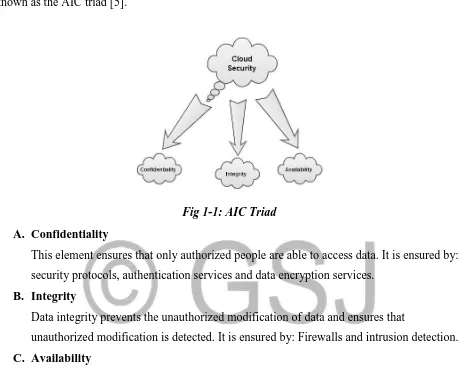
Most security principles in cloud computing can be traced back to the security triad (also called
The security triad includes three key security principles that are at the core of all security practices.
These three issues of cloud computing security are: confidentiality, integrity and availability;
known as the AIC triad [5].
Fig 1-1: AIC Triad
A. Confidentiality
This element ensures that only authorized people are able to access data. It is ensured by:
security protocols, authentication services and data encryption services.
B. Integrity
Data integrity prevents the unauthorized modification of data and ensures that
unauthorized modification is detected. It is ensured by: Firewalls and intrusion detection.
C. Availability
Availability ensures that systems and data are up and available when needed. It is ensured
by: fault tolerance, network security and authentication.
3. RELATED WORKS
RSA Encryption is one of the most popular and simple algorithms used to implement cloud
data security and privacy. Due to its simplicity and popularity in nature; there has been lot of
research carried out to improve performance of this algorithm and therefore there are so many
variants of this algorithm.
Venkatesh et al [10] proposes RSASS system for data security. The scheme uses RSA
algorithm for encrypting large files and storing the date. The system can be used for storing
large databases. But the use of linear methods compromises with the data retrieval speed.
Hence, this system is good for static data.In [6] De, S. Haldar et al indicated in their research
work that in traditional RSA algorithm; there is always a trade-off between security and
efficiency: at some point the, moduli must be large for security; on the other hand, small moduli
are preferred for efficiency. How large they have to be, depends on the speed of so-called
factorization Algorithm.Ashish Agarwal et al. [3] talk about security issues concerned with
cloud computing. Theirpaper has talked about some serious security threats that prevails this
field.Ashutosh Kumar et al. [4] focused on providing a secure architectural framework for
sharing and data gathering. This cynosure of this work is that the authors have made a
permission hierarchy at different levels. The authors have focused on security but with view
of use hierarchy.Delta encoding is a way of storing or transmitting data in the form
of differences (deltas) between sequential data rather than complete files [8]. This Delta
encoding techniques include both Newton forward and backward differentials.
4. METHODOLOGY
The methodology adopted in our research is the structured systems analysis method. In this
methodology the existed algorithm (RSA algorithm) was critically analyzed and examined to note
the possible problems/drawbacks.
4.1 RSA Algorithm
The RSA algorithm involves three steps: Key generation, encryption and decryption.
a. Step 1: Key Generation
1. Choose two distinct prime numbers p and q (e.g p= 3 and q =11).
2. Compute n = p * q = 3 * 11 = 33
3. Compute φ(n) = (p - 1) * (q - 1) = 2 * 10 = 20
4. Choose e such that 1 < e <φ(n) and e and n are co-prime. Let e = 7
5. Compute a value for d such that (d * e) % φ (n) = 1. Hence d = 3 ,[(3 * 7) % 20 =
1]
6. Therefore the following are valid
Public key is (e, n) – (7,33)
Private key is (d, n) – (3,33)
b. Step II: Encryption
For a plaintext message m, the encryption function is
c. Step III: Decryption
Therefore for an encrypted ciphertext c, the decryption function is
m (c) = cd (mod n)
4.2 RSA Flowchart
The figure 1-2 shows the flowchart for RSA cryptosystem.
(Fig 1-2: flowchart of RSA Algorithm)
Start
Choose two distinct prime numbers p and q
Check p & q are prime numbers
Compute n = p x q
Compute ɸ = (p-1) x (q-1)
Choose an integer e
Check if 1<e <ɸ
Check if e and ɸ are
co-prime primepri
NO
NO
Yes Yes
A
Yes
A
Use ‘e’ as public key exponent
Compute (d * e) % φ (n) = 1.
Public key is (e, n).
Encryption of message m is
c (m) = me
Obtain cipher text
Private Key is (d, n)
Decrypt message using
m (c) = cd
Obtain plaintext
Stop
4.3 Delta Encoding Technique
In our work we used Newton Forward differential to change the original text into an encoded
form by recording difference between successive objects and backward differentials to change
the encoded text into the original message.
a. Newton Forward Differential
In Newton Forward Differential data are encoded as follows:
Fd = md (for first value of message m)
and for the subsequent message(s)
Fd+1 = md +1 – md
Where d = 1, 2,3,… and m is the message.
For example, table 1-1 shows a plaintext and its encoded form
Message 10 12 8 6 14 15
Encoded 10 2 -4 -2 8 1
(Table 1-1: Plaintext and Encoded form)
b. Newton Backward Differential
In Newton backward Differential data are retrieved as follows:
md = Fd (First value of original text).
For subsequent values of message we have
md +1 = Fd+1 + md
PROPOSED ALGORITHM FOR SECURITY IN CLOUD ENVIRONMENT 5.1 Algorithm
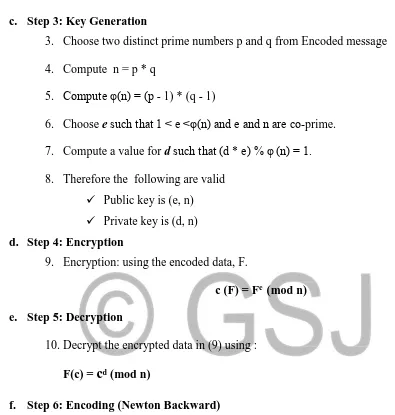
Our proposed algorithm of cloud data privacy involves Six steps: ASCII Message, Encoded form
(Newton Forward), Key generation, encryption, decryption and Newton backward.
a. Step 1: ASCII message
1. Obtain the ASCII code of the message entered.
2. Encode message (ASCII Code Values) using Newton Forward differential.
c. Step 3: Key Generation
3. Choose two distinct prime numbers p and q from Encoded message
4. Compute n = p * q
5. Compute φ(n) = (p - 1) * (q - 1)
6. Choose e such that 1 < e <φ(n) and e and n are co-prime.
7. Compute a value for d such that (d * e) % φ (n) = 1.
8. Therefore the following are valid
Public key is (e, n)
Private key is (d, n)
d. Step 4: Encryption
9. Encryption: using the encoded data, F.
c (F) = Fe (mod n)
e. Step 5: Decryption
10.Decrypt the encrypted data in (9) using :
F(c) =
c
d (mod n)f. Step 6: Encoding (Newton Backward)
11.Encoded message in (10) to obtain original message using Newton Backward
differential.
5.2Flowchart for proposed algorithm
Figure 1-3 shows the flowchart of the proposed algorithm
Start
Enter Message
(Fig 1-3: flowchart of Proposed Modified RSA
A
Obtain ASCII code of Message
Encode Message Using Newton Forward Diff.
Choose two distinct prime numbers p and q
Check p & q are prime numbers
Compute n = p x q
Compute ɸ = (p-1) x (q-1)
Check if 1<e <ɸ
Check if e and ɸ are
co-prime primepri
NO
NO
Yes
Yes
No
B
Choose an integer e
B
Use ‘e’ as public key exponent
Compute (d * e) % φ (n) = 1.
Public key is (e, n).
Encryption of encoded message F is
c (F) = Fe
Obtain cipher text
Private Key is (d, n)
Decrypt message using
F (c) = cd
Obtain plaintext
Stop
5.3Illustration of Proposed Algorithm for Security
In this proposed modified RSA Algorithm with Delta Encoding techniques, let us assume that Bob
wants to send a message “ I love my wife” to Alice with the following key attributes: p=3, q=11,
n=33,e=7 and d=3. Table 1-2 shows the protected message using the proposed algorithm
ORIGINAL
MESSAGE
ASCII NEWTON
FORWARD
ENCRYPTED
c (F) = Fe (mod n)
DECRYPTED
F(c) =
c
d (mod n)NEWTON
BACKWARD
MESSAGE
I 73 73 28 7 73 I
32 -41 -2 -41 32
l 108 76 10 76 108 l
o 111 3 9 3 111 o
v 118 7 28 7 118 v
e 101 -17 -8 -7 101 e
32 -69 -9 -69 32
m 109 77 11 77 109 m
y 121 12 12 12 121 y
32 -89 -23 -89 32
w 119 87 21 87 119 w
i 105 -14 -20 -14 105 i
f 102 -3 -9 -3 102 f
e 101 -1 -1 -1 101 e
(Table 1-2: A protected message using proposed algorithm)
6. RESULTS AND DISCUSSION
6.1 Comparison of Key Generation time and Total Execution
The simulation result of the proposed algorithm and the original RSA was implemented in
java. In the comparison between proposed algorithm and original RSA; different size of
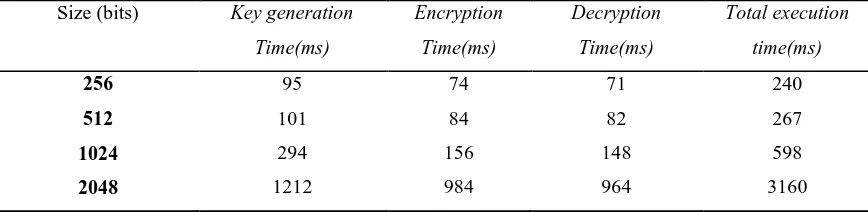
exponents (256,512, 1024, and 2048) were considered. Table 1-3 and Table 1-4 show the
simulation results of the proposed algorithm and original RSA.
Table 1-3: Key Generation, Encryption and Decryption Times for proposed algorithm.
Size (bits) Key generation
Time(ms)
Encryption
Time(ms)
Decryption
Time(ms)
Total execution
time(ms)
256 95 74 71 240
512 101 84 82 267
1024 294 156 148 598
2048 1212 984 964 3160
Table 1-4: Key Generation, Encryption and Decryption Times for original RSA.
Size (bits) Key generation
Time(ms)
Encryption
Time(ms)
Decryption
Time(ms)
Total execution
time(ms)
256 91 70 67 228
512 98 79 76 253
1024 289 152 141 582
2048 2542 982 956 4480
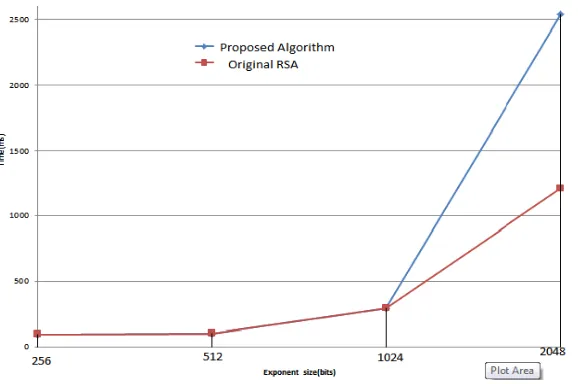
According to the results, the encryption, key generation and decryption times for the proposed
algorithm were always less than the original RSA algorithm when the exponent sizes were 256,
512 and 1024 bits. The key generation time comparison of the proposed algorithm and original
RSA shows drastic increment which resulted in increase in total execution time for the proposed
algorithm been larger than the original RSA. The key generation time comparison between
Fig 1-4: Key Generation Times Compared
4.2 Security Analysis (Compared)
The security analysis of the proposed algorithm and the original RSA has been investigated
according to three attack approaches: theBrute Force, Mathematical Attacks, and Timing attacks.
A. Mathematical Attacks
Mathematical attacks focus on attacking the underlying structure of RSA function. The
first intuitive attack is the attempt to factor the modulus N. Because knowing the
factorization of N, one may easily obtain M (N), from which d can be determined by d =
1/e mod M (N). In original RSA because it is homogenous in nature it is easily to factor
the modulus N whiles in this proposed algorithm it is heterogeneous in nature and therefore
make it difficult to factor the modulus.
B. Brute Force attacks
In brute force attacks you need to explore all the possible combinations to guess the private
key. In the proposed algorithm the attacker has to guess the encoded private key and the
original private key which makes it difficult to guess as compare to the original RSA which
requires the attacker to only guess the original private key.
C. Timing Attacks
In cryptography, a timing attack is a side channel attack in which the attacker attempts to
compromise a cryptosystem by analyzing the time taken to execute cryptographic
algorithms. Timing attack in original RSA may beprevented by including a random delay
to the exponentiationalgorithm or multiplying the cipher-text with a randomnumber [10]
while heterogeneous encryption algorithm like the proposed algorithm will protect
thetransferred message from the timing attack and it is notnecessary for multiplying the
cipher-text.
7.CONCLUSION
In this paper, a heterogeneous encryption algorithm has been suggested based on RSA and Delta
Encoding Techniques to improve security issues and reduction of execution time in cloud
computing environment. Original RSA is based on block cipher. Our work is based on stream
cipher. Stream ciphers are generally faster and more appropriate than block ciphers and a dual
encryption process has been applied to this proposed algorithm to raise the security level of the
algorithm in comparison of original RSA.
8. REFERENCES.
[1].Almarini, A. and Alsahdi, U. (2012), “Developing a Cryptosystem for XML
Documents”, International Journal of Information Science, Vol. 2. No. 5, pp. 65 – 69.
[2].Amazon Elastic Compute Cloud. http://aws.amazon.com/ec2/ (accessed on January 23, 2015)
[3].Ashish Al, Aparna A.,(2011), “The Security Risks Associated with Cloud Computing”. International Journal of Computer Applications in Engineering Sciences [VOL I, SPECIAL ISSUE ON CNS, JULY 2011] [ISSN: 2231-4946]
[4].Ashutosh Kumar D, Animesh Kumar D, Mayank N, Shiv Shakti S,(2012),”Cloud-User Security Based on RSA and MD5 Algorithm for Resource Attestation and Sharing in Java Environment. Software Engineering (CONSEG)”, CSI Sixth International Conference
[5].Cherdantseva, Y.; Hilton, J.(2013), "A Reference Model of Information Assurance & Security," Availability, Reliability and Security (ARES), Eighth International Conference on , pp.546-555, 2-6
[6].De, S. Haldar, A., and Biswas, S. (2013), “A Review on Recent Trends in
Cryptography”, International Journal of Latest Research in Engineering and Computer (IJLREC), Vol.1, Issue 1.Sept- Oct., pp. 50-55.
[8].Jeffrey C. Mogul, Fred D., Anja F, and Balachander K.,(1997), “Potential benefits of delta encoding and data compression for HTTP”, Proceedings SIGCOMM '97, Cannes, France
[9].Rivest, R., Shamir, A., and Adleman, L, (1978). “A Method for Obtaining Digital Signatures and Public Key Cryptosystems”, Communications of the ACM.
[10]. Venkatesh M,.SumalathaR,SelvaKumarC(2012), “Improving Public Auditability, Data Possession in Data Storage Security for Cloud Computing”, ISBN: 978-1-4673-1601-9/12 IEEE