E. Obataya (*)
Institute of Wood Technology, Akita Prefectural University, Akita 016-0876, Japan
Tel. 81-185-52-6984; Fax 81-185-52-6976 e-mail: [email protected] J. Gril
Laboratoire de Mécanique et Génie Civil, Université Montpellier 2, Montpellier 34000, France
P. Perré
Laboratoire de Recherche sur le Matériau Bois, Nancy F-54042, France
Received: October 31, 2003 / Accepted: March 24, 2004
Abstract To improve the drying method in the
manufac-ture of woodwind reeds, green canes (Arundo donax L.) were dried under various humidity–temperature conditions and the intensity of cell collapse was evaluated from the swelling due to steaming during the recovery of collapse. At 30°C, the intensity of collapse was increased by slower dry-ing. It was considered that: (1) slower drying resulted in higher sample temperature in the early stage of drying and acted to increase the collapse; (2) rapid drying stiffened the surface of the sample and such a “shell” prohibited the following collapse; (3) slower drying i.e., longer loading of liquid tension caused more remarkable and/or frequent vis-coelastic yields of cells. Consequently, the intensity of col-lapse increased when the cane was dried from its waxy outer surface or in the presence of node: both of them retarded drying. On the other hand, higher drying temperature caused greater intensity of collapse in spite of faster drying. It was suggested that the thermal softening of cane cells leads to easier yielding of the cell wall, and at the same time the rapid drying does not allow the recovery of collapse after the disappearance of free water. These results indi-cated that faster drying at lower temperature is preferable for drying cane with less collapse.
Key words Arundo donax · Cane · Shrinkage · Cell
coll-apse · Drying
Introduction
The cane Arundo donax L. is widely used for the vibrating plate (reed) of woodwind instruments such as the clarinet and saxophone. In our previous paper, we demonstrated serious collapse of parenchyma cells during drying.1
Be-cause the recovery of collapse sometimes Be-causes problem-atic swelling of the reed, it is necessary to establish a drying method that involves less collapse. However, the mecha-nism of cane collapse is still unclear whereas that of wood has so far been discussed in detail.
The cane for woodwind reeds is usually harvested in winter and dried in open air without being separated into individual internodes. In this case, the cane dries very slowly with the presence of nodes obstructing the dispersion of water along its longitudinal direction. In general, slow drying is recommended for wood to reduce the risk of checking and splitting due to a steep moisture gradient. However, it has been suggested that slow drying of wood and bamboo results in greater intensity of collapse.2,3
If the slow drying of cane also induces more remarkable collapse, we will have to reconsider the conventional drying method so far employed by many reed manufacturers. In this article, we describe the effects of drying conditions on the intensity of collapse as part of an effort to identify a better drying method that causes less collapse.
Materials and methods
Cane sample
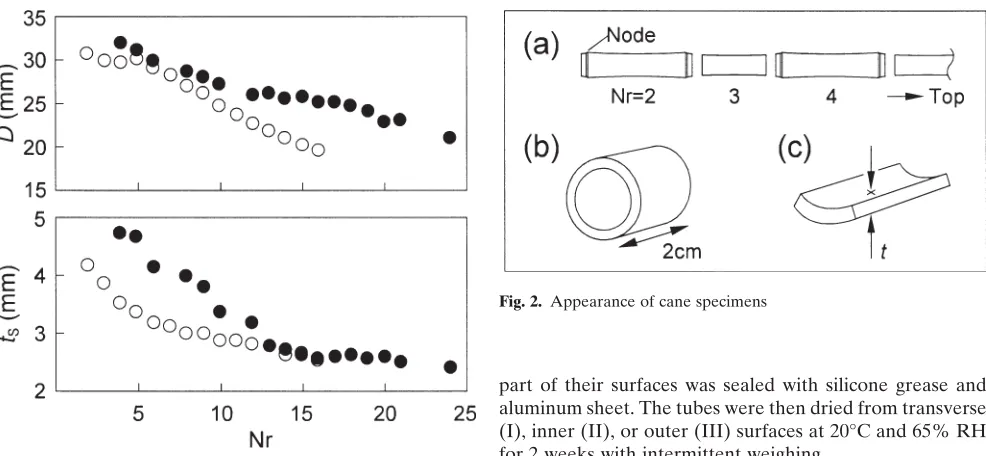
Figure 1 shows the average external diameter and thickness of internodes tested.
Drying of cane specimens
One cane pole was divided into short tubes as shown in Fig. 2a. The node was removed from seven internodes (Nr 3, 5, 7, 9, 11, 13, and 15) while it remained in the other eight internodes (Nr 2, 4, 6, 8, 10, 12, and 16). The tubes were then dried at 20°C and 65% relative humidity (RH) without the circulation of air.
Another cane pole was separated into short tubes, each of 2 cm in length, as shown in Fig. 2b. At least four tubes were made from each internode. These tubes were then dried in various drying conditions as described below.
Sixteen tubes made from four internodes (Nr 10, 15, 19, and 24) were divided into four groups (a–d) and dried at 30°C in an environmental chamber. Groups a and b were dried at 60% RH and 90% RH under air circulation, respec-tively. Groups c and d were dried at 90% RH without air circulation, while group d was wrapped with filter paper to retard drying. After the mass of the specimen was reduced by 50% (corresponding to about 25% moisture content), the specimens were dried at 20°C and 65% RH for 1 week. From five internodes (Nr 12, 14, 16, 18, and 20), 20 tubes were made and divided into four groups. These groups were dried at 30°, 60°, 80°, and 100°C in an environ-mental chamber until the weights of specimens equili-brated. For drying at 30°–80°C, the humidity was kept at 30% RH. After drying, the tubes were cooled and dried at 20°C on SiO2. Four internodes (Nr 5, 9, 13, and 17) were sectioned into 12 tubes and divided into three groups. A
part of their surfaces was sealed with silicone grease and aluminum sheet. The tubes were then dried from transverse (I), inner (II), or outer (III) surfaces at 20°C and 65% RH for 2 weeks with intermittent weighing.
From four internodes (Nr 4, 6, 8, and 21), 16 tubes were made and separated into four groups. The three groups were dried from the I, II, or III surfaces while an-other group was dried without sealing at 20°C and 65% RH for 2 weeks.
Surface temperature measurement
A piece with dimensions of 12 (L) 1 (R) 5 (T) mm was made from the inner part of a green cane stem (Nr 2). The sample was hung by a steel frame and dried in an environmental chamber kept at 30°C and 60% RH. The weight and surface temperature of the sample were recorded continuously. A pyrometer, Infratherm IN5 (IMPAC Electronic), was used for the surface temperature measurement. A detailed description of this experimental device can be found in the literature.4
The possibilities of sample dimension measurement offered by this device need further investigation and are not analyzed in this report.
Evaluation of intensity of collapse
Each cane tube was splinted into 8–12 strips. Because the collapse of cane is remarkable in the radial direction,1 we dealt with the thickness of cane stem as shown in Fig. 2c. The specimens were dried absolutely in vacuo over P2O5 at room temperature and their thickness (t1) was measured at their center point. The specimens were then humidified at 100% RH at room temperature for 1–2 weeks and then steamed at 90°–96°C for 1 h using a cooking steamer. The steamed specimens were cooled in wet cloth and their thick-nesses (tS) were measured immediately. Finally, the speci-mens were dried again in vacuo over P2O5, and their thicknesses (t2) measured. As suggested before,
1
the col-lapse of cane recovers almost completely by steaming, and the steamed cane shows few cases of recollapse in subse-quent drying. Therefore, the intensity of collapse remaining in the dry cane was evaluated by the following equation, Fig. 1. Average diameter (D) and thickness (tS) of cane internodes
tested plotted against the node number (Nr). Open circles, a cane pole used for testing the effect of node; closed circles, for testing the effects of drying conditions. The D was measured in the green state and the tS
SC
(
%)
100(
t2 t1)
tS. (1)Results and discussion
Effect of drying rate
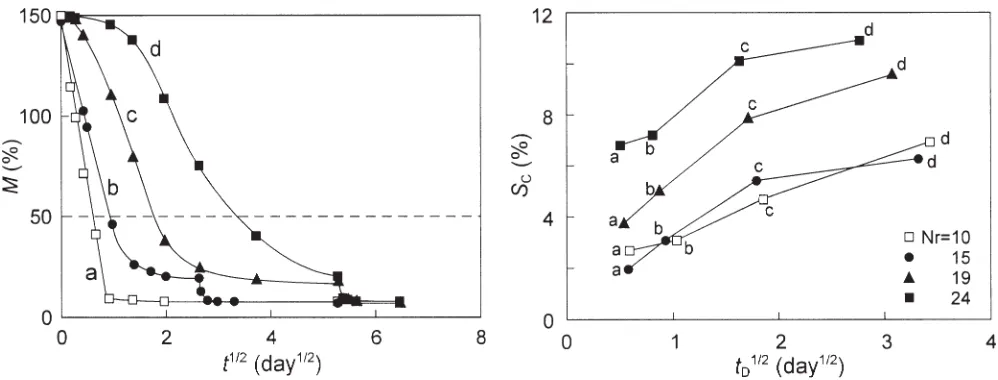
Figure 3 shows the average moisture content (M) of cane plotted against the square root of drying duration (t1/2
). Because the most remarkable collapse of cane occurs at M above 50%,1
here we define the drying time (tD) at which M reaches 50%. The effects of tD on the intensity of collapse (SC) is shown in Fig. 4. Irrespective of internodes, slow drying resulted in high intensity of collapse. Similar results have been reported for the collapse in wood2
and bamboo,3 but no sufficient explanations were given.
Keeping in mind that collapse results from the competi-tion between the capillary accompeti-tion (the driving force) and the mechanical behavior of the cell walls (the resisting force), both the process duration and the temperature level have to be involved in the process. These two parameters are in-deed of utmost importance to the viscoelastic behavior of the cell walls. In addition, the actual sample temperature, rather than the air temperature, should be considered. Figure 5 shows the change in the surface temperature of a wet cane sample during drying at 30°C and 60% RH. The surface temperature was very close to the wet bulb tem-perature (WBT) in the early stage of drying, and it gradu-ally approached the dry bulb temperature (DBT) until the fiber saturation point (FSP, M ⬇ 20%). When a sample is small enough to neglect the internal temperature gradient, the surface temperature can be representative of the sample temperature. Because the collapse of cane occurs above the FSP,1
the sample temperature relevant to the mechanical
phenomenon corresponds to the WBT depending on the RH. At a given air temperature (DBT), both the drying time and the WBT increase as the RH increases. These cumulative effects can explain why the drying rate has such an effect on the collapse. In the present case, however, the possible variation in the sample temperature was not so wide, from 24°C (60% RH) to 30°C (90% RH) where the temperature dependence of collapse was very small as is shown later. Thus, although the actual sample temperature might strengthen the trend, it does not seem to be a domi-nant factor in determining the intensity of collapse, at least in the low temperature range discussed here.
The second interpretation is the shell effect. In general, the cell wall becomes rigid as the moisture content de-creases below the FSP. When a sample is rapidly dried, its outer surface is dried and stiffened much faster than the Fig. 3. Average moisture content (M) of cane specimens (Nr 15)
dried at 30°C plotted against the square root of drying duration (t1/2). a,
Dried at 60% relative humidity (RH) with air circulation; b, dried at 90% RH with air circulation; c, dried at 90% RH without air circula-tion; d, wrapped with filter paper and dried at 90% RH without air circulation; broken line, a threshold to evaluate the drying time (tD)
Fig. 4. Intensity of collapse (SC) plotted against the square root of
drying time (tD
1/2). Abbreviations besides plots indicate the drying
con-ditions explained in Fig. 3
rapid drying.
The third explanation is the viscoelastic effect. It is gen-erally accepted that cell collapse is induced by the liquid tension of free water, except for a few species showing the collapse due to drying stress.5
If the cane cell wall is an elastic medium, no collapse should remain in dry cane be-cause the cells must completely recover their initial shapes after the disappearance of free water i.e., the removal of load. However, the collapse of cane actually remains even after the disappearance of free water because the cell wall is viscoelastic and its deformation is not immediately recov-ered after the removal of load. In addition, a part of strain is fixed by the temporary rearrangement of amorphous molecules, so called drying-set, and it remains unless the materials are well softened by proper hygrothermal treat-ment. Thus, the collapse of cane and its recovery by steam-ing are understood as the viscoelastic yield of cell wall and the release of drying-set, respectively. When we deal with the collapse as a viscoelastic phenomenon, it is quite natural that longer loading due to slower drying results in more remarkable or frequent yield of cells, and also, it expands the duration required for the recovery of collapse. This explanation is also valid for the effect of drying temperature described later.
Effect of drying temperature
Figure 6 shows the effect of drying temperature on the intensity of collapse. The intensity of collapse increased with increasing drying temperature irrespective of the inter-nodes. As described above, faster drying results in less col-lapse at around room temperature. However, it has been suggested that the dynamic Young’s modulus of wet cane drops at its softening point, at about 90°C.6
This indicates that the wet cell wall yields more easily at higher tempera-ture because of its hygrothermal softening. In addition, it is considered that the faster drying does not allow the recov-ery of collapse after the disappearance of free water, while it effectively fixes the remaining collapse in terms of drying-set. These may be the reason for greater collapse at high temperature.
Although many factors must be involved, the viscoelastic effect seems to be the most important factor that
deter-Fig. 6. Effect of drying temperature on the intensity of collapse (SC)
mines the intensity of collapse. It can explain the effects of drying rate and heating temperature at the same time, that is, the time–temperature dependent phenomenon. For more detailed discussion, the static viscoelastic behavior of cane should be clarified in the future.
Effect of drying surface
The cane stem has a waxy outer layer where silica and other inorganic substances are condensed.7
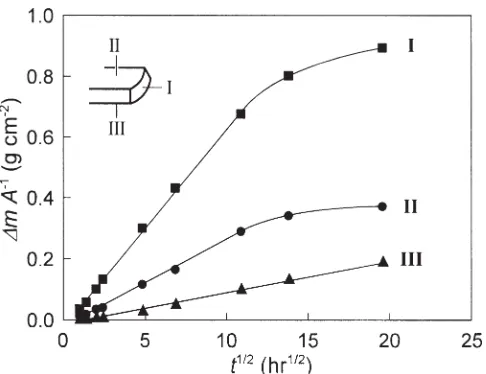
Such a layer was thought to retard the drying and to affect the collapse. Figure 7 shows the normalized reduction in mass (∆mA1
) of green cane specimens due to drying from transverse (I), inner (II), or outer (III) surfaces with the square root of drying duration (t1/2
). The reduction in mass (∆m) was nor-Fig. 7. Reduction in mass (∆mA1) of green cane specimens (Nr 5)
malized by the area (A) of the open surface. The ∆mA1 value increased linearly with t1/2
in the beginning of drying and then leveled off. From the linear correlation of ∆mA1 versus t1/2
in the range from 2 to 24 h, the drying rate (∆mA1
t1/2
) was evaluated. The drying rate is plotted against the node number (Nr) in Fig. 8. Irrespective of internodes, the drying rate of transverse section is twice that of the inner surface, and about seven times larger than that of the outer surface. The rapid drying from the transverse surface was attributed to the large vessels in vascular bundles, and the especially slow drying from the outer sur-face may be due to its dense and silicated structure.
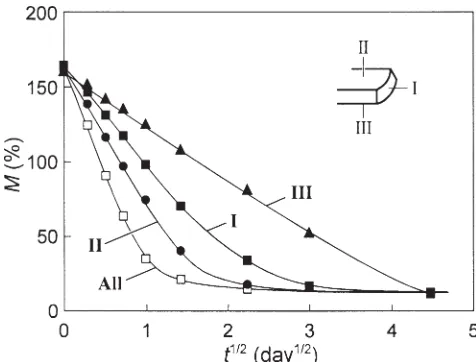
Figure 9 shows the reduction in M due to drying from different surfaces, and the SC values of the specimens are shown in Fig. 10. Drying from the outer surface caused the Fig. 8. Drying rate (∆mA1t1/2) at different surfaces of cane specimens
plotted against the position of internode (Nr). For abbreviations, see Fig. 7
Fig. 9. Changes in the average moisture content (M) of cane specimens (Nr 8) with the square root of drying duration (t1/2). All, dried from
all surfaces (unsealed); I, dried from transverse surface; II, dried from inner surface; III, dried from outer surface
Fig. 10. Intensity of collapse (SC) of cane specimens dried from
differ-ent surfaces. For abbreviations, see Fig. 9
most remarkable collapse probably because of slower dry-ing, whereas faster drying from the inner surface resulted in the least collapse. Interestingly, drying from the transverse section gave a relatively large SC value. It should be recalled that the cane specimen tested was only 2 cm long, and a steep moisture gradient could hardly be formed along the fiber direction. Furthermore, serious collapse was always observed in the middle layer where the parenchyma cells were less frequent than in the inner layer. A possible inter-pretation is that the differential drying of different tissues induced the collapse. The cane mainly consists of vascular bundles and parenchyma cells. Because the vascular bundle has large continuous vessels, it may dry much faster than the parenchyma cells. In this case, a steep moisture gradient can be formed between those two tissues to cause the collapse of parenchyma cells. Otherwise the shrinkage of thick cell walls in bundle sheaths might be a trigger for the collapse of surrounding parenchyma cells.
Effect of nodes
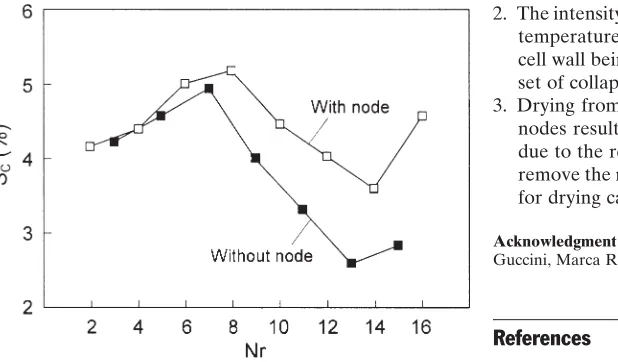
Because the presence of nodes retards drying from the transverse and inner surfaces of cane, the cane tubes with nodes dried much more slowly than those without nodes. Figure 11 shows the effect of nodes on the intensity of collapse. In the presence of nodes, the intensity of collapse increased above the eight node probably due to retardation of drying.
Conclusions
Cane specimens were dried in various conditions and the intensity of collapse was evaluated. The results are con-cluded as follows:
1. The intensity of collapse was increased by slower drying. It was considered that higher sample temperature and longer loading of liquid tension due to slower drying induced more remarkable collapse, while rapid drying stiffened the surface to restrict the following collapse. Fig. 11. Intensity of collapse (SC) for cane specimens plotted against
the node number (Nr) 1. Obataya E, Gril J, Thibaut B (2004) Shrinkage of cane (Arundodonax) I. Irregular shrinkage of green cane due to the collapse of parenchyma cells. J Wood Sci 50:295–300
2. Kanagawa Y, Hattori Y (1978) Progress of shrinkage in wood I (in Japanese). Mokuzai Gakkaishi 24:441–446
3. Suzuki Y, Kikata Y (1955) Study on bamboo XI. Shrinkage of bamboo in heat drying. Bull Tokyo Univ Forest 50:117–125 4. May BK, Perré P (2002) The importance of considering exchange
surface area reduction to exhibit a constant drying flux period in foodstuffs. J Food Eng 54:271–282
5. Kobayashi Y (1986) Cause of collapse in western red-cedar. Mokuzai Gakkaishi 32:846–847
6. Obataya E, Norimoto M (1999) Mechanical relaxation processes due to sugars in cane (Arundo donax L.). J Wood Sci 45:378– 383