Research
Symposium
Proceedings
Exploring the Research
of Central Australia
Knowledge
Intersections
Hosted by Batchelor Institute
The art work used for the Knowledge Intersections Research Symposium is by Kathy Inkamala and is called ‘Bush Black Berries.’
Kathy Inkamala - Western Aranda
Born in Alice Springs, Kathy’s mum and dad come from Hermannsburg where there is a long tradition of watercolour painting. Kathy has developed a love of depicting the world around her through her early exposure to art making. Kathy’s real passion is in depicting the Indigenous bush foods that she gathers and eats. Kathy completed her Certificate IV in Visual Arts at the Institute in 2016.
Kathy completed the Certificate II in Spoken and Written English in 2010 and a Certificate I in Visual Arts in 2014.
Batchelor Institute of Indigenous Tertiary Education Post Office, Batchelor, NT 0845
Phone: (08) 8939 7111 Fax: (08) 8939 7334 Freecall: 1800 677 095
© Batchelor Institute of Indigenous Tertiary Education 2017 Publication designed by Stevi Thomas
All rights reserved. Except as permitted under the Copyright Act 1968 (Cth), no part of this publication may be reproduced, stored in a retrieval system, or transmitted in any form by any means, electronic, mechanical, photocopying, recording or otherwise, without the prior written permission of the Publisher.
On Thursday 18th May 2017 the Desert Peoples Centre campus of Batchelor Institute hosted the inaugural Knowledge Intersections Research Symposium. This event came about out of a desire to showcase and share the excellent research work being done across the central Australian region. It was also an opportunity to explore the ‘Knowledge Intersections’ to be found across and between this work.
It was intentionally held in harmony with the NT Writer’s festival which took place from the 18th to 21st May, 2017. The theme of the NT Writers’ Festival was ‘Crossings | Iwerre-Atherre’. This theme, and the conceptual work behind it, was carefully developed by the NT Writers’ Festival organisers. The language in the title came from local Arrernte people who interpreted crossings as iwerre-atherre, meaning two roads meeting, neither blocking nor erasing the other; two-way learning or travelling together.
The theme ‘Knowledge Intersections’ was adopted for the research symposium to encourage local researchers to share how the research work they are doing reflects these thematic ideas. Specifically presenters at the symposium were challenged to reflect on these two questions;
• How can/does research help create intersections or meeting points for knowledge systems, without one blocking or erasing the other?
• How does two-way learning happen in research and how does it help us to travel together?
Researchers from across the central Australian region presented on diverse topics including Indigenous Ecological Knowledge, the boarding school experience, collaborative publishing projects, literature, resilience, decolonising education policies and practices, narratives, poetry and visual arts.
Included here are papers by most of the presenters from the symposium. We offer them as a record of the ideas shared on the day and a way of engaging with the intersections of knowledge even further. These papers have been peer edited.
The papers will also be included in a special peer reviewed issue of the Journal of Intercultural Studies in 2019.
Enjoy!
Dr Lisa Hall
On behalf of the symposium organising committee Batchelor Institute, DPC campus Alice Springs November 2017
Listening to Anangu Talk
Janine Oldfield and Vincent Forrester
Race, Rules and Relationships: What can Critical Race Theory
offer contemporary Aboriginal boarding schools?
Tessa Benveniste John Guenther, Sophia Rainbird, Drew Dawson, Lorraine
King
Representations of Indigenous cultural property in collaborative
publishing projects: the Warlpiri women’s
yawulyu
songbooks
Georgia Curran, Margaret Carew, Barbara Napanangka Martin
Remapping the landscape of resilience: learning from an Arrernte
teacher’s story
Al Strangeways and Lisa Papatraianou
Writing from somewhere: Reflections on positioning in research
Majon Williamson-Kefu
Walking, frontier and nation: re/tracing the songlines in Central
Australian literature
Glenn Morrison
Intersections: artistry and narrative in intercultural and
educational research
Judith Lovell
Possibilities for collaborative, intercultural visual arts practice
Jennifer Taylor
Making space for knowledge intersections in remote teacher
education: ways of being and tools for doing
Lisa Hall
Strengthening Australian Aboriginal participation in university
STEM programs: A Northern Territory perspective
Sam Osborne, Kathy Paige, Rob Hattam, Lester-Irabinna Rigney, Anne
Morrison
List of papers and authors
5
18
32
45
57
63
78
93
100
Listening to Anangu Talk
Abstract
This paper arises from PhD research on an Australian, Northern Territory (NT) language education policy, ‘Compulsory Teaching in English For the First Four Hours of Each School Day’, led to the synergy of research evidence from two knowledge systems. Initiated in response to local NT Indigenous concerns, the research explored these concerns in detail using qualitative critical case study ethnographic across-cultural research approaches.
This paper describes how Indigenous knowledge in relation to policy effects not only informed methodology but confirmed regional, national and international research in the field of bilingual education. In contrast, a critical discourse analysis on policy texts and discourse exposed flawed rationality and fallacy. This latter analysis was informed by Fairclough (1989) and Reisigl and Wodak’s (2009) Historical Discourse Analysis, as well as the works of Foucault, Bourdieu, and others. As such, this paper explains how the research explored the issue of policy analysis and effects to afford a western explanation with Indigenous perspectives as the foundation of research that can help us travel the knowledge journey together.
Janine Oldfield
Batchelor Institute
PO Box 1580 Alice Springs, NT, 0871 Australia
The Australian Northern Territory (NT), with a land mass equal to Germany, France & UK but with only 230,000 inhabitants (or 1% Australia’s population), has the highest percentage of Indigenous people and the largest number of Indigenous language speakers in Australia (Devlin, 2011). It also has some of the world’s highest illiteracy rates (Kraal, 2011). It thus represents, in normative terms, the country’s largest Indigenous education ‘problem’. Invariably in Australia, such Indigenous problems as education, health, and economics are said to entail complex issues of difference and disadvantage. Australian education researcher John Guenther (2015b) maintains that this ‘complexity’ and attendant mainstream befuddlement in Australia is actually a product of the failure to study Indigenous systems from within, a failure to capture the voice and perspectives of those who live within these systems and can make sense of them. This failure, moreover, ratifies racialized notions of deficit and ‘difference’, and reinforces concepts of disadvantage where none may exist in the minds of those in such systems (Guenther, 2015b). This failure, as such, only reinforces policies and solutions that do not enact real change where, according to NT linguist Christie, “’Real change’” will only occur, ... when categories are unsettled, where we have conversations which allow us all to rethink our assumptions and our possibilities” (Christie, 2013: 10).
The PhD research on which this paper is based, a critical analysis of the 2007 Northern Territory First Four Hours of English (that led to the NT Indigenous bilingual education policy vacuum), was a response to concerns from within ‘complex’ Indigenous social, educational and economic systems and a desire to enact ‘real change’ eschewed from a normative discursive rendering of Indigenous failure and deficit. It was therefore not only sensible but crucial that collaborations of power and knowledge should conjoin to ensure the pre-eminent place of Indigenous voices and perspectives in an academic debate on bilingual education.
This paper traces how deference to Indigenous expertise and cultural perspectives or voice, a process known as decolonising research (Tuhiwai Smith, 1999), led to a successful synergy of Indigenous and academic knowledge systems. It also highlights, however, the ‘mismatch’ between these knowledge systems that could have jeopardised the research entirely. Initially, this paper outlines the findings of the project’s community research that confirmed regional, national and international research in the fields of bilingual education and critical language planning and policy studies (CLPP). It then describes the policy analysis findings, using Reisigl and Wodak’s (2009) Historical Discourse Analysis, of flawed rationality and fallacy (described in more detail below). The majority of the paper, however, is devoted to an explanation and analysis of the methodology that led to knowledge system synergy in this project. It also outlines some of the hindrances involved in working across two knowledge systems and suggests ways to bridge this divide by recognising power and difference through the use of Indigenous methodologies.
Data Collection -Travelling Together
The primary aim of the research was to gather the perspectives and views through interviews of remote Indigenous people heavily and directly affected by the Northern Territory Compulsory Teaching in English for the First Four Hours of Each School Day (FFHP)(2008). It was also to critically analyse, using critical discourse analysis (CDA), this ground breaking education policy that attempted to abolish (Indigenous) bilingual education. This community line of inquiry is discussed initially.
The communities
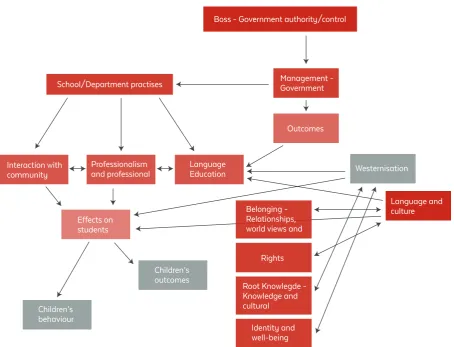
Boss - Government authority/control
School/Department practises
Outcomes
Interaction with community
Effects on students
Children’s outcomes
Children’s behaviour
Root Knowlegde -Knowledge and cultural
Identity and well-being
Language and culture Westernisation
Rights Professionalism
and professional LanguageEducation
Management - Government
Belonging - Relationships, world views and
Figure 1: Categories and Subcategories generated by content analysis and how they are related (how they influence each other) (Taken from Oldfield, 2016: 203).
Historical discourse analysis was then conducted on key interview excerpts.1 These themes arising from the content
analysis and discourse analysis, appearing above (Figure 1), were reflected back to participants and co-workers in subsequent visits and discussions. An important element of these interviews was the fact that they were with both children and adults and were semi-structured, which allowed a negotiation and collaboration to occur in the research. Also importantly, adult interview participants were selected using snowball interviews (where participants referred the researchers onto to other participants) and were purposive (non-probability and non-random). That is, adult participants were selected for their authority, their educational and/or leadership experience and cross-cultural and cross-cultural knowledge. They brought with them an enormous skill and knowledge set that is recognised regionally, if not nationally (see also Hall, 2016, on the need to recognise participant Indigenous expertise and capacity).
The major analysis outcomes of interview research in terms of the negative effects of the policy were largely framed in terms of injustice, inequality, hegemony, victimisation and danger (to students in relation to academic conditions and achievement as well as social and emotional well-being and social dysfunction). They also demonstrated considerable explanatory logic and complexity but an absence of dominant categorisation (neoliberal socio-economic notions). Moreover, the negative effects of the policy - poor well-being and academic outcomes, increasing social dysfunction, truanting and classroom behavioural management issues, poor socialisation, poor development of self-regulatory behaviour and self-destructive conduct as well as poor identity formation - were supported by international research (Baker, 2011; de la Sablonniere, et al, 2011; Collins, 1999; Cummins, 2000;
1 It is not the intention in this paper to elaborate on this highly attuned Western method of analysis, Historical Discourse Analysis (HDA). It is
Devlin, 1995; Gale et al, 1981; Guenther, 2015a; Ochs & Shieffelin, 1996; Malcolm, 1998; May, 2012; Wilkins, 2008 to name a few). The articulated reasons for these negative effects - insufficient first language development, the marginalisation of traditional Indigenous authority and the imbuement of youth with values and ethics antithetical to those in traditional Indigenous cultures - were also supported by the national and international research noted above.
The policy
The policy texts and discourse under analysis included the policy itself, an opinion piece by Marion Scrymgour, the Education Minister who introduced the policy, a Hansard text (a letter from the then Federal Education Minister, Julia Gillard, in response to a petition against the FFHP), and the transcript of a Four Corners interview with Gary Barnes (the Education Minister successor to Marion Scrymgour). Contrastingly, examination of the policy text and discourse disclosed language and cultural hierarchies, Indigenous cultural and linguistic deficit discourse, (highly outdated) behavioural approaches to literacy learning and teaching in addition to the need for mainstreaming and ‘normalisation’ of Indigenous communities so that they conform to nation-state values and norms (assimilate) and thereby overcome an embarrassing “poorly functioning political system” (Altman & Hickson, 2010: 188). It also included neo-liberal logic, particularly individual responsibility for poor and destructive choices (such as the failure to learn in a dominant language), to justify dominant monolingual instruction and explain Indigenous educational failure. These were expressed using metaphors of war that suggested a “governing crime” approach in education aimed at the neglect of parents and caregivers (Anthony, 2010: 90). In addition, this reasoning was underpinned by fallacy or the violation of ethical and logical/rational rules of argumentation in addition to contradicting all authoritative and valid national and international evidence on second language acquisition and education (such as that cited above).
The implications of the findings of this research are profound in the demonstration of the NT Department of Education’s failure to understand the role of language in education in addition to the creation of a highly racialized discourse which forms the foundation of discussion on (poor) NT educational practice. The research’s disclosure of racialized discourse strategies and the high degree to which they were applied in the text was importantly complemented by analysis of community interviews. Without the latter, not only would the impact of the policy discourse analysis not be realised, but, given how the research evolved, the research may very well not have occurred at all.
Listening
As with a growing body of Central Australian research, this research was initiated by the concerns of Indigenous community members themselves. That is, it represented an outcome of a “collective public problem” (Hall, 2016: 106)FF. As such, it did not represent a career step for the non-Indigenous researcher but rather a chance to air grave grievances and effect transformation. It arose from a series of community meetings in 2009 about the FFHP (one of which occurred in Alice Springs) and personal discussions with remote Indigenous teachers and Batchelor staff members involved in teacher education at Batchelor Institute. That is, it represented a good example of ground-up research which demanded sensitivity to Indigenous perspectives and ways of doing things. It was this approach that informed the methodology and allowed collaborative Indigenous ‘research strategies’ to comprise the basis of data collection and analysis as opposed to the use of traditional ‘top-down’ western research “done ‘to’ Indigenous people” that “produced few benefits for the Indigenous communities themselves” (Hall, 2016: 90).
Listening with head - De-colonising research
This process results in both a terra nullus or invisibility of Indigenous cultures, languages and people in Australia in public texts and policy discourse in addition to an attempted, but incomplete, fixity of an essentialised Indigenous identity and culture that is also tied intricately to dominant notions of Indigenous authenticity (Bhabha, 1990). Contemporaneously, Indigenous invisibility and essentialisation has been conjoined with racialized neoliberal ideologies that are dismissive of “the reality of racism as a powerful explanatory factor in analysing persistent racial inequalities” (Davis, 2007: 349-350). These ideologies, in effect, have created an essentialised, dysfunctional and demonised Indigenous identity that renders Indigenous people responsible for their own marginalisation and socio-economic failure. Australia’s best representation of such ideology as policy is seen clearly in the Northern Territory Emergency Response of 2007.
In contrast, de-colonising methodologies act to ensure an Indigenous-centric position where ongoing colonisation, inequality and hegemonic discourse is both recognised and analysed and research agendas are focused on the “states of being ... survival, recovery, development and self-determination” (Tuhiwai Smith, 1999: 116).2 While
de-colonising research relies heavily on postcolonial and critical race theory (which challenges dominant discourses by undermining the “universality of white experience/judgement as the authoritative standard”, Calmore, 1992: 2161-2162), there remains a “foregrounding [of] indigenous voices and epistemologies” (Swadener & Mutua, 2014: 31).3 In addition, the research, invariably nuanced by postmodernism and the social complexity this entails, is often
inherently critical with roots firmly planted in the traditions of Marxism, Habermas’ emancipatory knowledge and Freire’s emancipatory education (Merriam, 2014). This results in the research being framed “in terms of power - who has it, how it is negotiated, what structures in society reinforce the current distribution of power” (Merriam, 2014: 10). That is, decolonising research focuses on who dominates in our knowledge, the mechanisms they use to dominate in the framing of current realities, how these are being reinforced, what their consequences are, and how can we overcome the effects.
Listening with the heart – Indigenous Methodologies
De-colonising methodologies intersect with what is commonly termed Indigenous methodologies. Indigenous methodologies describe a set of relational research strategies. Hall (2016) maintains that an ethics of
“responsibility”, a reciprocity, forms the basis of such relational strategies. This ethics is not just related to relationships between researcher and community but, more importantly, an understanding of the relational ontologies and axiologies of Indigenous peoples (Hall, 2016). In this paradigm the researchers’ relationship to knowledge itself is and must be different (Hall, 2016: 94). It is this relational element that allows the de-colonising and Indigenous methodologies researcher to know “when to wait for a response ... when and when not to foreclose a situation” and when to be “playful” or “serious” (Thrift, 2004) and so ensure “encounters” are both productive and responsible. These encounters are enhanced when the researcher has some knowledge and experience of the participants and the context in which they live (Hall, 2016) which is the case in this project, as the Indigenous researcher came from the region and the non-Indigenous researcher had remote teaching experience, teacher training at Batchelor Institute and had married into an Anangu family.
Ray (2012) has described two types of Indigenous methodologies, both of which derive from decolonising
processes. One, strategic Indigenous methodologies, acts as a political device with anticolonial and anti-oppressive objectives. The principle operating framework of this methodology is the elucidation of power relationships in relation to Indigenous people (Ray, 2012). That is, research methods aim to capture “Indigenous agendas and contemporary Indigenous experiences of oppression, colonization and resistance” (Ray, 2012: 89). It thereby has its roots in critical postmodern theory. This is overlaid with a “transformative praxis” that creates or extends the intersection between the two knowledge systems and allows Indigenous people to “speak back to scientism, identify linier thinking as problematic for utopian visioning, and to bring attention to transformative work” (Ray, 2012: 89). Strategic Indigenous methodologies, however, have their limitations and cannot be applied to traditional Indigenous knowledge systems and alternative understandings since this would reinforce, as opposed to liberate, Indigenous peoples and knowledges from Western circumscription.
2 Tuhiwai Smith (1999) notes that ‘recovery’ refers to “recovery of territories, of Indigenous rights and histories” - an often crises-oriented
process to prevent their destruction.
3 In the case of the PhD research, postcolonial theorists included Foucault (1977, 1982, 1984) as well as critical settler colonial theorists such
The other Indigenous methodology of ‘convergence’ (a junction) is linked closely to that described by Hall (2016) and has the underpinning principle of relationality (Ray, 2012). This methodology represents the relationship of the researcher to western and Indigenous ideas and theories that inform the research but ensures these ideas, knowledge and methods remain “rooted within their respective knowledge systems” (Ray, 2012: 92). Kovach (2005) has identified some methodological strategies that could be considered to belong to Indigenous epistemologies but also have some intersections with western methodologies. These are;
a) experience as a legitimate way of knowing;
b) Indigenous methods, such as storytelling, as a legitimate way of sharing knowledge;
c) receptivity and relationships between researcher and participants as a natural part of the research ‘methodology’; and
d) collectivity as a way of knowing that assumes reciprocity to the community (Kovach, 2005:28) However, it is in this realm of Indigenous methodology that Indigenous academics question whether non-Indigenous researchers can operate under given the influence of economic, political, and sociocultural positioning on (as well as linguistic knowledge of) the researcher which influences “how research is collected and interpreted” (Dunbar, 2008: 86). However, a blanket rejection of the work of non-Indigenous researchers is also problematic since it suggests a stereotypical rather than a dialectical, dynamic and multiple positioning that is now recognised in postmodern theory (Dunbar, 2008). Jones and Jenkins (2014: 5) warn, however, that productive Indigenous research necessarily entails an interrogation and acceptance of the “lndigene-colonizer hyphen” or divide.
Indigenous and coloniser researchers and participants necessarily speak from different social positions determined by language, culture, politics, power and inequality. While this can mean that there is often “enough shared ground ... it also means that sometimes we speak separately - depending on the audience, the standpoint, or the politics” (Jones & Jenkins, 2014: 5). The danger in removing or not acknowledging the hyphen (difference) is that language becomes that of “hybridity, a codeword for sameness”. So, the hyphen must remain and, indeed, is to be “protected and asserted”, they contend. As Verran (2013: 144) notes, this acknowledgement of difference allows us to accept that “we may not be metaphysically committed to a common world” and to cultivate “a postcolonial impulse” and thereby decolonise the research process.
Such an awareness and approach means that a western voice often overlays the research of non-Indigenous researchers but the voice of Indigenous participants and co-researchers co-inhabit the collaborative space and comprise the fabric of research, as in this thesis. It could be said, therefore, that the research on language policy was predominantly strategic. However, the post-positivist Indigenous methods of research (that include the value of participant experience through interviews and story, the relationship of the researchers to the participants, collectivism, collaboration and the responsibility of the researchers to use the research on behalf of the communities as a measure of reciprocity) necessarily involved convergent methods since it was these methods that ensured the hyphen remained intact through an acknowledgement and closer alignment to Indigenous ontology and epistemology (Wilson, 2008).4
Regardless of these problems and issues, the inclusive change in research agendas that have arisen with Indigenous methodologies has led to increasing power and control over research projects and agendas by Indigenous communities, although this is not necessarily guaranteed due to the continued power of western academies (Tuhiwai Smith, 1999). However, it can lead to the validation of a community’s own definition, parameters of inquiry and perspectives (Tuhiwai Smith, 1999) which was the principle aim of the research under examination in this paper.
De-colonising research methods
Tuhiwai Smith (1999) notes that one of the most efficacious ways of ensuring Indigenous research agendas is with community research projects. In this research, an Indigenous research agenda was achieved with community based participatory research and ethnographic research (where the researcher takes on the role of participant observer). This involved participants as co-researchers to the degree that the two researchers took the lead from community members in terms of who to talk to and, to a degree, what to talk about in a dialogic egalitarian format. Given
4 This discussion of types and degree to which they apply to a particular line of research demonstrates how evolving Indigenous
the non-Indigenous researcher’s relationship to Batchelor and her Indigenous co-researcher and his relationship to the two communities, it was probably easier for the non-Indigenous researcher than other non-Indigenous outsiders to attain more equal positions of power with community participants and to get access to willing community participants. This process of collaboration involved review, revision and the reaffirmation of transcripts and research findings and even the use of more appropriate methodologies (Guenther, Osborne, Arnott, McRae-Williams & Disbray, 2014). Technically it involved the use of snowball interviews (where key community members were identified, interviewed and asked for referrals to others); regular consultation and debriefing (over a number of cite visits on a number of occasions); checking and re-checking data with participants (where transcripts were sent by post or read personally); the implementation of semi-structured interviews (that allowed participants to pursue topics of their choice or delve more deeply into topics); as well as personal (face-to-face) culturally appropriate interviews. That is, community members were regularly debriefed at site visits, there was regular consultation with key community members, and participants reviewed interview data and interpretation to ensure a community based analysis of social problems existed in the research, as opposed to a skewed interpretation from outside.
Generative, Both Ways, Indigenous methodologies
The research was not a fluid process but a dynamic ‘toing and froing’ and a ground-up practice that involved what Christie (2013) has termed generative research methodology. As Christie (2013) noted, this process entails;
The crucial, very local Aboriginal politics of sharing and concealment, ownership and boundary-making ... one that, following their lead, refuses the role of judging observer, and uses collaborative knowledge work to generate new methods, new objects, new practises and new worlds.
Indigenous researcher, Lana Ray (2012) noted that Indigenous methodologies become,
... operational through a mix of approaches and theories that [are] grounded in or congruent with pan-Indigenous principles and/or experiences such as colonialism ... [It involves] taking pan-Indigenous peoples’ understandings about the world and using them to guide a learning process. In this sense, what [is] inherent to the notion of Indigenous was working within Traditional ontological and epistemological learning processes (Ray, 2012: 87-88).
I liken Indigenous methodologies to the relationship between traditional story tellers and story holders where the story teller is instructed and compelled to tell the story according to the rules and interpretations handed down by the story holders but where there is a recognition that the story telling, while collective, allows for personal nuances and interpretations. Hall (2016: 116) and the Indigenous participants in her research have critically examined the Indigenous methodologies used in her project and referred to the process as ‘anma’ (a term that describes everyone flexibly working together, at their own pace and in their own time), ‘marl pa’ (which relates to friendship, rationality and “not leaving anyone out”) and Ngaparti Ngapartji (which translates as ‘you give, I give’ and relates to the fact that everyone’s needs must be met). These diverse views and interpretations of Indigenous methodologies attest to the dynamism of Indigenous research and its context dependence. It relates to the fact that research is determined by the research place, people, focus and content which in turn determine the type, hybridity and degree of Indigenous and non-Indigenous research strategies at work in Indigenous methodologies. However, to ensure Indigenous voices are not captured by western positivism, Indigenous guidance is required to override the process. The process of community participatory research in this research also meant that the community became a stakeholder in and owner of the research, that there was a reciprocity and “privileging of Indigenous voices” and participant power and agency (Rigney 1999 in Henry, et al, 2008: 8). We would deem this ownership the most important element of the collaboration in data collection and interpretation since it ensured exceptionally high care and consideration of participants’ views which enhanced the validity and reliability of data. Such ownership was further cemented with written agreements for the use of data in the PhD and other publications.
Hindrances
to maintain ethical standards which is underpinned by engagement. In agreement with Shay (2016), however, I propose that the NHMRC document poses some difficulties since it is written to a non-Indigenous audience and so does not necessarily encapsulate the positioning of all Indigenous and non-Indigenous researchers and the colonial context in which they work. Written also from a medical institutional perspective, it is problematically applied to educational and other institutions (Shay, 2016), particularly if the NHMRC is the ethics body through which the research requires clearance, which is the case for Central Australian Indigenous research. The following narratives illustrate some of the problems experienced in this process.
Moving through Ethical Processes
The first ethics application that was submitted was rejected due to possible ‘leading’ interview questions for Indigenous and other participants. This was anticipated to an extent given the high degree of political ‘sensitivity’ associated with remote Indigenous language education and Indigenous issues in general. These questions for Indigenous participants, where English was a second, third, fourth or fifth language, were created in conjunction with the non-Indigenous researcher’s main supervisor (where both the non-Indigenous researcher and the supervisor were English as a Second Language Teachers and had considerable ESL teaching experience in Central Australia). The original questions purposefully avoided advanced grammatical and academic English constructions such as conditionals, passives and nominalisation in order to reduce abstraction and focus on the ‘message’. To ensure the ethics went through the second time, the questions were restructured to a form that was at times unusable, due to the grammatical complexity and abstraction, in the interview process. This suggests that the ethics process is flawed and does not necessarily account for the needs of Indigenous research projects.
Big Brother
The research process in this case also required contact with the Northern Territory Department of Education as a starting point which was a colonial institutional power that was clearly threatened by the research, particularly given the fact that the research focus was Indigenous views on dominant language education. Despite the shocked surprise of one of the southern state supervisors, the non-Indigenous researcher did not expect to get research permission in the schools and received a polite letter that rejected the proposal for having poor research value (being qualitative rather than quantitative)5 and no key or important research identities attached to the research
(despite the principal supervisor running his own United Nations projects on the same issues and being a world leader in his field). They wished us luck on future research endeavours in a vain belief that this research would now cease. On the ‘upside’, not only did the research continue, but the rejection resolved the awkward problem of having to critique working teachers and principals at the schools which was not the main focus of the research project. As part of the NT Department of Education research protocols, the researchers were also required to contact the school principals from each community to ask if they would support the research. Given the sensitive topic of the research, one principal and their regional director were completely uninterested, stating that there was already a research project in that school (which never eventuated) while the other (an operating bilingual school) welcomed the research. Interestingly, the principal at the latter school was chastised for their supportive email communication with us despite this being the protocol for research applications.
Shire Conquest
After the rejection of this research by the department, the Shire council offices were then approached in the research locations to get evidence of ‘community’ permission and support for the research (as stipulated in the NHMRC guidelines). This, in fact, presented a quandary given the lack of Indigenous participation and leadership involved generally in Shire councils in the NT. The shires often represented non-Indigenous organisations that had been imposed on remote NT communities after the forced disbandment of remote NT Indigenous community councils and the acquisition of their assets in 2008 (even though some were nearly independent of government resources due to the success of their collective enterprises). As such, their permission would not necessary be representative
5 This is despite the fact that qualitative research has been acknowledged by Denzin and Lincoln (2008, 2011) as a major methodological
of community opinion and they embodied another colonial ‘gateway’ (see below) through which researchers on Indigenous issues have to navigate.
However, we were very fortunate. We knew we already had the support of one community, since they were entirely related to the Indigenous co-researcher, and had been important activists for bilingual education. The contact in the Shire Office at this community also happened to be related to the co-researcher. In the other community, they too had a long tradition of bilingual education and we were relying on that, the close ceremonial ties with the community of the Indigenous co-researcher and the close co-operation of the community with Batchelor Institute in the past. Fortunately again, we had a strong ally in that office who had grown up under the bilingual education system in that community. She quickly put us in contact with important participants at that site.
The peril in Indigenous research
We reflected at the time that it was only because of the experience at Batchelor Institute and dealing with institutional authorities in remote communities as well as existing familial relationships that the non-Indigenous researcher knew who to approach to begin with. Our relationships with people in one community (convergence) also meant we had an ‘automatic in’ and it was ‘pure luck’ that we managed to contact someone in the other community that was not hostile to our research. Both Shire offices could easily have ignored or rejected our research project with little justification. We wondered how anyone else without the community and ceremonial ties could possibly commence research under such conditions where the contentiousness of the research topic nearly resulted in the capriciousness and whimsy of gatekeeper institutions quashing the research project. Community research would have also been problematic for others since it was almost impossible to identify who to contact in order to begin the research process or enlist participants. It confirmed what other researchers, such as Shay (2016: 280) claim to be ongoing problems of Indigenous research, that of research in “a discipline and context that perpetuates imperialism, racism and exclusion”. As Shay (2016) states:
Principles such as self-determination and consultation are nearing towards impossible when Indigenous [and other] researchers seek to undertake Indigenous research in education contexts and I would propose other institutional settings also. The regulating and governing of research agendas in education lays squarely with either bureaucrats in a large system or education leaders who are in charge of individual school sites (Shay, 2016: 280).
Schools and other institutions are the mechanisms by which to generate a unified national polity as well as a hegemonic discourse that prescribes the ‘norms’ and ‘values’ of the nation-state through regulation, disciplining and punishment (Foucault, 1977; Shay, 2016; Tuhiwai Smith, 1999). The gatekeepers in these systems, the bureaucrats or site managers (including school principals), help to create a system of power and discipline which ensures the “wishes” of the dominant are inscribed in ”docile’ bodies” that “operate as one wishes” (Foucault 1977:138). Foucault (1977: 199) maintained, these “mechanisms of power” are contemporaneously exerted against the “abnormal individual, to brand him and to alter him” and even to render him terra nullus.
The implications for the researcher of Indigenous issues is that western institutions, and in particular educational departments and schools, will likely harbour values and norms that are not only anathema to the researcher, but obstructive to Indigenous research (to Indigenous experience and voice) given the positioning of Indigenous people. Although the navigation of such systems is not necessary as traumatic for non-Indigenous researchers since they may not have to repeatedly ‘navigate’ these institutions as a marginalised ‘abnormal’ outsider (both as student and researcher) (Shay, 2016), it is still distressing for those who have developed a close relationship to people in Indigenous communities, who value their values, skills and perspectives but are denied the ability to voice these in research due to protectionist discourse and gate-keeping roles.
to institutional gatekeepers (who are largely ‘white’ and ‘male’) in some institutions, will overwhelmingly dictate whether research goes forward at all, as in this research.
Shay (2016) contends, as such, that the current research process involved in Indigenous research has the same inequity that has plagued Indigenous issues for the last two centuries and claims the protectionism (the vulnerability of Indigenous people) embedded in the ethics and research process is a manifestation of the continuing social inferiority and subordination of Indigenous people. It does, as such, have the potential to
perpetuate the “absence of voice” and the “exclusion of ways of knowing from the perspectives of marginal groups” in Western knowledge systems (Kovach, 2005: 21, 22). However, Indigenous support, participation and research processes in Indigenous research (the convergent Indigenous methodologies), as in this project, can allow the researcher to hoe a research path overgrown with dominant western perspectives and power.
Interestingly, Kovach (2005) also argues that additional strain in navigating between two knowledge systems arises from the western academic emphasis on product, versus the Indigenous focus on process (which accentuates relationships and consultation), and individual versus collective ownership and rights of storytelling. From the convergent Indigenous methodological perspective of collectivity, ownership is community based and shared (as a consequence of reciprocity in responsibility) which was a concept completely foreign to one of the supervisors. However, tensions between the two knowledge systems can be overcome Kovach (2005: 33) argues with the increasing development of “methodologies from the margins”, or transdisciplinary research (Christie, 2006) such as the methodologies used in this research. Such methodologies will refine and develop the tenants, principles and processes of Indigenous methodologies in order to have a substantive place in the academy. In this regard, Kovach (2005: 33) writes;
The sustained autonomy but continued alliance between such approaches in crucial. Mutually beneficial and open-spirited dialogue that is critically reflective of each other’s practice will be necessary for growth. As positivism holds fast to its turf inside the academy, the methodologies from the margins will need each other (Kovach, 2005: 33).
In conclusion, this paper has attempted to outline the dynamic, rewarding but also problematic research path when one attempts to conjoin two knowledge systems and have Indigenous research participants ‘speak back’ to the academy. It initially outlined the community participatory and collaborative process involved in the critical research method and the findings of qualitative content and discourse analysis that showed communities under threat, imposed upon from above and metered unjust and iniquitous policy measures. It then outlined the critical discourse analysis findings of the policy itself and disclosed highly negative racialized discourse that had no basis in fact. The paper then discussed the community collaborative process in more detail in terms of decolonisation to create an Indigenous centric position in knowledge making and the use of Indigenous methodologies where the operation of power is elucidated and where Indigenous research methods are used (such as narration) and principles of collaboration are invoked (such as reciprocal responsibilities and learning together). Finally, it documented the hindrances that occur in research in an Indigenous space through western gatekeeping where, because of the highly sensitive nature of the research, researchers can be obstructed from researching in particular institutional domains. The research illuminates the power imbalance that remains in Australian, and particularly NT, Indigenous research spaces both in terms of research access (despite the identified importance of a research issue) and research focus in addition to the use of methodologies that focus on process and collaboration as opposed to ‘product’. This paper also argued, however, that such obstructions can be overcome with the continued development of collaborative research methodologies in the transdisciplinary Indigenous-Western research space.
References
Altman, J. and Hinkson, M., 2010. Very risky business: The Quest to Normalise Remote-living Aboriginal People. In G. Marston, J. Moss and J. Quiggin, eds., Risk, Welfare and Work. Carlton Vic: Melbourne University Press, 185-211.
Anthony, T., 2010. Governing Crime in the Intervention. In P. Billings, ed., Indigenous Australians and the Commonwealth Intervention. Annandale, NSW: Federation Press, 90-114.
Philadelphia, Adelaide: Multilingual Matters Ltd.
Bhabha, H. K., 2004. The Location of Culture. London and New York: Routledge. Calmore, J.O.,1992. Critical race theory, Archie Shepp and fire music: Securing an authentic intellectual life in a multicultural world. Southern California Law Review, 65,
2129-2230.
Christie, M., 2006. Transdisciplinary Research and Aboriginal Knowledge. The Australian Journal of Indigenous Education, 35, 78-89.
Christie, M., 2013. Generative and ‘Ground-Up’ Research in Aboriginal Australia. Learning Communities 13, 3-12. Collins, B.,1999. Learning Lessons: An Independent Review of Indigenous Education in the Northern Territory. Darwin:
Northern Territory Government.
Cummins, J., 2000. Language, power and pedagogy: Bilingual Children in the Crossfire Clevedon, Buffalo, Toronto, Sydney: Multilingual Matters Ltd.
Davis, D., 2007. Narrating the Mute: Racializing and Racism in a Neoliberal Moment. Souls 9 (4), 346-360. de la Sablonnière, R., Saint-Pierre, F. Taylor, D. and Annahatak, J., 2011. Cultural Narratives and Clarity of Cultural
Identity: Understanding the Well-Being of Inuit Youth. Pimatisiwin: A Journal of Aboriginal and Indigenous Community Health, 9(2), 301-322.
Denzin, N. and Lincoln, Y., 2008. Introduction: Critical Methodologies and Indigenous Inquiry. In N. Denzin, Y. Lincoln and L. Tuhiwai-Smith, eds. Handbook of Critical Indigenous Methodologies. Los Angeles: Sage, 1-19.
Denzin, N. and Lincoln, Y., 2011. The Sage Handbook of Qualitative Research. Los Angeles: Sage.
Devlin, B., 1995. The evaluation of bilingual programs in the Northern Territory. International Journal of the Sociology of Language, 1995(113), 23-36.
Dunbar Jr., C., 2008. Critical Race Theory and Indigenous Methodologies. In N. Denzin, Y. Lincoln and L. Tuhiwai-Smith, eds. Handbook of Critical and Indigenous Methodologies. Los Angeles: Sage, 85-99.
Fairclough, N., 1989. Language and Power. New York: Routledge.
Foucault, M.,1977. Discipline and Punishment: The Birth of the Prison. New York: Vintage Books. Foucault, M., 1982. The Subject and Power. Critical Inquiry, 8 (4), 777-795.
Foucault, M., 1984. The Order of Discourse. In M. Shapiro, ed. Language and Politics (Readings in Social and Political Theory). New York: New York University Press, 108-138.
Gale, K., McClay, D., Christie, M. and Harris, S., 1981. Academic Achievement in the Milingimbi Bilingual Education Program. TESOL Quarterly 15 (3), 297-314.
Garcia, O., 2009. Education, Multilingualism and Translanguaging in the 21st Century. In T. Skutnabb-Kangas, R. Phillipson, A. Mohanty and M. Panda, eds. Social Justice through Multilingual Education. Bristol, Buffalo, Toronto: Multilingual Matters, 140-158.
Guenther, J., 2015a. Overview of the Remote Education Systems research project qualitative results. Retrieved 24 March, 2015, from file:///C:/Users/Janine/Downloads/150324_Overview_of_RES_results-libre.pdf. Guenther, J., 2015b. The advantaged and disadvantaged of remote schools. Retrieved 11 May 2015, from
https://www.academia.edu/12170250/The_advantaged_and_disadvantaged_of_remote_ schools?auto=download&campaign=weekly_digest.
Guenther, J., Osborne, S., Arnott, A., McRae-Williams, E. and Disbray, S., 2014. Amplifying the voice of remote Aboriginal and Torres Strait Islander VET stakeholders using research methodologies. In 7th AVETRA International Conference, Informing changes in VET policy and practice, The central role of research. Surfers Paradise QLD: 22-23 April.
Henry, J., Dunbar, T., Arnott, A., Scrimgeor, M., Matthews, S. Muralakami-Gold, L. and Chamberlain, A., 2002.
Indigenous Research Reform Agenda: Rethinking research methodologies. Links Monograph Series: 2.
Melbourne: Cooperative Research Centre for Aboriginal and Tropical Health, 19. Retrieved from http://www. lowitja.org.au/sites/default/files/docs/IRRA2LinksMonograph.pdf.
Johnson, D. and Ricento, T., 2013. Conceptual and theoretical perspectives in language planning and policy: situating the ethnography of language policy. International Journal of the Sociology of Language, 2013 (219), 7-21.
Lo Bianco, J., 2001a. Officialising Language: A Discourse Study of Language Politics in the United States. Canberra: Australian National University, PhD, 367.
Lo Bianco, J., 2001b. From policy to anti-policy: How fear of language rights took policy-making out of community hands. In J. Lo Bianco and R. Wickert, eds. Australian Policy Activism in Language and Literacy. Melbourne: Language Australia Ltd.
Lo Bianco, J., 2007. Our (not so) Polyglot Pollies. Australian Review of Applied Linguistics, 30 (2), 21.21-21.17.
Jones, A. and Jenkins, K., 1998. Rethinking collaboration: Working the indigene-colonizer hyphen. In Denzin N., Lincoln Y., Smith L.T., eds. Handbook of Critical Indigenous Methodologies. New York: Sage Publications.
Kovach, M., 2005. Emerging from the margins: Indigenous methodologies. In L. Brown and S. Strega, eds. Research as resistance, critical, indigenous and anti-oppressive approaches. Toronto: Canada Scholars’ Press, 19-36. Malcolm, I. G., 1998. Cultural linguistics as a guide to bidialectal research and pedagogy. Applied Language and
Literacy Research, 1 (3). Retrieved 5 March 2013 from
http://pandora.nla.gov.au.ezp.lib.unimelb.edu.au/pan/22466/20011105-0000/www.cowan.edu.au/ses/research/ CALLR/onlinejournal/1998/Malcolm98.htm.
May, S., 2012. Language and Minority Rights: Ethnicity, Nationalism and the Politics of Language. New York, London: Routledge.
Merriam, S. B., 2014. Qualitative Research: A Guide to Design and Implementation, Wiley: Hoboken.
Mol, A. and Law, J., 2002. Complexities: an introduction. In J. Law and A. Mol. Durham, eds. Complexities: Social Studies of Knowledge Practices. Science & Cultural Theory. NC: Duke University Press, 1-22.
Moran, A., 2005. White Australia, Settler Nationalism and Aboriginal Assimilation. Australian Journal of Politics & History, 51 (2), 168-193.
Moran, H., 2008. Neoliberalism and Indigenous Affairs. Australian Review of Public Affairs. Retrieved 29 June 2015 from http://www.australianreview.net/digest/2008/04/moran.html.
National Health & Medical Research Council (NHMRC) Guidelines, 2003. Values and Ethics: Guidelines for Ethical Conduct in Aboriginal and Torres Strait Islander Research. Canberra: NHMRC.
Ochs, E. and Schieffelin, B., 1996. Language Acquisition and Socialisation: Three Development Stories and Their Implications. In B. Blount, ed. Language, Culture and Society; A Book of Readings. Prospect Heights, Illinois: Waveland Press, 470-512.
Ramirez, F. O. and Boli, J., 1987. The Political Construction of Mass Schooling: European Origins and Worldwide Institutionalization. Sociology of Education, 60 (1), 2-17.
Ray, L., 2012. Deciphering the “Indigenous” in Indigenous Methodologies. AlterNative: An International Journal of Indigenous Scholarship, 8 (1), 85-98.
Reisigl, M. and Wodak, R., 2001. Discourse and Discrimination: Rhetorics of racism and antisemitism. London: Routledge.
Shay, M., 2016. Seeking new paradigms in aboriginal education research: methodological opportunities, challenges and aspirations. Social and Education History, 5 (3), 273-296.
Swadener, B. and Mutua, K., 2014. Decolonizing Research in Cross-Cultural Contexts: Critical Personal Narratives.
Albany NY: Suny Press.
Thrift, N., 2004,’Practising Ethics. In M. Pryke, G. Rose and S. Whatmore, eds. Using Social Theory: thinking through research, Sage: London, 105-120.
Tuhiwai Smith, L.,1999. Decolonising Methodologies Research and Indigenous Peoples. London and New York: Zed Books.
Verran, H., 2013. Engagements between disparate knowledge traditions: Toward doing difference generatively and in good faith. In HRSC Press Editorial Board and K. Press, Contested Ecologies. Cape Town South Africa: HSRC Press, 141-161.
Wilkins, D., 2008. W(h)ither language, culture and education in remote Indigenous communities of the Northern Territory? Australian Review of Public Affairs, October 2008. Retrieved 8 January 2013 from
http://www.australianreview.net/digest/2008/10/wilkins.html.
Wilson, A. (2008). Research is ceremony: Indigenous research methods. Halifax and Winnipeg, Canada: Fernwood Publishing.
Wolfe, P.,1999. Settler Colonialism and the Transformation of Anthropology: The Politics and Poetics of an Ethnographic Event. London: Cassell.
Wolfe, P., 2002. Race and racialisation: Some thoughts. Postcolonial Studies, 5 (1), 51-62.
Wolfe, P., 2006. Settler Colonialism and the Elimination of the Native. Journal of Genocide Research, 8 (4), 387-409.
Author bios - Janine Oldfield and Vincent Forrester
Abstract
Boarding schools have been increasingly championed in strategies to move closer to educational equality for Aboriginal and Torres Strait Islander students. However, there is a significant lack of research and evidence on the implications of the boarding environment for Aboriginal students, families and communities. This paper presents a study of an Aboriginal residential program in South Australia. Semi-structured and narrative interviews with 55 participants (including residence staff, family, and past students) reveal the centrality of rules and relationships within this setting. A consideration of these themes from a Critical Race Theory perspective provides a socio-cultural basis to analyse the implications of race, racism and power. In doing so, underlying implications of the boarding model that should be acknowledged, explored and applied in this setting are identified. Implications for policy and practice are discussed.
Race, Rules and Relationships: What can
Critical Race Theory offer contemporary
Aboriginal boarding schools?
Tessa Benveniste
CQ University
44 Greenhill Rd, Wayville, 5043
John Guenther
Batchelor Institute
Sophia Rainbird
CQUniversity
Drew Dawson
CQUniversity
Lorraine King
Introduction
This paper provides a foreground for exploring the interactions between race, rules and relationships in a contemporary boarding environment for remote Aboriginal students. Boarding schools have been proposed as a solution to ongoing concern and political agendas to decrease the gap in measurable educational outcomes for Aboriginal and Torres Strait Islander students (Steering Committee for the Review of Government Service Provision, 2016). However, discussions of using boarding as a ‘solution’ to inequality in education largely ignore the challenges that this approach brings. Further, there is still a dearth of research on the experiences, impacts, social or educational outcomes of contemporary boarding. Yet historically, the experience of boarding school has produced detrimental lifelong psychological impacts, especially under past policies of forced assimilation of Indigenous peoples (Evans-Campbell et al., 2012; Hoerig, 2002; Smith, 2009). A growing body of recent research highlights concerns regarding the ongoing complexities and underlying impacts of the boarding experience for Indigenous and non-Indigenous students and families across Australia (Hadwen, 2014; Mander, 2012; Stewart, 2015). The current research forms part of a broader doctoral research project examining the expectations, experiences and outcomes of boarding for remote central Australian Aboriginal students, families and communities. The data presented here focus on the interactions and relationships between staff, students and families at the residence. Findings are viewed through the tenets of Critical Race Theory and used to identify directions for policy and practice.
Background and Literature
The ‘race’ in Critical Race Theory
Critical Race Theory and educational research
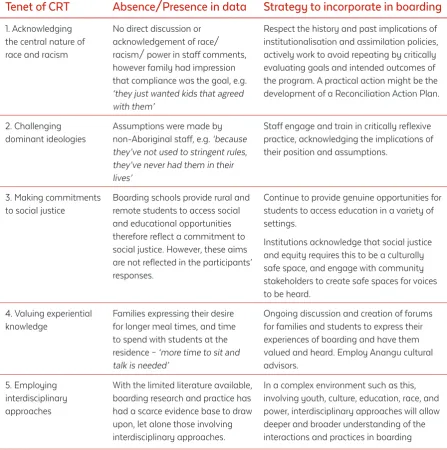
CRT demands that everyday practices match their rhetoric for social change (Su, 2007). The application of CRT in educational research allows the questioning of the role of schools, school processes, structures and policies in racial, ethnic and gender subordination (Solórzano & Yosso, 2002), and exposes underlying racism within educational practices and policies (McDonald, 2003). Its use in the field of education was originally introduced by Ladson-Billings and Tate (1995), who argued the need for critique of the ‘status quo’ in proposed educational reforms, for educational institutions were not matching in action what they articulated in commitments (Fasching-Varner, 2009; Ladson-Billings & Tate, 1995; Vass, 2014). CRT gives voice to marginalised minorities (Delgado & Stefancic, 2012), and values their knowledge and experiences of systems (Gillborn & Ladson-Billings, 2010b). Solórzano (1998) identified five key tenets of CRT that can be applied to inform educational theory, research, pedagogy and policy. These involve: (1) acknowledging the central nature of race and racism; (2) challenging dominant ideologies, (3) making commitments to social justice; (4) valuing experiential knowledge; and (5) employing interdisciplinary approaches (Solórzano & Yosso, 2002; Yosso, 2005).
Specific examples of applying CRT in educational research include studies on the experiences of racialised students or faculty in senior or higher education, pre-service teacher education programs, and multicultural education programs (Fasching-Varner, 2009; Jay, 2003; McDonald, 2003; Solórzano & Yosso, 2002). The application of CRT in Australian contexts, with regard to the ongoing racialised debates around Indigenous education, has been limited. However, McDonald (2003) and Vass (2015) used CRT to encourage increased use of narrative methodologies, in order to meaningfully articulate the experiences of the racialised ‘Other’ within education. As Vass (2015) explains – “while teachers are the front-line of education, researchers and policy makers play an important role with furnishing schools with tools and strategies for use in the classroom” (p.373). By using interdisciplinary approaches, CRT can be used to link theory with practice, scholarship with teaching, and the academy with the community (Yosso, 2005). As boarding schools are being proposed directly in line with educational strategies to create change for Aboriginal and Torres Strait Islander students, we argue that the tenets of CRT may be applicable to boarding residences as well as schools themselves.
Boarding schools as a cultural landscape
Boarding schools are largely educational institutions, with many residences deliberately incorporating education into leisure time (or time outside of school) (Benveniste et al., 2015), or providing space for extra resources such as tutoring, homework support, or facilities to study outside of school hours (Bass, 2014). Therefore, like the school setting, boarding residences can present a racialised cultural landscape, described by Vass (2014) as; “a space where relationships occur, understandings are shared and developed, and power is expressed and deployed founded on race-based assumptions” (p.178). The experiences and encounters throughout schooling contribute to constructing individual and group identities. Therefore, boarding research, like educational research (Jay, 2003), should seek to uncover how daily routines, curricular content, and social relations are shaped by hidden curriculum formed by the dominant group values, ideas, objectives and agenda. Although CRT has been used to examine practices for preparing teachers to teach culturally diverse students (Ladson-Billings, 1999; McDonald, 2003), as far as we are aware it has not yet been used to explore staff in the boarding environment.
positive impacts were seen for the students’ transition to boarding life. Furthermore, validating Aboriginal students as individuals, as well as their sense of self and cultural identity, played a large part in supporting their transition (Mander, 2012). Recent research by the Cooperative Research Centre for Remote Economic Participation has shown that acculturative effects of schools can be ameliorated through adopting a culturally responsive curriculum, employment of local staff in schools and fostering constructive relationships between schools and communities (Guenther et al., 2016). While not directly related to boarding contexts, the evidence points to the importance of maintaining connections to language, land and culture (Guenther et al., 2015a; Minutjukur et al., 2014).
Through analysis of qualitative data collected from staff, past students, and families engaged with an Aboriginal residential program, the present study aims to highlight their perspectives, and uncover the daily interactions and practices of boarding that influence their experience.
Current Study
The data presented are part of a case study (Hodgetts & Stolte, 2012) exploring a South Australian state government funded residential program that provides accommodation for remote and very remote Aboriginal students. The program was an initiative of Anangu (Aboriginal people) from the Anangu Pitjantjatjara
Yankunytjatjara (APY) lands in remote South Australia. The APY lands are located approximately 1,300km from Adelaide, where the residence is located. As opposed to a traditional ‘boarding school’, at which students usually reside in a building on the same campus as the school, the residence accommodation for this program is located separately from the school. Both the physical and organisational structures of the residence in this study have undergone changes over the 20 years in which the program has been running. The current residence structure provides accommodation for up to 80 students at a time, with boys and girls living in separate buildings.
Positioning and Methodology
The principal researcher is a non-Indigenous woman from Adelaide, South Australia. Thus, her perspectives of rural, remote and very remote communities are predominantly formed as an ‘outsider’ (Guenther et al., Forthcoming). However, the intention of the project was to develop productive dialogue between researchers and communities (Chilisa, 2012). To achieve this, preceding the commencement of formal interviews she spent two years volunteering, forming relationships and conducting informal ethnographic observations at the residence. This was alongside visits to students’ home communities in efforts to establish relationships with families and communities who accessed the program. Through this process, the broader research aims were developed collaboratively with both the staff of the residential program and with the families who accessed it. The intent was to hear the voices of Anangu participants, while understanding the limitations of being an outsider (Guenther et al., 2015b). Interpretations and analysis of interview data were also guided largely by working with experienced Indigenous and non-Indigenous researchers in the field. In particular, the majority of interviews in community were conducted alongside a Senior Aboriginal Community Researcher familiar to the families, communities and language.
Procedure and Analysis
develop a deeper understanding of the findings and how CRT may help view everyday boarding practices in a new light.
Findings
Everyday practices and elements of the program highlighted the influence of rules, routines and discipline, and relationships. These were identified as the major themes from the data, with sub-themes from rules, routines and discipline including student voice, and freedom and autonomy. Sub-themes from relationships included time to sit and talk, and family. Findings are presented here and supported with reference to the interviews with respondents. They are then considered through the lens of CRT.
Rules, routines and discipline
Jay (2003. p.7) highlights that “the hidden curriculum serves as a primary conduit of sociocultural reproduction”, and that schooling can subconsciously and consciously maintain hegemony by acculturating students to the norms, values and beliefs of the dominant group. This is done through the culture of the school and the school community, in structure and daily routines, social relationships and curriculum (formal and hidden). Furthermore, Lareau (2015) explains that educational success requires not only academic knowledge and test performance, but also compliance with the rules of an educational organisation. A more detailed analysis of the role and goals of an Aboriginal boarding residence found that time spent in the residence can intentionally supplement students’ learning at school, with daily routines and structured activities (Benveniste et al., 2015). Students learn ‘mainstream’ skills, and access a range of activities, concurrently gaining experience in the city. The benefits of clear rules and routines were cited by participants, including how they support students to settle in – ‘so that they become safe in knowing what they need to do’ (participant 28, youth worker), and ‘knowing what was expected of us’ (participant 39, past student). A past student remarked a busy residential environment helped students cope with homesickness – ‘to make us have fun, instead of getting bored or homesick’ (participant 37, past student). However, further findings suggest that when routines and structured time are implemented within large and diverse student populations, the pressure on staff and student relationships is increased. This was felt to lead to reactive behaviour from the students, to which staff members respond with ‘behaviour management’ or ‘reporting’
the student. One youth worker was particularly concerned as to the effect of staff responses on the self-belief of students:
If we had set up the environment differently, that [behaviour] wouldn’t have come out… if it was relaxed and calmer, she would get the [belief that] ‘oh they really like me, they look after me, they think I’m funny, they think I’m creative, I’m loved’ as opposed to ‘I’m a problem’ (Participant 26, youth worker)
Youth workers who are able to balance emotional and instrumental support (i.e. balancing emotional
responsiveness and caring with guidance, boundaries and discipline) have an increased ability to develop positive relationships with youth (Eccles & Gootman, 2002). However, not all staff will necessarily have the skills or the ability to achieve this balance. The following participant was concerned about a colleagues’ authoritarian approach to rules and discipline:
Can you put your padlocks and keys away mate, and just work with these kids? Just sit here and talk with them? (Participant 21, youth worker)
They went on to suggest that although rules and boundaries are necessary, taking the time to build relationships with students is more effective:
If you build a rapport and work with that kid they will cooperate with you so you have mutual respect. (Participant 21, youth worker)
Student Voice
Parents expressed concern about the expectation for their children to conform to the program’s rules, feeling that
‘houseparents didn’t listen to the kids’. Students who were seen as a ‘nuisance’ or ‘struggling’ were perceived to not receive as much attention or have as close a relationship with the youth workers, because ‘more time was spent on the good kids’ (participant 31, parent). Other parents felt that if their children were ‘outspoken’ with ‘good English’
and did not agree with the youth workers, that ‘they didn’t like that much…they just wanted kids that agreed with them’ (participant 3, parent). A non-Aboriginal community member also raised concerns about student meetings, which are held regularly at the residence, questioning whether students feel comfortable speaking up in this type of forum:
If there are any issues to be raised, it’s raised in front of everyone - which is not going to happen! And it’s led by the youth workers; they basically just tell them how good they’re going or how much they need to improve. So I’m not sure how much of a voice they [the students] have (Participant 36, community).
Furthermore, parents felt that their child needed someone other than the youth workers to talk to confidentially, without fear of ramifications, suggesting that they may not feel able to confide in the youth workers ‘because they’re frightened it goes back to the school and to everyone’ (participant 51, parent). These concerns indicate that student voice is limited, perceived as something they will be in trouble for, or perhaps valued by staff less than conformity. For this cohort, language barriers may also play a role in communication between staff and students; as for many students English is their second or third language, with concern expressed by staff about engaging with students who ‘aren’t confident in speaking English’ (Participant 26, youth worker). Communication concerns between students and staff are not unique to this setting, however, as Hodges and colleagues (2016) also found that boarders had concerns about their input in decisions made that affect them. These boarders felt that (despite the absence of language barriers) they were not encouraged to express their opinions, and that when they were expressed, their opinions were not respected.
Freedom and Autonomy
In other residential settings, such as child welfare services, staff have been identified with often contradictory demands between ‘controlling’ and ‘helping’ youth (Imber-Black, 1992 as cited in Fraser et al., 2016). A past student reflected on the perceived absence of ‘[…] freedom now, they [youth workers] think they just got to apply their rules, you know?’ (participant 37, past student). They also gave a poignant description of the institution:
It’s not the same, you know. Like… there’s no life in it. There’s no spirit. It’s like it’s a place where you keep all the robots or something (participant 37, past student)
The implications of the above comment speak to a broader concern that students’ autonomy, spirit and personality are not fostered in an institutionalised environment that is so focused on rules and routine. This is likely to be a more intensive experience for those students who have been accustomed to an entirely different set of cultural rules, or who have experienced a more autonomous lifestyle (Penman, 2006). The following comment suggests that youth workers may be aware of these differences, but could misinterpret ‘difference’ as ‘lack of rules’:
You can’t afford to be straight, not with these kids. If you make it too stringent, they’re going home and they won’t come back. Because they’re not used to stringent rules, they’ve never had them in their lives. (Participant 21, youth worker)
limited reflexive thought about their skills in cross-cultural communication and complicit role in perpetuating racial and power imbalances within the institutional structure.
Further, when students do express their agency, by choosing to leave the program and not return, it is imperative that we turn the focus not to the student as having not ‘fit’ the institution, but that the institution may not be fitting the student’s needs. This is not implying the fault lies with the individual staff members, as they are simply acting from within their own cultural understandings and educational practices, and attempting to assist students from their own worldviews and epistemologies.
Relationships
Time to sit and talk
Boarding schools are busy, complex living environments where staff are not only responsible for implementing programs and ensuring goals are met, but are also key to connecting the students to the program in order to ensure their ongoing commitment (Davidson et al., 2011, Hodges et al., 2013). While they may not be reflexive about perpetuating institutionalised racism, residence staff were aware of the importance of their roles, particularly their responsibility to be ‘role models’, and to ‘look after all aspects of their [students’] wellbeing - mental, physical and social’ (participant 24, youth worker). Relationships and wellbeing were even deemed the ‘core business’ of the organisation:
…if relationships are broken down, wellbeing is not present, then your core business has failed. It doesn’t matter what achievements you have on paper, your core business has failed (Participant 29, youth worker)
Discussions with remote community members about time they spend visiting students at the residence indicated that they believed ‘more time to sit and talk is needed’ because to ‘sit and talk over camp’ is a natural part of Anangu culture (participant 31, community). Residence staff did not deny the benefits of spending this time:
Nothing seems to be as great as sitting with a kid, or a group of kids, and having a chat, and reading a story, or telling them your story about your family and sharing stuff. Nothing seems to beat that for them. And we’re lacking in t