Vol. 3, Issue 11 (November. 2013), ||V3|| PP 06-15
Study of Concrete Involving Use of Waste Paper Sludge Ash as
Partial Replacement of Cement
Sajad Ahmad, M. Iqbal Malik, Muzaffar Bashir Wani, Rafiq Ahmad
(B.Tech Civil Engineering; Assistant professor IUST Kashmir),(B.Tech Civil Engineering; Assistant professor IUST Kashmir), (B.Tech Civil Engineering),
(B.Tech Civil Engineering; Assistant professor IUST Kashmir)
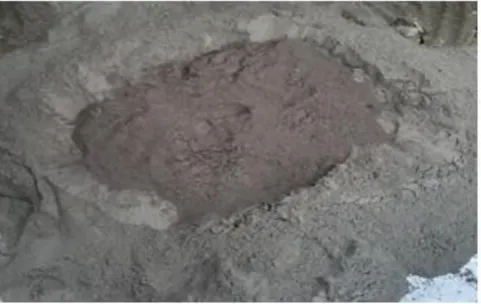
List of Figures and Tables: Figure1: Shows paper sludge ash
Figure2: Shows sieved paper sludge ash
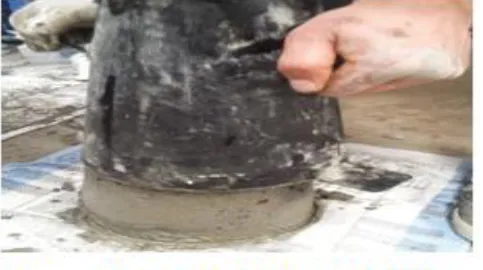
Figure3: Waste paper sludge ash added to cement for blending Figure4: Slump cone being removed slowly.
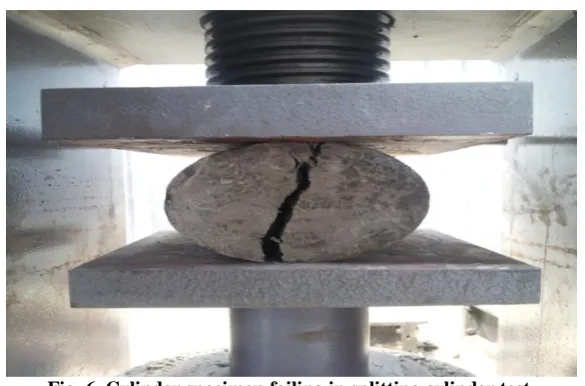
Figure5: Compressive strength test of cube using CTM Figure6: Cylinder specimen failing in splitting cylinder test Figure7: Slump Value (mm)
Figure8: Variation of Compressive Strength @ 7days age Figure9: Variation of Compressive Strength @28days age Figure10: 7 days Splitting Tensile Strength (N/mm2) Figure11: 28 days Splitting Tensile Strength (N/mm2) Figure12: Water Absorbed (%)
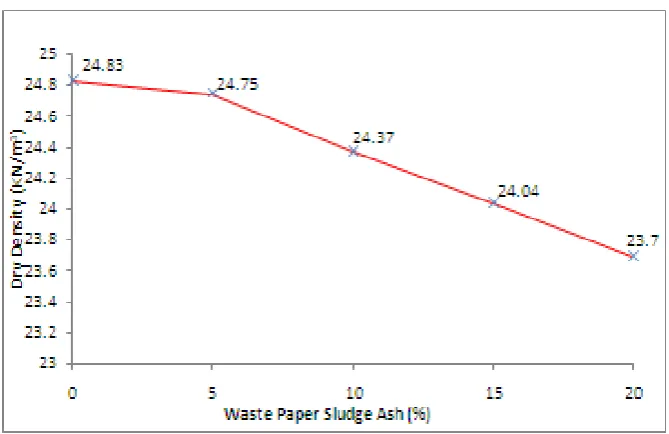
Figure13:Dry Density of Cube (KN/m3)
Abstract: - Cement manufacturing industry is one of the carbon dioxide emitting sources besides deforestation and burning of fossil fuels and concrete industry is one of the largest consumers of natural virgin materials. The global cement industry contributes about 7% of greenhouse gas emission to the earth’s atmosphere. In order to address environmental effects associated with cement manufacturing and constantly depleting natural resources, there is a need to develop alternative binders to make concrete industry sustainable. This work examines the possibility of using waste paper sludge ash as partial replacement of cement for new concrete. In this study waste paper sludge ash was partially replaced as 5%, 10%, 15% and 20% in place of cement in concrete for M-25 mix and tested for its compressive strength, tensile strength, water absorption and dry density up to 28 days of age and compared with conventional concrete. From the results obtained, it is found that Waste Paper Sludge Ash can be used as cement replacement up to 5% by weight and particle size less than 90µm to prevent decrease in workability. Further waste paper sludge has very high calorific value and could be used as a fuel before using its ash as partial cement replacement.
Keywords: - Compressive strength, Durability, split tensile strength, Waste Paper Sludge Ash Concrete, Workability
I. INTRODUCTION
resultant fly ash may contain reactive silica and alumina (in the form of metakaolin) as well as lime (CaO) which contributes chemically to the Portland cement ingredients. Paper sludge ash is therefore potentially suitable as an ingredient in:
- the cement kiln feed, contributing calcium, silica and alumina. - the manufacture of blended cements.
This research will summarize the behavior of concrete with the waste paper sludge ash by replacement of cement in the range of 5%, 10%, 15% and 20% which may help to reduce the disposal problem of sludge and enhance the properties of concrete. As wastepaper sludge ash contains higher percentage of silicon dioxide SiO2, it may provide extra strength to concrete. This project will try to study the design parameters of concrete on inclusion of waste paper as partial replacement of cement.
II. MATERIALS USED
2.1. Cement and Aggregates
Khyber ordinary Portland cement of 43 grade confining to IS 8112 was used throughout the work. Fine aggregates used throughout the work comprised of clean river sand with maximum size of 4.75mm conforming to zone II as per IS383-1970 with specific gravity of 2.6. Coarse aggregates used consisted of machine crushed stone angular in shape passing through 20mm IS sieve and retained on 4.75mm IS sieve with specific gravity of 2.7.
2.2. Waste paper Sludge Ash (WSA)
Table 1. Chemical composition of waste paper sludge ash
Element Percentage Content
O 15.83
Ca 14.94
Si 60.57
Al 2.06
Mg 3.59
S 1.07
K 0.16
Fe 0.92
III. EXPERIMENTAL INVESTIGATION 3.1. Mix Proportion
The concrete mix design was proposed by using IS 10262. The grade of concrete used was M-25 with water to cement ratio of 0.45. The mixture proportions used in laboratory for experimentation are shown in TABLE 2.
Table 2: Mix Proportions Paper
Sludge Ash %
w/c ratio
Water (Kg/m3)
Cement (Kg/m3)
Fine Aggregate
(Kg/m3)
Paper Sludge Ash
(Kg/m3)
Coarse Aggregate
(Kg/m3)
Slump (mm)
0 0.45 191.6 425.80 543.5 0.00 1199.36 25
5 0.45 191.6 404.51 543.5 21.29 1199.36 24
10 0.45 191.6 383.22 543.5 42.58 1199.36 20
15 0.45 191.6 361.93 543.5 63.87 1199.36 16
20 0.45 191.6 340.64 543.5 85.16 1199.36 13
3.2. Test on Cement
Consistency Test was performed on cement using Vicat’s Apparatus so as to determine the water-cement ratio.
3.3. Test on Fresh Concrete
3.2.1. Slump Test The workability of all concrete mixtures was determined through slump test utilizing a metallic slump mould. The difference in level between the height of mould and that of highest point of the subsided concrete was measured (Fig.3) and reported as slump. The slump tests were performed according to IS 1199-1959.
3.4. Tests on hardened concrete
Fig. 6. Cylinder specimen failing in splitting cylinder test
Table 3: Compressive Strength Test results for cube specimens of size 150mm x 150mm x 150mm
S. No. Paper Sludge Ash % Avg. load @ 7days (KN) Avg. Load @ 28 days(KN) Avg. Compressive Strength @7 days(N/mm2)
Avg. Compressive Strength @28 days(N/mm2)
1 0 483 633 21.48 28.07
2 5% 513 657 23.628 32.343
3 10% 453 593 20.15 26.29
4 15% 403 557 17.92 24.74
5 20% 345 498 15.14 22.147
Table 4: Splitting Tensile Strength Test results of 150mm x 300mm cylinders
S. No. Paper Sludge Ash % Avg. load @ 7days (KN) Avg. Load @ 28 days(KN) Avg. Split Tensile Strength @7 days(N/mm2)
Avg. Split Tensile Strength
@28 days(N/mm2)
1 0 150 180 2.122 2.546
2 5% 157 190 2.225 2.688
3 10% 153 177 2.157 2.510
4 15% 145 165 2.051 2.334
5 20% 125 150 1.768 2.122
3.5. Water absorption test
The average dry weight of cube specimens after removing from moulds was measured and the average weight of cube specimens after submerging in water for curing was measured at 28 days of age (Table 5). The percentage of water absorption was measured for each concrete specimen and it gave indirect measure of durability.
Table 5: Water Absorption Test results for cube specimens of size 150mm x 150mm x 150mm S.
No.
Paper Sludge Ash %
Dry weight of cube (gm)
Wet weight of cube (gm)
Water
absorbed (gm)
Percentage water absorption
1 0 8382 8280 98 1.17%
2 5% 8352 8456 104 1.245%
3 10% 8225 8340 115 1.398%
4 15% 8115 8241 126 1.552%
3.6. Light weight character
The average dry weight of concrete cube specimens containing 5%, 10%, 15% and 20% waste paper sludge ash in place of cement by weight was compared with average dry weight of normal M-25 concrete cube specimens and the percentage decrease in dry weight was measured (Table 6).
Table 6: Dry Weight Density results for cube specimens of size 150mm x 150mm x 150mm S. No. Paper Sludge Ash % Avg. Dry weight of cube (gm)
Avg. dry density of cube (KN/m3)
Percentage change in weight as compared to reference (%)
1 0 8382 24.83 0%
2 5% 8352 24.75 - 0.358%
3 10% 8225 24.37 - 1.870%
4 15% 8115 24.04 - 3.185%
5 20% 7998 23.70 - 4.580%
IV. RESULTS AND DISCUSSION
4.1. Fresh concrete
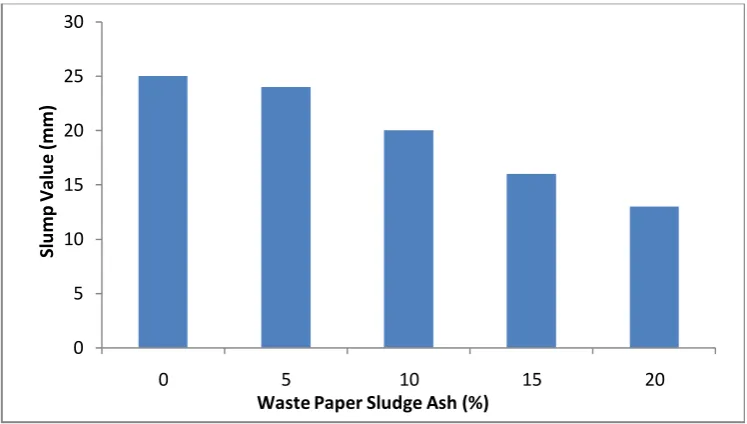
The slump values of all the mixtures are represented in TABLE 2. The slump decreased with the increase in waste paper sludge ash content. Waste paper sludge ash particles absorbed more water as compared to cement and thus decreasing the workability of concrete mix. Slump was maximum for the concrete mixture containing 5% waste paper sludge ash in place of cement. The variation of slump with waste paper sludge ash content is depicted in Fig. 7.
4.2. Hardened concrete
The compressive strength tests and splitting tensile strength tests are presented in TABLES 3 & 4 respectively. Compressive strength tests and splitting tensile strength tests were carried out at 7 and 28 days. An increase in compressive strength was observed at 5% replacement of cement by waste paper sludge ash and there after decreasing. The maximum compressive strength measured was 15% more than that of reference mix at 28 days corresponding to concrete mix containing 0% waste paper sludge ash in place of cement. Compressive strength for concrete mix with 10%, 15% and 20% waste paper sludge ash content was found to be less than that of reference mix. Splitting tensile strength was found to be more than that for reference mix at 5% cement replacement. Splitting tensile strength decreased with increasing waste paper sludge ash content. Fig. 8
Fig.7: Slump Value (mm)
0 5 10 15 20 25 30
0 5 10 15 20
Sl u m p V al u e (m m )
Fig.8: Variation of Compressive Strength @ 7days age
Fig.9: Variation of Compressive Strength @28days age
0 5 10 15 20 25
0 5 10 15 20
C
o
m
p
ress
ive
St
ren
gt
h
(N
/m
m
2)
Waste Paper Sludge Ash (%)
0 5 10 15 20 25 30 35
0 5 10 15 20
C
o
m
p
res
si
ve
S
tren
gt
h
(N
/m
m
2)
4.3. Water absorption
Water absorption test was carried out for all mixtures and percentage water absorption was measured. The percentage water absorption increased with increase in waste paper sludge ash content. The lowest value of water absorption was found for concrete mix with 5% waste paper sludge ash content. TABLE 5 & Fig.12 depicts the percentage water absorption for all mixtures.
4.4. Light weight character
V. CONCLUSION On the basis of results obtained, following conclusions can be drawn:
1. 5% replacement of cement by waste paper sludge ash showed 10% increase in compressive strength at 7 days and 15% increase in compressive strength at 28 days.
2. Cement in concrete can be replaced by waste paper sludge ash up to 5% by weight showing 15% increase in compressive strength at 28 days.
3. With increase in waste paper sludge ash content, percentage water absorption increases.
4. With increase in waste paper sludge ash content, average weight decreases by 4.58% for mixture with 20% waste paper sludge ash content thus making waste paper sludge ash concrete light weight.
5. Workability of concrete mix decreases with increase in waste paper sludge ash content.
6. Splitting tensile strength decreases with increase in waste paper sludge ash content and is more than reference concrete at 5% replacement.
7. Use of waste paper sludge ash in concrete can prove to be economical as it is non useful waste and free of cost.
8. Use of waste paper sludge ash in concrete will eradicate the disposal problem of waste paper sludge ash ,reduce emission of harmful pollutants by cement manufacture industry into our environment and thus prove to be environment friendly, paving way for greener concrete.
9. Use of waste paper sludge ash in concrete will preserve natural resources that are used for cement manufacture and thus make concrete construction industry sustainable and waste paper sludge can be used as fuel before using its ash in concrete for partial cement replacement and also the disposal problem for paper industries for this waste material is fully solved.
VI. ACKNOWLEDGEMENTS
The authors are thankful to Dr. J. A. Naqash, Associate Professor, Department of Civil Engineering, National Institute of Technology, Srinagar, J&K, India and Er. M. Iqbal Mirza, Assistant Professor, Department of Civil Engineering, Islamic University of Science and Technology, Awantipora, J&K, India and Dr. Shakeel Ahmad Engineering Geologist JKSPDC Srinagar J&K India.
REFERENCES
[1] A S Rossomagina, D V Saulin, and I S Puzanov. (2002). Prevention of Alkali-Silica Reaction in Paper Sludge Ash & Glass Aggregate Concrete.Perm State Technical University, Russia . 102 (1), 2.
[2] Shayan and A. Xu. (Jan.2009). Value added utilization of waste paper in concrete . Cement and Concrete Research. 44 (1), 81-89.
[3] Asoka Pappu, Mohini Saxena, and Shyan R. Asolekar. (2002). Solid Waste Generation In India And Their Recycling Potential In Building Materials. Regional Research Institute (CSIR) and IIT Bombay, India. 1 (2), 12-20.
[5] Carpenter, A. J. and Cramer, C.M. (1999). Mitigation of ASR in pavement patch concrete that incorporates highly reactive fine aggregate . Transportation Research Record 1668. 99 (1087), 60-67. [6] Vegas, J. Urreta,et.al. (August 2009). Freezethaw resistance of blended cement containing calcined paper
. Construction and Building Materials. 23 (8), 45-55.
[7] IS (Indian Standard) (1959) IS 1199-1959: Methods of Sampling and Analysis of Concrete, Bureau of Indian Standards, New Delhi
[8] IS (Indian Standard) (1959) IS 516-1959: Methods of Tests for Strength of Concrete, Bureau of Indian Standards, New Delhi
[9] IS (Indian Standard) IS 10262-1982: Recommended Guidelines for Concrete Mix Design, Bureau of Indian Standards, New Delhi
[10] Pera, J. and Amrouz, A.. (1998). Development of highly reactive metakaolin from paper sludge. Advanced Cement Based Materials. 7 (1), 49-56.
[11] R. Srinivasan, K. Sathiya, and M. Palanisamy. (2010). Experimental investigation in developing low cost concrete from paper industry waste . The Bulletin of the Polytechnic Institute of Jassy, Construction Architecture Section (Romania). 111 (3), 34-35.
[12] R.S. Gallardo, Mary Ann Q Adajar (December 2006). Structural performance of concrete with paper sludge as fine aggregates partial replacement enhanced with admixtures. In: Symposium on Infrastructure Development and the Environment, December 2006, University of the Philippines. pp. 1-60
[13] T.R. Naik, T. Friberg, and Y. Chun. (December 2003). Use of pulp and paper mill residual solids in production of cellucrete, College of Engineering and Applied Science . University of Wisconsin, USA. 11 (112), 18-30.
[14] T.R. Naik, Y. Chun, and R.N. Kraus. (2003). Use of residual solids from pulp and paper mills for enhancing strength and durability of ready-mixed concrete. US Dept. of Energy. DE-FC07 (00ID13867), 1-40.
[15] T.R. Naik, Y. Chun, and R.N. Kraus. (2005). Paper industry fibrous residuals in concrete and CLSM. Department of Civil Engineering and Mechanics, The University of Wisconsin- Milwaukee. CBU-2005 (10), 1-70.
[16] T.R. Naik. (July 2005). Concrete with paper industry fibrous residuals: mixture . ACI Materials Journal. 102 (4), 237-243.
[17] V. Mymrin, A.M.C. Ferreira, et. al. (September 2009). Paper production sludge application for producing of new construction materials. In: Symposium on Infrastructure Development and the Environment, September 2009, Bath, UK. pp. 6-9