Resumen: Objetivo: Determinar los comportamientos de salud bucal, la prevalencia de lesiones dentales, el nivel de información sobre los procedimientos de primeros auxilios en el caso de la avulsión dental y el conocimiento de los protectores bucales en una muestra de atletas portugueses. Materiales y métodos: estudio transversal de 1048 atletas del distrito de Viseu, Portugal. Se utilizó un cuestionario auto administrado que incluyó datos demográficos y preguntas sobre: I) hábitos de higiene bucal, II) ocurrencia de traumatismos orofaciales, III) uso de protectores bucales y IV) conocimiento de los atletas sobre el manejo de primeros auxilios en caso de avulsión dental. La comparación entre diferentes variables se realizó mediante la prueba de chi-cuadrado con el nivel de significancia establecido en p≤0.05. Resultados: La edad promedia de la muestra (76,24% hombres) fue de 18,14±8,17 años. En general, los resultados demostraron un bajo uso de hilo dental (25,48%) y un alto número de atletas (21,94%) que no habían visitado un dentista en más de un año. La prevalencia de trauma dental fue de 5,06% y las lesiones dentales más comunes que experimentaron los atletas fueron las fracturas de corona (60,38%). Casi la mitad de los participantes (45,23%) informaron que no sabían cómo actuar después de una avulsión dental. La tasa de uso de protectores bucales fue muy baja (9,73%). Hubo una relación significativa entre la prevalencia de lesiones dentales y el uso de protectores bucales (p=0,000; V de Cramer=0,145). Conclusión: la prevalencia de trauma dental en nuestra población fue baja. Un número bajo de atletas usa un protector bucal y hay una falta de conocimiento sobre temas de trauma dental. Programas de prevención y acciones de promoción entre esta población son importantes y deben ser adoptados.
Palabras Clave: Traumatismos de los dientes; avulsión de diente; protectores bucales; odontología preventiva; Atletas.
Abstract: Aim: To determine the oral health behaviors, the prevalence of dental injuries, the level of information about first-aid procedures in the case of dental avulsion and the mouthguard awareness in a sample of Portuguese athletes. Materials and Methods: Cross-sectional research among 1,048 athletes from the district of Viseu, Portugal. A self-administered questionnaire included demographic data and questions about: I) oral hygiene habits, II) occurrence of orofacial trauma, III) use of mouthguards and IV) athletes’ knowledge regarding first-aid management in case of dental avulsion was given. The comparison between different variables was made by Chi-square test with level of significant set at p-value ≤0.05. Results: The mean age of the sample (76.24% male) was 18.14±8.17 years. Overall, the results demonstrated a low use of dental floss (25.48%) and a high number of athletes (21.94%) that had not visited a dentist in more than a year. The prevalence of dental trauma was 5.06% and the most common dental injuries experienced by athletes were crown fractures (60.38%). Nearly half of the participants (45.23%) reported not knowing how to act following a dental avulsion. The rate of mouthguard use was very low (9.73%). There was a significant relationship between the prevalence of dental injuries and the use of mouthguards (p=0.000; Cramér’s V=0.145). Conclusion: The prevalence of dental trauma in our population was low. A low number of athletes use a mouthguard and there is a lack of knowledge concerning dental trauma issues. Prevention programs and promoting actions among this population are important and should be adopted.
Keywords: Program evaluation; oral health; health promotion; follow-up studies; preventive health services.
Luís Azevedo.1
David Simões Martins.1 Joana Fialho.2
Nélio Veiga.1,3 André Correia.1,3 Peter Fine.4
Comportamientos de salud bucal, lesiones dentales y conciencia del uso de protectores bucales entre una muestra de atletas portugueses: estudio transversal.
Oral health behaviors, dental injuries and
mouthguard awareness among a sample of
Portuguese athletes: a cross sectional study.
Affiliations: 1Institute of Health Sciences,
Universidade Católica Portuguesa, Viseu, Portugal. 2Polytechnic Institute of Viseu,
Portugal. 3Center for Interdisciplinary
Research in Health (CIIS), Universidade Católica Portuguesa, Viseu, Portugal. 4UCL
Eastman Dental Institute, 123 Gray's Inn Road, London.
Cite as:
Azevedo L, Martins DS, Fialho J, Veiga N, Correia A & Fine P. Oral health behaviors, dental injuries and mouthguard awareness among a sample of Portuguese athletes: a cross sectional study.
J Oral Res 2019; 8(3):177-184. Doi:10.17126/joralres.2019.028
Corresponding author: Luís Azevedo. Estrada da Circunvalação, 3504-505, Viseu, Portugal. Phone: 00351 916152289. E-mail: [email protected]
INTRODUCTION.
The regular practice of sport is essential for our physical and psychological well-being, with several benefits for general health.1,2 Although athletes are very active people with apparent good physical health, there are several studies which reported that the oral health of athletes (elite and professional) is often overlooked with self-reported impacts on their quality of life, training and performance.3-6 The athletes’ nutrition and the salivary changes that occur during sports practice, for example, are risks factors for oral health and may have influence the prevalence of dental caries and dental erosion.7-12
In addition, dental injuries (which traditionally have been the primary link between sports and dentistry) are an important risk factor for athletes and have a high prevalence during sports activities, mainly in contact sports.13,14 The type of sport, the degree of contact, gender and age of athletes determine the frequency of occurrence of these injuries in sports.15 According to the literature, the most common dental injuries during sports are dental fractures, dislocations and avulsions.16-18
When a traumatic dental injury occurs, a correct diagnosis and coordination between all health professionals is essential to make sure the correct treatment option is undertaken to ensure an optimum prognosis.19-21 However, a lack of knowledge in dental trauma management has been found among many groups of athletes.22
There are also many studies about the prevention of dental injuries in sports, especially in professional sports, which have been shown to be a factor in optimizing important sports and financial resources, in addition to the impact it can have on the well-being and longevity of the athletes' careers.23-25
Mouthguards have been considered the primary device for minimizing oral injuries during sports and physical activities.26,27 However, several studies report a very low compliance rate among athletes.16-18,28-30 On the other hand, there are also some authors who report that mouthguards have little or no beneficial role in preventing dental trauma in the sporting arena.31,32
To our knowledge, there are very few studies about dental injuries in Portuguese athletes published in the medical / dental indexed literature.
The aim of this study was to assess the oral health behavior, the prevalence of dental injuries, the level of information about first-aid procedures in the case of dental avulsion and mouthguard awareness in a sample of Portuguese athletes.
MATERIALS AND METHODS.
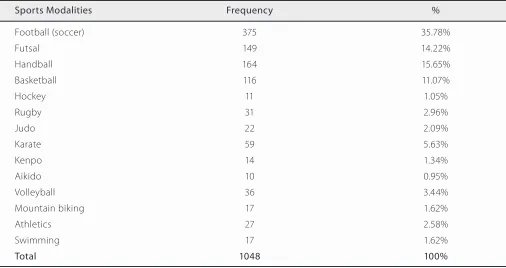
An observational cross-sectional research study was conducted in a sample of 1048 Portuguese athletes representing 52 sports clubs and 14 sports modalities (Table 1) from the District of Viseu, in the Centre Region of Portugal. The main inclusion criterion was that participants should be older than 12 years old.
Data collection was made by means of a questionnaire, based on other questionnaires used in previous studies16-18,28,33,34 that were translated into Portuguese by a certified translator. To assist in the interpretation of the medical terminology used, explanations were added in everyday language (e.g. avulsion = loss of a tooth by a direct impact). In this way we tried to reduce any possible bias due to the use of unfamiliar medical terms. Although other issues could be addressed in the questionnaire, this methodology was chosen in order to be able to compare the results obtained with those published by other authors.
A self-administered questionnaire with close-ended questions was delivered by the authors to the athletes who answered them autonomously.
The questionnaire enquired about: I) oral hygiene habits,
II) occurrence of orofacial trauma, III) use of mouthguards and
IV) athletes knowledge regarding first-aid management in case of dental avulsion. Sociodemographic information, like age and gender were also included.
Participants were requested to participate voluntary and those who accepted signed an informed written consent. Informed consent was signed by the parents or tutors of those under 18 years old.
The questionnaire was given to all athletes available during sport training, on a given day previously defined by the sport club, and they were collected immediately after they were completed.
Statistical Package for Social Sciences (SPSS) 23.0 for Windows (SPSS Inc, Chicago, IL, USA). The results of this study were analyzed using descriptive statistics. The level of significance (α) was set at 5% (0.05). For the analysis of the association between qualitative variables, the Chi-squared test was used. The intensity of the relationship between the variables is given by the Cramer's V.
RESULTS.
The sample consisted of 1071 questionnaires. However, only 1048 were considered valid, the other 23 being considered invalid because they were not filled in correctly or because they were not completely filled. The final sample examined consisted of 1048 (76.24% male) athletes which accepted participating in this study.
The mean age of the sample was 18.14±8.17 (range 12-67 years), with a major group between 12-20 years old (79.68%).
Concerning oral health behaviors, 61.55% (n=645) of athletes reported that they brush their teeth at least twice a day and only 3.05% (n=32) do not brush their teeth daily. After meals, only 31.87% (n=334) brush their teeth. Only 25.48% (n=267) use dental floss. In addition, 60.97% (n=639) use fluoride toothpaste, however 28.34% (n=297) did not know if their toothpaste contained fluoride.
Most of the respondents (55.16%; n=578) had had a dental appointment within the last six months. Nevertheless, 21.94% (n=230) had not visited a dentist in more than a year and the main reasons for not having a dental appointment more frequently was the fact that they only visit a dentist when pain is felt (60.72%; n=187) or they do not feel that they need a dental appointment (30.19%; n=93).
The majority of the sample (91.98%; n=964) underwent at least five sport training sessions per week and 1.05% (n=11) had more than ten training sessions. About 82.63% (n=866) trained less than 10 hours per week. When asked about for how many years they had participated in sport, 42.65% (n=447) mentioned that they had participated for between 5 and 10 years. However, 23.28% (n=244) had practiced sport for more than 10 years.
The frequency of training sessions per week (>5 training sessions and <5 training sessions) according to the prevalence of dental injuries were analyzed and the variables are significantly related (p=0.000; Cramer’s V=0.124). Also,
the number of hours of training and the prevalence of dental injuries were analyzed and statistical differences were determined (p=0.001; Cramer’s V=0.118). The relationship is weak (11.8%), but significant, so the prevalence of dental injuries is higher in athletes who train more than 10 hours per week.
In this study, 91 athletes (8.68%) reported that an oral health problem had already affected their sports training and 80 (7.63%) reported that it had affected a competition event. There were 478 athletes (45.61%) that suffered body lesions during sports training, like muscle lesions (57.74%; n=276) and bone fractures (24.06%; n=115), for example. There was a significant relationship between gender and body lesions. The incidence of ligament lesions was higher in women (p=0.010; Cramer’s V=0.114) and the incidence of bone fractures was higher in men (p=0.032; Cramer’s V=0.095). Only 11.64% (n=122) have ever had a facial lesion and the majority were soft tissue injuries (77.05%; n=94).
Regarding dental traumas, the prevalence was 5.06% (n=53) and the mean age of those who suffered dental trauma was 20.58±8.01 years. There was a statistical difference between gender and the prevalence of dental injuries, being higher among men (p=0.024; Cramer’s V=0.066). The most common dental injuries experienced by athletes were crown fractures (60.38%; n=32); Avulsions (32.08%; n=17) and lateral luxations (13.21%; n=7) were also noted, and most respondents (73.58%; n=39) reported that this had only happened once.
No statistical differences were found between sports modalities and prevalence of dental injuries; however by descriptive analysis, judo and aikido are the sports with the highest occurrences of dental injuries (13.6% and 10%, respectively). Also, there were no statistical differences between age and prevalence of dental injuries (p=0.169).
After a dental trauma, 37 athletes (69.81%) had a dental appointment, however only 43.24% (n=16) visited a dentist in the same day the trauma occurred.
Two hundred and fifty-one (23.95%) players had observed another player sustaining a dental injury during a game.
Table 1. Distribution of athletes according to sports modalities.
Table 2. Athletes knowledge about first-aid measures in a case of dental avulsion.
Sports Modalities Frequency %
Football (soccer) 375 35.78%
Futsal 149 14.22%
Handball 164 15.65%
Basketball 116 11.07%
Hockey 11 1.05%
Rugby 31 2.96%
Judo 22 2.09%
Karate 59 5.63%
Kenpo 14 1.34%
Aikido 10 0.95%
Volleyball 36 3.44%
Mountain biking 17 1.62%
Athletics 27 2.58%
Swimming 17 1.62%
Total 1048 100%
What do you do in a case of dental avulsion? Frequency %
I do not know how to act 474 45.23%
Wash and disinfect very well the tooth and go to the dentist 436 41.60% Put the tooth back in its place and go to the dentist 28 2.67% Put the tooth inside the mouth and go to the dentist 30 2.86% Put the tooth inside a glass of milk and go to the dentist 62 5.92%
Others 18 1.72%
regarding storage medium for avulsed teeth (e.g. wash and disinfect the tooth) (Table 2).
Statistical differences were determined between those who observed a colleague sustaining a dental injury during sport and the knowledge about the possible recovery of a tooth after an avulsion (p=0.000; Cramer’s V=0.118). There seems to be a tendency for those who have already observed a dental injury in a colleague during sport knowing that there is a possibility of recovering an avulsed tooth.
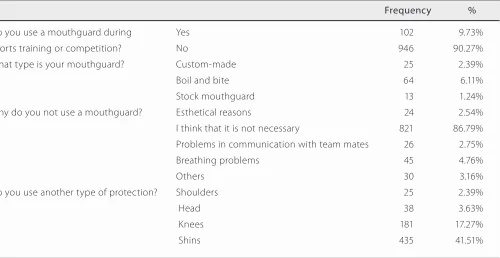
The rate of mouthguard use among athletes, as shown in Table 3, was very low (9.73%; n=102). Only 2.39% (n=25) of the sample use a custom-made mouthguard and the others used a boil-and-bite one (6.11%; n=64) and stock mouthguards (1.24%; n=13). The main reason for not using a mouthguard was the belief that it was not
necessary (86.79%; n=821). Other reasons like impaired communication (2.75%; n=26) and difficulties in breathing (4.76%; n=45) were rare.
After removing the sports modalities in which no one uses a mouthguard (BTT biking, aikido, athletics and swimming), statistical differences were determined between sports modalities and mouthguard awareness (p=0.000; Cramer’s V=0.390). The types of sports where the use of mouthguard is higher are rugby, karate, kenpo and hockey (58.1%, 35.6%, 35.7% and 27.3%, respectively).
Table 4. Distribution of athletes according to sports modalities.
Table 3. Athletes compliance about the use of mouthguards.
Inferential statistics p-value Cramer’s V
Frequency of training sessions per week versus Prevalence of dental injuries 0.000 0.124
Gender versus Ligament lesions 0.010 0.114
Gender versus Bone fractures 0.032 0.095
Gender versus Prevalence of dental injuries 0.024 0.066 Number of hours of training versus Prevalence of dental injuries 0.001 0.118 Those who observed a colleague sustaining a dental injury during sport versus 0.000 0.118 The knowledge about the possible recovery of a tooth after an avulsion
Sports modalities versus Mouthguard awareness 0.000 0.390 Use of mouthguards versus Prevalence of dental injuries 0.000 0.145
Frequency %
Do you use a mouthguard during Yes 102 9.73%
sports training or competition? No 946 90.27%
What type is your mouthguard? Custom-made 25 2.39%
Boil and bite 64 6.11%
Stock mouthguard 13 1.24%
Why do you not use a mouthguard? Esthetical reasons 24 2.54% I think that it is not necessary 821 86.79% Problems in communication with team mates 26 2.75%
Breathing problems 45 4.76%
Others 30 3.16%
Do you use another type of protection? Shoulders 25 2.39%
Head 38 3.63%
Knees 181 17.27%
Shins 435 41.51%
There was also a significant relationship between the prevalence of dental injuries and the use of mouthguards (p=0.000; Cramer’s V=0.145), meaning that those who have suffered a dental injury tend to use a mouthguard more frequently. For a better understanding, the inferential statistics are presented in Table 4.
DISCUSSION.
This study investigated the injury rate amongst athletes of several sporting modalities, with a particular focus on the occurrence of dental injury and the use of mouthguards. This report also analyses the oral health
behaviors of athletes and the level of their awareness about tooth replantation. The response to and the interest in the survey were good, allowing the conclusion that the topic of the importance of good oral hygiene habits, mouthguards and prevention of dental injuries definitely interests the athletes.
However, this research has some limitations, mainly focused on the questionnaire’ questions. For example, the questions applied focused on dental trauma, mainly dental avulsions and the use of mouthguards during the practice of physical exercise. No information was gathered on other types of dental trauma, besides dental avulsions, and if the athletes were using mouthguards during an event of dental trauma.
In this study, most of the athletes brushed their teeth at least twice a day. These results are in accordance with other studies amongst athletes.6,7
After meals, the percentage of athletes that brush their teeth was similar to the results founded in a study of Veiga et al.,35 among Portuguese young people, which reported that only 24.1% brush their teeth after dinner and only 10.1% brush after breakfast.
In our sample, the use of dental floss was not common. Also, Bryant et al.,7 reported a low prevalence of dental floss use (13%) in athletes.
With respect to dental appointments, the majority has last visited the dentist less than twelve months ago, similar to other studies.6 Nevertheless, there are some athletes who never visited the dentist or only visited when in pain, which suggest that it is necessary to provide more information and promotion of oral health in these groups.
An oral health problem had already affected sports training and sports competitions of only a few athletes. In contrast, higher values were founded in a study undertaken during the London 2012 Olympic Games,3 which suggested that 18% of athletes declared that their oral health had already had an impact in their trainings and physical performances.
The present work showed that a low number of the sample has already suffered a dental injury during sports activities. Crown fractures were the most common dental injuries experienced by athletes. The rate of dental injury demonstrated in this study is comparable to those reported in sports such as mountain biking (5.7%), squash (4.5%) and inline skating (9.2%).17,18,28
On the other hand, some authors reported higher rates of dental injuries in sports.3,6,16,22,28-30,3640
For example, Needleman et al.,3 reported an incidence of orofacial injuries of 17.6% during the London 2012 Olympic Games, of which 45.8% were facial lesions and
54.2% were dental injuries. Also, Gay-Escoda et al.,6 determined a prevalence of 23.3% of dental injuries among FC Barcelona football (soccer) players.
Almost all players who suffered a tooth injury reported that the accident happened only once, which was similar to other studies.16,33
Two hundred and fifty-one players had observed another player sustaining a dental injury during a game, just like a study among squash players which reported similar values (20.4%).17 By contrast, the study of Perunski et al.,30 showed higher percentages (30.82%).
Less than half of all participants knew that an avulsed tooth can be replanted. This is a major issue, because athletes should be get help on dental injuries and mouthguards from their coaches, according to the literature.41 This highlights the fact that not all players and coaches are correctly informed.
Several studies referred that better knowledge about the first aid of dental traumas increases the success rate of the teeth involved.42,43 However, there are a higher number of athletes that declared not knowing how to act in a situation of a dental avulsion. Inclusively, most of them answered incorrectly about procedures for storage medium for avulsed teeth (e.g. wash and disinfect the tooth). Only, 11.45% (n=120) responded correctly in the recommended way reported in the literature (human saliva/buccal vestibule or milk).44
It is quite clear that mouthguard use presents a very low rate among athletes. The results of this study are in accordance with similar studies that reported the prevalence of mouthguard use varied between 0,15% to 8.93%.16-18,28-30
However, amongst rugby athletes this prevalence was higher.33 Boil and bite mouthguards were the most common used amongst athletes, while custom-made mouthguards had a very low percentage of usage.
The reasons for not wearing a mouthguard varied and are largely identical to the data reported in other studies, but the most frequent reason was not perceiving any necessity of wearing one. Points of criticism also included impaired communication with team colleagues, difficulties in breathing and disagreeable aesthetics.45
CONCLUSION.
Although the prevalence of dental trauma in our population was low, athletes are considered a high-risk group. We also conclude that a significant low number of athletes are using mouthguards and there is a lack of knowledge concerning dental trauma issues.
Prevention programs and promoting actions and specific strategies among this population are important and should be adopted in order to reduce the incidence of orofacial trauma and to increase knowledge about this public health issue.
Conflict of interests: The authors declare no conflict of
interest in relation to published results.
Ethics approval: All the participants agreed and
authorized their participation in this study and signed an informed consent form. Informed consent was signed by the parents or tutors of those under 18 years old. Funding: No funding.
Authors’ contributions: LA planned the study, distributed and collected questionnaires and wrote the draft of the publication and is overall responsible for the contente as guarantor. DM co-developed the study and helps in the data collection. JF was responsible for the statiscal analysis. NV and AC contributed in the design/methodology of this research, and in the edition and correction of this manuscript. PF helped in English language and provided sport dentistry expertise in the interpretation of the data and final manuscript.
Acknowledgements: The authors would like to thank the
players for taking part in this research. They are also hugely grateful to the teams and especially the staff (coaches and presidents) for their support to conduct this study.
REFERENCES.
1. Smith JJ, Eather N, Morgan PJ, Plotnikoff RC, Faigenbaum AD, Lubans DR. The health benefits of muscular fitness for children and adolescents: a systematic review and meta-analysis. Sport Med. 2014;44(9):1209–23.
2. Eime RM, Young JA, Harvey JT, Charity MJ, Payne WR.
A systematic review of the psychological and social benefits of participation in sport for children and adolescents: informing development of a conceptual model of health through sport. Int J Behav Nutr Phys Act. 2013;10(1):98.
3. Needleman I, Ashley P, Petrie A, Fortune F, Turner W,
Jones J, Niggli J, Engebretsen L, Budgett R, Donos N, Clough T, Porter S. Oral health and impact on performance of athletes participating in the London 2012 Olympic Games: a cross-sectional study. Br J Sports Med. 2013;47(16):1054–8.
4. Ashley P, Di Iorio A, Cole E, Tanday A, Needleman I.
Oral health of elite athletes and association with performance: a systematic review. Br J Sports Med. 2015;49(1):14–9.
5. Needleman I, Ashley P, Meehan L, Petrie A, Weiler R,
McNally S, Ayer C, Hanna R, Hunt I, Kell S, Ridgewell P, Taylor R. Poor oral health including active caries in 187 UK professional male football players: clinical dental examination performed by dentists. Br J Sports Med. 2016;50(1):41-4.
6. Gay-Escoda C, Vieira-Duarte-Pereira D, Ardevol J,
Pruna R, Fernandez J, Valmaseda-Castellon E. Study of the effect of oral health on physical condition of professional soccer players of the Football Club Barcelona. Med Oral
Patol Oral y Cir Bucal. 2011;16(3):e436–9.
7. Bryant S, Mclaughlin K, Morgaine K, Drummond B. Elite
Athletes and Oral Health. Int J Sport Med. 2011;32:720–4.
8. Peinado A, Rojo-Tirado M, Benito P. Sugar and physical
exercise; the importance of sugar for athletes. Nutr Hosp. 2013;28(Supl.4):48–56.
9. Touger-Decker R, Van Loveren C. Sugars and dental caries 1–4. Am J Clin Nutr. 2003;78:881–92.
10. Budd SC, Egea J. Sport and Oral Health: A Concise Guide. 1st Ed. Springer Inter Publ. 2017.
11. Mulic A, Tveit AB, Songe D, Sivertsen H, Skaare AB. Dental erosive wear and salivary flow rate in physically active young adults. BMC Oral Health. 2012;12(1):8.
12. Frese C, Frese F, Kuhlmann S, Saure D, Reljic D, Staehle HJ, Wolff D. Effect of endurance training on dental erosion, caries, and saliva. Scand J Med Sci Sport. 2015;25(3):e319–26.
13. Ranalli DN. Sports dentistry and dental traumatology. Dent Traumatol. 2002;18(5):231–6.
14. Ramagoni NK, Singamaneni VK, Rao SR, Karthikeyan J. Sports dentistry: A review. J Int Soc Prev Community Dent. 2014;4(Suppl 3):S139-46.
15. Tuna EB, Ozel E. Factors affecting sports-related orofacial injuries and the importance of mouthguards. Sport Med. 2014;44(6):777–83.
Sweden. Dent Traumatol. 2011;27(2):95–101.
17. Persic R, Pohl Y, Filippi A. Dental squash injuries - A survey among players and coaches in Switzerland, Germany and France. Dent Traumatol. 2006;22(5):231–6.
18. Müller KE, Persic R, Pohl Y, Krastl G, Filippi A. Dental injuries in mountain biking–a survey in Switzerland, Austria, Germany and Italy. Dent Traumatol. 2008;24(5):522–7.
19. Lin S, Levin L, Emodi O, Fuss Z, Peled M. Physician and emergency medical technicians’ knowledge and experience regarding dental trauma. Dent Traumatol. 2006;22(3):124–6. 20. Ram D, Cohenca N. Therapeutic protocols for avulsed permanent teeth: review and clinical update. Pediatr Dent. 2004;26(3):251–5.
21. Schwartz-Arad D, Levin L, Ashkenazi M. Treatment options of untreatable traumatized anterior maxillary teeth for future use of dental implantation. Implant Dent. 2004;13(2):120–8.
22. Emerich K, Nadolska-Gazda E. Dental trauma, prevention and knowledge concerning dental first-aid among Polish amateur boxers. J Sci Med Sport. 2013;16(4):297–301.
23. Waldén M, Hägglund M, Ekstrand J. UEFA Champions League study: A prospective study of injuries in professional football during the 2001-2002 season. Br J Sports Med. 2005;39(8):542–6.
24. Hägglund M, Waldén M, Ekstrand J. Injury incidence and distribution in elite football—a prospective study of the Danish and the Swedish top divisions. Scand J Med Sci Sports. 2005;15(1):21–8.
25. Ueblacker P, Mueller-Wohlfahrt H-W, Ekstrand J. Epidemiological and clinical outcome comparison of indirect (‘strain’) versus direct (‘contusion’) anterior and posterior thigh muscle injuries in male elite football players: UEFA Elite League study of 2287 thigh injuries (2001–2013). Br J Sport Med. 2015;49(22):1461–5.
26. Quarrie KL, Gianotti SM, Chalmers DJ, Hopkins WG. An evaluation of mouthguard requirements and dental injuries in New Zealand rugby union. Br J Sports Med. 2005;39(9):650–1. 27. Marshall SW, Loomis DP, Waller AE, Chalmers DJ, Bird YN, Quarrie KL, et al. Evaluation of protective equipment for prevention of injuries in rugby union. Int J Epidemiol. 2004;34(1):113–8.
28. Fasciglione D, Persic R, Pohl Y, Filippi A. Dental injuries in inline skating - Level of information and prevention. Dent Traumatol. 2007;23(3):143–8.
29. Lang B, Pohl Y, Filippi A. Knowledge and prevention of dental trauma in team handball in Switzerland and Germany. Dent Traumatol. 2002;18:329–34.
30. Perunski S, Lang B, Pohl Y, Filippi A. Level of information concerning dental injuries and their prevention in Swiss basketball - A survey among players and coaches. Dent
Traumatol. 2005;21(4):195–200.
31. Blignaut JB, Carstens IL, Lombard CJ. Injuries sustained in rugby by wearers and non-wearers of mouthguards. Br J Sports Med. 1987;21(2):5–7.
32. McCrory P. Do mouthguards prevent concussion? Br J Sports Med. 2001;35(2):81–2.
33. Schildknecht S, Krastl G, Kühl S, Filippi A. Dental injury and its prevention in Swiss rugby. Dent Traumatol. 2012;28(6):465–9. 34. Lang B, Pohl Y, Filippi A. Knowledge and prevention of dental trauma in team handball in Switzerland and Germany. Dent Traumatol. 2002;18(6):329–34.
35. Veiga NJ, Pereira CM, Ferreira PC, Correia IJ. Oral health behaviors in a sample of portuguese adolescents: an educational issue. Heal Promot Perspect. 2014;4(1):35–45.
36. Nonoyama T, Shimazaki Y, Nakagaki H, Tsuge S. Descriptive study of dental injury incurred by junior high school and high school students during participation in school sports clubs. Int Dent J. 2016;66(6):356–65.
37. Collins CL, McKenzie LB, Ferketich AK, Andridge R, Xiang H, Comstock RD. Dental injuries sustained by high school athletes in the United States, from 2008/2009 through 2013/2014 academic years. Dent Traumatol. 2016;32(2):121–7.
38. Ferrari CH, De Medeiros JMF. Dental trauma and level of information: mouthguard use in different contact sports. Dent Traumatol. 2002;18(3):144–7.
39. Levin L, Friedlander LD, Geiger SB. Dental and oral trauma and mouthguard use during sport activities in Israel. Dent Traumatol. 2003;19(5):237–42.
40. Tiwari V, Saxena V, Tiwari U, Singh A, Jain M, Goud S. Dental trauma and mouthguard awareness and use among contact and noncontact athletes in central India. J Oral Sci. 2014;56(4):239–43.
41. Berg R, Berkey DB, Tang JMW, Altman DS, Londeree KA. Knowledge and attitudes of Arizona high-school coaches regarding oral-facial injuries and mouthguard use among athletes. J Am Dent Assoc. 1998;129(10):1425–32.
42. Levin L, Jeffet U, Zadik Y. The effect of short dental trauma lecture on knowledge of high-risk population: An intervention study of 336 young adults. Dent Traumatol. 2010;26(1):86–9.