Author for correspondence:
1Professor, Department of IT, Adhiyamaan College of Engineering, Hosur, Tamilnadu, India.
Volume-7 Issue-1
International Journal of Intellectual Advancements
and Research in Engineering Computations
Detection and neutralizing multiple spoofing attackers using PRR and IAT
1
Dr.D.Thilagavathy,
2J.Janwhisrivastava,
3V.Kowzalya
1
Professor, Department of IT, Adhiyamaan College of Engineering, Hosur, Tamilnadu, India.
2
UG Student, Department of IT, Adhiyamaan College of Engineering, Hosur, Tamilnadu, India.
3
UG Student, Department of IT, Adhiyamaan College of Engineering, Hosur, Tamilnadu, India.
ABSTRACT
In Network the drastic invention was brought up a big chances in wireless network. This Project has been evolved as one of the promising technology based on implementation of wireless network. Providing mobility, flexible infrastructure, fast and low cost deployment are the key features of EAACK. This is being most widely used wireless technology has limited security against network attacks . Dynamic configurability adds flexibility to Network but it makes it vulnerable to attacks like do’s, Wormhole, Man-In-Middle Attack, IP Spoofing Attacks. In this paper, an intrusion detection system was extended to Enhanced Adaptive ACKnowledgement (E-EAACK) and it will detect the localize and the intrusion of the attacker. This system consists of some security components like prevention, detection and reaction. Specially designed for NETWORK, E -EAACK serves in detection of malicious behavior without much affecting Network Performance. In order to detect and localize the multiple IP Spoofing Attacks. We propose, the use of digital signature for authentication of nodes and S-ACK scheme for detecting anomalous behavior in network. In implementation of GADE m odel for the detection of attacker and IDOL framework can be localized to the intruder and makes E -EAACK an effective security in solution for network.
Keywords:
Index Terms- Network, Eaack, Spoofing attack, Digital Signature, Gade, Idol.INTRODUCTION
In this current technology, mostly people prefer to access information from their current location at anywhere- anytime constantly.
Now a day there is an increased use in network with wireless technologies. Dynamic configuration and low cost of deployment in wireless promising technologies. Fixed infrastructure does not have network. To transmit packets in configuration network in setting up a paths with themselves. Self-configuring mobile nodes have a collection of fixed infrastructure. In network node both transmitter and receivers are equipped a node in network, Router and host act as a node in same period of node.
Two scenarios are concerning topology in network. Radio communication has a single hop directly with each other.
Relay message node depends on outside range. Routing message in outside act as a range in rely nodes with each other.
have some or the other limitations that are designed for a set of some known attacks. To prevent the newer attacks which are designed for bypassing security methods for the existing.
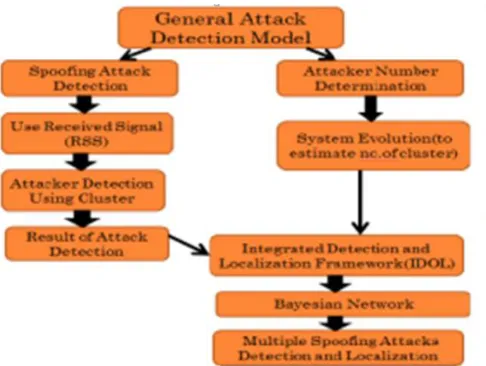
Due to the transparency of wireless networks, they are especially vulnerable to spoofing attacks where an attacker falsifies its identity to masquerade as another device, or even creates multiple illegal identities. In figure1, there are several general nodes which will attack network
and get neutralized with the several attacks and in turn if not neutralized, the path of the data sent will be diverted in order to ensure that data has been received appropriately.
It’s a serious threat that represent a form of identity in compromise and it can facilitate a variety of traffic injection attacks. In Do’s attacks; It is the desirable spoofing to detect the presence and absences of network [6] [7].
Figure 1: Architecture Diagram
RELATED WORK
Due to the limitations of most of NETWORK routing rules, nodes NETWORK are reluctant on other nodes cooperation to relay data. This dependency facilitates an attacker opportunity to have its impact on network by compromising one or more nodes. To tackle this problem, it arises the need of enhancing the security level of NETWORKs.
Watchdog
It was designed to improve the overall throughput of the network with its existence of malicious node. Then it works for detecting malicious node to its next hop transmission by constantly listening.
To increment the failure of counter in watchdog fails in relay packet of the network and it misbehave the threshold value at a specific counter with in a period of time, so the result value get increased. Watchdog scheme fails in the following: 1. Ambiguous collisions
2. Receivers collisions 3. Limited transmission power 4. False misbehavior report 5. Partial dropping[3]
TWOACK
Copyrights © International Journal of Intellectual Advancements and Research in Engineering Computations,
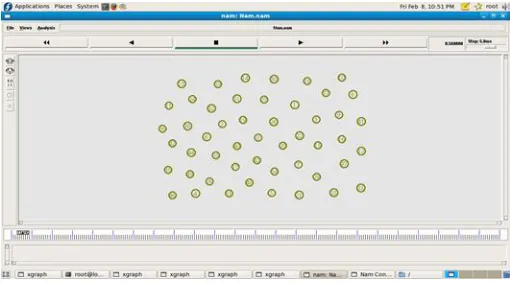
Figure 2: Node creation
The working process Of TWOACK is demonstrated figure, node a first forwards packet 1 to node B, and then node B forwards Packet 1 to node C. When node C receives Packet 1, as it is two hops away from node A, node C is obliged to generate a TWOACK packet, which contains reverse route from node B to node D, and sends it back to node C. The retrieval of this TWOACK packet at node A indicates the transmission of Packet 1 from node A to node C is successful. Other-wise, if this TWOACK packet is not received in a pride-fined time period, both nodes B and C are reported malicious. TWOACK scheme successfully solves the receiver collision and limited transmission power problems posed by Watchdog.
Therefore, the process of acknowledgement is required to every packet delivery in transmission process to add a significant amount of the unwanted network. Due to the limited battery power nature of NETWORKs, such redundant transmission process can easily degrade the life span of the entire network.
AACK
It is a hybrid scheme which uses TWOACK for acknowledgement. AACK is acknowledgement based net-work layer scheme which consists a combination of schemes called TACK (similar to TWOAACK) and end-to-end acknowledgement scheme called ACKnowledgement. Compared to TWOACK, AACK significantly reduces net-work overhead, while still able to maintain or even out-
shine the same network throughput [5]. In AACK, first the data transmit from source to destination. In this destination point the node receives a packet from the source, to its requirement and send it back for further more packet for resource in the reverse process route of the data packet.
The specified time period, indicates source to transmit and receives the acknowledgement of packet, where the transaction process is successfully completed. In the source it will switch to TACK scheme can send a TACK packet. In case of the hybrid scheme, they greatly reduces the network traffic and it is still unable to scope with the false forged acknowledgement and misbehavior report.
Detecting spoofing attacks in mobile wireless
environment
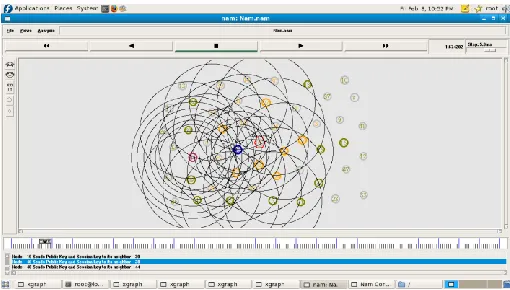
Figure 3: Simulation of Nodes
This approach may not have the required cooperation or any changes from wireless device to other than the packet transmission. In experiment from an office building that DEMOTE achieves shown the environment system accurate attack with the detection and neutralized in both signal space as well as physical space using localization [1] [3] [10].
Detecting and Localization wireless spoofing
attacks
The proposed system can able to detect and spoofing attacks makes a location with a specific
positions in attackers. Mostly the works can able to detect and neutralize for the wireless spoofing in cluster analysis. Later, this system indicates the attacker and detector in real-time of the internal localization system. It is also able to localize the positions of the attackers using point based algorithms. The Below figure4 has shown the detection of intrusion and neutralization of misbehaving nodes in the simulation of spoofing attacks and it will simulate where the path has attacks User-To-Network(UTN). The system has evaluated our method through investigation using both Wi-Fi network as well as in network.
Figure 4: Detection
In ZigBee network: Results shown that the possible detection in wireless spoofing with both low false positive rate and any high data rate [8].
SYSTEM DESCRIPTION
Copyrights © International Journal of Intellectual Advancements and Research in Engineering Computations,
ACK
An end to end acknowledgment scheme is called ACK. EEAACK used crossbreed scheme. The transmission is successful when there are no misbehaving from sender to receiver. Then receiver sends an acknowledgement packet to sender within specific time constraint, or else the sender will call off to Sender-Acknowledgement mode.
S-ACK
In the route the source sends S-ACK packet to detect misbehaving nodes. Source receives acknowledgement from S-ACK only after the packet reaches the respective three nodes ahead the route. The node from third route required to send an S-ACK acknowledgement to the first generating node. It modify easily and detect the misbehaving nodes in the presence of receiver collision and limited power for transmission.
The three consecutive nodesN1, N2, N3. N1 sends S-ACK data packet to N2 which is next in the route and N2 relays it to N3. When N3 receives the ACK data packet it acknowledges N2 with S-ACK acknowledgement packet and N2 acknowledges back to N1. If N1 doesn’t receive acknowledge within a particular time it will report N2, if generating a misbehavior report is malicious node by N3. The Source is send back to misbehavior report. To validate this report the MRA mode will switches itself to source.
MRA
Misbehavior Report Analysis (MRA) is a scheme of confirm misbehavior report generated in S-ACK mode. This report may be a false one as attacker may interfere in S-ACK scheme generating a false misbehavior report. In this result, it may cause destruction to compromising guiltless nodes from the networks.
In MRA the missing packet have received a different route through the destination whether check within the destination. MRA mode is initiated by checking local knowledge base of sender for getting al-tentative route to destination; otherwise source uses Dynamic Source Routing method for alternative route. Once the MRA packet gets destination, it compares the MRA packet with the local knowledge base to verify if the re-ported
packet was received by it. If received, then it in-forms the source that the misbehavior report is false else it is considered as a legitimate report.
Digital Signature
All the schemes are based on acknowledgement. Thee acknowledgements could be doubtful and checked for their rightfulness. This System are used digital signature in order to maintain integrity. If we don’t use digital signature the above discussed 3 schemes will be de-fenceless. The algorithms is implement digital signature schemes by the two algorithm RSA or DSA.
GADE
Generalize Attack Detection Model is stands for GADM. In our system is used to method of attack detection. There are two stages: attack detection; determine number of attackers. Transmission power of 10db to send packets is used to Attacker, whereas the transmission power level observed is used to 15 dB original node and it’s according to the attributes in Received Signal Strength. Physical space is the property of correlated with in the RAa. The spoofing attacker used transmission power of 10 dB to send packets, whereas the original node used 15 dB transmission power levels. System observed that the curve of Dm under the different transmission power level shifts to the right indicating larger Dm values. System observes this difference be- tween power levels and detects attack effectively in GADE model.
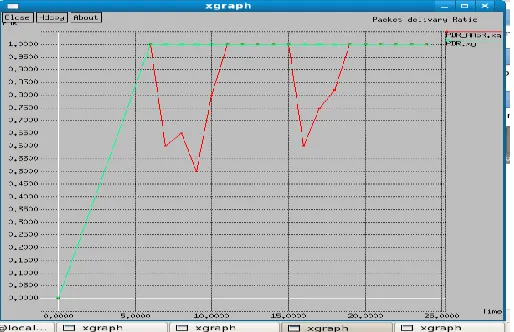
Figure 5: Packet delivery Ratio
The multiple adversaries will cause of attackers to estimation of the number of attackers which will cause failure in localizing. How many adversaries will use the same node because we do not know to identity the launch attacks, in determining the number of attackers which has a multiclass detection problem and it is similar to determining in the RSS readings which has many clusters exist. The System Evolution is a new method to analyses cluster structures and estimate the number of clusters. Evolution in method twin-cluster model, that are the two closest clusters in networks among K potential clusters from the data set. The twin-cluster model is used for energy calculation.
In advantage estimating the best partition is the suitable for Silhouette Plot. In this method Evolution performs under complex cases likewise when the existing slightly overlap between clustering and It have small cluster to the nearest large clusters.
In training data the collection of offline training in phase, which can further develop the performance of establishing its number in spoofing attacker. In addition, given several statistic methods available to detect the number of attackers, such as System Evolution and SILENCE, system can combine the characteristics of these methods to achieve a higher detection rate. This mechanism explores Support Vector Machines to classify the number of the spoofing attackers.
IDOL
Integrated detection and Localization Framework is stands for IDOL. IF localize multiple
attackers is used to Framework. In IDOL efficiently detects attackers which using different transmission power of mechanism. In mainstream the averaging RSS readings method which cannot differentiate RSS readings to different location and thus is not viable for localizing the attackers. This framework uses RSS medics returned from SILENCE as input to localization algorithms to estimate the positions of intruders. The efficiency of implementation in IDOL here the following algorithms are:
a. RADAR-gridded: For localizing algorithm used to RSS readings and nearest neighbor matching technique in localize the attacker, single space.
b. Area-Based Probability: In signal map incorporates in ABP. Experimental area is split into regular grid to equal size ac-cording to RSS reading observed for that particular grid. C. Bayesian Networks: BN uses signal to distance propagation model (multilateration) to localize the attacker.
CONCLUSION
Copyrights © International Journal of Intellectual Advancements and Research in Engineering Computations,
testing process can be able to determine the possible attacks. The analysis process achieves better accuracy in determining the spoofing attacks while they undergo, otherwise the silhouette Plot. In the Evolution, use of cluster can be analyzed alone. Latterly, it will be based on the determination of the number of attackers with the mechanisms. Our integrated detection and system
can localize any number of adversaries even when the attackers use different transmission power levels. The performance of the localizing adversaries achieves similar results as those under normal conditions thereby providing a strong evidence of the effectiveness of our approach in detecting wireless spoofing attacks, determining the number of attackers and localizing adversaries.
REFERENCES
[1]. L. Buttyan and J. P. Hubaux, Security and Cooperation in Wireless Networks. Cambridge, U.K.: Cambridge Univ. Press, 2007.
[2]. G. Jayakumar and G. Gopinath, Ad hoc mobile wire-less networks routing protocol review, J. Compute. Sci., 3(8), 2007.
[3]. S. Marti, T. J. Giuli, K. Lai, and M. Baker, Mitigateing routing misbehavior in mobile ad hoc networks, in Proc. Int. Conf. Mobile Computer. Network, Boston, MA, 6, 2000, pp. 255265.
[4]. K. Liu, J. Deng, P. K. Varshney, and K. Balakrishnan, An acknowledgment based approach for the detection of routing misbehavior in NETWORKs, IEEE Trans. Mobile Compute, 6(5), 2007, 536550. [5]. T. Sheltami, A. Al-Roubaiey, E. Shakshuki, and A. Mahmoud, Video transmission enhancement in
presence of misbehaving nodes in NETWORKs, Int. J. Multi-media Syst, 15(5), 2009, 273282.
[6]. D. Farias and D. Cheri ton, Detecting Identity-Based At-tacks in Wireless Networks Using Signal prints, Proc. ACM Workshop Wireless Security (Wise), 2006.
[7]. Q. Li and W. Trappe, Relationship-Based Detection of Spoofing-Related Anomalous Traffic in Ad Hoc Net-works, Proc. Ann. IEEE Comm. Soc. on IEEE and Sensor and Ad Hoc Comm. and Networks 2, 2006. [8]. Y. Chen, W. Trappe, and R.P. Martin, Detecting and Localizing Wireless Spoofing Attacks, Proc. Ann.
IEEE Comm. Soc. Conf. Sensor, Mesh and Ad Hoc Comm. and Networks (SECON), May 2007.
[9]. P. Bah and V.N. Padmanabhan, RADAR: An in-Building RF-Based User Location and Tracking Sys-tem, Proc. IEEE INFOCOM, 2000.