IMPACT OF VERMICOMPOST EXTRACT APPLICATION INTO SOIL
AND ON PLANT LEAVES ON MAIZE PHYTOMASS FORMATION
Peter Kováčik1, Marek Renčo2, Vladimír Šimanský3, Eva Hanáčková1, Barbara Wiśniowska-Kielian4
1 Department of Agrochemistry and Plant Nutrition, Slovak University of Agriculture in Nitra, Tr. A. Hlinku 2,
949 01 Nitra, Slovakia, e-mail: [email protected]
2 Department of Plant Nematology, Slovak Academy of Sciences, Hlinkova 3, 040 01 Košice, Slovakia, e-mail:
3 Department of Soil Science and Geology, Slovak University of Agriculture in Nitra, Tr. A. Hlinku 2, 949 01 Nitra,
Slovakia, e-mail: [email protected]
4 Department of Agricultural and Environmental Chemistry, University of Agriculture, A. Mickiewicza Ave. 21,
31-120 Kraków, Poland, e-mail: [email protected]
INTRODUCTION
Compost production has decreased continu-ally in Slovakia since 1990 on the other hand the slight increase of the waste material produc-tion suitable for composting has been recorded. Volume 16, Issue 4, Oct. 2015, pages 143–153
DOI: 10.12911/22998993/59363 Research Article
ABSTRACT
Nowadays in scientific literature many opposing data are presented of the impacts of
vermicompost extract on the quantity and quality of crop production. Therefore, the principal objective of two independent experiments was to study the effects of vermi-extracts, which were applied before maize sowing into soil and during the growing
season on the maize leaves, on its phytomass formation. The first, field experiment
consisted of 9 variants. Variant 1 was the control one without the extract application. We studied the effect of the rising doses (90, 130, 170, 210 dm3·ha-1) of vermi-extract
applied into soil before the maize sowing in the variants E1, E2, E3, E4. In the variants
E1+E, E2+E, E3+E, E4+E along with the rising doses of vermi-extract was also applied
the uniform dose of vermi-extract (40 dm3·ha-1) at the growth stage BBCH 15. The
second, pot experiment was pursued in the vegetation cage and comprised 3 variants: variant 1 was the control, in the variants 2 and 3 the foliar application of vermi-extract was used. The vermi-extract was applied once (growth stage BBCH 12) in the variant 2 and in the variant 3 it was used twice (at growth stages BBCH 12 and BBCH 16). The achieved results show that the vermi-extract applied in the presowing period in-creased the yield of maize grains if the application doses were 130–170 dm3·ha-1. The
positive or negative impact of the foliar application by vermi-extract on the yield of maize grains depended on the period of application and the grown cultivar. In order to increase the starch content in grains it was more suitable to carry out the presowing ver-mi-extract application than during the growing season. The presowing application and the foliar application of vermi-extract tended to decrease the nitrogen content in grain. The foliar application of vermi-extract had the positive impact on the plant height and stalk thickness of the maize plants only in short term. The information obtained from
the first half of maize growing season related to the plant height and stalk thickness was
not the appropriate indicator for the assessment of maize grain yields.
Keywords: vermicompost, vermi-extract, foliar application, maize. Received: 2015.06.06
Accepted: 2015.08.31 Published: 2015.10.01
The reasons are the considerable financial costs
needed for the produced composts transportation, therefore the agricultural companies buy them in the limited volumes. One solution providing the continual composts production and also their sale
-tion of liquid or dried composts. The effects of “the liquid composts“, i.e. water extracts from composts and vermi-extracts on plants have been studied by the world scientists for many years
[Ložek, Fecenko 1998, Ghorbani et al. 2008].
During the given period, both positive and negative results have been achieved. The main reason of the negative results is considered to be the fact that composts and also vermi-composts are produced from different kinds of waste, which causes that the undesirable matters are getting into extracts leading to the inhibitive even toxic im-pacts on crops. Therefore, it is necessary to utilize only clean components for the production of all types of composts which are used for the produc-tion of extracts [Kostecka 2009, Kováčik 2014].
If the appropriate components are used for the production of vermicomposts and subconse-quently vermi-extracts, these matters can have a positive impact on the phytomass formation of the cultivated crop [Tejada et al. 2008, Singh et
al. 2010]. The use of vermi-extracts in the diluted
form eliminates their potential negative impacts
on crops [Gutiérrez-Miceli et al. 2008].
In spite of the recorded positive and negative effects, the evidential and unevidential effects of vermi-extracts on the seed germination and yield
of crops was observed [Frederickson 2002, Zaller 2006]. It is important to emphasize that the ma -jority of the experiment results shows a positive impact of the foliar application of vermi-compost extracts on the chlorophyll and phytomass for-mation of the cultivated crops [Arancon et al.
2004, Edwards 1998, Pant et al. 2009]. It is rec -ommended to add either a small quantity of N or NPK fertilizers, or the fertilizers containing Cu,
Zn, B, etc. into the vermi-extracts [Ingham 2005, Gutiérrez-Miceli et al. 2008, García-Gómez et al. 2008]. Depending on the dose and growth stage
of plants the foliar application of vermi-extracts increases yields in a rather extensive scale, i. e.
from 5% to 27% and sometimes by 35% [Kováčik 2014]. The recorded positive effect of the
vermi-compost extracts (often enriched by NPK ferti-lizers) on a plant is not the result of percolated nutrients content but predominantly it is the result of impact of the percolated humic acids and fulvo acids, the growth regulators – auxins, giberelins
and cytokinins [Grappelli et al. 1987, Tomati et al. 1988, Tomati, Galli 1995, Arancon et al. 2005, Pant et al. 2012].
The world research of the vermi-compost ex-tracts utilization deals also with the study of their
impact on the state of health. There are many re-corded cases of their positive effect on the inhibi-tion of the plant diseases [Weltzien 1991,
Scheu-erell, Mahaffee 2002, Utkhede, Koch 2004, Lan
-thier 2007, Singh et al. 2008].
In the USA several firms sell the extracts from
vermi-composts as a pesticide. However, the im-pact of extracts on the inhibition of diseases lags behind considerably in comparison with the
ex-isting chemical pesticides [Wickland et al. 2001].
The annual growth of the extracts sold in this way
represented 25% in the USA in 2002 – 2008. In spite of this fact, several scientific publications have been presented in the USA, which had not
proved the fungicidal effect of vermi-extracts
[Lanthier 2007, Chalker-Scott 2005].
The existence of several opposing findings
related to the vermi-extracts impacts on the soil
microflora, on the crop health and on the quan -tity and quality of the crop production requires researchers intensify research in order to study the reasons of different impacts of vermi-extracts
[Scheuerell 2004].
In order to optimize the plant nutrition, pre-dominantly related to nitrogen nutrition, the growers are recommended to monitor the nu-trients content in plants, the amount of formed phytomass and chloropyll content during the
growing season. Kmeťová and Kováčik [2014]
registered almost the same strong relationship between the height of maize plants and grain yield, or between the thickness of plant stalks and grain yield as well as between the chloro-phyll content and grain yield. Based on this fact they claim that the information about the plant height and stalk thickness detected in the growth stages BBCH 14 till BBCH 18 indicates proper-ly the quantity of maize yield. The data about the relationship between the maize stalk thickness and the quantity of grain yield, or between the maize height and grain yield detected in the later growth stages are scarce and there is no studies in this subject in the Slovak.
MATERIAL AND METHODS
The impact of the vermi-compost extract ap-plied into soil and on plant leaves on the maize phytomass formation was studied in two
independ-ent experimindepend-ents. The first field experimindepend-ent was a
semi-operational one carried out in the cadastre of
village Opatovská Nová Ves (48°06′ N, 19°16′ E), district of Veľký Krtíš, on Loamy Luvisol. The sec-ond experiment was pot one pursued on the
Hap-lic Fluvisol in the vegetation cage located in the premises of the Slovak University of Agriculture
in Nitra (48°18´ N, 18°05´ E). The agrochemical parameters of soils on which the experiments were carried out are given in the Table 1.
The following analytical methods were used to determine soil parameters: NH4+–N – colori-metrically by Nessler agent and NO3-–N – colori-metrically by the phenol-2,4-disulfonic acid after extraction from soil by the 1% K2SO4 water so-lution; inorganic nitrogen content was calculated as Nan = NH4+–N + NO
3-–N; P was determined
colorimetrically, K and Ca – by flame photometry and Mg – by atomic absorption spectrophotome
-try in extract acc. to Mehlich III method [Mehlich 1984]; Cox – oxidometrically [Tiurin 1966]; Nt –
by Kjeldahl distilation method [Bremner 1960] in the modifications for soils and organic substrates [Kováčik 1997]. The content of organic matters
was determined by the gravimetric analysis, tem-perature 550–600 °C [Kováčik 1997], pH/KCl
– potentiometrically in the extract 1.0 mol·dm-3
KCl solution [Fiala et al. 1999].
The vermi-compost extract was obtained after two-day taking interfusion of the vermi-compost mixture and potable water, with the ratio between
compost and water as 1 : 10 (m/v). Subsequently,
the mixture was settling for 24 hours. After the sedimentation of the solid particles the upper, liq-uid part was decanted. The parametres of the used
extract are given in Table 2. The vermi-compost was produced from the vermi-compost con-sisting of cow dung (cca 50%), sheep dung (cca 10%), green grass (cca 10%) and wood chips (30%) fermented for 3–4 months. After that
pe-riod, 1/5 of the older vermi-compost containig
earthworms and cocoons of earthworms was added to the whole volume of compost. One dm3 of old vermicompost contained 70 earthworms with an average weight of 0.42 grams per creatu-re. The newly-formed compost was transported to the halls with appropriate ventilation and it was piled up the height of 30 cm. There the com-post fermented for 120 days with concurrence of earthworms and the earthworms were engrossed by the crushed fruit (300 kg) and vegetables (100 kg) of the total amount 400 kg of fodder
per month and 1 Mg.
The field experiment consisted of 9 variants described in Table 3 with three repetitions and it was based on the method of long parcels of land,
and each field had the width of 18 metres and
length of 110 metres.
The test crop was maize, cultivar Stira, FAO
420 sown 65,000 grains per hectare. The variant 1 was control, without the extract application. The increased doses of vermi-extract were applied into soil in the variants 2 to 9 during the spring soil preparation. The doses of vermi-extract were identical in the pairs of variants 2 and 3, 4 and 5, 6 and 7, 8 and 9 (90, 130, 170, 210 dm3·ha-1,
respec-tively), five days before the maize sowing. The
uniform dose (40 dm3·ha-1) of vermi-extract in a form of the foliar application was used in the un-paired variants (3, 5, 7, 9) during the growth stage BBCH 15 using the sprinkler of 18 metres span.
The maize harvest was carried out in the growth stage BBCH 97 by the six-row combine. The maize grain from each variant was transport-ed by a truck to the drier where it was weightransport-ed
Table 1. Soil agrochemical parameters before the foundation of experiments in a soil layer 0.0–0.3 m
Experiment Soil pHKCl
Nan P K Ca Mg Nt Cox Org. M.
mg·kg-1 d.m. g·kg-1 d.m.
Field Loamy Luvisol 6.47 13.35 74 222 1,860 341 1,604 20.80 50.2
Pot Haplic Fluvisol 6.52 17.6 26 300 4,670 1,096 3,234 22.95 95.9
Table 2. Parameters of vermi-extract
Nt Pt Kt Cat Mgt HAt FAt
pH mg·dm-3
1,100 980 6,540 508 421 8,200 194 7.02
and its water content was determined at the same time. At the end of the experiment the contents
of N, P, K, Ca, Mg and starch in the maize grain,
as well as thousand kernel weight (TKW) were determined. Nitrogen was determined by distil-lation by Kjeldahl method after mineralization in the medium of concentrated H2SO4 [Cohen
1910]. Phosphorus was determined spectrophoto
-metrically, potassium and calcium by flame pho -tometry, magnesium by atomic absorption spec-trophotometry after mineralization in the medium of mixture HNO3 and HClO4 (2:1, v/v) [Koppová et al. 1955]. Starch was determined polarimetri -cally by Ewers method [ISO 10520].
The pot experiment –22 kg of Haplic Fluvi -sol was taken from 0.3 m of humic horizon into the plastic pots of the diameter 0.35 m and height of 0.35 m. The agrochemical soil parameters are given in Table 1. The same methods were used to determine agrochemical soil parametres as in the
field experiment. The experiment consisted of 3
variants with 5-times repetitions (Table 4).
The vermi-compost was applied in autumn in a dose of 170 kg N·ha-1 into soil of all the variants. The variant 1 was control without treat-ment of vermi-extract. In variants 2 and 3 the
foliar application of vermi-extract was used. This extract was applied once in the dose of 40 dm3·ha-1 in the variant 2 and twice in doses 40 dm3·ha-1 of vermi-extract in the variant 3, totally 80 dm3·ha-1. The first application of extracts was carried out in the growth stage BBCH 12 (var. 2 and 3) and the second application in the growth stage BBCH 16 (var. 3). Before the application the extract was diluted by water in the ratio 1 :
25 (v/v) and the created vermi-dilution was ap -plied on the maize leaves.
The maize sowing of the hybrid PR38V91
from the company Pioneer (FAO 310) was carried
out in the second decade of April. 10 seeds were sown into a pot. The sowing depth was 0.03 m. During the whole growing season the experiment was checked regularly, the state of vegetation
health was monitored and before the first applica -tion of extracts the number of plants was consoli-dated to three plants per pot, which left until the end of the maize vegetation.
In the growth stage BBCH 17 the content of nitrogen, phosphorus, potassium, calcium, mag-nesium, sulphur, zinc, copper, manganese and iron was detected in the aboveground phytomass of maize plants. The same methods were used for
the determination of N, P, K, Ca and Mg as in the filed trial. Sulphur was determined nephelo -metrically after mineralization in the medium of mixture HNO3 and HClO4 (3:2, v/v) [Koppová et al. 1955]. Zn, Cu, Mn and Fe were determined by
the method of optical emission spectrometry with the inductively coupled plasma after mineraliza-tion in mixture of H2O2 and HNO3 (1 : 5, v/v) in the closed microwave system [Zbíral et al. 2005].
The experiment was terminated in the growth stage BBCH 97. The grain yield, the weight of aboveground phytomass and thousand kernel weight were detected.
The obtained results were statistically elabo-rated, analysis of variance (ANOVA) was per-formed and the differences between the variants were evaluated subsequently by LSD test in the PC program Stathgraphic, version 5.
Table 3. Variants of field experiment – the way of
vermi-extracts application
Variant Vermi-extract dose (dm
3·ha-1)
before sowing at growth stage BBCH 15 total
1. Control 0 0 0
2. E1 90 0 90
3. E1+E 90 40 130
4. E2 130 0 130
5. E2+E 130 40 170
6. E3 170 0 170
7. E3+E 170 40 210
8. E4 210 0 210
9. E4+E 210 40 250
Explanation: E – vermi-extract; BBCH – Biologische Bundesanstalt, Bundessortenamt und Chemische
In-dustrie scale accordind to Zadoks et al. [1974].
Table 4. Variants of pot experiment - the term and dose of vermi-extracts and vermi-solution application
Variant Term of application(growth phase) Dose of vermi-extract Dose of vermi-solution
dm3·ha-1 cm3·plant-1 cm3·pot-1 cm3·pot-1
1. Control – – – –
2. E BBCH 12 40 0.5 1.5 39
3. 2E BBCH 12 and BBCH 16 40+40 0.5 1.5+1.5 39+39
RESULTS AND DISCUSSION
Field experiment
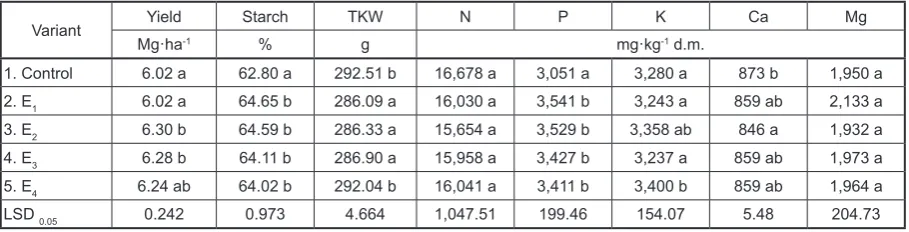
The presowing application of the vermi-com-post extract had the evidential impact on the grain yield, the starch content in grain, thousand kernel weight, and phosphorus content in grain of maize (Table 5).
The lowest application dose of extract into soil (var. E1) did not increase the grain yield (Ta-ble 6). All the other application doses of vermi-extract (var. E2, E3, E4) increased the grain yield of maize in comparison with the control variant.
The growths were significant after application
the doses of 130 and 170 dm3·ha-1 and insignifi -cant with the dose of 210 dm3·ha-1. The highest yield, and the highest yield increase in relation to the control treatment, was detected in variant E2, wherein 130 dm3·ha-1 of extract was applied be-fore the maize sowing.
The inceased dose of extract in relation to var-iant E2 had a depressive impact, in spite of that, the yields in the variants E3 and E4 were higher than in the control, unfertilized variant. The ob-tained data point out the fact that if the presow-ing application of vermi-extract should result in a considerable increase of yield, it is necessary to apply the doses higher than 90 dm3·ha-1, or it is appropriate to use the doses in the range 130–170
dm3·ha-1. The obtained results mean the original information in the Slovak environment as so far only the foliar effectiveness of vermi-extract has been tested.
The presowing application of the vermi-com-post extract increased considerably also the starch and phosphorus contents in the maize grain. The differences of the starch and phosphorus contents between the variants treated by vermi-extract were minimal, however, we can claim that along with the increase of the application dose of vermi-extract the starch and P content in the maize grain was decreased slightly (Table 5). The vermi-ex-tract usage decreased the TKW, and when 90–170 dm3·ha-1 was applied the decrease was significant statistically. The presowing utilization of
vermi-extract did not significantly affect the nitrogen,
magnesium, potassium and calcium contents in the maize grain, and grain from the variants 3-5 treated by vermi-extract had lower nitrogen and calcium contents than form the control variant (Table 5 and 6).
The impact of additional fertilizing by the vermi-compost extract in the growth stage BBCH 15 (Table 7) is evident in comparison to the un-paired variants (3, 5, 7, 9) with the odd ones (2, 4, 6, 8). These comparisons prove a positive impact of additional application of vermi-compost ex-tract on the maize grain yield, which increase by 0.63 even 9.14%. This detection corresponds with
Table 6. The impact of presowing application of vermicompost extract on the maize yield parameters – field
experiment
Variant Yield Starch TKW N P K Ca Mg
Mg·ha-1 % g mg·kg-1 d.m.
1. Control 6.02 a 62.80 a 292.51 b 16,678 a 3,051 a 3,280 a 873 b 1,950 a
2. E1 6.02 a 64.65 b 286.09 a 16,030 a 3,541 b 3,243 a 859 ab 2,133 a
3. E2 6.30 b 64.59 b 286.33 a 15,654 a 3,529 b 3,358 ab 846 a 1,932 a
4. E3 6.28 b 64.11 b 286.90 a 15,958 a 3,427 b 3,237 a 859 ab 1,973 a
5. E4 6.24 ab 64.02 b 292.04 b 16,041 a 3,411 b 3,400 b 859 ab 1,964 a
LSD 0.05 0.242 0.973 4.664 1,047.51 199.46 154.07 5.48 204.73
Explanation: E – vermi-extract, LSD0.05 – least significant difference at the level α = 0.05 (LSD test), different
letters at values indicate statistically significant differences between treatments.
Table 5. The impact of resources of variability on maize yield parameters in field experiment
Resources of
variability n
Yield Starch TKW N P K Ca Mg
F – calculated
Variant 4 2.643+ 4.741+ 5.104++ 1.994 8.579++ 3.407 10.683 1.334
Repetition 3 0.587 0.787 1.213 0.805 0.225 0.797 0.392 0.881
Rest 12
All 19
the finding of Klimeková et al. [2007] recorded
the yield increase only by 1.83% after application of 50 dm3·ha-1 vermi-extract on the winter wheat leaves in the growth stage BBCH 32. The above mentioned information cooresponds also with
the finding of Singh et al. [2010] who stated 9.8
to 13.9% increase of strawberry yield after the vermi-extract application. In neither case the de-crease of grain yield was recorded after the foliar extract application (Table 7).
The highest increase of grain yield as the result of the foliar application of vermi-extract (9.14%) was recorded in the variant 3 versus vari-ant 2, where the lowest quvari-antity of extract was applied in the presowing period.
The increase of the maize grain yield after the foliar application of extract varied in the broader range than after the application of vermi-extract into soil (0.63 to 9.14% versus 0.0 to 4.65%). The average increase of the grain yield after the foliar application achieved the level of 5.00% and after the application into soil only 3.16%. It is evident that a lower dose of extract (40 dm3·ha-1) applied
on a leaf can have a higher impact on the yield formation of maize grain in comparison with higher doses of extract (90 to 210 dm3·ha-1) ap-plied into soil.
The common effect of the presowing and fo-liar application of vermi-extract compared with the control, untreated by vermi-extract variant, increased the grain yield by 5.31 to 12.79% (vari-ants 3, 5, 7, 9 versus control).
Additional fertilization by the extract in the growth stage BBCH 15 (odd variants versus even variants) had smaller effect on starch content and thousand kernel weight, than on the grain yield,
or the given parameters were not influenced
by the foliar application of vermi-extract at all. There were differences only at the level of 0.48 to 1.78%.
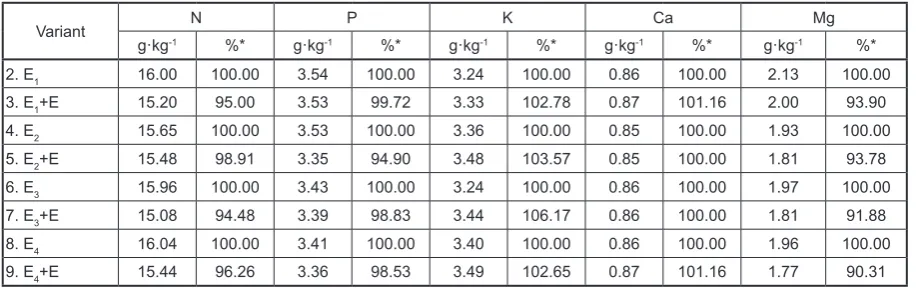
The impact of the foliar application of vermi-extract on the nitrogen, and also phosphorus and magnesium content was negative (Table 8).
The nitrogen content fell by 1.09 to 5.52%, phosphorus content by 0.28 to 5.10% and magne-sium content by 6.1 to 9.69%. The recorded de-Table 7. The impact of sidedress by vermicompost extract on the maize yield parametres – field experiment
Variant Yield Starch TKW
Mg·ha-1 %* %** g·kg-1 %* %** g %* %**
1. Control 6.02 100.00 – 628.0 100.00 – 292.51 100.00 –
2. E1 6.02 100.00 100.00 646.5 102.95 100.00 286.09 97.81 100.00
3. E1+E 6.57 109.14 109.14 643.4 102.45 99.52 283.55 96.94 99.11
4. E2 6.30 104.65 100.00 645.9 102.85 100.00 286.33 97.89 100.00
5. E2+E 6.34 105.31 100.63 638.4 101.66 98.84 290.00 99.14 101,28
6. E3 6.28 104.32 100.00 641.1 102.09 100.00 286.90 98.08 100.00
7. E3+E 6.37 105.81 101.43 645.6 102.80 100.70 283.87 97.05 98.94
8. E4 6.24 103.65 100.00 640.2 101.94 100.00 292.04 99.84 100.00
9. E4+E 6.79 112.79 108.81 646.4 102.93 100.97 286.54 97.96 98.12
Explanation: E – vermi-extract, * Control = 100%, ** presowing application = 100%.
Table 8. The impact of sidedress by vermicompost extract on the contents of some macroelements in maize grain
– field experiment
Variant N P K Ca Mg
g·kg-1 %* g·kg-1 %* g·kg-1 %* g·kg-1 %* g·kg-1 %*
2. E1 16.00 100.00 3.54 100.00 3.24 100.00 0.86 100.00 2.13 100.00
3. E1+E 15.20 95.00 3.53 99.72 3.33 102.78 0.87 101.16 2.00 93.90
4. E2 15.65 100.00 3.53 100.00 3.36 100.00 0.85 100.00 1.93 100.00
5. E2+E 15.48 98.91 3.35 94.90 3.48 103.57 0.85 100.00 1.81 93.78
6. E3 15.96 100.00 3.43 100.00 3.24 100.00 0.86 100.00 1.97 100.00
7. E3+E 15.08 94.48 3.39 98.83 3.44 106.17 0.86 100.00 1.81 91.88
8. E4 16.04 100.00 3.41 100.00 3.40 100.00 0.86 100.00 1.96 100.00
9. E4+E 15.44 96.26 3.36 98.53 3.49 102.65 0.87 101.16 1.77 90.31
crease of the nitrogen content in the maize grain along with the parallel increase of maize grain
yield corresponds with the data of Kováčik [2014]
who claims that the decrease of the nitrogen con-tent in the grains of cereals often occurs after the application of the growth stimulators without the simultaneous application of the nitrogen fertilizers. The rate of the N content drop in grains is deter-mined by several factors, among which the
unfa-vourable weather and the insufficient Nan content in soil rank among the most important factors.
Pot experiment
The obtained results (Table 9) show that it is evident the maize plants in the control vari-ant 1 were higher before the extract application than the plants in the variants treated by
vermi-extract. However, after 13–20 days from the first
application by vermi-extract (6th and 13th of June) the plants treated by extract (var. 2 and 3) were higher than those in the control variant. In the following week (21st of June) these differences in height were eliminated. The increase in plant height treated by extract was recorded nine days after the second spraying (28th June) similarly like
after the first spraying (var. 3 versus var. 2). The
plants of the variant 3 were the highest ones, and of the control variant were the lowest ones. In the middle of July, in the growth stage BBCH 18 and also in the following stages (BBCH 51, 59–61) the highest plants were recorded in the control variant. This means that the positive impact of the foliar application of extract on the maize
plant height is evident during the first 20 days af -ter spraying and with the older plants during the
first 10 days. However, the plant height recorded
at the end of the growing season refers that the stimulative effect is only the short-term one and the extract had the inhibitive impact on the plant height afterward. The detected information about the short-term stimulative effect of vermi-extracts
on the plant phytomass is significant. It explains
the reason of positive effects of vermi-extracts on
the plant phytomass publishing in many scientific
articles because they present the results of experi-ments lasted for only 5 or 6 weeks.
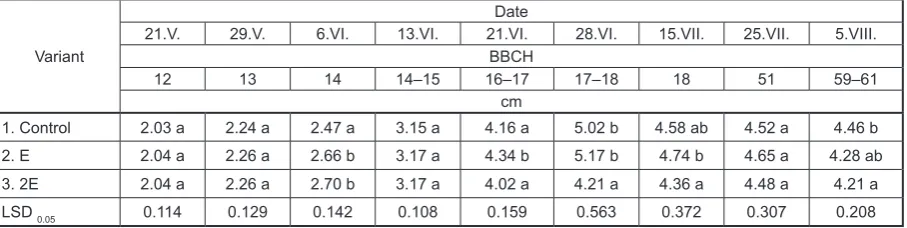
The impact of the extract application on the maize stalk thickness was the same till the growth stage BBCH 14 as the impact on the height of
maize plants (Table 10). 13 days after the first
application of vermi-extract (6th June) the plants treated by extract (var. 2 and 3) were consider-ably thicker than the plants in the control variant.
Table 9. The impact of one and two applications of vermi-extract on dynamics of maize growth – pot experiment
Variant
Date
21.V. 29.V. 6.VI. 13.VI. 21.VI. 28.VI. 15.VII. 25.VII. 5.VIII.
BBCH
12 13 14 14 – 15 16 – 17 17 – 18 18 51 59 – 61
cm
1. Control 8.33 b 12.88 b 14.44 a 19.88 a 36.00 a 45.16 a 60.22 b 105.44 b 128.11 b
2. E 7.55 a 11.33 a 15.05 b 22.94 b 36.01 a 48.88 b 55.77 a 99.11 a 118.11 a
3. 2E 7.55 a 11.33 a 15.05 b 24.00 b 36.01 a 52.05 c 58.44 b 104.00 b 118.00 a
LSD 0.05 0.648 1.203 0.576 2.308 0.287 2.942 1.836 2.849 3.718
Explanation: The first extract application was carried out on 24th of May (BBCH 12) and the second application
on 19th of June (BBCH 16). E - vermi-extract, LSD
0.05 – least significant difference at the level α = 0.05 (LSD test),
different letters at values indicate statistically significant differences between treatments.
Table 10. The impact of one and two applications of vermi-extract on dynamics of maize stalk coarsening – pot experiment
Variant
Date
21.V. 29.V. 6.VI. 13.VI. 21.VI. 28.VI. 15.VII. 25.VII. 5.VIII.
BBCH
12 13 14 14–15 16–17 17–18 18 51 59–61
cm
1. Control 2.03 a 2.24 a 2.47 a 3.15 a 4.16 a 5.02 b 4.58 ab 4.52 a 4.46 b
2. E 2.04 a 2.26 a 2.66 b 3.17 a 4.34 b 5.17 b 4.74 b 4.65 a 4.28 ab
3. 2E 2.04 a 2.26 a 2.70 b 3.17 a 4.02 a 4.21 a 4.36 a 4.48 a 4.21 a
LSD 0.05 0.114 0.129 0.142 0.108 0.159 0.563 0.372 0.307 0.208
The second application of the extract carried out in stage BBCH 16 (var. 3), i.e. 9 days after spray-ing (28th June) had evidently an inhibitive impact. The stalks were getting thicker, however, they grew considerably slower and for longer time than the stalks of the other two variants. These data correspond partially with the information
by Gutiérrez-Miceli et al. [2008], who recorded
thinner stalks of the sorghum plants (Sorghum bicolor) in some cases after the vermi-extract ap-plication in comparison with the control variant.
In the variants 1 and 2 the stalk girth was de-creased from the end of the growth stage BBCH 18. In the variant 3, wherein the second dose of extract was also applied, the stalks were getting thinner after the growth stage BBCH 51. These data point out indirectly that the extract applica-tion carried out in stage BBCH 16 delayed the maturation of stalk tissues and the transfer of the assimilates from the vegetative parts of plant to grain (Table 10).
In the growth stage BBCH 59–61 the thickest stalks were recorded in the control variant - un-treated by extract, and the narrowest stalks oc-curred in the variant where the extract was applied twice (var. 3). Similarly, the highest yield of maize grain and straw was detected in the control variant, and the lowest yield was obtained in variant 3.
These facts result in the information that plant height and thickness of maize stalks recorded in the growth stages BBCH 12 to BBCH 51 did not
correspond with the achieved quantity of maize grain yield. On the contrary, it is possible to detect a certain relationship between the plant height, stalk thickness and grain yield only in the growth stage BBCH 59–61. These data prove the
infor-mation of Kováčik [2014] that it is not unusual if the vegetation of field crops looks better optically (higher, more dark green) until the first half of the
growing season but it gives lower yields than the vegetation which appears to be weaker.
The lower grain yields in the variants treated by extract, recorded in the pot experiment (Table
11), are in contrast with the data of field experi -ment presented in the Table 7.
The data show that in neither case the de-crease of grain yield was recorded after the foliar application of extract. The reason for different ef-fects of the identical vermi-extract on the yield of maize grain consists probably in the different dates of extract application and in the different
maize cultivars. In the field experiment the ex -tract was applied in the growth stage BBCH 15 and the cultivar Stira was grown. Whereas, in the pot experiment the extract was applied in growth stages BBCH 12 or in BBCH 12 and 16, and the cultivar hybrid PR38V91 was grown.
The negative effect of the foliar application of extract on the vegetative phytomass was more considerable (9.14 to 18.5%) in comparison with the impact on the generative phytomass (0.24 to 11.3%). This caused a change of ratio between
Table 11. The impact of single and double application of vermi-extract on maize yield parametres – pot experiment
Variant
Yield
Grain/straw ratio
TKW
grain straw
g·pot-1 %* g·pot-1 %* g %*
1. Control 54.24 b 100.00 101.95 bc 100.00 0.510 251.44 a 100.00
2. E 54.11 b 99.76 92.63 ab 90.86 0.584 253.53 a 100.83
3. 2E 48.11 a 88.70 83.09 a 81.50 0.579 255.04 b 101.43
LSD 0.05 3.543 10.274 3.243
Explanation: see Table 9, * Control = 100%.
Table 12. The impact of single and double application of vermi-extract on some macroelements (N, P, K) con-tents in plants of maize in the growth stage BBCH17 – pot experiment
Variant N P K
mg·kg-1 %* mg·kg-1 %* mg·kg-1 %*
1. Control 12,894 a 100.00 4,048 b 100.00 33,466 a 10.00
2. E 13,263 b 104.41 4,386 c 108.35 33,197 a 99.20
3. 2E 13,084 b 101.47 3,779 a 93.35 31,577 a 94.36
LSD 0.05 220.124 185.458 1,935.324
Explanation: E – vermi-extract, LSD0.05 – least significant difference at the level α = 0.05 (LSD test), different
grain and straw in favour of grain. The extract utilization had the positive impact on the TKW.
The remarkable fact is that the contents of phosphorus, potassium, calcium, magnesium, zinc, copper, manganese and iron were lower in the growth stage BBCH 17, one week after the second application of extract, in comparison with the other variants (Tables 12, 13 and 14).
These data indicate a wide-spectral inhibition of nutrients intake as a result of foliar application
of vermi-extract. Similarly, Gutiérrez-Miceli et al. [2008] recorded the decrease of N, P and K
contents in the sorghum plants in the majority of cases after the application of extracts. On the
con-trary, Pant et al. [2012] detected a increase of N, P, K, Ca and Mg content in the plants of pak choi
after using several types of vermi-extracts.
CONCLUSION
1. The vermi-extract applied in the presowing pe-riod increased the maize grain yield if the ap-plication doses were at the level of 130 to 170 dm3·ha-1. In order to increase the starch content in grain it is more suitable to carry out the pre-sowing application of vermi-extract than the application during the growing season.
2. The positive or negative impact of the foliar vermi-extract application on the maize grain yield depended on the date of the extract
ap-plication and the grown cultivar. The pre-sowing application and foliar application of vermi-extract tended to decrease the nitrogen content in grain.
3. The foliar application of vermi-extract posi-tively affected plant height and stalk thick-ness of maize only in the short term. The plant height and stalk thickness of maize recorded in the growth stages BBCH 12 to BBCH 51 did not correspond with the achieved quantity
of maize grain yield. In the first half of the
maize growing season the information about the plant height and stalk thickness was not an appropriate indicator for the prognostication of quantity of maize grain yield.
Acknowledgements
This research was supported by the projects
VEGA 1/0591/13 and VEGA 2/0079/13.
REFERENCES
1. Arancon N.Q., Edwards C.A., Bierman P., Welch
C., Metzger, J.D. 2004. Influences of vermicom
-posts on field strawberries: 1. Effects on growth
and yields. Bioresour. Technol., 93 (2), 145–153.
doi:10.1016/j.biortech.2003.10.014.
2. Arancon N.Q., Edwards C.A., Bierman P., Metz -ger J.D., Lucht C. 2005. Effect of vermicomposts produced from cattle manure, food waste and paper
Table 13. The impact of single and double application of vermi-extract on some macroelements (Ca, Mg, S)
contents in plants of maize in the growth stage BBCH17 (pot experiment)
Variant Ca Mg S
mg·kg-1 %* mg·kg-1 %* mg·kg-1 %*
1. Control 1 876 b 100,00 5 174 c 100,00 337 a 100,00
2. E 1 714 a 91,36 3 727 b 72,03 270 a 80,12
3. 2E 1 660 a 88,49 3 001 a 58,00 304 a 90,21
LSD 0.05 136,214 313,628 88,957
Explanation: see Table 12.
Table 14. The impact of single and double application of vermi-extract on some microelements (Zn, Cu, Mn, Fe)
contents in plants of maize in the growth stage BBCH17 (pot experiment)
Variant Zn Cu Mn Fe
mg·kg-1 %* mg·kg-1 %* mg·kg-1 %* mg·kg-1 %*
1. Control 55.85 b 100,00 3.92 ab 100.00 49.62 b 100.00 339.34 c 100.00
2. E 53.16 b 95,18 4.26 b 111.52 51.05 c 102.88 294.38 b 86.75
3. 2E 52.02 b 93,14 3.80 ab 99.48 47.38 a 95.49 272.87 ab 80.41
LSD 0.05 4.074 0.586 1.408 29.047
waste on the growth and yield of peppers in the
field. Pedobiologia, 49 (4), 297–306.doi:10.1016/j.
pedobi.2005.02.001.
3. Bremner J.M. 1960. Determination of nitrogen in
soil by the Kjeldahl method. J. Agric. Sci., 55 (1),
11–33. doi:10.1017/S0021859600021572.
4. Chalker-Scott L. 2005. The myth of compost tea, Episode III: Aerobically-brewed compost tea
sup-presses disease. [online:] www.puyallup.wsu.edu/~ Linda%20Chalker-Scott/Horticultural%20Myths_ files/Myths/Compost%20tea%203rd%20time.pdf.
5. Cohen J.B. 1910. Practical Organic Chemistry.
MacMillan and Co., Limited; St. London, pp. 356.
6. Fiala K., Kobza J., Matúšková Ľ., Brečková V., Makovníková J., Barančíková G., Búrik V., Litavec T., Houšková B., Chromaničová A., Váradiová D., Pechová B. 1999. Záväzné metódy rozborov pôd.
Bratislava: VÚPOP, pp. 142.
7. Frederickson J. 2002. Vermicomposting trials at
the worm research centre: part 1. Technical
evalu-ation. Integrated Waste Systems, Open University,
pp. 107.
8. García-Gómez R.C., Dendooven L., Gutíérrez-Mi
-celi F.A. 2008. Vermicomposting leachate (worm
tea) as liquid fertilizer for maize (Zea mays L.) forage production. Asian J. Plant Sci., 7 (4), 360–
367. doi:10.3923/ajps.2008.360.367.
9. Ghorbani R., Koocheki A., Jahan M., Asadi G.A.
2008. Impact of organic amendments and compost extracts on tomato production and storability in agroecological systems. Agron. Sustain. Dev., 28,
307–311. doi:10.1051/agro:2008003.
10. Gutiérrez-Miceli F.A., García-Gómez R.C., Rin
-cón Rosales R., Abud-Archila M., Llaven O.M.A., Cruz M.J.G., Dendooven L. 2008. Formulation of
a liquid fertilizer for sorghum (Sorghum bicolor
L.Moench) using vermicompost leachate.
Biore-source Technology, 99, 6174–6180. doi:10.1016/j.
biortech.2007.12.043.
11. Grappelli A., Galli E., Tomati U. 1987. Earthworm casting effect on Agaricus bisporus fructification.
Agrochimica, 21, 457–462.
12. Ingham E.R. 2005. The Compost Tea Brewing Ma
-nual: Latest methods and research. Soil Food Web,
Corvallis, OR, 5th ed. 79 p.
13. ISO 10520. 1997. Native starch – Determination of starch content – Ewers polarimetric method, Inter-national Standard (E).
14. Klimeková M., Lehocká Z., Žák Š. 2007. The ef -fect of three forecrops and Vermisol application on yields and baking quality of winter wheat in orga-nic farming system. In: Proceeding of conference
Organic farming 2007, CULS in Prague, 53–55.
15. Kmeťová M., Kováčik P. 2014. The impact of ver -micompost application on the yield parameters of
maize (Zea mays L.) observed in selected phenolo-gical growth stages (BBCH-scale). Acta fytotechn. Zootechnica, 17 (4), 100–108. doi:10.15414/ afz.2014.17.04.100–108.
16. Koppová A., Pirkl J., Kalina J. 1955. Stanovění popelovin v rostlinném materiálu přesními expe
-ditívními metodami. Vědecké práce VÚRV, Praha,
1955.
17. Kostecka J. 2009. Selected aspects of the signifi-cance of earthworms in the context of sustainable waste management. In: Contemporary Problems of Management and Environmental Protection. W. Sądej (Ed.) Sevages and waste materials in envi-ronment. Olsztyn, 153–170.
18. Kováčik P. 1997. Rozbory pôd, rastlín, hnojív a výpočet dávok živín k poľným a záhradným plodi
-nám. Nitra: SPU v Nitre, 99 pp,
19. Kováčik P. 2014. Princípy a spôsoby výživy ras
-tlín. Nitra, SPU v Nitre, pp. 278.
20. Lanthier M. 2007. Compost tea and its impact on plant diseases. BC Organic Grower. 10 (2), 8–11.
21. Ložek O., Fecenko, J. 1998. Vplyv Vermisolu v kombinácii s dusíkatou výživou na úrodu a kvalitu zrna ozimnej pšenice. Poľnohospodárstvo, 44 (11),
835–846.
22. Mehlich, A. 1984. Mehlich 3 soil test extractant: A modification of Mehlich 2 extractant. Communica -tion in Soil Science and Plant Analysis, 15, 1409–
1416. doi:10.1080/00103628409367568.
23. Pant A.P., Radovich T.J.K., Hue N.V., Talcott S.T.,
Krenek K.A. 2009. Vermicompost extracts influ -ence growth, mineral nutrients, phytonutrients and antioxidant activity in pak choi (Brassica rapa cv. Bonsai, Chinensis group) grown under vermicom-post and chemical fertilizer. Journal of the Science
of Food and Agriculture, 89 (14), 2383–2392. doi:10.1002/jsfa.3732.
24. Pant A.P., Radovich T.J.K., Hue N.V., Paull R.E. 2012. Biochemical properties of compost tea asso-ciated with compost quality and effects on pak choi growth. Scientia Horticulturae, 148, 138–146.doi.
org/10.1016/j.scienta.2012.09.019.
25. Singh R., Sharma R.R., Kumar S., Gupta R. K.,
PATIL R. T. 2008. Vermicompost substitution
in-fluence growth, physiological disorders, yield and quality of strawberry (Fragaria ananassa
Duch.). Bioresour. Technol., 99 (17), 8507–8511.
doi:10.1016/j.biortech.2008.03.034.
26. Singh R., Gupta R.K., Patil R.T., Sharma R.R.,
Asrey R., Kumar A., Jangra K.K. 2010. Sequen-tial foliar application of vermicompost leachates improves marketable fruit yield and quality of strawberry (Fragaria ananassa Duch.). Scientia
27. Scheuerell S., Mahaffee W. 2002. Compost tea:
Principles and prospects for plant disease control.
Compost Science and Utilization, 10 (4), 313–338. doi:10.1080/1065657X.2002.10702095.
28. Scheuerell S.J. 2004. Compost tea production practices, microbial properties, and plant disease suppression. I International conference Soil and compost eco-biology, September 15th–17th 2004, León–Spain, 41–51.
29. Tejada M., Gonzalez J.L., Hernandez M.T., Gra -cia C. 2008. Agricultural use of leachates ob-tained from two different vermicomposting pro-cesses. Bioresour. Technol., 99 (14), 6228–6232.
doi:10.1016/j.biortech.2007.12.031.
30. Tomati U., Grappelli A., Galli E. 1988. The hor -mone-like effect of earthworm casts on plant
growth. Biology and Fertility of Soils. 5 (4), 288– 294. doi:10.1007/BF00262133.
31. Tomati U., Galli E. 1995. Earthworms, soil fertil
-ity and plant productiv-ity. Acta Zoologica Fennica,
196, 11–14.
32. Utkhede R., Koch C. 2004. Biological treatments
to control bacterial canker of greenhouse
toma-toes. Biocontrol, 49 (3), 305–313. doi:10.1023/
B:BICO.0000025373.69584.08.
33. Tiurin I.V. 1966. K metodike analiza deja
sravníteľnogo izučenja sostava počvennogo pereg -noja ili gumusa. Voprosy genezisa i plodorodija
počv. Moskva: Nauka, 1966.
34. Weltzien H.C. 1991. Biocontrol of foliar
fun-gal disease with compost extracts. [In:] Micro -bial Ecology of Leaves, Springer-Verlag, New York, p. 430–450. ISBN 978-1-4612-7822-1.
doi:10.1007/978-1-4612-3168-4_22.
35. Wickland L., Murray T., Jimerson J. 2001. Brewing
up solutions to pest problems. BioCycle, 42, 64–66. 36. Zaller J.G. 2006. Foliar spraying of vermicompost.
extracts: Effects on fruit quality and indications
of late-blight suppression of field-grown tomato -es. Biological agriculture and horticulture. 24 (2),
165–180. doi:10.1080/01448765.2006.9755017.
37. Zbíral J., Urbánková E., Čižmárová E., Tieffová P., Rychlý M., Šulová R., Kabátová N., Pospíchalová Markéta; Souček Jaromír, Keilová R., Srnková J. 2005. Analýza rostlinného materiálu. Jednotné pra
-covní postupy ÚKZÚZ. II. přepracované a rozší
-řené vydání. Národní referenční laboratoř ÚKZÚZ
Brno, pp. 192.
38. Zadoks J.C., Chang T.T., Konzak C.F. 1974.
A decimal code for the growth stages of ce-reals. Weed Research, 14 (6): 415–421.