Ethernet Network Bandwidth And Traffic
Density Management: Knowledge Management
Concept
1 Ikpeze Onyinye Florence
Department of Electrical/Electronics and Computer Engineering, College of Engineering, Afe Babalola University,
Ado-Ekiti, Nigeria. [email protected];
2 Apena Waliu Olalekan
Department of Electrical and Electronic Engineering, Federal University of Technology, Akure, Nigeria.
Abstract— Knowledge Management (KM) is a vital
factor to address issues intersected with process, people and technology. The study necessitates employing KM practices to address network bandwidth abuse and congestion. The paper analyze traffic managers (Bandwidth Meter - BWM and Website Zapper) in the conceptual view of KM using Electronic Library, College of Engineering, Afe Babalola University, Ado-Ekiti, Nigeria as a case study. This was achieved through use of existing network with 32 Local Area Networked (LAN) systems and software traffic managers to reveal knowledge sharing due to data traffic. BWMeter was deployed to determine the maximum limit (per hour) of traffic accommodated before congestion. The network was monitored at capacity of 600MB to trigger end user’s alert and reduces data speed limit to 2.5KBS, so that the internet can be surfed with ease and with a reasonable response time. Website Zapper was also installed on the LAN systems to block web access to sites that are non educative and which occupies and floods the bandwidth of the network such as pornographic sites, gambling site and online movie sites. The study adopted knowledge management concept to establish knowledge sharing (data traffic) in the College of Engineering, Afe Babalola University, Ado-Ekiti, Nigeria.
Keywords—Bandwidth Meter; Ethernet; Knowledge Management; Traffic Density; Website Zapper
1. INTRODUCTION
Knowledge management is the deliberate and systematic coordination of an organization's people, technology, processes, and organizational structure in order to add value through reuse and innovation. This is achieved through the promotion of creating, sharing, and applying knowledge as well as through the feeding of valuable lessons learned and best practices into corporate memory in order to foster continued organizational learning [1]. Application of Knowledge Management is paramount in managing traffic density. Traffic Managers are software that monitors, record, displays and saves all traffic going out and
coming into a network. With this Knowledge Management System, the difficulty faced in the network like congestion and also a sluggish network, is controlled and managed. As internet is growing exponentially
Vol. 3 Issue 7, July - 2017 corrupted or lost in transmission to be saved and also
to have a congested-free network as possible [3]. Furthermore, every user perceives the network differently and has a different set of expectations from the network. The network is not simply a physical media for information transfer. In a larger sense, the network is primarily a shared resource. When a resource such as a folder or printer is shared, access privileges and permissions are assigned to establish a policy for sharing. The policy based network access paradigm derives from the same principle. KM transforms the network into a managed resource. Centralized policy management and stateful network interface provisioning are powerful strategies to regulate networks and control traffic load for performance, efficiency and security. The rapidly emerging multimedia applications market in today’s dynamic workplace has introduced serious challenges to network bandwidth on local area networks. A strategy to regulate and control the network resource efficiently is mission-critical for enterprise networks. A network bandwidth is a vital resource worthy of conservation. Managing the network efficiently often defers the need to upgrade the network and reduces costs. The 90’s were a decade of abundance, as low-cost memory and faster processors promoted rapid sales of PCs to businesses and homes. As that trend curve flattens and budgets tighten, value-added services, performance enhancements and system optimizations become dominant factors with consumers. Judicious use of existing capacity and infrastructure provides better return on investment.
II. TRAFFIC MANAGERS INTEGRATION IN ETHERNET NETWORK APPLICATION
Research on previous work shows that most of the tools used for managing traffic density like PRTG, Network Sniffer, JitBit e.t.c are not compatible with all versions of windows [4]. In this work we used a software analyzer known as Bandwidth Meter which is compatible with all versions of Windows Operating System to manage traffic density in network application [5]. The unique features which supersedes its counterparts include:
· Graphical and numerical display of bandwidth
· Statistics can be exported / imported
· Easy installation and configuration with default options
· Supports LAN, WAN, VPN, ADSL, xDSL, Modem, Dial-Up, etc.
· Can run as a Service (Windows 2000, XP, and 2003 only)
Web Site Zapper was also used to control Web access to sites and it is also compatible with all web browsers [6].
The importance of traffic density management to the effective use of available bandwidth of the transmission media of any network cannot be over emphasized. In the College of Engineering, Afe Babalola University Ado-Ekiti, the E-Library has increased the performance of students academically in terms of research works and also made work easier, faster for both students, academic and non-academic staff. For these reasons and many more there is the need to efficiently manage traffic density in network applications to enable the objectives of setting them up realized.
A. Network Traffic Density
Fig. 1. Process, Technology and People
Application of Knowlwdge Management (KM) in the network will establish interaction between people (users of the network which includes students and staff), the process which is applied to support the technology and promote knowledge sharing as shown in Fig. 1.
B. Types of Network Traffic
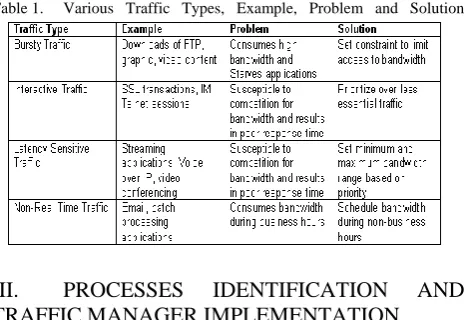
Networks accommodate an increasingly complex set of data traffic. Identifying the type of traffic will help network administrators to facilitate the optimization of the network [8]. Various types of traffic are:
Table 1. Various Traffic Types, Example, Problem and Solution
III. PROCESSES IDENTIFICATION AND TRAFFIC MANAGER IMPLEMENTATION
The software based tools employed in managing traffic density in network application in the conceptual view of knowledge management are Bandwidth Meter and Website Zapper.
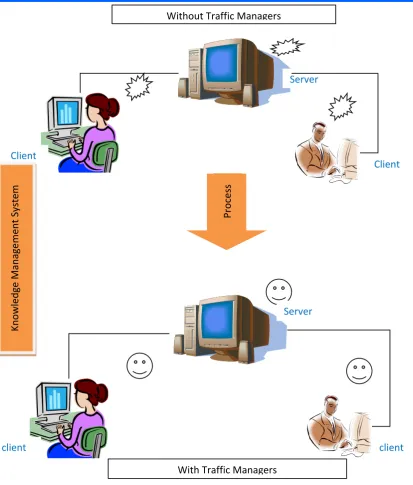
The Process in Fig. 2 illustrates the technological approach to fuse the software based traffic managers (Bandwidth Meter and Website Zapper) into a network for knowledge implementation and sharing within the Ethernet Network. The top picture shows what surfing the network is like without traffic managers, it is always challlenging and slow as a result of congestion during the peak period where the users of the network (clients) are doing all sort of thing online from heavy downloads to uploads, online games, omline movies etc all of which congests the internet. This was addressed in the bottom picture where KM system was implemented to block uneducative sites and slow down heavy downloads and uploads to prevent the network from being bursty. Process
(Installation and running of Software
based Technology)
People (Student, Academic and Non-Academic
Staff) Technology
(BandWidth Meter and Website Zapper)
Vol. 3 Issue 7, July - 2017
Fig. 2. Ethernet connected network showing effect of knowledge managerment system
A. BANDWIDTH METER
BWMeter is a powerful software employed to monitor, measure, display and control traffic to/from your computer on a network BWMeter is a powerful bandwidth meter, monitor and traffic controller, which measures, displays and controls all traffic to/from your
traffic as well as download / upload from the internet. You can even define filters which show your transfer with certain internet addresses (e.g. to see how much data you download from your favorite news server). BWMeter is ideal for home users to get an overview of how much bandwidth they use, as well as small to large businesses, where one computer can control the
Server
Client Client
Server
client client
Pro
cess
Without Traffic Managers
Knowledge
Manage
men
t System
Fig. 3. Details menu of Bandwidth Meter
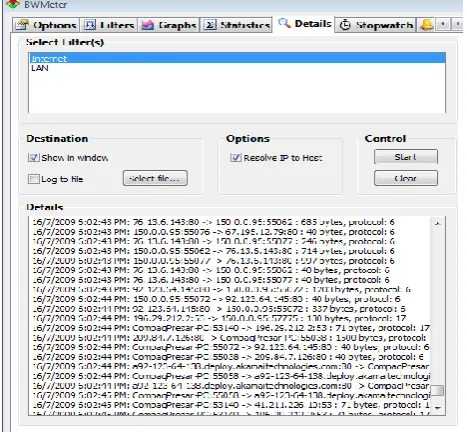
The details tab as shown in Figure 3 shows all network packets that are measured by the filters. It is intended as information for experienced users (e.g. to detect unwanted internet traffic). Recording each data packet is very time consuming so it takes a lot of CPU time and will slow down your network traffic if your computer is not fast enough. Therefore, it's recommended only to use the details view for special situations where it is needed.
Destination
The network packet details can be displayed in the list window and / or written to a log file. In the Destination group of options, you can choose where to send the details. The list window will display the last 512 packets. The log file doesn't have a restriction regarding the maximum size. It is only limited by the free space on your hard disk.
Options
Resolve IP to Host: If this option is selected, BWMeter will try to resolve IP addresses to host names for displaying details about network packets. E.g. "www.test.com" will be displayed instead of "208.48.34.132". This information will just be a hint and not always correct! BWMeter depends on the DNS servers of your system and these DNS servers do not always provide correct information.
Control
The control section includes a button to start recording the details. During recording, a red blinking indicator will be displayed. You can use the Clear button to clear the list window and the log file.
Details
Each line in the details list represents one data packet captured by the selected filter(s). The syntax is: Time: Source:SPort -> Destination:DPort : x bytes, protocol: p
Time: date and time when the packet was captured. Source: address or host computer where the packet comes from, SPort is the source port number.
Destination: address or host computer where the packet goes to
DPort: destination port number
x: length of the data packet in bytes and, p: protocol number used.
Fig. 4. Setting speed limit in Bandwidth Meter
This speed limit option as shown in Fig. 4 is very useful to restrict the traffic to a certain amount. , so that reading emails etc. will still be possible without exceeding the maximum allowed bandwidth. Or you can simply stop the traffic completely when the limit is reached.
B. Website Zapper
Furthermore a software program called Website Zapper was used in conjunction with BWMeter to control Web access, it closes Web browsers and is used to prevent students, employees or any person from going to undesirable sites, such as pornographic sites, gambling sites or sites where heavy applications such as movies, music, or games can be downloaded from all of which floods and congests the bandwidth of the network [10].
Vol. 3 Issue 7, July - 2017
Fig. 5. Website Zapper Edit Form
IV. ANALYSIS
The transfer rate of traffics are high during the morning hours and average during the mid-day and low during sunset (evening hours). In the morning hours, the number of users on the network are few, traffic density is “low” and the speed is “high” resulting in a traffic state that is characterized as “free”. In the afternoon when the number of users increases and sites containing interactive traffics are visited, traffic density is “not very high” and the speed is “medium” this results in a “crawling” traffic state. Towards sunset (evening) when the number of users is in its maximum, and sites where heavy downloads like movies, music, games etc. are done, activities involving voice conferencing, FTP graphics, streaming applications; all of which consumes high bandwidth and starves application which results in a traffic state characterized as “congested”.
It was observed that in the morning hours when the traffic state is “free”, the sum of the download and upload is within the range of 50MB-300MB within an hour, in the afternoon hours when the traffic state is “crawling”, the sum of download and upload is within 350MB-550MB, and in the evening hours when the traffic state is “congested”, the sum of download and upload is within 600MB-800MB.
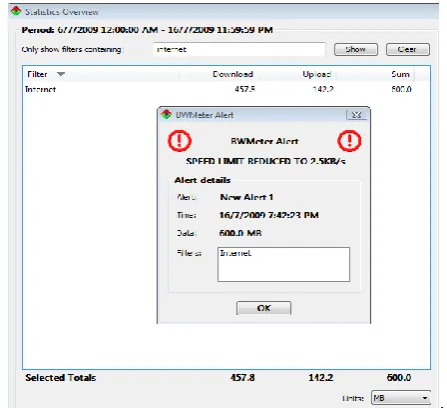
BWMeter was set such that when the sum of download and upload reached 600MB the speed limit of the download + upload is reduced to 2.5KB/s so that normal surfing of the internet can be made without constraint as shown in Fig. 6. An alert will be triggered
. Fig. 6. Bandwidth Meter Alert
The second software as shown in Fig. 7 (Website Zapper) was configured to block access to sites where heavy unnecessary downloads are done as well as restrict access to sex, nude sites etc. whenever restricted sites are attempted to be accessed, the webpage is blocked and the screen pops-up an alert.
Fig. 7. Website Zapper Alert
It is important that network administrator(s) are fully trained on how to implement and use these software based technology so that they collect and record the right data which will be needed to effectively manage the bandwidth and traffic density of the network.
b) Knowledge management system cost: It can be very expensive to install traffic mangers in a very big organization. Let’s say that an organization has over 50 LAN systems and they want them to access the traffic in and out of the network from a centralized location (server). They will have to create a strong data base which will handle all the traffic density made by each client (user) in a minute.
VI. CONCLUSION
Knowledge management is the concept under which information is turned into actionable
knowledge and made available effortlessly in a usable form to the people who can apply it As in this paper it is applied to an Ethernet network application which collectively managed the traffic density. This means that even if additional bandwidth is added to the network and it is not properly managed then that is no solution. Based on the findings of this analysis, it was concluded that the best measure to take in managing traffic density in conceptual vie of knowledge management is setting a limit on the BWMeter (this limit should such that whenever it is exceeded, the traffic state is “congested”), so that when it gets to that point, the speed limit of the download/ upload that caused the congestion of the network is reduced to a limit so that the network will be less congested and usual surfing of the network can be possible with a reasonable response time.
In addition to this, Website Zapper was also adopted to restrict internet access to non-educative and pornographic site which are huge sources of traffic congestion.
With these measures adopted, the bandwidth of the transmission media was able to be used effectively.
REFERENCES
[1] Garrick, J. & Clegg, S., Knowledge work and the new demands of learning. Journal of Knowledge Management, Vol. 4, No. 4, pg. 279–286, 2000.
[2] NetVeda LLC. Policy Based Network Traffic Management. Journal of Computing, Vol.1Issue 1, pg 191-194, 2003.
[3] Robert M. Metcalfe & David R. Ethernet: distributed packet switching for local computer networks. Communications of the ACM, Vol. 9 Issue 7, pg 395-404, July 1976.
[4] Lawrence G. Roberts. Computer networks and Intercomputer communication. SOSP '67 Proceedings of the first ACM symposium on Operating System Principles, pg 3.1-3.6, January 1967.
[5]http://www.desksoft.com/BWMeter.html, accessed 10/05/2009.
[6] Leonard Kleinrock, Communication Nets: Stochastic Message Flow and Delay. Mcgraw-Hill, New York, 2007 Dover Edition, pg 401-423, 1964.
[7] D. W. Davies, K. A. Bartlett, R. A. Scantlebury, and P. T. Wilkinson, A digital communications network for computers giving rapid response at remote terminals. SOSP '67 Proceedings of the first ACM symposium on Operating System Principles, pg 2.1 2.17, January 1967.
[8]http://ipv6.com/articles/applications/Network-Traffic-Management.htm, accessed 02/05/2009.
[9] Kihong Park & Walter Willinger, Self-Similar Network Traffic and Performance Evaluation. A Wiley-Interscience Publication John Wiley & Sons, Inc, pg 4-7, January 2002.