in the 21 century Volume 51, 2013 113
Tanrıverdi, S. (2007). Katılımcı okul kültürünün yabancı dil öğretmenlerinin iş motivasyonuyla ilişkisine yönelik örnek bir çalışma. Yayımlanmamış Yüksek Lisans Tezi, Yeditepe Üniversitesi Sosyal Bil
-imler Enstitüsü, İstanbul.
Tiryaki, A. (2008). İşletmelerde modern liderlik yaklaşımları ve çalışan motivasyonu ilişkisine yönelik bir uygulama. Yayımlanmamış Yüksek Lisans Tezi, Yıldız Teknik Üniversitesi Sosyal Bilimler Enstitüsü, İstanbul.
Williams, M., & Robert L. B. (1997). Psychology for language teachers: A social constructivist ap
-proach. Cambridge: Cambridge University Press.
Yılmaz, F. (2009). Eğitim örgütlerinde örgüt kültürünün öğretmenlerin iş motivasyonu üzerindeki etkisi.
Yayımlanmamış Yüksek Lisans Tezi. Selçuk Üniversitesi, Sosyal Bilimler Enstitüsü, Konya.
Advised by Judita Stankutė, SMC “Scientia Educologica”, Lithuania
Received: January 08, 2012 Accepted: March 11, 2013
Ergün Recepoğlu Assistant Professor, Dr., Kastamonu University, Department of Educational Sciences, Kastamonu, Turkey.
E-mail: [email protected]
FROM ELEMENTARY SCHOOL TO
UNIVERSITY EDUCATIONAL
PROGRAMMES: A COMPREHENSIVE
STUDY OF THE ADULT EDUCATION IN
SPAIN
Gonzalo Sacristán-Pérez-Minayo University of Burgos, Burgos, Spain E-mail: [email protected]
Ruth María Martín-Moro Adult Education Centre of Olmedo, Valladolid, Spain E-mail: [email protected]
Abstract
Lifelong learning plays an important role due to the actual needs that we have in terms of knowledge-based economy. It provides education both to working and non-working people who want to be part of this developing society. In this study, two different levels of the Spanish Adult Education are assessed but not only from an individual point of view, but also from the point of view of cooperation between them in order to improve the teaching-learning process. Both the Education Centre of Olmedo (Olmedo, Spain) and the University of Burgos (Burgos, Spain) are described deep inside and likewise, the activities that they two are developing to interconnect both the two centres and the educational levels so that the lear
-ning process is never interrupted. Activities such as seminars, web pages management, oral presentations and questionnaires showing different aspects of the educational process will be discussed in the present study. The use of the new Information Technology and Communication (ICT) should be enhanced for ef
-fective learning of our adult students. From our results, it will be demonstrated that adults can be part of the education system and therefore gain new skills and knowledge that let them succeed in their lives.
Key words: adult education, developing society, lifelong learning, teaching-learning process, teaching methodology.
Lifelong learning
Adult education is crucial in a developing society and a knowledge based economy. These individuals will gain life and work skills to facilitate their return to the mainstream.
Lifelong learning is developed at all levels of the Spanish education system.At all lev
-els, classes are specifically designed and developed to cater to Adult Education at Elementary Education or below or up to University. There are school counsellors who will guide them which classes to take to further their education and personal development. These individuals have reasonable expectation that the skills and knowledge gained from adult education will help them achieve their goals in life. Programs focused in Adult Education are held around the world, Europe, Spain and the region of Castilla y León in order to include older learners in the learning process.
UNESCO (2009) has worked with Member States since the First International Confer
-ence on Adult Education in 1945 to ensure that adults have the basic right to education and in 1976, the UNESCO General Conference approved the Nairobi Recommendation on the De
Volume 51, 2013
114 The European program Grundtvig, which is focused on old learners, tries to involve them into the European society, develop a European awareness and give them an opportunity to reach their working purposes.According to what the program says itself “ The Grundtvig pro
-gramme addresses the teaching and learning needs of those involved in adult education; it aims to provide new learning opportunities for all especially for adults at risk of social exclusion and for older workers. It brings together learners, teachers and organisations in adult education and enables them to exchange experiences, learn from each other and develop new approaches in adult education” (European Commission, 2007).
The Spanish Education Law, in the current LOE (Ley Orgánica de Educación, 2006) states that adult education has the aim of letting any person over 18 years old have the possibility to gain, update, complete or increase their knowledge or skills in order to develop their personal and/or professional career.
The Adult Education Law in the region of Castilla y León stands out that the knowledge society makes necessary Lifelong Learning in order to be up to date due to technological ad
-vances and a changing society. Education is the best instrument to improve equal opportunities and labour integration of all the people at risk of social exclusion. It also develops participation of adults in the Castilla y León society (Ley de Educación de Personas Adultas de Castilla y León, 2002).
the Adult Education at Elementary Education levels in Spain is divided into formal and non-formal education. Formal studies include �Level 1� or �Beginning Literacy and Numera-Formal studies include �Level 1� or �Beginning Literacy and Numera
-cy� and �Level 2� or �Advance Litera-cy� and non-formal education can include subjects such as: �Distance Secondary Education�(DSE), Foreign Languages and �Information and Com
-munication Technology�(ICT). Formal education is characterised by the possibility of getting a certificate issued in the centre and non-formal studies no certificate is issued in the centre.
The purpose of Level 1 is to help adults to improve their knowledge of the Spanish lan
-guage, its culture and basic reading, writing and maths skills (ORDEN EDU/1666, 2005). Level 2 has the objective of helping adults to get the necessary knowledge to be able to enrol in Secondary Education and so that improve their participation in the social, cultural and economic life (ORDEN EDU/1666, 2005).
Non – formal studies try to allow people to get some basic certificates of studies, access to professional training and the development of basic and professional competences (orden
EDU/661, 2012).
As regards to University studies, the adaptation to the European Higher Education Space implies the modification of some aspects of the teaching plans (Benito and Cruz, 2005). The teaching-learning processes are based on collaborative work between teachers and students, which requires a new definition of the teaching-learning activities. In the case of adult educa
-tion, the relationship between teacher - student becomes more important due to the personal proximity to students and therefore more responsibility and commitment to their personal learn
-ing. The current number of lectures and seminars should remain at least the same, as before the adaptation to the European Higher Education Space. Teaching/learning methods are chang
in the 21 century Volume 51, 2013 115 Olmedo (3.845). Subjects: �Level 1�, �Level 2�, �General English�.
•
Pedrajas de San Esteban (3.628). Subjects: �ICT�, �General English�. •
Iscar (6.844) Subjects: �Level 1�, �Level 2�, �General English�, �DSE� •
Mojados (3.295). Subjects: �Level 1�, �Level 2�, •
La Pedraja de Portillo (1.163). Subjects: �Level 1�, �Level 2�, •
Valdestillas (1.576) Subjects: �Level 1�, �General English�, •
Formal Studies such as �Level 1� or �Beginning Literacy and Numeracy� and �Level 2� are taught in our centre or �Advance Literacy�. Non–formal studies consists of �ICT studies�, �General English studies� and �DSE�.
As it is an Adult Education Centre, students from 18 years old (number, gender and age of students will be further addressed) can participate in one or two subjects depending on their interests.
�Level 1� is addressed to students which have little knowledge of the Spanish Language, can hardly read or write or even they cannot, and to those who, although they can write or read, they have a lot of difficulties to understand a reading or write about something. We normally have in this class elderly people because of their lack of studies, we will analyse it below. The teaching load is from 2.5 hours to 5 per week.
�Level 2� is for students that have not completed the Elementary Education but they have attended to school for some years and basic language and mathematic skills are already acquired. They also have the history and basic science classes. In them, students review what they learnt years ago and also improve their general knowledge. The teaching load is from 2.5 hours to 5 per week.
�ICT studies for adults� is focused to teach students basic computing and the use of mail
-ing and the Internet. Nowadays illiteracy is not only be-ing unable to write or read but also to use computers, at least, for personal use. One and a half hours per week is the teaching load.
The �General English course� introduces adults into the English language to facilitate them to join courses in the future where they can get a certificate that will help them in their attempt to be part of the working society. One and a half hours per week is the teaching load.
�DSE� is held to give adults the opportunity to get back into the education system and catch up on their studies. Most of them are young students that did not finish the Secondary Education and started to work very early. Some of them want to be promoted or have better jobs and having the opportunity to attend to classes 4 days a week, 2.5 hours a day for two years make it easier as they are able to work and go to classes. After passing the exam, some students join the University or College.
Extracurricular activities such as trips and excursions are considered an important part of the teaching process. These trips developed around the academic year have different objec
-tives:
To promote interconnection between villages. •
To make subjects more practical as activities are related to what is being studied. •
To open students´ minds by getting to know other foreign cultures. •
To achieve a better knowledge of our country and villages. •
To get a sense of European identity. •
To encourage the European dimension. •
To give the opportunity to the elderly to meet other people and visit different plac
-• es.
Every academic year, according to the planning of activities of the Adult Education Cen
-Volume 51, 2013
116 mote the Spanish culture (differences and similarities between us) and we travel to a European country as part of the �General English� program so as to raise awareness of the European identity.
University of Burgos: Overview
The University of Burgos has some adult education programs to improve lifelong learn
-ing. Some of these programs are: �Open University to old age�, �Experience Interuniversity Program� and �Preparation Courses for the University Entrance Examination for over 25 and 45 years (Course for over 25 and 45 years.)
The “Open University to old age” program is organized by the Student and University Extension Vice-Principalship, University of Burgos. This lifelong teaching program is based on a monographic course intended for adult students. These courses are organized in two different locations, Burgos and Aranda de Duero (Burgos, Spain). The timetables of these courses are: every Monday from 17:00 to 18:30 hours for the Burgos studies and every other Tuesday from 17:00 to 18:30 hours for the Aranda de Duero program.
The teaching plan in Burgos is:
First semester: �Two musical geniuses: Mozart and Beethoven�
Second semester: �The legal protection of the Family: Civil measures and Social Secu
-rity�
And the teaching plan in Aranda de Duero:
First/Second semester (Academic year): �Musicians, music and life�
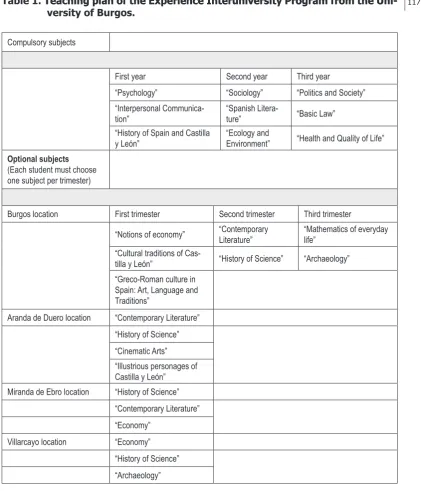
The “Experience Interuniversity Program” is an initiative founded by the Junta de Castilla y León Government (Spain) and it is made in collaboration with all the public and private Universities of the Castilla y León Community. The educational program is framed in active aging programs, which aims to give older people the opportunity to access culture and science as a formula for personal growth. People from 55 years old, living in the region of Cas
-tilla y León (Spain), could participate in this mentioned program. The principal objectives are summarized in three:
To facilitate older people to approach culture and science as a vehicle of expression •
of experiences and knowledge.
To promote the exchange of relationships, both between them and the other age •
groups, becoming the University environment a context of social interaction. To encourage occasions for learning and personal growth through reflection and •
dialogue with classmates and teachers.
The aim of this program is to give students: current knowledge, cultural activities, a teaching methodology adapted to the elderly, the necessary material for each subject and the access to and the use, as a student, of the University facilities. At the end of the three academic years, each student will get a Diploma from the University at which they have been studying.
Each student will make three compulsory and three optional subjects, plus complemen
in the 21 century Volume 51, 2013 117
Table 1. Teaching �lan of the E��erience �nteruniversity Program from the Uni-Teaching �lan of the E��erience �nteruniversity Program from the Uni-versity of Burgos.
Compulsory subjects
First year Second year Third year
“Psychology” “Sociology” “Politics and Society”
“Interpersonal
Communica-tion” “Spanish Litera-ture” “Basic Law”
“History of Spain and Castilla
y León” “Ecology and Environment” “Health and Quality of Life” Optional subjects
(Each student must choose one subject per trimester)
Burgos location First trimester Second trimester Third trimester
“Notions of economy” “Contemporary Literature” “Mathematics of everyday life” “Cultural traditions of
Cas-tilla y León” “History of Science” “Archaeology”
“Greco-Roman culture in Spain: Art, Language and Traditions”
Aranda de Duero location “Contemporary Literature” “History of Science” “Cinematic Arts” “Illustrious personages of Castilla y León”
Miranda de Ebro location “History of Science” “Contemporary Literature” “Economy”
Villarcayo location “Economy”
“History of Science” “Archaeology”
The University of Burgos also offers “Preparation Courses for the University En-trance Examination for over 25 and 45 years”. This course is for people from 25 to 45 years old who want to enrol at University for the first time and need to pass this exam to be allowed to study here.
The structure and content of the Entrance Examinations are different for students over 25 and for those over 45 years old. For over 25, there is a General phase and a Specific phase with five options: Arts and Humanities; Science; Health Sciences; Social Sciences and Law and Engineering and Architecture. For students over 45, there is a General phase and a personal interview.
Besides, the Microbiology Department has taught, since 2011/2012, a subject (�Agro
Volume 51, 2013
118 named GAGRIECA, from the Agrofood and Rural Development Engineering Degree of the University of Burgos. The peculiarity of these Adaptation Courses is the age of the students. They are usually people who work in different jobs and want to be updated at the univer
-sity. They have the previous university degree named �Technical Agricultural Engineers� and through the mentioned Adapted Course, they will be perfectly integrated at the new European Higher Education Space (Bologna Declaration).
The teaching resources used, among others, were: preparation of seminars and analy
-sis of scientific articles (oral presentations, titles proposal and summarizing articles). Visits to agrofood companies and the development of scientific conferences were also part of the complementary activities.
The evaluation of educational activities, both presential and non-presential, was conduct
-ed by the Student Satisfaction Survey design-ed specifically for the Microbiology Department. These questionnaires, specially intended for students, including some sections like the work
-ing time spent on each activity, evaluation of resources employed and the appropriate teach-ing methodology were used during the academic years 2011/2012 and 2012/2013 (Figure 1).
Olmedo Adult Education Centre: Results of the Study
Number of students, ages, gender and subjects are being analysed in this section. Formal and non-formal education are compared in terms of the number of students and ages.
Figure 2 shows the percentages per subject. A difference in �Advance Literacy�, 28%, can be noticed and points out that this is the most studied subjects in the centre. Nevertheless, were formal education subjects (�Beginning Literacy� and �Advance Literacy�) summed up between them and non-formal education (�DSE�, �ICT� and �General English�), it could be appreciated that both formal and non-formal have the same amount of students. However, in non-formal education the number of students per subject is very similar.
Figure 3 shows, that in general, students are mostly women except in �DSE� where the number of both men and women attending to classes, is nearly the same.
Students from 50 to 64 are the ones that attend to more classes (Figure 4). They are in
-terested in �Advance Literacy�, �General English� and �ICT� subjects. Students from 65 are interested in �Beginning Literacy� and in �DSE� the most part of the students are from 18 to 29 years old.
As regards to the number of male students, there are not notable differences between ages and subjects except in �DSE� (Figure 5).
in�General English� and �ICT�, the number of students of this age and gender (women) is half the number of �Advance Literacy� (Figure 6). Students between 50 and 64 are more in
in the 21 century Volume 51, 2013 119
University of Burgos - Agrofood and Rural Development Engineering Degree
Adaptation Course to European Credit System (EEES)
Academic Year 2011/2012. Microbiology Department
Subject: "Agrofood Microbiology" 1st Semester
Age Woman Man
Class attendance Less 25% Between 25-50% Between 51-75% More 75%
Subject difficult degree Low Medium High Very high
Initial interest degree Low Medium High Very high
Final interest degree Low Medium High Very high
Mark with an X the average weekly hours employed
<1 h de 1h a 4h de 5h a 8h de 9h a 12h >12h
1. RESEARCH ARTICLES
Preparation of Summary (Individual Activity) Proposal of three possible Titles
(Individual Activity) Preparation Seminar-Debate
(Individual Activity)
2. LABORATORY WORK
Preparation Practices Report (Group Activity)
Mark with an X the satisfaction degree of theactivities
LOW MEDIUM HIGH VERY HIGH
1. RESEARCH ARTICLES
Preparation of Summary (Individual Activity) Proposal of three possible Titles
(Individual Activity) Preparation Seminar-Debate
(Individual Activity)
2. LABORATORY WORK
Laboratory practical classes
Preparation Practices Report (Group Activity)
3. THEORICAL CLASSES
Theorical classes
SUBJECT SATISFACTION
DEGREE Low Medium High Very high
OBSERVATIONS (Suggestions, improvements, etc..)
Subject
Adaptation Course - Degree
Volume 51, 2013 120
Figure 2: Percentage of students �er subject in the adult educational �rogram develo�ed in the Olmedo Adult Education Centre in the 2012/2013 academic year.
in the 21 century Volume 51, 2013 121
0
10
20
30
40
50
60
70
Beginning Literacy
Advanced Literacy
General English
ict
dse
65 & above
50 & 64
18 & 29
Number of students per subject (men and women)
Figure 4: Number of students �er subject and age (men and women) in the Ol-medo Adult Education Centre in the 2012/2013 academic year.
0
10
20
30
40
50
60
70
Beginning
Literacy
Advanced
Literacy
General
English
ict
dse
65 & above
50 & 64
18 & 29
Number of students per subject (men)
Volume 51, 2013 122
0 10 20 30 40 50 60 70
Beginning Literacy Advanced
Literacy General English ict dse
65 & above 50 & 64 18 & 29 Number of students per subject (women)
Figure 6: Number of students �er subject and age (women) in the Olmedo Adult Education Centre in the 2012/2013 academic year.
University of Burgos: Results of the Study
The results obtained, during the 2011/2012 and 2012/2013 academic years, from the subject �Agrofood Microbiology� from the Adaptation Course to EEES (GAGRIECA) are shown in Figure 7. The best valoration of the activities, in the 2011/2012 academic year, was for Laboratory practical classes (90.6%), after the preparation of Practices Report (84.4%), Theorical classes (68.8%), Seminar (59.4%) and the proposal of Article titles and the Article Summary (56.3%). 81.3% of students considered that the development of the subject was very satisfactory (Figure 7a).
As regards to the 2012/2013 academic year, the Laboratory activities were the most va
in the 21 century Volume 51, 2013 123 The Microbiology Department, in collaboration with the Nutrition and Bromatology De
-partment, also held the Scientific Sessions named �Bromatological and Microbiological Aspects in Food Security�. In this way, these Scientifi c Sessions were organized to present the most re- Scientifi c Sessions were organized to present the most re-Scientific Sessions were organized to present the most re
-levant aspects of food security from the perspective of both microbiological and bromatological points of view. These scientific conferences were intended for all audiences, with a wide range of ages, from food industry professionals and students to the general public.
Discussion
The national and international development agenda looks at education as an important tool for transformation and change. Within education most attention is given to schooling and the wider formal sector of colleges and universities. Much less attention and still less resources go to youth and adult learning and the non-formal education sector. Lifelong learning systems have yet to be implemented (Duke and Hinzen, 2010). This article (Duke and Hinzen, 2010) describes the major processes, programmes and organizations such as EFA, CONFINTEA, ICAE and discuss them in the context of development issues.
From the results obtained from the subject �Agrofood Microbiology� from GAGRIE
-CA Course (University of Burgos), can be detected the need of using new teaching methods. Among them, the use of the Information and Communication Technologies (ICTs) is a useful educational tool to respond to the training needs, since they reduce the psychosocial and spa
-tiotemporal distance and they facilitate a meaningful and constructive learning (Gisbert, Adell, Rallo, Bellver, 1998).
Similarly toFernández-Ballesteros, Molina, Schettini, Del Rey (2012), those older adults who follow a university program will improve the core of active aging, which involves cogni
-tive, emotional, and social factors.
Due to the use of ICTs at University, at Elementary school the teaching methods for Adult Education need to be updated. Considering that, we use digital boards and computers in our classes. We also have a special class in which we teach how to use the basic tools to be a general user of this technology. ICTs at the Elementary level for Adult Education is a subject with a remarkable number of students (Figure 4).
Teaching methods in �Advance Literacy� are numerous. We have a lot of students at-students at
-tending to �Advanced Literacy� from 50 to 64, as we could observe in Figure 4. This is because most students between 50 and 64 in the area of the Olmedo Adult Education Centre have at
-tended to school and they are more interested in continuing with their studies. In this subject, students are used to the new technologies because the teacher uses the digital board and the computer on a regular basis. Students take part on presentations and researches in specific ma
-terials as history and science and we try to make them use the computers. Normally, it is not an easy task but they are ready to learn and use ICTs, although with more difficulties than younger students. The most part of the students are women (Figure 6) and we can affirm that they are very interestedin the use of ICTs in class.
In �DSE� the number of both men and women attending to classes is nearly the same, (Figure 3). This is because they are from 18 to 29. This is also important when we prepare our classes as these students are used to new technologies and it is easier for them to follow and participate in classes using computers. They are more interested in them if we use ICTs as it is something easy for them to manage.
The age of students in �Beginning Literacy� is something to stand out since they are mostly from 65 and above (Figure 4). Considering that most of them did not attend to school or only for a few years, illiteracy is common among them.In these classes the teaching methodol
Volume 51, 2013
124 Similarly, Hillier (2010) examines the growth of practitioner research in England through the creation of the Learning and Skills Research Network (LSRN) and identifies its effect on subsequent developments in what is generally known as the Lifelong Learning Sector (LLS). Hillier (2010) argues that research in the LLS needs to be designed appropriately but also needs to be undertaken where the intervention and origination of targets and goals is not a political but a sector-led endeavour.
Conclusions
The aim of the Adult Education is to make adults competent in different subjects and also be an active part of the society. The Adult Education Center of Olmedo and University of Burgos want students to have continuity in their studies and not stop at Elementary School, this is why as part of the teaching program, students are expected to visit the University, take part in workshops and make them interested in continuing with their education. A visit to the University of Burgos could be scheduled so as to provide students of the Centre of Olmedo with experiences that let them realise the possibility at their ages of having a continuing education.
The Teaching methods used in Elementary School will also help them to be encouraged to enrol in University as students will not have such a leap when attending to classes.
Acknowledgements
The authors would like to thank Álvaro García Prieto (Headmaster of Olmedo Adult Education Centre) for student data, J. Navarro and H. Frey for English revision and to Deanery of the Faculty of Science of the University of Burgos.
References
Benito, A., Cruz, A. (2005). Nuevas claves para la docencia universitaria en el E.E.E.S. Madrid, Spain: Nancea.
Duke, C., Hinzen, H. (2010). Youth and adult education within lifelong learning: Claims and challenges.
Development, 53 (4), 465-470.
Duomoulin, E. (2004). Trends in Food Science Education in Europe. 12th World Congress of Food Sci
-ence and Technology, Chicago, USA.
European Commission. (2007). Grundtvig: Success Stories - Europe creates opportunities. Luxembourg: Office for Official Publications of the European Communities.
Fernández-Ballesteros, R., Molina, M.Á., Schettini, R., Del Rey, Á.L. (2012). Promoting active aging through university programs for older adults. GeroPsych: The Journal of Gerontopsychology and Geriatric Psychiatry, 25 (3), 145-154.
Gisbert, M., Adell, J., Rallo, R., Bellver, A. (1998). Entornos Virtuales de Enseñanza-Aprendizaje. Cua
-dernos de Documentación Multimedia. Madrid, Spain.
Hillier, Y. (2010). Critical practitioners, developing researchers: The story of practitioner research in the lifelong learning sector. Journal of Vocational Education and Training, 62 (1), 89-101.
Ley de Educación de Personas Adultas de Castilla y León. (2002). Ley 3/2002, de 9 de abril, de Educa
-ción de Personas Adultas de Castilla y León. (BOCyL de 22 de abril de 2002). Junta de Castilla y León: España.
in the 21 century Volume 51, 2013 125
Reitmeier, C. A., Svendsen, L. K., & Vrchota, D. A. (2004). Improving Oral Communication Skills of Students in Food Science Courses. Journal of Food Science Education, 3, 15-20.
Sacristán-Pérez-Minayo, G., Reguera-Useros, J. I., Fernández-Muiño, M. A., Sancho-Ortiz, M. T. (2009). Adaptation of �Bromatology�, �Food and Culture�, �Microbiology� and �Food Microbiology� subjects lectured at the University of Burgos (Spain) to the European Credit Transfer System.
Problems of Education in the 21st Century, 15, 132-138.
UNESCO-Institute for Lifelong Learning. (2009). Global report on adult learning and education. Ham
-burg, Germany: UNESCO.
Advised by Miguel Ángel Fernández-Muiño, University of Burgos, Spain
Received: January 30, 2013 Accepted: March 14, 2013
Gonzalo
Sacristán-Pérez-Minayo PhD, Assistant Professor, Department of Microbiology, Faculty of Sciences, University of Burgos, Plaza Misael Bañuelos s/n, 09001 Burgos, Spain. E-mail: [email protected]
Website: http://www.ubu.es/ubu/cm
Ruth María Martín-Moro Primary Teacher, Adult Education Centre of Olmedo, Pl. Santa María, S/N, 47410 Olmedo, Valladolid, Spain.