Abstract—The article provides information on the mineral metabolism in the body of an agricultural bird. Studies have shown that when incorporating biologically active substances along with plant extracts, they help to improve the immunity of the birds. This article is devoted to the study of the effect of antibiotic and oak bark extract on mineral metabolism in the body of broiler chickens. During the study it was revealed that the pectoral muscles of the bird contain an excess of such trace elements as cobalt, silicon, vanadium, copper, zinc, and iodine. Oak bark extract in the pectoral muscles and in the muscles of the thigh contributed to the elimination of toxic elements, so the level of aluminum in absolute terms was significantly reduced. The inclusion of antibiotics also led to a significant decrease with respect to aluminum control. The maximum decrease in the level of toxic elements was observed in the group that was additionally co-administered with an antibiotic and oak bark extract. It has been found that extracts of these herbs enhance broiler immunity and help balance the intestinal flora necessary for digestion and for protection against pathogenic microorganisms.
Index Terms—Broiler muscle tissue, mineral metabolism, macronutrient composition, muscles of the bird, tetracycline antibiotic, toxic elements.
I. INTRODUCTION
The study of mineral metabolism in the body of agricultural poultry greatly contributes to the organization of their full feeding and the realization of the genetic potential of productivity [1], [2]. The question of studying the exchange of mineral substances and its regulation in the body of actively growing broiler chickens, especially with different feeding methods, remains open and requires the search for new ways to solve this issue. Recent studies show that the inclusion of biologically active substances in combination with plant extracts have a significant impact on the productivity and immunity of birds. The question of the effect of these substances on the chemical composition of tissues remains poorly understood. Biologically active substances are widely used in various fields of medicine and agriculture
[3].
Biologically active substances are widely used in various
Manuscript received July 26, 2019; revised September 14, 2019. The research was conducted with financial support from the Russian Science Foundation (Grant #16-16-10048).
The authors are with Federal Research Center of Biological Systems and Agrotechnologies of the Russian Academy of Sciences, 9 Yanvarya, 29, Orenburg 460000, Russia (e-mail: [email protected], [email protected], [email protected], [email protected]).
fields of medicine and agriculture. Some of them are extracted from plants and microorganisms; therefore, they have a natural origin, some are artificially synthesized, but completely reproduce the structure of their biological analogs.
Phytogenic substances, also known as botanicals, have immune-stimulatory effects that not only reduce or alleviate disease incidence in poultry flocks but also improve on meat quality [4], [5]. These substances used alone or in combination, have been incorporated in animal diets to prevent diseases and improve on carcass quality and milk production, albeit with variable results depending on the severity of the pathogen and stage of administration.
Thus, the purpose of this study is to determine the effect of oak bark extract and antibiotic on mineral metabolism in the body of broiler chickens.
II. MATERIALS AND METHODS
A. Experimental Studies
Experimental studies were performed under the conditions of the Common Use Center for Scientific Equipment of the FSBI BST RAS; in vivo experiments (Gallus gallus) were carried out. For the experiment, 120 heads of 7-day broiler chickens were selected (Smena-8, 4 groups, n = 30). The control group - basic diet (BD); group I- BD + Quercus cortex extract; group II - BD + antibiotic based on 20% chlorotetracycline (at this stage of research, 100% dosage was used in accordance with the recommendations of the manufacturer); group III - BD + antibiotic + Quercus cortex extract.
B. Regulations
The poultry housing and experimental procedures met the requirements of the instructions and recommendations of the Russian regulations (Order of the USSR Ministry of Health1 755 of August 12, 1977) and “The Guide for Animals” (National Academy Press, Washington, D.C., 1996). Drinkingalot.
C. Study Preparation
Before slaughter, birds were kept on starvation diet (except for drinking water) for 12 hours. They were weighed before and after slaughter; individual tissues and organs of experimental birds were also weighed. In the process of carcass processing, average muscle tissue samples were formed for each head, which were used to determine the
Changes in the Content of Chemical Elements in the
Muscle Tissue of Broilers on the Background of Plant
Extract and Tetracyclines
chemical and elemental composition of body tissues. Homogenized samples were dried at a temperature of 60-70 ° C and stored in test tubes with a ground-in lid.
III. EMPIRICAL ANALYSIS
A. The Elemental Composition
The elemental composition of animal and feed biosubstrates has been studied using atomic emission and mass spectrometry with inductively coupled argon plasma. Additional studies were conducted in the laboratory of ANO "Center for Biotic Medicine", Moscow (accreditation certificate GSEN.RU.TSOA.311, ROSS RU.0001.513118) (devices ICAP-9000 "ThermoJarrellAsh, USA, PerkinElmerOptima 2000DV, USA).
Statistical processing of the data was carried out using the
Statistica 10.0 software package. Data are presented as: mean (M) ± standard error of mean (m). Reliable results were considered at P≤0.05.
Considering the macronutrient composition in the pectoral
muscles of the studied bird, it should be noted that the calcium content in the groups, which additionally received the extract of oak bark and the antibiotic tetracycline with the ration, significantly increased 2.3 times and 5.6 times (p≤0.05), respectively, relative to the control group (Figure 1). A similar picture in the group, with the additional joint
introduction of oak bark extract and antibiotic, namely an increase of 12.5%, however, the changes were unreliable. Significant changes in the form of a decrease in the level of potassium and sodium were noted in the experimental group III, by 15.6% and by 25.9%, respectively, relative to the control.
Fig. 1. The level of macronutrients in the pectoral muscles of the experimental
group relative to the control, %.
In general, it should be noted that the content of all macronutrients decreased in the III experimental group, for example, magnesium in absolute value from 0.98 mg / kg to 0.83 mg / kg and phosphorus from 7.72 mg / kg to 7.01 mg / kg, however, the changes were unreliable. The opposite picture was observed in the group with the additional inclusion of only oak bark extract, in this case, an increase in potassium by 0.81%, magnesium by 1.02%, sodium by 1.89% and phosphorus by 5.3% should be noted, but the
changes also were unreliable.
B. Essential Elements in the Pectoral Muscles
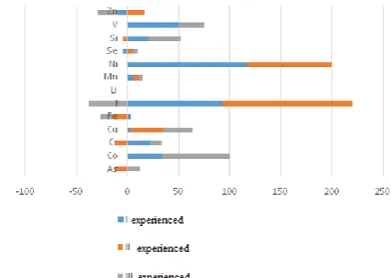
The distribution of the content of essential elements in the pectoral muscles of the studied bird was as follows, so in the first experimental group I should note a significant increase in cobalt level by 25.0%, silicon by 16.8%, iodine by 1.9 times and vanadium by 1.5 times (p≤0.05), relative to the
control group (Fig. 2). In the experimental group II, a sufficient increase in copper by 24.5%, zinc by 14.1% and iodine by 2.3 times (p≤0.05), relative to the control. In the
experimental group III, only copper was 22.2% and silicon was 24.1% (p≤0.05), the level of iodine significantly
decreased 1.6 times (p≤0.05), compared to the control group.
Fig. 2. The level of essential elements in the pectoral muscles of the experimental group relative to the control, %.
The addition of both tetracycline antibiotic and oak bark extract to the diet leads to the elimination of toxic elements from the muscle tissue of broiler chickens (Table I). The introduction of only oak bark extract into the diet of the studied bird leads to a significant decrease in the level of aluminum by 25.9% (p≤0.01) and cadmium by 1.6 times
(p≤0.05), relative to the control. Introduction to the diet only
antibiotic, led to a significant decrease in aluminum, cadmium and lead 1.4 times (p≤0.01), 3.5 times (p≤0.05) and
2.0 times (p≤0 , 01), in relation to the control group. The
joint introduction of antibiotic and oak bark extract also led to a significant decrease in aluminum by 1.6 times (p≤0.01),
cadmium and lead by 2.0 times (p≤0.05), relative to the
control.
TABLE I: THE CONCENTRATION OF TOXIC ELEMENTS IN THE PECTORAL MUSCLES OF BROILER CHICKENS, MG / KG
Group
Element Control I
experienced II
experienced III experienced
Al 5,13±0,49 3,8±1,88**
3,61±0,31*
* 3,17±0,22**
Cd 0,14±0,02 0,09±0,02*
0,04±0,005
* 0,07±0,011*
Pb 0,04±0,006 0,03±0,005
0,02±0,003
** 0,02±0,004** Sn 0,02±0,003 0,02±0,004 0,02±0,003 0,015±0,002 Sr 0,28±0,03 0,24±0,05 0,27±0,09 0,29±0,04
Note: * - p≤0.05; ** - p≤0,01 - significant differences with control
C. Chemical Elements in the Thigh Muscles
muscles of the examined bird, it should be noted that the content of macronutrients is observed to decrease in the latter, however, all changes were unreliable (Table II). However, it should be noted that in the experimental group I there was a significant increase in such elements as potassium by 17.4% and phosphorus by 13.8% (p≤0.05), relative to the control
group and in group III, a significant increase in sodium in 1,5 times (p≤0.05), with respect to the control.
TABLE II: THE CONCENTRATION OF MACRONUTRIENTS IN THE THIGH MUSCLES OF BROILER CHICKENS, G / KG
Group
Element Control I
experienced II
experienced III experienced
Ca 0,26 ±0,03 0,21±0,01 0,27±0,03 0,22 ±0,03 K 9,42±0,83 11,4±1,11* 9,31±0,93 9,18 ±0,92 Mg 1,13±0,11 1,19 ±0,13 1,08±0,13 1,11 ±0,09 Na 4,04±0,38 4,06±0,42 3,78 ±0,34 6,15±0,36* P 6,23±0,65 7,23±0,72* 6,18±0,63 6,40±0,34 Note: * - p≤0.05 - significant differences with control
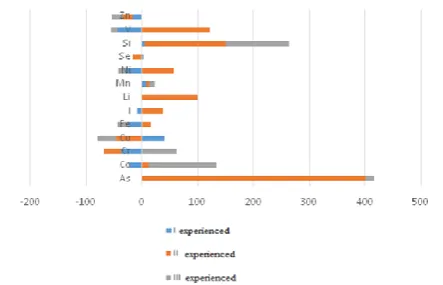
The antibiotic and oak bark extract had a mixed effect on the accumulation in the thigh muscles of essential and conditionally essential elements (Fig. 3). The additional introduction of oak bark extract into the diet led to a significant decrease in cobalt, iron, nickel and zinc by 22.2%, 24.5%, 28.6% and 15.8% (p≤0.05), respectively, relative to
control, but there was a significant increase in copper 1.4 times (p≤0.05), compared with the control. Introduction to
the diet of broiler chickens of tetracycline led to a significant decrease in arsenic by 2.0 times, copper by 1.8 times, selenium by 15.7% and zinc by 17.3% (p≤0.05), however, it
was also observed a significant increase in elements such as iron by 14.2%, iodine by 27.8%, lithium by 2.0 times, nickel by 1.6 times, silicon by 2.5 times and vanadium by 2.2 times (p≤ 0.05), relative to the control group. The joint inclusion of
antibiotics with oak bark extract contributed to a significant increase in cobalt and silicon 2.2 times (p≤0.01), chromium
1.6 times (p≤0.05), however, a significant decrease was
observed for copper of 1.5 times, iron by 19.1% and zinc by 21.1% (p≤0.05), in comparison with the control.
Fig. 3. The level of essential elements in the thigh muscles of the experimental group relative to the control, %.
D. The Concentration of Toxic Elements
It should be noted that oak bark extract, both in the
pectoral muscles and in the thigh muscles, contributed to the
elimination of toxic elements, since the aluminum level in absolute terms significantly decreased from 6.26 mg / kg to 5.50 mg / kg and lead from 0.06 mg / kg to 0.04 mg / kg (table 3). The inclusion of the antibiotic also led to a significant decrease with respect to the control of aluminum by 17.9% (p≤0.05) and lead by 3 times (p≤0.001). The maximum decrease in the level of toxic elements was observed in the group that was additionally administered together an antibiotic and oak bark extract, so the level of aluminum decreased by 35.5% (p≤0.01), cadmium 3.0 times and lead 6 times (p≤ 0,001), relative to the control.
TABLE III: THE CONCENTRATION OF TOXIC ELEMENTS IN THE THIGH MUSCLES OF BROILER CHICKENS, G / KG
Group
Element Control I experienced II experienced
III experienced
Al 6,26±0,43 5,50±1,15* 5,14±0,51* 4,04±0,40* *
Cd 0,003±0,0006 0,003±0,0011 0,003±0,000 7
0,001±0,00 02***
Pb 0,06±0,009 0,04±0,005* 0,02±0,015* **
0,01±0,013 *** Sn 0,01±0,002 0,01±0,004 0,01±0,002 0,01±0,002 Sr 0,32±0,038 0,34±0,04 0,34±0,052 0,29±0,035
IV. CONCLUSION
Biologically active substances are widely used in various fields of medicine and agriculture [6], [7]. Some of them are extracted from plants and microorganisms, therefore, have a natural origin, some are artificially synthesized, but completely reproduce the structure of their biological analogues [8].
The study of the biological effect of extracts of medicinal
plants on the organisms of farm animals and poultry has been
the subject of a large number of scientific works by foreign scientists. Thus, Sledzetal examines the effect of Boswelliaserrata resin on the hematological, biochemical, and immunological parameters of broiler chickens. It was concluded that this resin can be considered safe and effective as a food additive for broilers [9]. Khan, H. Zaneb, S. Masood (2016) studied the effect of the extract of the leaves of the Moringaoleifera plant on the morphology of the intestines of broiler chickens. It was noted that the length of the villi in the small intestine and the excretion of mucin increased during the experiments [10], [11].
Franciosini M.P. et al. (2016) studied the effect of aqueous extracts of oregano (Origanumvulgare L.) and rosemary (Rosmarinusofficinalis L.) on the immunity and microbial population of the intestines of broiler chickens. Based on the results obtained, it was concluded that extracts of these herbs enhance the immunity of broilers and contribute to the balance of the intestinal flora necessary for digestion and for protection against pathogenic microorganisms [10]-[12].
digestive juices, increase the production of endogenous enzymes, as well as improve nitrogen retention in poultry and increase body weight. Bitter substances can stimulate the formation of enzymes and the secretion of digestive juices, as well as blood circulation and metabolic processes in the intestine. Also, these compounds increase the secretion of digestive juice at the level of the autonomic nervous system. Saponins improve the resorption of elements (P, Ca), increase the permeability of the intestinal walls (increase the intercellular space), reduce the processes of decomposition of urea into ammonia (by reducing the intensity of decomposition of nitrogenous compounds into ammonia, water and carbon dioxide), which leads to a decrease in the level of ammonia fecs, reducing the load on the respiratory system [13], [14].
Some substances enhance the flavor and palatability of feed, which improves feed intake and productive performance [15], [16]. This result can be related to several biological activities, such as antioxidant, antimicrobial and flavor enhancer effects [17], [18]. Some phytochemicals can excite the olfactory nerves and taste buds [19], [20]. All of these effects can cause positive results like higher feed consumption and weight gain [21].
Some researchers found that the animal preferred the feed that was supplemented with garlic or rosemary over the feed that was supplemented with oregano or ginger. And Franz et al. [22]-[24], based on 23 studies with broilers, mentioned that the feed conversion ratio was improved with phytochemical additives. A lot of studies have reported a decrease in feed intake as a result of the high inclusion level (>1500 mg/kg) of phytochemical feed additives and the intrinsic properties of some compounds, such as a strong odor and flavor [25]. Thus, the high levels of phytochemical additives used in animal feed must be avoided, especially for porcine species, because of their sensitive palates. That studies testing these characteristics are limited, and the assumption that phytochemical additives improve feed palatability has not been completely justified yet.
Other phytogenic substances such as thyme, aloe have been used to improve growth performance and carcass quality and to some extent mortality on broiler chickens. For example, Thyme (Thymus vulgaris) is a medicinal herb that can be used as a natural alternative to antibiotics in poultry production [26]. It also has inhibitory effects on abdominal fat traits in broiler chickens. The use of phytogenic substances like aloe have a long history of use and are prevalent among animal producers who use it to alleviate disease incidence and as a substitute for AGPs. Moringa oleifera is now incorporated in poultry as well as other animal diets as a substitute for soya as well as its antimicrobial properties.
The use of a cocktail of botanical extracts that boosts the immunity among other physiological processes can improve on a number of desirable market attributes but the main one being ability to resist or suppress disease causing pathogens resulting in low mortality and improved rate of weight gain and reduction in fat content.
Researchers used the cocktail of botanical extracts is Phyt
Exponent®, an alcoholic extract of a mixture of herbs preserved in 62% alcohol to increase shelf life. The cocktail includes extracts of garlic (Allium sativum, Triticum repens, Viola triocolor Matricaria chalmomilla and Echinachea purpurea. This cocktail is given at a very low dose making it cost effective. It is entirely based on plant extracts and is therefore a natural product used to support not only recovery of the immune system but to improve on the growth performance and meat quality in livestock. It has healing effects on different target organs and therefore prevents mortality [27], [28].
The whole authors declare no conflict of interest about the paper.
Author Olga Kvan as corresponding author approved the final version.
REFERENCES
[1] V. I. Fisinin, A. S. Ushakov, G. K. Duskaev, N. M. Kazachkova, B. S. Nurzhanov, S. G. Rakhmatullin, and G. I. Levakhin, “Mixtures of biologically active substances of oak bark extracts change immunological and productive indicators of broilers,” Sel’skokhozyaistvennaya Biologiya, no. 53, pp. 385-392, February 2018.
[2] V. A. Bagirov, G. K. Duskaev, N. M. Kazachkova, S. G. Rakhmatullin, E. V. Yausheva, D. B. Kosyan, S. A. Makaev, and K. B. Dusaeva, “Addition of Quercus cortex extract to broiler diet changes slaughter indicators and biochemical composition of muscle tissue,” Sel’skokhozyaistvennaya Biologiya, no. 53, pp. 799-810, April 2018.
[3] G. K. Duskaev, S. G. Rakhmatullin, N. M. Kazachkova, Y. V. Sheida, I. N. Mikolaychik, L. A. Morozova, and B. H. Galiev, “Effect of the combined action of Quercus cortex extract and probiotic substances on the immunity and productivity of broiler chickens,” Veterinary World, no. 11(10), pp. 1416-1422, October 2018.
[4] B. Darabighane and S. N. Nahashon, “A review on effects of Aloe vera as a feed additive in broiler chicken diets,” Annals of Animal Science, vol. 14, no. 491-500, 2014.
[5] J. Ansari, S. H. Khan, A. Haq, and M. Yousaf, “Effect of the levels of Azadirachta indica dried leaf meal as phytogenic feed additive on the growth performance and haemato-biochemical parameters in broiler chicks,” Applied Animal Research, vol. 40, pp. 336-345, 2012. [6] S. Dokhani, T. D. Durance, and T. Cottrell, “Drying effects on major
volatile and phenolic components of achilleafilipendulina lam,” Journal of Essential Oil Bearing Plants, no. 15, pp. 885-894, June 2012. [7] R. U. Khan, S. Naz, M. Javdani, Z. Nikousefat, M. Selvaggi, V. Tufarelli,
and V. Laudadio, “The use of turmeric (Curcuma longa) in poultry feed,” World's Poultry Sci J., no. 68, pp. 97–103, January 2012.
[8] Z. Kruma, R. Galoburda, M. Sabovics, G. Saravacos, P. Taoukis, and M. Krokida, “Aroma composition of microwave vacuum dried dill (Anethumgraveolens L.) stems,” in Proc. 11th International Congress on Engineering and Food (ICEF), Athens, GREECE, pp. 1338-1343, 2011.
[9] M. Sledz, M. Nowacka, and A. Wiktor, “Selected chemical and physico-chemical properties of microwave-convective driedherbs,” Food and Bioproducts Processing, no. 91, pp. 421-428, April 2013. [10] M. Rubinskiene, P. Viskelis, and E. Dambrauskiene, “Effect of drying
methods on the chemical composition and color of peppermint (Mentha x piperita L.) leaves,” Zemdirbyste-Agriculture, no. 102, pp. 223-228, February 2015.
[11] R. U. Khan, H. Zaneb, S. Masood, M. S. Yousaf, H. F.Rehman, and H. Rehman, “Effect of moringaoleifera leaf powder supplementation on growth performance and intestinal morphology in broiler chickens,” Journal of Animal Physiology and Animal Nutrition, vol. 1, pp. 1-8, January 2015.
[12] M. P. Franciosini, P. Casagrande-Proietti et al., “Effects of oregano (Origanumvulgare L.) and rosemary (Rosmarinusofficinalis L.) aqueous extracts on broiler performance, immune function and intestinal microbial population,” J. Appl. Anim. Res., no. 4, pp. 474-479, April 2014.
CONFLICT OF INTEREST
[13] G. K. Duskaev, N. M. Kazachkova, A. S. Ushakov, B. S. Nurzhanov, and A. F. Rysaev, “The effect of purifi ed Quercus cortex extract on biochemical parameters of organism and productivity of healthy broiler chickens,” Veterinary World, no. 11, pp. 235-239, November 2018. [14] S. Rahman, S. Khan, N. Chand, U. Sadique, and R. U. Khan, “In vivo
effects of Allium cepa L. on the selected gut microflora and intestinal histomorphology in broiler,” ActaHistochem, no. 19, pp. 446–450, October 2017.
[15] Calin-Sanchez, A. Figiel, and K. Lech, “Effects of drying methods on the composition of thyme (thymus vulgaris L.) essential oil,” Drying Technology, no. 2, pp. 224-235, February 2013.
[16] H. Z. Ghasemzadeh, E. Jaafar, and A. Rahmat, “Variation of the phytochemical constituents and antioxidant activities of zingiberofficinale var. rubrumTheilade associated with different drying methods and polyphenol oxidase activity. Molecules,” J. Appl. Anim. Res., no. 21, pp. 34-37, June 2016.
[17] K. A. Beauchemin, “Dose response to eugenol supplementation in growing beef cattle: ruminal fermentation and intestinal digestion,” Anim Feed Sci Tech., 2010, vol. 158, pp. 57–64.
[18] Z. Havelka et al., “Effects of phytogenic feed additives on growth performance and on ammonia and greenhouse gases emissions in growing-finishing pigs,” Anim Feed Sci Technol., 2016, vol. 213, pp. 143–148.
[19] Y. Sultanbawa, “Plant antimicrobials in food applications: Minireview. In: Méndez-Vilas A, editor. Science against microbial pathogens: Communicating current research and technological advances,” vol. 2, 2011, pp. 1084-99.
[20] P. S. Negi, “Plant extracts for the control of bacterial growth: efficacy, stability and safety issues for food application,” Int J Food Microb, 2012, vol. 156, pp. 7–17.
[21] C. Younos et al., “Phytochemical composition and antioxidant capacity of three malian medicinal plant parts,” Evid Based Complement Alternat Med., 2011, pp. 674320.
[22] V. Velasco and P. Williams, “Improving meat quality through natural antioxidants,” Chil J Agric Res., 2011, vol. 71, pp. 313-322.
[23] F Alipour et al., “Effect of plant extracts derived from thyme on male broiler performance,” Poult Sci., 2015, vol. 94, no. 11, pp. 2630-4. [24] C. Franz et al., “Essential oils and aromatic plants in animal feeding–a
European perspective. A review,” Flavour Fragr J., 2010, vol. 25, pp. 327-340.
[25] L. Yan et al., “The effect of an herb extract mixture on growth performance, nutrient digestibility, blood characteristics and fecal noxious gas content in growing pigs,” Livestock Sci., 2011, vol. 141, pp. 143–147.
[26] A. Aghazadeh et al., “Thyme (Thymus vulgaris) extract consumption darkens liver, lowers blood cholesterol, proportional liver and abdominal fat weights in broiler chickens,” Italian Journal of Animal Science, vol. 10, pp. 101-105, 2011.
[27] N. Mgocheki, “Impact of botanical extracts on weight gain and abdominal fat content in broiler chickens,” International Journal of Sciences: Basic and Applied Research (IJSBAR), 2016, vol. 30, no. 5, pp. 394-402.
[28] J. M. Millman et al., “Prevalence of antibiotic-resistant E. coli in retail chicken: Comparing conventional, organic, kosher, and raised without antibiotics,” F1000 Research, vol. 2, pp. 1-13, 2013.
Copyright © 2019 by the authors. This is an open access article distributed under the Creative Commons Attribution License which permits unrestricted use, distribution, and reproduction in any medium, provided the original work is properly cited (CC BY 4.0).
O. B. Kvan is PhD, senior researcher, Federal Research Center of Biological Systems and Agrotechnologies of the Russian Academy of Sciences. The direction of research is the use of dietary supplements in the feeding of farm animals and birds. Author of more than 50 scientific publications on the research topic.
G. K. Duskayev is doctor of biological sciences, professor, deputy director for science at the Federal Research Center of Biological Systems and Agrotechnologies of the Russian Academy of Sciences. The direction of research is the correction of the productive and reproductive qualities of animals through the use of anti-stress drugs.
D. B. Kosyan is PhD, chief of genetic laboratory of Federal Research Center of Biological Systems and Agrotechnologies of the Russian Academy of Sciences. Her research areas are molecular biology, genetic and nanotechnology. She has more than 30 publications in science journals.