
JETIR1403076 Journal of Emerging Technologies and Innovative Research (JETIR) www.jetir.org 240
Binary Sequences Design Using MGA
M V Nageswara Rao
Professor Department of ECEGMR Institute of Technology, Rajam, India
Abstract—A Modified Genetic Algorithm (MGA) is used as a statistical technique for obtaining approximate solutions to combinatorial optimization problems. The MGA is a combination of Genetic Algorithm (GA) and Hamming Scan algorithms. It combines the good methodologies of the two algorithms like global minimum converging property of GA algorithm and fast convergence rate of Hamming scan algorithm. Sequences with good Discriminating factor are useful for channel estimation, radar, and spread spectrum communication applications. This algorithm is used to design Binary sequences, which have good Discriminating factor. The synthesized Binary sequence of length 126 is presented which have better autocorrelation value than literature. The design sequence is practically very useful for radar and communication applications.
Index Terms—Binary codes, Discriminating factor, Hamming Scan, Genetic algorithm
________________________________________________________________________________________________________
I. INTRODUCTION
Binary codes have been widely used in radar and communication areas, but the synthesis of binary codes with good Discriminating factor is a nonlinear multivariable optimization problem, which is usually difficult to tackle. The Genetic Algorithm (GA) technique proved to be an efficient and powerful tool to find optimal or near optimal solutions for complex multivariable nonlinear functions [1] but has slow convergence rate. The concept of Hamming scan algorithm has been employed for obtaining the pulse compression sequences at larger lengths with good correlation properties [2,3]. This algorithm has fast convergence rate but has demerit the viz., the tendency to be stuck with local minima. The MGA has global minimum estimation capability of GA algorithm and fast convergence rate of Hamming scan algorithm [2,3]. The MGA has proved more efficient and powerful tool to find optimal or near optimal solutions for complex multivariable nonlinear functions
Binary codes with low autocorrelation sidelobe levels and high merit factor are useful for radar pulse compression [4], channel estimation, and spread spectrum communication applications.
The aperiodic autocorrelation function (ACF) of sequence S of length N is given as,
(1)
If all the sidelobes of the ACF of any binary sequence are bounded by
|A (k)| 1, 1 | k N-1 (2)
then the sequence is called a generalized Barker sequence. In 1953[5] Barker introduced binary sequences for lengths N = 2,3,4,5,7,11, and 13, fulfilling the condition in (2).
Binary code is one of the most commonly used radar pulse compression signals due to the easy signal generation and processing. Therefore, binary code is increasingly becoming a favorable choice for radar signals and will be used as the basic code form for radar. In this paper, MGA is used for the design of Binary sequences which have good discriminating factor.
II. BINARY SEQUENCES DESIGN
A binary coded sequence of length N bits is represented by
S = [ s1, s2, s3,…. , sN] (3)
where value of s is either 1 or -1. A more practical approach to design a Binary sequence with low autocorrelation sidelobe levels and high discriminating factor is to numerically search the best Binary sequences by minimizing a cost function that measures the degree to which a specific result meets the design requirements. For the design of Binary sequences, the cost function is based on the sum of autocorrelation sidelobes energy. Hence, from (1) the cost function can be written as,
JETIR1403076 Journal of Emerging Technologies and Innovative Research (JETIR) www.jetir.org 241
1 -N
0 k
2 | A(k) |
E (4)
the minimization of cost function in (4) generate Binary sequences with high merit factor.
III. DISCRIMINATING FACTOR (DF)
The discriminating factor (DF) is defined by Golay [6] as follows.
| A(k) |
max A(0) DF
0 k
(5)
Hence the largest value of DF better is the sequence S. One criterion for the selection of a sequence S is to have a larger value of DF even at larger lengths. This criterion has greater analytical tractability and constitutes accurate measures of self-generated clutter in applications such as radar and Spread-Spectrum (SS) techniques but is more demanding on computer time.
IV. GENETIC ALGORITHM (GA)
GA technique, introduced by John Holland at University of Michigan proved efficient and powerful tool to find optimal or near optimal solutions for complex multivariable nonlinear functions. The major advantage of the GA algorithm over the traditional “greedy” optimization algorithms is the ability to avoid becoming trapped in local optima during the search process. The genetic algorithm creates a population of solutions and applies genetic operators such as crossover and mutation to evolve the solutions in order to find the best one(s). The three most important aspects of using genetic algorithms are: (1) definition of the objective function, (2) definition and implementation of the genetic representation, and (3) definition and implementation of the genetic operators. Once these three have been defined, the genetic algorithm should work fairly well. But the limitation of GA is slow convergence rate. This limitation is overcome by in modified Genetic algorithm.
V. HAMMING SCAN ALGORITHM (HSA)
The HSA is a traditional greedy optimization algorithm, which searches in the neighborhood of the point in all directions to reduce the cost function and has fast convergence rate. The Mutation is a term metaphorically used for a change in an element in the sequence. For example if a code element 1 of sequence S, is mutated by -1, and the cost for mutated element is evaluated. If the cost is reduced due to mutation, the new element is accepted; otherwise, the original code element is retained. This process is recursively applied to the entire sequence. The HSA mutates all the code elements in the given sequence one by one and looks at all the first order-Hamming neighbors of the sequence. Thus, Hamming scan performs recursively local search among all the Hamming-1 neighbors of the sequence and selects the one whose objective function value is minimum.
VI. MODIFIED GENETIC ALGORITHM (MGA)
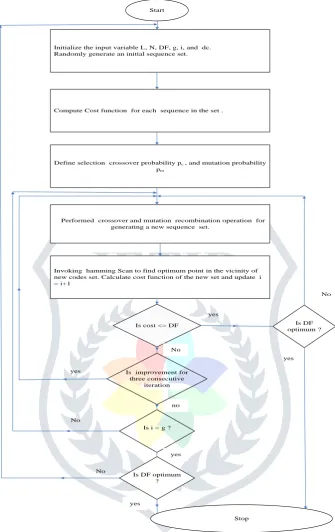
Modified Genetic Algorithm is proposed as a statistical technique for obtaining approximate solutions to combinatorial optimization problems [7]. The MSA is a combination of Genetic Algorithm (GA) and Hamming Scan algorithms. It combines the good methodologies of the two algorithms like global minimum converging property of GA algorithm and fast convergence rate of Hamming scan algorithm. The demerit of Hamming scan algorithm is that it gets stuck in the local minimum point because it has no way to distinguish between local minimum point and a global minimum point. Hence it is sub-optimal. The drawback in Genetic algorithm is that it has a slow convergence rate because even though it may get closer to the global minimum point, it may skip it because of the methodology it employs. The MGA overcomes these drawbacks.
It is quite effective to combine GA with Hamming Scan (HSA) Algorithm. GA tends to be quite good at finding generally good global solutions, but quite inefficient at finding the last few mutations to find the absolute optimum. Hamming Scan are quite efficient at finding absolute optimum in a limited region. Alternating MGA improve the efficiency of GA while overcoming the lack of robustness of HSA.
MGA are introduced as a computational analogy of adaptive systems. They are modeled loosely on the principles of the evolution via natural selection, employing a population of individuals that undergo selection in the presence of variation-inducing operators such as mutation and recombination. A fitness function is used to evaluate individuals, and reproductive success varies with fitness.
VII. BINARY SEQUENCES DESIGN USING MGA
JETIR1403076 Journal of Emerging Technologies and Innovative Research (JETIR) www.jetir.org 242
Initialize the input variable L, N, DF, g, i, and dc. Randomly generate an initial sequence set.
Compute Cost function for each sequence in the set .
Define selection crossover probability pc , and mutation probability
pm
Performed crossover and mutation recombination operation for generating a new sequence set.
Invoking hamming Scan to find optimum point in the vicinity of new codes set. Calculate cost function of the new set and update i = i+1
Is cost <= DF
no
yes
Is improvement for three consecutive
iteration No
yes
Is i = g ?
yes No
Is DF optimum ?
yes No
Start
Is DF optimum ?
No
yes
Stop
Fig. 1 Flow chart of Modified Genetic Algorithm
VIII. RESULT ANALYSIS
Binary sequences are designed using the MGA. The cost function for the optimization is based on (4). In this paper all the synthesized results are single realizations obtained using Pentium - IV, processor. Some of the synthesized Binary sequences, with good discriminating factors are presented. Table I shows discriminating factors of synthesized sequences. In table 1, column 1, shows sequence length, N, column 2, shows Discriminating Factor (DF).
JETIR1403076 Journal of Emerging Technologies and Innovative Research (JETIR) www.jetir.org 243 Fig 2 shows Autocorrelation Function (ACF) of designed sequence of length 126. The ACF is almost an impulse function, which indicates that synthesized code generate very less self-clutter. So we can say that design sequences are very useful for radar as well as for communication system.
Table 1 Discriminating factor of synthesized Binary sequences
Sequence Length DF
71 14.2
85 17.00
90 15.0
93 15.50
96 16.0
126 15.75
Table 2 Comparison between literature value [8] and synthesized value
Hex format of binary
Code ASP DF Source
2 E 2 0 0 6 A 6 3 0 B C 6 C C 9 0 7 9 6 2 8 4 2 B E 1 F D 2 1 A
11 11.4545 Ref [8]
0 5 D 1 7 E 9 D B 5 2 0 2 2 4 9 E 5 0 0 7 5 A 8 C 4 E 6 1 C 7 6
8 15.750 Synthesized
Fig. 2 Autocorrelation value of synthesized Binary code of length 126.
IX. CONCLUSIONS
An effective Modified Genetic algorithm has been used for designing the Binary sequences which can be used in radar systems and spread spectrum communications for significantly improving performance of the system. This new approach combines the GA and the Hamming Scan algorithms and provides a powerful tool for the design of Binary sequences. With the proposed optimization algorithm, the Binary sequences are designed with different code lengths, N.
The synthesized Binary sequences have good discriminating factors. The Sequence of length 126 which has DF far better than reference [8], has proved the efficiency of MGA. The synthesized Binary sequences are promising for practical application to radars and communications.
REFERENCES
[1] De Jong. K. A., “Genetic algorithms: a 10 year perspective”, In J.J. Grefenstette (Ed.). Proc. First Internat. Conference on Genetic Algorithms. Lawrence Erlbaum Associates, Hillsdade: pp. 169-177, 1985.
[2] Moharir.P.S, Singh.R.and Maru. V.M.,”S-K-H algorithm for signal design”, Electronics letters, Vol 32, no 18, Aug 1996, pp.1642-1649.
-126 0 0 126
50 100
Lag
A
u
to
c
rr
la
ti
o
n
v
a
lu
e
JETIR1403076 Journal of Emerging Technologies and Innovative Research (JETIR) www.jetir.org 244 [3] Moharir.P.S and Maru. V.M and Singh.R., “Bi-parental Product algorithm for coded waveform design in radar”, Sadhana,
Vol.22, no.5, Oct. 1997, pp 589-599.
[4] E. C. Farnett and G. H. Stevens, “Pulse compression radar,” Radar Handbook, Second ed. New York: McGraw-Hill, 1990. [5] Barker, R.H: “Group synchronizing of binary digital system” in Jackson, W, (Ed): Communication theory (Butterworths,
London, 1953), pp. 273-287.
[6] Golay. M.J.E., “The merit factor of long low autocorrelation binary sequences”, IEEE Trans. on Inform. Theory, IT-28, 1982, pp 543-549.
[7] S.P Singh., and K. Subba Rao., “Sixty-phase Code Design Using Modified GA” Proc of RACE -08, OU, Hyderabad, Dec 08. .
![Table 2 Comparison between literature value [8] and synthesized value](https://thumb-us.123doks.com/thumbv2/123dok_us/1385330.1649362/4.595.161.432.252.570/table-comparison-literature-value-synthesized-value.webp)
