Educational and vocational guidance and information services
for the youth in public libraries
J
A Fourie
lDepartment of Information Science, Unisa
[email protected]
Received: 7th December 2006
Accepted: 1stMarch 2007
The results of an investigation into the public library's role in the provision ofeducational and vocational guidance and information to the youth and its links to the school and other career guidance service providers in South Africa are reported. The empirical study focused on public library services to the youth ingeneral and to high school learners in
particular.
The results showed that public libraries continue to provide separate user services to children but that separate provision
isonly made for teenagers and young adults inthe case oflarge public libraries. Career-related requests are frequently received from high school learners but inadequate resources affect the development of specialised educational and vocational guidance and information services (EVGIS) for them. Lack
of
cooperation between public libraries, schools and other career guidance service providers hinders the developmentof
support networks for learners.Itisrecommended that existing general user services to the youth could be extended to introduce specialised EVGIS for high school learners. Recommendations are made inrespect ofcollections, facilities. staff and funding.
Keywords: Public library services; educational guidance; career guidance; youth information services; high schoolleamers.
I Introduction
Young people in South Africa face a number of serious problems in terms of the educational system and employment. There are high rates of unemployment among the economically active youth. In addition, wrong subject choices at school and poor examination results are the result of a lack of quality school guidance (Kruger 1995: 10-11,43; Jennings et 01.
1997:40; Van Zyl Siabbertet 01. 1994:59,70, 109).
The educational support services of the Department of Education are responsible for school guidance programmes in South Africa but these programmes are hampered by financial constraints and low teacher-learner ratios (Molefe
1994:263; Moolla 1996:3-4). The Department envisages that individual guidance will have to be addressed by professional counsellors and other guidance practitioners in the local community outside the school who it is hoped will form
networks of educational support for learners
(Quality education
for
all ...
2003:64-65,104-107). However, community-based organisations tend to focus primarily on out-of-school and unemployed youth rather than high school learners(Potgieter [1999]:33).
The provision of information is fundamental to a comprehensive school guidance programme. School counsellors have to assist learners in applying information in career decision-making. However, few schools have full-time counsellors with specialised guidance qualifications (Van Niekerk 2002:3). The school library is a vital resource centre for career
information. Teacher-librarians view cooperation with school counsellors as essential (Human 1992:96; White & Wilson 1997:2-6). However, most schools in South Africa do not have properly functioning libraries and few have full-time teacher-librarians (Lor 1998:7-8; Naidoo 1997:7). The public library could be an important source of support for the school guidance programme. However, the issue is whether the public library has the capacity to offer a complete career
guidance and information service to the youth and whether it cooperates with the school and other career guidance service providers.
The study on which this article is based addressed the question of the role of the public and community library in meeting the educational and vocational guidance and information needs of the youth, and its links to other service
providers.
2 Definitions
School guidance comprises four areas, namely educational, vocational, personal and social guidance. Educational guidance in schools involves help with study difficulties or the choice of subjects most suitable for the school learner's abilities and
future career. Educational information includes knowledge of educational and vocational institutions at which school leavers can prepare and train for their careers. Guidance in the vocational field means helping a person to choose a career, to find a job and to succeed in it (Lindhard, Dlamini
&
Barnard 1987: 1-7). Career guidance is an umbrella termI. J.A. Fourie, DUtt. et Phil., is a lecturer in the Department of Information Science, University of South Africa, South Africa
which can cover progression in learning and work in all its forms, since choices relating to learning and work are closely
interwoven (Watts
&
Kidd 2000:489).The terms 'career guidance' and 'educational and vocational guidance' will be used interchangeably in this article.Guidance is an element common to a number of user service functions, namely information provision and reference
work, user education, user advice and bibliotherapy. In her model for public library service, Gericke (2001: 19,225) identifies educational and vocational guidance as a form of user guidance. Educational and vocational guidance incorporates interviews and assessment, provision of information and interpretation, advice and counselling, referral,
practical assistance and information skills instruction (Butler 1988: 14-20; Durrance etal. 1993:20-3 I ; Oakeshott 1991: 14; Rawlings 1995:33; Watts
&
Kidd 2000:490).3 Studies on the provision of educational and vocational guidance and information services in public
libraries
The typical users of educational and vocational guidance and information services (abbreviated as EVGIS) or 'education and job information centres' and 'educational guidance services' as they are also known, have always been adult learners,
the unemployed and adults in career transition (Butler 1988: I 0; Durrance etal. I 993:viii-ix). The role of the public library in serving adult learners has been the focus of various studies abroad. For instance, research findings on public libraries and the provision of educational guidance services for adults, learners' advisory services and adult independent learners were reported in Carter and Neale (1985), Butler (1988) and Watkin (1995).
An overview of the subject literature reveals that educational and vocational guidance is largely offered to the youth as part of general reference and information and referral services (Willett 1995:70-71). In addition, large public libraries tend to provide information and referrals to the youth through their websites (Hughes-Hassell
&
Miller 2003: 143,/48-149;Prabha & Irwin 2003:67). However, a specialised career guidance and information service for high school learners does
not appear to be the general rule in public libraries at present. This could be due to the fact that schools and universities are expected to provide relevan~ career guidance.
Limited research has been conducted in South Africa on the provision of library services to young people seeking educational and vocational information. Gericke (200 I :289) found that educational and vocational guidance is offered by most public libraries at various levels to all groups ranging from the provision of information and materials to advice and referral. However, her study did not focus on services to the youth.
The empirical study (Fourie 2006) on which this article is based was aimed at investigating the provision of public library services to the youth in general and EVGIS to high school learners in particular to determine whether these services facilitate learners' access to educational and vocational guidance and information.
4 Research method
The study was conducted by means of a questionnaire survey of public libraries in South Africa. It was decided not to select a random sample from the entire population of public libraries but to use the size of a library's collection as a criterion for selecting the survey population, since larger public libraries are in a better position to develop specialised Iibrary'services. Indeed, the size of a library's collection has traditionally been seen as an indicator of its potential to serve the public (Van Heiden & Lor 2002: I I, I 3).
A list of all public libraries in South Africa ranked from the largest to the smallest in order of size of collections was drawn up. The list was based on data in the
Public and Community
Libraries Inventory
of
South Africq (PACLISA )
(2002), an updated unpublished version of PACLISA (2004) and theDirectory
of
South em African libraries
(1990). A figure of between 21 000 and 22 000 volumes (items) was used as the cut-off point for the selection of the s.urvey population. The smallestlibrary that participated in the study had a stock of 21 279 items. The survey population c~mprised 257 public libraries.
One could equate this method of selecting the survey populatioh to purposive sampling, a non-probability sampling method. It involves designating a group (of persons or institutions or other units of analysis) for selection because there is a specific reason to choose a unique sample, or you know they have some characteristics you want to study (Nardi 2003: 108).
Closed (structured) and open (unstructured) format questions were used in the questionnaire. Open questions were mainly used in combination with closed questions, that is, a question was compiled according to structured response
options but there was also an open option (closed and structured-open format). Structured questions are easy to answer and data processing and analysis are facilitated by prior encoding (Schnetler 1989:43).
.The questions consisted of multiple-choice options. The multiple-choice questions provided a choice between three
or more categories of responses. They pertained mainly to the extent (namely, 'often', 'sometimes' and 'never') with which a particular user guidance service is provided, the provision of staff, facilities, equipment, services and collections
where
SAJnl Libs &Info Sci 2007,73(1)
Stock,
<27429
27429 - 47 554
47555+
Medium
Table I
Number of public library responses by size of stock
Size N Percentage
,52 32,7
53 33,3
54 34,0
159 100,0
Small
Large
Total
5.1 General user services for the youth
Adequate information provision, user advice and user education services for the youth are prerequisites for an effective,
EVGIS for high school learners. These user services are supported
by staff, collections, facilities and equipment.
Collections usually house paper-based, auditory and audiovisual media and information in electronic form. Facilities and
equipment could include lending, study and reference areas, shelving, furniture, computer terminals and audio-visual
viewing and listening devices. These resources could be set aside for particular user groups.
Respondents were asked to indicate whether separate staff, facilities and equipment, collections and services are
provided for children and youth in their libraries. The following groups were distinguished: pre-school children from 0 to
6 years of age, primary school children from 7 to 12 years of age, teenagers from I3 to 18 years of age and young adults
from 19 to 25 years of age. '
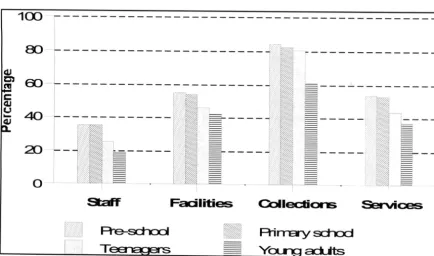
Figure I shows that most public libraries provide separate collections for pre-school children, primary school children
and teenagers. Less than two-thirds provide separate collections for young adults. Over half of the respondents provide
separate facilities for pre-school and primary school children and separate services for pre-school and primary school
children. Separate staff is provided by over one-third of respondents to work with pre-school and primary school
children respectively, but less than one-quarter provide separate staff to work with teenagers and young adults.
.
,a
=
the average of the variable with the highest measure of importance.
n
=
the average of the variable under consideration and
In compiling a weighted index the researcher is able to gain a more balanced overall view of individual responses. For
instance, in the calculation of an index a greater weight is given to 'often', as opposed to 'sometimes' and 'never'. In each
instance, weights of 2, I and 0 were used respectively to weigh the relative importance of the three responses given.
A good response rate of 61 ,9% (159) was achieved due to sound cooperation with the relevant library directors prior
to the posting of the questionnaires. Libraries that participated in the survey were grouped according to the size of their
stock into large, medium and small librari~s so that each group represented
approximately one-third of the 159
participating libraries. The three size groups (large, medium and small) roughly have the same number of respondents.
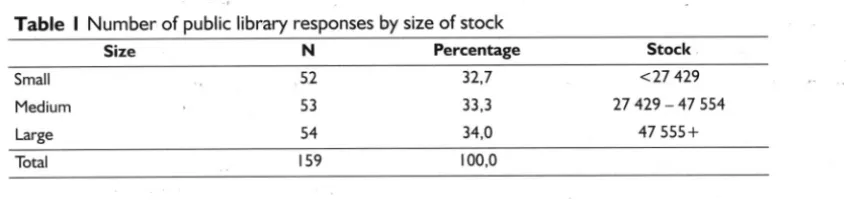
Table I shows the number of libraries whicl:tresponded in each group.
5 Results and discussion
Although the results of the empirical study focus on EVGISfor high school learners, they also pertain to general services
to the youth as a whole as these services could form the basis for developing a specialised service to the group.
for particular user groups, and a particular point of view (namely, 'important', 'fairly important', 'not important'). The
structured-open
formats also included an open category of response, namely 'Other (specify)'. In most ,questions
respondents could select more than one option. Some questions were a checklist of items from which respondents could
select the most applicable item in the list. Other types of items included were a ranking and an inventory question.
Cross-tabulations were done based on an analysis of the frequency tables. Cross-indices were used to create
composite scores of different variables so that.they could be compared. When comparing indices in relation to one
another the highest index score is equated to 100. The variable with the highest average value (variable a) was equated
with 100 and the values of other nth variables were calculated in accordance with the following formula (Tustin et
01.
2005:487 -490):
n
X 100
•
Table 2
User education and information skillsinstructionUser education and Often Sometimes Never Total Index
instruction in: N % N % N % N %
Library orientation 102 64,2 54 34,0 3 1,8 159 100,0 100
Reference source use skills 104 65,4 46 28,9 9 5,7 159 100,0 98
Study skills 17 10,7 40 25,2 102 64,1 159 100,0 29
Computer skills 26 16,4 21 13,2 112 70,4 159 100,0 28
Online search skills 22 13,8 27 17,0 110 69,2 159 100,0 28
Use of OPAC skills 19 11,9 21 13,2 119 74,9 159 100,0 23
Use of database skills II 6,9 17 10,7 131 82,4 159 100,0 15
Figure 1 Separate provision of resources and services for children and youth
100---OOT---- --- --- -
-111 ---~
-i~'h;----40-
1- ------tl~
---~:i~
~--I."' :i~
t*;ii
';Af'M ~
=f*'1
= / ~ =@f
==
@'f~==
;,~
=
}'~
=
10~=
2O
L----
---
1
@':..
r~~1
----";:;;-/C
~
==
==
12.«'1
==
ri';;
==
O;J!~
~--.-
~ _.__ ~~
Staff
Fadlities
OlIlections
Services
These results agree with Gericke's (200 I :299,307) findings in respect of collections and facilities for these groups. It is
clear that separate provision of resources and services decreasesas the age of users increasessince older groups are able to use collections, facilities, services and staff provided for the general public.
Cross-tabulation of data according to size of stock showed that large libraries are more likely to provide separate
resources and services for different age groups while medium-sized and small libraries are less likely to be able to do so. As career-related enquiries are presented at the reference desk, respondents were asked to indicate which kinds of information service are made available in their libraries to the youth. Most public libraries provide a general reference service (98, I %), a reference service to secondary school learners (86, I %) and a community information service
(78,5%). Nearly two-thirds (63,3%) offer a reference service for technikon and college students and half (50,6%) of the respondents provide a reference service for university students.
User advice embraces guidance in the choice of books and other information sources. The librarian stimulates and facilitates information use by means of various aids and techniques. Respondents were asked to indicate the extent of
reading advice provided to the youth in the library. Recommendation of sources is the predominant form of user advice offered. Of the 159 respondents, 69,2% often recommend sources, 21,4% sometimes recommend sources and only
9,4% never do so. The percentages in respect of the production of bibliographies, current awareness bulletins and subject indexes were insignificant.
To enable learners to make independent use of information collections they must be exposed to user education programmes. Respondents were asked to indicate the extent to which various forms of user education and information skills instruction are provided to the youth in the library. The results are shown in Table 2.
The data were used to compile a weighted index of the relative importance of the various forms of user education. The formula for calculating the index was explained in section 4. The index appearing in the right-hand column of the table
shows that the predominant forms of user education offered are library orientation and instruction in reference source use. However, instruction in study skills, computer skills instruction, instruction in online searches, instruction in the use
of the OPAC and instruction in the use of databasesare seldom offered.
Respondentswere asked to indicate how user education and information skills instruction are implemented in their libraries. The majority (78,4%) indicated that user education is presented during classvisits to the library, individually (64,1%), indirectly through pathfinders and learning guides (39,9%) and in library visits to schools (31,4%)
The public library's involvement in user education with school learners appears to be mainly centred on classvisits to the library rather than library visits to schools. Hart (2000:74) also found that most public libraries in the Cape Town
metropolitan area host primary school classesfor library orientation and about one-third offer these services for high schools.
These results show that even in the face of declining resources, public libraries in South Africa continue to provide
general reference and other user services to children and youth. These services are the backbone for the rendering of specialised services, such as EVGIS,to specific user groups. They must be put in place before more in-depth levels of service can be developed.
It is clear, however, that due to a lack of resources user services have not developed to their full potential. For instance, information skills instruction could be hindered by a lack of accessto computer facilities and the staff required to
design the relevant programmes. It remains to be seen whether the existing services already in place are able to render the services required to meet the youths' needs for information and guidance about educational and vocational
opportunities and training.
5.2 Educational and vocational guidance and information services for high school learners
Learners' educational and vocational guidance and information needs can be determined indirectly by relying on the reports of reference librarians who deal with their enquiries. Respondents were asked to indicate how often (daily,
weekly, monthly, lessthan once per month) they receive career-related enquiries from school learners in their libraries. Nearly two-thirds (62,5%) indicated that career-related enquiries are made by school learners on a daily (26,8%) or weekly (35,7%) basis.
Respondents also indicated the extent to which enquiries in regard to careers, educational and vocational opportunities and training are made by different groups. Of the 159 respondents, the majority (76,1%) indicated that
career-related requests are often received from senior secondary school learners, and 19,5% indicated that they sometimes received career-related enquiries from the group. Only 4,4% responded in the negative. The frequency of enquiries from junior secondary school learners, unemployed youth and university, technikon and college students is much lower than in the case of senior secondary school learners. The percentages in respect of requests from these
three groups were fairly similar to each other. This is clearly shown in Figure 2.
I
Senior secondary schoolleamers -
1I1111111111':~1
i : I
Junior secondary schoolleamers
_IIIIIIIIIIIIIIIIIIIIIWI1!
Ii'
. I I
Unemployed youth
_lllllllllllliflmll[11111
. I I I
Universi~, technikon, college srudents
-_11111111111111[1111111111
I
-f~~--~ ~ ~ 00 100
Percentage
• Often IIII Sometimes [j Never
•
Figure 2 Career-related enquiries by the youthThese results show that junior secondary school learners, unemployed youth and students also have a need for information on employment and educational opportunities. Obviously, junior secondary school learners' needs for this kind of information are not as urgent as the needs of older learners. The percentage of career-related requests of unemployed youth is indicative of the high rates of unemployment among out-of-school youth.
The fact that public libraries are used for the career-related enquiries of the abovementioned groups reflects the gaps existing in organisations and agencies who should be offering these services. Government and non-governmental
organisations, such as the Employment Service of the Department of Labour, and the National Youth Commission, do not
appear to be meeting the needs of the youth in this regard (Potgieter
[1999]:38).Unemployed youth in particular are at a
disadvantage since they cannot pay the fees which employment agencies and professional private counsellors charge for
their services.
As school awareness of public library services is important, respondents were asked to indicate the extent to which
career-related
requests are received from school counsellors, teacher-librarians and subject teachers. The majority of
respondents
indicated that school counsellors
(81,8%)and teacher-librarians
(72,3%)never make career-related
enquiries at the public library. Nearly two-thirds
(64,8%)of the respondents indicated that subject teachers never do so.
To determine learners' educational and vocational needs, respondents had to select the most important career-related
enquiries made by school learners from a list of I I topic areas. They were asked to rank the first five topic areas in order
of importance on a scale of I to 5. The results are shown in Table 3. All the data were used to compile a weighted index
as shown in the right-hand column of the table. In calculating the index the following weights were used to weigh the
relative importance of the topic areas ranked by respondents: 5
=
most important, 4
=
second most important, 3
third most important, 2
=
fourth most important, and I
=
fifth most important.
Table 3 Career-related enquiries by topic areas
Career-related topics Most Second Third Fourth Fifth Total Index
N % N % N % N % N % N %
University courses 30 27,3 19 17,3 31 28,2 14 12,7 16 14,5 110 100,0 100
Career planning 43 49,4 18 20,7 5 5,7 8 9,2 13 14,9 87 100,0 91
Bursaries, grants 25 23,4 17 15,9 21 19,6 24 22,4 20 18,7 107 100,0 89
Job search skills 18 15,3 IS 12,7 33 28,0 23 19,5 29 24,6 118 100,0 89
Occupations, training 29 31,S IS 16,3 20 21,7 14 15,2 14 15,2 92 100,0 85
Job opportunities 12 14,8 23 28,4 16 19,8 18 22,2 12 14,8 81 100,0 68
University entrance 7 8,0 23 26,1 18 20,S 23 26,1 17 19,3 88 100,0 67
School subjects 14 21,9 19 29,7 12 18,8 9 14,1 10 15,6 64 100,0 58
Entrepreneurship 4 7,0 6 10,5 13 22,8 22 38,6 12 21,0 57 100,0 38
Company information 3 13,0 3 13,0 6 26,0 7 30,4 4 17,4 23 100,0 17
Self-assessment 2 8,0 3 12,0 4 16,0 7 28,0 9 36,0 25 100,0 16
Number of respondents:158
Learners' main concerns appear to be the choice of a course of study at a university or college. It is closely followed by
concerns about career planning and bursaries, grants and loans. Further needs are employment-related,
namely how to
search for a job and occupatio!")and training requirements. Requests for information on job opportunities, university
entrance requirements and subject choices at school were less important.
Entrepreneurship,
company information and self-assessment proved to be the least important topic areas. The
apparent lack of importance attached to self-assessment is confirmed by Julien's
(1997: 157)findings. Her study showed
that many adolescents seeking information for career decision-making did not report any need for self-assessment
information. They were seeking help to select careers or choose a post-secondary educational institution, without having
a clear notion of what their interests, values and skillswere. She ascribed this situation to the fact that learners are obliged
to select their high school courses, which dictate which college and university programmes they can be accepted into,
before they are developmentally ready to do so.
To establish whether adequate resources are available to support EVGIS,respondents were asked to indicate whether
separate staff, facilities and equipment, collections and services are provided for career guidance for secondary school
learners, students and the general public. As can be seen in Table 4, the percentages in respect of separate provision of
career-related resources and services for each group are fairly similar. Well over half of the libraries provide separate
career-related collections for each group, whereas separate staff, facilities and services are provided for this purpose by
only a small percentage of libraries.
SAJnl LibsA.lnfo Sci2007,73(1)
Table 4
Separateprovisionfor EVGISfor different groupsSeparate provision High school learners Students General public
N % N 0/0 N %
Collections 105 66,0 94 59,1 104 65,4
Services 29 18,2 26 16,4 33 20,8
Facilities 30 18,9 28 17,6 29 18,2
Staff 28 17,6 23 14,5 27 17,0
None 47 29,6 56 35,2 43 27,0
Number of respondents: 159
As 29,6% do not provide separate resources and services for high school learners, one can assumethat approximately 70% make special provision for some form of service or for the resources necessaryto support an EVGISto this group.
The data was also cross-tabulated with libraries according to size of stock. As could be expected, larger libraries provide separate collections, staff, facilities and services for career-related purposes more frequently than medium-sized
and smaller libraries.
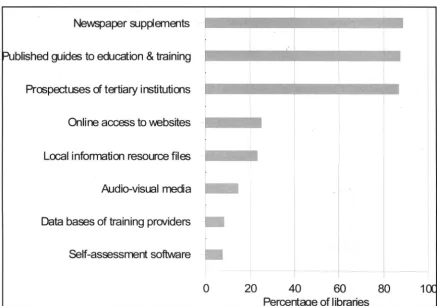
Respondents were also asked to indicate the kinds of career-related information collections and resources made available in their libraries to school learners. The results are shown in Figure 3. Paper-based information sources
predominate as can be seen from the first three categories appearing in the figure. The percentage of libraries which provide accessto online career websites, databasesof jobs and training providers and self-assessmentcareer software is
low. Gericke (200 I :285) also reported a fairly low percentage of availability of CD-ROMs, online databases and the Internet for information searchesiil respect of services to the general public.
Newspaper supplements
blished guides to education & training
Prospectuses of tertiary institutions
Online access to websites
Local information resource files
Audio-visual media
Data bases of training providers
I
•
Self-assessment software
••
o
20
40
Percent
60
80
e of libraries
1
Figure 3 Career-related information collections and sources held by public libraries
The effective rendering of EVGIS to learners involves the various forms of guidance already mentioned in section 2. Respondentshad to indicate the extent to which particular types of guidance are provided to learners in their libraries. The results are shown in Figure 4.
The data on which Figure 4 is based were used to compile a weighted index of the relative importance of the three responses (often, sometimes, never). The results show that educational and vocational guidance in public libraries is mainly focused on directing learners to relevant information sources (100) and the provision of information and information sources (97). This is followed by help in interpreting information and information sources (65), conducting
reference interviews to answer career-related queries (59) and referrals to outside service providers (57). Advice on
educational choices (35) and counselling interviews to assess career information needs (17) is seldom offered.
Directing leamers to info sources
-~~II'
~]:x;nlill
Pro.,;sion of career information
_~X,}/~
'
_" I --:-7"'~"=' .'
.7~"T7:I"1111111111111
Help in interp-eting career info sources XY;~:::f ;,' :"f:::{;':f, (:;:{ .' I
. d~=
'~~r""~[~'
eference inteMeM> to ansv-er career q.Jeries -_:~
S2fiL:
f}::11111111111111111111111I1
Referral to outside guidance _!~"']?/fU~;,'
;...,;J ~)
;~L'11111111111111
.'~...:tillL:{:;':i-"': .:LX'
~1--'~:"'':JY:j
Advice on edurntionaJ choces
"'U(~~~iiij~lllllllilllllllllllllllllllllllllllllll[11
Counselling/haping interview E~'2~JII 1111111111111111111111111111111111111111111111111111111111
r- I f - --~
o
20 40 60 80Percentage
Often Sometimes Never
Figure 4 Forms of educational and vocational guidance
The forms of guidance provided may be a reflection of the depth of information required by learners. The majority
appear to need only straightforward answers to their queries so that they only need to be directed to the available
resources or provided with information. A low percentage appear to have more complex queries. Referral is provided in
these cases since the public library cannot meet learners' needs for in-depth guidance.
These results confirm earlier findings abroad that librarians view help in interpreting educational guidance information
as part of their guidance functions, but that in-depth advice and counselling is not seen as a professional function since
librarians do not have the qualifications required to offer such forms of guidance (Butler 1988: 19,87,91-92, 95-97;
Childers 1984:26; Howcroft &Eskill-Blokland 200 1:239).
As a total of 133 (84%) of the libraries refer requests to other career guidance service providers, respondents were
asked to indicate the individuals or organisations to which they referred school learners for information and guidance.
Figure 5 shows that referrals to outside service providers occurs for the most part infrequently. For instance, over half of
the respondents indicated that they sometimes refer learners to student advisory services at universities and colleges,
whereas nearly one-third indicated that referrals to these services are often made .
80
60
40
20
o
Student advisory services
School counsellors
•
a.IIIIII\11111111111111I11l11111111ll111l111111ll2ill~:;t'G:~
IBmmlllllllllll\IIIIIIIIIIIIIIII~IIJIJIIl!,:mml!I[:[;"1':!"m!:!'!'!I!;'!']]!)I
Government agendes
.
11I1I111I1I1111\11I111I111111I1I1J111~m!m:m~mm:::I"::'-=:::4
University, college libraries .
~11l111"1l"11111111l"1111111111111111111!1;:11';:!:mmm'I:T1':':::=1
School Iibraries
~1111111111111111111111[II':i!:":;;[:I:'[m'ijT"'~:~',I~~;;!::~.;'";i":;~;~
Employment agendes
.IIIIIIIIIIIIIIIIIIIIIIIIIIW]["':b::I,mmY""::.;;';'I;;:m~.:';:;:':::;!:I:'I
Professional private counsellors
~IIIIIIIIIIIIIIIIIIIIIIIIl;I;[:)'::!;"".;;",:,,:'lli'm":':;:i:::;+!"2m"S~mi;[:ml; ..m:m;m;~il
• I
Career resou rce centres
.llIlllIlIlIllIlllIlIl!m;ji~II[[:m'
,;;r~.~I"llm~II;:ili[~llmlm;mmm,mmm[mml;mJillil'l
Information networks
&
services
Often
III1
Sometimes
Never
Figure 5 Referrals to career guidance service providers
The relative importance of the three responses ('often', 'sometimes', 'never') were weighted and the results show that
learners are mainly referred to student advisory services at universities and colleges (100), school counsellors and
guidance teachers (82), government organisations (75) and university and college libraries (71).
Since public librarians lack the expertise to deal with complex career-related enquiries it is not surprising that there is
a high percentage of referrals. However, these referrals involve only a few organisations and individuals outside the
library. Librarians do not appear to have built up or maintained networks of organisations and individuals to whom they
can refer learners. For instance, approximately two-thirds of the respondents never refer learners to professional private
counsellors or career resource centres. This could be due to the fact that these service providers may charge fees for
their services or for the use of their facilities, or there may be few individuals or organisations that offer professional
advice in the vicinity of the library.
Gericke (200 I:289-290) also found that the majority of respondents in her study referred members of the general
public to other organisations for vocational and career guidance. Butler's (1988: 19) study showed that many librarians
view early referral to educational guidance services outside the library as the best option.
Respondents were asked to indicate how frequently they contact service providers to follow up on learners'
enquiries, act on behalf of learners, or request feedback about help rendered by service providers to learners. The results
show that the majority of public libraries do not attempt to assist learners to implement their career goals outside the
library. Those who provide practical assistance do so very infrequently.
These results also confirm the findings of earlier studies abroad that librarians do not view practical assistance
(advocacy) as one of their functions and do not engage in follow-up or feedback activities (Butler 1988:19-20, I I I;
Childers 1984:27-28).
As effective referral depends on links between libraries and outside agencies and individuals it was necessary to
determine whether cooperation between public libraries, schools and other agencies exist.
5.3 Cooperation between the public library, the school and other service providers
The public library can share its resources with schools by making sources available for homework assignments, providing
study facilities and block loans of library materials for classroom use, or school and public library facilities could be housed
together. Respondents were asked to indicate any cooperative services with schools in which their libraries are involved.
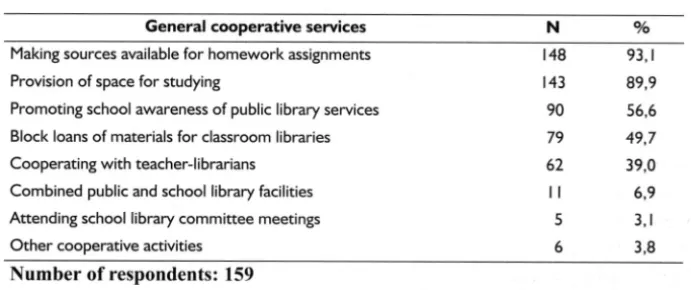
The results are shown in Table 5.
Table 5
General cooperative services with schools
General cooperative services
Making sources available for homework assignments Provision of space for studying
Promoting school awareness of public library services Block loans of materials for classroom libraries Cooperating with teacher-librarians
Combined public and school library facilities Attending school library committee meetings Other cooperative activities
Number of respondents: 159
N
148
143
90
79
62
II
5
6
%
93, I
89,9
56,6 49,7 39,0
6,9
3, I
3,8
The majority of libraries make sources available for homework assignments and provide space for studying. Over one half
are involved in promoting school awareness of public library services and nearly one half offer block loans of materials for
classroom libraries. As already mentioned in section 5.1, class visits to public libraries and library visits to schools for user
education purposes take place fairly frequently. This occurs in spite of the relatively low level of cooperation with
teacher-librarians.
Respondents were asked to indicate any career-related extension, outreach or cooperative programmes in which
their libraries are involved. The data show that career-related cooperative and outreach activities with schools or any
other organisation are not given priority in public libraries. Nearly 50% of the responses were in the negative in regard to
any of these activities.
Of the few libraries which engage in cooperative activities only 5,8% cooperate with school counsellors. It is not
surprising that there is very little cooperation with school counsellors. This result reflects the situation in many schools,
namely that they do not have posts for school' counsellors or guidance teachers. As commented by one respondent in
KwaZulu-Natal 'There are approximately 200 schools in and around our city but only old Model C schools have school
counsellors'. A comment from a librarian in the Western Cape appears to support this statement. 'Most schools in this predominantly white area, have well-stocked libraries and school counsellors'.
These comments seem to suggest that some former Model C schools have retained their school counsellors' posts but that other, less privileged, public schools lack provincial or national government support to maintain school guidance teachers to initiate such a programme. In addition, the important role played by school counsellors in meeting learners'
educational and vocational guidance and information needs are underlined by these statements.
This result supports findings reported in the subject literature which show that public library youth services are not as active in their support of community agenciesas they are with schools and that only a small percentage of public libraries
work cooperatively with school guidance counsellors (Boatman 2003:230; Willett 1995:68-69).
Most public libraries support the formal educational needs of school learners and the public library supplements school library resources because it has more comprehensive collections. If links with schools could be fostered, a
network of career guidance service providers could be developed. However, if there is no teacher-librarian or school counsellor it is difficult to see how such a network can be initiated.
It is clear that services are not provided at an in-depth level. Most libraries lack the required number of staff to fully
develop and maintain either general user services to children and youth or EVGISto high school learners. It was necessary to determine whether a lack of staff or any other factors in the internal and external environment of public libraries are hindering the development of educational and vocational guidance services to learners.
5.4 Barriers to the delivery of educational and vocational guidance and information service to learners
Various internal and external factors affect the rendering of library and information services. Internal factors are the availability of library resources, namely, collections, facilities, funding and staff. External factors are the educational, economic and cultural environment. Respondentswere asked to indicate the importance of the factors that restrict the
delivery of a career guidance and related information service to school learners. The results are shown in Table 6.
Table 6 Barriers to the provision of EVGISto learners
Factors Very important Fairly important Not important Total Index
N % N % N % N 0/0
Lack of funds 117 79,6 21 14,3 9 6,1 147 100,0 100
Lack of qualified staff 77 53,8 44 30,8 22 15,4 143 100,0 80
Lack of community support 41 31,8 52 40,3 36 27,9 129 100,0 60
Low income levels 37 29,8 34 27,4 53 42,7 124 100,0 50
Low education levels 32 26,0 39 31,7 52 42,3 123 100,0 48
Cultural differences 22 17,6 44 35,2 59 47,2 125 100,0 41
Number of respondents: 151
The data in Table 6 were used to compile an index. In this instance,weights of 2, I and 0 were used to weigh the relative
importance of the three responses. Lack of funds is viewed as the most important factor influencing the provision of EVGIS to learners with lack of qualified staff as the second most important factor. Lack of community support, low income and educational levelsand cultural differences are not viewed assignificant barriers to the development of EVGIS.
Problems in the appointment of qualified staff were underlined by the comments in answer to the open question.
Respondents were asked to mention any important points about career guidance and information services in public libraries that came to mind. Many of these comments pertained to a lack of qualified staff but also to a lack of funds and up-to-date information sources. Lack of staff time and lack of relevant sources were mentioned by I 1,3% and 12,6% of respondents respectively.
The crisis in the funding and management of public libraries brought about by unfunded provincial control is well documented (Gericke 200 1:271-275; Wilckens 2005). As a result, libraries have suffered severe losses of staff with
resulting negative effects on the quality of services. A lack of staff means that there is a lack of time to provide an individual service. As commented by one respondent 'Library staff rotate on counter service, one doing information requests'. A major need is not only for more staff but for staff with qualifications which match the needs of new libraries (Anderson 2005: 15).
A public library which renders EVGIS requires staff with relevant qualifications. Respondentswere asked to indicate the importance of professional Library and Information Sciencequalifications, further education and in-service training for career guidance and information service provision in public libraries. The results are shown in Table 7 with the calculated index in the last column.
Table 7 Librarians' views on the importance of LISand career guidance qualifications for staff
Staff training Very important Fairly important Not important Total Index
N 0/0 N % N 0/0 N %
Professional LIS qualifications 84 56,0 46 30,7 20 13,3 150 100,0 100
In-service career guidance training 69 46,6 64 43,2 15 10,1 148 100,0 96
Formal further education in career guidance 47 32,4 68 46,9 30 20,7 145 100,0 78
N umber of respondents: 154
The majority of Iibrarian~ regard professional LIS qualifications and in-service career guidance training as relatively more important for the delivery of an EVGIS than formal further education in the career guidance field.
6 Recommendations and conclusion
6.1 Collections, facilities, staff and funds
Public libraries will have to subscribe to electronic career development tools and computer-based career guidance and information systems available online and on CD-ROM. CV databases and electronic job postings are also available on ,the
Web. Libraries should be linked to the Internet and acquire the necessary computer facilities. Access to electronic resources will ease the burden on overworked staff and enable them to cope with learners' demands more efficiently.
Many public libraries lack the resources to develop separate services. In large public library systems a member of staff with sole responsibility for collections and services for the youth could coordinate the development of an EVGIS for high school learners. In medium-sized and smaller libraries, the collections and services for young people should be housed in
a separate area with separate facilities and collections for an EVGIS. Career-related collections and facilities for the adult general public could also be developed and extended for use by high school learners.
The availability of qualified staff is a prerequisite for specialised services and this is dependent on adequate financial
resources. The RI billion that the South African government is to invest in libraries should stop the deterioration of public libraries in the short-term (Bonthuys 2006:2). However, a long-term solution will only be achieved once the uncertainties regarding provincial funding and the organisational structure of public libraries have been fully addressed.
6.2 Staff development and training
Post-secondary education is very complex. If EVGIS are to be developed, then Library and Information Science training ,should furnish prospective librarians with knowledge about educational and employment opportunities and requirements
in different career fields. Knowledge about the number of subjects, types and levels of qualifications, different modes of attendance at tertiary institutions and fees and grant structures is also essential.
The facilitating and guidance functions required of librarians working in an EVGIS should be recognised in training courses. Librarians will have to be trained either formally or in-service to be able to conduct helping interviews to assess needs. They will ,then be in a position to decide whether the learner should be referred to a professional counsellor. Librarians could enrol for formal certificate courses in career guidance to supplement their professional qualifications.
6.3 Organising networks
By developing and maintaining a network of guidance to the learner, the librarian will ensure effective referral. Public
libraries can establish a system of communication with school counsellors and professional counsellors in private practice to offer a referral service for individual counselling. Librarians should also form partnerships with guidance groups in the public and private sector. They could cooperate with career resource centres and student advisory services in offering career workshops as part of an educational support programme.
6.4 Services
In planning services public libraries will have to make decisions on the following aspects:
• how existing~ervices can be extended to introduce new services
• the forms of educational and vocational guidance that can be incorporated into the existing framework of user services • how to cooperate with other service providers in ord~r to ensure a cOll:Jpleie EVGI? to the youth.
6.4.1 Existing services
Existing reference and community information services for the general public as well as speci,fic reference se,rvices to secondary school learners and students could provide a springboard from which a specialised EVGIS to high, school learners could be developed.
As more resources become available services can be expanded. As higher levels of service are reached, more in-depth guidance can be offered. For instance, a library that delivers a career reference service making use of regular staff could
initiate an EVGIS. The career information collection c<;>uldbe relocated to a separate area and a qualified staff member
who has undergone training as a lay career guidance practitioner could be appointed.
The introduction of EVGIS requires the adoption of a more active approach to service rendering. If the library gives
priority to a self-help service rather than individual guidance, it should be supported by network organiser activities, production of current awareness bulletins, indexes and bibliographies and instruction in information skills. This will entail improving user advisory and user education services which are not fully developed at present.
6.4.2 Forms
of
educational and vocational guidanceInterviews and assessment, information provision and interpretation, information skills instruction, advice, counselling and
referrals can be accommodated within the framework of existing library and information services for young people. The learner's first encounter with the service will be in an interview in which the librarian assesseshis or her needs. The young person's skills in regard to reading and computer use should be evaluated. This will enable the librarian to
direct the learner to appropriate sources. The librarian can conduct individual assessmentsto link the personal qualities of the learner with possible career fields, provided he or she has undergone the necessary training. Interactive career
assessment software could be made available for self-assessment by the learner but it takes one hour of uninterrupted time. Appointments would have to be made if the learner wishes to make use of the relevant library facilities on his or her own.
The public library should facilitate access to educational and career information by ensuring that it is presented in a usable format and language, or repackaged so that it is adapted to the purpose for which it is required. Staff can compile a separate local information file on careers, educational and job opportunities.
Information skills instruction programmes for learners who have to be assisted in interpreting and evaluating paper-based and web-paper-based textual information should be developed. The programme would necessitate collaboration between the public librarian, teacher-librarian and school counsellor.
Librarians need to develop skills in advising learners about career options and facilitating decision-making. With additional knowledge about educational requirements and routes to qualifications the librarian will be able to deliver an advisory and facilitating service. In-depth interviews are required where the young person experiences indecision about careers. However, librarians do not have the qualifications to counsel learners on personal problems since expert training
is required for this. Should the librarian detect a problem the learner should be referred to a qualified counsellor.
6.4.3 Cooperation
To fully develop cooperative and outreach services the librarian should promote school awareness of public library services and cooperation with teacher-librarians. Most public libraries ensure that sufficient resources are made available for school assignments through informal contacts with school staff. On this basis a system of formal communication between schools and public libraries should be initiated and developed.
Although the results show that cooperation between public libraries and other career guidance service providers is below 50% at present, public libraries should attempt to form partnerships with guidance groups and organisations in the
public and private sector. One particular government or non-governmental body should coordinate activities and disseminate career information. A network of service providers could ensure that out-of-school youth and high school learners in disadvantaged communities who do not have recourse to school counsellors, career resource centres or school libraries are provided with educational and vocational guidance and information.
References
Anderson, E. 2005. Public libraries in a woeful state.L1ASA-in-touch, 6(2): I 5.
Boatman, W. 2003. Public libraries as a bridge for college-bound young adults.Reference and User Services Quarterly, 42(3):229-234.
Bonthuys, J. 2006. 'n Miljard aan biblioteke bewillig.Naweek-Beeld, Saterdag II Februarie:2.
Butler, L. 1988.The role
of
public libraries in the provisionof
educational guidance for adults. Boston Spa,Wetherby: British Library Board. (Library and information research report, 22).Carter, J & Neale, B. 1985.Education, information, libraries and learners. Bradford, West Yorkshire: MCB University Press Limited. (Library management, volume 6 no 3).
Childers, T. 1984.Information and referral: public libraries. Norwood, NJ: Ablex PublishingCorporation. Directory
of
Southern African libraries, 1989. 1990. Pretoria: State Library.Durrance, Jc. et al. 1993.Serving job seekers and career changers: aplanning manual for public libraries. Part of the Public Library Development Program. Chicago: American Library Association.
Fourie, JA. 2006. Educational and vocational guidance and information for the youth in public and community libraries. D.Litt et Phil. thesis, University of South Africa, Pretoria.
Gericke, EM. 200 I. Dienslewering in die open bare biblioteek met spesiale verwysing na gebruikersleiding. D.Litt. et Phil.-tesis, Universiteit van Suid-Afrika, Pretoria.
Hart, G. 2000. A study of the capacity of Cape Town's children's librarians for information literacy education. Mousaion,
18(2):67-84.
Howcroft, G & Eskell-Blokland, L. 200 I. Ethical issues, in Counselling in Southern Africa: a youth perspective. Editors EVan Niekerk, A Prins. Johannesburg: Heinemann:2 I 8-243.
Hughes-Hassell, S&Miller, ET. 2003. Public library websites for young adults: meeting the needs of today's teens online. Library
&Information Science Research. 25: 143-156.
Human, B. 1992. Rol van die mediasentrum in die skool met besondere verwysing na integrering met skoolvoorligting. M.Ed.-tesis, Universiteit van die Oranje-Vrystaat.
Jennings, R.et al. 1997. The situation
of
youth in South Africa. Johannesburg: Community Agency for Social Enquiry.Julien, HE. 1997. How does information help? The search for career-related information by adolescents. D.Phil., University of Western Ontario, London, Ontario.
Kruger, J. 1995. Youth marginalization in South Africa: economic perspectives. Stellenbosch: Stellenbosch Economic Project, Centre for Contextual Hermeneutics, University of Stellenbosch. (Occasional papers no 12).
Lindhard, N, Dlamini, N &Barnard, W. 1987.Guidance in the classroom. 3rd edition. Cape Town: Maskew Miller Longman. Lor, PJ. 1998. Memorandum on the state of libraries in South Africa, March 1998. The LlASA Letter: newsletter
of
the Library andInformation Association
of
South Africa. 2( I ):7-12.Molefe, ORD. 1994. School guidance and multi-modal counselling for secondary school students. Ph.D. thesis, University of Pretoria.
Moolla, N. 1996. Reconstructing educational psychology in the South African context: school systems consultation as a dimension of service delivery. M.Ed. thesis, University of Cape Town.
Naidoo, V. 1997. The role of information skills, curriculum resource material and education library and information services in Curriculum 2005. Mousaion, 15(2):3-9.
Nardi, PM. 2003. Doing survey research: aguide to quantitative methods. Boston: Pearson Education, Inc. Oakeshott, M. 1991.Educational guidance for adults: identifying competencies. London: Further Education Unit.
PACLISA.2002. Pretoria: National Library of South Africa. (CD-ROM).
PACLISA. 2004. Centre for Geoinformation Science, University of Pretoria. (Unpublished electronic databases, accessed 15 September 2004).
Potgieter, F, [1999]. Accelerate change: youth development and the next five years. Youth Development journal, 2:30-44.
Prabha, C &Irwin, R. 2003. Web technology in public libraries: findings from research. Library hi tech, 21 (I ):62-69. Public and Community Libraries Inventory of South Africa see PACLISA.
Quality education for all, overcoming barriers to learning and development: report
of
the National Commission on Special Needs in Education and Training (NCSNET) and National Committee on Education Support Services (NCESS), Departmentof
Education, Pretoria, 28 November 1997. 2003. Pretoria: Department of Education. Also available:<http://wwweducation.gov.za/ index.asp?src=rsea>
(accessed I June 2004).Rawlings, J. 1995. Stock selection and management, inSupporting adult learners, edited by AL Bamber with contributions from R Aldrich, A Watkin, D Barker, J Rawlings. London: Library Association:31-38.
Schnetler, J. 1989. Principles of constructing questions and questionnaires, inSurvey methods and practice, J Schnetler (ed.), DJ Stoker, BJ Dixon, D Herbst, E Geldenhuys. Pretoria: Human Sciences Research Council, Opinion Survey Centre:43-49. Tustin, DH. et al. 2005. Marketing research in practice. Pretoria: Unisa Press.
Van Heiden, P&Lor, PJ. 2002. Public and community libraries inventory
of
South Africa: PACLISA final report. Project of the Print Industries Cluster Council Working Group and the Foundation for Library and Information Service Development ... Pretoria: National Library of South Africa.Van Niekerk, S. 2002. Voorligting wesenlik in skole. Beeld snuffelgids, Woensdag II Desember:3.
Van Zyl Siabbert, F.et al. 1994.Youth in the new South Africa. towards policy formulation: main report
of
the Cooperative Research Programme. South African youth. Pretoria: Human Sciences Research Council.Watkin, A. 1995. Staff training and development, inSupporting adult learners. edited by AL Bamber with contributions from R Aldrich, A Watkin, D. Barker, J Rawlings. London: Library Association: 15-23.
Watts, AG & Kidd, JM. 2000. Guidance in the United Kingdom: past, present and future. British journal
of
Guidance &Counselling,28(4):485-503.
White, M & Wilson, P. 1997. School counselors and teacher-librarians: a necessary partnership for effective schools. Emergency Librarian. 25( I): I-II. Also available: <http://web9.epnet.com/citation> (accessed 7th May 2004)
Wilckens, S. 2005. The future of public and community libraries: implications of the Municipal Structure Act [prepared on behalf of L1ASA]. (Unpublished).
Willett, HG. 1995.Public library youth services: apublic policy approach. Norwood, NJ: Ablex Publishing Corporation.
An overview of electronic information resources
sharing initiatives in Kenyan universities
Daniel C. Rotich
IDepartment of Publishing and Media Studies, School of Information Sciences, Moi University, P.O. Box 3900, Eldoret, Kenya.
dcrotich@hotmai/.com
and
Evans M. Munge
2Moi University library, P.O. Box 3900, Eldoret, Kenya.
[email protected]
Received: 5th June 2006 Accepted: 10th November 2006
Information professionals in Kenya have long been cognisant
of
the need to share and transfer information among themselves. Unfortunately, information resource sharing initiatives have been limited to inter-library loans (ILL) ventures which have also not been very successful. Someof
the reasons for failure have been: insufficient information resources for sharing, inadequate budget allocation to cater for the high costsof
information resources, and the lackof
appropriate communication infrastructure and enabling technologies to support any meaningful venture considering that most libraries in Kenya have been operating on manual systems.The widespread use
of
information and communication technologies (leTs) in Kenya since the 1990s has, however, enabled the realisationof a
numberof
information sharing initiatives omong libraries and information centres. This paper examines successes and/or failuresof
such initiatives among Kenyan universities in relation to the objectives for which they were intended to fulfil, arguing that progress can be achieved much more easily by focusing future efforts toward building on the successes, and avoiding the pitfalls that have been experienced.It is concluded that although on-line information sharing networks are not a panacea to all the problems facing information providers in Kenyan universities, they have, nevertheless, potential to open new avenues, enabling users to have access to vast information resources available within national and international databases, as awayofalleviating information scarcity in these institutions.
Key words: Kenya, information resources sharing, information networking
Introduction
Resource sharing, while seen in the context of librarianship, is an omnibus expression to cover operation, co-ordination, inter-library loans, co-operative acquisitions, co-operative storage and processing (Odini, 1991). Following this reasoning it can be argued that information resources sharing is a wide phrase embracing information services
co-operation, systems, and networking, This is in agreement with Odini's ( 1991)assertion that resource sharing may be seen as a term for working out inter-institutional relationships for the benefit of users in a profession which is frequently described as changing from materials-oriented to client-oriented.
Information professionals in Kenya realized that they can not manage to acquire all the information resources their institutions require, and also, as a result of the information explosion, the amount of information generated is so enormous as to render its complete collection by one institution impossible. Hence the need to share and transfer
information among themselves. Unfortunately, information resource sharing initiatives in Kenya's libraries and information centers have been limited to inter-library loans (ILL) ventures mostly among libraries of similar genealogy (for example, special libraries, academic libraries, and so on), and even these have had more failures than successes.
Among the reasons for failures have been: lack of institutional policies or obligations relating to resource sharing, insufficient information resources for sharing, inadequate budget allocation to cater for the high costs of resources, and lack of appropriate communication infrastructure and enabling technologies. In other words, there has been inefficient application of the concept of resource sharing in Kenya
ryvere,
2004).This paper provides an overview of the current situation of existing initiatives, focusing especially on their successes and/or failures in relation to the objectives which they were intended to fulfil, so that in future efforts will be focused
I. Daniel Rotich, PhD, is Head of the Department of Publishing and Media Studies, School of Information Sciences, Moi University, Kenya.
2. Evans Munge is Librarian, Moi University Library, Moi University, Kenya.
toward building on the successes and avoiding the pitfalls that have been experienced. Much of this information has been garnered from the authors'. own experiences, either as information services providers or as information sciences
educators in the Kenyan university scene, backed by information available in the professional literature and also from contacts within the library and information science network in Kenya.
Overview of universities in Kenya
In the context of this paper, universities are those institutions have been authorized to offer university education in Kenya through accreditation by the Commission for Higher Education (CHE). According to CHE (2006), Kenya currently has 23
universities, of which 6 are public (that is, those established by Acts of Parliament) and the rest are private. The public chartered universities are:
• University of Nairobi. Established in 1956 as the Royal Technical College, it became the first national university in Kenya in 1970. It is the largest university in the country;
• Moi University. It was established in 1984 as the second public university in Kenya. It also has a constituent college, the Western University College of Science and Technology (WUCST), which was established in 2002;
• Kenyatta University. Established in 1965 as Kenyatta College ,offering courses in secondary and teacher education. It was made a full-fledged university in 1985;
• Egerton University. It was founded in 1939 as a school for training white European youth for careers in agriculture. It achieved university status in 1987;
• Jomo Kenyatta University of Agriculture and Technology. It started operations in 1981 asa diploma awarding institution in the fields of agriculture and engineering. It became a full-fledged university in 1994, and
• Maseno University. Began as a government training institute in the I 980s, became a constituent college of Moi University before achieving full university status in 200 I .
The private universities are those established in accordance with the Universities Act, 1985 and University Rules, 1989. They fall into three categories: chartered, registered, and universities operating under Letters of Interim Authority. The
private chartered universities (and the years they were granted charters) are: University of Eastern Africa, Baraton ( 1978); Catholic University of Eastern Africa (1992); African Nazarene University (1993); Daystar University (1994); Scott Theological College (1997); United States International University (1999); Aga Khan University (2002), and Kenya
Methodist University (2006).
The registered universities are those that were offering degrees before the establishment of CHE and were issued
with a Certificate of Registration after fulfilling the requirements set out in the Universities Rules, 1989. These institutions, which were all registered in the I 980s, are: the Kenya Highlands Bible College; the Nairobi Evangelical Graduate School of Theology; the Nairobi International School of Theology; the Pan Africa Christian College, and St Paul's Theological
College. CHE is working with these institutions towards the award of charters.
The universities operating under Letters of Interim Authority are those that have applied to CHE for their
establishment and fulfilled requirements as stipulated in the Universities Rules, 1989, even though they are yet to be awarded charters. All these were either established or upgraded to university status between 2000 and 2002, and are Kabarak University; Kiriri Women's University of Science and Technology; Strathmore University, and the East African School of Theology.
The majority of these institutions are located in Nairobi Province (2 public and I 1 private), followed by Rift Valley (2 public and 4 private), Central Provice (I private and I public). Nyanza and Eastern each have one, public and private respectively.
Information resources sharing in the electronic age
With the widespread use of computers and related technologies in Kenya in the I 990s, information processing
organisations began to use information and communication technologies (ICTs) to enhance the hitherto moribund information resource sharing initiatives. Several factors have contributed to the need for electronic networks for on-line information sharing in Kenya.
One of these is the critical need for access to, and sharing locally and internationally available information resources.
The increase in the value and demand of information which continues to exert pressure on libraries to offer more effective service to their users, has also been gradually leading to a shift in focus from the need for accumulation and ownership of information resources to providing access (Wanyoike, 2004).
There has also been the recognition and appreciation, as in informatio.n environments in other parts of the world, of the emergence of a sophisticated 'new' class of clients with diverse information needs that require to be satisfied
(Ocholla, 1995). Information processing organisations in Kenya have thus been compelled to use new technologies such as ICTs to enhance service delivery, especially through information sharing.