R E S E A R C H A R T I C L E
Open Access
“
From Making to Learning
”
: introducing
Dev Camps as an educational paradigm for
Re-inventing Problem-based Learning
Irene-Angelica Chounta
1,2*, Sven Manske
2and H. Ulrich Hoppe
2* Correspondence:
1Human-Computer Interaction Institute, Carnegie Mellon University, Pittsburgh, PA, USA
2
Computer Science and Applied Cognitive Science, University of Duisburg-Essen, Duisburg, Germany
Abstract
Dev Camps are events that enable participants to tackle challenges using software tools and different kinds of hardware devices in collaborative project-style activities. The participants conceptualize and develop their solutions in a self-directed way, involving technical, organizational and social skills. In this sense, they are
autonomous producers or“makers”. The Dev Camp activity format resonates with skills such as communication, critical thinking, creativity, decision-making and planning and can be considered as a bridge between education and industry. In this paper we present and analyse our experience from a series of such events that were co-organized between an industrial partner acting as a host and several university partners. We take this as an indication to envision new opportunities for project-based learning in more formal educational scenarios.
Keywords:Maker movement∙dev camps∙project-based learning
Introduction
During the past decade, we have witnessed the emergence of the modern maker movement; driven by new technologies a community of makers has established shared spaces and created web-environments for sharing ideas and realizing innovative projects (Cavalcanti, 2013). In this philosophy,“making”usually refers to the construc-tion of physical objects, combining several disciplines, from crafting to electrical engineering. While “Do It Yourself” (DIY) projects do not necessarily require group activities, one of the core aspects of the maker philosophy is the maker space. The maker space refers to a genuine physical location, which serves as a persistent place for idea and knowledge exchange, planning, communicating and for realizing DIY projects. This leads to a micro-cosmos of making, which consists of a community willing to share ideas and tools.
“Maker” scenarios or “FabLabs” (Fabrication Laboratories) have been identified as a basis for new educational approaches (Blikstein & Krannich, 2013) where the maker culture extends beyond the actual products to the process of creating an artefact in a social arena (Dougherty, 2012; Sharples, McAndrew, Weller, Ferguson, Fitzgerald et al., 2013). During this process, makers learn how to search and to choose appropriate information, how to apply it in order to solve problems, how to communicate and collaborate in the community and how to evaluate one’s own practice.
21stcentury skills–cognitive, meta-cognitive and social skills that serve as a basis for acting autonomously and responsibly in a complex information society– relate closely to maker activities (Taylor, 2016). Although the definition of the term 21stcentury skills is still debated, scholars, policy makers and practitioners converge on the notion that students need to develop higher-order, domain-independent skills such as critical think-ing, reflection, collaboration, and self-regulation. This calls for educational formats that foster such interdependent skills on the part of the learners. However, the adoption of the maker culture as an educational paradigm can also be the source of pedagogical innovation since it transforms the learning activity from a teacher-imposed task to an interest-driven challenge that can overcome the separation between academic and industry-oriented skills (Trauth, Farwell, & Lee, 1993).
In this paper, we present our experience with organizing and supporting Dev Camps. Furthermore we discuss the possibility of using Dev Camps as parts of project-based learning activities to foster 21st century learning skills. We demonstrate the example of a sustainable Dev Camp that involves heterogeneous groups of students from different universities and subject areas in an informal setting and that provides common ground for industry and academia to experiment, practice, train and reflect. The purpose of the Dev Camp was to challenge learners at a high level by triggering creativity and innovation in teams. The teams had to self-organise their schedule and work distribution and they additionally had to select appropriate software tools in addition to given devices (such as Arduino kits, Quadcopters, 3D printers, etc.). The analysis of the activities indicated that the participants were able to plan their resources and actions efficiently and to generate and present innovative solutions. We see a particular challenge for future research in sup-porting “creativity management” in such productive educational scenarios by providing specific analytics and reflection tools in addition to the production tools. We perceive project-based learning as particularly well suited in this respect.
We identify the Dev Camp example as an opportunity for defining new types of project-oriented learning scenarios in technology-rich contexts. Latest trends in the USA demonstrate the usefulness and economic value of Dev Camps, and some companies have established such camps as a means for vocational training (as reported in New York Times (Lewin, 2014)). One of the big challenges is the transition from an informal setting to formal education in schools and also for vocational and workplace learning. Peppler argues that “the maker movement is an innovative way to reimagine education”(Peppler & Bender, 2013, p. 26). Particularly, we see the chance in establish-ing Dev Camps usestablish-ing software tools and easily available hardware devices to connect this idea of making with project-oriented education.
Related work
The Maker movement: Dev Camps, Hackathons and DIY
guides on making and building maker spaces (Bagley, 2014; Kemp, 2013). It is important that those Maker spaces are operating as independent entities, in schools, libraries and museums (Honey & Kanter, 2013; Norris, 2014; Ratto & Boler, 2014).
Historically, the modern making culture started in 1952 at MIT with the develop-ment of a numerically controlled milling machine (Gershenfeld, 2012). While this enabled the technology-oriented aspects of the modern making, social aspects occurred even earlier in history: women met in common spaces for knitting, and they exchanged their knowledge and tools. Furthermore, common space influences social aspects and leads to networking in terms of socializing. Modern maker spaces build on this idea (Dougherty, 2012). Maker fairs are organized either on a national or international level and may potentially lead to a global community of making. Nowadays, there is a huge variety of web communities for exchanging ideas, knowledge and project documenta-tions. The web community “instructables” contains DIY projects from cooking to electric circuits. This twofold character, serving educational and product-oriented purposes, has been picked up in different event-like institutions.
Hackathons, sometimes called “hack days”, are events which aim to create usable products or software. The word hackathon is composed of “hack” and “marathon”, indicating that such event is used to spend a longer period of time on a certain project. It inhibits social aspects – participants sit together in a room, which is often seen in contrast to open source software programming projects, where the developers are distributed all over the world and share only a virtual place. Such social making events as hackathons are also manifested in so-called coding or Dev Camps. Usually, such camps also involve a common accommodation and social events, but they also provide the participants to realize bigger projects where they spend more time. This is contrast-ing to usual workplace learncontrast-ing situations and vocational traincontrast-ing, which is often conducted during evening time and is interrupted by regular working duties.
Several barriers in adopting technology and ICT have been identified and studied, like for example the unwillingness of citizens to accept and use new technologies, the lack of trust of social institutions providing access or limited access to technical infrastructure for a big part of the target population (Bertot, Jaeger, & Grimes, 2010). A premise of making in terms of the maker philosophy is the motivation to realize projects without any fear of touching new technologies. As a caveat, costly devices such as 3D printers or milling machines are needed for industry-like customization or fabrication. FabLabs provide open and democratic access to this hardware, without following any commercial interests. The benefits of introducing the maker philosophy into formal education are obvious: from technology-skills to computational literacy and critical thinking (Blikstein & Krannich, 2013), from design, planning and communication skills to practical making skills (Steeg, 2008) - all this can be characterized as 21stcentury skills. While FabLabs are not generally available due to a lack of widespread distribution, the costs for establishing and maintain-ing such an institution even prevent their further spread.
Project based learning
in order to answer a question or problem that they choose themselves or that it is posed by a teacher or instructor (Blumenfeld, Soloway, Marx, Krajcik, Guzdial et al., 1991). The outcome of these activities is typically a product or an artefact that addresses the objective of the project (Blumenfeld et al., 1991). Usually projects are complex tasks that involve students in design, problem-solving, decision making and resources management within a social context, i.e., working together with peers to achieve a common goal (Thomas, 2000). An interesting characteristic of PBL is that the learning process and the final outcome cannot be fully predetermined. This requires students and teachers to continu-ously monitor, reflect, assess and update their practice (Barron, Schwartz, Vye, Moore, Petrosino et al., 1998).
The idea of project-based education can be traced back to Kilpatrick’s description of
“the project method” from 1918 (Kilpatrick, 1918). In contrast to its name it does not propose a specific method of teaching. In this sense, the teacher has the role of a facilita-tor and does not actively train the students. Schneider, Synteta and Frété adopted the idea of project-based learning for web-based educational approaches (Schneider, Synteta, & Frété, 2002). They characterize project-based learning by the following principles:
Engaging learning experiences that involve students in complex, real-world projects through which they develop and apply skills and knowledge;
Learning that requires students to draw from many information sources and disciplines in order to solve problems;
Learning in which curricular outcomes can be identified up-front, but in which the outcomes of the student's learning process are neither predetermined nor fully predictable experiences through which students learn to manage and allocate resources such as time and materials.
Project-based learning moves away from the traditional teacher-centred model that is usually adopted in education. Instead, students are encouraged to work and learn inde-pendently. Although not primarily devoted to learning, the currently emerging maker movement relies on very similar principles. We see this as an opportunity for defining new types of project-oriented learning scenarios in technology-rich contexts.
Summer Dev Camps
Organization and goal of the Dev Camps
An event lasts for 5 days and the participants are collocated in a group accommoda-tion close to Océ. During the project phase, the students work inside the Océ R&D. This helps them establish a good connection with the Océ employees and gain insight into running projects of the company in a research context. The Océ Dev Camps also features a number of social activities, such as barbecue, laser game, archery etc. that aim to bring participants closer and balance the projects’workload.
Projects
The projects are proposed by the participating universities and Océ. Students are free to choose with respect to their own preferences and skills. Coaches who originate from the participating universities supervise the projects both from a technical and a pedagogical perspective. There were no particular pre-requisites regarding students’ experience apart from a computer or media-sciences related background and a basic understanding of programming. In the Dev Camp, Océ used a lightweight version of SCRUM to teach methodology and collaboration in IT projects. This pedagogical approach is complemented through feedback and group sessions to evaluate team and individual skills. The main activity and team work is organized by students (self-organised), however during the project phases, planning and creativity techniques have been introduced for guiding and scaffolding. Similar to real IT projects, the students have to research, design and develop the project outcome and present their pro-gress and their product to different target groups throughout different phases.
The Océ Dev Camp aims to informal learning - in the sense that no formal assess-ment of the outcome is provided - with blended curricular and extra-curricular goals, depending on the students’background. To that end, the proposed projects target at multidisciplinary themes that involve real-life experience and require a goal-oriented planning. This whole setting and the relevance for society motivates students to en-gage actively in the creative processes triggered by the project scenario.
The projects presented in past Dev Camps can be divided into two main categories:
a) the“hardware + software”(H + S) projects. These projects involve the
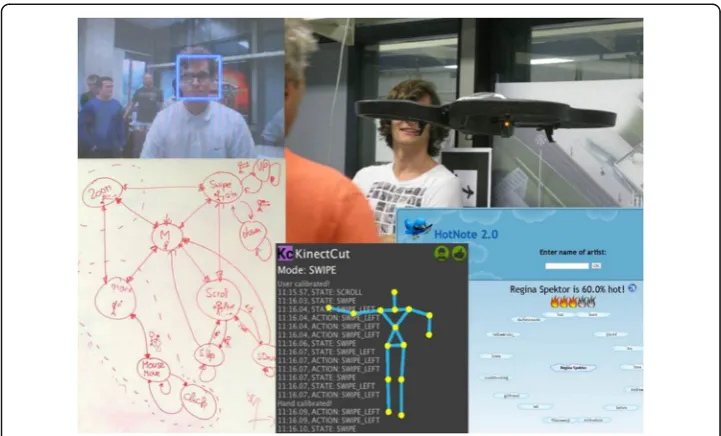
implementation of an innovative product incorporating the technical equipment provided by the Dev Camp. Examples of such projects are lock-picking support through 3D printed keys and an autonomous face-tracking drone;
b) the“data analytics”(DA) projects. Such projects focus on the syndication and aggregation of social media resources, big data analysis and meaningful
visualizations of the results. Examples of such projects are the analysis of twitter datasets about the Eurovision Song contest or“answer life’s burning questions” which was dedicated to the question“What shall we do tonight?”
In this paper, we study six projects, 4 H + S (amar, hr3d, manuela, smartIES) and 2 DA (alibi, mescal), that were created during the Océ Dev Camps:
– amar(Augmented Maintenance And Error Recognition): H + S project that explored augmented reality as a technological tool to support printer operators in locating errors and performing maintenance. The project was assigned to a team of four members with background in informatics, applied computer science and educational science and technology.
– hr3d(HR 3D Printing): H + S project which required students to use a 3D printer. This project had to come up with a semi-automatic method to add height informa-tion to pictures, in such a way that the user interacinforma-tion is kept to a minimum. The project was assigned to a team of four members with background in computer sci-ence and electrical engineering.
– manuela(Manual electronic learning for aircontrol): H + S project that posed as a challenge to master the Parrot A.R. Drone, a miniature radio controlled flying helicopter. This project was assigned to a team of 7 members with background in applied computer science, software engineering, educational technologies, creative technologies and media, information systems and software design.
– smartIES(Smart and Intelligent Environment Sensing): H + S project that proposed the use of a smart system for monitoring environmental conditions, such as temperature, humidity and lighting. This project was assigned to a team of 6 members with background in communications engineering, informatics, software engineering and computer science.
– alibi(Answer Life’s Burning Question): A DA project devoted to the processing of information provided by social media sites in order to propose or give answers to everyday questions of users. This project was assigned to a team of 4 members with background in industrial design, design of interaction, visualizations, systems design and engineering.
Participants and facilitators
The participants of the Dev Camp are usually bachelor and master students from various disciplines, such as Computer Science, Cognitive Artificial Intelligence, Strategic Product Design, Applied Cognition and Media Science and Biomedical Engineering. The students typically are between 20 and 25 years old. The number of participating students increased throughout the years from 15 to 25 for the 2014 Dev Camp. Typically, the participants form small teams of about 5 students and they have to work together on a challenging technical, activity-oriented project in real R&D settings. Students are free to choose a project with respect to their own preferences and skills.
Groups are created based on the students’preference with respect to projects. That is, students who stated their preference for a particular project are grouped together. If too many students apply for the same project, then students from different back-grounds and expertise are grouped together in order to ensure diversity and interdisci-plinarity. The overall goal is that each group consists of students from different universities who study in different fields.
The projects are supervised by coaches (facilitators) from the participating univer-sities, both from a technical and a pedagogical perspective. The coaches are chosen with respect to their field of expertise. They should be able to supervise the project and provide support if needed on a technical, methodological or mentoring level. Typically, the coaches are PhD candidates in areas such as Computer Science and Engineering.
During the development of the projects, the Océ employees usually have no specific roles unless it is a project proposed by Océ, but they are available to provide advice when needed and to help the students to become familiar with the surroundings and the company’s work routines.
In order to support coordination of the groups, we used a typical project manage-ment platform (Redmine - www.redmine.org). The platform was used to distribute resources and to collect material and output from the projects. Furthermore, it provided additional functionality to students to organize their practice, such as an svn
repository, Gantt Charts and a ticketing system as well as a wiki and a discussion board. The activity plan was organized by the students themselves. The final outcome of the projects was presented by the students during a final presentation that involved a bigger audience, consisting of both technical and management staff of Océ.
Analysis of the Dev Camp activities
Analysis of the activity
In addition, we interviewed senior coaches who provided information with respect to activity planning and quality of work. The coaches pointed out that all groups success-fully met the projects’goal while they were surprised about the quality of group work and their efficient time and resources management.
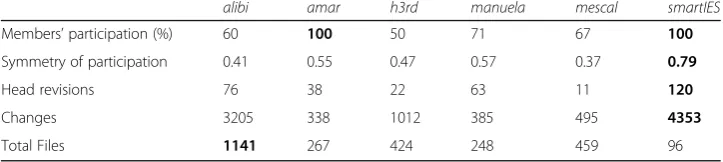
In Table 1, we present a small part of the analysis of the activity, as captured by the platform and the svn repository. We used the Gini coefficient on group members’ contribution to changes per project to compute the symmetry of participation (Martinez, Kay, Wallace, & Yacef, 2011). Gini coefficient ranges within [0, 1] where 0 corresponds to perfect symmetry and 1 to perfect asymmetry of members’participation in group work.
One would expect that technical projects would require more intense face-to-face activities while, on the contrary, analytical projects would be carried out online and that would be reflected on the use of the platform. However, this was not confirmed. On average, the projects committed 1632 changes, 55 head revisions and 439 files. The
smartIES project (H + S type) scored the highest number of changes (4353 changes) and revisions (120 revisions) while the group only committed 96 files. All group mem-bers used the platform in order to collectively edit the source code and to share resources. The high number of changes and revisions in combination with the low number of committed files might be an indication that the members of the smartIES
group were well-coordinated and they managed to perform the necessary edits and changes on the shared resources. The amar project had the smallest number of changes (338) even though all group members were active on the platform, like for
smartIES, and they committed 267 files in total. The mescal project (DA type) were least active in terms of head revisions (11 in total) and two out of the three group members used the platform. However the mescalproject scored the lowestGini coeffi-cient (0.37) that indicates that the activity among group members was symmetrical.
From the activity analysis, we found that the activity per group member was similar for all projects (about 20% per group member). This indicates that the projects are comparable with respect to scale. We should note that not all group members were similarly active on the platform (symmetry of participation).
In addition, the groups’ activity was analysed with respect to time management, efficiency and quality of the outcome. For three out of six projects (alibi, amar and
smartIES), all group members interacted with the platform during the realization of the project. For the rest of the projects, there were group members who had no activity on the platform, e.g., for the hr3d project only two out of four members were actively using the platform. The teams that carried out technical projects had a more uneven distribution of activity over the group members than the analytical ones. This might indicate that the members had undertaken specific roles that did not require the use of
Table 1Statistics of groups’activity as captured by the project management platform
alibi amar h3rd manuela mescal smartIES
Members’participation (%) 60 100 50 71 67 100
Symmetry of participation 0.41 0.55 0.47 0.57 0.37 0.79
Head revisions 76 38 22 63 11 120
Changes 3205 338 1012 385 495 4353
the platform. However, it is encouraging that most of the participants engaged at some point with the use of the platform even though it mostly served as a repository.
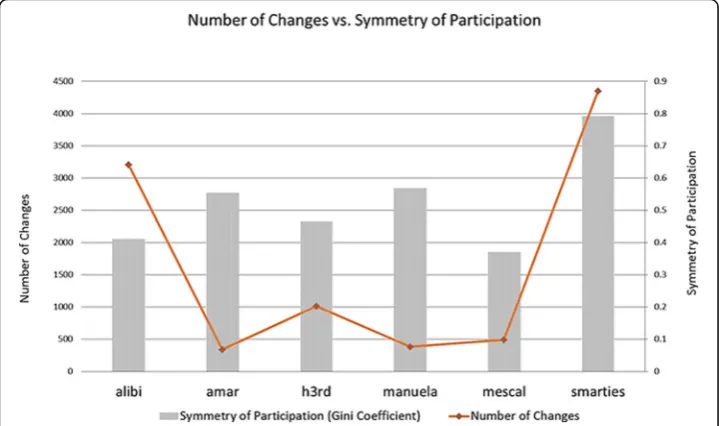
In Fig. 2 the symmetry of participation is portrayed with respect to the total number of changes for the six Dev Camp projects. The symmetry of participation could provide some indication for the number of changes that teams commit however there is no clear pattern. For example, teams with low Gini coefficients that is, teams with symmetrical activity, might commit more changes (e.g., teams alibiand mescal) since the team members use the platform symmetrically to access and work on material. Nonetheless, this is not always the case since in our example the team that has the highest Gini coefficient – indicating asymmetrical activity – also has the highest number of changes (smartIES).
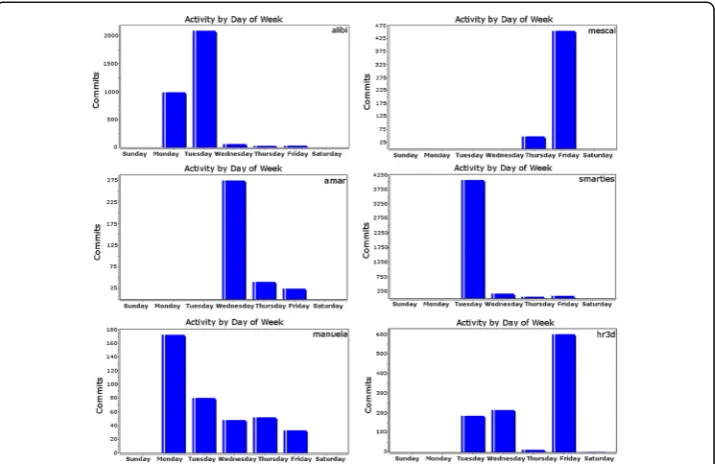
The duration of the projects was 5 days. Nonetheless, in some cases (alibi pro-ject) team members carried on working even after the end of the Dev Camp. On the first day (Monday), the students were split into teams and they were given a project. Teams were mostly active on the first and second day of the dev camp, possibly indicating that they had made a plan of action on the first day and they work towards the realization of the project. The last day, all teams presented their work. When it comes to collaborative activities, it is quite usual to come across teams that do not manage their time well, they put all their effort during the first or last days and then get tired or lose interest, causing a communication break down and eventually failure to produce a reasonable result. However in this case, all teams planned their time effectively and efficiently and managed to complete the tasks required for the project successfully. Figure 3 portrays the activity (the number of commits as captured by the platform’s svn repository) by day of the week.
In order to gain further insight, we asked a facilitator – who supervised multiple projects and was also part of the panel that evaluated the final presentation of the teams – to rate the student teams with respect to the quality of the solution they
provided. To that end, the facilitator assessed the outcome of the projects on a 5-point Likert scale (for the range [0, 4]) on six dimensions: Creativity, Novelty, Motivation, Plausibility, Technical Soundness, Understandability. We refer to the average value of the dimensions’ ratings as the Average_Quality. The results of the assessment are portrayed in Table 2.
The facilitator rated all projects higher than average (the average in our case is 2) for the six categories. The projecth3rdandsmartIESreceived the highest score (3.50 and 3.33 respectively) with respect to the quality of the outcome (Average_Quality) while the project mescal received the lowest rating (2.50). The projects scored lower on average for the Creativity and Novelty dimensions (2.83 and 2.17 respectively) while for the dimension of Plausibility the average score for all project was the highest (3.50 on a [0, 4] scale).
It is interesting that the two groups rated with the highest average quality score had quite different profiles. For the group smartIES(average quality = 3.33), all group mem-bers participated through the software platform (100%), most changes were committed
Fig. 3Activity (number of commits) by Day of the Week for the six RD projects of the Dev Camp
Table 2Quality assessment of the projects’outcome on six dimensions by a human expert
Dimensions alibi amar h3rd mescal manuela smartIES
Creativity 3 3 4 3 2 2
Novelty 2 2 3 2 2 2
Motivation 3 2 3 3 4 4
Plausibility 3 3 4 3 4 4
Technical Soundness 2 3 4 2 3 4
Understandability 4 3 3 2 4 4
(4353 changes) and also demonstrated an asymmetrical activity (Gini coefficient: 0.79) between group members. This group also uploaded the smallest number of files to the common repository (96 files). This might indicate that the group had a high but well-directed and coordinated activity and it might also explain the asymmetry in members’ activity; even though all students used the software platform at some point, their activity was targeted towards a very specific goal, thus avoiding un-necessary actions. The smartIESgroup was quite diverse with respect to the partic-ipants’ background. Two out of six group members had a background in computer science, one had a background in information science, one member came from ap-plied computer science, one from software engineering and one from electrical en-gineering. On the other hand, the highest quality score (3.50) was scored by team
h3rd that had a fairly symmetrical activity (Gini coefficient: 0.47), only half of its members participated through the software platform, an average number of changes was committed (1012) and an average number of files was uploaded (424 files). The h3rd team was homogeneous with respect to the participants’ back-grounds. Two of them had a background in computer science and the other two had a background in engineering (in total the team hr3d had 4 members). Team
manuela was also very diverse with respect to participants’ backgrounds. Two team members out of seven came from computer science, two of them had a back-ground in software engineering and software design, one member came from infor-mation systems, one had a background in creative technologies and media and one member was a phD student in educational technologies and learning analytics. This group scored high with respect to plausibility, motivation and understandability but average with respect to creativity and novelty (overall quality score = 3.17). This was surprising since one would expect diverse and heterogeneous groups to pro-vide more creative outcomes. Nonetheless, from the analysis of the activities we found no apparent patterns between in the teams’ activity and the quality assess-ments of the outcome as captured in our example and the need for further studies is evident.
SWOT analysis
In order to evaluate the strengths, weaknesses, opportunities and threats, we have specified internal and external factors that might affect the success of the pedagogical approach positively or negatively following the method of SWOT analysis. A SWOT analysis can provide meaningful insights and information for the later steps of planning towards achieving certain objectives (Dyson, 2004). The analysis on a 2 × 2 matrix is presented in Table 3.
In order to assess the potential for learning, we identify factors that derive from two perspectives: a) from the project-based learning perspective (PBL-P) and b) from the IT perspective (IT-P). These different perspectives are pointed out in Table 3.
allowing participants to use their own resources, tools and devices, we scaffold the intuitive and effortless adoption and integration of current technological trends. The notion BYOD (“bring your own device”) has been intensively discussed in the field of mobile learning community with respect to educational models where students are invited to bring their personal mobile devices in the classroom for learning purposes (Song, 2014). There is research revealing a correlation between the use of such devices and student engagement as well as progress of students’achievement (Chou, Block, & Jesness, 2012).
Furthermore, the proposed approach can act as a collaborative learning platform and promote cooperation. In order for the maker to create these artefacts, one has to learn, to communicate and to share (Sharples et al., 2013). Students who possess limited ex-pertise or technological skills can learn from skilful group mates and high-performing students can practice by guiding their team, thus introducing a positive lifestyle for young learners and practitioners especially in the fields of Computer Science and IT.
One of the negative aspects of the proposed method is that the learning process cannot be predefined and the standardization of skills is not possible. Just like in project-based learning, the learning outcomes of such an activity cannot be prede-termined (Schneider et al., 2002). This can also result in deviation from teachers’ routine work and organizational overhead since the learning process depends on the skills of the students and it can lead to different paths since the students are responsible for the activity plan they follow. This means that the teachers or the facilitators have to continuously monitor and assess the process, sometimes on topics they might not be familiar with (i.e., when a student uses a particular tech-nology not known to the facilitator)
In addition, the maker culture has been struggling with gender issues when it comes to users’participation with respect to the nature of projects. It is argued that the maker communities are dominated by males while women are either neglected or discouraged to participate (Guthrie, 2014). However, there is also evidence that engaging female makers with making, designing and creating things with electronic tools may build stronger interest and skills in computer science and engineering (Make Hers Report, Intel Corporation, 2014).
Discussion
Existing “maker” scenarios mainly take place in informal settings and aim at extracur-ricular activities. However, the maker culture is not only about the actual product. It is Table 3SWOT analysis of the proposed approach
Positive Negative
Internal factors Strengths Weaknesses
- Motivation, creativity, innovation scaffolding (PBL-P)
- Alternative take on IT skills (IT-P)
- The method does not support systematization and standardization of knowledge (PBL-P) - Dependence on attractive incentives for participants (PBL-P)
External Factors Opportunities Threats
- Integration of current technological trends in learning scenarios (IT-P) - Promoting collaboration and cooperation (PBL-P)
- Gender issues or excessive competition between participants (IT-P)
also about the process of creating an artefact in a social arena (Sharples et al., 2013). The final product of a challenge reflects and represents the overall experience of the maker: the knowledge one has to seek and to acquire, the impact of other people’s practice, the self-reflection and self-assessment over the final product, and lastly, the sharing of this expedition with the community (Dougherty, 2012). During the process, the maker learns how to search for and choose appropriate information, how to put it in use –sometimes even adopting it from a different context – how to communicate and collaborate with other members of the community, how to evaluate one’s practice and how to solve problems. In short, how to use and practice the so-called: 21st century skills. We believe that such important competencies can be supported through modelling, abstraction and scaffold self-reflection in conjunction with the learners making their own choices in the use of productive tools, i.e., by adopting the maker culture into the classroom.
A formal education setting presupposes the existence of a teacher. Unlike maker communities, where the members are considered equal and can usually act without a leader or instructor, this cannot be the case in the classroom. The teacher is and should always be responsible for the successful completion of a learning activity. However, we do not seek to replace the teacher role. In a maker scenario adapted for a classroom setting, we think of the learning process as a“critical making”process - deriving from the combination of critical thinking and reflective making. In this sense, the teacher is the process designer for the critical making. On one hand, the teacher does not prescribe the technology but is responsible for creating the conditions for learning through making. On the other hand, the students are the makers and the classroom is their maker space.
This adaptation of the maker culture in a formal setting is expected to raise critical questions and challenges. From a research point, it is not clear how such an approach would affect the teachers’ practice, the design and orchestration of learning activities and what kind of methodological framework could support this. It is evident that a socio-technical/pedagogical framework is required for the design and re-organization of the socio-technical and pedagogical processes to enable critical making. From a technological perspective, the challenge is to create the appropriate backbone infrastructure to facilitate critical making, provide personalized and customizable maker spaces and, most importantly, to host heterogeneous technological approaches, multiple media types and different devices–the toolboxes of the makers. Another crit-ical question that can be raised is: what about the students who are not makers or even digital natives? An adaptation of the maker culture in formal education would presup-pose that all students are or can potentially become makers or tinkerers. However, it is still uncertain to what extent students nowadays are able use digital technologies in so-phisticated ways despite the fact we call them Digital Natives (Kennedy, Judd, Church-ward, Gray, & Krause, 2008).
targeted at learning outcomes valuable for the labour market and professional development of the learners.
Conclusions and future work
In this paper, we presented our experience from the organization and support of pro-jects during a summer Dev Camp for university students. The purpose of this Dev Camp was to challenge learners at a high level, beyond average routine tasks, trigger creativity and innovation and study the interrelation of individual contributions and co-operation in creative teamwork. Based on a number of“programming challenges”, stu-dents collaborated in small teams for about a week to plan, elaborate and deliver creative solutions to given problems. The teams had to self-organise their schedule and distribution of work. Whereas hardware devices (Arduino kits, 3D printers, etc.) were provided, the choice of software tools and development methods was entirely up to the participants.
The analysis of the activities suggests that the participants were able to plan their re-sources and actions successfully and present innovative solutions for technical and analytical projects. Furthermore, the projects were rated with respect to their quality on six dimensions: creativity, novelty, motivation, plausibility, technical soundness and understandability. All projects were rated higher than the average which suggests that they were perceived by the raters as successful with respect to their outcome. Even though one might argue that diverse teams regarding the par-ticipants’ backgrounds would create more novel and innovative solutions, this was not reflected in our data. In addition, we found no connection between the teams’ activity and the quality of the outcomes. On the contrary, teams with different pro-files and different working styles produced outcomes of similarly good quality. However, for all the projects the participants were actively involved in the project and worked effectively within a collaborative context, only with a few exceptions. We argue that Dev Camps can act as a bridge between workplace, informal/formal learning that needs to be further studied. In future work, we plan to integrate characteristics of Dev Camps into project-based learning scenarios and study the effect in real classrooms.
Authors’contributions
All authors have approved the manuscript and agree with submission to the special issue of the International Journal of Educational Technology in Higher Education:“Learning design for in situ continuous professional development”.
Competing interests
The authors declare that they have no competing interests.
Publisher’s Note
Springer Nature remains neutral with regard to jurisdictional claims in published maps and institutional affiliations.
Received: 1 January 2017 Accepted: 17 May 2017
References
Bagley, C. A. (2014).Makerspaces: Top Trailblazing Projects, A LITA Guide. American Library Association.
Barron, B. J., Schwartz, D. L., Vye, N. J., Moore, A., Petrosino, A., Zech, L., & Bransford, J. D. (1998). Doing with understanding: lessons from research on problem-and project-based learning.Journal of the Learning Sciences, 7(3–4), 271–311.
Blikstein, P., & Krannich, D. (2013). The makers’movement and FabLabs in education: experiences, technologies, and research. InProceedings of the 12th international conference on interaction design and children(pp. 613–616). ACM. Blumenfeld, P. C., Soloway, E., Marx, R. W., Krajcik, J. S., Guzdial, M., & Palincsar, A. (1991). Motivating project-based
learning: Sustaining the doing, supporting the learning.Educational Psychologist, 26(3–4), 369–398. Britton, L. (2014).Examining the maker movement through discourse analysis.
Cavalcanti, G. (2013). Is it a Hackerspace, Makerspace, TechShop, or FabLab.Make, May,22.
Chou, C. C., Block, L., & Jesness, R. (2012). A case study of mobile learning pilot project in K-12 schools.Journal of Educational Technology Development and Exchange, 5(2), 11–26.
Dougherty, D. (2012). The maker movement.Innovations, 7(3), 11–14.
Dyson, R. G. (2004). Strategic development and SWOT analysis at the University of Warwick.European Journal of Operational Research, 152(3), 631–640.
Gershenfeld, N. (2012). How to make almost anything: The digital fabrication revolution.Foreign Affairs, 91, 43. Guthrie, G. (2014).Where Are the Women in Makerspaces? | Make: DIY Projects and Ideas for Makers.
Hatch, M. (2013).The maker movement manifesto: rules for innovation in the new world of crafters, hackers, and tinkerers. McGraw Hill Professional.
Honey, M., & Kanter, D. E. (2013).Design, make, play: Growing the next generation of STEM innovators. Routledge. Intel Corporation. (2014).MakeHers Report: Engaging Girls and Women in Technology through….
Kalil, T., & Miller, J. (2014).Announcing the First White House Maker Faire. The White House Blog.
Kemp, A. (2013).The makerspace workbench: Tools, technologies, and techniques for making. Maker Media, Inc. Kennedy, G. E., Judd, T. S., Churchward, A., Gray, K., & Krause, K.-L. (2008). First year students’experiences with technology: Are they really digital natives.Australasian Journal of Educational Technology, 24(1), 108–122. Kilpatrick, W. H. (1918).The project method: The use of the purposeful act in the educative process. New York: Teachers
college, Columbia University.
Lewin, T. (2014).Web-era trade schools, feeding a need for code(p. 13). New York Times.
Martinez, R., Kay, J., Wallace, J. R., & Yacef, K. (2011). Modelling symmetry of activity as an indicator of collocated group collaboration. InInternational Conference on User Modeling, Adaptation, and Personalization(pp. 207–218). Springer. Norris, A. (2014). Make-her-spaces as hybrid places: Designing and resisting self constructions in urban classrooms.
Equity & Excellence in Education, 47(1), 63–77.
Peppler, K., & Bender, S. (2013). Maker movement spreads innovation one project at a time.Phi Delta Kappan, 95(3), 22–27. Ratto, M., & Boler, M. (2014).DIY citizenship: Critical making and social media. MIT Press.
Schneider, D., Synteta, P., & Frété, C. (2002). Community, Content and Collaboration Management Systems in Education: A new chance for socio-constructivist scenarios. InProceedings of the 3rd Congress on Information and
Communication Technologies in Education(pp. 175–184).
Sharples, M., McAndrew, P., Weller, M., Ferguson, R., Fitzgerald, E., Hirst, & Gaved, M. (2013).Innovating pedagogy 2013: Exploring New Forms of Teaching, Learning and Assessment, to Guide Educators and Policy Makers.
Song, Y. (2014).“Bring Your Own Device (BYOD)”for seamless science inquiry in a primary school.Computers & Education, 74, 50–60.
Steeg, T. (2008).Makers, Hackers and Fabbers: what is the future for D&T?.
Taylor, B. (2016). Evaluating the Benefit of the Maker Movement in K-12 STEM Education.Electronic International Journal of Education, Arts, and Science (EIJEAS),2.
Thomas, J. W. (2000).A review of research on project-based learning.
Trauth, E. M., Farwell, D. W., Lee, D. (1993). The IS expectation gap: Industry expectations versus academic preparation.