The Thirty-Third AAAI Conference on Artificial Intelligence (AAAI-19)
Large-Scale Heterogeneous Feature Embedding
Xiao Huang, Qingquan Song, Fan Yang, Xia Hu
Department of Computer Science and Engineering, Texas A&M University{xhuang, song 3134, nacoyang, xiahu}@tamu.edu
Abstract
Feature embedding aims to learn a low-dimensional vector representation for each instance to preserve the information in its features. These representations can benefit various off-the-shelf learning algorithms. While embedding models for a single type of features have been well-studied, real-world instances often contain multiple types of correlated features or even information within a different modality such as net-works. Existing studies such as multiview learning show that it is promising to learn unified vector representations from all sources. However, high computational costs of incorporating heterogeneous information limit the applications of existing algorithms. The number of instances and dimensions of fea-tures in practice are often large. To bridge the gap, we pro-pose a scalable framework FeatWalk, which can model and incorporate instance similarities in terms of different types of features into a unified embedding representation. To en-able the scalability, FeatWalk does not directly calculate any similarity measure, but provides an alternative way to sim-ulate the similarity-based random walks among instances to extract the local instance proximity and preserve it in a set of instance index sequences. These sequences are homoge-neous with each other. A scalable word embedding algorithm is applied to them to learn a joint embedding representation of instances. Experiments on four real-world datasets demon-strate the efficiency and effectiveness of FeatWalk.
Introduction
Feature embedding (Zhang et al. 2015b), aka representation learning (Bengio, Courville, and Vincent 2013) or dimen-sionality reduction (Hinton and Salakhutdinov 2006), aims to learn low-dimensional vectors for all instances, such that instances with similar original features tend to have similar vector representations. By reducing the redundancy and ex-tracting meaningful information, it could be efficiently uti-lized to and enhance the performance of various real-world applications such as syntactic analysis (Chen, Zhang, and Zhang 2014), human action recognition (Guo et al. 2017), and person re-identification (Wu et al. 2018).
Beyond a single data source, real-world systems are of-ten imbued with multiple types of correlated instance fea-tures (Guo 2013) or even data of a distinct modality such as networks (Yang et al. 2015) and images (Srivastava and
Copyright c2019, Association for the Advancement of Artificial Intelligence (www.aaai.org). All rights reserved.
Salakhutdinov 2012). Learning a representation jointly from all types of features is potentially helpful to make it more informative, since they often complement each other. For example, Facebook users have multiple types of features such as attributes in the introductions, words in posts, con-tents in photos, and rich friend relationships (Tang et al. 2015). These features are all highly correlated with each other (Smith, Fischer, and Yongjian 2012), i.e., the con-tents posted by users would reflect their status described in the introductions; in turn, the social status have a sig-nificant impact on users’ words (Hogg and Terry 2000); and friends tend to share posts with similar topics (McPher-son, Smith-Lovin, and Cook 2001). In addition, recent work such as multiview learning (Ding and Fu 2014; Gong et al. 2014) and attributed network embedding (Huang, Li, and Hu 2017a; Liu, Huang, and Hu 2017) have demonstrated the benefits of joint learning. Therefore, it is promising to per-form feature embedding based on instance features collected from multiple aspects.
However, as it becomes increasingly easier and cheaper to collect data, existing heterogeneous feature embedding al-gorithms (Zhang et al. 2015c) face many challenges when applied to real-world systems. Three major ones are sum-marized as follows. First, the ever-growing data volume along with the complex data properties put demands on the scalability of algorithms. For example, there are 2.23
bil-lion1 monthly active Facebook users in the second
quar-ter of 2018, and each user could have thousands of posts and friends. Capacities of existing algorithms such as cou-pled matrix factorization (Yang et al. 2015) and canoni-cal correlation analysis (Foster, Kakade, and Zhang 2008; Yuan, Sun, and Ge 2014) are highly restricted under large-scale settings. Second, real-world instance features often are heterogeneous sources or even might be within a different modality such as networks (Yang et al. 2015). High com-putational costs of fusing heterogeneous information limit the applications of existing algorithms. A widely used ap-proach is to calculate the instance proximity, i.e., similari-ties between instances, based on each source, and conduct joint learning based on these homogeneous instance prox-imities (Huang, Li, and Hu 2017b). But the computations of
1
instance proximities would lead to high time and space com-plexity, not to mention the subsequent operations. Another effective way is to employ deep neural networks (Ngiam et al. 2011), which is not scalable either. Third, the data spar-sity problem is significant (Zhang et al. 2015b), e.g., in so-cial media, a large proportion of words or attributes often only contribute to a small number of users, providing insuf-ficient information to accomplish effective embedding.
To bridge the gap, we study the problem of large-scale heterogeneous feature embedding. We focus on two most common types of data in practice, i.e., feature matrices and the topological structure (Yang et al. 2015). We target at jointly embedding multiple feature matrices and an instance relation network. It could be summarized as two research questions. (1) How to effectively utilize heterogeneous in-stance features and a relation network to learn a unified em-bedding representation? (2) How to cope with the large scale issue while maintaining the effectiveness of the joint em-bedding framework? Guided by these questions, we propose a scalable heterogeneous feature embedding framework -FeatWalk. Our major contributions are listed as follows.
• Formally define the problem of large-scale heterogeneous
feature embedding;
• Propose an effective framework FeatWalk to incorporate
multiple types of high-dimensional instance features into a joint embedding representation;
• Design an efficient algorithm that avoids computing
ilarity measure, and provides an alternative way to sim-ulate the similarity-based random walks among instances to model the local instance proximity;
• Empirically validate the efficiency and effectiveness of
FeatWalk on four datasets from real-world systems.
Problem Statement
Notations: We use boldface lowercase alphabets to denote
vectors (e.g.,h) and boldface uppercase alphabets to denote
matrices (e.g.,H). For a matrix H, its transpose is
repre-sented asH>and itsithrow is denoted ashi. We use{X(i)}
and{xi}to represent a sequence of matricesX(i)and scalars
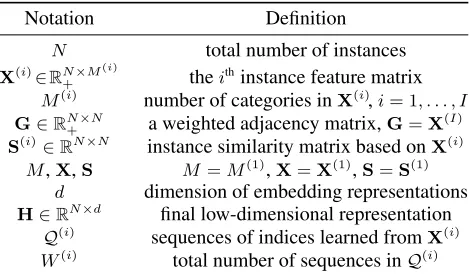
xi. The main symbols are list in Table 1.
Let{X(i)}, fori= 1, . . . , I, be a set of correlated feature
matrices ofNinstances fromIdifferent views. Let the last
oneX(I)=Gbe a weighted adjacency matrix that describes
the relations among theNinstances. To have physical
mean-ings, we assume that elements of all matrices in{X(i)}are
non-negative. A specific example would be the products on Amazon. They have descriptions from multiple sources such as product information and customer reviews, which
com-plement each other and could be used to construct{X(i)}.
Customer purchase records (Linden, Smith, and Zada 2005)
are also available and could be used to buildG.
Given these assumptions, we formally define the large-scale heterogeneous feature embedding problem as follows. Given a large number of instances, associated with a set of
instance feature matrices {X(i)} and an instance relation
network G, we aim to learn a low-dimensional
represen-tationhi for each instance i, such that all the meaningful
Table 1: Main symbols and their definitions in the paper.
Notation Definition
N total number of instances
X(i)∈RN×M
(i)
+ thei
thinstance feature matrix
M(i) number of categories inX(i),i= 1, . . . , I
G∈RN×N+ a weighted adjacency matrix,G=X
(I)
S(i)∈
RN×N instance similarity matrix based onX(i)
M,X,S M =M(1),X=X(1),S=S(1)
d dimension of embedding representations
H∈RN×d final low-dimensional representation
Q(i) sequences of indices learned fromX(i)
W(i) total number of sequences inQ(i)
information in{X(i)}and
Gcould be well preserved inH.
The amount of learned meaningful information inHcould
be evaluated based on the performance ofHin real-world
applications such as classification and clustering.
Heterogeneous feature embedding can be roughly sep-arated into two categories, i.e., multiview and multimodal feature embedding. The former aims to learn a unified rep-resentation of instances from multiple feature matrices ob-served from different aspects (Li et al. 2015). The latter fo-cuses on multiple sources with distinct modalities such as networks, images, and audio (Ngiam et al. 2011).
Different from these previous studies, in addition to the multiple feature matrices, our work takes the instance re-lation network into consideration, which is a common and crucial type of information in real-world systems. The topo-logical structure has a different modality than feature ma-trices. We also target at developing a scalable framework to make it practical. It is distinct from attributed network bedding (Huang et al. 2018) since the latter focuses on em-bedding a single network and a single feature matrix.
Large-scale Feature Embedding
To jointly embed the heterogeneous information in{X(i)},
we propose an efficient framework -FeatWalk. It achieves
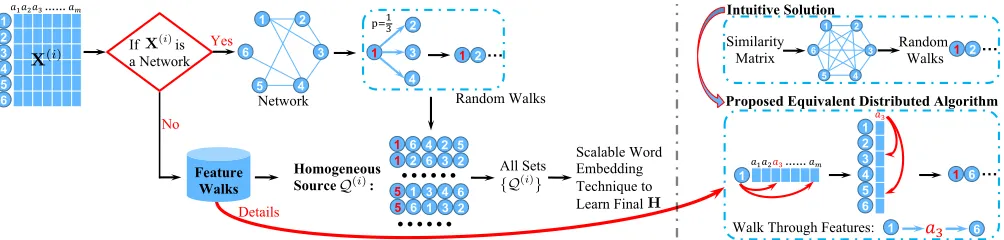
scalability by avoiding the computation of instance similar-ities, and provides an alternative way to simulate similarity-based random walks among instances. Figure 1 illustrates its
main idea. Although{X(i)}are heterogeneous, proximities
between instances defined by rows of eachX(i)are
homoge-neous. FeatWalk first learns the instance proximities defined
by all {X(i)} viaFeature Walks, and then jointly
incorpo-rates them into a unified embedding representation H. To
model the instance proximity in X, an intuitive solution is
to construct a new graphSwith instance similarities as edge
weights, and then perform random walks onSto learn a set
of sequencesQ(1). However,
Sis often dense because of the
common feature categories. AsNkeeps increasing, it would
become too expensive to be manipulated. We propose a
dis-tributed algorithm -Feature Walks, which could obtain the
same results as the intuitive solution but avoid the
computa-tion ofS. The learnedQ(1)consists of instance indices that
pre-4 1 2 3 6 5
!"!#!$……!%
4 1 2 3 6 5 1
Walk Through Features:
!"!#!$……!%
1 !$ 6
!$ 4 1 2 3 6 5 Homogeneous Source : Feature Walks
……
1 6 4 2 5 1 2 6 3 2
5 1 3 4 6 5 6 1 3 2
……
Random Walks
&'"$
1
4 2
3 1 2…
Intuitive Solution 4 1 2 3 6 5 Similarity
Matrix RandomWalks
Proposed Equivalent Distributed Algorithm
1 6… 1 2…
X(i)
<latexit sha1_base64="R4AK65s2uH7hH99tWJ4cQWBqvNc=">AAAB9HicbVBNSwMxEJ3Ur1q/qh69BItQL2VXBD0WvXisYD+gXUs2zbah2eyaZAtl2d/hxYMiXv0x3vw3pu0etPXBwOO9GWbm+bHg2jjONyqsrW9sbhW3Szu7e/sH5cOjlo4SRVmTRiJSHZ9oJrhkTcONYJ1YMRL6grX98e3Mb0+Y0jySD2YaMy8kQ8kDTomxkpf2/AB3sse0ys+zfrni1Jw58Cpxc1KBHI1++as3iGgSMmmoIFp3XSc2XkqU4VSwrNRLNIsJHZMh61oqSci0l86PzvCZVQY4iJQtafBc/T2RklDraejbzpCYkV72ZuJ/XjcxwbWXchknhkm6WBQkApsIzxLAA64YNWJqCaGK21sxHRFFqLE5lWwI7vLLq6R1UXOdmnt/Wanf5HEU4QROoQouXEEd7qABTaDwBM/wCm9ogl7QO/pYtBZQPnMMf4A+fwARUZGg</latexit>
<latexit sha1_base64="R4AK65s2uH7hH99tWJ4cQWBqvNc=">AAAB9HicbVBNSwMxEJ3Ur1q/qh69BItQL2VXBD0WvXisYD+gXUs2zbah2eyaZAtl2d/hxYMiXv0x3vw3pu0etPXBwOO9GWbm+bHg2jjONyqsrW9sbhW3Szu7e/sH5cOjlo4SRVmTRiJSHZ9oJrhkTcONYJ1YMRL6grX98e3Mb0+Y0jySD2YaMy8kQ8kDTomxkpf2/AB3sse0ys+zfrni1Jw58Cpxc1KBHI1++as3iGgSMmmoIFp3XSc2XkqU4VSwrNRLNIsJHZMh61oqSci0l86PzvCZVQY4iJQtafBc/T2RklDraejbzpCYkV72ZuJ/XjcxwbWXchknhkm6WBQkApsIzxLAA64YNWJqCaGK21sxHRFFqLE5lWwI7vLLq6R1UXOdmnt/Wanf5HEU4QROoQouXEEd7qABTaDwBM/wCm9ogl7QO/pYtBZQPnMMf4A+fwARUZGg</latexit>
<latexit sha1_base64="R4AK65s2uH7hH99tWJ4cQWBqvNc=">AAAB9HicbVBNSwMxEJ3Ur1q/qh69BItQL2VXBD0WvXisYD+gXUs2zbah2eyaZAtl2d/hxYMiXv0x3vw3pu0etPXBwOO9GWbm+bHg2jjONyqsrW9sbhW3Szu7e/sH5cOjlo4SRVmTRiJSHZ9oJrhkTcONYJ1YMRL6grX98e3Mb0+Y0jySD2YaMy8kQ8kDTomxkpf2/AB3sse0ys+zfrni1Jw58Cpxc1KBHI1++as3iGgSMmmoIFp3XSc2XkqU4VSwrNRLNIsJHZMh61oqSci0l86PzvCZVQY4iJQtafBc/T2RklDraejbzpCYkV72ZuJ/XjcxwbWXchknhkm6WBQkApsIzxLAA64YNWJqCaGK21sxHRFFqLE5lWwI7vLLq6R1UXOdmnt/Wanf5HEU4QROoQouXEEd7qABTaDwBM/wCm9ogl7QO/pYtBZQPnMMf4A+fwARUZGg</latexit>
<latexit sha1_base64="R4AK65s2uH7hH99tWJ4cQWBqvNc=">AAAB9HicbVBNSwMxEJ3Ur1q/qh69BItQL2VXBD0WvXisYD+gXUs2zbah2eyaZAtl2d/hxYMiXv0x3vw3pu0etPXBwOO9GWbm+bHg2jjONyqsrW9sbhW3Szu7e/sH5cOjlo4SRVmTRiJSHZ9oJrhkTcONYJ1YMRL6grX98e3Mb0+Y0jySD2YaMy8kQ8kDTomxkpf2/AB3sse0ys+zfrni1Jw58Cpxc1KBHI1++as3iGgSMmmoIFp3XSc2XkqU4VSwrNRLNIsJHZMh61oqSci0l86PzvCZVQY4iJQtafBc/T2RklDraejbzpCYkV72ZuJ/XjcxwbWXchknhkm6WBQkApsIzxLAA64YNWJqCaGK21sxHRFFqLE5lWwI7vLLq6R1UXOdmnt/Wanf5HEU4QROoQouXEEd7qABTaDwBM/wCm9ogl7QO/pYtBZQPnMMf4A+fwARUZGg</latexit>
Q(i)
<latexit sha1_base64="wMYlu5YIKMhyZDlr7WiTvc/ikGo=">AAAB+nicbVDLSsNAFL2pr1pfqS7dDBahbkoigi6Lbly2YB/QxjKZTtuhk0mYmSgl5lPcuFDErV/izr9x0mahrQcGDufcyz1z/IgzpR3n2yqsrW9sbhW3Szu7e/sHdvmwrcJYEtoiIQ9l18eKciZoSzPNaTeSFAc+px1/epP5nQcqFQvFnZ5F1AvwWLARI1gbaWCX+wHWE4J50kzvkyo7Swd2xak5c6BV4uakAjkaA/urPwxJHFChCcdK9Vwn0l6CpWaE07TUjxWNMJniMe0ZKnBAlZfMo6fo1ChDNAqleUKjufp7I8GBUrPAN5NZULXsZeJ/Xi/WoysvYSKKNRVkcWgUc6RDlPWAhkxSovnMEEwkM1kRmWCJiTZtlUwJ7vKXV0n7vOY6Nbd5Ualf53UU4RhOoAouXEIdbqEBLSDwCM/wCm/Wk/VivVsfi9GCle8cwR9Ynz8fOZPk</latexit> <latexit sha1_base64="wMYlu5YIKMhyZDlr7WiTvc/ikGo=">AAAB+nicbVDLSsNAFL2pr1pfqS7dDBahbkoigi6Lbly2YB/QxjKZTtuhk0mYmSgl5lPcuFDErV/izr9x0mahrQcGDufcyz1z/IgzpR3n2yqsrW9sbhW3Szu7e/sHdvmwrcJYEtoiIQ9l18eKciZoSzPNaTeSFAc+px1/epP5nQcqFQvFnZ5F1AvwWLARI1gbaWCX+wHWE4J50kzvkyo7Swd2xak5c6BV4uakAjkaA/urPwxJHFChCcdK9Vwn0l6CpWaE07TUjxWNMJniMe0ZKnBAlZfMo6fo1ChDNAqleUKjufp7I8GBUrPAN5NZULXsZeJ/Xi/WoysvYSKKNRVkcWgUc6RDlPWAhkxSovnMEEwkM1kRmWCJiTZtlUwJ7vKXV0n7vOY6Nbd5Ualf53UU4RhOoAouXEIdbqEBLSDwCM/wCm/Wk/VivVsfi9GCle8cwR9Ynz8fOZPk</latexit> <latexit sha1_base64="wMYlu5YIKMhyZDlr7WiTvc/ikGo=">AAAB+nicbVDLSsNAFL2pr1pfqS7dDBahbkoigi6Lbly2YB/QxjKZTtuhk0mYmSgl5lPcuFDErV/izr9x0mahrQcGDufcyz1z/IgzpR3n2yqsrW9sbhW3Szu7e/sHdvmwrcJYEtoiIQ9l18eKciZoSzPNaTeSFAc+px1/epP5nQcqFQvFnZ5F1AvwWLARI1gbaWCX+wHWE4J50kzvkyo7Swd2xak5c6BV4uakAjkaA/urPwxJHFChCcdK9Vwn0l6CpWaE07TUjxWNMJniMe0ZKnBAlZfMo6fo1ChDNAqleUKjufp7I8GBUrPAN5NZULXsZeJ/Xi/WoysvYSKKNRVkcWgUc6RDlPWAhkxSovnMEEwkM1kRmWCJiTZtlUwJ7vKXV0n7vOY6Nbd5Ualf53UU4RhOoAouXEIdbqEBLSDwCM/wCm/Wk/VivVsfi9GCle8cwR9Ynz8fOZPk</latexit> <latexit sha1_base64="wMYlu5YIKMhyZDlr7WiTvc/ikGo=">AAAB+nicbVDLSsNAFL2pr1pfqS7dDBahbkoigi6Lbly2YB/QxjKZTtuhk0mYmSgl5lPcuFDErV/izr9x0mahrQcGDufcyz1z/IgzpR3n2yqsrW9sbhW3Szu7e/sHdvmwrcJYEtoiIQ9l18eKciZoSzPNaTeSFAc+px1/epP5nQcqFQvFnZ5F1AvwWLARI1gbaWCX+wHWE4J50kzvkyo7Swd2xak5c6BV4uakAjkaA/urPwxJHFChCcdK9Vwn0l6CpWaE07TUjxWNMJniMe0ZKnBAlZfMo6fo1ChDNAqleUKjufp7I8GBUrPAN5NZULXsZeJ/Xi/WoysvYSKKNRVkcWgUc6RDlPWAhkxSovnMEEwkM1kRmWCJiTZtlUwJ7vKXV0n7vOY6Nbd5Ualf53UU4RhOoAouXEIdbqEBLSDwCM/wCm/Wk/VivVsfi9GCle8cwR9Ynz8fOZPk</latexit> If is a Network No Yes Network
X<latexit sha1_base64="R4AK65s2uH7hH99tWJ4cQWBqvNc=">AAAB9HicbVBNSwMxEJ3Ur1q/qh69BItQL2VXBD0WvXisYD+gXUs2zbah2eyaZAtl2d/hxYMiXv0x3vw3pu0etPXBwOO9GWbm+bHg2jjONyqsrW9sbhW3Szu7e/sH5cOjlo4SRVmTRiJSHZ9oJrhkTcONYJ1YMRL6grX98e3Mb0+Y0jySD2YaMy8kQ8kDTomxkpf2/AB3sse0ys+zfrni1Jw58Cpxc1KBHI1++as3iGgSMmmoIFp3XSc2XkqU4VSwrNRLNIsJHZMh61oqSci0l86PzvCZVQY4iJQtafBc/T2RklDraejbzpCYkV72ZuJ/XjcxwbWXchknhkm6WBQkApsIzxLAA64YNWJqCaGK21sxHRFFqLE5lWwI7vLLq6R1UXOdmnt/Wanf5HEU4QROoQouXEEd7qABTaDwBM/wCm9ogl7QO/pYtBZQPnMMf4A+fwARUZGg</latexit><latexit sha1_base64="R4AK65s2uH7hH99tWJ4cQWBqvNc=">AAAB9HicbVBNSwMxEJ3Ur1q/qh69BItQL2VXBD0WvXisYD+gXUs2zbah2eyaZAtl2d/hxYMiXv0x3vw3pu0etPXBwOO9GWbm+bHg2jjONyqsrW9sbhW3Szu7e/sH5cOjlo4SRVmTRiJSHZ9oJrhkTcONYJ1YMRL6grX98e3Mb0+Y0jySD2YaMy8kQ8kDTomxkpf2/AB3sse0ys+zfrni1Jw58Cpxc1KBHI1++as3iGgSMmmoIFp3XSc2XkqU4VSwrNRLNIsJHZMh61oqSci0l86PzvCZVQY4iJQtafBc/T2RklDraejbzpCYkV72ZuJ/XjcxwbWXchknhkm6WBQkApsIzxLAA64YNWJqCaGK21sxHRFFqLE5lWwI7vLLq6R1UXOdmnt/Wanf5HEU4QROoQouXEEd7qABTaDwBM/wCm9ogl7QO/pYtBZQPnMMf4A+fwARUZGg</latexit><latexit sha1_base64="R4AK65s2uH7hH99tWJ4cQWBqvNc=">AAAB9HicbVBNSwMxEJ3Ur1q/qh69BItQL2VXBD0WvXisYD+gXUs2zbah2eyaZAtl2d/hxYMiXv0x3vw3pu0etPXBwOO9GWbm+bHg2jjONyqsrW9sbhW3Szu7e/sH5cOjlo4SRVmTRiJSHZ9oJrhkTcONYJ1YMRL6grX98e3Mb0+Y0jySD2YaMy8kQ8kDTomxkpf2/AB3sse0ys+zfrni1Jw58Cpxc1KBHI1++as3iGgSMmmoIFp3XSc2XkqU4VSwrNRLNIsJHZMh61oqSci0l86PzvCZVQY4iJQtafBc/T2RklDraejbzpCYkV72ZuJ/XjcxwbWXchknhkm6WBQkApsIzxLAA64YNWJqCaGK21sxHRFFqLE5lWwI7vLLq6R1UXOdmnt/Wanf5HEU4QROoQouXEEd7qABTaDwBM/wCm9ogl7QO/pYtBZQPnMMf4A+fwARUZGg</latexit><latexit sha1_base64="R4AK65s2uH7hH99tWJ4cQWBqvNc=">AAAB9HicbVBNSwMxEJ3Ur1q/qh69BItQL2VXBD0WvXisYD+gXUs2zbah2eyaZAtl2d/hxYMiXv0x3vw3pu0etPXBwOO9GWbm+bHg2jjONyqsrW9sbhW3Szu7e/sH5cOjlo4SRVmTRiJSHZ9oJrhkTcONYJ1YMRL6grX98e3Mb0+Y0jySD2YaMy8kQ8kDTomxkpf2/AB3sse0ys+zfrni1Jw58Cpxc1KBHI1++as3iGgSMmmoIFp3XSc2XkqU4VSwrNRLNIsJHZMh61oqSci0l86PzvCZVQY4iJQtafBc/T2RklDraejbzpCYkV72ZuJ/XjcxwbWXchknhkm6WBQkApsIzxLAA64YNWJqCaGK21sxHRFFqLE5lWwI7vLLq6R1UXOdmnt/Wanf5HEU4QROoQouXEEd7qABTaDwBM/wCm9ogl7QO/pYtBZQPnMMf4A+fwARUZGg</latexit> (i)
Details Scalable Word Embedding Technique to Learn Final All Sets
{Q(i)}
<latexit sha1_base64="ooMUelKsr/9IKhX4w+dO5QDrvSU=">AAAB/nicbVBNS8NAFHypX7V+VcWTl2AR6qUkIuix6MVjC7YWmlg22027dLMJuxuhLAH/ihcPinj1d3jz37hpc9DWgYVh5j3e7AQJo1I5zrdVWlldW98ob1a2tnd296r7B10ZpwKTDo5ZLHoBkoRRTjqKKkZ6iSAoChi5DyY3uX//SISkMb9T04T4ERpxGlKMlJEG1SNPexFSY4yYbmcPuk7PMi8bVGtOw5nBXiZuQWpQoDWofnnDGKcR4QozJGXfdRLlayQUxYxkFS+VJEF4gkakbyhHEZG+nsXP7FOjDO0wFuZxZc/U3xsaRVJOo8BM5lHlopeL/3n9VIVXvqY8SRXheH4oTJmtYjvvwh5SQbBiU0MQFtRktfEYCYSVaaxiSnAXv7xMuucN12m47Yta87qoowzHcAJ1cOESmnALLegABg3P8Apv1pP1Yr1bH/PRklXsHMIfWJ8/YImVvA==</latexit><latexit sha1_base64="ooMUelKsr/9IKhX4w+dO5QDrvSU=">AAAB/nicbVBNS8NAFHypX7V+VcWTl2AR6qUkIuix6MVjC7YWmlg22027dLMJuxuhLAH/ihcPinj1d3jz37hpc9DWgYVh5j3e7AQJo1I5zrdVWlldW98ob1a2tnd296r7B10ZpwKTDo5ZLHoBkoRRTjqKKkZ6iSAoChi5DyY3uX//SISkMb9T04T4ERpxGlKMlJEG1SNPexFSY4yYbmcPuk7PMi8bVGtOw5nBXiZuQWpQoDWofnnDGKcR4QozJGXfdRLlayQUxYxkFS+VJEF4gkakbyhHEZG+nsXP7FOjDO0wFuZxZc/U3xsaRVJOo8BM5lHlopeL/3n9VIVXvqY8SRXheH4oTJmtYjvvwh5SQbBiU0MQFtRktfEYCYSVaaxiSnAXv7xMuucN12m47Yta87qoowzHcAJ1cOESmnALLegABg3P8Apv1pP1Yr1bH/PRklXsHMIfWJ8/YImVvA==</latexit>
<latexit sha1_base64="ooMUelKsr/9IKhX4w+dO5QDrvSU=">AAAB/nicbVBNS8NAFHypX7V+VcWTl2AR6qUkIuix6MVjC7YWmlg22027dLMJuxuhLAH/ihcPinj1d3jz37hpc9DWgYVh5j3e7AQJo1I5zrdVWlldW98ob1a2tnd296r7B10ZpwKTDo5ZLHoBkoRRTjqKKkZ6iSAoChi5DyY3uX//SISkMb9T04T4ERpxGlKMlJEG1SNPexFSY4yYbmcPuk7PMi8bVGtOw5nBXiZuQWpQoDWofnnDGKcR4QozJGXfdRLlayQUxYxkFS+VJEF4gkakbyhHEZG+nsXP7FOjDO0wFuZxZc/U3xsaRVJOo8BM5lHlopeL/3n9VIVXvqY8SRXheH4oTJmtYjvvwh5SQbBiU0MQFtRktfEYCYSVaaxiSnAXv7xMuucN12m47Yta87qoowzHcAJ1cOESmnALLegABg3P8Apv1pP1Yr1bH/PRklXsHMIfWJ8/YImVvA==</latexit>
<latexit sha1_base64="ooMUelKsr/9IKhX4w+dO5QDrvSU=">AAAB/nicbVBNS8NAFHypX7V+VcWTl2AR6qUkIuix6MVjC7YWmlg22027dLMJuxuhLAH/ihcPinj1d3jz37hpc9DWgYVh5j3e7AQJo1I5zrdVWlldW98ob1a2tnd296r7B10ZpwKTDo5ZLHoBkoRRTjqKKkZ6iSAoChi5DyY3uX//SISkMb9T04T4ERpxGlKMlJEG1SNPexFSY4yYbmcPuk7PMi8bVGtOw5nBXiZuQWpQoDWofnnDGKcR4QozJGXfdRLlayQUxYxkFS+VJEF4gkakbyhHEZG+nsXP7FOjDO0wFuZxZc/U3xsaRVJOo8BM5lHlopeL/3n9VIVXvqY8SRXheH4oTJmtYjvvwh5SQbBiU0MQFtRktfEYCYSVaaxiSnAXv7xMuucN12m47Yta87qoowzHcAJ1cOESmnALLegABg3P8Apv1pP1Yr1bH/PRklXsHMIfWJ8/YImVvA==</latexit>
H
<latexit sha1_base64="xKYgWuLcjRPXiiopN8UafI94uVI=">AAAB7nicbVBNS8NAEJ3Ur1q/qh69LBbBU0lE0GPRS48V7Ae0oWy2k3bpZhN2N0IJ/RFePCji1d/jzX/jps1BWx8MPN6bYWZekAiujet+O6WNza3tnfJuZW//4PCoenzS0XGqGLZZLGLVC6hGwSW2DTcCe4lCGgUCu8H0Pve7T6g0j+WjmSXoR3QsecgZNVbqZoMgJM35sFpz6+4CZJ14BalBgdaw+jUYxSyNUBomqNZ9z02Mn1FlOBM4rwxSjQllUzrGvqWSRqj9bHHunFxYZUTCWNmShizU3xMZjbSeRYHtjKiZ6FUvF//z+qkJb/2MyyQ1KNlyUZgKYmKS/05GXCEzYmYJZYrbWwmbUEWZsQlVbAje6svrpHNV99y693Bda9wVcZThDM7hEjy4gQY0oQVtYDCFZ3iFNydxXpx352PZWnKKmVP4A+fzB+YLj0Q=</latexit>
<latexit sha1_base64="xKYgWuLcjRPXiiopN8UafI94uVI=">AAAB7nicbVBNS8NAEJ3Ur1q/qh69LBbBU0lE0GPRS48V7Ae0oWy2k3bpZhN2N0IJ/RFePCji1d/jzX/jps1BWx8MPN6bYWZekAiujet+O6WNza3tnfJuZW//4PCoenzS0XGqGLZZLGLVC6hGwSW2DTcCe4lCGgUCu8H0Pve7T6g0j+WjmSXoR3QsecgZNVbqZoMgJM35sFpz6+4CZJ14BalBgdaw+jUYxSyNUBomqNZ9z02Mn1FlOBM4rwxSjQllUzrGvqWSRqj9bHHunFxYZUTCWNmShizU3xMZjbSeRYHtjKiZ6FUvF//z+qkJb/2MyyQ1KNlyUZgKYmKS/05GXCEzYmYJZYrbWwmbUEWZsQlVbAje6svrpHNV99y693Bda9wVcZThDM7hEjy4gQY0oQVtYDCFZ3iFNydxXpx352PZWnKKmVP4A+fzB+YLj0Q=</latexit>
<latexit sha1_base64="xKYgWuLcjRPXiiopN8UafI94uVI=">AAAB7nicbVBNS8NAEJ3Ur1q/qh69LBbBU0lE0GPRS48V7Ae0oWy2k3bpZhN2N0IJ/RFePCji1d/jzX/jps1BWx8MPN6bYWZekAiujet+O6WNza3tnfJuZW//4PCoenzS0XGqGLZZLGLVC6hGwSW2DTcCe4lCGgUCu8H0Pve7T6g0j+WjmSXoR3QsecgZNVbqZoMgJM35sFpz6+4CZJ14BalBgdaw+jUYxSyNUBomqNZ9z02Mn1FlOBM4rwxSjQllUzrGvqWSRqj9bHHunFxYZUTCWNmShizU3xMZjbSeRYHtjKiZ6FUvF//z+qkJb/2MyyQ1KNlyUZgKYmKS/05GXCEzYmYJZYrbWwmbUEWZsQlVbAje6svrpHNV99y693Bda9wVcZThDM7hEjy4gQY0oQVtYDCFZ3iFNydxXpx352PZWnKKmVP4A+fzB+YLj0Q=</latexit><latexit sha1_base64="xKYgWuLcjRPXiiopN8UafI94uVI=">AAAB7nicbVBNS8NAEJ3Ur1q/qh69LBbBU0lE0GPRS48V7Ae0oWy2k3bpZhN2N0IJ/RFePCji1d/jzX/jps1BWx8MPN6bYWZekAiujet+O6WNza3tnfJuZW//4PCoenzS0XGqGLZZLGLVC6hGwSW2DTcCe4lCGgUCu8H0Pve7T6g0j+WjmSXoR3QsecgZNVbqZoMgJM35sFpz6+4CZJ14BalBgdaw+jUYxSyNUBomqNZ9z02Mn1FlOBM4rwxSjQllUzrGvqWSRqj9bHHunFxYZUTCWNmShizU3xMZjbSeRYHtjKiZ6FUvF//z+qkJb/2MyyQ1KNlyUZgKYmKS/05GXCEzYmYJZYrbWwmbUEWZsQlVbAje6svrpHNV99y693Bda9wVcZThDM7hEjy4gQY0oQVtYDCFZ3iFNydxXpx352PZWnKKmVP4A+fzB+YLj0Q=</latexit>
Figure 1: To avoid the computation of similarity matrices, FeatWalk performs equivalent random walks through features.
serves the information in X. IfX(i) is a network, e.g., G,
we conduct random walks on this network directly to learn
the sequencesQ(i). Finally, all{Q(i)}are homogeneous. By
considering the instance indices as words and sequences as sentences, a scalable word embedding technique is applied
to{Q(i)}to learn a joint representationH.
Tackling the Heterogeneity Among Features
{X(i)} are collected from different aspects. They are
not only mutually dependent on and complement each other (Smith, Fischer, and Yongjian 2012; Guo et al. 2017), but also heterogeneous with each other. To incorpo-rate the heterogeneous information, a commonly used ap-proach (Zhang et al. 2015b) is to calculate the instance
prox-imity based on each source respectively, and learnH from
all instance proximities jointly. It could effectively tackle the heterogeneity since instance proximities are homogeneous.
Definition 1. (Instance Proximity)It refers to the
similar-ities between instances defined by the features of instances,
i.e., the rows of eachX(i).
However, the computation and manipulations of
sim-ilarity matrices increase exponentially as N increases.
Thus, existing algorithms such as coupled spectral embed-ding (Huang, Li, and Hu 2017b) and similarity-based deep models (Huang, Loy, and Tang 2016; Wu et al. 2018) cannot be directly applied under large-scale settings.
FeatWalk follows this effective approach and copes with the scalability issue by sampling local instance proximity in a distributed manner. We illustrate its basic idea with the first
type of featuresXand the last oneG. It is straightforward
to extend to the scenarios with multiple{X(i)}.
Intuitive Solution As shown in Figure 1, to model the
in-stance proximity defined by X, an intuitive solution is to
compute its similarity matrix to construct a new graphS, and
perform truncated random walks onSto learn and preserve
the instance proximity into a set of sequencesQ(1).
Details are introduced as follows. The weight of edge
between instancesiandj inSis defined as the similarity
between their instance features. The probability of walking
from instanceitojis determined by the edge weight, i.e.,
P(i→j) = sij
PN
n=1sin
. (1)
Each walk has the same lengthL. Each sequence in Q(1)
consists of instance indices that record the walking trajecto-ries. It could capture the local instance proximity, because as the number of learned sequences keeps increasing, the
prob-ability of indexjfollows indexiinQ(1)would approach to
P(i→j). Thus, learning an embedding representation based
on the indices’ co-occurrence probabilities is equivalent to the one based on the instances’ linking probabilities.
However, this intuitive solution has several problems.
First, as N increases, the size of S would increase
expo-nentially. The calculation, storage, and manipulations ofS
would become expensive. Second, Sis often quite dense,
which makes the random walks onSinefficient. For
exam-ple, when creating feature matrix for Twitter users based on their tweets, the commonly used words such as “good”
and “think” would make S close to a clique. Then the
time complexity of sampling a neighbor fromsiwould
be-comeO(N)(Devroye 1986), which is expensive. Therefore,
we propose a distributed algorithm -Feature Walks, which
solves these problems by avoiding the computation ofS.
Feature Walks Since the computation and operations ofS
are expensive, we design an alternative way to simulate the
similarity-based random walks onS, with details as follows.
I. We normalize the feature matrixX. We use`2norm to
nor-malize each row ofXand getX. Since it is hard for random¯
walks to simulate the probabilities with small values, we
re-move the small elements in X, i.e., elements smaller than¯
βMean( ¯X), and getX. Mean( ¯ˆ X)denotes the mean value of
all elements inX¯ andβis a threshold value. We use`1norm
to normalize each row ofXˆ and get a new matrixY, i.e.,
yim=PMximˆ
p=1ˆxip
. (2)
II. Given an initial instancei, we randomly select a feature
category based on the normalized feature of instancei, i.e.,
ˆ
xi. Letamdenote themthfeature category, then the
proba-bility of selectingamis defined as follows,
P(i→am) =yim. (3)
III. Given thatam is selected, we randomly select an
in-stance based on the mth column of Y. The probability of
selecting instancejdefined as follows,
P(am→j) = yjm
PN
n=1ynm
In such a way, we accomplish the walk from instanceitoj.
IV. The length of each walk is set asL. To make sure local
proximities of all instances could be sampled, we select each instance as the initial index in turns. However, the number
of random walks using instance ias an initial index, i.e.,
wi, is not fixed. We assign it based on the complexity of corresponding instance, which is defined as follows,
wi= nnz(xi)W
(1)
PN
n=1nnz(xn)
, (5)
where nnz(·)denotes the number of non-zero elements, and
W(1)is the total number of walks assigned for modelingX.
We design the function in (5) based on two assumptions. First, instances with more features tend to have more edges, and they would require more random walks to simulate its
linking probabilities. For example, if inS, instances4and6
have four and one edges respectively. We need to walk from
instance4at least four times and from instance6at least one
time to capture their relationships with all neighbors. Sec-ond, in a network, instances with more edges tend to be more important (Narayanan, Belkin, and Niyogi 2006). To make the local proximity of important instances well-preserved, we sample more sequences for them. Thus, we assign the
numbers of walks{wi}based on the complexity.
Theoretical Analysis of Feature Walks We now prove
that the output ofFeature Walksis equivalent to the output
of random walks onS. LetDbe a diagonal matrix with the
reciprocal of the sum of each column ofYon the diagonal.
Theorem 1. The probability of walking from instanceitoj
viaFeature Walksis equal to the one via random walks on
the similarity graphS, with the definition as follows.
S=YDYT. (6)
Proof. In Feature Walks, the process of walking from
in-stanceito feature categoryamis independent of the process
of walking fromam toj. Thus, the probability of walking
fromitojis defined as follows.
P(i→j) =
M
X
m=1
P(i→am)P(am→j),
= M
X
m=1
yimyjm
PN
n=1ynm
.
(7)
It should be noted thatP(i→j) =P(j→i). On the other
hand, for the random walks onS, we have,
sij= [yi1, . . . , yiM]◦[d11, . . . , dM M]y>j =
M
X
m=1 yimyjm
dmm , (8)
where notation ◦ denotes the element-wise multiplication
and degreedmm = 1/PN
n=1ynm. Thus, we haveP(i →j)
equals the probability of walking fromitojin the random
walks onS, withPN
i=1sij= 1.
Instance Proximity in Network Given the relation
net-work G, we model its instance proximity via conducting
random walk on it directly. It is because instances with stronger relationships tend to be more similar. Homophily
hypothesis (McPherson, Smith-Lovin, and Cook 2001) and social influence (Zhang et al. 2015a) have demonstrated that instances with similar features tend to have similar network structures, and the latter would also have a significant impact on the former ones.
Similar toFeature Walks, the length of each walk is set as
L, and the total number of walks assigned to modelGis set
as W(I). The number of walks usingias the initial index,
i.e.,wi, is defined as follows,ˆ
ˆ
wi= nnz(gi)W
(I)
PN
n=1nnz(gn)
. (9)
Joint Learning with Multiple Feature Matrices
All the sequences in all the sets {Q(i)} are homogeneous
with each other. Thus, we could put them together to jointly
perform the instance proximity learning. LetW be the total
number of sequences that we could sample. To balance the
contributions ofXandG,W(1)andW(I)are defined as,
W(1)=αW and W(I)= (1−α)W. (10)
By applying a scalable word embedding method (Mikolov et al. 2013), we could learn a joint embedding representation
Hfrom{Q(i)}. Word embedding (Pennington, Socher, and
Manning 2014) aims to map each word in a set of sentences into a low-dimensional vector, so that words with simi-lar semantic meaning would have simisimi-lar vector represen-tations. Since massive amounts of documents are available in practice, many scalable word embedding algorithms such as word2vec (Mikolov et al. 2013) and GloVe (Pennington, Socher, and Manning 2014) have been proposed. We could take advantage of these efficient algorithms to learn joint
low-dimensional representations of instances from {Q(i)},
by considering the instances in{Q(i)}as words in sentences.
It is straightforward to extend FeatWalk to multiple
in-stance features{X(i)}. We could performFeature Walkson
eachX(i)and learn multiple sets of homogeneous sentences.
Then a jointHcould be learned from these sentences.
Complexity Analysis
LetNX(i)be the numbers of nonzero entries inX(i). LetT
de-note the number of operations required to obtainHbased on
theWlearned sentences. In the tasks of sampling from a
dis-crete probability distribution, we use the alias method (De-vroye 1986). The time complexity of the setup of alias
method isO(NX(i))and each sampling takesO(1)time. Then,
the time complexity of modelingX(i) isO(NX(i)+W(i)L).
Thus, the time complexity of generating all sequences is
lin-ear with the numbers of nonzero entries in{X(i)}. The total
time complexity of FeatWalk is O(P
iN
(i)
X +W L+T). It
should be noted that the processes of learning any two se-quences are independent of each other. We could implement them in parallel to further accelerate FeatWalk.
Experiments
hetero-(a) Flickr (b) ACM (c) Yelp (d) Number of workers
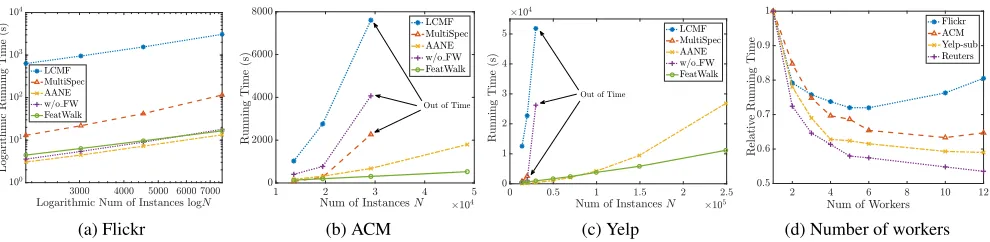
Figure 2: Running time of FeatWalk and different heterogeneous feature embedding methods on Flickr, ACM, and Yelp.
geneous feature embedding compared with the state-of-the-art embedding methods? (2) How effective is the representa-tions learned by FeatWalk compared with other embedding methods in applications such as classification? (3) What are
the impacts of parametersα, the window size,L, the number
of sentences per instanceW/N, anddon FeatWalk?
Four Real-world Datasets
The four real-world datasets that we employed in the exper-iments are all publicly available. The first dataset contains two feature matrices. Each of the last three datasets contains one feature matrix and one network.
Reuters(Amini, Usunier, and Goutte 2009):18,758
docu-ments from Reuters are used as instances. They are origi-nally written in English. We employ their Italian translations
asX, withM = 11,452, and the Spanish translations asX(2),
withM(2)= 9,243, via the bag-of-words model. To make the
embedding task more challenging, the original top10%
fre-quent features have been removed. Each document is from one of the six populous classes.
Flickr (Huang, Li, and Hu 2017b): 7,564 Flickr users are
employed as instances. They share photos online, and attach many related tags to their photos. These tags reflect the
in-terests of instances. We use them asX, withM = 12,047.
Instances also follow each other and form a networkG
natu-rally, with239,365undirected edges in total. The nine groups
that instances have joined are employed as their labels.
ACM(Tang et al. 2008):48,579papers published in ACM
are utilized as instances. We employ paper abstracts asX,
withM = 10,000, and construct an undirectedGbased on
the citation links, with288,374edges in total. All instances
are from nine areas such as Artificial Intelligence (AAAI, IJCAI, etc.), Data Mining (KDD, ICDM, etc.), and Machine Learning (ICML, COLT, etc.), which serve as the labels.
Yelp(Yelp 2017):249,012Yelp users are used as instances.
They have written reviews for different businesses. We set
the reviews asX, withM = 20,000. Their friend
relation-ships are employed to constructG, with1,779,803edges in
total. All businesses are categorized into eleven classed such as Nightlife and Services. Categories of the businesses that an instance has reviewed are set as his/her labels.
Baseline Methods
To study the performance of FeatWalk, we compare it with three categories of baselines. First, to investigate the impact of each type of features, we include three single feature em-bedding methods, i.e., NMF, Spectral, FeatWalk X. Second, to study the impact of the networks, we include two net-work embedding methods, i.e., DeepWalk and LINE. Third, to analyze the efficiency and effectiveness of FeatWalk, we include three state-of-the-art heterogeneous feature embed-ding methods, i.e., LCMF, MultiSpec, and AANE, and a variation of FeatWalk named w/o FW. No deep models are included since they are not scalable (Tu et al. 2018).
• NMF(Pedregosa et al. 2011): It is a scalable version of
non-negative matrix factorization, optimized by the hi-erarchical alternating least squares algorithms. It reduces
the dimension ofX(orX(2)) to learnH.
• Spectral(von Luxburg 2007): It calculates the cosine
sim-ilarities between vectors xi (orx(2)i ) to construct a new
graph, and applies spectral embedding on it to learnH.
• FeatWalk X: It learns the embedding representation H
only from the feature matrixX(orX(2)) via FeatWalk.
• DeepWalk (Perozzi, Al-Rfou, and Skiena 2014): It
per-forms random walks on Gand learns sequences of
in-stance indices. word2vec is applied to them to learnH. It
is a variant of FeatWalk that only usesG.
• LINE (Tang et al. 2015): It learns Hfrom Gby jointly
modeling its first and second order instance proximity.
• LCMF(Zhu et al. 2007): It conducts classical coupled
ma-trix factorization betweenXandGto learnHjointly.
• MultiSpec(Kumar, Rai, and Daume 2011): It computes
all instance similarity matrices and jointly models them via coupled spectral embedding.
• AANE(Huang, Li, and Hu 2017a): It is the state-of-the-art
embedding method for networks with node attributes.
• w/o FW: FeatWalk without usingFeature Walks. Instead,
it calculatesSdirectly, and performs random walks onS.
Experimental Settings
To analyze the effectiveness of FeatWalk and baselines, we
apply their learned embedding representations H to
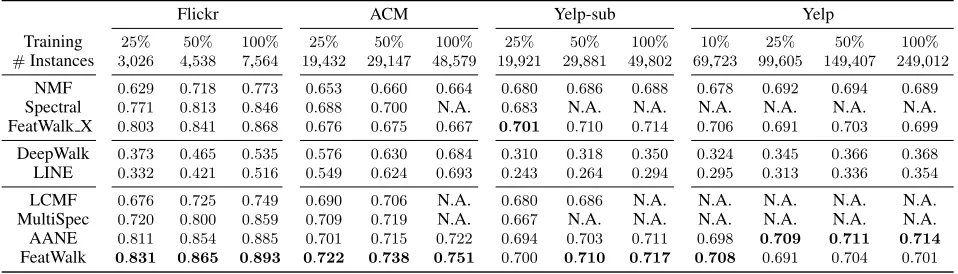
Table 2: Classification performance of FeatWalk and all baselines on Flickr, ACM, and Yelp-sub in terms of micro-average.
Flickr ACM Yelp-sub Yelp
Training 25% 50% 100% 25% 50% 100% 25% 50% 100% 10% 25% 50% 100%
#Instances 3,026 4,538 7,564 19,432 29,147 48,579 19,921 29,881 49,802 69,723 99,605 149,407 249,012
NMF 0.629 0.718 0.773 0.653 0.660 0.664 0.680 0.686 0.688 0.678 0.692 0.694 0.689
Spectral 0.771 0.813 0.846 0.688 0.700 N.A. 0.683 N.A. N.A. N.A. N.A. N.A. N.A. FeatWalk X 0.803 0.841 0.868 0.676 0.675 0.667 0.701 0.710 0.714 0.706 0.691 0.703 0.699
DeepWalk 0.373 0.465 0.535 0.576 0.630 0.684 0.310 0.318 0.350 0.324 0.345 0.366 0.368
LINE 0.332 0.421 0.516 0.549 0.624 0.693 0.243 0.264 0.294 0.295 0.313 0.336 0.354
LCMF 0.676 0.725 0.749 0.690 0.706 N.A. 0.680 0.686 N.A. N.A. N.A. N.A. N.A. MultiSpec 0.720 0.800 0.859 0.709 0.719 N.A. 0.667 N.A. N.A. N.A. N.A. N.A. N.A.
AANE 0.811 0.854 0.885 0.701 0.715 0.722 0.694 0.703 0.711 0.698 0.709 0.711 0.714
FeatWalk 0.831 0.865 0.893 0.722 0.738 0.751 0.700 0.710 0.717 0.708 0.691 0.704 0.701
validating feature embedding methods (Xia et al. 2010; Zhang et al. 2015b). The classification task aims to classify a new instance into one or multiple categories, based on its embedding representation and the trained classifier. The per-formance is measured by two standard metrics, i.e., micro-average and macro-micro-average (Huang, Li, and Hu 2017b).
We apply5-fold cross-validation on all datasets, i.e.,
ran-domly select 4
5 of all instances as a training group and the
remaining as a test group. If the dataset has a network, then the edges between the training and test groups would be kept. We concatenate feature matrices in two groups to cre-ate new instance feature matrices. To evalucre-ate an embed-ding method, we apply it to the new instance feature
ma-trices to learnH, which contains vector representations for
instances in the training groupHtrainand instances in the test
groupHtest. To perform classification, we build an SVM
(Pe-dregosa et al. 2011) classifier based onHtrainand
correspond-ing labels. Then we apply the learned classifier to predict the
labels of instances in the test group based onHtest.
We use the original papers’ default settings to determine the parameters of baselines. FeatWalk X and w/o FW use
the same parameters as FeatWalk. If it is not specified,dis
set as100and100% of the instances in the training group
are used. We performed ten test runs and used the arithmetic average as the final experimental results. We ran the experi-ments on a Dell OptiPlex 9030 i7-16GB desktop.
Efficiency of FeatWalk
To investigate the first question proposed at the beginning of this section, we compare FeatWalk with the three state-of-the-art heterogeneous feature embedding methods and w/o FW. The running time of all methods as a function of the
number of instancesN on Flickr, ACM, and Yelp is shown
in Figure 2. The result on Reuters is similar, so we omit it. From the results in Figure 2, we have three major obser-vations. First, the running time of FeatWalk is almost
lin-ear toN, which demonstrates its scalability. For example, in
Figure 2c, the slope of the green curve (FeatWalk) remains
invariable asN increases. AsN keeps increasing, LCMF,
MultiSpec, and w/o FW run out of time since their running time increase exponentially. Second, the distributed
sam-pling algorithmFeature Walkshas significantly accelerated
FeatWalk and made it scalable. WhenNis small, as shown
Table 3: LCMF and AANE can not be applied to Reuters.
#Instances 7,503 (25%) 11,255 (50%) 18,758 (100%)
X(1) X(2) X(1) X(2) X(1) X(2)
NMF 0.658 0.673 0.684 0.689 0.695 0.695 Spectral 0.679 0.689 0.694 0.704 0.710 0.714 FeatWalk X 0.698 0.700 0.727 0.728 0.744 0.745
MultiSpec 0.707 0.727 0.740 FeatWalk 0.720 0.748 0.771
in Figure 2a, w/o FW has almost the same running time as
FeatWalk, since the manipulations of similarity matrixSare
cheap at this time. However, whenN keeps increasing, as
shown in Figure 2b, the running time of w/o FW increases exponentially until it runs out of time. FeatWalk has signif-icantly less running time than w/o FW on both ACM and Yelp. Third, FeatWalk always has the least running time
whenN is large. WhenN is small, AANE might have less
running time than FeatWalk. FeatWalk has almost the same running time as AANE on Flickr, and is always faster than AANE on ACM. On Yelp, FeatWalk needs more running
time than AANE whenN < 82,000, but it becomes faster
than AANE whenN ≥82,000since it is almost linear toN.
It should be noted that AANE is designed for embedding a single feature matrix with a single network, while FeatWalk is general to multiple ones, e.g., FeatWalk could be applied to Reuters, while AANE can not.
The running time of FeatWalk can be further reduced by using the multi-thread implementation. Figure 2d shows the relative running time of FeatWalk as a function of the
num-ber of workerscon all datasets. From the results, we have
three observations. First, FeatWalk becomes more efficient
ascincreases. Second, ascincreases from1to2, the running
time decreases less than50%. It is because the multi-thread
implementation only accelerates the learning of sequences
{Q(k)}, not the word embedding process. Third, the running
time of FeatWalk on Flickr keeps increasing whenc≤5. It
is because N = 7,564is relatively small and it takes extra
(a)αand window size (b) Walk lengthLandW/N (c) Embedding representation dimensiond
Figure 3: The impacts of parametersα, window size, walk lengthL, number of sentences per instanceW/N, anddon FeatWalk.
Effectiveness of FeatWalk
To answer the second proposed question, we compare the classification performance of all methods on the four datasets, which are list in Tables 2 and 3. Since Spectral, LCMF, and MultiSpec are not capable of embedding the
dataset Yelp, we randomly sample20%of it and construct a
new dataset named Yelp-sub. DeepWalk, LINE, LCMF, and AANE could not be applied to the dataset Reuters since it has no network.
From the results in Tables 2 and 3, we have three major findings. First, FeatWalk X performs better than single fea-ture embedding methods, i.e., NMF and Spectral. By taking
advantage of the extra information (Gor X(2)), FeatWalk
further improves the performance. For example, on Reuters,
FeatWalk achieves3.6%of improvements than FeatWalk X
and 10.9% of improvements than NMF. Second, by
in-corporating the heterogeneous information, FeatWalk out-performs all network embedding methods, i.e., DeepWalk
and LINE. For example, FeatWalk achieves 9.8% of
im-provements than DeepWalk on ACM. Third, on all datasets except Yelp, FeatWalk achieves better performance than all heterogeneous feature embedding methods, i.e., LCMF, MultiSpec, and AANE. For example, on Flickr, FeatWalk
achieves a gain of0.9% over AANE. It demonstrates that
the way that FeatWalk has used to incorporate the heteroge-neous information is effective.
To study the performance of all methods w.r.t. differ-ent training set percdiffer-entages, i.e., the percdiffer-entage of in-stances in the training group (among the four folds in the cross-validation) that have been used, we vary it as
{25%,50%,100%}. The results on the four datasets are
shown in Tables 2 and 3. From the results, we observe that the aforementioned findings hold consistently as the train-ing set percentage increases. FeatWalk undeviattrain-ingly out-performs all baselines on all datasets except Yelp. For
ex-ample, on Reuters, when the training set percentage is50%,
FeatWalk achieves6.3%of improvements than Spectral and
2.9% of improvements than MultiSpec. On Yelp, the
formance of FeatWalk decreases when the training set
per-centage increases from 10% to 25%. It is because the
se-quence sets reach the memory limit and an online version
of word2vec is used to learnH.
Parameter Analysis
We now study the third proposed question. Performance of FeatWalk on Flickr as a function of the first instance feature
matrix weightαand window size, a function ofLandW/N,
and a function of d are shown in Figures 3a, 3b and 3c.
Results on other datasets are similar, so we omit them.
First, we varyαfrom 0to1 and the window size from
1 to 10. When α = 0, only G is used to learnH. When
α= 1, onlyXis used to learnH. The window size denotes
the maximum distance that is used to define context words in word2vec. From the results in Figure 3a, we observe that
FeatWalk achieves the best performance whenα= 0.62, i.e.,
when the contributions ofXandGare balanced. Whenαis
fixed, the performance of FeatWalk keeps stable as the
win-dow size increases from1to10. Second, we vary the walk
length Las from2 to60 and the number of sentences per
instanceW/N from2to20. From the results in Figure 3b,
we find that the performance of FeatWalk keeps increasing
as the product of L andW/N increases, and keeps stable
when the product is sufficiently large. Third, we varyd as
{20,60,100,140,180}. From the results in Figure 3c, we
ob-serve that, asdincreases from20to180, the performance of
FeatWalk keeps stable and is always better than all baselines.
Conclusion And Future Work
Acknowledgments
This work is, in part, supported by DARPA (#N66001-17-2-4031) and NSF (#IIS-1750074 and #IIS-1718840). The views, opinions, and/or findings expressed are those of the author(s) and should not be interpreted as representing the official views or policies of the Department of Defense or the U.S. Government.
References
Amini, M.; Usunier, N.; and Goutte, C. 2009. Learning from mul-tiple partially observed views - an application to multilingual text categorization. InNIPS, 28–36.
Bengio, Y.; Courville, A.; and Vincent, P. 2013. Representation learning: A review and new perspectives. TPAMI 35(8):1798– 1828.
Chen, W.; Zhang, Y.; and Zhang, M. 2014. Feature embedding for dependency parsing. InCOLING, 816–826.
Devroye, L. 1986. Sample-based non-uniform random variate gen-eration. InWinter Simulation Conference, 260–265.
Ding, Z., and Fu, Y. 2014. Low-Rank common subspace for multi-view learning. InICDM, 110–119.
Foster, D. P.; Kakade, S. M.; and Zhang, T. 2008. Multi-view dimensionality reduction via canonical correlation analysis.Toyota Technical Institute-Chicago.
Gong, Y.; Ke, Q.; Isard, M.; and Lazebnik, S. 2014. A multi-view embedding space for modeling internet images, tags, and their semantics. International Journal of Computer Vision106(2):210– 233.
Guo, Y.; Tao, D.; Liu, W.; and Cheng, J. 2017. Multiview cauchy estimator feature embedding for depth and inertial sensor-based human action recognition. IEEE Trans. on Systems, Man, and Cy-bernetics47(4):617–627.
Guo, Y. 2013. Convex subspace representation learning from multi-view data. InAAAI, 387–393.
Hinton, G. E., and Salakhutdinov, R. R. 2006. Reducing the dimen-sionality of data with neural networks. Science313(5786):504– 507.
Hogg, M. A., and Terry, D. I. 2000. Social identity and self-categorization processes in organizational contexts. Academy of Management Review25(1):121–140.
Huang, X.; Song, Q.; Li, J.; and Hu, X. 2018. Exploring expert cognition for attributed network embedding. InWSDM, 270–278. Huang, X.; Li, J.; and Hu, X. 2017a. Accelerated attributed net-work embedding. InSDM, 633–641.
Huang, X.; Li, J.; and Hu, X. 2017b. Label informed attributed network embedding. InWSDM, 731–739.
Huang, C.; Loy, C. C.; and Tang, X. 2016. Local similarity-aware deep feature embedding. InNIPS, 1262–1270.
Kumar, A.; Rai, P.; and Daume, H. 2011. Co-Regularized multi-view spectral clustering. InNIPS, 1413–1421.
Li, Y.; Nie, F.; Huang, H.; and Huang, J. 2015. Large-scale multi-view spectral clustering via bipartite graph. InAAAI, 2750–2756. Linden, G. D.; Smith, B. R.; and Zada, N. K. 2005. Use of prod-uct viewing histories of users to identify related prodprod-ucts. Google Patents.
Liu, N.; Huang, X.; and Hu, X. 2017. Accelerated local anomaly detection via resolving attributed networks. InIJCAI, 2337–2343.
McPherson, M.; Smith-Lovin, L.; and Cook, J. M. 2001. Birds of a feather: Homophily in social networks.Annual Review of Sociol-ogy27(1):415–444.
Mikolov, T.; Sutskever, I.; Chen, K.; Corrado, G. S.; and Dean, J. 2013. Distributed representations of words and phrases and their compositionality. InNIPS, 3111–3119.
Narayanan, H.; Belkin, M.; and Niyogi, P. 2006. On the relation between low density separation, spectral clustering and graph cuts. InNIPS, 1025–1032.
Ngiam, J.; Khosla, A.; Kim, M.; Nam, J.; Lee, H.; and Ng, A. Y. 2011. Multimodal deep learning. InICML, 689–696.
Pedregosa, F.; Varoquaux, G.; Gramfort, A.; Michel, V.; Thirion, B.; Grisel, O.; Blondel, M.; Prettenhofer, P.; Weiss, R.; et al. 2011. Scikit-learn: Machine learning in python.JMLR12:2825–2830. Pennington, J.; Socher, R.; and Manning, C. 2014. GloVe: Global vectors for word representation. InEMNLP, 1532–1543.
Perozzi, B.; Al-Rfou, R.; and Skiena, S. 2014. Deepwalk: Online learning of social representations. InKDD, 701–710.
Smith, A. N.; Fischer, E.; and Yongjian, C. 2012. How does brand-related user-generated content differ across youtube, facebook, and twitter?Journal of Interactive Marketing26(2):102–113. Srivastava, N., and Salakhutdinov, R. R. 2012. Multimodal learn-ing with deep boltzmann machines. InNIPS, 2222–2230. Tang, J.; Zhang, J.; Yao, L.; Li, J.; Zhang, L.; and Su, Z. 2008. Arnetminer: Extraction and mining of academic social networks. InKDD, 990–998.
Tang, J.; Qu, M.; Wang, M.; Zhang, M.; Yan, J.; and Mei, Q. 2015. Line: Large-scale information network embedding. In WWW, 1067–1077.
Tu, K.; Cui, P.; Wang, X.; Wang, F.; and Zhu, W. 2018. Structural deep embedding for hyper-networks. InAAAI, 426–433.
von Luxburg, U. 2007. A tutorial on spectral clustering.Statistics and Computing17(4):395–416.
Wu, L.; Wang, Y.; Gao, J.; and Li, X. 2018. Deep adaptive feature embedding with local sample distributions for person re-identification.Pattern Recognition73:275–288.
Xia, T.; Tao, D.; Mei, T.; and Zhang, Y. 2010. Multiview spec-tral embedding. IEEE Trans. on Systems, Man, and Cybernetics
40(6):1438–1446.
Yang, C.; Liu, Z.; Zhao, D.; Sun, M.; and Chang, E. Y. 2015. Net-work representation learning with rich text information. InIJCAI, 2111–2117.
Yelp. 2017. www.yelp.com/dataset/challenge. Yelp Dataset Chal-lenge.
Yuan, Y.-H.; Sun, Q.-S.; and Ge, H.-W. 2014. Fractional-order em-bedding canonical correlation analysis and its applications to multi-view dimensionality reduction and recognition. Pattern Recogni-tion47(3):1411–1424.
Zhang, J.; Tang, J.; Li, J.; Liu, Y.; and Xing, C. 2015a. Who influ-enced you? predicting retweet via social influence locality. TKDD
9(3).
Zhang, L.; Zhang, Q.; Zhang, L.; Tao, D.; Huang, X.; and Du, B. 2015b. Ensemble manifold regularized sparse low-rank ap-proximation for multiview feature embedding.Pattern Recognition
48(10):3102–3112.