Licensed under Creative Common Page 141
http://ijecm.co.uk/
ISSN 2348 0386
OMAN AS A FUTURE LOGISTICS HUB: A CONCEPTUAL STUDY
Ali Mohsin Salim Ba-Awain
Faculty of Business and Information Science, UCSI University, Malaysia
Dazmin Daud
Faculty of Business and Information Science, UCSI University, Malaysia [email protected]
Abstract
The paper aims to explore the relationship between logistics infrastructures and economic
growth in Oman. The method used for this conceptual paper is based on literature reviews from
journal articles, conferences, books and online news which are related to the keywords and
research area. Logistics infrastructure and logistics educational needs are the crucial elements
for a national economic growth. Issues encountered for Oman as a future logistics hub are
developing effective coordination between free trade zone areas and logistics infrastructure, and
upgrading logistics programs in higher education institutions. There is a need for a greater study
on determining the relationship between logistics infrastructures, logistics educational needs
and economic growth although a lot of researches solely done on the general economic and
education dimensions in Oman. Further research, both empirical and non-empirical, must be
done in order to uncover more issues in this area. Plus, the study only covers the logistics and
neglects the element of supply chain management.
Keywords: Oman, logistics infrastructure, logistics educational needs, logistics hub
INTRODUCTION
Licensed under Creative Common Page 142 effective and accurate planning of logistics sector is able to contribute to the economic growth of a nation (Engman, 2005). Logistics sector is increasingly becoming a vital component of an international trade for assisting a nation's economic growth. Developing and improving logistic sector in one nation contributes to the competitive advantage of the nation (Lean, Huang & Hong, 2014).
Logistics activities are driven by the comprehensive movement of goods. Ballou (2007) explains logistics activities as a movement of goods from raw material source to the last market destination. From the perspective of logistics management, the Council of Supply Chain Management Professionals or CSMP defines it a process of active and productive planning, implementing, and controlling of good, labor, information flow and storage from starting point to last consumer point (Stadtler, 2005). For these logistics activities to perform in a productive manner, every Government in a country must provide logistics infrastructures (Navickas, Sujeta & Vojtovich., 2011). These infrastructures include transportation networks, information and communication devices, storage systems and packing services.
For the developed countries, there are no issues in providing logistics infrastructures (see Arroyo, Gaytan & de Boer, 2006; Bookbinder, 2003). However, for the third world countries, this could be an issue due to the limited economic outputs for the logistics investments (Devlin & Yee, 2005). Investing and developing of logistics infrastructures in the third world countries is a must for these countries to gain a competitive advantage in the international trade. Furthermore, it can create more employment opportunities and provide low costs in import and export activities (Kotzab & Wünsche, 2015).
Licensed under Creative Common Page 143 run make the Oman economy in danger due to the deterioration in production capacity, high production costs, and fluctuating oil prices (Hakro & Ommezzine, 2016).
Despite the importance of logistics sector for a country economic growth, a research on the impact of logistics activities on economic growth in Oman is still lacking. This country is located at the gateway to the Gulf and has a logical distribution hub for the Indian subcontinent and nations in East Africa. Despite its attractive location, its massive investment in road and port infrastructure is beyond the limits due to independence and limited coordination between current transport and distribution system and other constituents in the logistics system. In addition, the weakness of soft systems including customs/border procedures, company incorporation, and legal and documentary procedures that failed to keep pace with other developments. Hence, a clear and integrated strategy is urgently required for trade facilitation. There is a real need to urge for alternative economic drivers like logistics to boost the economic growth of Oman. This can be achieved by assessing, monitoring and integrating all logistics activities in terms of its infrastructure.
This research seeks to propose the idea of developing Oman as a logistics hub through directing the investments for on-going logistics infrastructures. The Government of Oman needs to accurately and effectively plan their logistic activities in order to achieve advantages in costs and efficiency. In addition to that, logistics activities in Oman will play a great role in developing and also increasing the standard of living.
Therefore, a specific research question is derived from this research: to what extent the development of logistics infrastructures will affect the economic growth of Oman?
This research provides salient information for both practitioner and academic. It provides the Government of Oman handful information on how logistics activities will impact the country's economic growth. Logistics sector can focus on improving the overall situation of the country by creating opportunities for job employment. As for the academic, it helps higher education institutions in Oman to develop logistics programs compatible with the needs of the country.
LOGISTICS INFRASTRUCTURE GROWTH IN THE SULTANATE OF OMAN
Licensed under Creative Common Page 144 The logistics system in the Sultanate of Oman is undertaking a transformation to solve infrastructure bottleneck, lack of investment in port handling capacity, and poor land transport connectivity with other GCC countries (Middle East Logistics, 2016). For this reason, Oman Government has provided unlimited support to major infrastructure projects. This will enable logistics system in Oman to enhance its capacity and productivity. Oman's logistics sector is becoming important in the 21st century. It is expected to support Oman GDP growth when the country becomes the global hub in the year 2040 (Finance Tribune, 2018). Focus areas will be on the development of modern seaports, airports and land transport (road and rail).
Under the Asyad program, Oman can exploit its strengths by focusing on logistics activities. For instance, in the year 2016, Oman's infrastructure grew by 3.4 percent compared to the year 2015 (Al Barwani, 2016). In another infrastructure development, there is a high priority given to the development of national rail network to link with the Gulf Cooperation Council (GCC) countries (Smith, 2016).
The shortage of skilled manpower in Oman is significant (Al-lamki, 2000). The "Omanization" as described by Al-lamki is focusing on developing competitive HR development program in all sectors including logistics. In another study, Issan and Gomaa (2010) found that graduates knowledge and skills do not match industrial requirements in Oman.
From a logistics demand point of view, skilled manpower in Oman is needed to meet the demand for Oman industrial free trade zones (FTZs). There are four FTZs in Oman. Three FTZs are located nearby to the deep water ports in Sohar, Duqm, and Salalah where each of the FTZ engages in port-free zone industrial and commercial cluster. The fourth one is located in Mazyona, 4 km from Yemen, where it provides border gateway for local and international investors with efficient access to the Yemen market. Figure 1 shows these four FTZ.
Licensed under Creative Common Page 145 These four FTZs have huge commercial land areas. Al-Shanfari (2012) has described one of the economic challenges in Oman is to develop modern infrastructure for its FTZs. The FTZs must be fully equipped with road networks, telecommunications and other necessary utilities and services.
Logistics Educational Needs in Oman
The "educational needs" is a condition of the necessity for education on a specific topic identified by a gap in professional or working practice (Daud, 2012; Lai, 2010). In relation to logistics, it is a situation that refers to the gap between what the logistics practices expect to be a competent logistician and what actually occurs at present. Studies regarding the relationship between logistics programs offered by higher education institutions (HEIs) and logistics educational needs (LEN) have received considerable attention in the logistics education literature (for examples see Gravier & Farris, 2008; Wu, 2007). Such interest might be attributed to the belief that logistics programs facilitate logistics graduates' knowledge of logistics. The logistics programs offered by higher education institutions must match the development of logistics itself. From the logistics practitioners' perspective, they prefer applied logistics program over the traditional comprehensive university logistics programs.
In Oman, majority of the previous studies have focused on English language (Al Barwani, Al-Mekhlafi & Nagaratnam, 2013), general higher education (Al-Lamki, 2010; Issan & Gomaa, 2010; Carroll, Razvi, Goodliffe & Al-Habsi, 2009) and adoption of new technology in education (Al-Mukhaini, Al-Qayoudhi & Al-Badi, 2014). Meanwhile, Al'Abri (2011) has emphasized the importance of changing education policy in Oman due to globalization. An argument is presented that education policy in Oman has been affected seriously by globalization processes, leading to deep shifts and changes in the ways in which education policies are developed, implemented and evaluated.
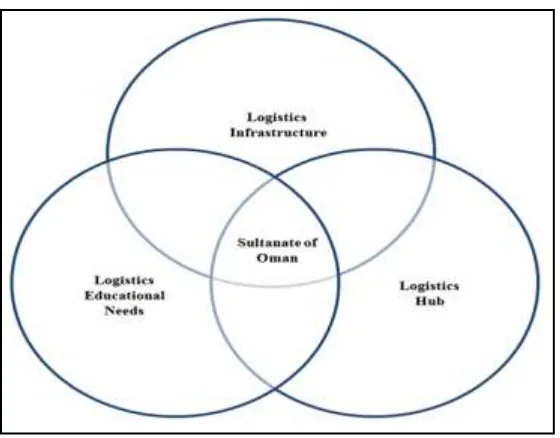
From the above discussion, a proposition is derived. The proposed proposition is: There is a relationship between logistics infrastructure, logistics educational needs and future logistics hub for Oman.
Licensed under Creative Common Page 146 Figure 2: A Conceptual Framework
The conceptual framework will assist:
Economic policymakers in the Oman Government to have a constructive long-term
strategy on the development of logistics infrastructure;
Oman Government to ensure the roles of logistics infrastructure match with the plans to
transform Oman into a global logistics hub;
A roadmap for the above logistics hub contribute positively to Oman's GDP;
Employers to identify key areas of knowledge and skills which are critical for Oman's
logistics graduates to acquire before they can work in logistics working environment; and
The Ministry of Manpower Oman to develop effective training needs analysis for existing
Oman's key persons who are currently working in logistics.
As for the contribution to theory (academic), the conceptual framework will assist higher education institutions in Oman to review back the existing logistics program for future employability of graduates. It will have learning outcomes that provide appropriate knowledge and skills for future logisticians.
CONCLUSION & WAY FORWARD
Licensed under Creative Common Page 147 logistics graduates must be able to apply logistics knowledge they acquired from the higher education institutions in their working environment. This leads to logistician competency which can contribute to productivity and later to the country economic growth. Effective collaboration between logistics practitioners, the Government of Oman and higher educational institutions will ensure a holistic planning that will be able to make Oman as an important logistics hub. The way forward for further research about the relationship between logistics educational needs, logistics infrastructure and logistics hub must be done in future.
REFERENCES
Ahmed, M.M. (2013). Economic Growth and Social Development in the Sultanate of Oman. Ahmed, Medani M., Economic Growth and Social Development in the Sultanate of Oman (January 23, 2013). Retrieved on April 9, 2018 from https://ssrn.com/abstract=2205547 or http://dx.doi.org/10.2139/ssrn.2205547
Al Barwani, T., Al-Mekhlafi, A. & Nagaratnam, R.P. (2013). Service-Learning Might be the Key: Learning From the Challenges and Implementation Strategies in EFL Teacher Education in Oman. International Journal of Instruction, 6(2), 109-128.
Al Bawani (2016). Oman infrastructure set to grow by 3.4% in 2016. August 23, 2016. Retrieved on April 9, 2018 from http://www.constructionweekonline.com/article-40633-oman-infrastructure-set-to-grow-by-3-4-in-2016/
Al’Abri, K. (2011). The Impact of globalization on Education Policy of Developing Countries: Oman as an Example. Literacy Information and Computer Education Journal, 2(4), 491-502.
Al-lamki, S.M. (2000). Omanization: A Three Tier Strategic Framework for Human Resource Management and Training in the Sultanate of Oman. Journal of Comparative International Management, 3(1), 1-18.
Al-Lamki, S.M. (2010). Higher Education in the Sultanate of Oman: The challenge of access, equity and privatization. Journal of Higher Education Policy and Management, 24(1), 75-86. DOI: https://doi.org/10.1080/13600800220130770 Al-Mukhaini, E.M., Al-Qayoudhi, W.S. & Al-Badi, A.H. (2014). Adoption Of Social Networking In Education: A Study Of The Use Of Social Networks By Higher Education Students In Oman. Journal of International Education Research, 10(2), 143-154.
Al-Shanfari, D.A. (2012). Entrepreneurship in Oman: A snapshot of the main challenges. In Multi-Year Expert Meeting on Entreprise Development Policies and Capacity-building in Science, Technology and Innovation (STI) (Fourth session), Geneva, 16-18 January 2012.
Arroyo, P., Gaytan, J. & de Boer, L. (2006). A survey of third party logistics in Mexico and a comparison with reports on Europe and USA. International Journal of Operations & Production Management, 26(6), 639-667. DOI: https://doi.org/10.1108/01443570610666984
Ballou, R.H. (2007). The evolution and future of logistics and supply chain management. European Business Review, 19(4), 332-348. DOI: https://doi.org/10.1108/09555340710760152
Bookbinder, J.H. (2003). Comparison of Asian and European logistics systems. International Journal of Physical Distribution & Logistics Management, 33(1), 36-58. DOI: https://doi.org/10.1108/09600030310460990
Carroll, M., Razvi, S., Goodliffe & Al-Habsi, F. (2009). Progress in Developing a National Quality Management System for Higher Education in Oman. Quality in Higher Education, 15(1), 17-27. DOI: https://doi.org/10.1080/13538320902731328
Daud, D. (2012). Logistics educational needs of Malaysia: A conceptual study. Academic Research International, 3(3), 336-344.
Denktas-Sakar, G. & Karatas-Cetin, C. (2012). Port Sustainability and Stakeholder Management in Supply Chains: A Framework on Resource Dependence Theory. The Asian Journal of Shipping and Logistics, 28(3), 301-319.
Devlin, J. & Yee, P. (2005). Trade Logistics in Developing Countries: The Case of the Middle East and North Africa. The World Economy, 28(3), 435-456. DOI: https://doi.org/10.1111/j.1467-9701.2005.00620.x
Licensed under Creative Common Page 148
Finance Tribune (2018). Oman looks to logistics sector to strengthen GDP. Wednesday, January 17, 2018. Retrieved on April 9, 2018 from https://financialtribune.com/articles/world-economy/80177/oman-looks-to-logistics-sector-to-strengthen-gdp
Gravier, M.J. and Farris, M.T. (2008). An analysis of logistics pedagogical literature. The International Journal of Logistics Management, 19(2), 233-253. DOI: https://doi.org/10.1108/09574090810895979
Hakro, A.N. & Omezzine, A.M. (2016). Oil prices and macroeconomic dynamics of the Oman economy. The Journal of Developing Areas, 50(1), 1-27. DOI: 10.1353/jda.2016.0021
Issan, S.A. & Gomaa, N.M.M. (2010). Post Basic Education Reforms in Oman: A Case Study. Literacy Information and Computer Education Journal (LICEJ), Volume 1, Issue 1, March 2010, 1-9.
Kotzab, H. & Wünsche, S. (2015).Competences and qualifications of logistic managers—An empirical analysis of job postings in Germany. In: Dethloff J., Haasis HD., Kopfer H., Kotzab H. & Schönberger J. (eds) Logistics Management. Lecture Notes in Logistics. Springer, Cham. DOI: 10.1007/978-3-319-13177-1_40
Kwasnicki, W. (2013). Logistics growth of the global economy and competitiveness of nations. Technological Forecasting and Social Change, 80(1), 50-76. DOI: https://doi.org/10.1016/j.techfore.2012.07.007
Lai, H.K.J. (2010). Building operation and maintenance: education needs in Hong Kong.
Lean, H. H., Huang, W. & Hong, J. (2014). Logistics and economic development: Experience from China. Transport Policy, 32, 96-104. DOI: https://doi.org/10.1016/j.tranpol.2014.01.003
Middle East Logistics (2016). Analysis: Oman logistics industry’s transformation, Monday 21 March 2016. Retrieved on April 9, 2018 from https://www.logisticsmiddleeast.com/article-12320-analysis-oman-logistics-industrys-transformation
Navickas, V., Sujeta, L., & Vojtovich, S. (2011). Logistics systems as a factor of country’s competitiveness. Economics and Management, 16, 231-237.
Port Hinterlands and Regionalization. Hofsra University, New York, USA (2006). Retrieved on April 9, 2018 from http://people.hofstra.edu/Jean-paul_Rodrigue/downloads/TN_JPR_KRIHS_Paper%202.pdf
Rodrigue, J. & Notteboom, T. (2006). Challenges in the Maritime-Land Interface.
Ruttner, R., Nadeau, J., Lettice, F., Lim, M. & al Shamaisi, 2017). Place branding of seaports in the Middle East. Place Brand Public Diplomacy, online. DOI: 10.1057/s41254-017-0072-8
Smith, K. (2016). Oman suspends railway project. International Railway Journal, May 03, 2016. Retrieved on April 9, 2018 from https://www.railjournal.com/index.php/middle-east/oman-suspends-railway-project.html
Stadtler, H. (2005). Supply chain management and advanced planning – basics, overview and challenges, 163(3), 575-588. Retrieved on April 9, 2018 from https://doi.org/10.1016/j.ejor.2004.03.001
Taneja, P., Ligteringen, H. & van Schuylenburg, M. (2010). Dealing with uncertainty in design of port infrastructure systems. Journal Design Research, 8(2), 101-118.
Times of Oman (2017). Asyad formation to help Oman become top logistics hub. June 4, 2017. Retrieved on April 9, 2018 from http://timesofoman.com/article/110430
Trading Economics (2018). Oman GDP annual growth rate 2000-2018. Retrieved on April 9, 2018 from https://tradingeconomics.com/oman/gdp-growth-annual