R E V I E W
Block periodization of endurance training
–
a
systematic review and meta-analysis
This article was published in the following Dove Press journal: Open Access Journal of Sports Medicine
Knut Sindre Mølmen *
Sjur Johansen Øfsteng * Bent R Rønnestad
Section for Health and Exercise Physiology, Inland Norway University of Applied Sciences, Lillehammer, Norway
*These authors contributed equally to this work
Background: Block periodization (BP) has been proposed as an alternative to traditional (TRAD) organization of the annual training plan for endurance athletes.
Objective:To our knowledge, this is the first meta-analysis to evaluate the effect BP of endurance training on endurance performance and factors determinative for endurance performance in trained- to well-trained athletes.
Methods:The PubMed, SPORTdiscus and Web of Science databases were searched from inception to August 2019. Studies were included if the following criteria were met: 1) the study examined a block-periodized endurance training intervention; 2) the study had a one-, two or multiple group-, crossover- or case-study design; 3) the study assessed at least one key endurance variable before and after the intervention period. A total of 2905 studies were screened, where 20 records met the eligibility criteria. Methodological quality for each study was assessed using the PEDro scale. Six studies were pooled to perform meta-analysis for
maximal oxygen uptake (VO2max) and maximal power output (Wmax) during an
incre-mental exercise test to exhaustion. Due to a lower number of studies and heterogenous measurements, other performance measures were systematically reviewed.
Results: The meta-analyses revealed small favorable effects for BP compared to TRAD
regarding changes in VO2max (standardized mean difference, 0.40; 95% CI=0.02, 0.79) and
Wmax (standardized mean difference, 0.28; 95% CI=0.01, 0.54). For changes in endurance performance and workload at different exercise thresholds BP generally revealed moderate-to large-effect sizes compared moderate-to TRAD.
Conclusion: BP is an adequate, alternative training strategy to TRAD as evidenced by
superior training effects on VO2max and Wmax in athletes. The reviewed studies show
promising effects for BP of endurance training; however, these results must be considered with some caution due to small studies with generally low methodological quality (mean PEDro score =3.7/10).
Keywords:block training, traditional training, high-intensity training
Introduction
Historically, the block periodization (BP) training approach appeared for the first
time in the early 1980s and has since then been popular and widely used among
high-performance coaches.1BP was at that time and even today, an alternative to
traditional periodization (TRAD). TRAD is simultaneously developing different training abilities throughout the annual training season, where BP has highly concentrated training blocks targeting and developing selected abilities in
sequences of 1–4 weeks.1,2The BP approach was conceptualized to overcome the
suggested limitations of TRAD, which has been criticized for conflicting
physiolo-gical responses to multi-targeted training, resulting in 1) excessive fatigue, 2)
Correspondence: Sjur Johansen Øfsteng Section for Health and Exercise Physiology, Inland Norway University of Applied Sciences, Postbox 400, Elverum 2418, Norway
Email [email protected]
Open Access Journal of Sports Medicine
Dove
press
open access to scientific and medical research
Open Access Full Text Article
Open Access Journal of Sports Medicine downloaded from https://www.dovepress.com/ by 118.70.13.36 on 26-Aug-2020
insufficient training stimulation and 3) inability to provide
multi-peak performances over the season.1,3However, the
effectiveness of BP and its methodological theories have
also been criticized for not being sufficiently founded in
empirical research literature.4–6
Several successful examples of BP training have been
proposed during the last decades, with the first English
written report, a single-case study, published in the
mid-1990s.7However, thefirst English written studies
compar-ing BP and TRAD were not published before the year
2010.8,9Subsequently, several studies have been published
and with the growing literature in thefield, there is a need
to evaluate the current pooled evidence for the effect of BP of endurance training in trained athletes. Vladimir Issurin, one of the pioneers fronting BP training, states that BP has taken different forms according to the positions and
experiences of those who presented them.10 He himself
defines BP training as 2–4 week mesocycles with highly
concentrated workloads directed at targeted training
abil-ities, carried out in a specific order (“accumulation”,
focusing on basic abilities; “transmutation”, focusing on
sport-specific abilities;“realization”; focusing on recovery
and peaking toward competition).10 Each of these blocks
will then build off the physiological adaptations of the
prior training block. On the other hand, others define
shorter training blocks (~1 week, ie, microcycles) as BP training and have generally a slightly different approach to
the concept.11,12 The main difference between Issurin’s
and the alternative BP model is that, roughly speaking, Issurin focuses on concurrently developing a small
selec-tion of abilities in each mesocycle. In contrast to Issurin’s
model has the alternative model a more unidirectional
focus on one specific ability in each microcycle, which
has similarities to the model introduced by Professor
Verkhoshansky in the 1970s.13
In this paper, we define BP training as either one or
more blocks with≥1 week duration of concentrated
train-ing focus with either a uni- or multitargeted approach, which means that both BP models are included. The pur-pose of this paper was therefore to: 1) systematically evaluate the current evidence for the effect BP of endur-ance training has on endurendur-ance performendur-ance and factors determinative for endurance performance in trained- to well-trained athletes; 2) conduct meta-analyses to pool and evaluate the existing effects and 3) to address the methodological quality, strengths and limitations of the current literature on this topic. To our knowledge, this is
the first published meta-analysis to evaluate the effect of
BP of endurance training.
Methods
Literature search
This systematic review and meta-analysis followed the
guidelines established by the PRISMA statement,14except
for the descriptive results from the literature search which in this paper is mentioned in this chapter (ie, optimized PRISMA).
A PubMed, SPORTdiscus and Web of Science litera-ture search from inception to August 6, 2019, was
con-ducted. The search terms included “periodization” OR
“periodized” OR “periodisation” OR “periodised” OR
“block” OR “blocked” OR “blocking” AND “training”
OR “exercise” AND “endurance” OR “concurrent” OR
“traditional”. Two independent observers reviewed the
studies and then individually decided whether inclusion was appropriate. Results were compared, discrepancies between reviewers were discussed and a consensus-based
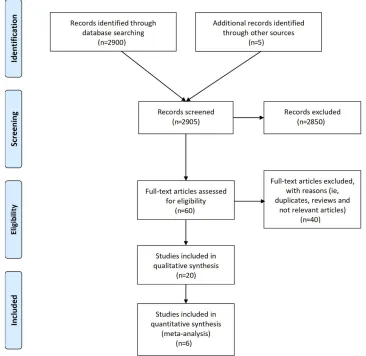
decision was taken. Aflowchart of the search strategy and
study selection is shown in Figure 1. Two independent
reviewers assessed the methodological quality and risk of bias for each study using the PEDro scale from 1 to 10.
Studies with scores >6 were considered “high-quality”,
studies with scores 4–5 were considered to be “
medium-quality”and studies that scored below 4 were considered
to be“low-quality”.15
Studies were included in the review with the following criteria: 1) the study examined a BP of endurance training intervention; 2) the study had a one-, two or multiple group-, crossover- or case-study design; 3) the study assessed at least one key endurance variable or factor before and after the intervention period.
Data extraction
We extracted the following characteristics from each eli-gible trial: authors; year of publication; groups; training status; sample size; sex; mean baseline age and body weight; exercise modality; training period and frequency; training session protocol including work intensity and duration; if sessions were supervised or not. If applicable, the following variables with mean and variance measures were retrieved for baseline-, post- and change-values:
maximal oxygen uptake (VO2max; mL⋅min−1⋅kg−1) and
maximal power output (Wmax) during an incremental exercise test to volitional exhaustion; workloads at
Open Access Journal of Sports Medicine downloaded from https://www.dovepress.com/ by 118.70.13.36 on 26-Aug-2020
different exercise thresholds (workload at second ventila-tory threshold, onset of blood lactate accumulation or 2, 3
or 4 mmol⋅L−1capillary lactate concentration); work
econ-omy; gross efficiency; endurance performance variables
(closed-end tests, time to exhaustion-tests, Yo-Yo-tests).
For data only described infigures or graphs, we used Fiji
software16 to read the data. Some of the data were
obtained through personal contact with the authors.
Results from database search
The database search identified 2900 potentially relevant
jour-nal articles (Figure 1). Five studies were additionally
included and identified through contact with the study
authors, resulting in a total of 2905 records. Screening of titles and abstracts for inclusion criteria revealed 60 eligible articles for full-text review. Of these, a total of 20 records were included in this study.
The 20 studies in this review were published between the
years 1993–2019. Characteristics of studies, participants and
training interventions are summarized inTable 1. One of the
included studies had a three groups-comparison design (1
week intervention),17six had a two groups-comparison design
(5.8±3.8 weeks intervention, range: 1.6–12 weeks),8,18–22five
had a one group-design (47.3±74.0 weeks intervention, range:
1.9–176 weeks),23–27three were crossover studies (12.0±7.8
weeks intervention, range: 3–17 weeks)9,12,28andfive were
case-studies (26.2±27.1 weeks intervention, range: 1–58
weeks).7,29–32
Six of the 20 studies were eligible for meta-analysis (ie, parallel-design studies comparing BP with TRAD). Average length of these training interventions was 4.9±4.0
weeks (range: 1–12). Four of the studies were conducted on
male participants, while the remaining two studies included both males and females. The studies were performed on
cyclists in three occasions11,17,22 and on cross-country
skiers,20 hockey players21 and alpine skiers8 in the other
three studies. According to De Pauw et al’s33guidelines to
classify subject groups in sport-science research were all
Figure 1Flowchart of the search strategy and study selection.
Open Access Journal of Sports Medicine downloaded from https://www.dovepress.com/ by 118.70.13.36 on 26-Aug-2020
T able 1 Characteristics of the studies and par ticipants Gr oups P articipants T raining intervention Endurance training Authors Exp . gr oups Matched? Sport Sex T raining le ve l Ex er cise form T raining Duration (w eeks) A vg. freq. / we ek Ex er cise intensity Duration/ session Additional/ repl acement Supervi sion Outcomes Pyne and T our etski (1993) [case study] Block periodization Swimming Male Athlete Swimming W eek 1: LIT focus W eek 2: Anaer obic thr eshold focus W eek 3: HIT focus. 3 n/a (61 – 69 km/w eek) LIT , MIT and HIT n/a Replacement n/a Blood lactate responses Gar cia-Pallarés et al (2009) [one gr oup-design] 1. Block periodization 11 Ka yak ers Male Athletes Ka yaking and res istance ex er cises 3 blocks (1. VT 2 -focus, 5 w eeks. 2. V O2 max-focus, 5 w eeks. 3. Competition pace-focus, 2 w eeks.). 12 12.5 70 – 100% VO 2 max 20 – 120 mins Replacement Y es V O 2 max, maximal paddling speed, VT 2 , 1RM, muscle powe r assessments Bre il et al (2010) [two gr oup-design] Meta: YES 1. HIT block periodization No 13 Alpine skiers Mix ed Athletes
Bicycling and obstacle running
3x3 da ys with HIT blocks (5 HIT sessions per block). 1.6 9.6 90 – 95% HRmax 16 mins HIT
Replacement (resistance training
in addition) Ye s V O 2 max, Wmax, TTE @ 90% pre-W max, VT 1 ,V T2 , SJ, CMJ 2. Contr ol training 8 Alpine skiers Mix ed Athletes n/a Continued normal training. 1.6 n/a n/a n/a n/a Gar cia-Pallarés et al (2010) [cr ossov er design] 1. Block periodization No 10 Ka yak ers Male Athletes Ka yaking and res istance ex er cises 3 blocks (1. VT 2 -focus, 5 w eeks. 2. V O2 max-focus, 5 w eeks. 3. Competition pace-focus, 2 w eeks.). 12 n/a 70 – 100% VO 2 max 20 – 120 mins Replacement Y es V O 2 max, maximal paddling speed and powe r, VT 2 2. T raditional periodization ““ “ Ka yaking and res istance ex er cises 3 blocks (1. VT 2 -focus, 12 w eeks. 2. V O2 max-focus, 6 w eeks. 3. Competition pace-focus, 4 w eeks.). 22 n/a 70 – 100% VO 2 max 20 – 120 mins Replacement Y es Mallo (2011) [one gr oup-design] Block periodization 1 Soccer team Male Athletes Running, res istance ex er cises, fl exibility 4 consecutiv e seasons wher e each season was structur ed into thr ee training stages which w er e further subdivided into thr ee training blocks. 4 seasons á 309±10 da ys n/a LIT and HIT n/a Replacement n/a P oints obtained in matches, table position ( Continued )
Open Access Journal of Sports Medicine downloaded from https://www.dovepress.com/ by 118.70.13.36 on 26-Aug-2020
T able 1 (Continued). Gr oups P articipants T raining intervention Endurance training Authors Exp . gr oups Matched? Sport Sex T raining le ve l Ex er cise form T raining Duration (w eeks) A vg. freq. / we ek Ex er cise intensity Duration/ session Additional/ repl acement Supervi sion Outcomes Mallo (2012) [one gr oup-design] Block periodization 22 Soccer pla yers Male Athletes Running, res istance ex er cises, fl exibility One season that was structur ed into fi ve training stages which w er e further subdivided into thr ee training blocks. 44 n/a LIT and HIT n/a Replacement n/a Y o-Y o-test, CMJ, 10-m sprint Stør en et al (2012) [case study] Incr eased HIT volume and reduced total training volume (with HIT blocking) 1 Cyclist Male Athlete
Running and bicycling
~4 months pre season training: 3 HIT sessions/ w eek +2 HIT blocks á 14 sessions in 9 da ys. 52 (~17 w eeks with experimental training) ~4.4 90 – 95% HRmax 16 mins HIT Replacement of HIT , reduced total training volume n/a V O 2 max, lactate thr eshold, cycling econom y, TT performance W ahl et al (2013) [two gr oup-design] HIT block periodization with activ e recovery Y es, by HIT volume 8 triathletes Mix ed Athletes
Bicycling, running and swimming
3x3 da ys with HIT blocks (4 – 5 HIT sessions per block) +1 extra da y with tw o HIT sessions. Active res t periods between inter vals. 2 7.5 90 – 95% HRmax ~15 mins HIT Replacement Y es V O 2 max, Wmax, VT 1 , VT 2 , TT performance, Wingate, Hb mass HIT block periodization with passiv e recovery 8 triathletes Mix ed Athletes
Bicycling, running and swimming
3x3 da ys with HIT blocks (4 – 5 HIT sessions per block) +1 extra da y with tw o HIT sessions. Passiv e rest periods between inter vals. 2 7.5 90 – 95% HRmax ~15 mins HIT Replacement Y es Rønnestad et al (2014) [two gr oup-design] Meta: YES 1. HIT block periodization Y es, by total and intensity- speci fi c training volume 10 Cyclists Male Athletes Bicycling 5 HIT sessions in w eek 1, ther eafter 1 HIT session/w eek in w eek 2 – 4. 42 8 8 – 100% HRmax 30 mins HIT Replacement of HIT training n/a V O 2 max, Wmax, powe r @ 2mmol/L [La −], cycling econom y, gr oss ef fi ciency 2. T raditional organization 9 Cyclists Male Athletes Bicycling 2 HIT sessions/wee k. 4 2 88 – 100% HRmax 30 mins HIT Replacement of HIT training n/a ( Continued )
Open Access Journal of Sports Medicine downloaded from https://www.dovepress.com/ by 118.70.13.36 on 26-Aug-2020
T able 1 (Continued). Gr oups P articipants T raining intervention Endurance training Authors Exp . gr oups Matched? Sport Sex T raining le ve l Ex er cise form T raining Duration (w eeks) A vg. freq. / we ek Ex er cise intensity Duration/ session Additional/ repl acement Supervi sion Outcomes Rønnestad et al (2014) [two gr oup-design] Meta: YES 1. HIT block periodization Y es, by total and intensity- speci fi c training volume 8 Cyclists Male Athletes Bicycling 3 blocks á 4 w eeks. Each block with 5 HIT sessions in w eek 1, ther eafter 1 HIT session/w eek in w eek 2 – 4. 12 2 88 – 100% HRmax 30 mins HIT Replacement of HIT training n/a V O 2 max, Wmax, powe r @ 2mmol/L [La −], 40min all-out test, gr oss ef fi ciency , Hb mass 2. T raditional organization 7 Cyclists Male Athletes Bicycling 2 HIT sessions/wee k. 12 2 88 – 100% HRmax 30 mins HIT Replacement of HIT training n/a W ahl et al (2014) [one gr oup-design] HIT block periodization 12 Soccer pla yers Male Athletes
Running, dribbling tracks
and small-sided games 4×2 – 3 da ys with HIT blocks (2 – 4 HIT sessions per block). 1.9 6.5 90-95% HRmax 16 mins HIT Additional n/a Y o-Y o-test, RSA test, CMJ Clark et al (2014) [thr ee gr oup-design] Meta: YES Short sprints block Y es, by total and HIT volume 9 Cyclists Male Athletes Cycling Short sprints, 5 – 20 s. 7 consecutiv e da ys. 1 7 All-out 15 mins sprinting Replacement Y es V O 2 max, Wmax, powe r @ OBLA, gr oss ef fi ciency , TT performance Long sprints block 10 Cyclists Male Athletes Cycling Long sprints, 15 – 45 s. 7 consecutiv e da ys. 1 7 All-out 15 mins sprinting Replacement Y es Contr ol 9 Cyclists Male Athletes Cycling Continued normal training. Same amount of total training as exp . gr oups. n/a Fer nandez-Fer nandez et al (2015) [one gr oup-design] HIT block periodization 12 T ennis pla yers Male Athletes T ennis- speci fi c HIT sessions 5×2 – 3 da ys with HIT blocks (2 – 3 HIT sessions per block). 2.4 5.4 90 – 95% HRmax or VIFT ~15 mins HIT Additional Y es 30:15 intermittent fi tness test, RSA test, CMJ, 20-m sprint Rønnestad et al (2016) [two gr oup-design] Meta: YES HIT block periodization Y es, by total and intensity- speci fi c training volume 10 XC-skiers Mix ed Athletes
Uphill cross- countr
y skiing 5, 1, 3, 1, 1 HIT sessions/we ek in w eek 1 – 5. 5 2.2 88 – 100% HRmax 30 mins HIT Replacement of HIT training n/a V O 2 max, Wmax, powe r @ 4mmol/L [La −], fractional utilization of V O2 max, w ork econom y T raditional organization 9 XC-skiers Mix ed Athletes
Uphill cross- countr
y skiing 2, 2, 3, 2, 2 HIT sessions/we ek in w eek 1 – 5. 5 2.2 88 – 100% HRmax 30 mins HIT Replacement of HIT training n/a ( Continued )
Open Access Journal of Sports Medicine downloaded from https://www.dovepress.com/ by 118.70.13.36 on 26-Aug-2020
T able 1 (Continued). Gr oups P articipants T raining intervention Endurance training Authors Exp . gr oups Matched? Sport Sex T raining le ve l Ex er cise form T raining Duration (w eeks) A vg. freq. / we ek Ex er cise intensity Duration/ session Additional/ repl acement Supervi sion Outcomes Rønnestad et al (2016) [case study] HIT block 1 Cyclist Male Athlete Cycling 7 consecutiv e da ys with 3 sets of 9.5 mins of 30 swo rk inter vals interspersed with 15 s re cov er y. 1 7
Highest possible average pow
er output 28.5 mins HIT Replacement n/a V O 2 max, Wmax, powe r @ 2mmol/L [La −], maximal volunt ary tor que, SJ Manchado et al (2017) [cr ossov er design] Block periodization Y es, by
total endurance training volume 11 Handball pla
yers
Fe
male
Athletes
Running, handball- speci
fi c endurance ex er cises and res istance ex er cises A CC (5 w eeks)-, TRA (5 w eeks)-, and REA (6 w eeks) period focusing on maximal thr ee ph ysical abilities/period. 16
3/2 endurance sessions (A
CC/TRA period, resp .) 85 – 95% HRmax 25 – 30 mins Replacement n/a V O 2 max, thr owing ve locity , SJ, CMJ, maximal stren gth, 20-m sprint T raditional organization ““ “ “ GP (4 w eeks)-, SP (4 w eeks)-, and C (8 w eeks) period focusing on mix ed, multitargeted training. 16
3/2 endurance sessions (GP/SP period, resp
.) 70 – 85% HRmax 25 – 40 mins Replacement n/a McGa wle y et al (2017) [cr ossov er design] Block periodization Y es, by total and intensity- speci fi c training volume 20 XC-skiers Mix ed Athletes Cr oss countr y
skiing, running and res
istance ex er cises 9 HIT sessions in w eek 2 (0 in w eek 1 and 3), 4 and 5 LIT sessions in w eek 1 and 3 (0 in w eek 2), 3 re sistance training sessions in w eek 1 and 3 (0 in w eek 2). 36 6 0 – 100% HRmax 20 mins
HIT sessions, 58–
127 min LIT sessions Replacement Y es V O 2 max, w ork econom y, TT performance, muscle characteristic (capillary density , fi ber ar ea, fi ber type distribution, ox idative and glycolytic enzymes activity) Ev enly-distributed training ““ “ 3 HIT sessions/week, 2 – 3 LIT sessions/w eek and 2 resistance training sessions/we ek. 3 5.3 60 – 100% HRmax 20 mins
HIT sessions, 58–
127 min LIT sessions Replacement Y es ( Continued )
Open Access Journal of Sports Medicine downloaded from https://www.dovepress.com/ by 118.70.13.36 on 26-Aug-2020
T able 1 (Continued). Gr oups P articipants T raining intervention Endurance training Authors Exp . gr oups Matched? Sport Sex T raining le ve l Ex er cise form T raining Duration (w eeks) A vg. freq. / we ek Ex er cise intensity Duration/ session Additional/ repl acement Supervi sion Outcomes Rønnestad et al (2018) [two gr oup-design] Meta: YES HIT and resistance training block periodization Y es, by total and intensity- speci fi c training volume 8 Ice hock e y pla yers Male Athletes
Bicycling and res
istance ex er cises HIT -focus in w eek 2 and 5 (5 sessions/we ek) and focus on re sistance training the other w eeks (1 HIT session/w eek). 6 2.3 “
Maximal sustainable work
intensity ” 28.5 mins HIT Replacement of HIT and resis tance training Ye s V O 2 max, Wmax, Wingate, maximal tor que, SJ T raditional periodization 8 Ice hock e y pla yers Male Athletes
Bicycling and res
istance ex er cises 2 – 3 HIT sessions and 5 – 6 resistance training sessions each w eek. 6 2.3 “
Maximal sustainable work
intensity ” 28.5 mins HIT Replacement of HIT and resis tance training Ye s Rønnestad et al (2018) [case study] Block periodization 1 Cyclist Male Athlete
Bicycling and res
istance ex er cises T raining blocks lasting 1 – 2 w eeks focusing on LIT , MIT and HIT separately , while maintaining the others. 58
n/a (~12hrs/ week)
60 – 100% HRmax 16 – 420 mins Replacement n/a V O 2 max, Wmax, powe r @ 3mmol/L [La −] Strøm Solli et al (2019) [case study] Block periodization Season 2005 – 2006 1 Cr oss countr y skier Fe male Athlete
Skiing, running, cycling, res
istance ex er cises Block periodization of HIT training: 7 HIT blocks of 7 – 11 da ys including 8 – 13 HIT sessions. 121% higher total HIT volume than TRAD . 52 157 HIT sessions in total 60 – 100% HRmax n/a Replacement n/a W orld Cup victories and ranking T raditional periodization Season 2014 – 2015 Ibid. Fe male Athletes
Skiing, running, cycling, res
istance ex er cises T raditional periodization. 15% and 70% higher LIT ant MIT volume than BP . 52 77 HIT sessions in total 60 – 100% HRmax n/a Replacement n/a Abbre viations: “ , “ the same as abov e ” ; HIT , high-intensity training; MIT , moderate-intensity training; LIT , low-intensity training; V O2 max, maximal o xygen uptak e; Wmax, peak pow er output; TTE, time to exhaustion; VT 1 , fi rst ventilator y thres hold; VT 2 , second ventilator y thres hold; SJ, squat jump height; CMJ, counter mov ement jump height; 1RM, one-r epetition maximum; HRmax, maximal heart rate; [La −], capillar y lactate concentration; Hb mass , hemoglobin mass; TT , time trial; VIFT , velocity obtained in the intermittent fi tness test; RSA, repeated sprint ability; XC-skiers, cr oss-countr y skiers; A CC , accumulation; TRA, transformation; REA, re alization; GP , genera l pr eparation; SP , speci fi c prep aration; C , competition; OBLA, onset of blood lactate accumulation.
Open Access Journal of Sports Medicine downloaded from https://www.dovepress.com/ by 118.70.13.36 on 26-Aug-2020
experimental groups classified as trained or well-trained
(per-formance level≥3) at baseline for absolute peak power output
(all groups >339 W). This was the same for relative VO2max
(performance level≥3; >55 mL⋅min−1⋅kg−1), except for one
study8 where the subjects were classified as recreationally
trained (performance level 2; 53 mL⋅min−1⋅kg−1).
PEDro scores for included parallel design-studies are
shown in Table 2. The 10 included studies achieved a
mean PEDro score of 3.7/10. Six of the studies achieved a rating of moderate quality, while the remaining four studies were of low quality.
Calculation of effect sizes for
meta-analysis
VO2max and Wmax were evaluated in the meta-analysis
since these two are considered to be the most important
predictors of endurance performance33and were the most
common reported variables across studies. Other variables were not highlighted in the meta-analysis considering the test protocols being to heterogenetic for comparison in a meta-analysis (ie, measures of anaerobic threshold).
Standardized mean difference estimates with their
cor-responding sampling variance were computed for VO2max
and Wmax for BP and TRAD groups in each study with eq. (1),
g¼c mð Þðn1Þ xpostxpre
SDpre
(1)
where xpost and xpre are the means of BP and TRAD’s
pretest and posttest and SDpreis the standard deviation of
the pretest scores. c mð Þ ¼pffiffiffiffiffiffiffiffiffiffiffiffiffiffiffiffiffiffiffiffiffiffiffiffiffiffiffiffiffiffiffiffiffiffiffiffiffiffiffiffiffiffiffiffiffiffiffiffiffiffi2=mΓ½m=2 ½=Γðm1Þ=2 is
a bias-correction factor for adjustment of small samples.34
The sampling variance for the standardized mean differ-ence was computed with the formula eq. (2),
var gij ¼
2 1ðrijÞ
nij þ
ðgijÞ2
2nij (2)
wheregijis the unbiased standardized mean change andrij
is the estimate of the pre-post test correlation for groupjof
study i. The difference in the two standardized mean
change scores was then calculated with eq. (3),
g¼gð ÞT gð ÞC (3)
wheregð ÞT andgð ÞC are the BP and TRAD group,
respec-tively. The calculation of standardized mean difference and sampling variance were computed based on equations
from Becker34 and Morris35 using the metafor package
for R.36
Statistical analysis
Meta-analysis wasfitted using a random-effect model
threat-ing variation between studies as a random effect and varia-tion between BP and TRAD groups as random effects nested
within studies.35,37Model parameters (amount of
heteroge-neity) were estimated by the Paule-Mandel-estimator with a
Knapp and Hartung adjustment.37,38 Studies were weighted
by the inverse of the sampling variance. The heterogeneity
among studies was explored usingT2 andI2, with values of
20%, 50% and 75% indicating low, moderate and high
heterogeneity, respectively.39 The meta-analysis was
modu-lated using the metafor package for R.36Due to the limited
number of studies which in turn reduces the overall power for the models, moderator or sub-groups analysis were not
performed.39 If a study had three comparison groups, the
intervention groups were combined as recommended by the
Cochrane handbook.39The criteria to interpret the magnitude
of the effect size (ES) were the following: 0.0–0.2 trivial,
0.2–0.6 small, 0.6–1.2 moderate, 1.2–2.0 large and >2.0 very
Table 2PEDro scores
Authors PEDro Scale: item number Total Rating
1 2 3 4 5 6 7 8 9 10 11 score
Breil et al (2009) Yes 0 0 0 0 0 0 1 0 1 1 3 Low
Garcia-Pallarés et al (2010) No 0 0 1 0 0 0 0 0 1 1 3 Low
Rønnestad et al (2014) No 0 0 1 0 0 0 1 0 1 1 4 Medium
Rønnestad et al (2014) No 0 0 1 0 0 0 1 0 1 1 4 Medium
Wahl et al (2013) No 0 0 0 0 0 0 1 0 1 1 3 Low
Clark et al (2014) Yes 0 0 1 0 0 0 1 0 1 1 4 Medium
Rønnestad et al (2016) No 1 0 1 0 0 0 1 0 1 1 5 Medium
Manchado et al (2017) No 0 0 1 0 0 0 0 0 1 1 3 Low
McGawley et al (2017) No 1 0 0 0 0 0 1 0 1 1 4 Medium
Rønnestad et al (2018) No 1 0 0 0 0 0 1 0 1 1 4 Medium
Open Access Journal of Sports Medicine downloaded from https://www.dovepress.com/ by 118.70.13.36 on 26-Aug-2020
large.40ESs (Cohen’sd) for endurance performance, exercise
economy/efficiency and workloads at different exercise
thresholds are presented as calculated in the original articles.
Results
Meta-analyses
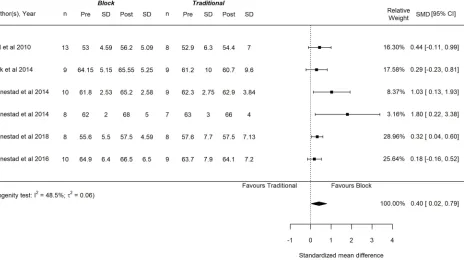
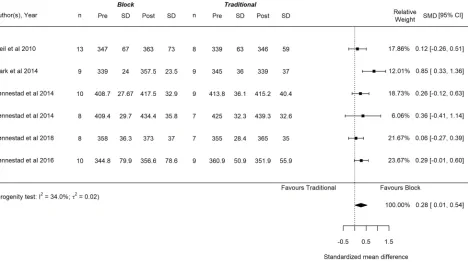
The VO2max and Wmax analyses comprised 107 subjects,
nested within 6 studies.Figures 2 and3show a summary
of the data and each study`s standardized mean difference as well as the pooled size.
Maximal oxygen uptake
The overall ES for VO2max of 0.40 (95% CI=0.02, 0.79)
shows a small favor for BP compared to TRAD and the
null hypothesis was rejected (t=2.7, p=0.04). The
predic-tion interval (95% CI=−0.32, 1.12) implied that the true
effect in 95% of study settings is uncertain. The T2=0.06
and I2=48.4% implies low-to-moderate variance among
the true effect.
Maximal power output
Wmax showed an overall ES of 0.28 (95% CI=0.01, 0.54) which elucidates a small favor of BP compared to TRAD
and the null hypothesis is rejected (t=2.6, p=0.04). The
prediction interval (95% CI=−0.18, 0.73) states that the
true effect in 95% of study settings is uncertain. The
T2=0.02 and I2=34.0% implies low-to-moderate variance
among the true effect.
Systematic review
Endurance performance was assessed in eight of the examined studies
Measures of closed-end cycling performances was
con-ducted in five studies11,12,17,19,29. Rønnestad et al11
observed an increased mean power output during 40 mins cycling in both groups (BP: 8.2±5.7%, TRAD: 4.1±3.1%). This revealed a moderate ES in favor of BP training com-pared to TRAD (ES=0.89), although the difference in
rela-tive changes between the two groups was not significant
(p=0.12). Wahl et al19did alsofind a superior mean power
output in 20 mins cycling performance after 2 weeks BP. Interestingly, the group that did passive recovery between high-intensity training (HIT) interval bouts tended to increase more than the group performing active recovery (passive recovery, +27±10 W; active recovery, +14±18 W;
p=0.09). A shorter block of 7 days with consecutive
max-imal intensity sprinting sessions did also augment time trial performance (computer-simulated 20 km) were long sprints
(15–45 s) gave the same improvement in mean power
out-put as shorter sprints (5–20 secs; +6.8±5.8% and +4.6
±4.4%, respectively),17 which was significantly different
Figure 2Forest plot of studies comparing the changes in maximal oxygen consumption (mL⋅min−1⋅kg−1) between block and traditional periodization training. The data
shown as standardized mean difference (SMD) are mean [95% CI]. Weight=statistical weight of each study.
Open Access Journal of Sports Medicine downloaded from https://www.dovepress.com/ by 118.70.13.36 on 26-Aug-2020
from the TRAD group (−3.3±4.2%; p<0.01, ES=0.67–
0.82). In the case study of Støren et al,29a 15%
improve-ment was evident on their ~23-km indoor-bike time trial. In contrast to this, time trial performance (600-m treadmill rollerski time trial at 6° gradient) was only improved after
TRAD of HIT (−3±5 s;p<0.05, ES=0.44) and not after BP
of HIT (−1±6 s) in cross-country skiers.12The changes were
however not statistically different between groups.
One study8 conducted a time-to-exhaustion test at a
workload corresponding to 90% of the athletes’
pre-inter-vention Wmax for evaluation of endurance performance. However, neither BP nor TRAD enhanced the
perfor-mance (p>0.05). On the other hand, 13 days of BP in
soccer players revealed a large improvement in Yo-Yo Intermittent Recovery Test Level 2 (from 407±43 m to
507±57 m, p<0.05; ES=1.92).26The same was evident in
Mallo et al’s25 seasonal monitoring (Yo-Yo Intermittent
Recovery Test Level 1, from 2037±264 m to 2676±255
m; p<0.01) and after a comparable BP intervention were
the players improved their maximal speed during the
30–15 Intermittent Fitness Test by 6.5±2.9% (p<0.001).27
Workloads at different exercise thresholds
Cyclists have revealed tendencies to greater improvements of
power output at 2 mmol·L−1lactate concentration following
both 422and 12 weeks11with BP. The 4-week intervention
gave a 10±12% increase in BP, while no changes were
observed in TRAD, with no statistically significant differences
between the groups, but the ES was in favor of BP (ES=0.71). For the 12-week study, the relative improvements were 22 ±14% and 10±7% for BP and TRAD, respectively. This revealed an even larger ES of BP compared to TRAD
(p=0.054; ES=1.12). In another study, a 1-week training
block enhanced power output at onset of blood lactate
accu-mulation with ~7% (ES=0.53–0.60) compared to
volume-matched TRAD, regardless if the block training was
per-formed as long or short sprints (p<0.05).17In a study
compar-ing BP with either passive or active recovery between HIT interval bouts only the group that did passive recovery
improved power output at second ventilatory threshold.19A
greater difference in change was also present compared to
active recovery (p<0.05; ES=0.52). In long-term case-studies,
58 and 17 weeks of BP revealed a 36% improvement in power
output at 3 mmol·L−1lactate concentration and 14% increase
in power output at lactate threshold, respectively.29,31BP and
TRAD were equally effective in improving paddling power at second ventilatory threshold (+10% vs +11%, respectively) in
rowers,9while in cross-country, skiers were BP superior to
TRAD in improving power output at 4 mmol·L−1lactate
con-centration (11±10% and 2±4%, respectively; p<0.01;
ES=1.26) after a 5-week training period.20
Figure 3Forest plot of studies comparing the changes in maximal power output (Wmax) between block and traditional periodization training. The data shown as
standardized mean difference (SMD) are mean [95% CI]. Weight=statistical weight of each study.
Open Access Journal of Sports Medicine downloaded from https://www.dovepress.com/ by 118.70.13.36 on 26-Aug-2020
Exercise efficiency and economy
Rønnestad et al11observed a non-significant improvement
in gross efficiency for their BP training group (from 20.3%
to 20.9%;p=0.12). The relative improvement corresponded
to a moderate ES in advantage of BP compared to TRAD training (ES=1.10; TRAD, from 19.6% to 19.5%). Quite
similar results were present in Clark et al17where none of
the groups changed gross efficiency significantly (p>0.05;
5.1±3.9%, 3.2±2.4% and 1.5±4.3% improvement for BP with long sprints, BP with short sprints and TRAD training, respectively). However, the relative improvement of gross
efficiency for short and long sprints revealed small to
mod-erate ESs compared to TRAD (ES=0.26 and 0.65,
respectively).17 Similarly, neither BP nor TRAD changed
skiing economy following 5 weeks of HIT-training,20
whereas McGawley et al,12 on the other hand, showed
improvement in skiing economy in TRAD only.
Discussion
The present study investigated the effects of BP on fac-tors determinative for endurance performance and endur-ance performendur-ance measurements based on systematic analyses of pooled data from the existing literature. The
meta-analyses revealed evidence for beneficial effects of
BP compared to TRAD regarding VO2max and Wmax in
trained athletes. Due to a lack of studies and heterogene-ity between the tests used to evaluate endurance
perfor-mance measures, workloads at different exercise
thresholds and exercise efficiency/economy,
meta-ana-lyses were not performed for these factors. However,
the vast majority of these data revealed either beneficial
or similar effects for BP compared to TRAD. The fi
nd-ings emphasize that BP, as defined in the present paper, is
an adequate, alternative strategy with potentially greater training effects than TRAD for trained to well-trained athletes. Nonetheless, the number of eligible studies are quite small (n=10) and they achieved only low-to-mod-erate PEDro scores. Some methodological considerations
when interpreting the efficacy of BP are therefore
impor-tant to address.
Meta-analysis of VO
2max and Wmax
The included studies in the meta-analyses comprised young
(25±7 years), trained athletes with average VO2max of
60±4 mL⋅min−1⋅kg−1and Wmax of 367±33 W. The
selec-tion of participants requires that several aspects need to be elucidated regarding the external validity of these results.
From an applied point of view, these results indicate that trained individuals, within a relatively short duration of time
(4.9 weeks average study length; range, 1–12 weeks) can
benefit from BP by a more efficient improvement of
VO2max and Wmax compared to TRAD. The pooled ES
of BP on VO2max was 0.40 (t=2.7,p=0.04) and Wmax was
0.28 (t=2.6, p=0.04). Although this per se is considered
small effects,40 this may actually be an important effect
considering that the athletes included in these analyses have performed a substantial training volume over a number of years before inclusion. For this reason, substantial
improvements are not commonly observed in this
population.41With this in mind, BP seems to be a beneficial
training strategy that successfully can enhance an athlete`s
VO2max and Wmax further, at least in the short term. BP
gave approximately the same ES for VO2max and Wmax,
which is quite reasonable since they are previously shown
to be closely related.42
The included studies were conducted in the
presea-son and lasted ≤12 weeks. Therefore, the effect of BP
during the competitive season or in the longer term is not adequately explored. Nonetheless, some evidence is
available for a beneficial effect of BP training also in a
long-term perspective. Two single-case studies of elite
cyclists revealed an increased VO2max and Wmax of
10–20% following 58 and 17 weeks of BP performed
in training cycles of ~1–2 weeks.29,31 However, a
female elite cross-country skier, who trained two sea-sons with either a BP or TRAD focus, showed no difference in the number of World Cup victories or ranking, indicating successful utilization of both
train-ing models.32The latter is not surprising since years of
TRAD is a well-established and efficient training
strat-egy to enhance performance, as previously shown in
case studies.43,44 Two studies have also compared the
effects of BP and TRAD in two consecutive seasons with a cross-over design. Both of these showed a favor of BP in terms of similar or greater increases in
VO2max with either a volume-matched approach28 or
with performing fewer sessions and a shorter training
intervention9 compared to TRAD in elite kayakers and
handball players, respectively. These findings indicate
that BP can be an alternative to TRAD for elite athletes also in a longer training perspective, even though gen-eral methodological weaknesses regarding single-case studies must be considered.
Open Access Journal of Sports Medicine downloaded from https://www.dovepress.com/ by 118.70.13.36 on 26-Aug-2020
Endurance performance
Clark et al17 is the only study that observed a statistical
improvement after BP compared to TRAD. The positive effects observed in the other studies have either been stated
as non-significant superior improvements for BP11or have
lacked an appropriate control group to evaluate interaction
effects.19 Accordingly, no interaction effects between BP
and TRAD were either evidenced for a 600-m cross-country
skiing time trial12or a time to exhaustion test in cycling.8
Conversely, large improvements have been observed in endurance performance following 13 and 17 days of BP in soccer and tennis players measured as increased distance
covered in Yo-Yo-test and speed at 30–15 test.26,27 There
have also been shown improved time during a 23 km time
trial in an elite cyclist following a year using BP.29 In
addition, Mallo25displayed an increased Yo-Yo-test
perfor-mance after a 44-week season following a BP program in professional soccer players. However, all these latter results must be considered with caution due to the lack of control
groups25–27and the use of case-study design.29These
some-what inconsistentfindings in endurance performance make
it a bit more difficult to interpret the implications of BP.
However, the ESs in the studies have generally shown moderate to large effects of BP vs TRAD on endurance
performance11,17,19,25,26 although one has shown a small
positive effect of TRAD.12 Overall, independent of sport
discipline or performance assessment, it is pretty consistent that BP seems to improve rather than impair endurance performance.
Workloads at different exercise
thresholds, exercise ef
fi
ciency and
economy
BP and TRAD increased power output at a definite
exercise threshold in all included studies, except for
the TRAD group in Rønnestad et al.22 Improvements
were larger for BP compared to TRAD in cyclists17 and
cross-country skiers20 at onset of blood lactate
accumu-lation. In contrast, equal improvements of power output
at a definite exercise threshold have been observed in
kayakers,9 whereas one study observed a tendency in
favor of BP11 and another study observed a
within-change for BP, but not for TRAD and no significant
change between groups.22 Again, implication of BP is
divergent. Interestingly, Garcia-Pallarés et al9 trained
approximately half of the volume in BP compared to TRAD (12 vs 22 weeks) and increased power output at
second ventilatory threshold to the same extent. This can support the feasibility of concentrated stimuli for enhancing exercise threshold, in addition to the general
moderate to large ESs in favor of BP.11,17,20,22
Moreover, considering the case-studies with their limita-tions, long-term effect of BP shows substantial improve-ments of 14% and 36% in exercise threshold power
output.29,31 When it comes to exercise efficiency and
economy, there are too few studies to make a discussion of them. Furthermore, taken the relatively short inter-vention period in the included studies and the high training status of the athletes, non or only minor
changes in this variable would be expected.45–47
To BP, or not to BP
The somewhat divergent results reviewed in this paper and the uncertainty with statistical models complicate
the interpretation of the efficacy of BP. We suggest that
BP should be considered in a holistic perspective, mean-ing that trainmean-ing history, trainmean-ing goals and everyday life situation among other factors should be evaluated before BP is integrated as a part of an athlete training program. There is consensus among researchers that variation and progression in training stimulus is necessary to augment physiological adaptations and to continuously develop
endurance performance.44 In this context might both
Issurin’s and the alternative model of BP display an
advantage; TRAD induces smaller variations between mesocycles/microcycles than BP. However, within a microcycle/mesocycle TRAD will induce larger varia-tions than BP. In response to this, the highly
concentra-tion of specific training in BP seems to be an advantage
for inducing adaptations in well-trained athletes.
Nevertheless, whether the enhancement of VO2max,
Wmax or endurance performance is related to changes
in training stimulus or BP per se is still difficult to
elucidate. Rønnestad et al20 tried to accommodate this
question by implementing variations of HIT stimuli (two and three sessions per week) within a mesocycle of TRAD. In this volume-matched HIT and low-intensity training design, BP was superior in developing Wmax
and power output corresponding to 4 mmol·L−1 blood
lactate concentration.
Regardless of whether the superior training effects of BP are related to BP itself or just a variation in stimuli, they both are closely intertwined. Training variation in the long-term planning is systematically applied in both the
BP and TRAD model.6So, in the long-term training plan
Open Access Journal of Sports Medicine downloaded from https://www.dovepress.com/ by 118.70.13.36 on 26-Aug-2020
both models aim to dynamically balance training with the purpose of avoiding dilution of training effects and the
negative effects of monotony.5,6Therefore, in the lack of
an universally accepted definition of periodization,6 it
might in some cases be difficult to distinguish between
the two distinct models since they both are using some sort of variation in the organization of (long-term) training. The included studies are generally characterized by
intro-duction of specific block(s) subsequent to a period with
TRAD. This might just be a way of manipulating training to achieve a variation in training stimuli to optimize endur-ance improvements within the annual periodization plan. However, the long-term effects of this organization may not directly be answered by the relatively short-term stu-dies conducted so far in the literature. The direction of future research should be emphasized to investigate the long-term effects of several blocks throughout a whole season, compared to the TRAD model, on performance, physiological and biological performance determinants.
The cross-over- and case-studies included have
gener-ally implemented multitargeted BP programs.9,23–25,28,31
They are characterized by a prolonged nature, conducted over one training season or consecutive seasons. We should not underrate these study designs since these stu-dies demonstrate greater ecological validity due to a more real-world setting. These studies have mainly employed
the Issurin model of BP with three specific mesocycles;
accumulation, transmutation and realization, whereby a minimum of different physiological abilities, eg, Wmax
and maximal muscle strength,9 have been focused in a
particular mesocycle. This is to a certain extent different
to the alternative BP model were a specific ability is
focused (ie, VO2max) in each microcycle, while other
abilities are maintained (ie, muscular strength) with
typi-cally one session.11,21 Independent of the two BP models
the existing evidence displays that both models are
suc-cessful promotors of training adaptations and efficient
training strategies both for team and individual sports, although the effect in team sports is less explored.
Overall, the reviewed studies displayed low to med-ium quality according to the PEDro scale. More or less all studies are at a higher risk of bias, mostly because of lack of blinding of testers and specifying randomization (Table 2). Furthermore, all except two studies8,17did not provide eligibility criteria for the study participants. It may therefore be a question whether selection bias has
occurred. In addition, the definite direction of the effects
and the magnitude of such training have to be inter-preted with some caution when considering the 95% prediction interval in the meta-analyses. The prediction interval, which addresses the actual dispersion of the
true ES48 is again wider for VO2max (95% CI=−0.32,
1.12) as compared to Wmax (95% CI=−0.18, 0.73).
Both prediction intervals overlap coverage of the
con-fidence intervals for the point estimates, which suggests
that the true effect might fall beyond the confidence
intervals for each respective point estimate and therefore reveals an uncertainty for the true effect of BP.
Regarding the small number of available data used in the meta-analyses, the estimated between-study variance can be particularly inaccurate. We controlled for this
factor by using the Knapp and Hartung adjustment36
together with the Paule–Mandel heterogeneity estimator,
which are suggested to be more robust and produce less
bias when sample size and study number is low.37,38
Heterogeneity scores for both models showed
low-to-moderate heterogeneity considering the I2and T2scores
(Figures 2 and 3), which implies that the models are
valid.37 It is also important to examine the potential for
publication bias. According to Sterne et al,49
interpreta-tion of a funnel plot asymmetry should not be empha-sized when there are <10 studies in a meta-analysis due
to a lack of test power making it difficult to distinguish
chance (ie, false positivefindings) from real asymmetry.
To accommodate the concern of asymmetry both a
fixed- and random-effect model was fitted for both
VO2max and Wmax, indicating the same magnitude of
the effects between the models.
Conclusion
Irrespective of the BP models used, the meta-analyses
showed favorable effects of BP for VO2max and Wmax,
and the consistency in moderate-to-large ESs displayed for both workload at different exercise thresholds and endurance performance measurements in BP suggests also superior adaptations compared to TRAD. In gen-eral, these results seem promising, but since majority of the reviewed studies are small and of low methodologi-cal quality, the results must be considered with this in mind.
Disclosure
The authors report no conflicts of interest in this work.
Open Access Journal of Sports Medicine downloaded from https://www.dovepress.com/ by 118.70.13.36 on 26-Aug-2020