Adaptation and Analogical Problem Solving
Stephen A. Hunt
September 1997
All rights reserved
INFORMATION TO ALL USERS
The quality of this reproduction is dependent upon the quality of the copy submitted. In the unlikely event that the author did not send a complete manuscript and there are missing pages, these will be noted. Also, if material had to be removed,
a note will indicate the deletion.
uest.
ProQuest U642982
Published by ProQuest LLC(2015). Copyright of the Dissertation is held by the Author. All rights reserved.
This work is protected against unauthorized copying under Title 17, United States Code. Microform Edition © ProQuest LLC.
ProQuest LLC
789 East Eisenhower Parkway P.O. Box 1346
Analogical problem solving is the mapping of the conceptual structure of one set of ideas - the source knowledge domain - onto another set of ideas - the target knowledge domain. Mapping is composed of both the matching of elements - objects and their causal relations - in the source with elements in the target, and the transferring of further causal relations from the source to the target. The target domain is taken to constitute a problem, and the causal relations transferred a solution plan for that target problem. This thesis examines adaptation and analogical problem solving, both how putative solutions are verified as being relevant or valid, and how putative solutions which fail to verify as valid are adapted to render them valid.
Experiments 1- 5 are concerned with an analytic account of verification and adaptation. They are designed to determine Wiat is necessary to both verify A ether a solution plan is valid and to adapt a failed solution plan to render it valid. Experiments 6 - 9 are concerned with a behavioural account of adaptation. They are designed to determine how an individual actually adapts a failed solution plan to render it valid.
I would like to acknowledge the help of the following in the preparation of this thesis:
Title Page page 1 Abstract...page 2 Acknowledgements... page 3
Table of Content page 4
List of Tables and Figures : Tables page 9
List of Tables and Figures: Figures...page 12
Chapter One: Introduction.
1.1 Aims of the Research page 13
1.2 Nature of Problems page 16
1.2.1 Constitution of Problems...page 16
1.2.2 Problem Types page 17
1.3 Nature of Analogy...page 18 1.3.1 Centner's Definition of Analogy... page 18 1.3.2 Critical Evaluation of Centner's Definition... page 20 1.3.3 Speedi Acts Analysis of an Analogy...page 20 1.3.4 Analogy: A Definition...page 22
1.4 Analogical Problem Solving page 22
1.4.1 Mental Models account of Analogical Problem Solving page 23
1.5 Verification and Adaptation page 29
1.5.1 Verification... page 29 1.5.2 Adaptation... page 31
2.1 Introduction... page 37 2.2 Theoretical Status of Theories of Analogical Problem Solving...page 37 2.3 Structure-Moping Theory... page 40 2.3.1 Introduction... page 40
2.3.2 Structure-Mapping Theory page 40
2.3.3 Empirical Evidence for the Structure-Mapping Theory...page 41 2.3.4 Critical Evaluation of the Structure-Mapping Theory page 42 2.4 Pragmatic Theory...page 44 2.4.1 Introduction... page 44 2.4.2 Pragmatic Theory and Constraints Satisfaction page 45 2.4.3 Empirical Evidence for the Pragmatic Theory... page 47 2.4.4 Critical Evaluation of the Pragmatic Theory... page 48 2.5 Incremental Analogy Theory... page 50 2.5.1 Introduction... page 50 2.5.2 Process of Incremental Analogizing page 50 2.5.3 Empirical Evidence for the Pragmatic Theory page 53 2.5.4 Critical Evaluation of the Incremental Analogy Theory page 54 2.6 Case-Based Reasoning... page 56
2.6.1 Introduction page 56
2.6.2 Case-based Reasoning and Adaptation page 57
3.1 Experiment 1 page 66 3.1.1 Introduction... page 66
3.1.2 Method. page 69
3.1.3 Results...page 72 3.1.4 Discussion...page 75
3.2 Experiment 2 page 78
3.2.1 Introduction... page 78
3.2.2 Method. page 81
3.2.3 Results...page 83 3.2.4 Discussion... page 86
3.3 Summary of Chapter Three page 89
Chapter Four: Operations of Adaptation
4.1 Experiment 3 page 90
4.1.1 Introduction... page 90
4.1.2 Method page 94
4.1.3 Results...page 97 4.1.4 Discussion... page 98 4Jl Experiment 4...page 102
4.2.1 Introduction... page 102
4.2.2 Method page 108
4.3.1 Introduction page 122
4.1.2 Method. page 125
4.1.3 Results page 127
4.1.4 Discussion page 128
4.4 Summary of Chapter Four page 131
Chapter Five: Comparison of Operations of Adaptation
5.1 Experiment 6 page 132
5.1.1 Introduction page 132
5.1.2 Method. page 136
5.1.3 Results page 139
5.1.4 Discussion page 144
5.2 Experiment 7 page 149
5.2.1 Introduction page 149
5.2.2 Method. page 151
5.2.3 Results page 152
5.2.4 Discussion page 157
5.3 Summary of Chapter Five... page 160
Chapter Six: Effort and Adaptation
General Discussion...page 178
References... page 190
Appendices
Appendix A: Materials from Experiment 1... page 200 Appendix B: Materials from E?q)eriment 2... page 206 Appendix C: Materials from Experiment 3... page 209
Appendix D: Materials from E?q)eriment 4 page 212
Appendix E: Materials from Experimoit 5... page 218 Appendix F: Materials from Experiment 6... page 220
Appendix G: Materials from Experiment 7 page 224
Appendix H: Materials from Experiment 8 page 225
Tables
Chapter One: Introduction
Table 1.1.1 Introductian: Solar System and Atom Analogy (from Eysenck & Keane, 1991)....page 13
Chapter Two: Literature Review
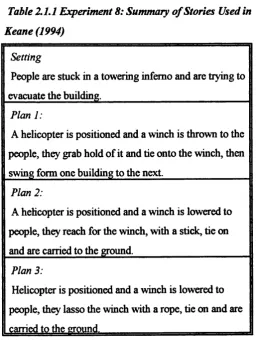
Table 2.1.1 Literature Review : Summary of Stories Used in Keane (1994)...page 23
Chapter Three
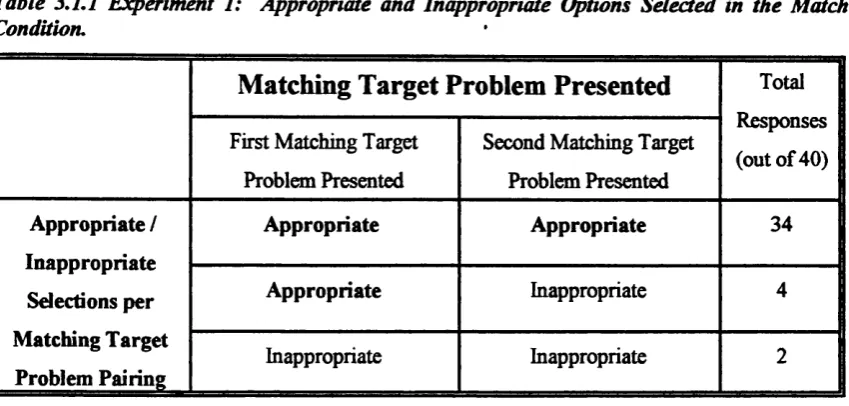
Table 3.1.1 Experiment 1 : Appropriate and Inappropriate Options Selected in the Match Condition. ... page 72
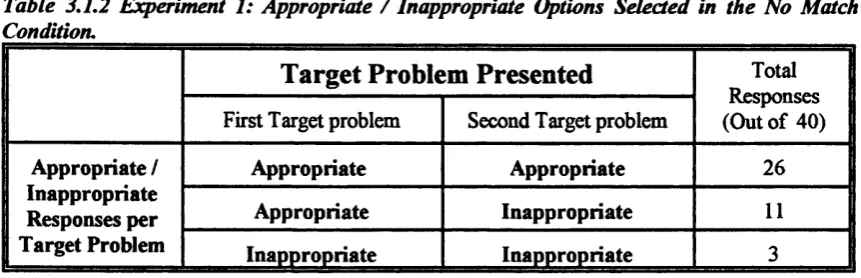
Table 3.1.2 Experiment 1 : Appropriate / Inappropriate Options Selected in the No Match Condition. ... page 73
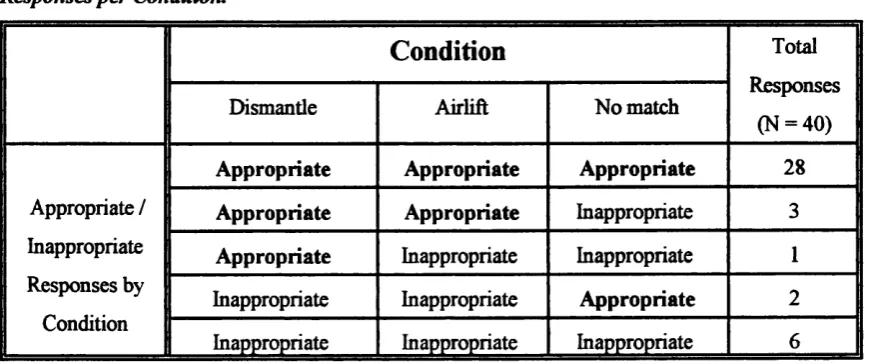
Table 3.2.1 Experiment 2: Total Numbers of Participants Advancing Appropriate / Inappropriate Responses per Condition... page 83
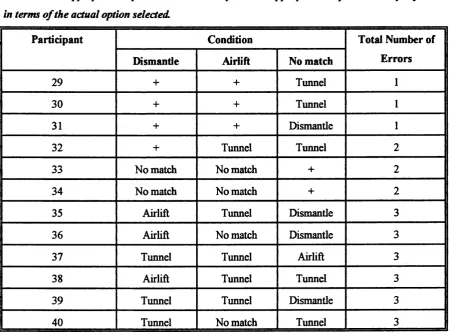
Table 3.2.2 E?q)eriment 2: Error Type and Total Number of Errors Per Participant for All Conditions. ... page 84 Chapter Four
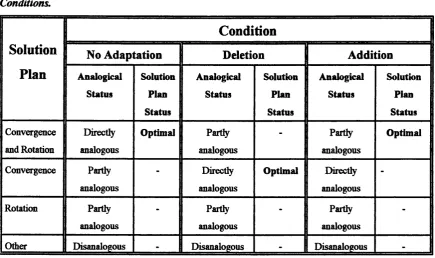
Table 4.1.1 Experiment 3: Status of Solution Plans for the No Adaptation, Deletion and Addition Conditions... page 96
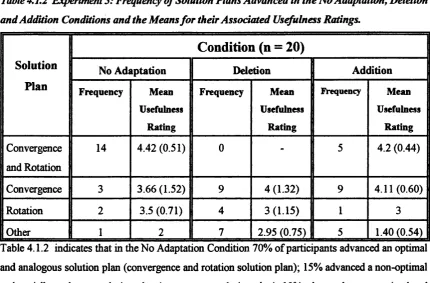
Table 4.1.2 Experiment 3: Frequency of Solution Plans Advanced in the No Adaptation, Deletion and Addition Cœditicms and the Means Ry their Associated Usefulness Ratings... page 97
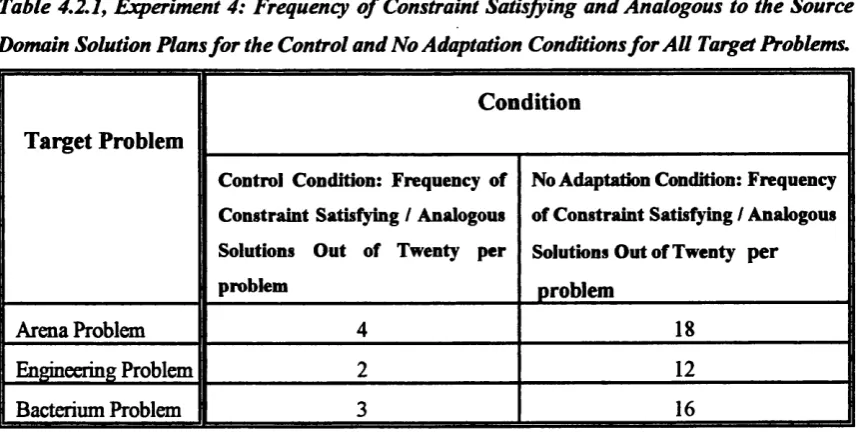
Table 4.2.1, Experiment 4: Frequency of Constraint Satisfying and Analogous to the Source Domain Solution Plans for the Control and No Adq)tation Conditions for All Target Problems... page 110
Solution Plans Advanced For Eadi Conditim for Eadi Problem Type page 112
Table 4.2.4, ETqjcriment 4: Mean Usefulness’ Ratings for the 19 Participants who Advanced Constraint Satisfying and Analogous to the Source Domain Solution Plans in All Conditions page 113
Table 4.2.5, Experiment 4: Arena Problem: Frequency of Solution Plans Advanced in the No Adaptation, Deletion and Addition Conditions and the Means for their Associated Usefulness Ratings. page 114
Table 4.2.6, Experiment 4: Engineering Problem: Frequency of Solution Plans Advanced in the No Adq)tation, Deletion and Addition Conditions and the Means for their Asscxiated Usefulness Ratings. page 116
Table 4.2.7 Experiment 4, Bacterium Problem: Frequency of Solution Plans Advanced in the No Ad^tation, Deletion and Addition Conditions and the Means fw their Asscxiated Usefulness Ratings. page 117
Table 4.3.1 Experiment 5: Status of the Solution Plans in the No Adaptation and Substitution Conditions...page 126
Table 4.3.2 Experiment 5: Frequency of Solution Plans Advanced in the No Adaptation and Substitution Conditions and the Means for their Asscxiated Usefulness Ratings... page 127
Chapter Five
Table 5.1.1 E^qxriment 6: Frequencies of Matches Made Between World War II and Gulf War Items for All Conditions...page 139
Table 5.1.2 Experiment 6: Means for ‘Total Response Times’ (in seconds) for All Conditicxis... page 140
; Conditions...page 143
Table 5.2.1 Experiment 7 : Frequencies of Matches Made Between World War H and Gulf War Items
for All Conditions page 152
Table 5.2.2 Experiment 7: The Means for the ‘Total Response Times’ (in seconds) for All Conditions ... page 153
Table 5.2.3 Experiment 7: The Means for ‘Start Times’ (in seconds) for All Conditions ... page 155
Table 5.2.4 Experiment 7: The Means for ‘Total Response Times Minus Start Times’ (in seconds)
for AllC(xiditi(xis page 156
Chapter Six
Table 6.1.1 Bqimmait 8: Frequency of Source Analogues Selected for All Conditions page 166 Table 6.1.2 Experiment 8;Frequency of Solution Plans as Written Answers for All Conditions...page 167
Table 6.2.1 &q)mment 9: Categorisation of Solution Plans for All Conditions page 173
Table 6.2.2: E?q)enment 9: Frequencies of Convergence Solution Against Other Solution Types for All
Cmdrtims page 174
Introduction
1.1 Aims of the Research
This thesis examines how analogically derived solutions are produced for specific problems. The
principal goals of the thesis are to investigate how analogical solution plans to given problems are
verified as valid, and how solution plans which fail to verify as valid are adapted in order to render
them valid. That is, to describe the psychological processes involved in the verification and
adaptation o f putative solutions in the context of analogical problem solving. A simple example o f
an analogy is given in Figure 1.
Figure 1 Introduction: H itler -Saddam Analogy.
TERROR: Hundreds of Kurds died from poison gas
desert
By MARK DOWDNEY Foreign Editor
N
t h e t o w e r in g o t h in g d en ts eg o of Saddam H ussein. And nothing“pleasure palaces” since the Gulf War. In his home town of Tikrit. he has created no less than 13 palaces, linked to a lake created by diverting water from the Tigris River.
One palace is four times the size of the White House.
The analogy drawn in Figure 1 wcxks by establishing a match between the two individuals. This match is made firstly in terms of the relations they have with their respective countries both being ruthless dictators. Secondly, the relations they have to neighbouring countries - to which they both had expansionist designs. Once the match has been estabhshed it is possible to apply the analogy in a pioblon solving context Determining how to respond to Saddam’s invasion of Kuwait, for example, might involve identifying the sequence of actions which were used to respond to Hitler’s aggression and transferring them fi"om the context of World War H to that of the Gulf region 1991. The combination of matching and transferring across knowledge domains is termed "analogical mapping’. The use of analogy to solve problems occurs in many diverse areas, such as scientific research (Oppenheimer, 1956), foreign pohcy decision making (Houghton, 1996), and education (Carey, 1986; Lewis, 1989; Reed 1989). A capacity to reason analogically has also been treated as an indicator of intelhgoice (Bejar et a l, 1991). While use of analogy has also been linked to creativity (Maier 1970; Popper 1987).
Psychological researdi into analogical problem solving has been, hitherto, largely concerned with how potential source analogues are accessed (e.g. Gick & Holyoak, 1983) and how analogical mapping is effected between source and target domains (Gentner, 1983; Holyoak, 1985; Keane, 1988a; 1988b). This research has produced a number of valuable findings and as a result three distinct models of analogical mapping have been developed: the Structure-Mapping theory (Gentner, 1989), the Pragmatic theory (Holyoak & Thagard, 1989) and the Incremental Analogy theory (Keane, 1990a). Recently it has becxxne ^parent that analogical mapping, while necessary for successful analogical problem solving, is not itself sufficient to account for problem solving performance in many instances (Novick & Holyoak, 1991).
been assumed to be the automatic consequence of successful mapping. Consequently, neither process has been subject to any sustained research in their own right (Keane, 1993).
VerificatioQ stands as a precursor to the process of adaptation. It is a failure to verify a putative solution procedure as vahd that triggers ad^tation. Verification as a stage in analogical problem solving has not gone unrecognised, and has been expHcitly incorporated into at least one model of analogical problon solving (Keane, 1990a). HowevCT, the process itself has received little research in its own right (Keane, 1993). Consequently, the paucify of research concerning the process of verification alhed to the fact that verification is intimately bound up with adaptation, necessitates its investigation.
Adaptation has recently been recognised as a conceptual process distinct from mapping. Novick & Holyoak (1991) state ‘we agree that mapping is necessary for transfer but disagree that it is sufficient. Even with a successful mapping, difhculty in ad^ting the source solution procedure to work for the target problem may impede transfer’.
In sum it is proposed that the adaptation of a solution procedure involves mental operations that do not fall under the rubric of analogical mapping. Consequently, without an account of adaptation any model of analogical problem solving will stand as incomplete with respect to people’s actual problem solving performance (Keane, 1994/1996). It is this fact that provides the rationale for investigating adaptation in the present work.
The experiments in this thesis thus attempt to be more explicit about the nature of verification and adaptation than has previously been the case. In so doing the research is intended to contribute to a more complete understanding of the process of analogical problem solving as a whole.
1.2 Nature o f Problems
In dealing with any issue associated with human problem solving it is first necessary to define wbat counts as a problem.
1.2.1 Constitution o f Problems'.
A problan exists when there exists a "desired" state which is at variance with the present state and it is at least theoretically possible to realise the desired state. Otherwise, the putative problem must be counted as fictitious (Ayer, 1978). Further, a problem only exists where there is no automatic process of percqrtiœ (x recognitiœ via which the desired state be brought about (Glass & Holyoak, 1986). That is, there must exist some form of impediment to immediately rendering the desired state an actuality; without such what obtains is a non-problem (Gilhooly, 1989).
The above criterim is intended to be uncontentious and have a universal application. It amounts to no mcxe than an analytic definitim of those occasions on which a problem exists; as such it features in the work of several authors cœcemed with issues relating to problem solving (e.g. Glass & Holyoak, 1986; Kahney, 1986; Gilhooly, 1989). Having thus provided a description of those situations in which problems can be legitimately considered to occur it is now important to give an account of those elements which, when taken together, constitute a problem (Holyoak, 1990).
The identity of elements which make up any given problem can be accounted for in general terms; examples will accompany the description of each of the elements. In order for a problem to exist the following constituent elements must themselves obtain:
An initial state: this is simply the point at which a desired state - here after ‘goal state' - is conceived of and where the problem solving process, if it is to be undertaken at all, is initiated. Examples of such initial states are: a situation in which an individual is suffering fi-om hunger, or when someone has begun a game of chess.
effect such a transformation in a single stage. Thus, in an attenq)t to solve a problem various sub-goals may be identified; a sub-goal stands as de facto goal state, the realization of which is designed to advance the individual towards the realization of the final goal state. With reference to the examples, in an effort to satisfy hunger one could begin by examining the contents of a fiidge; this task then stands as a sub-goal and the actions involved in its realization the operators. When engaged in a chess match the set of operators would be more cleaify defined, namely the set of legal moves available at any given stage of the match. A sub goal m ^ then be to castle as swiftly as possible.
Set of constraints: these are the additional conditions concerning which path to the goal state is appropriate or legitimate. Obtaining food honestly could be considered a constraint. In chess a path constraint is often imposed in the form of a time limit on each player.
The broad anafysis of the notion of a ‘problem’ offered above should apply to all problems regardless of their nature. However, it is important to note that there exists a distinction between two problem types.
1.2.2 Problem Types
Throughout much of the Uterature concerned with problem solving an important distinction is drawn betweoi two problem types, viz. well-defined problems, and ill-defined problems (e.g. Reitman, 1964). Essentially well-defined problems are those problems in which the constituent elements - e.g. goal state, operators - are precisely specified. The constituent elements of such problems are then, theoretically, open to an exhaustive description by the individual before any goal state is realized.
Well-defined problems themselves are most fi*equently found in the formal sciences or in the form of deliberately constructed pass-times or games (Gilhooly, 1989; Chamess, 1991). A chess problem is a prime exanq)le of a well-defined problem: its operators, the possible moves the pieces can make, the initial state and final goal state are all precisely prescribed, and those individuals, or even computers, who can play chess must be famihar with these prescriptions.
certain your car doesn't start yet have no idea about how directly to rectify this. In this case the individual has httle conception of what the relevant operators are, vdiere as a mechanic should. In the case of axistraints, hx example, a bomb disposal expert may be attempting to dispose of a time bomb but have no idea when it is due to explode, so having no idea of the time period he has to woih in.
Alternatively the ^incompleteness^ could consist of a hmdamental absence or unavailabihty of informati(Xi. It would, fOT exan^le, be difficult for anyone, novice or expert, to design a computer that could respond like a human in all eventuahties. As the above examples suggest, incompleteness is part of real world problems: we caimot always know all that might be relevant.
In summary, all problems consist in an initial state, a goal state, a set of operators, and a set of constraints. Problems can be distinguished as being either well defined or ill defined \ depending on the degree to which their constituent elements are specified. Having thus defined the term ‘problem", the term ‘analogy’ will now be considered.
1.3 Nature o f Analogy
This section is concerned with specifying a cogent definition of the term ‘analogy’ - in the sense of natural language-based analogy - as this is a key term in the present work and occurs fi*equently throughout it. This will begin with an examination of the definition of analogy formulated by Gentner (specifically Gentner, 1989).
1.3.1 Centner's Definition of Analogy
Gentner identifies four distinct kinds or types of similarity which can obtain between two separate knowledge domains: mere appearance; relational abstraction; literal similarity; and analogy. In each case the same basic process takes place: knowledge is matched from one domain - the base domain - to another - the target domain. The differences which exist between the types of similarity consist in
1
the items that are matched between the two domains. However, it is first necessary to outline briefly Centner's representational assumptions. Gentner holds that mental representation consists in the configuration of four types of representational constructs: entities which stand for objects and three types of predicate: Object attributes are defined as those predicates which take only one argument, e.g. "Red (x)'. Object relations are those predicates which take two or more argumoits as their relations, e.g. "Louder (a,b)'. Object relations themselves can be fiuther divided between first-order predicates ^diich take objects as their arguments, e.g. 'Ignites (x,y)' and second order predicates which take propositions as their arguments, e.g. 'Cause [Ignites (x,y) Bums (y,z)]'.
Mere appearances matches: These occur when only the object attributes between two domains can be matched. These matches are described by Gentner as ‘in a sense the opposite of analogies' (Gentner,
1989), and are considered to be of limited utihty, e.g. the cloud looks like a face.
Relational abstraction: In such cases only the relational structure between two domains is matched. This is the case when the source or base domain consists only of abstract information, consequently there are no concrete properties to match, e.g. heat is a through vector.
Literal similarity: This form of similarity obtains when the relational predicates and the object attributes fi’om the two domains are matched, e.g. priests are like Rabbis.
Analogy: This occurs Wien only the relaticmal predicates between two domains are matched no matter how much more additional information inheres in either domain, e.g. the moon is like a magnet. It is worth quoting Gentner's definition as it is a remarkably austere one, not to say singular:
an analogy is a way of focusing on relational commonalties independently of the objects in which those relations are embedded...Objects are placed in correspondence in virtue of their like roles in the common relational structure; there does not need to be any resemblance between the target objects and their corresponding base objects. (Gentner, 1989).
Gentner also states ‘If the base representation includes concrete objects whose individual attributes must be left behind then the comparison is an analogy.'(f6;(/)(Itahcs mine).
examination of a particular use of an analogy will be made in order to determine whether Gentner's definition coheres with the common usage of that term. This is the subject of the following section.
13.2 Critical Evaluation of Centner s Definition
Ordinary language usage of the term ‘analogy’ suggests that an analogy can be described as holding betweoi two domains vèen salient instances of both their relational predicates and object attributes are matched.
This, as yet aitirely unsubstantiated claim about the common usage of the term ‘analogy’, is itself no reason to reject Gentner's definition. Yet Ariiile Gentner’s definition is stipulated there is no accompanying justification for its universal adoption. Consequently, there exists no compelling a priori reason to accept uncritically Gentner's definition. Yet to reject it requires the identification of at least one instance of a similarity drawn between two knowledge domains, which would ordinarily, and unequivocally, be described as an instance of an analogy, that does not conform to Gentner's definition. Such an instance is considered in the next section.
1 3 3 Speech Acts Analysis of an Analogy
The role of analogy in problem solving is Gentner's principal concern. However, analogies are employed fcff a wide variety of purposes, such as: apportioning praise or blame, drawing attention to exemplary or reprchaisible bdiaviour, and making compliments or insults. A specific instance of the final category will be considered in the remainder of this section, namely making an insult.
Speaking of Margaret Thatcho-'s final year in ofQce Nigel Lawson was quoted as stating ‘She was, very much, in her bunker’ (Lawson, 1993). This statement was not literally true of Margaret Thatcher; ratho" it served to suggest to the listening public her prevailing attitude to govenunent during her final period in office. Nigel Lawson, in uttering the phrase was not (just) reporting something, he was also insulting Margaret Thatcher. This, in Austin’s (1986) terminology, is a performative act.
This state<of-aSairs does invite coii^)arison with an abstract object located in a defensible area, the better to ward off hostile forces. This abstract knowledge domain could be derived from concrete knowledge an individual might have about the properties and purposes of bunkers in general.
While efrecting such a comparison certainly casts Margaret Thatcher in an unflattering hght, drawing such a comparison is not the intended effect of Lawson's utterance. In fact Lawson's insult consisted in the implicit comparism of Margaret Thatcher to a specific individual who actually so u ^ t refuge in a now infamous bunker, namely Adolph Hitler. Here is a knowledge domain whose relational properties can be compared with those belonging to the domain concerning Margaret Thatcher. Gentner would treat this as an analogy.
However, simply matching the relational properties inherent in the two specified domains would constitute no more of an insult than the comparison of Margaret Thatcher's position to that of the individual in the abstract domain. In order for Lawson's utterance to achieve its effects - i.e. for the listener to appreciate the nature of the insult - it is not enough for the listener to match the corresponding relational features between the Thatcher and Hitler domains. In this case objects and object attributes must also be matched, e.g. the persons Hitler and Thatcher must be matched, as well as personahty traits, such as stubbornness and a dictatorial approach to government.
This form of similarity under Gentner's analysis counts, not as analogy, but as an instance of hteral similarity. Yet this is a wholly inappropriate description. It amounts to holding that the relative positions of Margaret Thatcher in the closing months of her period in office and Adolph Hitler's final months in power were hterally similar, a description which is clearly not the case: Hitler was hterally in his bunker, Margaret Thatcher was not.
13.4 Analogy: A Definition
Keane supplies an alternative definition of analogy wliich is broad enough to capture common ascriptions of analogy as well as those instances captured by Gentner's definition. ^
An Analogy is the product of certain cognitive processes in which specific coherent aspects (Le. causally-mtegrated aspects) of the conceptual structure of one domain are matched or transferred into another demain in the transfer of these specific conceptual aspects, relations will tend to be iroportant, although attributes may also be important. (Keane, 1988a.)
This definition of analogy will then be adhered to throughout the present work, unless specifically stated otherwise. The definition introduces the notions of matching elements between domains, and the transfer of elements between domains These two processes comprise analogical problem solving itself^ which is considered in the following section.
1.4 Analogical Problem Solving
Analogical problem solving can be characterised as being the mapping of the conceptual structure of one set of ideas -the source domain- onto another set of ideas -the target domain (Eysenck & Keane,
1991). This process was introduced informally when considering Figure 1. More specifically, in problem solving the target domain is taken to constitute a problem, and information mapped from the source domain to the target is constitutive of a solution to the target problem. The process of analogical mapping consists of two basic operations, matching and transferring.
Matching: This involves idmtifying similarities between known elements in both the source and target domain, and then matching them. That is, holding them in correspondence.
Transferring: This process typically involves relations that obtain between the elements in the source domain being transferred to the target domain. This process occurs in the absence of matching, i.e. it completes the areas of missing information in the target domain.
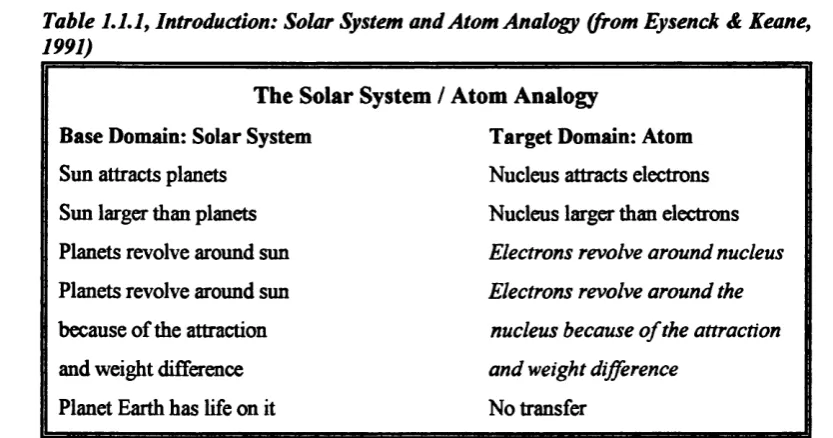
Table L l.l , Introduction: Solar System and Atom Analogy (from Eysenck & Keane, 1991)
The Solar System / Atom Analogy
Base Domain: Solar System Target Domain: Atom
Sun attracts planets Nucleus attracts electrons Sun larger than planets Nucleus larger than electrons Planets revolve around sun Electrons revolve around nucleus Planets revolve around sun Electrons revolve around the because of the attraction nucleus because o f the attraction and weight diff^ence and weight difference
Planet Earth has life on it No transfer
The description of analogical problem solving outlined above is not intended to be contentious or specific to a particular theory: such details as are given are equally true for each of the theories, specifically the Structure-Mapping theoiy (Gentner, 1989), the Pragmatic theory (Holyoak & Thagard, 1989) and the Incremental Analogy thecxy (Keane, 1990a), although the manner in which the mapping is reputed to be effected does differ according to particular theories. The three theories are considered in the next chapter. The immediately following section provides an account of analogical mapping within the genial fi^mework of mental models, in wder to give the process a psychological grounding.
1.4.1 Mental Models account of Analogical Problem Solving
The purpose of this section is to place the process of analogical problem solving in the context of a specifically psychological theory of information processing, namely mental models. Mental models theory, in this context, is associated with Gentner & Gentner (1983) Holyoak (1884a; 1984b) and Holland, et al. (1989), although the notion of metal models has a relatively long history.
Maital models in genial will rarely feature sufficient elements to map one-to-one with all elements in the environment That is, th ^ will seldom be isomorphic with the environment. Rather, the model will stand as a simplified representation of the environment, rich enough in detail to realise specific goals. Simplified models are realised by reducing the number of elements in the environment which require specific representation.
All elements of the environment sharing given properties can be represented as members of a single category, and all members of each category can be treated as indistinguishable. So all elements in the environment which share given properties can be treated as belonging to a single category. This process of categorisation is effected by the apphcation of mapping functions, conditional rules which group elements of the environmait together according to their properties and determine their membership of particular categories, for example: 'If an object is large grey and has a trunk then it is an elephant’. In Holland et al. ’s (1986) terminology mapping functions are synchronic rules.
Categories can include both enviroiunental states and actions. Thus, a mental model will be able to represent the process by which categories of environmental states associated with categories of actions lead to subsequent categories of states. Changes occurring in the world are realised by 'transition functions’. In terms of mental models a transition hmction is intended to mimic the transition function opa*ating in the wœld. The transition function is represented in terms of condition-action rules, which take the form 'If <condition> then <action>'. The rules that constitute the transition function are termed diachronic - as they describe expected changes in the environment over time. An example of such a rule is 'If the flame touches the paper then the paper will bum'.
Q-Morphisms
The accuracy of any prediction derived from a mental model is, in part, determined by the initial categorisations made. In ordCT to correct for erroneous predictions resulting from too course an encoding models can be supplemented by introducing additional information in order to make finer grained distinctions between items. This process effectively introduces sub-categories for elements, along with refinements to any relevant transition functions associated with the new sub-category. In the case of the categorisation of objects as elephants a further distinction could be added:
The "size of ears’ distinction establishes two refined categories for previously undistinguished "large grey objects with trunks’. The refined categories do not, however, have to replace more general categwies and transitim functions, ratfaa- they can stand as instances of more specific expectations. The predictive power of the model is thus enhanced at each successive level of specificity. Holyoak (1985) states 'The overall structure of the model can be defined recursively as a nested set of morphisms, termed quasi-mophisms or q-mcxphisms. A q-morphism is equivalent to an extended notion of default hierarchy.' Having indicated the manner in which the environment is held to be represented it is important to examine how problems are represented.
Mental Models and Representation
Initial representaticm of a problem requires the ccxistmcticxi of a problem model. The following example features the radiation problem (see Duncker, 1945 / 1972; Gick & Holyoak, 1980; and Appendix I: 1 for a copy of the problem itself). The problem is as follows:
There is tumour located in a patient’s stomach, and it is impossible to operate. There is, however, a kind of ray that can be used. If set at high intensity it can destroy the tumour but will also destroy the healthy tissue that surrounds the tumour. If set at low intensity it wont destroy the tissue but wont destroy the tumour either. Consequently the problem is to destroy the tumour without harming the patient.
The mental representation of a problem may feature multiple levels of specification but at the highest level a problem can be represented in terms of the four central components which comprise problems: goals; setting; operators, and constraints (see Section 1.2.1). At this highest level the radiation problem would take the following form:
The initial setting specifies the following: the tumour is in the patient's stomach; that the doctcf has rays; that high intensity rays can destroy both tumour and healthy tissue; that low intensity rays can destroy neitho" tumour nor healthy tissue.
The operator is that the intensity of the rays can be altered.
This form of mental representation of the radiation problem can be characterised as an instance of a problon schema. A schema is a structured cluster of concepts; usually, it involves generic knowledge and may be used to represent events, sequences of events, precepts, situations, relations, and even objects (Eysenck & Keane, 1991). A problem schema is a pre-stored mental model for a category of problans. h ccmtains a variety of information such as a description of the features that can be used to identify problem situations of the relevant type and those features of the situation that are critical to achieving a sohiticxi and it provides information about specialised solution methods that maybe useful.
The radiation problem itself is ill-defined: while most of the components of the problem are clearly specified the operators are not so clear. Consequently it is impossible to solve the problem simply by applying the given operators.
Solving the radiatim problem then may only involve encoding it in accord with a pre-existing abstract problem schema, a schema fi*om which an appropriate solution can be accessed and apphed to the problem Yet in the absence of any such general abstract schema a solution may have to be identified from a concrete case or example: that is, from an analogous knowledge domain. This method is considered next.
Mental Models Analogy and Problem Solving
Holyoak (1985) specifies four basic steps in analogical problem solving: • Constructing mental representations of the source and target. • Selecting the source as a potentially relevant analogue to the target.
• Mapping the components of the source and the target, or identifying components that play corresponding roles in the two situations.
• Extending the mapping to generate rules that can be applies to the target in order to achieve a solution.
A rd)el gmsral wished to cq)tuie a fcvtiess, wfaidi is situated at the centre of converging roads. Unfortunate^ each road contained a bridge and each of the bridges were mined, mines which would e?q)lode if subjected to too great a weight. Consequently the general was unable to send the entire army along any one road safely. Yet if he sent a small force along any one of the roads it would prove insufficient to capture the fortress. Consequently the general decided to divide his troops into small units and send them down may of the roads to the fortress simultaneously. In this way the general was able to concentrate a sufficiently large force on the fortress and capture it.
This story can be given the following schematic representation:
The initial setting is that there is a fortress at centre of converging roads. There are bridges on the roads which are mined & will explode if subjected to too great a weight. The general has an army
The operators are .divide army, move army, attack with army.
The constraints are that the general is unable to send entire army along one road safely. While a single small unit is insufficient to culture the fortress.
The goal is to use army to capture fortress.
The solution plan is to send small groups along multiple roads simultaneously. The outcome is that the fortress is captured by the army.
Solving the radiation problem by analogy would, then, firstly involve identifying some similarities between it and die G enoa's stoiy. Frequently diese will be abstract similarities between corresponding goals, constraints, or operators common to the two analogues. A partial mapping is then initiated between the corresponding goals, constraints and objects featured in both the target and source (Holyoak, 1985). Matches, in the example, could be established between the doctor’s goal of using rays to destroy a tumour and the general’s goal of using an army to capture a fortress.
The individual, in the case of die exanqile, identifies operators - those which were ^plied to the army in the source domain - and then apphes them to the rays in the target problem. Specifically, the qi^atcxs of divisicm and multiple and simultaneous ccmvergence on a cental point. Hence low intensity r ^ can pass through the tissue and leave it unharmed, but converge on the tumour and so produce a single point of high intensity.
The final stage in analogical problem solving involves the generation of an abstract problem schema. This is devdoped when two or more problems, which exhibit like structures, have been encountered. An abstract problem schema could take the following form:
The initial setting is that there is a central target which is inaccessible, and requires the apphcadon of force to be overcome. You have access to sufficiently great force.
The operators are: reduce force intensity, move source of force, apply force. The constraints are that you are unable to apply full force along one path safely The goal is to use force to overcome a central target.
The solution plan is to apply weak forces along multiple paths simultaneously. The outcome is that a central target is overcome by force.
The abstract common structure for the two problems represents the type of problem for which convergence solutions are appropriate. Such schema are generated by identifying those elements for each model which either played roles in arriving at the solution or were appropriately mapped across the analogues.
Verification and Adaptation
In considering research concerning analogical problem solving Keane (1993) makes the following statement.
The final and most recent stage that has been added to the set of sub-processes involved in analogy is tiiat of adaptation (Novick, 1988; Holyoak & Novick 1992(j/c)) or validation (Anderson & Thompson 1989; Keane, 1988, 1990) or verification (Falkenhainer, 1987,1990). In early accounts of analogy, the assumption had been that when an analogy was drawn between two things, most of the work was carried out by mapping alone. This view is inq)hcit in all initial statements in the hterature (see Centner, 1983; Gick & Holyoak, 1980; Holyoak, 1985). However, it is clear that something more must be done. A close examination of many analogues reveals that moping alone is not sufficient to solve the problem by analogy; that the results of the m ^ in g need to be vahdated or verified and if needs be adapted to make them fit the target problem.
From this brief description it is possible to make specific points concerned with both adaptation and verification, beginning with verification.
U . l Verification
The above quotation fiom Keane (1993) indicates that while mapping is a necessary condition for analogical problem solving - indeed it is the core process - it is not sufficient. To produce a complete model of analogical problem solving further processes need to be incorporated, namely verification and adaptation. However, hitherto verification and adaptation have received little attention in the psychological literature. Yet Keane {ibid) goes on to state that this is not the case in A I research and research into Case-based reasoning in particular. While Case-based reasoning is a specific branch of AI what renders it germane to the present work is that its founding principle is psychological in origin. Consequently, this section will begin with a brief outline of some of the findings from Case-based reasoning research. Case-based reasoning is considered in greater depth in Chapter Two, as is its relation to analogical reasoning.
A case-based reascma’ solves new problons by ad^Aing solutions that were used to solve old problems. The process of ad^tation consists of two parts: a) detennining what’s different between the input (new problem) and the retrieved case; b) modifying the solution stored in the retrieved case to take these differences into account.
In the context of the present work the two parts of the adaptation process can be treated as describing (a) verifcatim and (b) adaptation. While this is not a distinction made by Riesbeck and Schank (1989) it is, never-the-less, legitimate in the context of analogical problem solving. This is because it is at least theoretically possible to retrieve a case which does not differ from the current problem and so can be apphed directfy, but the absence of any difference must still be established. Estimating whether or not this is the case is the essence of verification. The same considerations apply to analogical problem solving: any analogously derived solution plan must be verified as being appropriate with respect to the requirements of a particular target domain. Verification then determines the adequacy of the solution plan, rather than an optimal mapping between possible source and target domains.
The process of verification is posited as an element in an architecture for analogical processing developed by Centner (1989). Centner proposes that once analogical inferences have been made between two domains -that is a mapping has been estabUshed- the results of this inference are subject to evaluatim. Evaluation is initially carried out in terms of the posited analogies’ structural soundness. Following this, however, the relevance and vahdify of the inferences in the target domain are evaluated, with respect to the goals of the reasoner.
PriOT to the present work specific conceptions of verification have been developed but their application is limited Keane (1990a), for exan^le, has hypothesised that verification could take place on the basis of the individual's background knowledge. Where some set of inferences from a source domain - either the matching of elements or the information transferred - conflicts with the individual's background knowledge the putative analogy is not vaified as vahd If thoe is no confhct then the analogy is verified as vahd While this stands as a perfectly coherent conception of a species of verification, its application is essoitially local: in the absence of any relevant and confhcting background knowledge the putative analogy would simply be verified as vahd
I contend that verification can be characterised as determining whether the elements matched and transfoied will realise the target problem’s goal state without thereby violating the constraints in the target problem. Thus, the process of verification is conceived of as being one of ‘constraints ccHupariscm’. A putative analogy, and analogous solution plan, fails to verify as vahd when it fails to satisfy the constraints in the target problem. This issue is examined in Chapter Three.
Vmfication, however, is not simply worth investigating for its own sake but also because the results of verification directly determine whether a putative solution plan becomes a candidate for adaptation or not. The issue of adaptation is the subject of the next section.
1.5.2 Adaptation
Ad^tation was previously defined as (a) determining what’s different between a new problem and a retrieved case, and then, (b) modifying the solution stored in the retrieved case to take these differences into account. While this definition is taken fiom hterature on Case-based reasoning (Riesbeck and Schank, 1989) it is sufficiently general to cover instances of psychological adaptation in the context of analogical problem solving, where it is the analogically derived solution plan which is subject to modification. However, for the purposes of the present work only (b) is treated as referring to adaptation, as it is only under (b) that alterations are made to a retrieved case. As Section 1.5.1 indicated (a) can be treated as the result of the process of verification. The remainder of this section identifies the issues related to adaptation that this thesis is concerned with.
Adaptation Operations
^goao^lisatioQ’ can be treated as an instance of schema induction (Gick and Holyoak, 1983) and so is best considered in the context of learning from successful analogizing, addition and substitution stand as two candidate operaticxis. The term "candidate’ is used advisedly for two reasons. Firstly, Novick and Holyoak’s investigation was concerned with analogical problem solving in the context of maths problons, ratho- than natural language problems which typically feature in analogical problem solving research. Second^, these operations were not tested fcs* directly, rather t h ^ were identified on the basis of a post hoc categorisation of participants’ answers, both correct answers and errors, to the problems.
These cmsiderations do not prevent Novick and Holyoak’s findings from providing a starting point for further research into adaptation, but they do not entail that any operations they have identified also feature in the context of natural language analogizing.
None-the-less, cm the basis of Novick and Holyoak’s research it is hypothesised that the operations of adding and substituting elements are applied in the context of natural language analogues. However, literature on Case-based reasoning (Riesbeck and Schank, 1989; Kolodner, 1993) suggests that a further operation can be added to those identified by Novick and Holyoak: that of deleting elements. By incorporating deletion into a taxonomy operations apphed to adapt a possible solution plan I advance the following hypothesis: the operations of deleting and adding elements stand as the basic, or primitive, operations, and the operation of substituting elements is the product of a combination of these two basic operations.
Whether these operations are actually applied wfren dealing with natural language problems is examined in Chapter Four, as are the conditions under which they are apphed. Yet before examining any further issues considered in the present work it is important to introduce a conceptual distinction between two possible types of adaptation, types which are not distinguished by their constituent operations, but by the domain to which they are apphed. This is important because this thesis is only concerned with examining one of these types.
Types o f Adaptation: Procedural and Implementational
Keane (1994) has lecoitfy initiated research into implementational adaptation: This amounts to either the addition of elements to the target domain which have hitherto gone unmentioned but which are required for a solution plan to be implemented, or to the deletion of elements that are judged irrelevant to the inq)Iemaitatioo of a solution plan. It is important to note the use of the term ‘irrelevant’ rather than ai^ term suggesting the deletion of constraints which block the ^plication of a solution plan, as it is in virtue of just such blocking constraints that procedural adaptation is effected in the first place.
An example of implementational adaptation is as follows: generating the convergence solution to Duncker’s radiatim problem involves directing multiple low intensity rays simultaneously at a tumour. Givm that it is initially assumed that there is only m e available source fi’om which to direct the rays, the individual, in solving a problem, must then generate several further sources and add these to their representation of the target problem, in order to implement the convergence solution coherently. Consequently, I suggested that implementational adaptation constitutes a fiirther type of adaption - although reahsed in terms of the same operations as procedural adaptatim - which needs to be incorporated into any complete account of ad^tim , and by extension analogical problem solving itself. However, while acknowledging the distinction between the two types of adaptation the thesis is concerned only with procedural adaptation.
Ease o f Applying Different Adaptation Operations
Apart from estabhshing what adaptation consists in a further issue I cmsider is wfiether there are differences between the ease of applying one adaptation operation rather than another. Novick and Holyoak (1991) determined that the ^h catio n of the operation of adding elements as responsible for the greatest number of errors, compared with the application of the other adaptation operations. Consequently, I hypothesise that f l y i n g the operation of adding elements is relatively more difficult than carrying m t analogical mapping requiring no adaptation (here after no adaptation’). This issue is examined in Chapter Four. I further hypothesise that applying the operatim of deleting elements should be relatively easier to apply than the operation of adding elements. This issue is examined in Chapters Four and Five.
target demain: specifically to map the least amount of information necessary to realise the goal target problem’s goal state. This aim to minimise effort is characterised as a constraint on individuals analogical problem solving performance. Furthermore, I argue that, as a result of the aim to expend minimal effort, the individual is alreacty disposed to apply the operation of deleting elements, hence its relative ease of application. This issue is examined in Chapter Six.
1.6 Nature o f the Experimental Work
The present work ccmsists of nine individual experiments: the first two are concerned with verification, the remaining seven with adaptation. Experiments 1 and 2 examine how putative solution plans are vaified as vahd for a target problon. Experiment 1 examines analogical matching: the result indicates those domains idmtified as analogous, fiom a set of competitors, were those which could be classified as sharing identical sets of structural relations.
E7q)eriment 2 examines analogical mapping: the result indicates that the source domains identified as cmtaining solution plans vahd in the target domain, from a set of competing source analogues^, were those that had a solution plan which satisfied the constraints in the target problem.
The results of E^eriment 2 provide a basis on which to proceed with an investigation of adaptation itself. Characterising verification as a process of 'constraints comparison' I maintain that adaptation is initiated as a result of a failure to verify a solution plan as valid. Further, that any subsequent ad^taticm is aimed at ronoving the confhct between the solution plan and the constraints in the target problem, specifically by altering any constraint violating elements of the solution plan, so that the solution plan satisfies the constraints in the target.
Experiments 3,4 & 5 examine the issue of what adaptation actually is: what is done to a solution plan, which fails to satisfy the target problems constraints, in order to render it vahd in the context of a target problem.
2
'Cooq)etmg Source Analogues’. This refers to a set of analogues only one of which provides a vahd solution plan
to a given target problem, the remaining members of the set violate particular constraints stated in the problem.
Experiments 3 and 4 examine how solution plans which fail to verify as vahd are adapted to render them vahd. The findings indicate that adaptation can be explained in terms of applying the operations of eitho* adding elonaits to the solutim plan, or deleting elements from the solution plan. The results of both Experiments 3 & 4 also indicate that f l y i n g the operation of adding elements is more difficult than no adaptaficsi: they do not indicate any ccmsistent evidence that applying the operation of deleting elements is more difficult than no adaptation.
E?q)eriment 5 examines a fiirther operation, substituting elements in the solution plan, one for another, so that it is rendered vahd. It is argued that for the class of problems under consideration - natural language problems - substitution can be explained in terms of a combination of the operations of adding and deleting elements.
E^qieriment 6 uses response time measures to examine the relative ease of applying the operations of deleting and adding elements to adapt a source analogue. The results indicate that applying the operation of adding elements is more difficult than applying the operation of deleting elements. Experiment 7 again used response time measures and examines more thoroughly the process of adapting a solution plan by applying the operation of deleting elements. The results indicate that the relative ease of applying the deletion technique alters as a fimction of the amount of information that needs to be dealt with.
Experiment 8 examines whether there is a tendency to apply one adaptation operation rather than anoüier, in cœditims v\hoe it is possible to apply either the operation of deleting elements, or adding elements to adapt a solution plan. The results indicate that there is a tendency to apply the operation of deleting elements rather than adding elements. This tendency is accounted for as a fimction of the operations’ relative ease of apphcation.
1.7 Summary o f Chapter One
In sum the thesis is intended to contribute to the hterature in the following respects. I formulate a gmanl characterisation of verification, and indicate how Üiis guides any subsequent adaptation. It also identify operations constitutive of adaptation, namely the deletion and addition of elements. Furthamcxe I present the case for these being the primitive adaptation techniques, and I introduce a conceptual distinction between types of adaptation, viz procedural and implemoitational adaptation.
The thesis also establishes that diexe are différences in the relative ease of apphcation of the operations of deleting elonoits and adding elonaits, and that the relative difficulty results in a tendency to apply the operation of deleting rather than adding elements. This tendency and the difference between the difioences in the relative ease of applying the two operations I explained in terms of an aim to expend minimal effmt when mapping information fi’om a source toa target domain. The aim to expend minimal effcHt disposes the individual to apply the operatim of deleting elements, hence its relative ease of apphcation.
Literature Review
2.1 Introduction
The literature review has four cmqx)iients. The first outlines a conceptual framework in which theories of analogical problem solving can be placed. The second reviews theories of analogical problem solving. The third examines AI research on Case-based reasoning. The fourth examines psychological research on adaptation, and its place in broader psychological theory about reasoning.
Keane (1990a) identifies three theories designed to account for analogical problem solving, viz. : the Structure Mapping Thecxy (Centner 1983) with its cœ^utaticmal model the Structure Mapping Engine (Forbus et al., 1994); the Pragmatic Theory (Holyoak, 1985) its computational model being ACME (Holyoak & Thagard, 1980; 1990); and the Incremental Analogy Theory (Keane, 1990a), its computational model being the Incremental Analogising Mechanism. Keane (1988b), and Keane et al. ( 1994) review these models. The theories are examined in the present work. Prior to this, however, an account is given of the 'level of explanation" each theory is concerned with.
2.2 Descriptive Status o f Theories o f Analogical Problem Solving
Informational Constraints
The informational ccmstraints constitute what an analogy is, or what needs to be computed to produce appropriate outputs given certain inputs. The informational constraints themselves fall into three distinct categories:
Structural constraints. These ensure that any mappings made are predominantly one-to-one, and feature in all three thecxies of analogical problem solving. Keane et al. {ibid.) identify three techniques enq>loyed to conform to the structural constraints.
Favour type-type matches between entities: Thus, objects are matched with objects; attribute predicates with attribute-predicates; and relational predicates with relational-predicates.
Maintain structural consistency. In cases where propositions are matched then their predicates should be matched along with an appropriate matching for the objects / arguments.
Favour systematic sets o f matches: Where two or more possible sets of mappings obtain that set with the most higher order cormectivity between its elements should be chosen.
Sinularity constraints : There are two versions of this constraint. Centner (1989) holds only identical concepts are matched between domains <m the basis of their similarity. Holyoak (1985) favours a more liberal interpretation of this constraint whereby concepts with a semantically similar content are favoured as candidates for matching between domains.
Behavioural Constraints
Empirically founded, this level is concerned with specific aspects of the individual's problem solving behaviour. It involves a description of the following; what is involved in rendering one analogical problem more difihcult than another, the differing processing times associated with different problems; and the kind of errors individuals are Uable to produce. Consequently, any cognitive theory of analogical reasoning which fails to include such behavioural constraints is incomplete as it will not capture, and therefore caimot explain, certain characteristics of human analogical problem solving performance. Keane (1991a) identifies two specific behavioural constraints:
• Limitations of the working memory. • Influence of background knowledge.
Background knowledge can significantly influence analogical mapping it at least two ways. Firstly, prior knowledge about the domains may influence the rate at which problems are solved. Secondly, possible mappings which are at variance with the individual’s background knowledge may not be mapped even when they are appropriate in the target domain.
The limitations of the working memory can influence analogising in at least two respects: information loss - which could lead to errors in analogising; and the possibility of information overload of the working memory. To avoid overload Keane hypothesises individuals will select small subsets of possible matches fi’om a given problem, rather than attempt to consider all possible matches. This process of sub-division is not a necessary feature of analogical problem solving, rather it is a likely feature of problem solving practice, in that it occurs on those occasions when information overloads the available working memory.
23 Structure-Mapping Theory
23.1 Introduction
Centner’s somewhat narrow detinition of 'analogy* was presented in Section 1.3. This is the definition of analogy adhered to through out the present section, which examines Centner's Structure-Mapping Theory (e.g. Centner, 1983; Centner, & Toupin, 1986; Centner, 1988; Centner, 1989; Clement & Centner, 1991).
23.2 The Structure-Mapping Theory
The Structure-M^ing Theoiy can be stated with reference to two structural constraints, two selection constraints, and the influence of an individual's plans and goals.
The individual’s plans and goals determine the working monoiy representation of the current situation. Once a potential source analogue has been retrieved analogical mapping continues without any further influoice fixxn pragmatic factors. Analogical mapping itself is determined by structural and selection constraints. The first of the structural constraints determines that any mapping will be one-to-one. The individual seeks to maximise the consistency between the two domains by maintaining one-to-one mq)pings. Each object in the source is assigned to one object at most in the target (Gentner, 1983). The second structural constraint is directed at further maintaining consistency. Objects are placed in correspondence on the basis of their surrounding relational structures; relations, though, are only matched in cases where they are identical.
will be rejected on structural grounds ' {ibid.). Following this any adequate analogy is also evaluated on pragmatic grounds, whereby the analogy is assessed as to whether it is appropriate to the goals of the individual.
Justifying this subordinate role for the influence of goals and plans Gentner {ibid.) states 'we need to c^ture the fact that the analogy can be influenced by the goals of the individual while at the same time capturing what is specific about analogy'. Gentner goes on to argue that factors such as the goals an individual has cannot be a necessary constituent of analogical problem solving because analogies can occur outside a goal driven context. Having outlined the Structure Mapping Theory the relevant empirical evidence which supports it will be considered.
23.3 Empirical Evidence for the Structure-Mapping Theory
The central thesis of the Structure-Mapping Theory is that people reason analogically by transferring relations and omitting attributes. Gentner and Block (Keane, 1988a) found that people mention more relations in their interpretations of straight forward analogies (e.g. 'an atom is like the solar system') than attributes. Gentner and Clement (1988) conducted research concerned with comparisons between people’s object description (e.g. the description of a cigarette) and their interpretation of comparisons (e.g. 'a cigarette is Like a time bomb'). They found that although object descriptions included relational and attribution information interpretation of comparisons tended to include relations and omit object attributes.
23.4 Critical Evaluation of the Structure-Mapping Theory
Thoe are several criticisms levelled at Gartner's theory although it ought to be stated that none of them question the fact that systematic sets of propositions are important to analogical problem solving, rather thty focus on the narrow nature of Centner's theory rather than seek to replace it whole sale.
Holyoak (1985) claims that the systematicity principle would determine that for any given source analogue the same set of predicates would be selected for mqrping what ever the context of the enquiry. This is because the predicates mapped are identified purely on the basis of their inclusion in more gaieral systems, their ccxitoit being irrelevant This ccmsequence is, Holyoak claims, manifestly at odds with exanq)les of analogical reasoning, where the same source domain can provide difiering mappings depending cm the nature of the target domain. This criticism, Gentner (1989) holds, is based on a mis reading of the Structure-Mapping Theory. The predicates treated as candidates for transfer are not idoitified onfy on the basis of a syntactic anafysis of the source analogue alone, but rather on a detailed match between both source and target domain: that is, 'the maximally systematic and consistent match of relational structure.' (Gentner, 1989). Hence differing target domains will result in differing structures being mapped from the same source analogue. Clement and Gentna (1991) conclude 'a preference fw cohooit ^sterns of common information appears to be a psychologically real constraint on analogical mapping.'
One of the central points of the present work is to test the adequacy of the systematicity principle in accounting for people’s actual analogical problem solving performance. That is, the degree to which it actually stands as a bdiavioural constraint This is undertaken in Experiment 9 which effectively pits the systematicity principle against the claim that the amount of elements transferred fi'om the source to the target are constrained by an aim individuals have to expend minimal effort when mapping. This is possible because the predictions derived from each of the two claims are inconsistent. The systonaticity principle predicts an individual, attempting to solve a problem analogically, would map as extensive a set of integrated relations as possible to generate a valid solution plan for the target problon. In the case of the aim to expend minimal effort, howeva, the individual would be expected to map as few relations as are necessary to generate a valid solution plan.
point is also echoed by Keane (1988a). Und^ Centner's (1983) analysis the only constraint detennining which relations are mqjped horn the source domain to the target domain is the systematicity principle: only those lower-order relational predicates which are constrained by hi^er-order relations (e.g. 'causes') will tmd to be transferred to the target domain during analogising. Were this the only criterion oa which relations are selected for transfer it would leave the selection of apposite relations seriously under-determined.
In the case of the solar system-atom analogy, for example, it is both appropriate and legitimate for Gentner to claim that predicates such as 'Revolve around (planet, sun)' will be transferred - because they are constrained Ity higher order predicates. However, according to the systematicity principle alone there is no basis on which to claim further predicates such as 'Hotter than (sun, planet)' will not be mapped when these too are constrained by higher-order predicates, even where such predicates are completely irrelevant to the problem at hand. Clearly, such problems of selection would not beset a pragmatically orientated theory, as only those relations vdiich appear relevant to the problem at hand, in this case structural relations, would be identified as candidates for transfer in the first place.
The incorporation of the goal relevance constraint into the Structure-Mapping Theory (Gentner, 1989) would appear to effectively overcome the problem of selection. The initial representation of a target domain would tend to include only relational predicates identified as goal relevant, hence only such predicates would ever be candidates for mapping. Any irrelevant predicates that were transferred would presumably be discarded when the complete analogy was evaluated in terms of its goal relevance.
This though does not deal with the claim that the systematicity principle, and the predictions derived from the Structure Mapping Theory, are inconsistent with those derived for the claim that individuals aim to minimise effort when mapping from the source to the target. The two claims can be tested in instances where it is possible to map either a complex set of relations or a more economic set from the same source analogue. In this instance both sets stand as valid solution plans for the given target problem. This is undertaken in Experiment 9, where predictions about human problem solving performance derived from the Structure Mapping Theoiy are tested against those derived from the hypothesised aim to minimise effort.