Licensed under Creative Common Page 499
http://ijecm.co.uk/
ISSN 2348 0386
IMPACT OF REMITTANCE INFLOWS ON CHILD LABOUR
PREVALENCE IN DEVELOPING COUNTRIES: AN
APPLICATION OF SYSTEM-GMM APPROACH
Idris Isyaku Abdullahi
Department of Accounting and Finance Technology, Faculty of Management Technology, Abubakar Tafawa Balewa University, Bauchi, Nigeria
&
Department of Economics, Faculty of Economics and Management, University Putra Malaysia, Serdang Selangor, Malaysia
Hamisu Sadi Ali
Department of Economics, Faculty of Economics and Management, University Putra Malaysia, Serdang Selangor, Malaysia
Abstract
The present study examined the impact of migrant workers’ remittance on child labour
predominance in developing countries. We intend to see whether financial inflows sent by
migrant workers to their home countries could reduce the child labour threats in the countries
under investigation using system-GMM approach. The result reveals that inflow of remittances
reduce child labour prevalence in the sample countries, which means financial resources sent
by the migrant workers improve the level of schooling as additional sources of income for the
parents and hence they will send their children to schools rather than engaging them in under
aged works. The implication is that authorities in these countries should formulate policies that
will help in efficient utilization of remittances that will boost their investment drives as well as
enhance educational level which will improve the skill human capital in the long-run and reduce
child labouring which is a harmful to the overall economic growth and development.
Licensed under Creative Common Page 500
INTRODUCTION
The contributions that migrant workers’ remittances gave to the global economy cannot be
ignored more especially in the developing countries. Migration phenomenon despite its shortcomings in the migrant sending countries (e.g. brain drain) still plays an important role in strengthening the migrant sending economies through the massive benefits enjoyed from the financial inflows into those economies which remain important financial resources in most receiving countries. Although the rate global poverty declines from 1990 to 2010, but still 1.2 billion people in the world are extremely poor (United nation, 2015). The extreme level of poverty necessitates numerous children to participate in under aged works in order to help themselves and their family members to attain basic necessities of life. Child laboring is a serious menace to societies considering its adverse effect of reducing skilled human capital because when those children participate in child labour, it denies them the chances of attending school and as such in the long run it affect the nature and quality of skill man power in an economy. The International labour organization (2012) shows that there are 168 million child laborers in the world, which means this proportion of children are either not attending schools regularly or quit prematurely. Financial inflows sent by migrant workers to their home countries is considered as a substitute of increasing liquidity restraints for the households, enhance investment and reduce the level of child laborers.
The objective of the paper is to estimate the impact of remittances on child labour prevalence in developing countries, as the main hypothesis remains that, does incoming financial inflows increases or reduces prevalence of child labour in the selected developing countries under investigation, or it have no effect on it at all?
LITERATURE REVIEW
Licensed under Creative Common Page 501 The finding shows that remittances do not have any impact on school attendance, the rate of child laborers in household that receive remittances tend to decline and increase unpaid family work of that same family. Furthermore, the result shows essential gender variation and age of the children, whereas girls school enrolment increase with an increase in remittances, boys seems not to benefit from it rather become an alternative for family work activities. Ebeke (2012) in his article examined the association between remittances and child labour prevalence in developing countries. The paper is trying to find out whether remittances sent by migrant workers could assist to counterbalance financial difficulties and income problems on child labour menace. The result shows that remittances considerably reduce child labour prevalence in countries with fragile financial system and high income instability. Though, there is no any finding on significant relationship between adults’ and child work at home.
Alcaraz, et al. (2012), in their study on the impacts of remittances from U.S. to one of the significant receiving country (Mexico) on child labour and school attendance of Mexican households during 2008-2009 U.S. economic recessions. The result shows that when the level of remittances declines due to recession in the U.S economy, the level of child labourers significantly increases and school attendance dropped in Mexico. Bargain and Boutin (2014) in their study on the relationship between child labour and migrant workers remittances in Burkina Faso show that, on average remittances do not have any significant impact on child labour, but it still reduce child labour prevalence in the long-run. Despite the fact that there is no any gender differences, but remittances seem to mostly influence the participation of younger children in the labour market. Menaca (2015) examined the links between remittances as an extra earning and its impacts on children school attendance and child labour using Colombian household being one of the higher recipient of remittances in their region. The finding shows that one percent (1%) increase in remittance inflows could probably leads to a decline of child labour and also increases the probability of attending school. The result indicated the importance of remittances which serve as an alternative that enhance welfare of children and reduce child labour and increase school attendance.
Conceptual framework
The conceptual frame work was derived from the pioneering contribution of Rogers and Swinnerton (2004), Baland and Robinson (2000), Dustman and speciale (2006) as well as Ebeke (2012). Let’s presume that there exist a number of identical households in an economy
Licensed under Creative Common Page 502 period and supplies one unit of labour whose value is A1 with (A1 ≥ 1). Households are assumed to commence its production activities with an initial level of wealth comprising of income from inheritance which includes farmland and or livestock and is represented by A0. It follows that income of parents in the first period is considered to be the sum from his employment as well as his inheritance A = A0 + A1. At time t = 1, it is assumed that children may also have being working. Time not spent working is spent in school. The time children spend at work has a value of 1. The child has a unit time endowment. In the first instance parent decides how to allocate time endowed to their children between participating in labour activities by children (𝑙) or attending school (1- 𝑙). In the subsequent time, children become adult and supply only a unit of labour represented by ℎ(1- 𝑙). Following Baland and Robinson (2000); Rogers and Swinnerton (2004) and Ebeke (2012), the function ℎ(1- 𝑙) possessed properties as follows: ℎ(0) = 1,
ℎ′(1 − 𝑙) > 0, and ℎ′′(1 − 𝑙) < 0.
Let c1 and c2 represent the consumption by households at the initial and the subsequent periods. It is assumed that the utility derived by the households is separable as in below:
𝑤(𝑐1, 𝑐2) = U(c1) +βU(c2) (1)
The function 𝑤 is considered continuously differential twice; strictly increasing and is strictly concave. We distinguish in the analysis three likely situations which includes; the credit market work efficiently, the credit market do not work and uncertainties confronts households on parent initial income.
Financial constraints, child labour and remittance
Households are assumed to borrow and lend money freely from the credit market during the first best situation. For simplicity of the notion, interest rate is considered to be equal to zero. Parents allocate their children time endowment optimally between labour (𝑙) and schooling (1-𝑙) and the optimal value of savings (s):
max
𝑙,𝑠 𝑈(𝑐1) + 𝛽𝑈(𝑐2)
𝑐1= 𝐴 + 𝑙 + 𝑅(1 − 𝑙) − 𝑠
𝑐2= ℎ(1 − 𝑙) + 𝑠 (2)
Where R are remittances which are aimed to ‘buy’ education of children (more precisely, to cover a fraction R of the opportunity cost of schooling where, (0 < R ≤ 1). The first order
conditions with respect to 𝑙 and 𝑠 are respectively presented below: (1- 𝑅)𝑈′(𝑐
1) = 𝛽ℎ′(1 − 𝑙)𝑈′(𝑐2)
𝑈′(𝑐
Licensed under Creative Common Page 503 The first best children time allocation between labour and schooling is such that:
ℎ′(1 − 𝑙) = 1 − 𝑅 (3)
By implicit function theorem on ℎ′(1 − 𝑙) - 1 + R = 0, the impact of remittance on child labour can be analyse based on equation (4) below:
𝛿𝑙
𝛿𝑅 =
1
ℎ′(1−𝑙)< 0 (4)
It is concluded that child labour decreases with inflow of remittances. What will happen in the absence of efficient credit market in the economy? The problem is given as:
max
𝑙 𝑈(𝑐1) + 𝛽𝑈(𝑐2)
𝑐1 = A + 𝑙 + R (1- 𝑙) (5)
𝑐2 = ℎ(1 − 𝑙)
The first order condition with respect to 𝑙 leads to the following: (1-R)𝑈′(𝑐1) =𝛽ℎ′(1 − 𝑙)𝑈′(𝑐2)
Children’s time allocation between labour and schooling is such that:
ℎ′(1 − 𝑙) = (1−𝑅)𝑈′(𝑐1)
𝛽𝑈′(𝑐
2) (6)
By implicit function theorem on ℎ′(1 − 𝑙)-((1-R)𝑈′(𝑐
1)) /(𝛽𝑈′(𝑐2)) = 0 we get the impact of remittance on child labour where there exist no credit market:
𝛿𝑙
𝛿𝑅 =
𝑈′(𝑐 1)
𝛽𝑈′(𝑐
2)ℎ′′(1−𝑙)< 0 (7)
With ℎ′′(1 − ℎ) < 0 when expression (7) is compared with expression (4), it is noticed that the effect of remittance on child labour when there exist no credit market is high in absolute term in comparison to the effect of remittance where there exist an efficient credit market. The theoretical model in other words predicts that the marginal impact of remittances on child labour reduction decreases with the level of financial development.
Remittance, income shocks and child labour
It is now assumed that households’ faces risk on parent income in the first period in which case
A automatically becomes stochastic and follows a distribution with mean Am and variance σ2. The household problem is written as:
max
𝑙 𝐸[𝑈(𝑐1)] + 𝛽𝑈(𝑐2)
𝑐̃1 = 𝐴̃ + 𝑙 + R (1-𝑙) (8)
𝑐2= ℎ(1 − 𝑙)
Licensed under Creative Common Page 504 A second order Taylor’s expansion around Am leads to the following expression of the expected
utility function:
max
𝑙 𝑈(𝐴𝑚+ 𝑙 + 𝑅(1 − 𝑙)) + 𝛽𝑈(1 − 𝑙)) +
1
2 σ
2𝑈′′(𝐴
𝑚+ 𝑙 + 𝑅(1 − 𝑙)) (9)
First order condition with respect to 𝑙 gives:
ℎ′(1 − 𝑙)= (1−𝑅)(1/2)σ2𝑈′′(𝑐1)+𝑈′(𝑐1))
𝛽𝑈′(𝑐
2) (10)
The impact of remittance on child labour is given as: 𝛿𝑙
𝛿𝑅 =
(1/2)σ2𝑈′′(𝑐
1)+𝑈′(𝑐1))
𝛽𝑈′(𝑐
2)ℎ′′(1−𝑙) < 0 (11)
With 𝑈′′(𝑐
1) > 0 when the parent is prudent, it can therefore be concluded that the greater the risk to the parent income, the greater will be the impact of remittance on the reduction of child labour.
RESEARCH METHODOLOGY
The conceptual framework of this study suggests that marginal effect of remittance inflow on child labour decreases with the level of financial development. However a slight deviation will be considered to ascertain the direct instead of the indirect effect of remittance inflow. The study hypothesized that, the efficiency of remittance inflow on child labour decrease with rises level of financial constraints. The model for the study is therefore specified using the following equation:
𝐶𝐿𝑖𝑡 = 𝛼 + 𝛿𝐶𝐿𝑖𝑡−1+ 𝑋𝑖𝑡′𝛽 + 𝛾1𝑅𝑀𝑖𝑡+ 𝛾2𝐷𝐶𝑃𝑖𝑡 + 𝑄𝑖𝑢𝑡 + 𝜀𝑖𝑡
i=1,……,42 and t=1,…….,5 (12)
Where CL represents child labour prevalence, RM represents remittance inflow as a share of GDP and Domestic credit to private sector (DCP) represent financial development, 𝑄𝑖 represent country specific effect while 𝑢𝑡 represent the time effect and 𝜀𝑖𝑡 represent the error term. The matrix X represents other determinants of child labour at macro level. GDP per capita is included in the model and is expected to reduce the child labour prevalence following the work by Edmonds and Pavcnik, 2006, Dehejia and Gatti, 2005.
Licensed under Creative Common Page 505
EMPIRICAL RESULTS AND DISCUSSION
Table 1: Descriptive statistics of the variables
Variables Observation Mean Std-dev Minimum Maximum
Child labour 210 2.472 0.861 0.693 4.285
Poverty 210 4.043 1.131 0 5.094
Remittance 210 0.838 1.643 -4.044 3.215
Domestic credit to private sector 210 3.436 0.502 2.395 4.506
GDP per-capita 210 7.261 0.967 5.215 9.316
Government final consumption
expenditure
210 2.641 0.393 1.941 3.226
Fertility 210 1.083 0.456 0.336 2.026
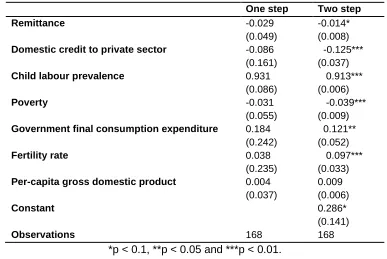
Table 2: Regression of remittances, financial development and child labour prevalence
One step Two step
Remittance -0.029
(0.049)
-0.014* (0.008)
Domestic credit to private sector -0.086
(0.161)
-0.125*** (0.037)
Child labour prevalence 0.931
(0.086)
0.913*** (0.006)
Poverty -0.031
(0.055)
-0.039*** (0.009)
Government final consumption expenditure 0.184
(0.242)
0.121** (0.052)
Fertility rate 0.038
(0.235)
0.097*** (0.033)
Per-capita gross domestic product 0.004
(0.037)
0.009 (0.006)
Constant 0.286*
(0.141)
Observations 168 168
*p < 0.1, **p < 0.05 and ***p < 0.01.
Licensed under Creative Common Page 506 child labour prevalence by providing insurance against income shocks. Other control variable such as fertility also expressed expected sign of being positively related to child labour prevalence. The over identification test (Sargan test) failed to reject the hypothesis that instruments are not correlated with the error terms of the structural equations, for both one and two step system-GMM there exist no autocorrelation in our model.
CONCLUSION AND POLICY RECOMMENDATIONS
We wanted to see whether the incoming migrant workers’ remittances have any influence on
reducing the level of child labour in the countries under investigation. Using 44 developing countries and applied system-GMM framework, the finding shows that remittance inflows which serve as an additional income to the parents’ leads to a decline of child labourers in the
countries under investigation. The efficiency of utilizing remittances in reducing child labour is also worth investigating and this is left for further research on this important aspect. The policy recommendation is that public authorities in these countries are left with no option than to initiate policies if presently not in place that help in efficient utilization of the financial inflows from developed countries. However, if the policies are already in place, they need to be properly implemented considering the roles remittances played in reducing child labour and poverty menaces. Creating good policy frameworks for effective retaining and sustaining the financial inflows received from migrant workers will be a good alternative for creating investment funds with moderate charges that will motivate the recipients to use formal mediums in receiving the inflows and this will enhance the level of financial inclusion and reduce financial exclusion in the economies. Investigating the impact of remittances on reducing income inequality in these countries could be a good area to explore and hence is suggested for future research.
REFERENCES
Acosta, P. (2011). School attendance, child labour, and remittances from international migration in El Salvador. Journal of Development Studies, 47(6), 913-936.
Alcaraz, C., Chiquiar, D., & Salcedo, A. (2012). Remittances, schooling, and child labor in Mexico. Journal of Development Economics, 97(1), 156-165.
Andres Cuadros Menaca (2015): Accounting for Remittance Effects on Children’s Schooling and Child Labor. University of Arkansas, Sam M. Walton College of Business, Business Building 301 Fayetteville. Baland, J., Robinson, J., 2000. Is child labor inefficient? Journal of Political Economy, 108 (4), 663–679. Bargain, O., & Boutin, D. (2014). Remittances and Child Labour in Africa: Evidence from Burkina Faso. Bayot, N. (2007). The effect of remittances on child labor in Mexico. University of Nevada at Las Vegas. Dehejia, R., Gatti, R., 2005. Child labor: the role of financial development and income variability across countries. Economic Development and Cultural Change 53, 913–931.
Licensed under Creative Common Page 507 Ebeke, C. H. (2012). The power of remittances on the international prevalence of child labor. Structural Change and Economic Dynamics, 23(4), 452-462. International Labour Organisation (ILO), Marking progress against child labour, http://www.ilo.org, 2012.
Ebeke,C.H (2012).The power of remittances on the international prevalence of child labour. International monetary fund, Washington, DC 20431, United States
Edmonds, E., Pavcnik, N., 2006. International trade and child labor: cross-country evidence. Journal of International Economics 68 (1), 115–140.
Nations, United, United Nations Millennium Development Goals, Available online at http://www.un.org/millenniumgoals, 2015.
Rogers, C., Swinnerton, K., 2004. Does child labor decrease when parental incomes rise? Journal of Political Economy 112 (4), 939–946.
APPENDICES
1. System-GMM estimation result
System dynamic panel-data estimation Number of obs = 168 Group variable: code Number of groups = 42
Time variable: year
Obs per group: min = 4 avg = 4 max = 4 Number of instruments = 41 Wald chi2(7) = 177454.14 Prob > chi2 = 0.0000
Two-step results
--- lcl | Coef. Std. Err. z P>|z| [95% Conf. Interval] ---+---
lcl |
L1. | .9132824 .0056344 162.09 0.000 .9022392 .9243255 |
ldcp | -.1252142 .0365429 -3.43 0.001 -.196837 -.0535914 lgfc | .1209264 .0518379 2.33 0.020 .0193261 .2225268 lfer | .0967394 .0334621 2.89 0.004 .0311548 .162324 lgdpc | .0085607 .0056511 1.51 0.130 -.0025154 .0196367 lpov | -.0388137 .0093391 -4.16 0.000 -.057118 -.0205093 lrem | -.0143816 .007549 -1.91 0.057 -.0291773 .0004141 _cons | .2859448 .1410266 2.03 0.043 .0095378 .5623518 ---
Instruments for differenced equation
GMM-type: L(2/.).lcl L(2/2).ldcp L(2/2).lgfc L(2/2).lfer L(2/2).lgdpc L(2/2).lpov Standard: D.lrem
Instruments for level equation
GMM-type: LD.lcl LD.ldcp LD.lgfc LD.lfer LD.lgdpc LD.lpov Standard: _cons
. estat sargan
Sargan test of overidentifying restrictions H0: overidentifying restrictions are valid
chi2(33) = 25.87693 Prob > chi2 = 0.8066
estat abond
Arellano-Bond test for zero autocorrelation in first-differenced errors +---+
Licensed under Creative Common Page 508
2. Scatter plot diagram that shows the linkage between child labour prevalence and
remittances in developing countries
Argentina
Armenia Benin
Bhutan
Bolivia
Brazil
Burkina Faso
ColombiaCostaricaEcuador
Elsalvador Geogia
Guatemala
Honduras
India Indonesia Kazakhstan
Malawi
Mali
Moldova
Montenegro
Moroco Mozambique
Nicaragua Niger
Nigeria
Pakistan
Panama Paraguay Peru
Philippens Senegal
Serbia Srilanka Swaziland
Tanzania
Togo
Turkey
uganda
Ukaraine
Uruguay Venezuela
0
20
40
60
R
e
mi
tt
a
n
ce
s
0 5 10 15 20 25
Child Labour