© 2018 IJSRST | Volume 4 | Issue 2 | Print ISSN: 2395-6011 | Online ISSN: 2395-602X Themed Section: Science and Technology
Survey on Energy and Reliability based Efficient Routing Protocol in Mobile
Wireless Sensor Network
Vidyadhar Vijay Mohite
,Prof. Aprana A. Junnarkar
Department of Computer Engineering, Modern College of Engineering, Pune, Maharashtra, India
ABSTRACT
In the recent era, Wireless sensor networks (WSN) have gained popularity in various real time applications. Routing is the big challenging issues of wireless sensor networks and it becomes a point of attraction of many researchers in recent years. The efficiency of routing protocol is affected by limited energy and reliability of nodes. These are the key issues, always faced by researchers during the design of routing protocols in WSN. This paper concentrates on the energy efficient and reliable routing protocols in WSN. This paper discovers some recent routing protocols designed for solving the problem of energy and reliability of nodes WSN. Some of the routing protocols are Energy efficient and reliable routing protocol, VGDRA algorithm, Energy efficient and reliable transport protocol, Fault tolerant clustering protocol, etc. This paper also presents the comparative analysis of these recent techniques based on techniques used, advantages and their disadvantages.
Keywords : Energy Efficiency, Mobile Base Station (BS), Mobile Nodes, Reliability, Routing Protocol, Wireless Sensor Networks.
I.
INTRODUCTION
Wireless sensor network (WSN) applications typically
contains the observation of some physical
phenomenon through sampling of the environment. Mobile wireless sensor networks (MWSNs) are a special class of WSN in which mobility plays a vital role in the execution of the application. In recent years, mobility has become an important area of research for the WSN community. Although WSN deployments were never envisioned to be fully static, mobility was primarily regarded as having several challenges that needed to be resolved, consisting connectivity, coverage, and energy consumption, among others. Moreover, recent studies have been showing mobility in a more favorable light. Rather than complicating these problems, it has been describe that the introduction of mobile entities can resolve some of these problems . In addition, mobility enables sensor nodes to target and track moving phenomena
make assumptions about the environment or network topology that do not apply to dynamic networks
Routing in WSNs is very challenging due to the special characteristics that differentiate WSNs from other wireless networks such as wireless ad hoc networks or cellular networks. Many new algorithms have been developed, taking into consideration the inherent features of WSNs and the application and architecture requirements. Depend on the network structure adopted, routing protocols for WSNs can be classified into flat network routing, hierarchical network routing, location-based network routing . In flat network routing, all nodes have the same functionality and they work together to execute sensing and routing tasks. The Sensor Protocols for Information via Negotiation (SPIN) and Directed Diffusion fall into this category. Hierarchical network routing divides the network into clusters to achieve energy-efficient, scalability and one of the famous hierarchical network routing protocol is low-energy adaptive clustering hierarchy (LEACH) . In location-based network routing, location information of nodes is used to estimate the routing path. This information can be obtained from global positioning system (GPS) devices attached to each sensor node. Examples of location-based network routing protocols consist geography adaptive routing (GAF) and Geographic and Energy-Aware Routing (GEAR) .
In this work, a novel routing protocol, which is named as Energy-Efficient and Reliable Routing protocol for mobile wireless sensor network (E2R2), is implemented. This protocol is a hierarchical one. The main objective is to accomplish energy efficiency and to offer connectivity to the nodes. The mobility of the nodes is considered while routing decisions are made. Behind such routing the objective is that the data packets need to move through suitable routes in spite of node mobility and in presence of subsequent link failures.
II.
LITERATURE SURVEY
This paper [1], presented an energy-efficient and reliable routing protocol for mobile WSNs. This developed protocol E2R2 is hierarchical as well as cluster based. Every cluster consist of one CH node, and the CH node is supported by two DCH nodes, which are named as cluster management nodes. Through simulations and compare with M-LEACH study the performance of the proposed protocol. It performs better M-LEACH in terms of lifetime along with throughput. In the proposed protocol, the
throughput enhancement is 15% on average over
M-LEACH. Such a routing protocol is useful when the sensor nodes and the BS are mobile.
This paper [2], describe that multipath routing can be used for energy efficient recovery from failure in wireless sensor networks. For a disjoint multipath configuration whose patterned failure flexibility is compared with braided multipaths, and it have about 50% higher flexibility to isolated failures and a third of the overhead for alternate path maintenance. It is
harder to design localized energy-efficient
mechanisms for constructing disjoint alternate paths, because the localized algorithms lack the information to find low latency disjoint paths. At the last, increasing the number of disjoint paths does increase the flexibility of disjoint multipaths but with a proportionately higher energy cost.
high energy. Now the sensor network can be constructed as logical grids of uniform size and data aggregation can be done using energy efficient routing. In this paper [3],the proposed algorithm is an improved form of VGDRA algorithm which is grid based routing algorithm but lacks the concept of calculating energy on the basis of distance. In the proposed algorithm, sensor network is separated in logical grids of k-cells and a Cell Header (CH) is elected among each cell that acts as leader to cluster. The algorithm proves to be efficient in terms of energy by minimizing route construction cost considering shortest distance to sink.
This paper [4], implemented a clustering routing protocol CRT2FLACO on the basis of type-2 fuzzy logic and ACO for balancing the network load and to improve the lifetime of WSN. This proposed protocol examines the three basic parts of residual energy, neighbor nodes as well as the distance to base station as inputs of a type-2 Mamdani FLS and after that estimate the possibility of a node upgrading as a candidate cluster head and the cluster head competition radius. To controlling the overhead existing in WSN implementation of type-2 fuzzy logic is better way. The network load is effectively handled
by fuzzy unequal competition radius and
implementation of multi-hop routing protocol method for data transmission. In addition to, protection of data is examined by utilizing encryption algorithm in transmission of data. Because of the high packet delivery rates the lifetime of network is improved.
This paper [5] developed ERTP, an Energy-efficient and Reliable Transport Protocol for Wireless Sensor Networks. It is designed for data streaming applications, in which sensor readings are transmitted from one or more sensor sources to a base station (or sink). ERTP uses a statistical reliability metric which ensures the number of data packets delivered to the sink exceeds the defined threshold. The extensive discrete event simulations and experimental result
shows that ERTP is significantly more energy efficient than recent methods and can minimize energy consumption by more than 45% when compared to current approaches. Consequently, sensor nodes are more energy-efficient and the lifetime of the unattended WSN is increased.
This paper [6], developed a centralized routing protocol known as Base-Station Controlled Dynamic Clustering Protocol (BCDCP), which distributes the energy dissipation evenly among all sensor nodes to enhance network lifetime as well as average energy savings. The execution of BCDCP is then compared with clustering-based framework like as LowEnergy Adaptive Clustering Hierarchy (LEACH), LEACH
centralized (LEACH-C), and Power-Efficient
Gathering in Sensor Information Systems (PEGASIS). The experimental result show that BCDCP minimizes overall energy consumption and enhance network lifetime over its comparatives.
In this paper [8], a better scheme is developed called Fault Tolerant Clustering Protocol for Mobile WSN (FTCP-MWSN) with mobile sensor nodes. This procedure is not only energy efficient but also reliable. Furthermore, it does not need any extra time slot for estimating the mobility of sensor nodes and thus, gives faster and reliable data delivery to base station (BS).
The experimental results show that FTCP-MWSN protocol has more energy efficiency, throughput, network lifetime and reliability than the existing protocol.
III.
PROPOSED SYSTEM
The proposed protocol is a hierarchical one.
The major goal of system is to achieve energy efficiency and to provide connectivity to the nodes. The mobility of the nodes is considered while routing decisions are made.
Sr.no Paper Title Technique used Advantages Disadvantages
1 E 2 R 2:
Energy-Efficient and
Reliable Routing for
Mobile Wireless
Sensor Networks
presented an energy-efficient and reliable routing protocol for mobile WSNs
Energy efficiency, throughput, and extend lifetime of the nodes under the influence of the proposed protocol
This work can be extended to improve the throughput even in
the high-data-rate
situation.
2 Virtual Grid based
energy efficient
mobile sink routing algorithm for WSN
It is improved form of
VGDRA algorithm
which is grid based routing algorithm.
It is efficient in terms of energy by minimizing route construction cost
considering shortest
distance to sink.
Energy constraint
problems
3 Securely energy
aware routing in WSN with efficient clustering
Implemented a
clustering routing
protocol for balancing the network load and to improve the lifetime of WSN
The network load is effectively handled by fuzzy unequal competition radius and implementation
of multi-hop routing
protocol method for data transmission
Network lifetime
4 ERTP:
Energy-efficient and reliable transport protocol for data streaming in
wireless sensor
networks
designed for data
streaming applications,
in which sensor
readings are
transmitted from one or more sensor sources to a base station
More energy efficient than recent methods and can
minimize energy
consumption.
High energy
consumption
5 A centralized
energy-efficient routing protocol for
wireless sensor
networks
which distributes the
energy dissipation
evenly among all sensor
nodes to enhance
network lifetime as well as average energy savings.
minimizes overall energy consumption and enhance network lifetime
The objective behind such routing is that the data packets need to move through suitable routes in spite of node mobility and in presence of subsequent link failures.
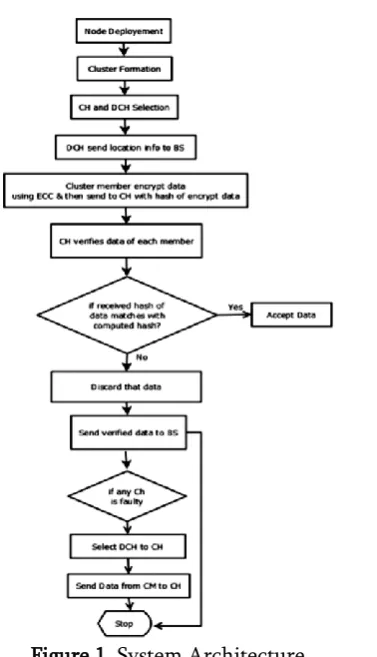
Also in contribution system secure the data using ECC encryption algorithm and also generate the hash of encrypted data. Here in proposed system user first generate the network and form the clusters.
After that cluster head (CH) and DCH is selected in each cluster.
The work of DCH is the send location to the base station (BS).
The cluster members encrypt the data using ECC encryption algorithm and send to the CH with hash of encrypt data.
CH verifies data of each member, if received hash of data matches with computed hash then accept the data, otherwise discard it. Send verifies data to the BS.
The proposed system architecture are as follows :
Figure 1. System Architecture
IV.
CONCLUSION
From this paper we conclude that the routing in wireless sensor network is strongly affected by the energy and reliability of nodes. This paper presents various solutions provided by researches in recent years. Various techniques for energy efficiency and reliability based routing protocols are discussed and compared here on the basis of the technique used, advantages and disadvantages.
V.
REFERENCES
[1]. Junqiang Sarma, Hiren Kumar Deva, Rajib Mall, and Avijit Kar. "E 2 R 2: Energy-Efficient and Reliable Routing for Mobile Wireless Sensor Networks." IEEE Systems Journal 10.2 (2016): 604-616.
[2]. Ganesan, Deepak, et al. "Highly-resilient, energy-efficient multipath routing in wireless sensor networks." ACM SIGMOBILE Mobile Computing and Communications Review 5.4 (2001): 11-25.
[3]. Bhatti, Rajanpreet, and Gurinderjeet Kaur. "Virtual Grid based energy efficient mobile sink routing algorithm for WSN." Intelligent Systems and Control (ISCO), 2017 11th International Conference on. IEEE, 2017.
[4]. Chavan, Anita, and Simran Khiani. "Securely energy aware routing in WSN with efficient clustering." Advanced Communication Control and Computing Technologies (ICACCCT), 2016 International Conference on. IEEE, 2016.
[5]. Le, Tuan, et al. "ERTP: Energy-efficient and reliable transport protocol for data streaming in wireless sensor networks." Computer Communications 32.7 (2009): 1154-1171.
[6]. Muruganathan, Siva D., et al. "A centralized energy-efficient routing protocol for wireless sensor networks." IEEE Communications Magazine 43.3 (2005): S8-13.
[7]. Heo, Junyoung, Jiman Hong, and Yookun Cho. "EARQ: Energy aware routing for real-time and reliable communication in wireless industrial sensor networks." IEEE Transactions on Industrial Informatics 5.1 (2009): 3-11.