EFFECT OF USING A COMPLEX OF AGRO-TECHNICAL PRACTICES
ON PLANOSOLS
Ivan Dimitrov1, Miroslav Ivanov1, Iliyna Gerasimova1, Martin Nenov1, Vanya Lozanova1, Ana Samodova2, Hristina Georgieva2
1
Institute Of Soil Science, Agro-Technology and Plant Protection “Nikola Pushkarov"
2
SE- Experimental Station on Irrigated Agriculture, Ivaylo, Pazardzhik E mail: [email protected]
Abstract: The problem of updating agricultural technology, particularly in the field of agriculture, is important for agriculture. Alternative technology solutions that meet the performance criteria are a prerequisite for successful economic activity.
The aim of the study is to determine the effect of the application of an agro-technical complex of events, which successfully supports the soil fertility of the Planosoils and the sustainable level of productivity of the field crops.
In the field experiment in the station for irrigation agricultural Pazardzhik Valley, in three-polar crop rotation maize-barley-rape are studied three factors - soil tillage system, mineral fertilization and ways of managing plant residues.
The study found that the moisture content of the soil was mainly influenced by the type of treatment applied (loosening as a main plow and plowing as a pre-sowing) and the use of plant residues. The over compaction found in the beginning of the experiment in the 25-40 cm layer is partly overcome by performing a deep rupture to the depth of 35 cm. Despite the short period of the study, there was a certain decrease in the content of digestible potassium forms. The results show the activation of the microbiological activity after planting of the plant residues - an increase of the amount of the cellulose microorganisms and of the ammonifiable bacteria, the most noticeable in the high fertilization rate and the intensive treatments. The main part in the formation of crop rotation productivity is mineral fertilization. The impact of the tillage system is more marked in the first year of maize and especially during the third year of rape. Lack of fertilization influences yields significantly in rapeseed compared to maize and barley.
KEY WORDS: AGRICULTURAL PRACTICES, SOIL TILLAGE, FERTILIZATION, PLANT RESIDUES, PRODUCTIVITY
INTRODUCTION
The problem of updating agricultural technology in agriculture, grain-production in particular, is important for production. Alternative technology solutions that meet the performance criteria are a prerequisite for successful business activity. In order to achieve sustainable agriculture, it is necessary to make periodic changes in the technologies for growing individual crops and adding additional calories of energy in the form of fertilization, plant protection, watering and growing in environmentally disadvantaged areas (Arvidsson et al., 2003; Stoynev, 2004; Basitov, 2008). Agro-technical solutions also play a vital role as a major part of production technology. For a major agro-technical practice to be carried out, a number of requirements have to be met and the most accurate solution to be taken (Mitova et al 1999, Terra et al 2006, Karlen et al., 2013)
The rationalization of agro-technical practices allows the reproductive potential of crops to be more fully used at a good level of soil fertility (Dimitrov and Mitova, 1998, Nikolova et al., 2001, Zarkov and Koteva 2005, Terra et al., 2006; Toncheva et al., 2015).
The aim of the study is to determine the effect of the application of an agro-technical complex of practices, which
successfully to supports the soil fertility of the planosols and the sustainable level of productivity of the field crops.
MATERIAL AND METHODS
In a field experiment conducted in the Experimental Station on Irrigated Agriculture, Pazardzhik in three-field crop rotation system maize-barley-rape in the conditions of irrigated agriculture, three factors were studied - soil treatment system (scheme 1), mineral fertilization norms (scheme 2) and plant residues management methods - by introducing the plant residues into the soil with the treatment (option O1) and by removing them,
by baling or chopping, and extracting them outside the test area (option O2).
According to the requirements of the crops and the agro-ecological conditions, differentiated processing systems are used with variants of basic, pre-sowing and inter-row machining solutions. In the experiment, three levels of fertilization - zero and two fertilization norms with nitrogen and phosphorous fertilizer, potassium fertilization was carried out for the third crop in the crop rotation - oilseed rape.
Scheme 1. Systems for soil cultivation in crop rotation
Crop Option О1 Option О2
Maize for grain tillage 25-30cm disc harrow 10-12 cm
tillage 25–30cm
Barley (winter) tillage 15-18 cm disc harrow 10-12 cm
Oilseed rape disc harrow 10-12 cm
loosening 35-40cm
tillage 20-25cm
Scheme 2.Fertilization variants
Crop Fertilization variants
Т0 Т1 Т2
Maize no fertilization
(фон P7)
N20P15К0
Superphosphate, ammonium nitrate
N25P20К0
Ammophos, Са- ammonium nitrate
Barley no fertilization N6P8 К0
Superphosphate, ammonium nitrate
N8P10K0
Ammophos, Са- ammonium nitrate
Rape no fertilization N15P12 K6
potassium sulfate
Superphosphate, ammonium nitrate
N20P15K6
Eurobio
NPK fertilizer, Са- ammonium nitrate
The following indicators have been monitored: productivity - main and additional crop production and total crop rotation productivity calculated in kg/da;
hardness meter with a cone angle of 30◦, every 5 cm to a depth of 40 cm; general porosity of the soil - by ratio of bulk and relative mass of the soil;
agrochemical - mobile forms: nitrogen - by the method of Bremner and Keeney; phosphorus - by the method of P. Ivanov; potassium by the method of P. Ivanov; soil solution reaction (pH) - potentiometrically in water and potassium chloride; carbonates - using the Scheibler method, organic matter content in the soil - by Tyurin;
microbiological indicators: main groups of soil micro-organisms - ammonifying bacteria, actinomycetes, mineral nitrogen digesting bacteria, microscopic fungi, cellulose digesting microorganisms. The samples are taken from the surface layer of the soil (0-30 cm) near the roots of the plants; total biological activity (soil respiration) - determined by the method of Alef and Nannipieri.
The amount of plant residues is determined from 0.5m2 area in three replicates; layer distribution of residues - by wet soil sieving of ¼ m2.
The sum of the rainfall during the growing season of the crops is for maize 2014 (IV-IX) - 569,3 mm, for winter barley 2014/2015 (X-VI) - 627,7 mm and for oilseed rape 2015 / 2016 (IX-VI) -447.3 mm.
RESULTS AND DISCUSSION
The tested agrotechnical factors influence the condition of the soil parameters and the productive potential of the cultivated crops.
Effect on soil’s physical characteristics: After maize sowing, a consistent differentiation of water content in the soil was established. In the surface layer, as a result of moisture evaporation, the content is 75-87% of Saturation, in the layer 20-30 cm is about 90% and in the deeper layers within the boundaries of Saturation. Substantial differences due to soil treatment have not been established. Only one irrigation with a rate of 80 m3/da was made to maintain a presumptive humidity of 75% of Saturation.
Fig. 1.Content of soil moisture in weight% 2015/2016 – rape [a) germination, b) before harvesting] When inspecting the barley until the wax ripeness phase
begins, the moisture content of the test area decreases with the measured values from 11.22% to 16.06%. There is a tendency of higher moisture content in the soil of the lots with tillige of the vegetation residues - the value differences are from 1.10% to 2.03%.
The moisture content of the Planosols in the autumn after rape sowing is from 12.36 to 17.23% (Fig. 1,a). A watering with a 20 m3/da rate was made to accelerate germination. The measured
soil moisture values in the pre-harvest test were from 9.35% to 14.87% (Fig. 1,b). The humidity in the 0-40 cm layer for the loosening area is higher than the plowing trough - from 1.3% in the surface layer to 2.47% in the 30-40 cm layer due to different
evaporation rates and the retention of moisture to the depth of loosening.
In the first year, the high moisture content has an impact on soil density. In the wax ripeness phase, when the humidity is about 80% of the Saturation, an increase in the values of this parameter in the 0-20 cm layer was recorded, the differences with post- germination readings being in the range 0.08-0.13 g/cm3. Although less expressed, there is an increase in volume density for the layer 30-40 cm. Prior to harvesting of the barley, the bulk density was high for the entire studied layer 0-40 cm, which ranged from 1.63 g/cm3 to 1.76 g/cm3. In order to overcome this overfill of the layer for option O1, rupture is included up to a depth of 40 cm.
Fig. 2.Soil bulk density g/cm3 2015/2016 г. – rape [a) germination, b) before harvesting].
In the third year in the rape rosette stage it was found that after loosening to a depth of 35 cm the soil bulk density in the layer 10-20 cm was lower with 0.06-0.07 g/cm3 of the lots with the
residue and 0.05-0.09 g/cm3 in the removal variants compared to the
Combining the effect of loosening with the use of plant residues from previous crops helps to lower the parameter values compared to those with plowing 0.08-0.11 g/cm3 for the 10-20 cm layer and 0.07-0.09 g/cm3 for the 20-30 cm layer, respectively for variants O1
and O2.
Taking into account the soil hardness, similar trends have been established with those of the bulk density. In the third year of rape growing, it was found that, after loosening, the values for this parameter were about 20 kg/cm2 lower in the 20-30 cm layer compared to the tillage lots. Until the harvesting of the crop, the values increase significantly after the drought.
Effect on agrochemical characteristics of the soil: From the analysis of the taken field baseline samples, the content of digestible nitrogen in the soil layer of 0-30 cm was good and at a depth of 30-60 cm from satisfactory to good. A comparative uniformity of content from individual sampling was established. The content of mobile forms of phosphorus marks the same trend. From the agrochemical analysis it was found that potassium had a satisfactory quantity and no fertilization with this macroelement was planned.
After the completion of the vegetation of the first crop of crop rotation - grain maize, it was found that, despite high nitrogen fertilization rates and pre-existing soil reserves, the ammonia and nitrate nitrogen content was lowered. It can be assumed that a part of the nitrogen labile compounds are washed in depth of the soil profile as a result of the abundant supply of rainwater. From a
content of 13.0-21.9 mg/100g of soil in the plow horizon, phosphorus decreases to 7.8-13.7 mg/100g of soil. With smaller differences, the content of digested potassium is also decreased. After barley vegetation, it is found that there is a satisfactory supply of digestible nitrogen. There is no reduction in nitrogen as a result of the denitrification activity of the micro-organisms. The content of digestible forms of phosphorus in the high fertilizer variants T1 is
higher with 1.2-1.7 mg/100g of soil compared to variants T2. The potassium content decreases in all tested variants.
In the third year, from the samples taken at the end of rapeseed's vegetation, the highest content of digestible nitrogen is in the variant with zero fertilization and use of the plant residues from the previous crops (T0O) - 22.8 mg/kg, probably due to fewer
harvested plants and lower yields. In the variants with plowing of plant residues the level of digestible phosphates increases - from 11.4 mg/100g after plowing to 16.1 mg/100g soil after loosening to 35 cm (Table 1). There is a tendency of decrease of phosphorus in the under layer in variants without plant residues (O2).
Potassium decreases in the variants with removal of the plant mass - by 2.5; 4.6 and 5.6 mg/100 g of soil according to the fertilization options. This fact confirms the positive role of plant mass usage for improving the soil diversity diet - Planosols. The reaction of the soil solution is slightly acidic, and in the variants using the physiologically neutral and alkaline mineral fertilizers T2
there is a slight tendency to raise the pH.
Table 1. Agrochemical characteristics of Planosols in rape growing in 2016.
Variant Depth of
the layer in cm
рН ∑
N-NH4+NO3
P2O5 K2O Hummus
H2O KCl mg/kg mg/100gr %
Т0О1С1 0-30 6,1 5,4 22,8 10,1 22,0 1,99
Т0О1С1 30-60 6,3 5,6 17,3 3,2 16,7 1,08
Т1О1С1 0-30 6,2 5,3 18,1 11,2 25,5 1,88
Т1О1С1 30-60 6,3 5,4 11,5 8,0 14,8 1,56
Т2О1С1 0-30 6,4 5,6 20,2 16,1 26,5 1,80
Т2О1С1 30-60 6,5 5,7 13,2 12,0 13,9 1,43
Т0О2С2 0-30 6,1 5,3 20,7 10,1 19,5 1,77
Т0О2С2 30-60 6,2 5,4 16,7 8,6 12,3 1,78
Т1О2С2 0-30 6,1 5,2 21,3 11,0 21,9 1,97
Т1О2С2 30-60 6,1 5,3 14,8 8,7 17,2 1,54
Т2О2С2 0-30 6,3 5,4 22,4 11,4 20,9 1,72
Т2О2С2 30-60 6,2 5,4 18,4 8,6 11,3 1,43
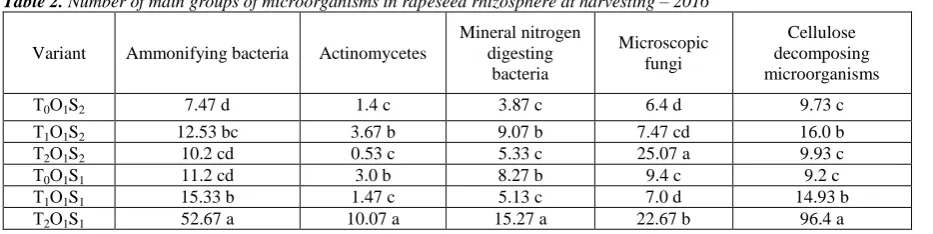
Effect on microbiological activity in the soil: In the Planosols, the highest amount of ammonifying bacteria was recorded in both treatments at the fertilization rate T2. In the jointing phase of the barley growth, an increase in the amount of cellulose-producing
microorganisms was detected in all variants when plowing plant residues.
Table 2. Number of main groups of microorganisms in rapeseed rhizosphere at harvesting – 2016
Variant Ammonifying bacteria Actinomycetes
Mineral nitrogen digesting
bacteria
Microscopic fungi
Cellulose decomposing microorganisms
Т0О1S2 7.47 d 1.4 c 3.87 c 6.4 d 9.73 c
Т1О1S2 12.53 bc 3.67 b 9.07 b 7.47 cd 16.0 b
Т2О1S2 10.2 cd 0.53 c 5.33 c 25.07 a 9.93 c
Т0О1S1 11.2 cd 3.0 b 8.27 b 9.4 c 9.2 c
Т1О1S1 15.33 b 1.47 c 5.13 c 7.0 d 14.93 b
Т2О1S1 52.67 a 10.07 a 15.27 a 22.67 b 96.4 a
During the third year when in the deposition area was introduced plant mass from 669.4 to 1004.8 g/m2 and good conditions were created for activating the activity of microorganisms in the soil. In the rosette formation stage in the rape rhizosphere an increase in the amount of cellulose microorganisms was registered in all variants with plawing of plant residues - higher in those with mineral fertilization.
Fig. 3. Yields grain maize kg/da experiment at Experimental Station on Irrigated Agriculture, Pazardzhik Effect on crop productivity: For the conditions of the
studied area, yields are influenced by agro-technical factors. In the first year of cultivation - grain maize, relatively high yields were obtained, with a yield of 694 to 751 kg / da (Figure
3) being obtained for the highest T2 fertilization rate. The higher
norm logically leads to an increase in yield, with differences between the fertilizer lots T2 and T1 from 37.8 kg/da to 71.1 kg/da.
Table 3. Dispersion analysis of maize yield 2014. Source of variation Sum of the
squares
Sum of the squares %
Degrees of freedom
Average quadratic deviation
F-test Level of
significance
Fertilizing (F) 39801,812 80,363 2 19900,906 51,919 ,000***
Processing (O) 2610,031 5,270 1 2610,031 6,809 ,023 *
F*O 2516,271 5,080 2 1258,136 3,282 ,073 -
Error 4599,722 9,287 12 383,310
Total sum 49527,836 17
Statistical data processing indicates that fertilization has the most significant impact on yields. Soil treatment has a negligible effect on yields. The impact of the interaction between the agrotechnical factors tested is also very low.
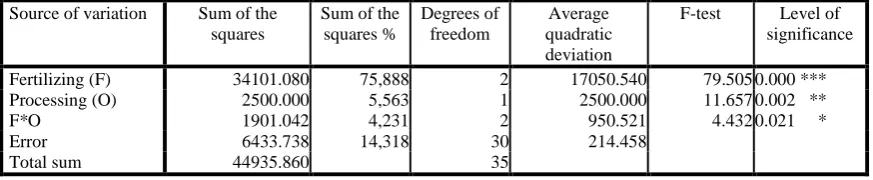
Table 4. Dispersion analysis of barley yield 2015. Source of variation Sum of the
squares
Sum of the squares %
Degrees of freedom
Average quadratic deviation
F-test Level of significance
Fertilizing (F) 34101.080 75,888 2 17050.540 79.505 0.000 ***
Processing (O) 2500.000 5,563 1 2500.000 11.657 0.002 **
F*O 1901.042 4,231 2 950.521 4.432 0.021 *
Error 6433.738 14,318 30 214.458
Total sum 44935.860 35
In the second year the increase of the yield is mainly due to the fertilization carried out. For barley, at three fertilization levels and two soil treatment systems, the dispersion analysis of the data shows that on the yields a significant effect on have both fertilization (probability of error p<0.1%) and soil treatment (at p <0.2%). The mutual influence of the two studied factors is also statistically proven (at p <5%).
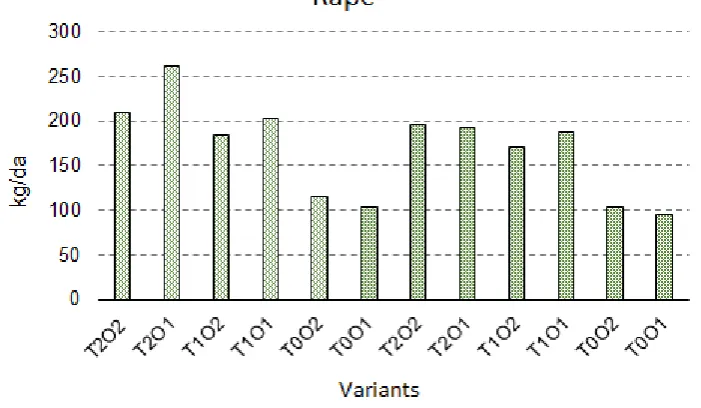
For the rapeseed also the greatest impact on agro-technical factors has the fertilization. The highest yields are
fertilization variant T2 - in option O1 after loosening 260 kg/da, and
in option O2 212,2 kg/da (Fig. 4). Compared to the non-fertilizing
variants, the increase in the yield is 60.2% and 55% respectively for options O1 and O2. The application of loosening as the main
treatment increases the yields compared to the plowing - 41.1 and 19.6 kg/da for the T2 and T1 fertilizer lots, and with 15.8 and 16.8
Fig.4. Rape yield kg/da, Experimental Station on Irrigated Agriculture, Pazardzhik 2016.
From the dispersion analysis, it can be seen that for rape, statistically fertilization has the highest impact on yields (p<0.1%). There are statistically proven differences between the average yields obtained from the different fertilization variants, as the fertilization
rate increases as well as the yields (Table 5). Soil treatment has less impact on the yield value (p<1%), but as has been shown in other studies, it supports the effective impact of other agro-technical factors.
Table 5. Dispersion analysis of rape yield – 2016. Source of variation Sum of the
squares
Sum of the squares %
Degrees of freedom
Average quadratic deviation
F-test Level of significance
Fertilizing (F) 78261.744 85,408 2 39130.872 112.565 0.000 ***
Processing (O) 995.403 1,086 1 995.403 9.863 0.002 **
F*O 1946.832 2,125 2 973.416 4.300 0.027 *
Error 10428.838 11,38175, 30 347.628
Total sum 91632.816 35
Rape seed yield is also influenced by the use of plant mass. In variants O1 (with the plowing of the available plant mass)
and O2 (with removal from the experimental area) differences in
yields were obtained - with loosening and high fertilization rate of 48.8 kg, and after plowing with 23.4 kg, at the lower fertilizer rate of 16.4 kg and 13.5 kg respectively, and the smallest differences were recorded in the non-fertilizing variants - 8.5 kg and 11.0 kg, respectively.
CONCLUSIONS
Effective growth of crop yields of three-field crop rotation system maize-barley-rape is ensured by applying a treatment system including more intensive treatments, optimal fertilization, and plowing residual plant mass in the soil. The most significant is the impact of applied mineral fertilization with nitrogen and phosphorus. Lack of fertilization influences yields more significantly in rapeseed compared to maize and barley. The soil treatment system also has an impact on the level of yields obtained, better evidenced when growing oilseed rape.
The moisture content of the soil is mainly influenced by the type of treatment applied (loosening as a base and plowing as a pre-sowing) and by the use of plant residues. The excessive compaction found in the beginning of the experiment in the 25-40 cm layer is partly overcome by performing a deep loosening to the depth of 35 cm.
In spite of the short period of the study, there was a certain decrease in the content of digestible potassium forms and a slight increase in soil pH.
The results show the activation of the microbiological activity after plowing of the plant residues - an increase of the amount of the cellulose decomposing microorganisms and of the
ammonifying bacteria, the most noticeable in the high fertilization rate and the intensive treatments.
REFERENCES
1.Arvidsson I., T. Keller, K. Gustafsson. (2003). Specific draught for mouldboard plough, chisel plough and disc harrow at different Water contents. Proceedings of 16th Trinnial ISTRO Conference, Brisbane,
Australia, 43-48.
2.Basitov, V. (2008). Energy productivity of field crop rotation on soil type Vertisoil in South central discrict. Plant science, 45, 360-363.(Bg).
3.Dimitrоv, I., Мitovа, T. (1998). Influence of soiltillage system and fertilization on the productivity of crop rotation in irrigated conditions.
Plant science, 35, 4, 270-276.
4.Karlen, D., C. Cambardella, I. Kovar, T. Colvin. (2013). Soil quality response to long-term tillage and crop rotation practice. Soil and Tillage Research, 133, 54-64.
5.Mitova, T., Stoinev, K., Dimitrov, I. (1999). Methodological Procedure for Assessment of Soil Tillage Systems in Sustainable Agriculture. Soil science, agrochemistry and ecology, № 6, 171-175.(Bg).
6.Nikolova, D., Borisovа, M., Мitovа T., Dimitrоv, I. (2001). Influence of the di. Soil science, agrochemistry and ecology, 36 (4-6), 231-233.(Bg).
7.Stoynev, K. (2004). Ecological and technological aspects of modern agriculture. Ecoinnovation Ltd., Sofia.(Bg).
8.Terra, I., I. Shaw, D. Reeves. (2006). Soil management practices and landscape attribute impact on field-scale corn productivity. Proceedings of 17th Triennial ISTRO Conference, Kiel, Germany, 1275-1280.
9.Toncheva, R., Dimitrov, I., Nikolova, D., Nenov, M. (2015). Investigation the Productivity of Maize in Different Agroecological Regions and Agrotechnical Treatments. II. Irrigated Conditions. Soil science, agrochemistry and ecology, № 4, 65-73.(Bg).
![Fig. 1.Content of soil moisture in weight% 2015/2016 – rape [a) germination, b) before harvesting]](https://thumb-us.123doks.com/thumbv2/123dok_us/8586809.1720096/2.595.71.536.556.720/fig-content-soil-moisture-weight-rape-germination-harvesting.webp)