DOI: 10.14738/abr.71.5835.
Belkasseh, M. (2019). TQM’s Theory. Archives of Business Research, 7(1), 111-121.
TQM’s Theory
Mohammed Belkasseh
Ecole Nationale de Commerce et de Gestion de Settat – Hassan 1st University of Settat, Kingdom of Morocco
ABSTRACT
This paper suggests a literature review attempting to an in-depth look to the scientific thought around quality implementation in organizations. It provides a critical view to the plethora of designations mentioned in many contributions that are not necessarily different in their respective meanings. This would disperse the concentration and slow down the pace of quality theory’s scientific evolution. The paper joins a set of contributions to suggest TQM as a unifying concept that would enable to overcome the delay of recognition of quality implementation as a theory.
Key Words: Quality, Management, Theory, Scientific Thought, Epistemology, TQM.
JEL: M00, M10
INTRODUCTION
The contributions of quality specialists were not all directly aimed at presenting TQM as a management concept’s designation and the tools for its implementation within an organization. Instead, they were based on a growing awareness concerning the importance of the philosophy of considering customer satisfaction as the ultimate goal of the organization (Crosby (1979, 1996), Deming (1982, 1986), Feigenbaum (1951, 1961, 1991), Ishikawa (1985) and Juran (1951, 1962, 1974, 1988, 1989, 1992)). This was done, on the one hand, by focusing on the functioning’s continuous improvement internally to reduce costs where Crosby (1979) considers that both high-end and mass products can have a high-quality level. On the other hand, through supporting the role of statistical tools to eliminate defects Juran (1988). Or, by focusing on the systemic nature of organizations within the environment, the importance of leadership, and the need to reduce process variation Deming (1993).
A debate is then opened on the quality pioneers and the degree of their direct prescription of TQM as a quality management system. For instance, Romano (1994), by introducing W. Edwards Deming as one of the most respected actors in the quality management movement, testifies that he said he had never used the term TQM because, for him, it conveys no meaning. Neave (1995) reports that, since 1950, Deming left the task of teaching statistical quality control to his assistants and devoted himself to the most important concepts dealing with the system’s theory. For the author, one could largely identify his teaching in Japan with what is called today TQM. But in fact, he went far beyond that in his approach. And when TQM became widespread, he would have strongly preferred to dissociate from it. Though, Tamimi et al. (1995) clearly note that Deming's 14 points generated the greatest impact on the evolution of TQM than any other contribution and were extensively studied worldwide.
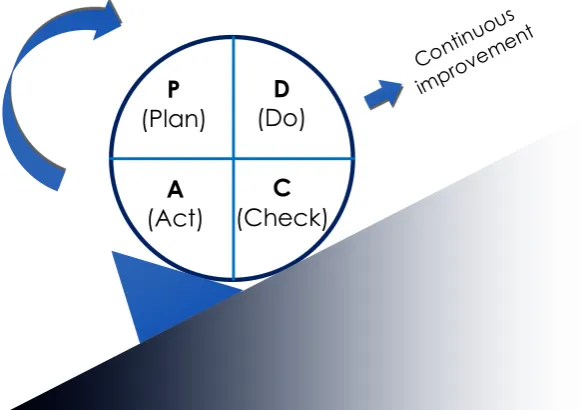
Figure 1 - Deming wheel of continuous improvement: Plan, Do, Chack, Act. Deming (1986)
Following the same interest in analyzing the contributions of other pioneers of quality philosophy and forms of its adoption in an organizational environment, English (1996) considers that Juran and Crosby are TQM’s theoreticians. Boaden (1997) notes also that since the beginning of TQM in the mid-1980s, Deming, Juran, and Ishikawa have contributed significantly to its development. And Hackman and Wageman (1995) truly consider them as the founders of TQM.
The fact is that the logic of TQM is a recent framework for consolidating past contributions on quality management. In the light of it, many researches process analysis oriented are conducted to the more detailed of the organizational functioning. Each of the past contributions, by focusing on a given idea of quality and its implementation according to specific designation, has drained its own stream of research. Each research area may deal with specific terms distinct from each other without diverging on the same meaning and the philosophy that are all promoting. Moreover, in many cases, the historical evolution from quality inspection to TQM claimed by Dahlgaard et al. (2002) is not necessarily taken into consideration.
This paper is structured into three parts. The first presents Quality Control as a fundamental concept dealt with throughout the scientific reflection around quality management. The second provides a summary of other subsequent contributions. And the third part attempts to present a converging framework towards the designation of TQM as the elucidation of quality implementation in organizations. Finally, a conclusion is dressed to highlight the added value of this paper.
QUALITY CONTROL: A FUNDAMENTAL CONCEPT
Quality Control (QC) that dates from 1924 Dahlgaard et al. (2002), remains one of the key concepts that are still relevant because of the general philosophy it advocates as a set of tools and techniques to be used in organizations. The QC has been considered as a paradigm shift of improving the quality levels from inspection / correction to prevention. Shingo (1986) would be one of the pioneers reviving QC through his Zero Quality Control (ZQC) model. The author has emphasized inspection and the defects prevention from their origin. Thus, he demonstrated the effectiveness of control through prevention rather than inspection.
A
(Act)
P
(Plan) (Do) D
C
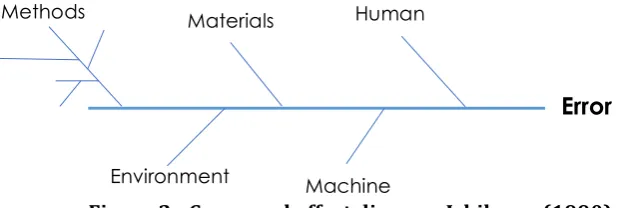
Ishikawa (1990) is one of the quality experts who have revived the concept of QC. According to him, the QC is to develop, design, produce, market, and maintain products and services with an optimization of the cost-effectiveness and usefulness that customers obtain with satisfaction. To achieve this, the author mentions that all separate parts of an enterprise must work together. The author presents his famous cause and effect diagram, shown in the figure below, in fish bones, used to put everyone in the organization depending on their respective positions to detect the causes of "non-quality" issues namely by analyzing a problem through all its probable causes. These are grouped into five major areas, including: Materials, Environment, Methods, Machine, and Human.
Figure 2 - Cause and effect diagram Ishikawa (1990)
Costin (1994); Ebert and Griffin (2000); Evans et al (1990); Juran and Gryna (1998); and Oakland (1993) likewise define QC. For them it deals with ensuring compliance with the requirements and standards, achieving the objectives set, meeting customer expectations. It requires monitoring, analyzing, measuring, comparing, managing, harmonizing, and testing both functioning operations and products to deliver and setting actions to take in cases non-compliance and deviations are detected. Authors assert that controls are performed in order to compare the results, analyze them, and use them in the decision-making process. Juran and Gryna (1998) summarize QC definition by associating it with the measured and monitored performance logic. According to the them, QC is a systematic process during which current measures of quality compliance are established, compared to quality objectives, and followed by action to be taken in cases of discrepancy.
Juran (1988) mentions three key success factors including an apparent top management leadership to lead the quality revolution; an appropriate quality management training for multi-level employees; and an emphasis on gradual continuous improvement.
OTHER SUBSEQUENT CONTRIBUTIONS
Other authors have tried to initiate a form of enrichment of concepts mentioned above by adding value towards a better conception of quality implementation. In this sense Goetsch and Davis (2006); Juran and Gryna (1998) and Oakland (1993) join quality planning (QP) to QC, which would be based on product development, implementation of an idea, evaluation and improvement. For them, the QP is established both in the realization of current activities within the organizational functioning and those to be identified and undertaken in the future. Roderick (1996) mentions QP as part of a strategic approach. According to him, quality strategic planning intends to engage all the management components by setting objectives and coordinate employees efforts to insure the implementation of the detailed quality planning.
For Foster (2004), this is the assimilation of three main spheres of quality. According to him, it is a form of presenting quality management in three different activities included in the table below where he adds to the control activities those of insurance and those related to the management process.
Methods Materials Human
Machine
Error
Quality Control Quality Assurance Quality Management
Refers to tracking missed opportunities in terms of: - processes stability and performance,
- reducing the variability, - optimizing of the process beyond the initial measures, sampling, preparing, and consolidating monitoring standards.
Refers to the activities performed in order to:
- guarantee the product quality, - provide an essential link with the design,
- analyze the types of errors and their impact, the improvement of the process, the reliability of the product and the durability of the tests, etc.
Refers to all activities including: - control and insurance (in particular)
- plan quality improvement activities,
- create an organizational quality culture,
- Regular training for employees
Table 1 - The three spheres of quality Foster (2004)
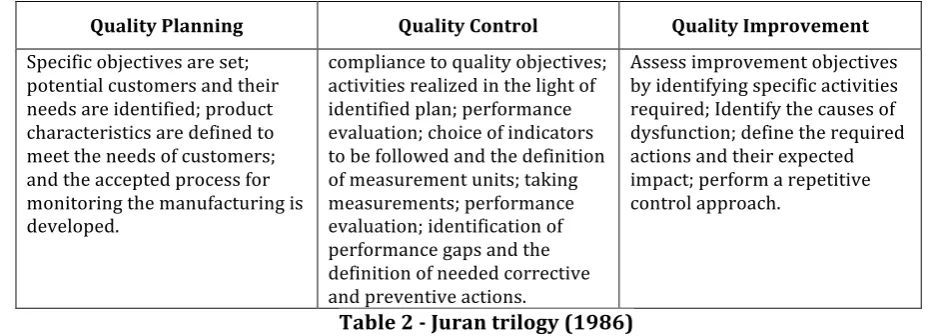
In another conception, Bisgaard (2007); Godfrey and Kenett (2007) and Spurgeon et al. (1990) prefer to rely on Juran trilogy (1986). The latter adds to the control two other types classifying quality management namely planning and improvement efforts presented all in the table below:
Quality Planning Quality Control Quality Improvement
Specific objectives are set; potential customers and their needs are identified; product characteristics are defined to meet the needs of customers; and the accepted process for monitoring the manufacturing is developed.
compliance to quality objectives; activities realized in the light of identified plan; performance evaluation; choice of indicators to be followed and the definition of measurement units; taking measurements; performance evaluation; identification of performance gaps and the definition of needed corrective and preventive actions.
Assess improvement objectives by identifying specific activities required; Identify the causes of dysfunction; define the required actions and their expected impact; perform a repetitive control approach.
Table 2 - Juran trilogy (1986)
In the same perspective of enriching contributions, the growing importance attributed to Quality Control was undoubtedly one of the main ways of developing concepts towards the holistic quality approach proposed by TQM. Thus, Feigenbaum (1961) suggests, based on "Quality Control", the "Total Quality Control" (TQC). For him, it is an effective system of integrating quality development, maintenance, and improvement of diverse groups within an organization to make production processes lead to customer satisfaction. For him, the control should begin from the product design and end only when the product is in the hands of the customer who remains satisfied. As far as Garvin (1988) is concerned, he talks about Company Wide Quality Control (CWQC), which includes four main elements, namely: the implication functions other than manufacturing in quality activities; employee participation at all levels; the continuous improvement objective; and an attention to the positioning customers give to quality.
GATHERING TERMS AND CONSOLIDATING TQM
This would mean that the authors would advocate a form of organization based on their contribution in quality and would maintain that the designation initially used refers to a concept quite different from the others even if they are all very close to each other and suggest almost the same approach. Moreover, in attempting to present the basic philosophies that feed TQM, Kuei (1998) referred to the Juran trilogy. In the figure that follows, the author was able to dissect the trilogy to reveal a clear diagram demonstrating its perfect correspondence with the meaning of TQM.
Quality
Planning Quality Control
Quality Planning
Quality Control
Period 1 Period 2
Figure 3 - Juran trilogy correspondence with the meaning of TQM Kuei (1998)
In the same line, other authors like Godfrey et al. (1997) and Martinez et al. (1998) draw attention to the variety of existing terms and designations and try to converge them under a single concept to ensure a better understanding of TQM's general philosophy. It is an initiative to federate the efforts of practical analysis and scientific enrichment related to the implementation of total quality in the organization. Thus, Godfrey et al. (1997) note that all control activities in their broadest sense (going beyond the basic sense of control over activities performed by the work force) are included in TQM.
Martinez et al. (1998) refer to the definition of quality according to ISO 8402 to mention that TQC and CWQC are essentially TQM. A reflection that Dahlgaard et al. (2002) widely share. For them, TQC was popular in Japan. It has been later developed to what the Japanese themselves call the CWQC which is identical with what is now called TQM. Also, Feigenbaum (1991), finally admitted that TQM is indeed the TQC with broad impact in the organization. Avery and Zabel (2003) note that this variety of terms and designations would be due to the fact that, since the beginning of the 1980s, Total Quality Management (TQM), Total Quality Control (TQC), Quality Assurance and Continuous Improvement of Quality ... have all been used more or less interchangeably.
In an article published in the Financial Times in 1991, we note a consolidation of a progressive approach joining the first efforts in quality management to the current TQM. According to the article, TQM is a term that embraces many of the best practices in production. Its scope has
40 -
Sporadic problems
Chronic problems
Quality improvement x
x x
x x x
x x
x
x x x
Cost of poor quality
20 -
Lessons learned
expanded from its very first focus on statistical monitoring of manufacturing processes. It now includes several techniques like JIT and others. It emphasizes the service offered to the customer (internal and external). And it implies a change in the way people work, especially concerning team coordination and management. Thus, a prominent level of accountability and commitment of the staff is required in the work process, etc. They are all devices aimed at redirecting the production process so that it gives rise to products or services of consistent quality for a period, at least meeting the requirements of the customer. Focusing on the customer, as a direct result of competition, is one of the areas that have also been particularly developed by TQM in the recent years.
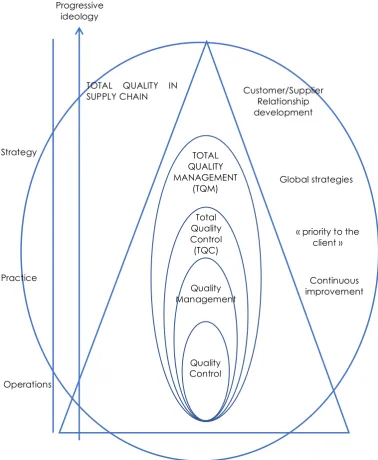
The figure Below stressed by Levy (1998) is a form of consolidation of the existing difference between the terms while bringing them together in the same progressive logic of TQM implementation. The author summarizes his reasoning by giving significant importance to integrating TQM in the organization's supply chain as a pledge of developing customer-supplier relationships.
Figure 4 - Progressive ideology of TQM integration Levy (1998) Progressive
ideology
Strategy
Practice
Operations
TOTAL QUALITY IN SUPPLY CHAIN
TOTAL QUALITY MANAGEMENT
(TQM)
Total Quality Control (TQC)
Quality Management
Quality Control
Customer/Supplier Relationship development
Global strategies
« priority to the client »
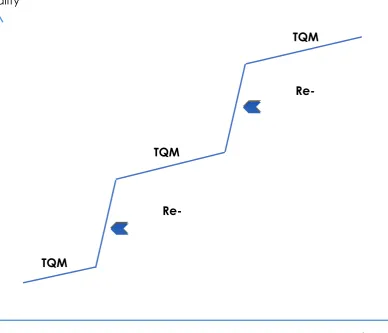
In relation to another concept, that of Business Process Reengineering (BPR), Morgan (1995) reveals number of common points and differences it has with TQM. He provides a comparative table in three basic areas namely: the impact of philosophy on management and its systems; the impact on operations, and the impact on the employees. In each area, specific aspects are compared. Among the differences reported by the author, the main control measure of TQM is the quality cost, whereas in the Organizational Process Improvement (OPI) it would be the process cost. As a result, TQM suggests more improvement opportunities than OPI. At the end of his reflection, the author recognizes that it is difficult to rule on the independence of the two concepts. For him, the success of some theories that combine the concepts could indicate an evolution of a new management system. However, Gordon (1994) notes that, during an interview with Joseph Juran, he mentions that OPI is only a new label of continuous improvement feeding TQM. A reflection shared by Jurison (1993) too. The latter places the process of reengineering in a cyclical approach continuous improvement oriented within TQM approach as shown in the figure below.
Figure 5 - Reengineering process cyclical approach within TQM Jurison (1993)
CONCLUSION
This paper identifies TQM as a theoretical framework. The latter intends to conceive quality implementation in the entire organizational functioning. The different concepts mentioned in the literature would use different designations but would have the same philosophy. It joins the call of several authors namely Dale (1999) ; Hendricks et Singhal (2000) ; Oakland (1989) ; Kuei (1998) ; Godfrey et al. (1997) et Martinez et al. (1998) ; Dahlgaard et al. (2002) ; Feigenbaum (1991) ; Levy (1998) ; Gordon (1994) ; Jurison (1993) ; and others emphasizing
TQM
Re-engineering
TQM
TQM
Quality
Time
would stimulate a form of scientific efforts federation to enrich and develop the concept of total quality and its implementation in organizations.
In a nutshell, Kuei (1998) presents a genesis of the main contributions in quality. She talks about "the leaders of total quality". The author has categorized the contributions in quality into three major key aspects that have enriched the philosophy of TQM as summarized in the figure below.
Figure 6 - Total Quality leaders’ contributions’ system genesis Kuei (1998)
A path forward
Through its literature review, the logic provided by this paper calls for a better consolidation of achievements in terms of scientific contributions. The latter being the result of past added value and, at the same time, a reference and a vast field of questioning for future contributions. This elucidates the scientific logic. The latter, to detect, analyze and understand the laws that govern the world, opens the debate and allows to form and organize the puzzle of an image representing a perceived reality. Along with providing additional pieces, the first aspects discussed are questioned. This would be due to the emergence of contradictory results compromising them totally or partially or to the skepticism inherent to any scientific process
Fondamental
Human relationships
Time
Reality/truth Human
nature Human activities
Total Quality leaders’ contributions’ system genesis
Power /
Status Barriers
Peer relationship
s
Language Reward /
punishment Measures
Means
Goals Mission Correction
External
recalling the limits of observation and, consequently, questioning the reliability of the perceived reality.
Moreover, every scientific thought must respect a certain orthodoxy. As a result, philosophical posture and subsequent methodological choices are made. From here springs the importance of the subject dealt with on which the scientific reasoning will be applied. It can be attempting to highlight a whole already established theory or some theoretical constructs in progress on which an infinite number of debates are opened. The question raised concerns the choices to be made by the researcher to better present his or her scientific reasoning. For instance, in the first case, he or she would adopt a positivist epistemology bearing in mind that he or she began his or her reflection from a designated theory. In the second case, he or she would be more interested in a form of subjectivity which, through a constructivist epistemology, would enable him or her to express his or her own perception of specific cases observed.
When it comes to quality, this paper reveals enormous intellectual efforts that do not necessarily represent a complementary set but a field of uncertainty. In this sense, in addition to the dilemma about the existence of the quality theory, the researcher would not be able to clearly identify an appellation cited by another contribution to express his or her own idea. He or she would tend to refer to a set of terms designating the same thing or even provide his or her own designation for an idea clearly expressed in the literature.
In this case, to what extent one could evoke a certain lack of assurance towards past contributions as well as obstacles characterizing the respective approaches of contributions that would slow down the scientific logic pace concerning quality? Is it not time yet to recognize quality, after all existing contributions from academicians and practitioners, as a truly theory? Some would argue that the development of a theory would take several centuries. For information, one of the first definitions given to quality is related to Hammurabi’s code in its article 229. This code dates from about two thousand years before Jesus Gitlow et al. (1995).
References
Avery Christine and Zabel Diane. (2003). The Quality Management Sourcebook: An international guide to materials and resources. Taylor & Francis e-Library.
Bisgaard, S. (2007). “Quality Management and Juran’s Legacy”. Quality and Reliability Engineering International, No. 23(6), 665–677.
Boaden, R. J. (1997). “What is total quality management… and does it matter?”. Total Quality Management, Vol. 8, No. 4, pp. 153-171.
Costin, H. I. (1994). Readings in Total Quality Management. New York: The Dryden Press Harcourt Brace College Publishers.
Crosby, P. (1979). Quality is Free: The Art of Making Quality Certain. McGraw-Hill. New York. NY. Crosby, P. (1996). Quality is Free: Making Quality Certain in Uncertain Times. McGraw-Hill, New York.
Dahlgaard Jens J., Kai Kristensen and Gopal K. Kanji (2002). Fundamentals of Total Quality Management Process analysis and improvement. Taylor & Francis. London and New York.
Dale, B.G. (1999). Managing Quality. Third Edition. Oxford: Blackwell Publishers Ltd.
Davis, D. and Fisher, T.J. (1994). “The pace of change: a case study of the development of a total quality organization”. International Journal of Quality & Reliability Management, Vol. 11 No. 8, pp. 5-18.
Deming, W. E. (1982). Quality, Productivity and Competitive Position. MIT Center for Advanced Engineering, Cambridge, MA.
Ebert, R. J., & Griffin, R.W. (2000). Business Essentials (3rd ed.). New Jersey: Prentice Hall. English, L.P. (1996). “Help for data-quality problems”. Information week. No. 600, pp. 53-62.
Evans, J. R., Anderson, D.R., Sweeney, D.J., & Williams, T.A. (1990). Applied production and operations management. New York: West Publishing Company.
Feigenbaum, A. V. (1951). Quality Control: Principles, Practice and Administration. McGraw-Hill, New York. Feigenbaum, A. V. (1961). Total Quality Control. McGraw- Hill, New York.
Feigenbaum, A. V. (1991). Quality Control: Principles, Practice and Administration. Third ed. McGraw-Hill, New York.
Financial Times, 20 March 1991.
Foster, S. T. (2004). Managing Quality. An Integrative Approach (2nd ed.). Pearson Education International. Garvin, D. A. (1988). Managing Quality: The Strategic and Competitive Edge. New York: The Free Press.
Gitlow, H., Oppenheim, A. and Oppenheim, R. (1995). Quality Management: Tools and Methods for Improvement, 2nd ed., Burr Ridge, IL: Irwin.
Godfrey, A.B., & Kenett, R.S. (2007). “Joseph M. Juran, a perspective on past contributions and future impact”. Quality and Reliability Engineering International, Vol. 23 Issue 6, October, 653–656.
Godfrey, G., Dale, B., Marchington, M. and Wilkinson, A. (1997), “Control: a contested concept in TQM research”. International Journal of Operations & Production Management, Vol. 17 No. 6, pp. 558-73.
Goetsch, D.L. and Davis, S. (2006). Quality Management. Introducing to Total Quality Management for Production, Processing, and Services (5th ed.). Upper Saddle River, New Jersey: Pearson Education International.
Gordon, Jack. (1994). “An Interview with Joseph M. Juran”. Training 31:35–41.
Grandzol, J.R. and Traaen, T. (1995). “Using mathematical programming to help supervisors balance workloads”. Interfaces, Vol. 25 No. 4, pp. 92-103.
Hackman, J.R. and Wageman, R. (1995). “Total quality management: empirical, conceptual, and practical issues”. Administrative Science Quarterly, Vol. 40 No. 2, pp. 309-42.
Hendricks, K.B., & Singhal, V.R. (2000). “Firm characteristics, total quality management, and financial performance”. Journal of Operations Management 238 (2000) 1–17.
Ishikawa, K. (1985). What is Total Quality Control? – The Japanese Way, Prentice Hall, Englewood Cliffs, USA. Ishikawa, K. (1990). Introduction to Quality Control. 3A Corporation, Tokyo.
Juran, J. M. (1951). Quality Control Handbook. McGraw-Hill, New York.
Juran, J. M. (1962). Quality Control Handbook. Second ed. McGraw-Hill, New York. Juran, J. M. (1974). Quality Control Handbook, third ed. McGraw-Hill, New York.
Juran, J. M. (1986). “The Quality Trilogy. A Universal Approach to Managing for Quality”. ASQC 40th Annual Quality Congress. California. pp. 1–9.
Juran, J. M. (1988). Juran on Planning for Quality. New York: The Free Press.
Juran, J. M. (1989). Juran on Leadership for Quality: an Executive Handbook. Free Press, New York.
Juran, J. M. (1992). Juran on Quality by Design: the New Steps for Planning Quality into Goods and Services. Free Press, New York.
Juran, J. M. and Gryna, F. M. (1998). Quality Planning and Analysis. Fourth Edition, McGraw-Hill Companies, Inc., New York.
Jurison, J. (1993). “The role of information systems in total quality management”. Knowledge and Policy, 7(2)3-16. Kuei Chu-Hua (1998). “Comparing Deming’s and Juran’s philosophies to the formation of total quality leaders’ world views”. In Madu N. C. (1998) Handbook of Total Quality Management. Springer Science-Business Media Dordrecht. Pace University. New York, USA.
Martinez-Lorente Angel R., Frank Dewhurst and Barrie G. Dale (1998). “Total quality management: origins and evolution of the term”. The TQM Magazine. Volume 10 · Number 5. pp. 378–386.
Milakovich, M.E. (1991). “Total quality management in the public sector”. National Productivity Review, Vol. 10, No. 2, pp. 195-213.
Morgan, C. (1995). “TQM and BPR Compared”. In Burke, G. and Peppard, J. (ed.). Examining Business Process Reengineering: Current Perspectives and Future Directions. London, Kogan Page Ltd.
Neave H. R. (1995). “W. Edwards Deming (1900-1993): the man and his message”. Total Quality Management. G. K. Kanji (ed.) Springer Science-Business Media Dordrecht.
Oakland, J. S. (1989). Total quality management. Oxford, UK: Heinemann.
Oakland, J. S. (1993). Total Quality Management (2nd ed.). Oxford: Butterworth-Heinemann.
Pollock, S. (1993). “The KISS principle works”. Journal for Quality & Participation, Vol. 16 No. 7, pp. 90-2. Rago, W.V. (1994). “Adapting total quality management (TQM) to government: another point of view”. Public Administration Review, Vol. 54 No. 1, pp. 61-4.
Roderick M. (1996). “Quality system. An International Part of Total Quality Management”. Computers ind. Engng, 31(3/4), pp. 735-757.
Romano, C. (1994). “Report card on TQM”. Management Review, Vol. 83 No. 1, pp. 22-5.
Schay, B.W. (1993). “In search of the Holy Grail: lessons in performance management”. Public Personnel Management, Vol. 22 No. 4, pp. 649-68.
Shingo, S. (1986). Zero quality control: source inspection and the poka-yoke system. Cambridge, MA: Productivity Press.
Spurgeon, S.P., Marcinko, F., Mengele, M.J., & Lyman, R.C. (1990). QPL or QML. “A quality trilogy approach”. Annual Quality Congress Transactions, Vol. 44, May, USA, CA: San Francisco, 189–193.
Tamimi, N. and Gershon, M. (1995). “A tool for assessing industry TQM practice versus the Deming philosophy”. Production & Inventory Management Journal, Vol. 36 No. 1, pp. 27-32.