Increasing Transmission Rate, Network Life
in WSN by Reducing Data Gathering Delay
using BRH-MDG and DSDV Protocol
S.Revathy
#1, E.Srinivasan
#2, G.Elumalai
#3#1 Assistant Professor, Department of Electronics and Communication Engineering, Jeppiaar Institute of Technology, Chennai, Tamil Nadu, India.
#2 Assistant Professor, #3 Associate Professor,
Department of Electronics and Communication Engineering, Panimalar Engineering College, Chennai, Tamil Nadu, India.
Abstract:
Increasing the life span of energy resource and network is critical constraint on Wireless Sensor Network (WSN) is employing the batteries followed by data manipulations. Energy consumption rate for sensor in WSN varies greatly based on the protocols used for system implementations. In this research we maximized the networks life span by reducing the data gathering delay. In previous implementations less moving velocity of Mobile Collector (MC) in multi-hop, this increases the data gathering dormancy. In our research with help of NS-2 simulator we found a set of special nodes referred to as polling points (PP) in the network and determined the tour of mobile collector by visiting each polling points in a specific sequence, mobile data gathering is optimized by BRH-MDG (Bounded Relay Hop Mobile Data Gathering), reducing the gathering delay was achieved by DSDV (distance sequence distance vector) proactive protocol in efficient way
.
Keywords: Mobile Collector (MC), Polling Points
(PP), BRH-MDG, DSDV Proactive Protocol, NS-2 Driven Network Simulator, Intel core Duo Processor, Data gathering.
I. INTRODUCTION
Wireless sensor network (WSN) has become a leading area of research, WSN is distributed and self-directed, and tiny, low powered devices such as sensor nodes alias. It responds and detects some type of input from the physical or ambient environmental conditions, also measure and monitors sensing task like heat, pressure, light, sound, vibration and presence of objects. Data exchanges through multiple nodes, and connected to other network like ethernet. It may construct the networks in various topologies like star, tree, and mesh [1].
For maintaining power beside the network life span, energy consumed on monitoring the environment with periodical sampling, a major portion of energy expenditure in WSNs attributed to the activities aggregating data to the data sink. Due to the stringent energy constraints in WSNs, recent research has striven to address the issue of energy saving in data aggregation
Fig: 1 Multi-hop wireless sensor architecture
Each such sensor network node has typically several parts shown in Fig 2 components of WSN consists radio transceiver with an internal antenna or connection to an external antenna, a microcontroller, an electronic circuit for interfacing with the sensors and an energy source, usually a battery or an embedded form of energy harvesting [2]. Mobile data gathering, which employs one or more mobile collectors that are mobilizing device or vehicles equipped with powerful transceivers and batteries, a separate node used to collect the information's from various nodes in network and forwarded to the required base station [3].
Fig: 2 Components in WSN
and RREP (Route Reply) [9] [11]. These user information packet, try to find alternative routes from the route cache, alternative routes are not available, the source node, enter route discovery phase to find new routes [4] [5] [8]. The main difference between DSR and AODV is in the way they keep the information about the routes: in DSR it is stored in the source while in AODV it is stored in the intermediate nodes. However, the route discovery phase of both is based on flooding. This means that all nodes in the network must participate in every discovery process, regardless of their potential in actually contributing to set up the route or not, thus increasing the network loads [11].
NS (version 2) is an object-oriented, discrete event driven network simulator developed at UC Berkely written in C++ and OTcl. NS is primarily useful for simulating local and wide area networks. The Network Simulator (NS-2) is a discrete event simulator developed by the University of California at Berkely, provide substantial support for simulation of TCP, routing and multicast protocol over wired and wireless (local and satellite) networks [6]. It provides tools for generating data traffic and node mobility scenario pattern for the simulation. NS-2 provides split programming model.
Fig: 3 Functional blocks of NS-2 Simulator
NS-2 helps user to get started quickly. Among NS-2, OPNET and Glomosim (Global mobile information system simulator) then NS-2 was chosen as the tool for our ad hoc wireless simulations [16]. NS-2 most widely used simulator for ad hoc wireless simulations, which runs on Linux Platform [14][15]. Easily extensible for any extension to existing ad hoc routing protocol can be implemented. Since most of the currently published results for MANETs (Mobile ad hoc network) have been used NS-2 for simulation too [7].
MANET is an autonomous system of mobile routers connected by unguided mediums. The routers are independently mobilized in random manner, they organize themselves arbitrarily, and thus, the network’s wireless topology may change rapidly and unpredictably [18]. In proactive routing protocol, every node maintains routing information's to rest of nodes in the network. These protocols maintain different number of routing tables varying from protocol to protocol. There are various well known proactive routing protocols, example: DSDV
(Destination-Sequenced Distance-Vector Routing), OLSR (Optimized Link State Routing Protocol), WRP (weighted rendezvous planning), etc. [10] [13][17].
DSDV routing is adapted from the conventional Routing Information Protocol (RIP) to ad hoc networks routing. It adds a new attribute, sequence number, to each route table entry of the conventional RIP. Using the newly added sequence number, the mobile nodes can distinguish state route information from the new and thus prevent the formation of routing loops. The main contribution of the algorithm solve the routing loop problem [11][12][13].
II. METHODOLOGY AND EXPERIMENTATIONS
A. Fact Finding:
We found the methods for gathering the information's required about the existing system like Observation, Record Searching, Special purpose Records, Sampling, Questionnaires, Interviewing in our work situation will provide clues and alternates the any cause, various situations. Record searching gave quantitative information which facilitates sizing of proposed system and helps to point the areas of difficulties which are being experienced. Questionnaires used to collect the quantifiable data about the system, generally most of techniques need to be supplement more details in interview situation, responsibilities for certain procedures only achieved for interviewing.
B. Input Design:
In our design if data fetching is random sequence in system it leads to errors. Input of the system prime inputs and user information data utilized internally, externally as well enrich the proposed system with numerous facilities that make it more advantageous in comparison with the exiting normal system.
C. Feasibility Analysis:
D. Cluster Head Selections:
Fig: 4 Cluster Head and Node
Base station is a cluster head performs computational functions such as data aggregation and data compression in order to reduce the number of transmission to the base station (or sink) thereby saving energy. Clustering based algorithms are believed to be the most efficient routing algorithm for the WSNs. Clustering along with reduction in energy consumption improves bandwidth utilization by reducing collision.
E.Back drop in Less Hop Count Transmission:
According to multi-hop routing, packets have to experience multiple relay before reaching the data sink, Minimizing energy consumption on the forwarding path does not necessarily prolong network lifetime as some popular sensors on the path. So to avoid the problem in multi-hop routing we are setting the less hop count transmission. Data continuously forwarded by static forward node it loss more energy so node failure, we used dynamic forward node with less hop count node here energy loss is very much less.
F. Information Processing Phase:
In this process will be repeated for specified regular intervals of time. A subset of sensors will be selected as the polling points (PP), each one aggregating the local data from its affiliated sensors within a certain number of relay hops. These PPs will temporarily cache the data and upload them to the mobile collector (MC).
G. Data Dissemination Phase (DDP):
Mobile collector has freedom to move to any location in the sensing field, provides an opportunity to plan an optimal tour. We found a set of special nodes referred to as PPs in the network and determine the tour of the mobile collector by visiting each PP in a specific sequence. When it arrives, it polls each PP to request data uploaded then to MC. In DDP the aggregated information from each cluster-head is passed to MC based on dissemination interval chosen.
H.Energy Efficient Routing:
The PP uploads data packets to the mobile collector in a single hop. The mobile collector starts
its tour from the static data sink, which is located either inside or outside the sensing field, collects data packets at the PPs and then returns the data to the data sink. Finally MC hand-over the data to data sink, such as BS. By this we can increase the life time of the sensors and also we reduce the data gathering delay in WSN. By using DSDV each node periodically broadcasts routing updates in order to keep an up-to-date view of the network topology. In such way, routes to all destinations are readily available at every node all times.
I. Process Flow Chart:
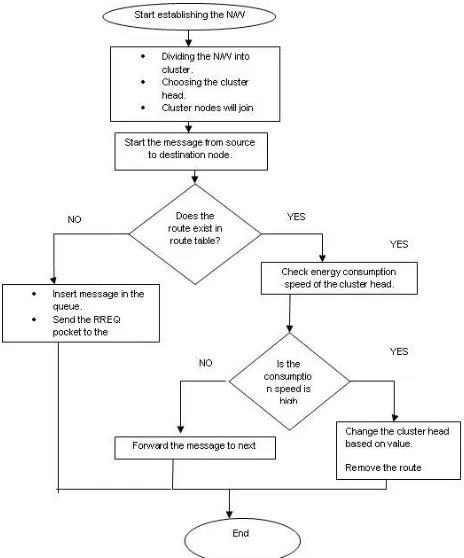
Initially establishing the Network and choose the cluster, and find the medium and join the nodes to carry the user information from source to destination, if route is found atonce monitor the energy consumption and data exchanging speed is very high, like wise we tried to reducing the energy consumption and increasing the life span of network, suppose the route was not found transmitting data is hold for some time in queue and then proceed, complete process showed in Fig 5.
Fig 5: Execution and Process Flow chart
III RESULTS AND DISCUSSIONS:
Fig 6: Trace File format
We create an event scheduler for manipulating multiples of data's, as packet by packet, processor (Inter Core 2 Duo) executes user instructions as per FIFO (First In First Out) concept and avoid the congestion during data packets exchanging between source to destination. Fig 6 describes file tracing format for data exchanging between the nodes, based on source and destination address, event, packet size and its identity, sequence number along with time of data executions
Fig 7: Fixations Cluster head and node formations
Totally 39 number of nodes with initial energy up to 500 joules, Mobility model is 0 - 20m/s random way point, data packet size and its value is 512 Bytes with CBR (Cluster based routing).
Fig 8: Nodes under data gathering
The time consuming is 800 seconds, Omni directional antennas for data exchanging between the nodes. Total date rate transmission 4 packets/sec, utilization of power for transmission as 1 Watts, 0.001 Watts as sleep power and maximum range of data transmission up to 300m.
Fig 9: Throughput vs. Time (Sec)
The Data sharing between the nodes executes between the certain time periods. Time period 2899 to 14000 seconds data’s and user information manipulated and transferred to the base station showed in Fig 9, 8000Kbps data’s are transferred in 5000 to 6000 seconds. We attained maximum level of data transmission up to 42000 Mbps in 10000 seconds. In Fig 10 describes attainment of maximum data transmission range with help of mobile collector, 20000 Mbps data’s are transferred at a distance 380, 0000 in meters this reduce the power consumption and increasing the lifetime of network.
Fig10: Transmission range with and without using Mobile Collector
In case without using mobile collector, 10000Mbps of data is transferred at a distance 1850000 in meters, due to absence of mobile collector time consuming process increased, need of power also increases.
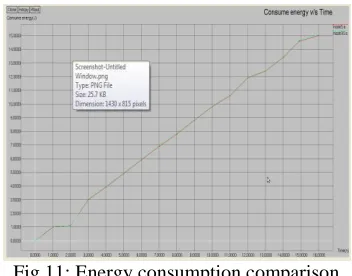
Fig 11: Energy consumption comparison
system extends the life span of the network due utilization of mobile collector.
IV CONCLUSION:
In all networks topologies the sensor nodes are consuming much more energy absorption, this energy constraint problem should be considered up to now, several research activities performed and various methods have been proposed about cluster-based WSN. In this research paper we presented a brief analysis of data gathering, increasing network life span in terms of energy consumption in cluster-based WSN. In our simulation we showed interpose between energy saving and data gathering dormancy produced by length of the mobile collector also we proposed polling points which are accumulated into bounded relay hopping problems. To have a good solution and efficient throughput we presented a comprehensive algorithms for selecting the polling points among different sensors in cluster, these ample algorithms can showed greatly abbreviated way for data gathering tour length with a small relay hop count, and we achieved invention target improvement nearer to crowning level, i.e., up to 89% on the tour length compared to SHDG (Single-hop data gathering) and CME (Controlled Mobile Element) schemes. By increasing the count of polling points between the cluster we may reducing the further data gathering delay and helpful to increasing life span of networks and other resources as long as possible.
REFERENCES:
[1]. Unai Burgos, Ugaitz Amozarrin, “ Routing in Mobile Wireless Sensor Network: A Leader-Based Approach”, Journal of Sensor, MDPI, Page 2-15, July 2017.
[2]. Miao Zhao, Yuanyuan Yang, “Bounded Relay Hop Mobile Data Gathering In Wireless Sensor Network”, IEEE Transactions on Computer, Vol 61, Issue 2, Page 265-277, February 2012.
[3]. Rahule Shah, Sumit Roy, “Data MULES: Modeling a Three-Tier Architecture for Sparse Sensor Network”, IEEE Page 30-41, 2003.
[4]. Muhammad Farhan Sjaugi, Mohamed Othman,” A New Distance Based Route Maintenance Strategy for Dynamic Source Routing Protocol”, Journal of Computer Science, Vol 4, Issue 3, Page 172-180, 2008
[5]. B. Thanikaivel, B.Pranisa, “Fast and Secure Data Transmission in MANET”, International Conference in Computer Communication and informatics”, Page 10-12, 2012
[6]. Deepak Kumar, Ashutosh Srivastava, “ Performance Comparison of Pro-active and Reactive Routing Protocols for MANET”, Computing Communication and Applications (ICCCA), IEEE, Page 22-24, Aril 2012
[7]. Feny Bao, Ing-Ray Chen, “ Hierarchical Trust Management Sensor Netwrok and Its Applications to Trust- Based Routing and Intrusion Detection”, IEEE Transaction on Network and Service Management, Vol 9, Issue 2, Page 169-183, June 2012
[8]. Fei Dai, Jie Wu, “Proactive Route Maintenance in Wireless Ad Hoc Networks”, IEEE Xplore, Page 16-20, August 2005.
[9]. Mohammad AI-Rabayah, Robert Malancy, “A New Scalable Hybrid Routing Protocol for VANETs”, IEEE Transaction on Vehicular Technology, Vol 61, Issue 6, July 2012.
[10]. Anto Ramya S.I, “Destination Sequenced- Distance Vector Algorithm”, International Journal on Computer Science and Engineering (IJCSE), Vol 7, Issue 11, Page 129-136, November 2015.
[11]. Akshai Aggarwal, Savita Gandhi, “Performance Analysis of AODV, DSDV and DSR in MANETS”, International Journal of Distributed and Parallel Systems (IJDPS), Vol 2 Issue 6, November 2011.
[12]. Ebrahim Mahdipour, Amir Masound Rahmani, “Performance Evaluation of Desitination-Sequenced Distance Vector (DSDV) Routing Protocol”, IEEE Xplore, International Conference on Future Network, August 2009.
[13]. Kushboo Tripathi, Tulika Agarwal, “ Performance of DSDV Protocol Over Sensor Networks”, International Journal of Next Generation Networks (IJNGN), Vol 2, Issue 2, June 2010.
[14]. Rachna Chaudhary, Shweta Sethi, “ A Study of Comparison of Network Simulator-3 and Network Simulator-2”, International Journal of Computer Science and Information Technologies, Vol 3, Issue 1, Page 3085-3092, 2012.
[15]. Genita Gautam, Biswarajsen, “ Design and Simulation of Wireless Sensor Networks in NS2”, International Journal of Computer Application, Vol 113, Issue 16, Page 14-16, March 2015.
[16]. Sirwan A. Mohammed, Dr. Sattar B. Sadkhan, “ Design of Wireless Networks Based on NS2”, Journal of Global Research in Computer Science, Vol3, Issue 12, Page 1-8, December 2012.
[17]. Mao Shengli, “ Research in The Application of NS2 Network Simulation Based on Clustering Algorithm”, The Open Automation and Control System Journal, Vol 7, Page 1210-1215, 2015.