RESEARCH ARTICLE
MICROORGANISM COMBINATION FOR RAPID INCREASE OF PEPTIDE YIELD IN SOLID-STATE
FERMENTATION OF SOYBEAN MEAL AND THE CORRESPONDING MECHANISM
*Junjun Guan, Guohao Yang, Haicheng Yin, Feng Jia and Jinshui Wang
College of Biological Engineering, Henan University of Technology, Lianhua Street, Zhengzhou New and
High-tech Industrial Development Zone, Zhengzhou 450001, China
ARTICLE INFO
ABSTRACT
Background: Soybean meal was used as substrate to evaluate effects of three microorganisms, Bacillus
sublitis (B), Saccharomyces sp. (S) and Lactococcus lactis (L), on peptide production by solid-state
fermentation (SSF) with a shorter fermentation time (such as 36h or less), and the corresponding mechanism, under the condition of liquid soybean meal dextrose medium as culture medium and soybean meal as solid substrate without other supplements, thus forming a environment of limited living condition, enhance microbial competition.
Results: Some synergistic effects and appropriate inoculation ratio of starter culture were found to increase peptide yield and protease activity, reduce the pH of system to acidity and shorten the fermentation time to 36h or less in soybean meal SSF. The highest peptide content was achieved at the inoculation ratio of 2:1:1 of microorganism combination of B+S+L, also with the highest protease activity and quick growth characteristics of these three microorganisms, indicating that the peptide production was associated with the protease activity and various microbial growths.
Conclusions: So appropriate inoculation ratio of starter culture speeded up the SSF of soybean meal and the mechanism of microorganism improvement of peptide production in SSF of soybean meal could be inferred reasonably, demonstrating the potential for the high peptide production of soybean meal SSF in the industry.
Copyright © 2014 Junjun Guan et al. This is an open access article distributed under the Creative Commons Attribution License, which permits unrestricted use, distribution, and reproduction in any medium, provided the original work is properly cited.
INTRODUCTION
As a main protein source for animal feedstuffs, soybean meal
often has several antinutritional factors including
carbohydrates, such as galactosyl derivatives of sucrose and non-starch polysaccharides (Choct et al., 2010), and antigenic proteins, such as glycinin and β-conglycinin (Song et al.,
2010), which might cause hypersensitivity. Some
antinutritional factors of soybean meal may be inactivated through heat treatment or extrusion (Maenz et al., 1999), but heating excessively or insufficiently will cause the reduced nutrition potency and biological activity (Peres et al., 2003). Chemical inactivation was reported earlier (Sessa and Nelsen, 1991), but is often accompanied by the residual reagent, therefore causing the adverse effect on animals. As to enzyme treatment for soybean meal (Graham et al., 2002), the higher cost may be the main reason for the limited application in industry. Microbial fermentation (Hong et al., 2004; Refstie et
al., 2005) is a more economical approach to reduce the
antinutritional factors of soybean meal, and the use of different strains for soybean meal fermentation, not only can produce
*Corresponding author: Junjun Guan,
College of Biological Engineering, Henan University of Technology, Lianhua Street, Zhengzhou New and High-tech Industrial
Development Zone, Zhengzhou 450001, China
microbial enzymes to reduce anti-nutritional factors in soybean meal, but also can accumulate some other beneficial metabolites such as peptides. Solid-State Fermentation (SSF) is often used to process soybean meal for the lower cost of production, and the commonly used microorganisms are
Bacillus subtilis (Teng et al., 2012), Lactobacillus (Gao et al.,
2013), yeast (Mo C-w and Huang, 2007), koji
(Chantasartrasamee et al., 2005), Aspergillus niger (Hong et
al., 2004) and so on, which are thought of the main factor that
affect the quality of fermented soybean meal. So, selection of single or mixed culture in SSF will have a major influence on the composition of product. Now mixed-culture SSF tends to be applied in practice due to the synergistic effect usually existing among the most microorganisms. Based on the characteristics of strains chosen, soybean meal SSF can be divided into three types of fermentation, including aerobic fermentation (Teng et al., 2012), anaerobic fermentation (Gao
et al., 2012), and two-stage aerobic-anaerobic fermentation
(Wei et al., 2013), and the latter was usually used in some industries, which contained aerobic fermentation such as
Bacillus subtilis at the early stage to produce a large amount of
active substances such as protease, amylase, cellulase enzymes, digestive enzymes, and peptide etc, and anaerobic fermentation such as Lactobacillus at the later stage to secrete acidic substances that make the fermented product with sour
ISSN: 0976-3376
Asian Journal of Science and Technology Vol. 5, Issue 2, pp. 117-123, February, 2014ASIAN JOURNAL OF
SCIENCE AND TECHNOLOGY
Article History:
Received 20th November, 2013 Received in revised form 07th December, 2013 Accepted 30th January, 2014 Published online 21st February, 2014
Key words:
flour and improve the proteolysis to produce small protein, peptide and free amino acid etc. So, through SSF, microorganism can remove the anti-nutritional factors, and cause protein (macromolecule) degradation to produce small protein and peptide that contributes to the animal absorption. Therefore, peptide, especially small peptide (< 10 kDa), produced in the SSF of soybean meal, is the important index to judge the quality of fermented product. Furthermore, now efficient improvement of peptide in soybean meal SSF is interesting more and more researchers. Although, fermented soybean meal has been found with great potential for application of livestock, poultry and aquaculture, there are still many inadequacies or problems in the process, especially in the large-scale SSF, such as longer fermentation time (> 2 d) (Gao et al., 2013; Chantasartrasamee et al., 2005), substrates becoming tacky and clumping together, high temperature (40-50 ˚C or more) inside substrates, and ammonia-like smell produced (Allagheny et al., 1996), which usually stem from excessive aerobic fermentation or deep solid substrate without good breathability or a longer fermentation time etc, and also make a greater impact on the product quality and profit. Since SSF occurs when microorganisms grow on the solid substrates, the interaction among different microorganisms is believed necessary to solve these problems.
SSF of soybean meal with three individual and combined microorganisms, Bacillus sublitis, Saccharomyces sp. and
Lactococcus lactis, was previously investigated by some
researcher at the small scale with a longer fermentation time (Refstie et al., 2005; Teng et al., 2012; Gao et al., 2013; Mo and Huang, 2007; Wang et al., 2011), mostly due to the synergistic effects among them under the appropriate conditions in mixed-culture SSF, but up to now little is known about the effect of various combinations of these microorganisms inoculated at different ratio for the improvement of peptide production. Thus, the objectives of the present study were to systematically investigate if any synergistic effect exists among the three microorganisms based on the peptide production with a shorter fermentation time (such as 36h or less), and the corresponding mechanism, under the condition of liquid soybean meal dextrose medium as culture medium and soybean meal as solid substrate without other supplements, thus forming a environment of limited living condition, enhance microbial competition. In addition the compositions of culture medium and solid substrate concerned in this study have been not reported by other researchers until now.
RESULTS AND DISCUSSION
Preliminary experiments
In this study, Bacillus sublitis (B), Saccharomyces sp. (S) and
Lactococcus lactis (L) were chosen as the starter cultures,
owing to their physiological, enzymological and biochemical properties and possible existence of the reciprocity and synergistic effect between strains (Soccol et al., 2010). In order to improve the microorganism adaptation of SSF condition (only soybean meal of solid substrate), the liquid culture medium for these three microorganisms before their inoculation, was only mixed with soybean-meal powder and dextrose, without other additives, thus leading to relatively limited nutrition for the microorganisms, entering the
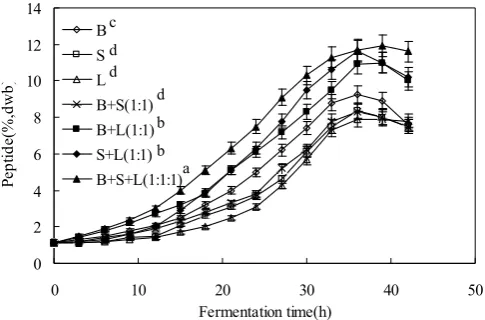
logarithmic growth phase earlier, and so decreasing the incubation time of cultures to 8 h compared to often 18-24 h reported (Wang et al., 2011). The peptide content of unfermented soybean meal assayed was 1.1% (dwb) as control, and after SSF, soybean meal had a significantly higher peptide content (P<0.05), no matter single-culture or mixed-culture SSF, with the time to the highest peptide content for each treatment at 36h or less, from the preliminary experiment seen in Figure 1. Through further analysis, it was found that soybean meal with mixed inoculation had significantly higher peptide content (P < 0.05) than that with single inoculation except the treatment of B+S(1:1), and triple microorganism combination SSF also had significantly higher peptide content (P < 0.05) than SSF with dual microorganism combination. Moreover, for dual microorganism combination SSF, no significant difference (P>0.05) between B+L(1:1) and S+L(1:1) was found, but both treatments had higher content of peptide (P<0.05) compared to B+S(1:1); for single microorganism SSF, soybean meal with Bacillus sublitis inoculation alone had significantly higher content of peptide (P < 0.05) than the other treatments of S and L.
0 2 4 6 8 10 12 14
0 10 20 30 40 50
Fermentation time(h)
P
e
p
ti
d
e
(%
,d
w
b
)
B S L B+S(1:1) B+L(1:1) S+L(1:1) B+S+L(1:1:1)a
b b c
d d
d
Figure 1. Time profiles of peptide content at different microorganisms and combinations during SSF of soybean meal.
Different letters represent significant differences at P = 5%. LSD0.05 = 0.5187. All different microorganism combinations are
described in Table 1
These results obtained from the preliminary study suggested that there was some synergistic effect among the three microorganisms, especially for the combinations of B+L, S+L and B+S+L, but no synergistic effect was found in SSF with B+S combination at inoculation ration at 1:1. It was true that under the condition of culture incubation in present study, the microorganisms should naturally make full use of soybean meal in SSF so that the higher content of peptide was produced, possibly because protein is the main composition of soybean meal with the content of 46%, resulting in the higher chance of its access to microorganisms. Similarly, only soybean meal as the solid substrate in SSF, would be the relative homogeneity and also used fully and rapidly and therefore reduce the incubation time of SSF to 36 h or less, compared to 48-72 h reported (Refstie et al., 2005; Teng et al., 2012; Gao et al., 2013; Mo and Huang, 2007; Wang et al., 2011).
Microorganism combination
meals were shown in Figure 2. For B+S combination (Figure 2a), the highest content of peptide was obtained in treatment of B+S(2:1), which was not significant difference (P > 0.05) with single-culture treatment of B, and the lowest content of peptide was found in treatment of B+S(1:2), which was even significantly lower (P < 0.05) than single-culture treatment of S, and at 1:1 inoculation ratio of B+S, the content of peptide was similar to the single-culture treatment of S. For B+L combination (Figure 2b), appropriate inoculation ratio of B+L could improve the content of peptide: treatments of B+L(2:1) and B+L(1:1) had significantly higher (P<0.05) peptide content than the single-culture treatments, and the highest value was found in treatment of B+L(2:1), but the lowest value (P<0.05) was found in treatment of B+L(1:2), even lower than that of treatments of B and L. For S+L combination (Figure 2c), though the highest numerical value of peptide content was obtained in treatment of S+L(1:1), there was no significant difference (P>0.05) with S+L(2:1). And for B+S+L combination (Figure 2d), treatment of B+S+L(2:1:1) had the highest level of peptide (P<0.05), followed by the treatments of B+S+L(1:1:1) and B+S+L(2:2:1), between which there was not significant difference (P>0.05), and next followed by B+S+L(1:2:1) and B+S+L(2:1:2) that had also no significant difference (P>0.05) in the level of peptide, but treatments of B+S+L(1:1:2) and B+S+L(1:2:2) had significantly lower (P<0.05) content of peptide than single-culture treatment of B, and had no significant different (P > 0.05) with the single-culture treatments of S and L.
0 2 4 6 8 10 12 14 16 18
B S B+S(1:1) B+S(2:1) B+S(1:2)
P
e
p
ti
d
e
(%
,d
w
b
)
c a
b b
a
a
0 2 4 6 8 10 12 14 16 18
B L B+L(1:1) B+L(2:1) B+L(1:2)
P
e
p
ti
d
e
(%
,d
w
b
)
c
d
b
a
e
b
0 2 4 6 8 10 12 14 16 18
S L S+L(1:1) S+L(2:1) S+L(1:2)
P
e
p
ti
d
e
(%
,d
w
b
)
b b
a a
c
c
0 2 4 6 8 10 12 14 16 18
B S L
B+S
+L(1
:1:1
)
B+S
+L(2
:1:1
)
B+S
+L(1
:2:1
)
B+S
+L(2
:2:1
)
B+S
+L(1
:1:2
)
B+S
+L(1
:2:2
)
B+S
+L(2
:1:2
)
P
e
p
ti
d
e
(%
,d
w
b
)
c
f e b c a
b
ef ef d
d
Figure 2. Effect of inoculation ratios of dual microorganism combinations of B+S (a), B+L (b), S+L (c) and B+S+L (d) on peptide contents of soybean meal, with incubating for 36h. Means
followed by the same letter are not significantly different at P = 5%. LSD0.05 = 0.6692 for B+S (a), LSD0.05 = 0.7154 for B+L (b), LSD0.05 = 0.7284 for S+L (c) and LSD0.05 = 0.7726. All different
microorganism combinations are described in Table 1
In mixed-culture fermentation, competition between
microorganisms for living space can improve the nutrient utilization (Hibbing et al., 2010) and thus leads to some substances produced including peptide etc. Obviously, there were synergistic effects in some duial/triple microorganism combinationsn soybean meal SSF, including B+L(1:1),
S+L(1:1), B+S+L(2:1:1), B+S+L(1:1:1), B+S+L(2:2:1),
oxygen in environment of SSF to produce lots of metabolins and gradually form a good environment that could promote growth of Saccharomyces sp. and Lactococcus lactis. On the contrary, as a facultative anaerobe, Lactococcus lactis with the higher proportion (such as B+L(1:2), S+L(1:2), B+S+L(1:1:2)) in mixed-culture SSF, could multiply quickly so as to form an anaerobic and high-acidity environment, thus leading to restraining the growth of the other microorganisms. Similar effect also happened to Saccharomyces sp. with the higher proportion (such as B+S(1:2)) in mixed culture.
Protease activity
Further study on the relation of inoculation ratio and peptide yield was conducted by determining the protease activity during the course of SSF. Selection of microorganism combination was according to the peptide production based on the previous batehes. As can be seen in Figure 3a, total protease activity in single-culture SSF was not higher than that in optimal mixed-culture SSF, especially for treatments of S and L, and treatment of B+S+L(2:1:1) had the highest total protease activity (P<0.05), followed by B+L(2:1). For the developing trend, it was related to the microorganisms used, and for example, similar trend was found among B, S and B+S(2:1), and as the fermentation was in progress, the total protease activity increased slowly in the first 9h, quickly for B+ L(2:1), S+L(1:1) and B+S+L(2:1:1) in the followed time, quickly for B and B+S (2:1) in the following 15h and decreased slowly for B and B+S (2:1) in the last 12h, and for S and L, it increased slowly in the course of SSF, compared to the other treatments. These results indicated that SSF with the optimal combination of starter cultures for the higher yield of peptide also could produced higher total protease activity and mixed-culture SSF helped to produce higher activity than single-culture SSF.
0 200 400 600 800 1000 1200
0 10 20 30 40
T
o
ta
l
p
ro
te
a
se
a
c
ti
v
it
y
(U
/g
)
Fermentation time(h) B
S L B+S(2:1) B+L(2:1) S+L(1:1) B+S+L(2:1:1)a
b a b
b c c
a
5 5.2 5.4 5.6 5.8 6 6.2 6.4 6.6 6.8 7
0 10 20 30 40
Fermentation time(h)
p
H
0 100 200 300 400 500 600 700 800
P
ro
te
a
se
a
c
ti
v
it
y
(U
/g
)
pH Acid protease Alkaline protease Neutral protease
b
5 5.2 5.4 5.6 5.8 6 6.2 6.4 6.6 6.8 7
0 10 20 30 40
Fermentation time(h)
p
H
0 50 100 150 200 250 300 350 400 450
P
ro
te
a
se
a
c
ti
v
it
y
(U
/g
)
pH Acid protease Alkaline protease Neutral protease
c
Figure 3. Time profiles of total protease activity at different microorganisms and combinations (a), and various protease activities and pH of substrates for B+S+L(b) and B+S(c) during
SSF of soybean meal. Different letters represent significant differences at P = 5%. LSD0.05 = 119.87. All different microorganism combinations are described in Table 1.
Therefore, it can be inferred that protease activity seemed to be responsible for peptides release (Alexandre et al., 2001), that is, peptide was produced by proteolysis in SSF. However, different microorganism combination could affect the protease activity, such as B+S+L(2:1:1) and B+S (2:1) with different trends of total protease activity (Figure 3a). Since total protease activity includes acid, alkaline protease activity, various protease activities pH were determined for B+S+L(2:1:1) (Figure 3b) and B+S (2:1) (Figure 3c) during SSF process. For the activities of alkaline and neutral proteases and pH, the developing trends of B+S+L(2:1:1) and B+S(2:1) were similar, the highest activity at 24h of fermentation time and the neutral protease with the higher activity. But, for the acid protease activity, B+S+L(2:1:1) had an increased value at the later stage (24-36h) (Figure 3b), while similar trend was not found in B+S (2:1), with very low activity and high pH above acidity (Figure 3c), maybe due to no Lactococcus lactis used in B+S(2:1) that could produce lactic acid (Cock and Stouvenel, 2006) to adjust the pH of substrate to acidity and improve the activity of acid protease produced during SSF. Hence it can be also inferred that
Lactococcus lactis improved the activity of protease in the
later stage of SSF, enhanced the peptide production and thus increased rapidly the yield of peptide for SSF of soybean meal.
Microbial growth
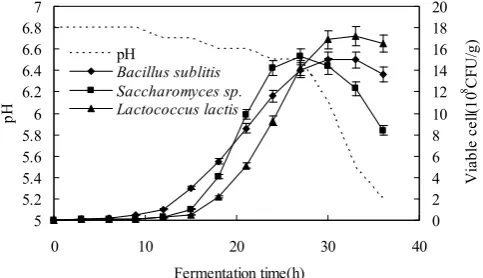
The optimal combination of B+S+L(2:1:1) was investigated on the microbial growth profiles and the results were shown in Figure 4. In the fermentation time of 0-18h, Bacillus sublitis grew more quickly than the other microorganisms, and after 15h, Saccharomyces sp. and Lactococcus lactis started to grow quickly and the degree of increase was greater for the former, but after 27h, the growth of Saccharomyces sp. and Bacillus
sublitis showed a slow decline trend, while until 33h, Lactococcus lactis came to grow slowly. Correspondingly, the
pH of substrate was changed from 6.8 to 5.2, especially for the later stage of SSF (>27h) with a sharp decline, due to faster
growth of Lactococcus lactis. As SSF progresses,
and as the fermentation went on and oxygen was depleted among the particles of substrate, the environment was suitable for the growth of Saccharomyces sp. and Bacillus sublitis more and more. Accordingly, the optimal combination of B+S+L(2:1:1) gave full play to growth characteristics of these three microorganisms and thereby speeded up the SSF of soybean meal.
5 5.2 5.4 5.6 5.8 6 6.2 6.4 6.6 6.8 7
0 10 20 30 40
Fermentation time(h)
p
H
0 2 4 6 8 10 12 14 16 18 20
V
ia
b
le
c
e
ll
(1
0
8 C
F
U
/g
)
pH
Bacillus sublitis Saccharomyces sp. Lactococcus lactis
Figure 4. Time profiles of viable cell of various microorganisms and pH of substrates for B+S+L(b) during SSF of soybean meal
Mechanism
It is possible that the protease activities that are affected by microbial growth conditions manipulate the formation of peptides to some extent (Korhonen and Pihlanto, 2006). Results showed that the peptide yield was associated with the activity of protease produced in the mixed-culture SSF. For the microorganisms used in this study, Bacillus sublitis is often regarded as aerobe, while both of Saccharomyces sp. and
Lactococcus lactis are regarded as facultative anaerobe, so
protease activity in single-culture SSF was lower than that in mixed-culture SSF, which might be caused by the synergistic effect among the microorganisms, and as a result, the higher content of peptide was obtained in mixed-culture SSF in the preliminary experiments. And thus, the mechanism of microorganism improvement of peptide production in SSF of soybean meal could be inferred as follows:
For the optimal microorganism combination of B+S+L(2:1:1), in the earlier stage of SSF, Bacillus sublitis grew more rapidly to mainly cause the increase of activities of neutral and alkaline proteases, and with the fermentation processing, the growths of Saccharomyces sp. and Lactococcus lactis were speeded up gradually, resulting in the falling pH to acidity and therefore the increase of activity of acid protease in the later stage of SSF. Under the living environment formed, various microbial growths and various activities of proteases that were enhanced successively, interacted synergistically with each other and thus contributed to the peptide yield by the proteolysis. As a result, the shorter fermentation time was applied in the soybean meal SSF.
METHODS
Microorganisms and culture preparation
Bacillus sublitis (ACCC 01746), Saccharomyces sp. (CICIM
Y0362) and Lactococcus lactis (ACCC 11092) were provided
by Henan Engineering Laboratory for Collection and Selective Breeding of Industrial Microorganisms (Zhengzhou, China). The strains were cultured on nutrient agar (peptone beef extract agar) plates for Bacillus sublitis, potato dextrose agar plates for Saccharomyces sp., and MRS agar plates for
Lactococcus lactis. The plates were incubated at 30 ˚C for 24 h
for Bacillus sublitis and Saccharomyces sp. and 7 days for
Lactococcus lactis until colonies produced, and were kept at 4
˚C as cultures until use.
Solid substrate and chemicals
Soybean meal was produced by Henan Sunshine Oils and Fats Group (Zhengzhou, China) and analysed for protein (46%, N×6.25) by Kjedhal method. All chemicals and medium ingredients were purchased from Shanghai Chemical Co. (Shanghai, China).
Solid-State Fermentation (SSF)
Two culture loops of Bacillus sublitis (B), Saccharomyces sp. (S) and Lactococcus lactis (S) were respectively transferred to 250 mL conical flasks containing 50 mL of liquid soybean meal dextrose medium made of 4% soybean-meal powder (particle size <0.15mm, passing through 100-mesh screen) and 1% dextrose, in order to adapt the strains for the solid substrate. The flasks were shaken at 150 rpm for Bacillus
sublitis and statically placed for Lactococcus lactis and Saccharomyces sp. at 30 ˚C for 8 h. The solution was used as a
stock solution for SSF. A 250-mL conical flask, which was capped with rubber stopper perforated with a syringe needle for gas release, was used for SSF. A total inoculum of 10% (v/w) was used to inoculate 50 g of substrate. Solid substrate with an original moisture content of 12% was adjusted to a moisture content of 50% by using distilled water, and the initial pH was maintained at a natural level as reported (Wang
et al., 2011) and actually tested at 6.8±0.1 in this study. No
nutrients or minerals were added to the substrate, due to soybean meal as the natural medium that contains the organic carbon, nitrogen, phosphorus, vitamins and metal ions to allow microbial growth, and the case that a supplement such as wheat bran might relatively reduce the total content of protein in soybean meal owing to the lower content of protein in supplement and thus would affect the nutrient value for application in animal feed. In addition, for this scheme the effect of microorganisms on the SSF of soybean meal could be investigated clearly without the interference of the supplement. The substrate was sterilized at 121 °C and 103 kPa in an autoclave for 20 min. And, SSF was done by statically incubating the substrate at 30 °C in a thermostat incubator within a water reservoir to maintain the relative humidity and moisture level of the substrate, and the samples were withdrawn every 3 h. All treatments were repeated three times.
Microorganism combination in SSF
Table 1. Inoculation ratios of different starter microorganisms
Microorganism
combination Ratio Expressed
B+S
1:1, 1:2, 2:1 B+S(1:1), B+S(1:2),
B+S(2:1) B+L
1:1, 1:2, 2:1 B+L(1:1), B+L(1:2), B+L(2:1) L+S
1:1, 1:2, 2:1 L+S(1:1), L+S(1:2),
L+S(2:1)
B+S+L
1:1:1, 1:1:2, 1:2:1, 1:2:2, 2:1:1, 2:2:1, 2:1:2
B+S+L(1:1:1), B+S+L(1:1:2), B+S+L(1:2:1), B+S+L(1:2:2), B+S+L(2:1:1),
B+S+L(2:2:1), B+S+L(2:1:2)
Peptide and dry matter assays
The peptide content in sample was determined by Lowry method (Lowry et al., 1951). Before analysis, 1 g sample was put into 50 mL of 15% (w/w) TCA solution and stirred and incubated for 5 min at 25 ˚C, and then the mixture was filtered. After the filtrate was centrifuged at 4,000×g for 30 min, the obtained supernatant, containing peptide (< 10 kDa) from fermented soybean meal, could be analyzed by Lowry method. The content of small peptide, expressed as a percentage (dwb), was calculated by dividing the weight of TCA-soluble peptide by the dry matter mass in the original sample. The dry matter mass was determined by weighing after oven-drying at 105 °C overnight.
Protease assays
The Folin method (Mcdonald and Chen, 1965) was used for the assay of protease. 1 g sample was put into 50 mL of lactic acid buffer solution (pH3.0) for acid protease and phosphate buffer solution (pH3.0) for neutral protease and borate buffer solution (pH10.5) for alkaline protease, stirred and incubated for 5 min at 25 ˚C, and then the mixture was filtered by four layers of gauze. The filtrate containing protease from fermented soybean meal could be analyzed by Folin method. The protease activity, expressed as U/g (dwb), was calculated by dividing units of protease activity by the dry matter mass in the original sample. One unit of protease activity is defined as the amount of 1 mL enzyme solution required to produce an increase of 1 μg tyrosine under the defined conditions.
Microbiological analysis
The microbiological properties were determined according to the pour plate technique (Ustunol et al., 2001). 1 g sample yogurt sample was diluted with 90 mL of 0.1%peptone water. Further dilutions were made as required. The standard pour plate method was employed to determine the viable cell counts, and the microbial species were judged by the colony morphology. The protease activity, expressed as CFU/g (dwb), was calculated by dividing viable counts by the dry matter mass in the original sample.
Statistical analysis
Analysis of Variance (ANOVA) and Least Significant Difference (LSD) were used in order to determine the differences among treatments (P < 0.05) by SAS (version 9.1).
List of abbreviations used
ANOVA: Analysis of variance B: Bacillus sublitis
dwb: Dry weight baisis L: Lactococcus lactis
LSD: Least significant difference S: Saccharomyces sp.
SSF: Solid-state fermentation TCA: Trichloroacetic acid
Competing interests
The authors declare that they have no competing interests.
Authors' contributions
JG conceived of the study, carried out the peptide yield studies, participated in the sequence alignment and drafted the manuscript.
GY participated in the design of the study and carried out peptide and pH assays.
HY performed the statistical analysis. FJ performed the protease assays.
JW participated helped to draft the manuscript. All authors read and approved the final manuscript.
Authors' information
Junjun Guan, Ph.D., is Associate Professor of Biochemistry at College of Biological Engineering, Henan University of Technology, China. Research interests include the study of protein chemistry, thermodynamics, fermentation and efficient use of food protein resources.
Guohao Yang is Associate Professor of Biochemistry at College of Biological Engineering, Henan University of Technology, China. Research interests include the study of protein chemistry and food microorganism.
Haicheng Yin is Associate Professor of Biochemistry at College of Biological Engineering, Henan University of Technology, China. Research interests include the study of nutrition and efficient use of food protein resources.
Feng Jia, Ph.D., is Associate Professor of Biochemistry at College of Biological Engineering, Henan University of Technology, China. Research interests include the study of nutrition and food microorganism.
Jinshui Wang, Ph.D., is Professor of Biochemistry at College of Biological Engineering, Henan University of Technology, China. Research interests include the study of food chemistry and efficient use of food protein resources.
Acknowledgements
meal processed”, and no. 121PCXTD518, “Technology innovation team of biotechnology and biomass resources transformation and security”.
Conclusions
In summary, some synergistic effects and appropriate inoculation ratio were found to increase peptide yield and protease activity, reduce the pH of system to acidity and shorten the fermentation time to 36h or less in soybean meal SSF. Among treatments, microorganism combination of B+S+L(2:1:1) could speed up the microbial growth, have the highest protease activity, and thus produce the highest peptide yield, indicating that the peptide production was associated with the protease activity and quick growth characteristics of these three microorganisms, indicating that the peptide production was associated with the protease activity and various microbial growths. So appropriate inoculation ratio of starter culture speeded up the SSF of soybean meal and the mechanism of microorganism improvement of peptide production in SSF of soybean meal could be inferred reasonably, demonstrating the potential for the high peptide production of soybean meal SSF in the industry.
REFERENCES
Alexandre H, Heintz D, Chassagne D, Guilloux-Benatier M, Charpentier C, Feuillat M: Protease A activity and nitrogen fractions released during alcoholic fermentation and autolysis in enological conditions. J Ind Microbiol
Biotechnol 2001, 26: 235-240.
Allagheny N, Obanu ZA, Campbell-Platt G, Owens JD: Control of ammonia formation during Bacillus subtilis fermentation of legumes. Int J Food Microbiol 1996, 29: 321-333.
Chantasartrasamee K, Na Ayuthaya DI, Intarareugsorn S, Dharmsthiti S: Phytase activity from Aspergillus oryzae AK9 cultivated on solid state soybean meal medium.
Process Biochem 2005, 40: 2285-2289.
Choct M, Dersjant-Li Y, McLeish J, Peisker M: Soy oligosaccharides and soluble non-starch polysaccharides: a review of digestion, nutritive and anti-nutritive effects in pigs and poultry. Asian-Aust J Anim Sci 2010, 23: 1386-1398.
Cock LS and De Stouvenel AR: Lactic acid production by a strain of Lactococcus lactis subs lactis isolated from sugar cane plants. Electron J Biotechnol 2006, 9: 40-45.
Gao Y-l, Wang C-s, Zhu Q-h, Qian G-y: Optimization of Solid-State Fermentation with Lactobacillus brevis and
Aspergillus oryzae for Trypsin Inhibitor Degradation in
Soybean Meal. J Integr Agric 2013, 12: 869-876.
Graham K, Kerley M, Firman J, Allee G: The effect of enzyme
treatment of soybean meal on oligosaccharide
disappearance and chick growth performance. Poult Sci 2002, 81: 1014-1019.
Hibbing ME, Fuqua C, Parsek MR, Peterson SB: Bacterial competition: surviving and thriving in the microbial jungle.
Nat Rev Microbiol 2010, 8: 15-25.
Hong K-J, Lee C-H, Kim SW: Aspergillus oryzae GB-107 fermentation improves nutritional quality of food soybeans and feed soybean meals435. J Med Food 2004, 7: 430-435.
Korhonen H and Pihlanto A: Bioactive peptides: Production and functionality. Int Dairy J 2006, 16: 945-960.
Lowry OH, Rosebrough NJ, Farr AL, Randall RJ: Protein measurement with the folin phenol reagent. J Biol Chem 1951, 193: 265-275.
Maenz DD, Irish GG, Classen HL: Carbohydrate-binding and agglutinating lectins in raw and processed soybean meals.
Anim Feed Sci Technol 1999, 76: 335-343.
Mcdonald CE and Chen LL: Lowry modification of the Folin reagent for determination of proteinase activity. Anal
Biochem 1965, 10: 175–177.
Mo C-w, Huang G: Production of fermented soybean meal by solid state fermentation. Chin Oils Fats 2007, 32: 38-40. Peres H, Lim C, Klesius PH: Nutritional value of heat-treated
soybean meal for channel catfish (Ictalurus punctatus).
Aquaculture 2003, 225: 67-82.
Refstie S, Sahlström S, Bråthen E, Baeverfjord G, Krogedal P:
Lactic acid fermentation eliminates indigestible
carbohydrates and antinutritional factors in soybean meal for Atlantic salmon (Salmo salar). Aquaculture 2005, 246: 331-345.
Sessa D, Nelsen T: Chemical inactivation of soybean protease inhibitors. J Am Oil Chem Soc 1991, 68: 463-470.
Soccol CR, Vandenberghe LPdS, Spier MR, Medeiros ABP, Yamaguishi CT, Lindner JDD, Pandey A: The potential of probiotics: a review. Food Technol Biotechnol 2010, 48: 413-434.
Song YS, Pérez VG, Pettigrew JE, Martinez-Villaluenga C, de Mejia EG: Fermentation of soybean meal and its inclusion in diets for newly weaned pigs reduced diarrhea and measures of immunoreactivity in the plasma. Anim Feed
Sci Technol 2010, 159: 41-49.
Teng D, Gao M, Yang Y, Liu B, Tian Z, Wang J: Bio-modification of soybean meal with Bacillus subtilis or
Aspergillus oryzae. Biocatal Agric Biotechnol 2012, 1:
32-38.
Ustunol Z, Gandhi H. Growth and viability of commercial
Bifidobacterium spp. in honey-sweetened skim milk. J Food Protect 2001, 64: 1775-1779.
Wang D, Guang X, Deng X, Wei Z, Ding Y: Study on fermenting soybean meal by a multi-strain mixtur. Cereal
Feed Ind 2011, (4): 36-39.
Wei C, Liu M-f, Xuan L, Wang Z: Comparison on different production technology and nutritional quality of soybean meal by solid state fermentation. Food Ferment Ind 2013, 39: 93-97.