Englefield, Chris (2014) Radioactive source security: why do we not yet have a
global protection system? Nuclear Engineering and Technology, 46 (4). pp.
461-466.
Downloaded from: http://insight.cumbria.ac.uk/id/eprint/1629/
Usage of any items from the University of Cumbria’s institutional repository ‘Insight’ must conform to the following fair usage guidelines.
Any item and its associated metadata held in the University of Cumbria’s institutional repository Insight (unless stated otherwise on the metadata record) may becopied, displayed or performed, and stored in line with the JISC fair dealing guidelines (available here) for educational and not-for-profit activities
provided that
• the authors, title and full bibliographic details of the item are cited clearly when any part of the work is referred to verbally or in the written form
• a hyperlink/URL to the original Insight record of that item is included in any citations of the work
• the content is not changed in any way
• all files required for usage of the item are kept together with the main item file.
You may not
• sell any part of an item
• refer to any part of an item without citation
• amend any item or contextualise it in a way that will impugn the creator’s reputation
• remove or alter the copyright statement on an item.
The full policy can be found here.
1. INTRODUCTION
This paper is intended to provide a global perspective on a global issue: the protection of radioactive sources from theft from the premises where they are normally kept, or from sabotage in situ or from their malicious use at some other location that meets the objectives of an adversary. It is not a commentary on the situation in any single State; it is more an attempt to describe what the term “radioactive source security” means and to high-light the fact that relatively few States have taken action to provide what I would argue is adequate security for these items.
Since the terrible events of 11 September 2001, the prospect of potential “dirty bombs” has been looming
over society. Dirty bombs are a signiicant threat because
although they are relatively simple to create and transport, the consequences of their deployment (clean-up of con-tamination, denial of use of the affected area etc) create strong propaganda images that engender the fear that gives
the adversary political inluence. In addition, recovery costs
are disproportionately large compared to the value and technological level of the weaponry involved (1).
Some governments see their nations as “target States” so they are more concerned about these issues than others. As a result, they have put in place a series of security measures to protect radioactive sources from theft and misuse as weapons. But in Europe the number of States that have taken these steps is actually very low, perhaps
only 20 per cent of the total number of States in the Eu-ropean Union (2).
Obtaining the data from which this conclusion was made was not straightforward, and it has proved even
more dificult to obtain it for the wider world. Profes -sional judgement (based on business intelligence gleaned from international meetings, journals and electronic media) suggests that if anything, the proportion of States who have taken positive steps to secure radioactive sources is even lower in other continents than in Europe. This raises the question: why? That is, why have not more States taken precautions to minimise the probability of a suc-cessful diversion of a radioactive source to malicious uses? This question is discussed in this paper.
1.1 The Meaning of the Term “Security of Radioactive Sources”?
Before going further, it is appropriate to say a word about the terms used in this paper. “Safety” and “security”
have been deined and discussed at some length elsewhere
(3). A convenient summary (with new emphases) is:
“Safety is about protecting people from radioactive sources;
Securityis about protecting radioactive sources from people.”
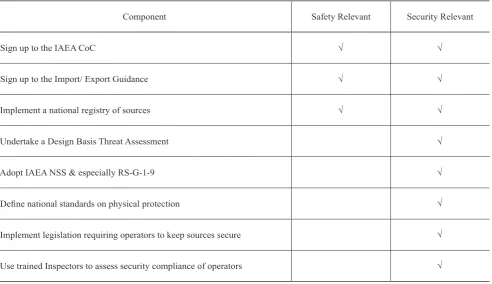
To make this even clearer, the following table (Table 1) lists some elements of radioactive source security so as to show how administrative safety measures shade into
RADIOACTIVE SOURCE SECURITY: WHY DO WE NOT YET
HAVE A GLOBAL PROTECTION SYSTEM?
C. ENGLEFIELD1, 2
1Isognos Limited, Lancaster, UK
2Honorary Research Fellow, University of Cumbria, Bowerham Road, Lancaster, LA1 3JD. UK E-mail : [email protected]
Received July 14, 2014
Security of radioactive sources has been an issue since the earliest days of safety regulation of such materials. Since the events of September 11 2001, some governments and regulatory bodies have been much more focussed on these issues and have introduced extensive and enhanced security arrangements. International organisations like the IAEA and WINS have worked hard to help States in this regard. However, only a minority of States have implemented statutory security systems for radioactive source security.
Why have so many States still to take action? What can be done to encourage and support these changes? This paper will offer some possible explanations for the lack of action in so many States and some potential answers to these questions.
C. ENGLEFIELD Radioactive Source Security: Why do We Not Yet Have a Global Protection System?
clarify the possible threat, the consequent needs and the practical implementation of radioactive source security, to those for whom it is not familiar.
2. THE IMPORTANCE OF A GLOBAL PROTECTION SYSTEM
There are two complementary strands of thought about
why radioactive source security matters. The irst strand
concerns the potential consequences of radioactive ma-terials by an adversary. It is not proposed to provide a summary of the potential consequences of such an attack here, but IAEA reports on radiological accident response (4,5,6) demonstrate some of the consequences of accidents. Such accidents may be used as analogues of deliberate at-tacks. This is because, although the causes may be differ-ent, the consequences will be very similar. It is reasona-ble to expect that deliberate and well thought-through use of radioactivity as a weapon will have similar radiological, social, psychological and economic consequences. If the scenarios in these reports are unfamiliar, it should be
em-phasised that the consequences are very signiicant: a few
deaths, very many other casualties of differing degrees of severity and other long-lasting consequences (including disproportionately large recovery costs and radioactive tangible security measures including physical protection
and effective regulation.
The intention of this table is to try to deine what is
meant by the term “security” in real life practical terms. This is necessary because there exists a spectrum of measures from the administrative to the use of hardware and other recognised security measures and it is essential to understand this. It is possible to claim that radioac-tive source security is in place in a State which has only signed up to the IAEA Code of Conduct or created a na-tional inventory of radioactive sources. These measures are worthwhile, but are only a part of the story – they are
only the irst steps towards establishing an effective and
comprehensive system to ensure the security of radioactive sources.
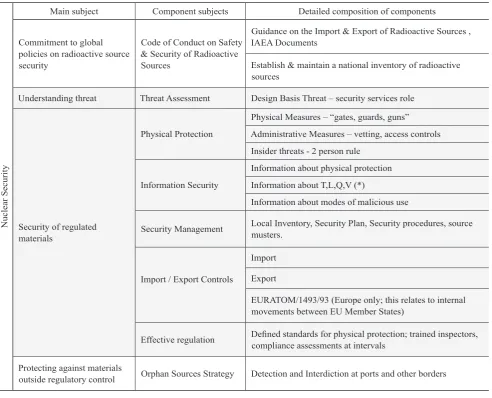
Table 2 is an attempt to provide an “at a glance”
sum-mary of a more meaningful deinition of the term security,
in order to help distinguish these things from actions tak-en for the purposes of safety. The lightly shaded area of the body of the table highlights what constitute security measures rather than safety measures. It should be noted that the intellectual distinction between safety and
secu-rity of radioactive sources is dificult to explain. Simple
demonstrations like Table 2 that convey the ideas that are involved in “security” as distinct from “safety” should not be dismissed. Instead, every effort should be made to
Component Safety Relevant Security Relevant
Sign up to the IAEA CoC √ √
Sign up to the Import/ Export Guidance √ √
Implement a national registry of sources √ √
Undertake a Design Basis Threat Assessment √
Adopt IAEA NSS & especially RS-G-1-9 √
Deine national standards on physical protection √
Implement legislation requiring operators to keep sources secure √
Use trained Inspectors to assess security compliance of operators √
nuclear materials. It may be concluded therefore that the overall risk from diversion of radioactive materials to ma-licious uses could be as high as for the nuclear materials threat.
The second strand of thought is based on the concept of deterrence. Deterrence theory has been used to examine radiological terrorism (7). As a concept, deterrence has been applied in criminology and also in military studies. Extended deterrence is a military term which describes the effect whereby one State deters third party States
from attacking other allied States. There are points of iner
detail within deterrence theory that can’t be considered here, but the two main forms of deterrence are: punishment and denial.
waste management challenges) that have the potential to harm and greatly distress large numbers of people and or bring down a government. Despite the sceptical views sometimes expressed by those more concerned about nu-clear weapons of mass destruction, radiological weapons do cause mass disruption. Neither are they simply (as some-times popularly described) weapons of “mass distraction” that only cause authorities to take their concentration off the nuclear material threat. It can be asserted that
radio-logical weapons are suficiently signiicant, in terms of
their potential consequences, not to be disregarded. Fur-thermore, the probability that they are accessible to an adversary is so much greater since they are more numer-ous, less well protected and more widely distributed than
N
uc
le
a
r S
e
c
uri
ty
Main subject Component subjects Detailed composition of components
Commitment to global policies on radioactive source security
Code of Conduct on Safety & Security of Radioactive Sources
Guidance on the Import & Export of Radioactive Sources , IAEA Documents
Establish & maintain a national inventory of radioactive sources
Understanding threat Threat Assessment Design Basis Threat – security services role
Security of regulated materials
Physical Protection
Physical Measures – “gates, guards, guns”
Administrative Measures – vetting, access controls
Insider threats - 2 person rule
Information Security
Information about physical protection
Information about T,L,Q,V (*)
Information about modes of malicious use
Security Management Local Inventory, Security Plan, Security procedures, source musters.
Import / Export Controls
Import
Export
EURATOM/1493/93 (Europe only; this relates to internal movements between EU Member States)
Effective regulation Deined standards for physical protection; trained inspectors, compliance assessments at intervals
Protecting against materials
outside regulatory control Orphan Sources Strategy Detection and Interdiction at ports and other borders
Table 2. An Attempt to Describe the Scope of Radioactive Source Security in Terms of Some of its Safety and Security Components
C. ENGLEFIELD Radioactive Source Security: Why do We Not Yet Have a Global Protection System?
does not explain why these problems are perceived as in-surmountable, nor does it help inform us how they might be overcome. So instead, it is useful to consider some of the things that could be done to overcome inertia at the
political level. This entails equipping the inluencers of
national governments with enough information for them really to understand the issues: to change their minds so
that they can in turn, inluence the minds of their political
superiors. The potential outcome is a greater national political awareness of a potential radiological terrorism threat, its relevance to all States and the need for political support for a global protection system. This is the reason for this and other papers (1, 2, 3, 8).
A guiding principle of implementation of radioactive source security should be the recognition that security measures are being put into place to enable practitioners to use radioactive sources despite the security climate; they are not to stop legitimate practitioners from using ra-dioactive sources because of the security climate. This is where the technical challenges lie: to balance the security measure that could be used to protect radioactive sources from an adversary against the continuing need to be able
to use them for their justiied beneicial uses.
Consideration has been given elsewhere to technical cultural issues that may have caused apathy and delays in implementing an effective source security regime in most countries. (8). Are there perhaps other reasons that
can be identiied?
One possibility is that it all appears to be too dificult. On encountering for the irst time the idea of protecting
radioactive sources held in a hospital, university or similar institution with high levels of public access and/or high staff turnover, the challenge seems to be daunting. How do you secure a hospital that may have 100 entrances / exits? How do you protect radioactive sources in a university that may have 1500+ physical sciences and medical un-dergraduate and post-graduate students who may need to use radiation during their studies? While neither of these challenges are easy, they and others are both man-ageable if they are approached with a prepared mind (9). A key step to achieving the correct mindset is to liaise with international colleagues who have been through the process and learned the lessons about how to overcome
dificult logistical and management barriers. Good use
should be made of IAEA, WINS and bilateral relation-ships to enable sharing of these lessons. It is probably the
most signiicant factor in solving these problems: being
able to call on the advice of an experienced practitioner
in this ield.
At the time of writing, these are relatively few in number. In the 28 countries of the European Union, re-search suggests that only about six States have imple-mented a security system for radioactive sources in a way that means that they will have really learned how to im-plement radioactive source security (2). It is likely that this proportion is no larger when averaged over all States Recognition of deterrence by punishment has its roots
in 17th century Western philosophy such as Thomas
Hob-bes (1588–1678) and Jeremy Bentham (1748–1832) and can be summarised by the notion that one of the reasons that criminals are jailed is that the consequences of their
crime exceed the beneits they acquired by committing
the crime. As a result, they are not so inclined to do it again. And others who are aware or witness the punish-ment are also deterred from repeating the crime.
But we are concerned with deterrence “by denial”. Deterrence by denial means persuading the adversary not to attack by convincing him that his attack will be de-feated - that is, that he will not be able to achieve his op-erational objectives. At the local level, an obviously well protected establishment that holds radioactive sources will have highly visible security measures. These might include: CCTV systems, access control systems, visible security staff and obvious physical protection measures such as hardened doors and windows. The adversary may
recognise that these measures are going to be dificult to defeat without a signiicant risk of detection and inter
-diction. As a consequence he may be inluenced to try
another premises where security measures are obviously absent, less robust or allowed to fall into disuse.
The same ideas can be extended to the national level. If country A is obviously well protected, then an adver-sary may turn to country B where there are no security ar-rangements in place. Denying the adversary the choice of radiological weaponry is really only achieved if all States take adequate precautions to protect their radioactive sources. A global protection system for radiological source securi-ty is therefore a form of extended deterrence with the aim of denying the adversary access to this form of weaponry. (Transporting a radioactive source internationally is not
a dificult challenge, so importing it into a target country
is a very credible option).
Clearly, denying the use of radioactive sources in a “dirty bomb” may result in “encouraging” the adversary to use some other (perhaps more conventional) technology maliciously. This option may be relatively more accessible to the adversary and (crucially from the States’ perspec-tive), more familiar to the defensive forces of the state and hence more manageable. At the least, radiological recovery and clean-up will be averted, even if these are replaced by other consequences.
3. REASONS WHY A GLOBAL PROTECTION SYSTEM HAS NOT BEEN ACHIEVED
by practitioners more than governments or regulatory bodies. These provide very clear practical guidance on measures that may be used to secure radioactive sources (15).
Finally, the third noteworthy organisation is the
In-ternational Radiation Protection Association (“IRPA”). IRPA (16) has only recently started its work in this area,
but it seems likely that within 12 months it will be pro-viding its own platform to point practitioners to the re-sources of the IAEA and WINS. (It does not aspire to generate its own guidance documents but to assist in the dissemination of extant best practice information). But in
addition, IRPA should be inluential in encouraging the development of professionals in this ield. The profes -sional development of both safety and security
special-ists in the ield of radioactive sources is an important as -pect of capacity building.
4. CONCLUSIONS
There is a disappointingly low level of uptake of well developed national radioactive source security arrange-ments in Europe, and very probably around the rest of the world. The reasons for this are many, but to simply justify this as a “lack of political will at the national level” is to ignore the threat and the need to improve this state of affairs.
It is constructive to explore the underlying reasons for the lack of political will and to try to change this. One way is to provide education and support to those who can
inluence the people who operate at the political level. To
do this, information and support is required. There are
signiicant resources available to help in this endeavour,
including the considerable resources of the IAEA and
WINS, the support of experienced professionals via IRPA
and also bilateral support arrangements.
In the relatively few States that have fully implemented radioactive source security, this inertia has been overcome and lessons have been learned about how to implement a national system of radioactive source security. This demonstrates that the challenges can be overcome. But actively sharing knowledge and whenever possible shar-ing experiences, will only improve the global situation.
ACKNOWLEDGEMENTS
This work was supported by The International Safety and Security Unit of the Cumbrian Centre for Health Technologies, University of Cumbria, UK.
REFERENCES_______________________________
[ 1 ] C. Englefield. “Radioactive Source Security: The Politics of Radiological Terrorism”. Radiation Regulator, vol. 1, pp 124-131 (2013). www.radiationregulator.net.
[ 2 ] C. Englefield. “Implementation of Radioactive Source Security in Europe: A Brief Survey”. Radiation Regulator,
in world, but data on this is far from complete. Bilateral arrangements to share information in these matters are not
likely to be eficient as the resources that can provide the insights – that is, the number of “experts” in this ield - are very
limited. So some kind of knowledge transfer is probably the best way forward.
Three international organisations can be identiied
as having the resources and the potential to assist with
knowledge transfer in this ield.
The irst of these is the International Atomic En -ergy Agency (“IAEA”). This Agency focuses primarily at governmental and regulatory body level. With a long established role in brokering international standards in nuclear safety and security, the IAEA has in recent years extended its contributions from the protection of nuclear power plants and other nuclear facilities to the protection of radioactive sources and their associated facilities. The IAEA provides a range of relevant services and documents. The protection of special nuclear materials is based on
the Convention on Physical Protection of Nuclear Mate
-rials (“CPPNM”) (10) and its international best practice
recommendations document (11).
However, radioactive source security does not have a legally binding document. Despite this, some 120 States have made a political level commitment to the IAEA Code of Conduct (CoC) on the Safety and Security of Ra-dioactive Sources (12). Though non-binding, if a govern-ment writes to the IAEA expressing commitgovern-ment to the CoC and asserts that it is working towards following the guidance contained therein, then this is clearly positive and helpful. However, the actual achievement of what is described in the CoC is not necessarily what the State is reporting. And (as the IAEA Nuclear Security Series demonstrates well) there is a great deal more to achiev-ing radioactive source security than those measures that are provided by the CoC. This Series provides detailed implementation guidance with a graded approach and a wider scope not only of radionuclides but also of ideas including (for example), the insider threat and sabotage. (The question of whether the CoC should be upgraded to a legally binding convention is beyond the scope of this paper. It seems likely that with the right motivation, fund-ing and international support, many more States could achieve a high level of protection of their radioactive sources irrespective of whether they are legally bound to do so).
Underpinning the work of the IAEA and their CoC is a suite of documents (the Nuclear Security Series) (13) and a suite of services (14) to provide capacity building in Member States. While the latter services are still pre-dominantly based on special nuclear materials, there is a growing capability within the IAEA itself to support and advise States on the security of radioactive sources.
C. ENGLEFIELD Radioactive Source Security: Why do We Not Yet Have a Global Protection System?
Conf. Safety and Security of Radioactive Sources: Maintaining Continuous Global Control of Sources throughout their Life Cycle. IAEA. Abu Dhabi, United Arab Emirates. October 2013. [ 10 ] IAEA. Convention on Physical Protection of Nuclear
Materials. IAEA. Vienna, Austria. (2014). http://www.iaea. org/Publications/Documents/Conventions/cppnm.html [ 11 ] IAEA. Nuclear Security Recommendations on Physical
Protection of Nuclear Material and Nuclear Facilities (INFCIRC/225/REVISION 5; Nuclear Security Series 13). IAEA. Vienna, Austria. (2011). http://www-pub.iaea.org/ MTCD/publications/PDF/Pub1481_web.pdf
[ 12 ] IAEA. Code of Conduct on the Safety and Security of Radioactive Sources. IAEA. Vienna, Austria. (2004) http:// www-pub.iaea.org/MTCD/publications/PDF/Code-2004_ web.pdf
[ 13 ] IAEA. IAEA Nuclear Security Series. http://www-ns.iaea. org/security/nuclear_security_series.asp
[ 14 ] IAEA. IAEA Services: http://www-ns.iaea.org/reviews/default. asp?s=7&l=57.
[ 15 ] World Institute for Nuclear Security (“WINS”). https://www. wins.org/index.php?article_id=6114.
[ 16 ] International Radiation Protection Association (“IRPA”). http://www.irpa.net/
vol.2 In press (2014). www.radiationregulator.net.
[ 3 ] C.Englefield. “Towards Sustainable Nuclear Security”. A Keynote Address to the IAEA Int. Conf. Safety and Security of Radioactive Sources: Maintaining Continuous Global Control of Sources throughout their Life Cycle. IAEA. Abu Dhabi, United Arab Emirates. October 2013. [ 4 ] IAEA. The Radiological Accident in Goînia. IAEA. Vienna,
Austria. (1988) http://www-pub.iaea.org/MTCD/Publications/ PDF/Pub815_web.pdf.
[ 5 ] IAEA. The Radiological Accident in Samut Prakarn. IAEA. Vienna, Austria. (2002). http://www-pub.iaea.org/MTCD/
Publications/PDF/Pub1124_scr.pdf
[ 6 ] IAEA. The Radiological Accident In Nueva Aldea. IAEA. Vienna, Austria. (2009). http://www-pub.iaea.org/MTCD/
Publications/PDF/Pub1389_web.pdf.
[ 7 ] J. Pandza. The role of communication in managing the threat of radiological terrorism. Unpublished draft PhD
thesis, King’s College London. London, UK.