A
Lightweight Batch Anonymous Authentication Scheme
for VANET Based on Pairing-free
Cheng Song, Mingyue Zhang, Zongpu Jia, Weiping Peng, and Hairu Guo School of Computer Science and Technology, Henan Polytechnic University,
Jiaozuo, Henan, 454003, China [email protected], [email protected],
{jiazp, pwp9999, guohr}@hpu.edu.cn
Abstract. Aimed at improving the security and efficiency of anonymous authentication in vehicular ad hoc network (VANET), a certificateless batch anonymous authentication scheme without bilinear pairings is put forward. By coordinating Trust Authority (TA) and vehicles to generate the public/private key pairs and pseudonyms, the system security is freed from dependency on tamper-proof devices. Through comprehensive analyses, this scheme is proved not only to be able to realize such security properties as authentication, anonymity, traceability, unforgeability, forward or backward security, etc., but also able to resist Type I and Type II attacks in the random oracle model. Moreover, this scheme effectively reduces system storage load by means of certificateless authentication, and the authentication efficiency can also be increased by realizing batch authentication based on pairing-free calculation. Accordingly, the scheme is proved to be significant in theory and valuable in application in the Internet of Things or embedded environment with limited resources.
Keywords: VANET; pairing-free; certificateless; anonymous authentication; random oracle model.
1.
Introduction
Along with the wide use of vehicles in modern society, a series of transportation problems gradually emerge, like insufficiency of parking lots, traffic congestion, traffic accidents, etc. Consequently, such issues as traffic management, secure driving and traffic information exchange are drawing more and more attention. In managing large numbers of vehicles, Intelligent Transport System (ITS) [1] is widely adopted domestically and abroad. To establish the next-generation transport system, VANET [2]based on Mobile Ad hoc Network (MANET) [3] is emphasized more and more by enterprises and academia. In VANET, vehicles are able to obtain instant traffic information, weather information and entertainment information by communicating with roadside units (RSUs), which further enhances the enjoyment of driving and brings great convenience to vehicle users.
threats to the lives and properties of both drivers and passengers. Consequently, user’s privacy protection [4] is the fundamental demand for secure communications in VANET. Currently, the dominant method of privacy preservation is anonymous authentication [5], which, nevertheless, is complex in algorithm and relatively heavily-loaded in computation. Besides, the topological structure is caused to vary constantly by the wireless communications in VANET and the highly dynamic vehicles. As a result, the communication efficiency of information interaction in VANET draws more and more attention. Therefore, to improve the security and efficiency of anonymous authentication becomes one of the urgent tasks in VANET research. Aiming at some shortcomings, we proposed a lightweight batch anonymous authentication scheme for VANET. Compared with other schemes, we don't use the bilinear pairing algorithm with high computation complexity. So our scheme effectively reduces the computation cost. What’s more, our scheme reduces the storage cost greatly because of certificateless.
The rest of this paper is organized as follows: In section 2, we introduce the related work. In Section 3, we introduce the VANET model. The proposed protocol is described in detail in Section 4. In Section 5, we give a theoretical proof of the scheme, such as correctness, anonymity, forward and backward privacy, and under the random oracle model we prove that the scheme can resist Type I and Type II attack, and an efficiency analysis is provided too. The last section concludes the paper.
2.
Related Work
In recent years, researchers have conducted lots of researches on the privacy protection and data security for VANET and have put forward different anonymous authentication schemes. Raya, et al. firstly proposed an anonymous authentication protocol based on alias certificate [6], in which pseudonyms are adopted as user’s true identity to protect user’s private data. SPECS [7] introduced a batch verification protocol with enhanced security and privacy, in which a single vehicle could form a group with any other vehicles after batch verification and communicate with each other safely without involving RSU. However, Shi-Jinn, et al. [8] affirmed that SPECS couldn’t resist impersonation attack, i.e. the masked vehicle could release false messages and even communicate safely with other legitimate vehicles. In Ref. [8], for ensuring privacy, each vehicle employs different pseudonyms generated by RSU when sending messages so that it needn’t be equipped with large numbers of public/private key pairs, whereas the security of RSU couldn’t be guaranteed. To solve this problem, Tzeng proposed an identity-based anonymous authentication scheme [9], in which each vehicle is equipped with a tamper-proofing device to store system’s master key, the vehicle could generate pseudonyms by applying this master key. Nevertheless, recent study [10] shows that the security of Tzeng’s scheme depends too much on the tamper-proofing device and attackers can obtain private information via side-channel attacks (like laser scanning and efficiency analysis). As a result, once tamper-proofing device is attacked and the master key is leaked the whole system’s security will be threatened. Wang et al. proposed an effective identity privacy protection scheme ECPB [11] based on group
In the Ref. [12], an ID-based batch authentication scheme is proposed, where pseudonyms in each message signature process are assumed to be different, and the traceability can be achieved, too. Shao et al. proposed a threshold anonymous authentication protocol based on group signature which can achieve batch certification [13]. Lu et al. proposed a privacy protection scheme SPRING [14], which uses the constantly changing pseudonyms to protect the privacy of users. With the participation of trusted authority (TA), the efficiency of authentication is improved.
3.
VANET Model
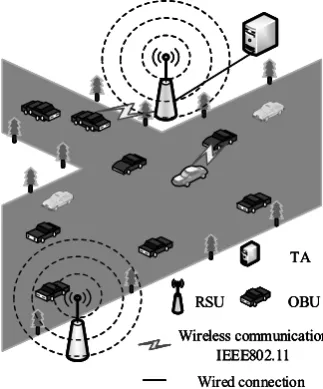
Different from the traditional Internet, VANET mainly adopts wireless communication mode, and the communication entity is vehicle. The system model includes three parties: trusted service center Trust Authority (TA), roadside unit RSU and vehicle unit OBU. The communications are two types: communication between vehicle and RSU and communication between vehicle and vehicle. The system network model is shown in Fig. 1.
Wired connection TA
RSU OBU
Wireless communication IEEE802.11
TA
RSU OBU
Wireless communication IEEE802.11
Wired connection TA
RSU OBU
Wireless communication IEEE802.11
Wired connection TA
RSU OBU
Wireless communication IEEE802.11
Fig. 1. VANET Model
vehicles via wireless. The RSU communicates with the vehicle using the DSRC protocol [15], which enables RSU to validate the request information sent by the vehicle.
Vehicle unit OBU. In VANET, each vehicle is equipped with wireless communication module OBU, through which vehicles can communicate with RSU or other vehicles equipped with OBU.
4.
The Proposed Scheme
The scheme proposed in this paper is composed of five phases: initialization phase, secret key generation phase, signature phase, authentication phase and update phase.
4.1. Initialization
l is a safety parameter of TA, TA randomly selects prime numbers p and qsatisfies s 1
q p , then randomly selects g Zp
, x Zq
, computes xmod
yg p , where 1mod
q
g p, g1. The master key of the system is x, and the public key is
pub
P y. Define three hash functionsH: 0,1
Zq
, H1: 0,1
Zq
, H2: 0,1
q
Z
. Then the system’s public parameters are
p q g P, , , pub,H H H, 1, 2
.4.2. Secret Key Generation
Step1: Let IDi be the identity of vehicle user Vi, Vi randomly selects ( , )b vi i Zq
as secret values, then computes:
vimod
i
B g p (1) 1
i i
PID b p (2) and transmits (ID PID Bi, i1, i) to TA via secure channel.
Step 2: TA receives (ID PID Bi, i1, i), randomly selects r Zq
, and calculates partial private key:
PSi r xsimodq (3) then calculates
PIDi2 IDiH xPID( i1PIDi1 ti Ppub) (4) The pseudonym of Vi is PIDi (PID PID ti1, i2, )i ,whereti is the valid time of
i
PID .
1( )
i i i i
S H PID B PP (5)
mod
r i
PPg p (6) then transmits (PP PS PIDi, i, i) to Vi.
Step3: After Vi receives PPi and PSi sent by TA, it firstly verifies that mod
i i
PS s pub i
g P PP p
?
, if holds, then goes to step 4. Step4: Vi computes:
SKiviPSi (7)
Let SKi be the secret key, PKi1Bi, PKi2 PPi, and set the public key as 1 2
( , )
i i i
PK PK PK .
The flowchart in public/private-key-generating phase is shown in Fig. 2:
mod
r i
PPg p mod
v i
B g p
mod
i i
PS r xs q
) || || ( i i i
i H ID B PP
s 1
) || || ||
( i i i pub
i
i ID H xPID PID t P
PID2 1 1 1
i i
PID b p
1 2
( , , )
i i i i
PID PID PID t
1
i i
PK B
2
i i
PK PP
1
(ID PID Bi, i, i)
(PP PS PIDi, i, i) 1 2
( , )
i i i
PK PK PK
?
mod i i
PS s
pub i
g P PP p
i i i
SK v PS
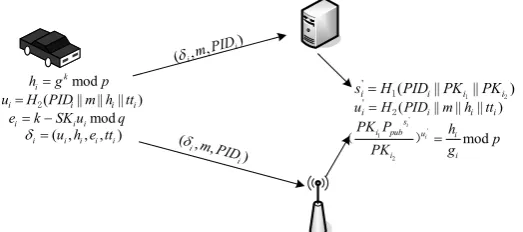
Fig.2. Message exchange flowchart in public/private-key-generating phase
4.3. Signature Phase
Vi randomly selects k Zq
, computes: kmod
i
h g p (8) ui H PID2( i m hitti) (9)
ei k SK ui imodq (10)
i
tt is the current timestamp, then let i( , , ,u h e tti i i i)be the signature of messagem, transmit ( , ,i m PIDi) to RSU.
4.4. Authentication Phase
Single vehicle authentication. Single vehicle authentication refers to a single vehicle request RSU or other vehicles for authentication. After the RSU or vehicle receives the message signature ( , ,i m PIDi)from the vehicle Vi, they firstly check the validity of ti
and whether the timestamp tti is in a valid time interval, then computes:
2 2
'
1( )
i i i i
S H PID PK PK (11) ui'H PID2( i m hi tti) (12) then verifies that ' ' 1 2 mod i i i s i pub u i
e i
PK P h
p
PK g
?
( ) (13) If it holds, the authentication succeeds; otherwise, the message is rejected.
Batch authentication. Supposing that n different messages are ( ,1 m PID1, 1) , 2 2 2
( ,m PID, ) ,…,(n,m PIDn, n) , where i( , , )u h ei i i ,
1 2
( , , )
i i i i
PID PID PID t ,
1
i n.
According to the sources of the signature message, the batch authentication is divided into three types:
(1) Different messages from the same vehicle, i.e. all the PIDiare the same in each
certification message.
(2) Same messages from different vehicles, i.e. all messages m are the same in each certification message.
(3) Different messages from different vehicles.
No matter what kind of type of the batch authentication, we can authenticate them via a common method.
When the RSU or the vehicle receives the batch authentication messages, the RSU or vehicle firstly checks the validity of tiand whether the timestamps tti are in a valid
time interval, then computes: 2 2
'
1( )
i i i i
S H PID PK PK '
2( )
i i i i
u H PID m h tt for each authentication message, and then verifies that
' ' ' 2 1 1 1
( ( ) ) mod
n i i i i i n s u i u i pub e i i PK h P p PK g
?( ) (14) If it holds, it means that these distinct n signatures are valid.
For the first type, the n authentication messages are from the same vehicle, all the
i
PID are the same, PKi1 , PKi2 and '
i
s are respectively the same. So, the authentication formula can be simplified to: ' ' 1 1 2 1 mod n i i i i
s u n
i pub i
e i i
PK P h
p PK g
?( ) (15)
' ' 1 2 mod i i s i pub u i
i i
PK P h
p PK g
( )
mod
i i i
ekSK u q mod
k i
hg p
( , , , )
i u h e tti i i i
( , , )
i i
m PID
( , , ) i i m PID ) || || ( ' 2 1 1 i i i
i H PID PK PK
s ) || || || ( ' i i i i H PID m h tt
u 2
) || || ||
( i i i
i H PID m h tt
u 2
Fig. 3. Message exchange flowchart in signature authentication phase
4.5. Update Phase
In VANET, if the node is revoked or a new node is added, TA will provide real-time updates to the vehicles or RSU, inform them which PKi is latest addition and which
i
PK is invalid. So, in the verification phase, if another vehicle or RSU receives the authentication information sent by the cancelled vehicle Vi, they will not find the corresponding PKi to these messages, thus, messages from the cancelled vehicle will
be invalid. Moreover, there is an effective timestamp forPIDi, and even when the
updates are not timely, the valid time of PIDi will also be the limiting factor for the
verification.
5.
Analysis
5.1. Correctness Analysis
This section is to prove the correctness of single authentication and the correctness of batch authentication, as is shown the following.
The correctness of single authentication. During single vehicle authentication, the single vehicle is valid or not according to the formula: ' ' 1 2 mod i i i s i pub u i
e i
PK P h
p
PK g
?
( ) .
Because:
' ' ' 1
i i i i
e u s u i pub
g PK P ' ' ' ' '
1 2 2
-i i i i i i
e u s u u u i pub i i
g PK P PK PK
.
' ' ' ' '
1 2
-( mod )
i i i i i i i i i
k -SK u modq u s u PS s u u
i pub pub i
g PK P g P p PK
' ' ' ' '
1 2
( ) mod ) mod ( ) mod
-( ( mod ) )
i i i i i i i i i i
k - v - r xs p u q u s u r xs q x s u u
i pub i
g PK P g g p PK
(
' ' ' ' '
2
( ) mod ) mod ( ) mod
-( mod ) ( mod ) ( ( mod ) )
i i i i i i i i i i i
k - v - r xs p u q v u x s u r xs q x s u u i
g g p g p g g p PK
(
' ' ' ' ' ' 2
(
)-mod
i i i i i i i i i i i i i i
k -v u ru xs u v u xs u r xs u xs u u i
g g g g g PK p
' ' ' ' ' ' ' 2
-mod
i i i i i i i i i i i i i i i
k -v u ru xs h v u xs u u r xs u xs u u i
g PK p
' 2 mod i u k i
g PK p
' 2 mod i u i i
h PK p
.
' ' ' '
1 2 mod
i i i i i
e u s u u i pub i i
g PK P h PK p
' ' ' 2 1 mod i i i i u i i s u
i pub e
h PK
PK P p
g ( ) ' ' 1 ' 2 mod i i i i s u i pub i
e u
i
PK P h
p g PK ( ) So, the single vehicle authentication is correct.
The correctness of batch authentication. During batch authentication, the batch vehicles are valid or not by verifying that ' ' ' 2 1 1 1
( ( ) ) mod
n i i i i i n s u i u i pub e i i PK h P p PK g
? ( ) . Because: ' ' ' ' 1 2 ' ' ' '1 1 1 2 1 1
2 2 2 2
1 2 1 2 ( ) ( ) ( ) ( ) i n i n s s s s
pub u pub u i pub u n pub u
i n
PK P PK P PK P PK P
PK PK PK PK
1 2
1 2
( ) mod
i n
i n e e e e
h h
h h
P
g g g g
' '
' '
' '
1 1 1 2 1 1 1
2 2 2 2
1 2 1 1 2 mod n i i
i n i
i
n s u i u n u
u u i
pub e
i
i n
PK PK PK PK h
P p
PK PK PK PK g
( )( ) ( ) ( ) ' ' ' 1 1 2 1 1 mod n i i i i in s u n
i u i
pub e
i i i
PK h P p PK g
( )
' ' ' 2 1 1 1( ) mod
5.2. Security Analysis
Privacy protection. In this scheme, each pseudonym PIDi involves the system master
key x and bi selected randomly by user, while x and bi is only known to TA and Vi
respectively. Based on discrete logarithm assumption, when x and bi are unknown, it difficult for any attacker to compute PIDi. Consequently, even if the attacker obtains
the pseudonym PIDi of Vi, it’s unable to obtain any identity information of Vi.
Traceability. If a vehicle user sends an abnormal message, TA can still track the malicious vehicle even though it releases messages through a pseudonym. TA has system master keyx. According to the pseudonymPIDi (PID PIDi1, i2, )ti and the equation PIDi2 IDiH xPID( i1PIDi1 ti Ppub) , TA can get IDi PIDi2 ,
1 1
( i i i pub)
H xPID PID t P then the true identity IDi of Vi can be deduced.
Consequently, when the signature is invalid, TA could trace vehicle’s responsibility based on the signature.
Unlinkability. User’s unlinkability means that attacker is unable to judge whether two messages are from the same vehicle or not. The unlinkability of the program is proved by the linking game. Set this scheme as , challenger as A, signer RSU as
, while B0 and B1 stands for two loyal vehicle users.Definition 1: Linking game
Step 1: A adopts key-generating algorithm KeyGen( )k to generate public/private key pairs(SK,PK), and obtains system’s public parameters
p q g P, , , pub, ,H H H1, 2
;Step 2: A selects two different messages: m0andm1;
Step 3:Select random bitb{0,1}, then send mb and m1b to B0 and B1 secretly,
with b being a secrecy for the challenger;
Step 4: Signer
conducts this signature scheme respectively with B0 and B1;Step 5: If B0 and B1 output two valid signatures b and 1b which respectively
correspond to messages m0andm1, then send b and 1b to challenger in random
order; otherwise, return to the challenger; Step 6: The challenger guesses that b is from
' b, if '
b b, then A wins this game. This paper defines that the advantage of A winning this game is:
2 [ ] 1
Link '
Adv,A(A) =| Pr b = b - |, where
'
[ ]
Pr b b stands for the probability of ' b b.
Theorem 1. If any A fails to win this linking game with significant probability in
polynomial time, then this scheme is proved to have unlinkability.
Suppose another situation: after implementing this signature scheme, A obtains two signatures (0,m PID0, 0)and( ,1 m PID1, 1). To prove the unlinkability of this scheme, let j{0,1} and ( ,i m PIDi, i) {( 0,m PID0, 0) ( ,,1 m PID1, 1) , if signature is
guaranteed to be valid, 1 2
'
1( )
j j j j
s H PID PK PK and '
2( )
j j j j j
u H PID m h tt
can invariably be realized, then validate the equation
' ' 1
2
mod j
j j
s u j pub j
e j
PK P h
p
PK g
( ) . In this
way, challenger is unable to identify from which signer the message is sent, hence this scheme is possessed with unlinkability.
Forward and backward security. Forward security means that even if attacker obtains the currently-authenticated secret information, it will not be able to deduce the information related to the preceding authenticated message. Backward security means that even though attacker obtains the relevant information about authentication, it will not be able to deduce the subsequent authentication information so as to trace the authentication process of vehicles. In this scheme, if attacker obtains the signature message i ( , , ,u h e tti i i i) , where kmod
i
h g p , ui H PID2( i m hitti) and
i i i
e k SK u
mod
q
,becausek
is randomly selected by Vi in every signature, consequently, attacker is impossible to deduce the preceding or subsequent 'i
h based on the current hi. Meanwhile, since ui involves the randomly number
k
, pseudonymi
PID and signature message
i has validity period, and many random numbers areinvolved during computing ei, so it is impossible for attacker to deduce the preceding
or subsequent signature messages by means of current signature messages, thus this scheme satisfies forward and backward security.
Man-in-the-middle attack (MITM attack). In MITM attack, attacker keeps connected with two parties during communications, and makes them believe that they are communicating and exchanging information under safe circumstances, so as to acquire useful information to attack. In this scheme, a random number will be generated in each communication between RSU and Vi, whereas the random number used by attacker in establishing connection with RSU (or Vi) is different from the random number generated in the communications between RSU and Vi, therefore, attacker is unable to communicate with valid users to implement MITM attack by establishing communications connection with valid users.
Type I attack. Type I attack refers to exterior attacker which is able to replace valid users’ public keys.
Theorem 2. Under the assumption of Discrete Logarithm Problem (DLP), the proposed
scheme can implement the unforgeability of the adaptive selection message attack in the random oracle model.
Lemma 1. In Game I, within the limited time
t
, suppose Type I attacker AI is able toissue qparqueries to the partial private key extraction oracle, launch qpub queries to
2
H
q queries to random oracle H1and H2respectively, and launch qsig queries to
signing oracle to output a valid signature with the probability
, then there is an algorithm
, which can solve DLP with the probability:' 1 1 1 1 1
( ) (1 ) ( ) (1 )
2 2
par pubr pri
q q q
p
par par par
l q q q
,
where p is the bit length of Zp.
'
( 3 8 ) (2 3qpubr 6 )
pub pubr sig e pub sig m
tt q q q t q q t ,
where tm refers to the time needed in conducting a single modular multiplication, and
e
t refers to the time needed in a single modular exponentiation.
In the following, it is proved that there exists an algorithm
can solve DLP with the help of AI in random oracle model:Give
a random challenge tuple ( , , )p g
of DLP and aims to output
satisfy modg p , algorithm
initializes AI with system parameter 1 2( , , ,p q g ppub, ,H H H, ), then
respond the oracle queries from AI as a challenger. The specific process of queries in oracle model is as follows:Partial private key extraction queries: When AI quires this oracle model withPIDi,
records the answers between AI and
with the listLpar(PID PSi, i). If
finds(PID PSi, i) in the list Lpar, then
returns PSi to AI; otherwise,
randomly selects[1, par]
c q .
(1) If ic,
randomly selects PSi Zq
, transmits PSi to AI, and stores
(PID PSi, i)in the listLpar.
(2) If ic,
validatesPIDi PID , outputs “failure” and halts.
Public key extraction queries: When AI queries this oracle model by inputtingPIDi ,
and records the answers between AI and
with Lpub(PID PKi, i1,PKi2, , )s vi i . If
finds1 2
(PID PKi, i,PKi , , )s vi i in Lpub , then
transmits (PKi1,PKi2) to AI; otherwise:(1) If PIDi PID
,
randomly selects2
i p
PK Z
to calculate si Zp
, sets
1 2
1
mod
i
s i i pub
PK PK P p
, transmits (PKi1,PKi2) to AI, and stores 1 2
(PID PKi, i,PKi , , )si in Lpub..
(2) If PIDi PID
,
recovers (PID PSi, i) from Lpar ; if
fails to find(PID PSi, i)in the list Lpar, it obtains a newPSi by performing partial private key
extraction queries. Then B randomly selects si Zp
and vi Zp
2 mod
i i
ps s i pub
PK g P p and 1 vimod
i
PK g p, then
transmits (PKi1,PKi2) to AI, and stores (PID PSi, i) and (PID PKi, i1,PKi2, , )s vi i in Lparand Lpub.Public key replacement queries: When AI queries this oracle with the tuple,
1 2
(PID PKi, i,PKi ) ,
recovers (PID PSi, i) from Lpar; if
fails to find(PID PSi, i)in Lpar, it obtains a newPSi by performing partial private key extraction queries, then
verifies whether the equation 1 1 2 2( )
mod
i i i
i H PID PK PK
PS
pub i
g P PK p is valid or not. If the equation is valid,
outputs “failure” and stops operating; otherwise,
continues to carry out the following two steps:(1) If
finds(PID PKi, i1,PKi2, , )s vi i in Lpub ,
validates 1 1
i i
PK PK and
2 2
i i
PK PK , then stores (PID PKi, i1,PKi2, , ) in Lpub.
(2) Otherwise,
obtains a new PKi1and PKi2 by performing queries of public key extraction with the inputPIDi, then validates and ,, and stores 1 2 (PID PKi, i,PKi , , ) in Lpub.
1
H queries: When AI conducts H1queries by inputting(PID B PPi, ,i i), assume that AI has already obtainedBi and PPi by public key extraction queries, that is,PKi1andPKi2 . Consequently,
finds the corresponding1 2
(PID PKi, i,PKi , , )s vi i in Lpub , and
returns si to AI.
2
H queries: When AI conducts H2queries by inputting(PID m h tti, i, , )i i ,
recordsthe queries between AI and
witL2in the form of (PID m u h tti, i, i, ,i i). If
finds(PID m u h tti, i, i, ,i i) in L2, then
returnsu
i to AI; otherwise
randomly selectsi q
u Z
, returns ui to AI, and stores (PID m u h tti, i, i, ,i i)in L2.
Private key extraction queries: When AII quires this oracle model by inputtingPIDi: (1) If PIDi PID
, B will output “failure” and stop operating. (2) If PIDi PID
, recovers (PID PSi, i) in the list Lpar and recovers
1 2
(PID PKi, i,PKi , , )s vi i from ; if fails to find (PID PSi, i) and
1 2
(PID PKi, i,PKi , , )s vi i from the corresponding list, it obtains newPSi and by
issues a partial private key extraction query and a public key extraction query on PIDi.
Then transmits vi PSi to AII, and stores
1 2
(PID PKi, i,PKi , , )s vi i and
(PID PSi, i) in the lists and Lpar.
pub
L
i
e
pub
Signing queries: AI conducts H2queries by inputting (PID mi, i), assuming PIDi has
been queried before. (1) If PIDi PID
,
outputs signature
i corresponding to message mi, and transmits
i to AI;(2) Otherwise,
randomly selects e ui, iZq, recovers the corresponding
1 2
(PID PKi, i,PKi , , )s vi i in Lpub , and calculates 1 2
i i i i i
e u s u u i i pub i
h g PK P PK .
( , , , )
i u h e tti i i i
serves as a valid signature sent from signer PIDi to message mi.
returns
i to AI and stores (PID m u h tti, i, i, ,i i)in L2. If (PID m h tti, i, ,i i)has alreadybeen recorded in L2or PKi1and PKi2 have been replaced,
will output “failure” and halts.Forgery: Finally, AI stops queries and outputs a valid signature ( , , )h u e with respect
(PID m, ) . If PID PID
, then
outputs “failure” and halts; otherwise,
repeats the operation in the similar random way, while the choices in H2 queries are different.
can obtain the other valid signature ' '( , , )h u e , both signatures should satisfy:
e u su u i pub i
g PK P hPK and e' u' su' u'
i pub i
g PK P hPK
Consequently,
satisfies
' ' '
' log
e e u u g
e e g
u u
, then judged from
'
' e e
u u
,
can successfully solves DLP.Probability analysis: We analyze the probability of
winning the game. Since H2 is a random queries oracle, the probability of AI generating a valid signature corresponding to(PID m , ) without queries H2(PID m h ) is at least1/ 2l . The
probability of
not halts in public key replacement simulation is(1 1/ 2 )
p qpubr
; theprobability of
not stopping simulation in private key extraction queries is (1 1 / )qpripar
q
; the probability of
continuing normal operation in DLP computation phase is 1 /qpar. Therefore, the probability of
winning the game is at least:1 1 1 1 1
( ) (1 ) ( ) (1 )
2 2
par pubr pri
q q q
p
par par par
l q q q
the maximum time needed in
operation is: ( 3 8 ) (2 3qpubr 6 )pub pubr sig e pub sig m
Type II attack. Type II attacker refers to internal attacker which is able to obtain the system master key.
Lemma 2. In Game II, within the limited time '
t , suppose Type II attacker AII is able to launch qparqueries to partial private key extraction oracle, launch qpubqueries to public
key extraction oracle, launch and queries to random oracle models and respectively, launch qpri queries to private key extraction oracle, and launch qsig
queries to signing oracle to output a valid signature: '
(3 pub + 8 sig)e (3 pub 6 sig)m
t t q q t q q t with the probability , then there is an algorithm ,which can solve DLP with the probability:
1 1 1
> ( - ) (1 - ) 2l
pri
q '
pub par
q q
. Where refers to the time needed in executing a
single modular multiplication, and refers to the time needed in a single modular exponentiation.
In the following, it is proved that an algorithm exists to solve DLP with the help of AII. The specific proof process is as follows:
Give a random challenge tuple ( , , )p g
of DLP, aims to output satisfy , algorithm initializes AI with system parameter1 2
( , , ,p q g ppub,H H H, , )and the system master key , then undertakes the queries from AII as a challenger. The specific process of queries in oracle model is as follows:
Public key extraction queries: When AII queries this oracle model by inputtingPIDi ,
challenger B records the answers between AII and with 1 2
( , , , , , )
pub i i i i i i
L PID PK PK PS s v . If finds
1 2
(PID PKi, i,PKi ,PS s vi, , )i i in the
list Lpub , then transmits to AII; otherwise, randomly selects
:
(1) If , randomly selects , , to calculate
, , transmits (PKi1,PKi2) to AII, and stores in the list Lpub.
(2) If , validates PIDi PID* , randomly selects , ,
to calculate , , transmits
1 2
(PKi,PKi ) to AII , and stores
1 2
(PID PKi, i,PKi ,PS s vi, , )i i in the list Lpub.
1
H queries: When AII queries H1 with inputting(PID B PPi, ,i i) , assume that AII has
made public key extraction queries on PIDito obtain Bi and PPi, which are actually
1
H
q
2
H
q H1 H2
m
t
e
t
mod g
p
x
(PK PKi1, i2)
[1, par]
c q
ic PSi Zq
siZp
i p
v Z
2 mod
i i
ps s i pub
PK g P p
1 mod
i
v i
PK g p
1
(PID PKi, i,PKi2,PS s vi, , )i i
ic PSi Zq
siZp
i p
v Z
2
i i
ps s i pub
PK g P modp
1 2
1 simod
i i pub
and . Consequently, finds the corresponding
1 2
(PID PKi, i,PKi ,PS s vi, , )i i in , and returns si to AII.
2
H queries: When AII conducts H2queries by inputting (PID m h tti, i, ,i i) , records the answers between AII and with L2 in the form of (PID m u h tti, i, i, ,i i). If finds
(PID m u h tti, i, i, ,i i) in L2, then returns ui to AII; otherwise randomly selects
i q
u Z
, returns ui to AII, and stores (PID m u h tti, i, i, ,i i)in L2.
Private key extraction queries: When AII queries this oracle by inputtingPIDi:
(1) If PIDi PID*, B will output “failure” and stop operating.
(2) If *
i
PID PID , recovers (PID PKi, i1,PKi2,PS s vi, , )i i from Lpub ; if fails to find (PID PKi, i1,PKi2,PS s vi, , )i i from Lpub, it obtains newPSi and by issuing public key extraction query. Then transmitsviPSi to AII, and stores
1 2
(PID PKi, i,PKi ,PS s vi, , )i i in Lpub.
Signing queries: AII conducts H2queries by inputting (PID mi, i) , assuming PIDi has been queries before.
(1) If PIDiPID*, outputs signature corresponding to message , and transmits to AII;
(2) Otherwise, randomly selects e ui, iZq
, recovers the corresponding 1 2
(PID PKi, i,PKi ,PS s vi, , )i i in , and calculates .
( , , , )
i u h e tti i i i
serves as a valid signature sent from signer PIDi to message .
returns to AII and stores (PID m u h tti, i, i, ,i i)in . If (PID m h tti, i, ,i i) has already been recorded in , will output “failure” and stop simulating .
Forgery and Probability analysis: After all the queries, B can obtain by a similar approach to Lemma 1, then B can solve the DLP problem. And we use the same way as Lemma 1 to get the probability of winning the game is at least:
1 1 1
( ) (1 )
2
pri
q
par par
l q q
the maximum time needed in operation is: (3 pub 8 sig)e (3 pub 6 sig)m
t q q t q q t
Comparison of security properties in the proposed scheme with that of other schemes is shown in Table 1. The proposed scheme can further enhance the security of anonymity authentication for VANET.
1
i
PK
2
i
PK
pub
L
i
e
i mii
pub
L
1 2 mod
i i i i i
e u s u u i i pub ii
h g PK P PK p
i
m
i
L22
L
'
'
e e
u u
Table 1. Comparison of security
schemes Ref.[11] Ref.[12] Ref.[13] Ref.[14] Ref.[16]
the proposed
scheme
anonymity √ √ √ √ √ √
traceability √ √ √ √ √ √
unlinkability √ √ √
for/backward
security √ √ √
MITM attack √ √ √ √
TypeⅠ √
TypeⅡ √
5.3. Efficiency Analysis
Computation complexity. For the sake of qualitative analysis and comparison in analysis of computation complexity, we use Tmul to denote a point multiplication
operation in elliptic curve, Tpar to denote a bilinear pairing operation, Texp to denote an
exponential operation, and Th to denote a MapToPoint hashfunction operation. In the experiment of the Ref.[16], runs 2 GHz CPU, 4-GB RAM processor to find that the operation time of Texp is 0.6ms, Tpar is 1.6ms, Th is 2.7ms and Tmul is 0.6ms. The
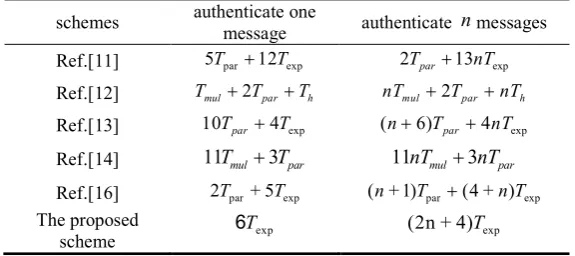
comparison with the existing schemes is shown in Table 2: Table 2. Comparison of computation costs
schemes authenticate one
message authenticate nmessages Ref.[11] 5Tpar12Texp 2Tpar 13nTexp Ref.[12] Tmul 2TparTh nTmul2TparnTh
Ref.[13] 10Tpar4Texp (n6)Tpar4nTexp
Ref.[14]
Ref.[16] 2Tpar+ 5Texp ( + 1)n Tpar(4 + )n Texp The proposed
scheme exp
T
6 (2n + 4)Texp
As is shown in the table, the proposed scheme doesn’t require bilinear pairings operation which is quite complicated in computation; instead, it adopts exponential operation with low computation complexity. Therefore, this scheme has obvious advantages in computational complexity concerning either single message authentication or batch authentication.
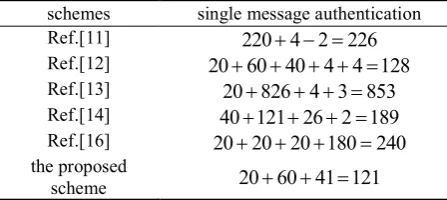
Communication complexity. Communication complexity means the number of bytes needed in communications. The communication overhead of a single complete verification in VANET authentication scheme is mainly composed of identity information, signatures and messages, etc.
Let the length of original message be 20 bytes. In scheme [11], the signature of message is 220 bytes, timestamp is 4 bytes, and ID is 2 bytes. In scheme [12], original message is 20 bytes, signature is 60 bytes, pseudonym is 40 bytes, timestamp is 4 bytes, and ID space is 4 bytes. In scheme [13], the original message is 20 bytes., signature space is 826 bytes, timestamp is 4 bytes, and ID space is 3 bytes. In scheme [14], signature is 40 bytes, certificate is 121 bytes, anonymous secret key is 26 bytes, and ID space is 2 bytes. In scheme [16], the original message is 20 bytes, signature is 20 bytes, the public key is 20 bytes, anonymous the certificate is 180 bytes. In this proposed scheme, original message is 20 bytes, signature is 60 bytes, and pseudonym is 41 bytes, as is shown in Table 3:
Table 3. Comparison of communication complexity (unit: bytes)
schemes single message authentication Ref.[11] 220 4 2 226 Ref.[12] 20 60 40 4 4 128 Ref.[13] 20 826 4 3 853 Ref.[14] 40 121 26 2 189 Ref.[16] 20 20 20 180 240 the proposed
scheme 20 60 41 121
The comparison demonstrates that this proposed scheme has certain advantage in communication complexity.
6.
Conclusions
To solve the efficiency problem in anonymity authentication in existing privacy protection schemes for VANET, this paper proposes a certificateless batch anonymity authentication scheme without bilinear pairings operation. Analyses shows that this scheme is not only guaranteed many security properties like anonymity, traceability, unlinkability, forward and backward security, etc. on the basis of correctness. We prove that this scheme can resist Type I and Type II attack under random oracle model. Meanwhile, the public/private keys in this scheme are distributed generated, which effectively avoids the dependence on tamper-resistant device inside vehicle. Furthermore, by adopting certificateless batch authentication without bilinear pairings operation, computation and storage costs are cut down considerably. Therefore, this scheme has much theoretical significance and applied value in the resource-limited Internet of Things or embedded environment.
is difficult for anonymous authentication schemes under traditional VANET models to meet the requirements of privacy protection in vehicle anonymous authentication in various communication environments. Therefore, it remains to be tackled for the author to further improve and optimize the proposed scheme so as to satisfy the growing demands of communication of VANET in various conditions.
Acknowledgement. This work was supported by the Natural Science Foundation of China project (61300124, 61300216, 61872126); Henan Provincial Department of Science and Technology Research Project (132102210123).
References
1. Giovanna C., Giuseppe, M., Antonio, P., et al.: Transport models and intelligent transportation system to support urban evacuation planning process[J]. Iet Intelligent Transport Systems, vol.10, no.4, pp. 279-286. (2016)
2. Rizvi, M., Pasha, S., Tamrakar, S.: MANET Parameter Analysis and its Impact on Next Generation Network[C]// International Conference on Recent Trends in Computer Science and Electronics Engineering. (2017)
3. Chouhan, P., Kaushal, G., Prajapat, U.: Comparative Study MANET and VANET[J]. International Journal of Advanced Trends in Computer Science & Engineering. (2016) 4. Diep, P T N., Yeo, C K.: A trust-privacy framework in vehicular ad hoc networks
(VANET)[C] //Wireless Telecommunications Symposium (WTS), 2016. IEEE, pp. 1-7. (2016)
5. Liu, F B., Zhang, K., Li, H., et al.: Threshold traceability anonymous authentication scheme without trusted center for Ad Hoc network[J]. Journal on Communications, vol.33, no.8, pp.208-213. (2012)
6. Raya, M., Hubaux, J P.: Securing vehicular ad hoc networks[J]. Journal of Computer Security, vol.15, no.1, pp.39-68. (2007)
7. Chim, T W., Yiu, S M., Hui, L C K., et al.: SPECS: Secure and privacy enhancing communications schemes for VANETs[J]. Ad Hoc Networks, vol.9, no.2, pp.189-203. (2011)
8. Horng, S J., Tzeng, S F., Pan, Y., et al.: b-SPECS+: Batch Verification for Secure Pseudonymous Authentication in VANET[J]. IEEE Transactions on Information Forensics & Security, vol.8, no.11, pp.1860-1875. (2013)
9. Horng, S J., Tzeng, S F., Li, T., et al.: Enhancing Security and Privacy for Identity-based Batch Verification Scheme in VANET[J]. pp.1-1. (2017)
10. Mahanta, H J., Azad, A K., Khan, A K.: Differential Power Analysis: Attacks and Resisting Techniques[M]// Information Systems Design and Intelligent Applications. Springer India, pp.349-358. (2015)
11. Wang, Y., Zhong, H., Xu, Y., et al.: ECPB: Efficient conditional privacy-preserving authentication scheme supporting batch verification for VANETs[J]. International Journal of Network Security, vol.18, no.2, pp.374-382. (2016)
12. Shim, K A.: Reconstruction of a Secure Authentication Scheme for Vehicular Ad Hoc Networks Using a Binary Authentication Tree[J]. IEEE Transactions on Wireless Communications, vol.12, no.11, pp. 5386-5393. (2013)
13. Shao, J., Lin, X., Lu, R., et al.: A Threshold Anonymous Authentication Protocol for VANETs[J]. IEEE Transactions on Vehicular Technology, vol.65, no.3, pp.1-1. (2016) 14. Lu, R., Lin, X., Shen, X.: SPRING: A Social-based Privacy-preserving Packet Forwarding
15. Tong, Z., Lu, H., Haenggi, M., et al.: A Stochastic Geometry Approach to the Modeling of DSRC for Vehicular Safety Communication[J]. IEEE Transactions on Intelligent Transportation Systems, vol.17, no.5, pp.1-11. (2016)
16. Azees, M., Vijayakumar, P., Deboarh, L J.: EAAP: Efficient Anonymous Authentication With Conditional Privacy-Preserving Scheme for Vehicular Ad Hoc Networks[J]. IEEE Transactions on Intelligent Transportation Systems, vol.1, no.10, pp(99).1-10. (2017)
Cheng Song was born in 1980 in Guangshan City, Henan Province. He received the Ph.D. degree from the Beijing University of Posts and Telecommunications in 2011. He is now an lecture at the School of Computer Science and Technology in Henan Polytechnic University. His main research interests include Networking Security and Application, Privacy protection and Trusted Computing.
Mingyue Zhang, the corresponding author of this paper, received the master's degree from Henan Polytechnic University in July 2018. she is currently a Ph.D. student at Nanjing University of Science and Technology. Her research focuses on network information security and privacy protection
Zongpu Jia was born in 1963 in Dengzhou City, Henan Province. He received the Ph.D. degree from Jilin University. He is now a professor at the School of Computer Science and Technology in Henan Polytechnic University and a doctoral supervisor. His main research interests are in the areas of Computer Network Technology, Internet of Things Technology and Application, and Information Systems. He has published more than 80 articles over a series of research topics.
Weiping Peng was born in 1979 in Tianmen, Hubei, China. He received the Ph.D. degrees from Beijing University of Posts and Telecommunications in 2011.He is now an associate professor in the School of Computer Sciences and Technology, Henan Polytechnic University. His research interests include Data Loss Protection,information security and Trusted Computing.
Hairu Guo was born in 1977 in Shuozhou City, Shanxi Province. He received the Ph.D. degree from the Beijing University of Posts and Telecommunications in 2013. He is now an associate professor at the School of Computer Science and Technology in Henan Polytechnic University. His main research interests include Artificial Intelligence, Quantum Computing.
Received: December 22, 2017; Accepted: August 2, 2018.