DEVELOPMENT PARTNERSHIP
by
Kimberly Tucker
A dissertation
submitted in partial fulfillment of the requirements for the degree of
Doctor of Education in Curriculum and Instruction Boise State University
BOISE STATE UNIVERSITY GRADUATE COLLEGE
DEFENSE COMMITTEE AND FINAL READING APPROVALS
of the dissertation submitted by
Kimberly Tucker
Dissertation Title: Mentor’s Perspective: Impact of Working in a Professional Development Partnership
Date of Final Oral Examination: 22 November 2019
The following individuals read and discussed the dissertation submitted by student Kimberly Tucker, and they evaluated the student’s presentation and response to questions during the final oral examination. They found that the student passed the final oral examination.
Jonathan Brendefur, Ph.D. Chair, Supervisory Committee
Kenneth Bell, Ph.D. Member, Supervisory Committee
Julianne Wenner, Ph.D. Member, Supervisory Committee
Jane Shimon, Ph.D. Member, Supervisory Committee
iv
ACKOWLEDGEMENTS
The completion of this dissertation would not have been possible without the love, support, and mentorship of so many people that I am lucky to have in my life. First, I want to thank my husband Brian who from the moment I came home and told him I wanted to quit my good paying job to go back to school said, “Go for it. I got your back.” Brian, you did have my back throughout the whole process. You finished remodeling three houses, worked 55-hour weeks at your more than full-time job, and emotionally supported me through my entire doctoral degree. You took your vacation days, evenings, and weekends to help make sure I was able to reach this dream. I love you and like you! I want to thank my brother Ted and mom for calling me daily to make sure that I was staying on track and for counseling me throughout the entire process! This
dissertation would not have happened had it not been for you both believing in me. Thank you to my brother Russ for helping to make me tough and for your support throughout the years. Thank you to my dad who has passed for teaching me to be confident and to not let anything get in the way of my goals. I am so thankful to have you all in my life. Thank you to my committee members Dr. Bell, Dr. Shimon, Dr. Brendefur, and Dr. Wenner. Thank you for helping me work through the “messiness” of qualitative research. You all have shown me what it means to be a scholar, educator, and a good human. Dr. Bell and Dr. Shimon, thank you for your mentorship, guidance, and
v
vi ABSTRACT
The purpose of this single case study was to explore a Physical Education (PE) mentor teacher’s perception of working with a Professional Development Partnership (PDP) for over 17 years. The researcher coined the new term PDP, which deviates from a Professional Development School in that a PDP is not a school-wide endeavor. A PDP can be a model used for a teacher education program for subject areas where there are limited, or only one, teacher at the given school, as seen in PE. In particular, this study examined how a PDP influenced a mentor teacher’s professional development and the ways in which value was created by partnering with the PDP. The study applied the Value Creation Framework (VCF) created by Wenger, Trayner, and de Laat (2011) for assessing value created from working in a Community of Practice (CoP). A CoP can be described as any group of individuals who are interested in a common endeavor,
vii
viii
TABLE OF CONTENTS
ACKOWLEDGEMENTS ... iv
ABSTRACT ... vi
LIST OF TABLES ... xiv
LIST OF FIGURES ...xv
OPENING REMARKS FROM THE RESEARCHER...1
CHAPTER ONE: INTRODUCTION ...2
Introduction ...2
Statement of Problem ...4
Purpose of the Study ...5
Research Questions ...5
Overview of the Study ...6
CHAPTER TWO: LITERATURE REVIEW ...8
Differences in Physical Education and General Education ...8
Benefits of Physical Education ...8
Similarities in PE and General Education ...10
Teaching Strategies ...11
Differences in Physical Education and General Education ...12
Lack of Funding ...13
ix
Marginalization ...14
Lack of Colleagues to Discuss Pedagogical Content Knowledge ...14
Safety Concerns with Large Numbers of Students ...15
Knowledge Gained through Learning Communities ...16
Social Learning ...16
Communities of Practice ...20
Legitimate Peripheral Participation ...25
Theoretical Framework ...27
Value Creation Framework ...27
Professional Development Schools...31
Benefits of Being a Mentor Teacher ...35
Collaboration and Reflection ...36
Professional Development ...37
Summary of Literature Review ...39
CHAPTER THREE: METHODOLOGY ...40
Introduction – Qualitative Single Case Study ...40
Research Design...42
Sampling Procedures ...42
Participants ...43
Site ...48
Data Collection ...49
Interviews ...52
x
Observation ...54
PowerPoint Presentation ...55
Confidentiality ...55
Data Analysis ...56
Trustworthiness ...60
Researcher Bias and Assumptions ...60
CHAPTER FOUR – FINDINGS ...61
Introduction ...61
Cycle 1: Immediate Value ...61
New Participation...62
Cycle 2: Potential Value ...66
New Members of the PDP Contribute New Knowledge ...67
Cycle 3: Applied Value ...70
Apply Skills Acquired from Participating in the PDP ...71
Enlist Others into the PDS ...76
Smaller Class size ...78
Cycle 4: Realized Value: performance improvement ...81
Achieving Something New Through Social Interaction ...81
More Success ...90
Cycle 5: Reframing Value ...97
Stay in teaching as a Result of Participating in the PDP ...98
Viewed as a Teacher Leader ...101
xi
New understanding affecting those who have the power to define success -
Change in the Stakeholders View PE ...110
Findings outside the Value Creation Framework ...119
Downside of Working with the PDP ...119
Advise for building Strong PDPs ...123
CHAPTER FIVE: CONCLUSION...133
Introduction ...133
Discussion of Results ...134
Increased Professional Development ...134
Research Question: Through participation in a PDP, how does a mentor teacher perceive the interaction influences their professional development? ...134
Value Through Participating in a PDP ...136
Research Question: In what ways does a mentor teacher find value through their participation with a PDP?...136
Immediate Value ...137
Potential Value ...138
Applied Value ...138
Realized Value ...139
Reframing Value ...141
Downside ...142
Advise How to Develop Strong Partnerships ...142
Summary of Findings ...144
Limitations: ...144
xii
Implications for Practitioners ...144
Recommendations for Future Research ...146
Conclusion: ...147
REFERENCES ...148
APPENDIX A ...159
Recruitment Email for Supporting Participants ...159
APPENDIX B ...161
Recruitment Email for Main Participant ...161
APPENDIX C ...163
Interview Questions for Chris ...163
Immediate Value – Cycle 1 ...164
Potential Value – Cycle 2 (Questions 6. And 7. Sense of community) ...164
Applied Value – Cycle 3 ...164
Realized Value: – Cycle 4...164
Reframing Value – Cycle 5 ...164
APPENDIX D ...166
Interview Questions for Dr. Lambert, Aaron, Mr. Brown, and Mrs. Kelly ...166
Immediate Value – Cycle 1 ...167
Potential Value – Cycle 2 (Questions 6. And 7. Since of community) ...167
Applied Value – Cycle 3 ...167
Realized Value: – Cycle 4...167
Reframing Value – Cycle 5 ...167
xiii
Personal Value Narrative Form ...168
APPENDIX F...171
Observation Check Sheet ...171
APPENDIX G ...175
xiv
LIST OF TABLES
Table 2.1 Participants demographics ... 47 Table 2.2 Value creation cycles and definitions (adapted from Wenger et al. (2011),
xv
LIST OF FIGURES
Figure 2.1 Communities of Practice: Learning, Meaning, and Identity Wenger
(1998), p. 73 ... 23 Figure 2.2 Legitimate Peripheral Participation (LPP) ... 26 Figure 2.3 Wenger, E., B. Traynor, and M. De Laat. Chart from Assessing Value
Creation for Communities of Practice and Networks: A Conceptual
OPENING REMARKS FROM THE RESEARCHER
The researcher will use the analogy of building a fire as it may be similar to building a strong Professional Development Partnership (PDP). To create a strong fire, the builder must take great care. A fire needs three fundamental components: oxygen, fuel, and heat to ignite. When building a fire, one must build a foundation of kindling – first small amounts of kindling must be put on a fire, then all the way to building your way up to large pieces of wood. This analogy of building a strong fire may be applied to building a strong successful PDP. A
partnership, such as PDP, takes time to develop properly. If time, trust, and an open mind-set are allocated, the partnership can ignite, and instructional change can result.
It is the hope of the researcher that a PDP model will be utilized around the country, and for that matter, the world, so that PE teachers and other teachers who are working in specialty areas may find other professionals to form a Community of Practice (CoP). Human interaction is the most important aspect of life. Make time for other teachers who have lost their way and help them find a new path to travel. Always remember why you chose to be a teacher in the first place. For me, it was to make a positive difference in childrens’ lives and help instill a passion for learning. Seek to find answers to the questions you have and find others who share your same passions. Once you find your CoP, go for “walks and talks,” meet after school, talk in the
CHAPTER ONE: INTRODUCTION
Introduction
People are social by nature, and teachers thrive professionally through collaboration and working alongside others in their profession (Hoadley, 2012). Collaboration and professional development are enhanced when they are discipline-specific. A teacher’s professional growth can increase when it is done in a social environment where learning is enhanced through collaborative efforts and discussion with colleagues (Patton & Parker, 2015). Due to the fact that frequently, there is only one or a limited number of PE teachers at a given school, Physical Education (PE) teachers are put into collaborative groups with general education teachers. It is imperative for PE teachers to participate in discussions around their own curriculum, assessment strategies, and pedagogy (Armour & Yelling, 2004). Therefore, there is a need for PE teachers to have their own communities from which they can learn and increase their professional development (Patton & Parker, 2015; Johnson, Moorcroft, Tucker, Calvert, & Turner, 2017).
Trayner, 2015). A CoP is a group of people who share common endeavors, repertoire, and related experiences (Lave & Wenger, 1991).
A CoP can offer great value by providing individuals with a community of other like-minded people. For example, a PE teacher who has no learning community may feel isolated, but then they become a mentor teacher in a Professional Development School (PDS). PDSs are structured in a social work environment that supports collective learning and can have a positive influence on the mentor teacher (Cozza, 2010; Rodgers & Keil, 2007). When a robust PDS is formed, the PDS can become a CoP where the group can help develop and support innovation which can result in pedagogical change (Goodyear and Casey, 2015). Similarly, the PDS can provide a CoP where collaboration can increase professional development opportunities (Castle, Fox, & Souder, 2006; Riley, Hurwitz, Hackett, & Miller, 2005; Schvarak, Coltharp, & Cooner, 1998; Vontz, Franke,
Burenheide, & Bietau, 2007).
The research that has been conducted on PDSs shows positive results from the mentor teacher (Tang & Choi, 2005; Rippon & Martin, 2006; Beutel & Spooner-Lane, 2009). Further research needs to be added to the literature on how PE mentor teachers perceive the partnership with universities and student-teachers, and the value the
example, in music, art, and PE - there is only one or a limited number of teachers at the school, whereas in a general education setting, there are numerous teachers. Therefore, the researcher coined the new terminology Professional Development Partnership (PDP). A PDP deviates from a PDS (PDS), however, a PDP is not a school-wide endeavor where multiple mentor teachers are involved in the partnership. There are many members who can comprise a PDP, (a) the professors working in a teacher education program, (b) the mentor teacher, (c) student-teachers, (d) other mentor teachers working at schools where a PDP has been established, and (e) the school principal.
Statement of Problem
Teaching should be a collaborative rather than an isolated endeavor (Heidorn & Jenkins, 2015). Numerous PE teachers are the sole PE teacher in their building and are unable to form a community with others who teach the same subject matter (Curtner-Smith, 2001; Stroot & Ko, 2006; Parker et al., 2010). In schools where there are only one or two PE teachers, it is likely the PE teacher will be put into a group of general
education teachers to form a learning community or the PE teacher will have no learning communities at all. There are similarities between PE and general education, and it is important to note that teachers from different content areas can engage in worthwhile conversations. Teachers in different content areas can benefit from collaborating,
however, numerous differences exist between PE and general education. Without having other teachers who teach in the same subject matter, a teacher can lag in their ability to grow professionally (Parker et al., 2010).
express feelings of physical and intellectual isolation from other practitioners teaching at their school (Curtner-Smith, 2001; Stroot & Ko, 2006). Additionally, it has been reported that non-core academic subjects such as PE are often regarded as less important subject matters; which can lead to an increased feeling of marginalization (Kougioumtzis, Patriksson, & Stråhlman, 2011; Lux and McCullick, 2011). PE teachers need to confer with others in their field and be able to form a community (Parker et al., 2010).
Purpose of the Study
This qualitative single case research study explored the PE mentor teacher’s perception of working with a PDP and how the interaction influenced their professional development. Additionally, this study identified the perceived value the PE mentor teacher had from working in a Professional Development Partnership (PDP), which the researcher has labeled as a CoP. This paper is structured with a review of the relevant literature, followed by a description of The Value Creation Framework (VCF)established by Wenger et al.(2011). In this paper, the VCF was used as the theoretical framework and analytical tool to help articulate the perception of how a mentor places values obtained through participation in a PDP.
Research Questions
a) Through participation in a PDP, how does a mentor teacher perceive the interaction influences their professional development?
b) In what ways does a mentor teacher find value through their participation with a PDP?
Overview of the Study
Chapter One examines how Physical Education (PE) has similarities and differences from general education. The differences between PE and general education have led some PE teachers to experience a lack of community for which they can collaborate and obtain professional development through social interactions.
Chapter two provides a literature review exploring a) benefits of PE; b)
knowledge gained through learning communities; c) The Value Creation Framework; d) Professional Development Schools (PDSs); and e) the benefits of being a mentor. This chapter takes a comprehensive exam of the literature on how social networks can influence a mentor teacher’s professional development.
Chapter three describes the methodology used for this single case study. The chapter details the research design and procedures used for the data which was collected. The data was analyzed using the VCF. Finally, the researcher presented her bias and assumptions as it pertains to the study.
Chapter four presents the primary participant’s perception of working with the Professional Development Partnership (PDP). Additionally, findings are presented from the four participants on how they perceived the PDP influenced the main participant.
CHAPTER TWO: LITERATURE REVIEW
Differences in Physical Education and General Education
This literature review explores (a) benefits of PE; (b) similarities in PE and general education; (c) differences in PE and general education; (d) knowledge gained through learning communities; (e) The Value Creation Framework; (f) PDSs; and (g) benefits of being a mentor. It was necessary to take a comprehensive examination in these areas of research as it helped paint a picture of how partnering with teacher education programs may influence a mentor teacher.
Benefits of Physical Education
One might ask, “What is PE, and why is it important?” According to SHAPE America (2015), currently the nation's largest organization of health and PE teachers:
and teens - more than 23 million kids - are overweight or obese. Yet, it is estimated that only 3.8 percent of elementary schools offer daily PE (Lee, Burgeson, Fulton, & Spain, 2007). SHAPE America (2014) reported PE helps to provide positive impacts for childrens’ physical, mental, and emotional health. Similarly, students who regularly engage in physical activities demonstrate better classroom behavior, superior ability to focus, and lower rates of school absence.
Additionally, Ntoumanis (2001) emphasized that PE can play a significant role in an individual’s health by creating positive attitudes toward exercise if the student is motivated to participate in PE. PE programs have been demonstrated to provide
opportunities for students to improve their fitness and overall health. Positive experiences in PE programs can influence children to be physically active as adults (Sallis &
McKenzie, 1991). Many PE programs aid in improving a student’s physical fitness, teach social skills and strengthen self-confidence. Overall, PE provides ample benefits to a child’s overall health.
the program and aid as a framework to enhance students’ performance in the gymnasium. The National Standards and grade-level outcomes for K-12 PE state the National
Standards for PE are as follows (SHAPE America, 2014):
Standard 1 - The physically literate individual demonstrates competency in a variety of motor skills and movement patterns.
Standard 2 - The physically literate individual applies knowledge of concepts, principles, strategies, and tactics related to movement and performance.
Standard 3 - The physically literate individual demonstrates the knowledge and skills to achieve and maintain a health-enhancing level of physical activity and fitness.
Standard 4 - The physically literate individual exhibits responsible personal and social behavior that respects self and others.
Standard 5 - The physically literate individual recognizes the value of physical activity for health, enjoyment, challenge, self-expression, and social interaction.
Similarities in PE and General Education
education. Many effective teaching strategies used in the general education setting are comparable to teaching in the PE setting.
Teaching Strategies
As stated above, a PE teacher and a general education teacher may collaborate about teaching strategies, as they are analogous in nature. Marzano, Gaddy, and Dean (2000) identified successful strategies for increasing student achievement across grade levels and content areas as follows: a) identifying similarities and differences, b) summarizing and note-taking, c) reinforcing effort and providing recognition, d)
homework and practice, e) nonlinguistic representation, f) cooperative learning, g) setting goals and providing feedback, h) generating and testing hypotheses, i) activating prior knowledge, and j) teaching specific types of knowledge. Marzano et al' strategies can help both PE and general education teachers successfully assist their students’ academic needs, and teachers can help discourse around these teaching strategies.
Not only are there similarities in effective teaching strategies across all content areas, but there are also several teaching approaches and teaching styles that are similar. The following teaching methods have been identified as effective teaching styles which can be used by both PE and general education teachers: Direct Style, Task (station) Style, Mastery Learning (outcome-based) Style, Cooperative Learning (reciprocal) Style, Inquiry Style, Guided Discovery (convergent) Style, Problem-Solving (divergent) Style, and Free-Exploration Style (Mosston &Ashworth,1986; Pangrazi & Beighle
In addition to the similarities in teaching strategies and methods, PE and general education teachers both need to consider effectively using time, space, and equipment during their lessons (Rink, 2006; Pangrazi & Beighle, 2016). Similarly, the use of proper stop signals, grouping students for activities, distribution of equipment, and effective demonstrations are essential to quality teaching (Shimon, 2011). Moreover, providing proper cues for performing tasks and the use of appropriate feedback during learning are vital to a student's success in PE classes as well as in all classroom settings. Rink (2006) stated teaching strategies such as informing, extending, refining, and applying tasks are all important. Additionally, breaking down the content and sequence of skills into more manageable parts are helpful strategies to use when teaching. These procedures should be used in a PE setting as well as in a classroom setting.
Both PE teachers and general education teachers must also be reflective
practitioners and engage in professional development. Professional development has been indicated as an array of educational practices that are aimed to improve practice and outcomes (Darling-Hammond & McLaughlin, 2011). Reflective teachers think about students’ performance, plan lessons according to the curriculum, and continually think about increasing the effectiveness of their lessons (Graham et al., 2013). Professional development has the potential to increase teachers’ knowledge, advance their practice, and contribute to their professional growth (Patton & Parker, 2015).
Differences in Physical Education and General Education
general education setting. PE has its unique challenges that are often not seen in the classroom setting and can cause a lack of ability for PE teachers to be able to collaborate with general education teachers. These differences can cause marginalization
(Kougioumtzis et al., 2011; Lux and McCullick, 2011), lack of funding (Richards, Templin, & Gaudreault, 2013), and a lack of community to help increase professional development (Curtner-Smith, 2001; Stroot & Ko, 2006; Parker et al., 2010). A lack of community for PE teachers can lead to further isolation and lack of innovation. Lack of Funding
organizations to develop specialist frameworks,” (Danielson, 2007, p.110) where the administrators can adequately assess PE teachers’ performance.
Lower Perceived Academic Value
Many PE teachers report feeling a lack of support from their administrators and other colleagues. Additionally, PE has a lack of monetary support in the majority of school districts (Richards et al., 2013). Unfortunately, many school administrators place a low emphasis on the quality of a PE program (Barosso, McCullum-Gomez, Hoelscher, Kelder, & Murray, 2005). Currently, there are also several school districts across the nation that do not require PE due to the lack of funding in the districts.
Marginalization
PE teachers can experience feelings of marginalization from other general
education teachers, administrators, and from the district level both indirectly and directly (Eldar, Nabel, Schechter, Talmor, & Mazin, 2003; Mäkelä & Whipp, 2015). As the problem of marginalization compounds, many PE teachers feel they are unable to contribute to their schools in a meaningful way (Kougioumtzis et al., 2011). As feelings of marginalization continue, some PE teachers feel as if they are “second-class teachers” which can make it a challenge to form social networks, (Gaudreault et al., 2017).
Lack of Colleagues to Discuss Pedagogical Content Knowledge
As in any subject area, teaching content differs from subject to subject. Shulman (1987) coined the term pedagogical content knowledge, which can be described as the integration of subject expertise and skilled teaching within a subject matter where content and pedagogy are combined. Pedagogical content knowledge is the perfect mix of
Pedagogical content knowledge can be described as the “overarching conceptions of what it means to teach a particular subject, knowledge of curricular materials, and curriculum in a particular field, knowledge of students’ understanding and potential
misunderstanding of a subject area, and knowledge of instructional strategies and representations for teaching particular topics” (Grossman,1989, p. 25).
Shulman (1987) identified seven categories of teachers’ knowledge as follows: a) content knowledge, b) general pedagogical knowledge, c) curriculum knowledge, d) pedagogical content knowledge, e) knowledge of learners, f) knowledge of contexts, and g) knowledge of educational ends. To help increase pedagogical content knowledge, it is imperative for PE teachers to have other PE teachers to collaborate with about their content knowledge (Patton & Parker, 2015).
Safety Concerns with Large Numbers of Students
Another area which differs between PE teachers and general education is the amount of movement which takes place in the PE setting. Many PE teachers take great joy in educating students to be active and relish in the opportunity to teach in an environment where students are moving. PE teachers may encounter safety concerns which can happen from active learning (Shimon, 2011). Physical activity, movement, and physical skill development are the primary objectives of a PE program, but this
(Danesco, Miller, & Spicer, 2000), with the majority of those injuries occurring in the gymnasium. Proper supervision can help ensure safety and prevent injuries in the PE setting (Hernandez & Strickland, 2005). PE teachers need to be able to collaborate with other PE teachers about these safety concerns and how to properly conduct their lessons. Conversations about ways to keep students safe as they move do not often come up with general education teachers.
Knowledge Gained through Learning Communities
Many PE teachers are the only PE teacher at their respective schools and are unable to form a community with others who teach the same subject matter (Johnson et al., 2017). When individuals do not have a community in which they can learn from, they can feel isolated and professionally stagnant (Curtner-Smith, 2001; Stroot & Ko, 2006; Gaudreault et al., 2017). Learning communities can play an essential role in increasing the professional growth of a teacher. Many mentor teachers report by entering a partnership with teacher education programs, the partnership increased their practice. Patton and Parker (2015) suggest communities can help break down feelings of isolation and enable teachers to converse with others within their practice. Professional learning networks have begun to develop in an education setting as an effective means for
supporting teachers’ practice (Andrews & Lewis, 2002; Strahan, 2003; Hollins, McIntyre, DeBose, Hollins, & Towner, 2004;).
Social Learning
Learning Theories saw learning as a social experience where the individual around them can change their knowledge. Vygotsky (1978) and other cognition theorists view learning as a collaborative experience which can be enhanced through social interactions. In the 1920s and 1930s, Vygotsky (1978) described Sociocultural Theory as knowledge gained through the social process of culture and the society in which they live. Vygotsky viewed learning and development as taking place socially and culturally, which is shaped by the environment in which the individual lives (Vygotsky, 1978). As conditions change, a person’s prospect for learning may increase. For example, the individuals working in a teacher education program may take a social learning approach and enhance their experience through socially working with one another.
Vygotsky (1978) coined the term ‘the Zone of Proximal Development’ which is described as the “distance between the actual developmental level as determined by independent problem-solving and the level of potential development as determined through problem-solving under adult guidance or in collaboration with more capable peers,” (p. 86). Vygotsky advocated for the learner and the ‘expert other’ to work together jointly to enhance learning. The Zone of Proximal Development can also be described as the range of learning that can occur for an individual where learning can be increased by the support of a higher-skilled individual. While Vygotsky’s
In addition to Vygotsky’s (1978) work on the Zone of Proximal Development, he also described the framework of organized structures as “schemas.” Schemas are shared when individuals form a social group, and through social interactions. Rumelhart and Norman (1978) described the modification of schema through ‘tuning’, which occurs when existing schemata evolves and becomes more constant with new experiences. In other words, the individuals working in the teacher education program could increase each other’s schemas through social interactions and sharing of stories.
Similar to Vygotsky’s work, Jerome Bruner (1986) believed society significantly drove people's learning and the environment the learner lived in, and described the profound benefits of learning in social, cultural communities. Bruner stated in social negotiation, “learning in most settings is a communal activity, a sharing of the culture” (Bruner, 1986, p. 127). Bruner challenges that we must consider the extent to which culture shapes our minds.
This could be illustrated using the example of the student-teacher and the mentor teacher through the ways they develop culture and socially negotiate the learning
environment in a given school. The student-teacher steps into a classroom or gymnasium where the culture and norms of the school already exist. The student-teacher may desire to change specific routines, procedures, or incorporate alternative teaching methods into the already established setting. Through negotiating with the mentor teacher and the students, the student-teacher may be able to adjust particular protocols in the
communal activity in which individuals share aspects of their life and culture while collaborating.
Social Learning Theories consider the world around us and alters how we
communicate about the world (Elder-Vass, 2012). Our understanding and meaning of the world differ from group to group. Our reality is shaped by our culture, education, social networks, religion, environment, and countless other attributes. We are all unique individuals, and Social Learning Theories eloquently permit the individual to express their views, perceptions, and stories. Story telling can be described as individuals or a group telling, retelling, re-experiencing, and re-imagining stories of their lived-in worlds (Conelly & Clandinin, 1990; Denscombe, 2010). These stories can be articulated through different media, such as written text and/or interviews (Denscombe, 2010). From a narrative point of view, stories can be analyzed in terms of how individuals construct their personal or surrounding world (Dingyloudi & Strijbos, 2015).
Communities of Practice
As stated above, learning is a social event. The work of Social Learning Theories such as Bruner and Vygotsky may have helped form the ideas of Lave and Wenger’s development of Communities of Practice. Lave and Wenger’s work on CoP (Lave & Wenger, 1991; Wenger, 1998) can be used as a theoretical framework or a lens in which the world can be viewed. CoP was a term coined by Jean Lave and Etienne Wenger’s book from 1991 called Situated learning:Legitimate Peripheral Participation. Wenger further articulated the term in his book called Communities of Practice: Learning, Meaning, and Identity (1998) where he explored the inter-relationship of an insurance company and how communities were formed. Communities exist in nearly every avenue of life, including areas such as knowledge-building communities, learner communities, or teacher communities (Barab & Duffy 2012).
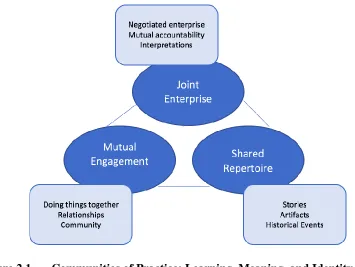
CoPs are constructed when individuals with common endeavors establish a community. The idea of CoP was established as the foundation of a Social Theory of Learning (Lave & Wenger, 1991). A CoP generates a space where learning is alive, collaborative, open, highly interactive, and is often informally structured (Johnson et. al, 2017). A CoP share common ideas and similar characteristics. According to Wenger (1998), CoP defines competence by combining three elements (a) mutual engagement, (b) joint enterprise, and (c) shared repertoire.
systems developed within the social communities where meaning and learning is constructed (Wenger, 1998).
First, members build their community through mutual engagement, and this happens because each participant inhabits identity and uniqueness to the group. To be determined a CoP, the group must sustain mutual engagement to pursue enterprise with one another, so learning can occur. This building of learning is a significant cornerstone of all CoP. A community can be defined as membership in which the group shares mutual engagement or practice in a common endeavor. It is not enough to call the group of individuals a CoP if they work in the same school or a group of PE teachers who teach in the same school district. The group could be called a CoP if, “…they sustain dense relations of mutual engagement organized around what they are there to do,” (Wenger, 1998, p. 74). It is imperative the members are included in what matters to the group to belong to the CoP. At times this may be talking about the newest teaching strategy or having a conversation about the stresses of the member’s personal life. The unique contributions of each member of the CoP add to the development of the community. Wenger (1998) specifies a CoP is not always harmonious. Conflict, jealousy, and power struggles can commonly occur in a CoP as the group spends a considerable amount of time talking, inputting their opinions, and sharing the common daily routines.
same ideas on all decisions, and in some communities, the community sees disagreements as productive (Wenger, 1998). The community is positioned within a broader system; for example, a mentor teacher and student-teachers are influenced by the institution of public education as a whole. The teachers and student-teachers must practice within the rules and policies designated within public schools; however, they must find time for fun, to gossip, and at times, to be off-task.
Functioning within the rules and finding time for off-task behaviors are both significant to the formation of a CoP (Wenger, 1998). The group needs to find ways to make life or work bearable. Professional development can be enhanced through social environments where collaboration is a priority. Members are bound together by a collective development of the understanding of what their community is about, and they hold each other accountable to this sense of joint enterprise (Wenger, 1998). CoP can help build a culture of collaboration and can enhance the professional development of individuals involved.
Figure 2.1 Communities of Practice: Learning, Meaning, and Identity Wenger (1998), p. 73
Lave and Wenger (1991) stated “learning is an integral and inseparable aspect of social practice” where all members can influence the community and can impact the culture. Hoadley (2012), described a CoP as an organic community where mutually agreed customs and rules exist. Ownership of the community is established gradually, and it can take years for the emergence of the cultural norms (Barab & Duffy, 2012; Hoadley, 2012).
The development of a CoP takes time (Hoadley, 2012), and multiple members of the group make up the representatives that develop its unique culture. For example, a CoP could involve mentor teachers, student-teachers, and university staff members in a
teacher education program. In this relationship, the student-teacher could affect the culture of the program as much as the university professor. Each member of the partnership can bring their uniqueness to the table. A CoP creates a ‘space’ for meaningful communication which enables the expansion of the groups’ pedagogy (Caldero´n, 1999).
them started” (Goodyear & Casey, 2015, p. 186). This ‘boundary spanner’ could be the facilitator of the group or the university supervisor.
Legitimate Peripheral Participation
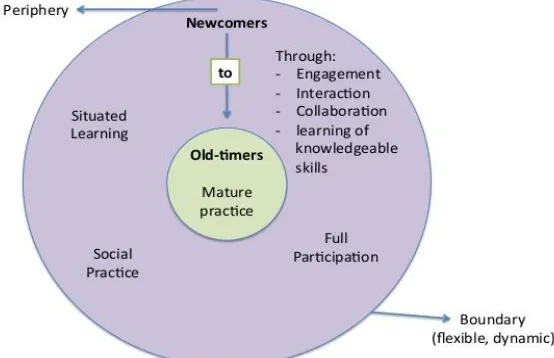
Lave and Wenger (1991) described the term legitimate peripheral participation as the experience of a newcomer over an extended period becoming an old timer. The community views individuals not independent of one another, but part of a cultural and community context (Lave & Wenger 1991; Wenger 1998). Hoadley (2012) stated, “initially, people may participate in tangential ways, but over time they take up more and more of the identity of group membership and centrality and more and more of the
central practices of the group,” (p. 291). This term could further be defined by the process of moving from an apprentice (e.g., a student-teacher) which is on the “periphery” of the community towards the “center” of the community (e.g., the mentor teacher and all other PE teachers in a high school). Through engagement, interaction, collaboration, and learned skills - the newcomer could become an insider. An insider is viewed by the established community (the old timers) as a part of their group (Lave & Wenger, 1991).
collaborate, collude, and collide, and what they enjoy, dislike, respect, and admire” (Lave & Wenger, 1991 p. 95).
For example, some student-teachers may start to be seen by the mentor teacher as an insider as the student-teacher takes over classroom responsibilities, is considered by the students as the teacher in charge, actively participates in staff meetings, and
contributes to day-in-day-out matters of a school. Lave and Wenger (1991) caution, however, that not all newcomers become an insider, as the pre-existing community may not accept some individuals. Just as the student-teacher can be viewed as an insider, a mentor teacher may become an insider with university staff members involved with the teacher education program and the university staff members within the schools in which they work. Well established teacher education programs have the potential for all individuals to become insiders in the community.
Theoretical Framework
Value Creation Framework
The Value Creation Framework (VCF) constructed by Wenger et al., (2011) is the theoretical framework used to frame this research project. The VCF is a conceptual foundation for promoting and assessing value created within communities. The VCF focuses and helps articulate the value produced through social learning. Social interactions are classified by Wenger et al. (2011) by using the terms network or
community. A network can be defined as a more casual relationship between members of the group where commitment to the group is minimal. Members of a network may share access to resources such as a lesson plan, a phone number, equipment, or an idea; however, frequently the flow of information stops after the resource is obtained and discontinues after the short interaction. The term community is used to describe a group of individuals who often meet about a shared goal in an enriching manner where
information and resources are shared. As described in Wenger’s prior work with Lave, communities can become something more robust and be defined as a CoP, as articulated above.
Members of the community can find value through participation with others and may find knowledge produced through the interaction. The VCF can be used as an analytical tool to help describe the value produced through social interactions and the value of the learning, which is enabled by community involvement (Wenger et al., 2011). The phrase value creation is defined as the value of the learning facilitated by the
creating knowledge together, keeping up with the field, stimulating change, and offering new types of professional development opportunities” (Wenger et al., 2011, p. 7).
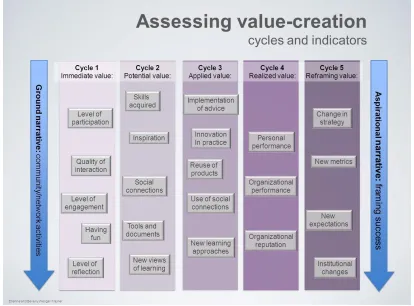
The framework is based on the four levels of the Kirkpatrick Model of Learning Evaluation (Kirkpatrick, 1976) which assesses the effectiveness of training, including affective, cognitive, behavioral, and contributive; however, the VCF has five cycles to help describe stories, narratives, or formative events of a community where members have developed professionally. The term ‘cycles’ describes value production by participating in a CoP (Wenger et al., 2011), and the cycles are as followed:
Cycle 1. Immediate Value: Activities and interactions. The most basic cycle of value creation considers networking/community activities, and interactions that are sparking the interest of the individual.
Cycle 2. Potential Value: Knowledge capital. Activities and interactions can produce “knowledge capital” when the value is realized at a later date and time. Cycle 3. Applied Value: Changes in practice. Adapting and applying knowledge
capital that leads to change in practice, approaches, or protocol.
Cycle 4. Realized Value: Performance improvement. After applying the
knowledge capital, reflection on what effects the application of knowledge capital had on the member’s practice is taken into consideration.
Figure 2.3 Wenger, E., B. Traynor, and M. De Laat. Chart fromAssessing Value Creation for Communities of Practice and Networks: A Conceptual Framework.
Need page Number
If the unit was put into action by the PE teacher(s) - Applied Value would come to fruition. Now, let’s say the teachers meet back up after they have taught the unit, and they reflect on how the unit has helped their students with their motor learning. The process of the teachers’ reflecting on how the applied unit was applied would be an example of Realized Value. Taking this example to the next level, assume that the unit was a hit, and the district PE coordinator hears about the unit. Before the teachers started teaching the unit, educational gymnastics was not a part of the district curriculum; however, the district wants the unit to be a part of the district-wide curriculum. Finally, let’s say the two PE teachers collaboratively meet with the district, the unit is added to the district curriculum, the two PE teachers conduct training for other PE teaches in the district, and the unit is successfully implemented into other schools around the district. The
successfully applied new unit would be an example of Reframing Value. It is important to note that there are ‘loops’ existing between all five cycles, as the cycles are not independent of one another. There is no hierarchy between the cycles and value may be represented simultaneously between multiple value creation cycles (Wenger et al., 2011).
Professional Development Schools
PDSs are communities of individuals who form a partnership in a public school and involve the collaboration between mentor teachers, university faculty members, and pre-service teachers. When the Holmes Group described a PDS model, they recognized the concept was parallel to the previous school-university partnerships, like the
“laboratory schools” John Dewey proposed at the beginning of the twentieth century (Schussler, 2006). The Holmes Group (1990) defined PDSs as:
Bringing practice teachers and administrators together with university faculty in collaboration to improve teaching and learning on the part of their respective students. It is the hope PDSs provide opportunities for teachers, students,
administrators, and university faculty to increase professional development where all individuals in the PDSs work on a) mutual deliberation on the problems with student learning and their possible solutions, b) shared teaching in the university and schools, c) collaborative research on the problems of educational practice, and d) cooperative supervision of prospective teachers and administrators (p. 56). The National Council for Accreditation of Teacher Education (NCATE) was established as an organization to help ensure high-quality teacher preparation. From 1995 to 2001, NCATE worked with hundreds of teacher educators and practitioners and
created the following characteristics of a Professional Development School. NCATE (2001) defined the five Defining Characteristics of PDSs as follows:
• Standard II: Accountability and Quality Assurance—Addresses the responsibility of a PDS partnership to uphold professional standards for teaching and learning.
• Standard III: Collaboration—Addresses the development and implementation of a unique university/school community which shares responsibility across institutional boundaries.
• Standard IV: Equity and Diversity— Addresses the responsibility of the PDS partnership to prepare professionals to meet the needs of diverse learners • Standard V: Structures, Resources, and Roles—Addresses the infrastructure
PDS partnerships use and creates to support its work.
Similarly, the National Association for PDSs (NAPDS), a national PDS organization, released a policy statement in, “What It Means to Be a Professional
Development School,” at its 2008 meeting. The following are nine required essentials of Professional Development Schools:
1. A comprehensive mission that is broader in its outreach and scope than the mission of any partner and that furthers the education profession and its responsibility to advance equity within schools and, by potential
extension, the broader community;
2. A school-university culture committed to the preparation of future educators embraces their active engagement in the school community; 3. Ongoing and reciprocal professional development for all participants
4. A shared commitment to innovative and reflective practice by all participants;
5. Engagement in and public sharing of results of deliberate investigations of practice by respective participants;
6. An articulation agreement developed by the respective participants delineating the roles and responsibilities of all involved;
7. A structure that allows all participants a forum for ongoing governance, reflection, and collaboration;
8. Work by college/university faculty and P–12 teachers in formal roles across institutional settings; and
9. Dedicated and shared resources and formal rewards and recognition structures.
PDSs are innovative institutions formed through partnerships between professional education programs and P–12 schools. PDSs have a four-fold mission:
• the preparation of new teachers, • faculty development,
• inquiry directed at the improvement of practice, and • enhanced student achievement.
the partnership. PDSs can help prepare student-teachers for the challenges and rewards of teaching in the academic environment, can contribute to aid in the professional
development of mentor teachers, increase student performance, and provide an
opportunity for research to be implemented in the classroom setting (Abdal-Haqq, 1998; Teitel, 2001). Castle and Reilly (2011) acknowledge PDSs as having multiple characters which have the potential for promoting positive outcomes for student-teachers, including:
• earlier, longer, and more structured field experiences
• greater school-based and university-based faculty collaboration on coursework and field experiences
• greater integration of coursework and field experiences
• more exemplary models of teaching along with more trained mentors
• more frequent and sustained supervision and feedback from more people on a broader variety of roles and more time on-site by the university supervisor • more exposure to diverse, school-wide authentic learning experiences • more supportive and reflective discussion and dialogue around issues of
practice and professionalism within a learning community
• more interconnections between teacher preparation, professional development, student learning, and inquiry.
PDSs aim to prepare student-teachers, mentor teachers and improve student performance through the application of research-based practices. Clinard and Ariav (1998) examined elementary PDSs in American and Israeli teacher education programs. The study took place for one year, and data was collected through observations,
their cognitive coaching skills when they could guide their student-teachers. The mentor teacher described growth in their listening skills, asking challenging questions, providing non-judgmental feedback, and reassessing their classroom management. Through
observations, inquiring, and insightful reflection, the mentor teachers increased their knowledge through the community and culture of learning brought about by working with the PDSs.
A seven-year longitudinal study of 1,000 graduates working within traditional education programs or in a PDS found that mentor teachers working in a PDS had greater teacher retention rates (Latham & Vogt, 2007). Members of the PDS partnerships find benefits from the collaborative exchange and report an increase in professional
development opportunities (Castle et al., 2006; Riley et al., 2005; Schvarak et al., 1998; Vontz et al., 2007). Additionally, partnerships through a PDS enhance a collaborative work environment that supports collective learning (Cozza, 2010; Rodgers & Keil, 2007). PDS provide a clinical preparation site where all parties involved can benefit from the learning interactions which take place in the school setting and improve both the quality of teaching and the success of student’s learning.
Benefits of Being a Mentor Teacher
1997; David, 2000; Holloway, 2001). The relationship between a mentor teacher and the student-teacher can also pass on personal values and experiences to the next generation of novice teachers (Tauer, 1998). As student-teachers work one-on-one with mentor
teachers, this relationship is designed to ultimately help student-teachers to be ready to have their own classroom.
Similarly, this partnership has been reported to increase the success of the mentor’s career. Mentor teachers are essential to the success of a student-teacher, and many mentor teachers find having a student-teacher beneficial to their professional achievements (Tang & Choi 2005, Rippon & Martin 2006, Beutel & Spooner-Lane 2009). Regardless of the type of teacher preparation program, it has been reported that most mentor teachers find benefits from working with the programs. These successes can include enhancements in the mentor teacher’s collaboration and reflection practices and professional development.
Collaboration and Reflection
It is essential that practitioners have other colleagues to collaborate with about their subject matter. The connection between the student-teacher and the mentor teacher can serve as professional development for the mentor teachers, and the mentor teacher appreciates being able to collaborate with another professional (He, 2010). Mentor
teachers state when they continue to collaborate with their student-teachers for years after the partnership, the exchanges provide some of their richest collegial interactions
teaching practices with mentor teachers, and mentor teachers also value reflecting and collaborating with pre-service teachers.
Teachers enjoyed the personal relationships established with the student-teachers and claimed these relationships were one of the most positive outcomes teachers gained from the experience of having a student-teacher (Iancu-Haddad & Oplatka, 2009). Similarly, Heller and Sindelar (1991) found the relationship between the mentor and a student-teacher increased productivity, improved instructional performance, and helped lower teacher turnover. Many individuals also felt a sense of gratification in their jobs which increased their sense of overall happiness.
Professional Development
It is crucial teachers continue to enhance their professional development and are willing to learn new teaching strategies. Mentor teachers can increase their professional development as a result of forming relationships with members involved in a teacher education program. Mentor teachers report a rise in personal job satisfaction, professional fulfillment, and esteem from working with student-teachers (David, 2000). Furthermore, many teachers feel it is important to “pay it forward to the next generation” of teachers; by mentoring, they can have a positive influence on education. Mentor teachers often learn new teaching strategies from student-teachers (Giwa, 2012). It has been found mentors view the opportunity as rewarding and mentors state the partnership can advance their careers through guiding, team-teaching, and collaborating with their mentee.
mentors and mentees (Danielson, 1999). As the result of working in pre-service teachers, mentor teachers report an upsurge in professional growth, increase in professional
competency, enhanced ability to be a reflective practitioner, and improvement in their coaching skills (Huling, 2001). Russell and Russell (2011) reported that many mentor teachers were enthusiastic about working with pre-service teachers as they were able to gain insight on new teaching trends and collaborate with another person about their subject matter.
Additionally, mentors were more likely to work with university professors on research projects as a result of working with a Professional Development School, which has the potential for academic growth and pedagogical content knowledge to increase within both the public schools and university (The Holmes Group,1990). Mentors found that having student-teachers provided them opportunities for renewal, re-energized them, and gave them a sense of commitment to their profession from the interaction of having a mentee (Oplatka, 2005). Findings from past research indicate teacher preparation
program partnerships motivate mentors, and they embrace the opportunity to develop new skill sets from their mentees (Bova & Phillips, 1984; Lopez-Real & Kwan, 2005; Simpson, Hastings, & Hill, 2007).
Not only are mentor teachers often able to increase their professional
achievements. Mentor teachers are essential to the success of a student-teacher, and many mentor teachers find having a student-teacher is also advantageous to their professional accomplishments.
Summary of Literature Review
CHAPTER THREE: METHODOLOGY
Introduction – Qualitative Single Case Study
As described in the review of the literature, a PDS offers multiple benefits to the members involved in the partnership. The question then becomes, what do we call a teacher education program partnership which is not a part of a Professional Development School, yet still has strong partnership ties with the members involved in a teaching training program? The researcher has coined the term PDP to describe the collaborative relationship which exists between the following members – a mentor teacher, school administrators, teacher educators at the selected school, professors involved in working with pre-service teachers, university supervisors, and pre-service teachers. A PDP shares nearly all the same components of a PDS; however, a PDP has not been accepted as a school-wide model. This community is formed through the interaction of the individuals involved in the pre-service education program. The researcher believes that it is
important to make the distinction between a PDS and a PDP, and for new terminology to arise, as a PDP has a unique relationship between its members.
This qualitative single case study aimed to examine a mentor PE teacher’s
including the fact Chris had worked with the PDP for 17 years, had been a teacher for 22 years, and would collaborate weekly with members of the PDP. While the research was being conducted, Chris did not work at a designated school-wide PDS; therefore, the term PDP was used to describe the partnership.
A single case study design was used for examining the research questions posed in this study. Due to the fact that PDPs have not been studied before this research project, this research aimed to shed light on how the partnership influences a mentor teacher. A case study can be described “as an empirical inquiry that investigates a contemporary phenomenon within its real-life context; when the boundaries between phenomenon and context are not clearly evident; and in which multiple sources of evidence are used,” (Yin, 1984, p. 23). A single case study can best be articulated through a comprehensive exploration of an in-depth case (Creswell, 2003) where a detailed descriptive, enclosed by time and place, case is examined. The study was designed with consideration of the single case and was described through the collection and examination of extensive data (Creswell, 2013; Merriam, 2009). Single case studies can provide a forum for an in-depth investigation into complex issues by observing a natural phenomenon which exists in a set of data (Yin, 1984).
This single case study used qualitative research methods as it allowed the
was conducted with the goal of learning how working with a PDP created value for Chris using VCF. Through the use of the VCF, the researcher was able to provide a foundation for the evaluation process where the researcher integrated heterogeneous sources of data to create a picture of how communities or networks potentially create value for Chris (Wenger et al., 2011).
Research Design
Sampling Procedures
For this study, purposeful sampling was employed as the researcher wanted to gain deep understanding and insight (Merriam & Tisdell, 2016) on a single participant working in the PDP. Additionally, criterion-based sampling was used for the selection of the participant in this study (Goetz & LeCompte, 1984). This method was used to select the participant, Chris, as he met the “predetermined criteria” (Patton, 1990) for the research project. “Predetermined criteria” was classified as follows: (a) the participant has been recommended by his principal, (b) the participant was approved by Unity Valley University staff members to have student-teachers, (c) the participant has collaborated weekly, for the past 18 years, with staff from Unity Valley University, and (d) the participant has written the PE Curriculum for the State Department of Education.
The above criteria were the basis for the researcher to determine this exemplary case. Unity Valley has no formal assessment to determine the level of the quality of mentor teachers while partnering with a student-teacher. However, the mentor teacher participating in this case study has been thoroughly trained from Unity Valley University. He continued to work alongside professors at the university and has been strongly
Participants
Chris was the primary participant in this single case study and an in-depth
examination was conducted to help articulate the value or lack of value Chris experienced by working with the PDP. For triangulation purposes, four of Chris’ colleagues who were able members of the PDP were interviewed to enrich the case study. These colleagues included Dr. Lambert - a university professor, Aaron - a mentor teacher and one of Chris’ former student-teachers, Mrs. Kelly - Chris’ current principal, Mr. Brown - Chris’ former principal. These four colleagues were interviewed on how they view Chris’ career has been influenced as a result of interacting with the PDP. The five interviews occurred for triangulation and validity purposes.
Chris
Chris is the main participant in this study. While the study was taking place, Chris was employed in an urban public school located near Unity Valley University. He had taught as an elementary PE teacher for 22 years. In 2002, Chris met Dr. Lambert, a PE professor at Unity Valley University and the PDP began. Chris had worked with 50+ student-teachers, had been a University Adjunct Supervisor for a total of 10 years, and had been trained to evaluate student-teachers’ final work portfolios. Chris had attended training provided by Unity Valley University and was identified by the professors at the university as a competent and qualified mentor to work with the student-teachers. Chris had presented at numerous State and National Conferences and was a member of SHAPE America.
Elementary PE Methodsstudents. These students were in their junior year and were enrolled at Unity Valley University. The methods class met for two days a week. One day a week, the classes were conducted at the university where students were instructed on how to deliver best teaching practices in an elementary PE setting, and the other day of the week, the method students and Dr. Lambert would go to Chris’ PE classes and co-teach lessons. On the days that the methods students were at Chris’ school, they applied the knowledge they had obtained and practice teaching the knowledge to Chris’ K-6 grade students in small group settings or with entire classes with assistance from Chris and Dr. Lambert. Additionally, Chris participated in the following professional
committees:
Leadership Team
Safety Team
Adapted PE committee within his school district
Art Committee
Smart Goals Committee
Mission/Vision Statement Committee
IEP and IEP(Speech) Administrator Designee
504 Committee
Working on his Leadership Degree Ed specialist degree (Masters)
Presented at 9 national conferences and 10 state conferences
Conducted countless district trainings
Attended professional training throughout the United States
2011 mentor of the year – Unity Valley University
Teacher of the Year - School District for Outstanding Service Award Dr. Lambert
Dr. Lambert had worked at Unity Valley’s Department of Kinesiology for 21 years. Before working at the university, he had taught elementary and middle school PE and health classes. Dr. Lambert was the professor who developed the PDP and had worked with Chris for 18 years. Through the development of the PDP, he was able to help prepare pre-service teachers and worked with local K-12 schools, including his most extended partnership, which was with Chris. Additionally, Dr. Lambert and Chris
partnered to teach Elementary PE Methods course at Chris’ school for eight years. The Elementary PE Methods class provided instructions for planning, organization, and management techniques when teaching PE in the elementary school setting. Dr. Lambert was interviewed for triangulation purposes, and the interview occurred in his office at Unity Valley University (Appendix B).
Aaron
skilled mentor PE teacher. During the study, both Chris and Aaron collaborated weekly, and both of them were working on their administrative leadership master’s degrees. Chris and Aaron had both presented at State and National Conferences together and had
collaborated regularly for the past nine years. Aaron was a member of SHAPE America. Subsequently, Aaron was also interviewed for triangulation purposes since he had many interactions with Chris.
Mrs. Kelly
Prior to the PDP being formed, Mrs. Kelly first met Dr. Lambert when she was a student in Dr. Lambert’s Elementary PE Methods course during the first year that Dr. Lambert became a professor at Unity Valley University. Mrs. Kelly and Chris first met while they were both coaching basketball at the elementary level. Mrs. Kelly then worked with Chris as his assistant principal while Mr. Brown was the principal for one year. During the time that the study was conducted, Mrs. Kelly had been Chris’ principal for five years. Chris had worked with approximately 26 student-teachers. Additionally, there had been approximately 20 Block I (a term used to describe the semester before student-teaching) students who have worked with Chris during the time she has been Chris’ principal. Chris and Mrs. Kelly had not presented together at any state or national conferences.
Mr. Brown
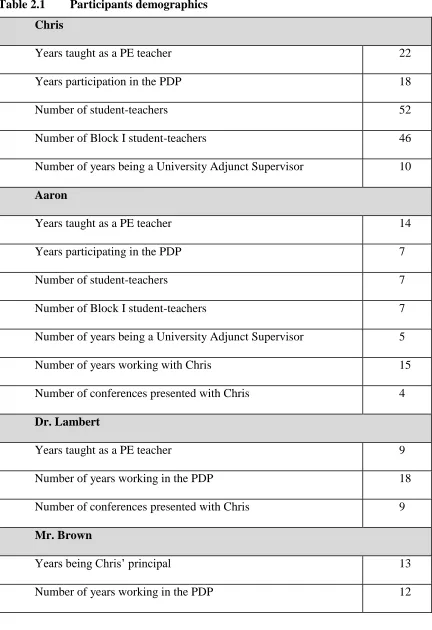
Table 2.1 Participants demographics
Chris
Years taught as a PE teacher 22
Years participation in the PDP 18
Number of student-teachers 52
Number of Block I student-teachers 46
Number of years being a University Adjunct Supervisor 10
Aaron
Years taught as a PE teacher 14
Years participating in the PDP 7
Number of student-teachers 7
Number of Block I student-teachers 7
Number of years being a University Adjunct Supervisor 5
Number of years working with Chris 15
Number of conferences presented with Chris 4
Dr. Lambert
Years taught as a PE teacher 9
Number of years working in the PDP 18
Number of conferences presented with Chris 9
Mr. Brown
Years being Chris’ principal 13
Number of student-teachers Chris had during the time he was the principal
26
Number of Block I student-teachers Chris had the principal 26
Number of conferences presented with Chris 3
Mrs. Kelly
Number of years both Chris and Mrs. Kelly both coached basketball at the same time
10
Years being Chris’ assistant principal while Mr. Brown was the principal
2
Years being Chris’ principal 5
Number of years working in the PDP 7
Number of student-teachers Chris had during the time she was the principal
26
Number of Block I student-teachers Chris had during the time she was the principal
20
Number of conferences presented with Chris 0
Site
Cypress Dale Elementary had 3 out of 5 stars on the School Star Rating System, and 11% of the students on Free and Reduced-Price Lunch.
Data Collection
During the final semester of Unity Valley’s PE Teacher Preparation Program, the university had student-teachers complete 16-weeks of a Professional Year Internship, Chris is one of the mentor teachers who has student teachers. Upon proper completion of the internship, the student-teachers would receive a K-12 PE Teaching Endorsement. Since the teaching endorsement is a K-12 endorsement, the student-teachers spend eight-weeks each in an elementary and secondary PE setting.
Chris was given guidelines on how to integrate the student-teachers to assume all teaching responsibilities. Student-teachers were first given minimal responsibilities such as taking roll, distributing equipment, assisting individuals or small groups, and shadow teaching portions of the mentor teacher’s lesson. During the first few weeks, the student-teacher was under constant supervision by Chris. By week two, the student-student-teacher began to teach one or two classes a day. This teaching load would gradually increase as Chris felt the student-teacher was ready to take over the PE classes fully. During this time, the student-teacher began working on their sample unit, lessons, and assessments. By week four or five, the student-teacher would assume complete responsibility for teaching, planning, and evaluation responsibilities.
Standard 1: Learner Development. The teacher understands how learners grow and develop, recognizing that patterns of learning and development vary individually within and across the cognitive, linguistic, social, emotional, and physical areas, and designs and implements developmentally appropriate and challenging learning experiences.
Standard 2: Learning Differences. The teacher uses an understanding of individual differences and diverse cultures and communities to ensure inclusive learning environments that enable each learner to meet high standards.
Standard 3: Learning Environments. The teacher works with others to create environments that support individual and collaborative learning, and that encourage positive social interaction, active engagement in learning, and self-motivation.
Standard 4: Content Knowledge. The teacher understands the central concepts, tools of inquiry, and structures of the discipline(s) they teach and create learning experiences that make the discipline accessible and meaningful for learners to assure mastery of the content.