Volume 16 Number 2 pp. 554–559 CThe Authors 2013 doi:10.1017/thg.2012.151
A Behavior Genetic Analysis of Trait Emotional
Intelligence and Alexithymia: A Replication
Holly M. Baughman,1Julie Aitken Schermer,2Livia Veselka,1Juliette Harris,3and Philip A. Vernon1 1Department of Psychology, University of Western Ontario, London, Ontario, Canada
2Management and Organizational Studies, University of Western Ontario, London, Ontario, Canada 3Department of Twin Research and Genetic Epidemiology, King’s College London, London, UK
This replication study examines relations between alexithymia and trait emotional intelligence (trait EI) at the phenotypic, genetic, and environmental levels. A sample of 1,444 same-sex twin pairs (850 MZ pairs and 594 DZ pairs) completed the Toronto Alexithymia Scale-20. A subset of 494 same-sex twin pairs (287 MZ pairs and 207 DZ pairs) had earlier completed the Trait Emotional Intelligence Questionnaire. Individual differences in alexithymia were attributable to genetic, non-shared environmental, and shared environmental factors. All but one of the facets of alexithymia were negatively and significantly correlated with the factors of trait EI, and these phenotypic correlations were entirely attributable to correlated genetic and correlated non-shared environmental factors. These bivariate results provide a valuable replication of those of Baughman et al. (Twin Research and Human Genetics, Vol. 14, 2011, pp. 539–543), which was conducted with substantially smaller samples of twins.
Keywords: trait emotional intelligence, alexithymia, behavioral genetics
Alexithymia is characterized by the inability to identify and express one’s emotions, an incapacity to distinguish be-tween one’s emotions and bodily sensations, and a ten-dency to engage in externally oriented thinking (EOT) — a cognitive style that shows a preference for the external details of everyday life rather than for content related to a person’s inner experience (Bagby et al., 1994a). Alexithymia has been linked to various physical and mental health condi-tions, such as posttraumatic stress disorder, somatic illness, substance abuse, and cancer (Krystal et al., 1986; Taylor et al., 1997; Todarello et al., 1989). Less research, however, has been conducted in the area of individual differences in alexithymia or regarding alexithymia’s relations with other personality traits, such as emotional intelligence.
Emotional Intelligence
Emotional intelligence (EI), also referred to as interpersonal intelligence, concerns the ability to understand and manage oneself and others in social situations (Thorndike, 1920). EI can be operationalized either as a trait or as an ability. Trait EI is concerned with individuals’ perceived capacity to un-derstand, process, and use information about emotions in everyday life, and is therefore assessed by self-report mea-sures. Ability EI is characterized by people’s actual abil-ities and is measured by performance tasks (Petrides & Furnham, 2001). However, researchers have encountered
psychometric difficulties when measuring ability EI (P´erez et al., 2005), so the present study will focus on emotional intelligence as a personality trait rather than as an ability. Previous studies pertaining to trait EI have reported posi-tive associations between the construct and numerous other variables, including life satisfaction, well-being, and social support (Austin et al., 2004).
Trait Emotional Intelligence and Alexithymia
Given that EI and alexithymia are conceptually similar in their shared focus on emotion-related understanding (Parker et al., 2001), the relation between them has been of some interest. Researchers have commonly assessed EI using the BarOn Emotional Quotient Inventory (EQ-i) and Schutte et al.’s (1998) self-report measure of EI, both of which define the trait as an ability, and therefore offer lim-ited scope in its assessment (Petrides et al., 2004). That
RECEIVED14 September 2012;ACCEPTED1 October 2012. First
published online 9 January 2013.
being said, this line of research has consistently reported moderate-to-strong negative correlations between EI and alexithymia, as measured by the Toronto Alexithymia Scale (e.g., Austin et al., 2004; Parker et al., 2001; Saklofske et al., 2003), suggesting an inverse relation between the variables of interest.
In order to study EI as a personality trait, the short form of the Trait Emotional Intelligence Questionnaire (TEIQue-SF) was employed in the present study. Few studies have examined this measure of trait EI in relation to alexithymia. Pham et al. (2010) reported a strong negative correlation between the TAS total score and TEIQue in a forensic sample of psychopaths. At the subclinical level, Mikolajczak et al. (2007) reported significant negative correlations between all factors of alexithymia and trait EI. Similarly, Baughman et al. (2011) found significant negative correlations between all factors of alexithymia and trait EI, with the exceptions of alexithymia’s EOT factor and the trait EI dimensions of emotion regulation and stress management.
Behavior Genetic Studies of Alexithymia
Relatively little research has been conducted regarding the etiological underpinnings of alexithymia. Early researchers reported various risk factors for alexithymia, which were primarily environmental or familial in nature (Berenbaum, 1996; Fukunishi et al., 1997). More recent studies, how-ever, have supported the role of genetic factors. To date, five behavior genetic (BG) studies of alexithymia have been conducted, with inconsistent findings.
A study by Heiberg and Heiberg (1977) suggested that alexithymia is influenced solely by genetic factors. Valera and Berenbaum (2001) demonstrated that the EOT fac-tor of alexithymia is influenced by genetic facfac-tors, but also reported that remaining dimensions — difficulty iden-tifying feelings (DIF) and difficulty describing feelings (DDF) — were influenced by both genetic and non-shared environmental factors. These studies suffered a number of limitations, including small sample sizes and measurement problems.
A large-scale adult twin study of 8,785 twin pairs sug-gested that individual differences in all three factors of alex-ithymia are attributable to genetic and non-shared envi-ronmental factors (Jørgensen et al., 2007). Two recent BG studies reported similar results (Baughman et al., 2011; Picardi et al., 2011). Baughman et al. (2011) further re-ported that the phenotypic correlations that they observed between alexithymia and trait EI were attributable to cor-related genetic and corcor-related non-shared environmental factors. The sample sizes in the study by Baughman et al. (2011), however, were very small and the results of what they referred to as a pilot study need to be replicated with a larger sample.
The Present Study
The present study aimed to replicate the findings of Baughman et al. (2011) using a larger sample of twins. Based
on Baughman et al.’s results, it is predicted that individual differences in alexithymia will be attributable to genetic and non-shared environmental factors. It is also predicted that all facets of alexithymia will be negatively correlated with all factors of the TEIQue-SF, and that these correlations will themselves be due to correlated genetic and correlated non-shared environmental factors.
Method
Participants
Participants were 850 monozygotic (MZ) pairs (771 female and 79 male pairs) and 594 dizygotic (DZ) same-sex twin pairs (556 female and 38 male pairs) who completed the Toronto Alexithymia Scale-20 (TAS-20). A subsample of 287 MZ same-sex twin pairs (257 female and 30 male pairs) and 207 DZ (191 female and 16 male pairs) had previously completed the TEIQue-SF. The average age of the twins was 60.5 years (SD=13.37), and they ranged in age from 18 to 89 years. Participants were recruited from the De-partment of Twin Research and Genetic Epidemiology at Kings College London in the United Kingdom. The twins’ zygosity was previously established either by genome scans (100% accurate), DNA tests (99.5% accurate), or via their responses to the ‘Peas in the Pod’ zygosity questionnaire (95% accurate).
Self-report questionnaires were sent to these adult twins, who are all volunteers from the Twins UK Adult Twin Reg-istry (Spector & Williams, 2006). All were ascertained from the general population and shown to be comparable to age-matched population singletons. These unselected MZ and DZ twins have been recruited since 1992 using twin regis-ters and national media campaigns, and have been used in a wide variety of studies (www.twinsuk.ac.uk). For historical reasons, the cohort is predominantly female. The twins in the registry are not selected for any particular trait and they volunteer to take part in studies that cover a wide range of traits and common medical conditions (Andrew et al., 2001). The study was approved by the St Thomas Hospi-tal research ethics committee, and all twins in the study provided their informed consent.
Measures
describe them’ (EOT). The TAS-20 has also been found to have excellent psychometric properties (Bagby et al., 1994b; Parker et al., 2003).
Trait Emotional Intelligence Questionnaire–Short Form (TEIQue-SF). The TEIQue-SF (Petrides, 2009) is a self-report questionnaire consisting of 30 items to which partic-ipants respond on a five-point Likert scale (1=completely disagree; 5=completely agree). The measure yields a global trait EI score, as well as scores on four factors: well-being, self-control, emotionality, and sociability. Internal consis-tency reliability coefficients for the global and factor scores have been reported to range from .66 to .89 in the UK twin sample (Veselka et al., 2010).
Procedure
In 2011, all volunteers in the Twins UK Adult Twin Registry were asked to complete a battery of self-report question-naires. A total of 6,552 individuals agreed to participate and, of these, 1,444 adult same-sex twin pairs (850 MZ; 594 DZ) completed the TAS-20 and a number of other measures not pertinent to the present report. A subsample of 494 same-sex twin pairs (287 MZ; 206 DZ) had previ-ously completed a battery of questionnaires in 2009, which included the TEIQue-SF. All participants provided their in-formed consent and were mailed a debriefing form upon completion of the study.
Analyses
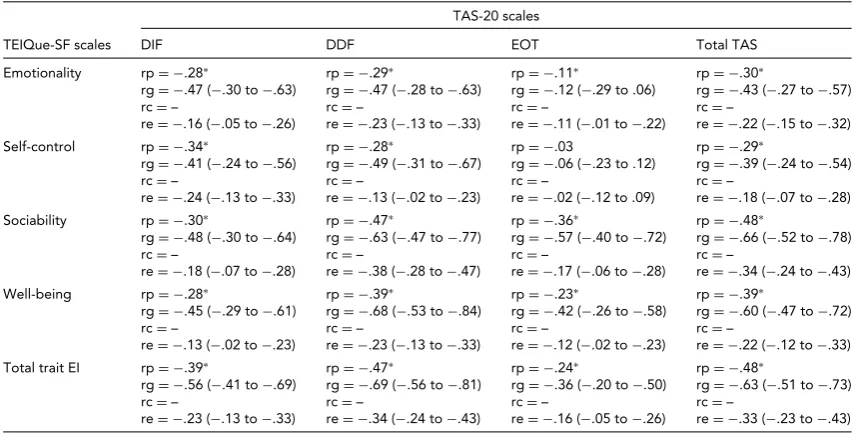
We conducted univariate and bivariate behavioral genetic analyses using the Mx software package (Neale et al., 1999) to determine the extent to which individual differences in alexithymia and the phenotypic correlations between alex-ithymia and trait EI can be accounted for by common ge-netic and/or common environmental factors. For the bivari-ate analyses, we used the method of Cholesky or triangular factor analysis (Neale & Cardon, 1992) to assess the cross-correlations within twin pairs (i.e., the correlation between one twin’s score on one variable with their co-twin’s score on another variable). We began by fitting a full ACE model to our data to investigate potential correlated genetic (A), common environmental (C), and/or unique environmen-tal (E) effects. Subsequently, reduced AE and CE models were tested. The models with the lowest2change value (relative to the full model) and the lowest AIC value were selected as the best-fitting models. For each of the correla-tions presented in Table 2, a reduced AE model was found to have the best fit. Consequently, genetic (rg) and non-shared environmental (re) correlations were estimated.
Due to the very large number of female twins in our samples, we also re-ran the univariate analyses separately among just females. We also tested for sex differences in alexithymia and trait EI and examined correlations between these variables and age.
TABLE 1
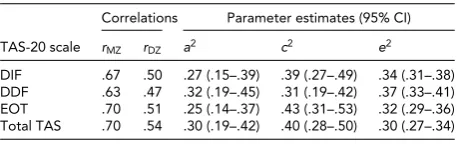
Twin Correlations and Univariate Model-Fitting Results for the TAS-20
Correlations Parameter estimates (95% CI)
TAS-20 scale rMZ rDZ a2 c2 e2
DIF .67 .50 .27 (.15–.39) .39 (.27–.49) .34 (.31–.38)
DDF .63 .47 .32 (.19–.45) .31 (.19–.42) .37 (.33–.41)
EOT .70 .51 .25 (.14–.37) .43 (.31–.53) .32 (.29–.36)
Total TAS .70 .54 .30 (.19–.42) .40 (.28–.50) .30 (.27–.34)
Note: DIF = difficulty identifying feelings; DDF = difficulty describing
feelings; EOT=externally oriented thinking;a2=additive genetic
effects;e2=non-shared environmental effects.
Results
Shown in Table 1 are the MZ and DZ twin correlations and the results of univariate BG analyses on the TAS-20, which were carried out with the software package Mx (Neale et al., 1999). These results are based on the full sample of 1,444 twin pairs. As can be seen, MZ correlations are larger than DZ correlations for all four dimensions of alexithymia, and, in each case, the best-fitting model showed that indi-vidual differences were attributable to additive genetic (a), shared environmental (C), and non-shared environmental (E) factors. Heritabilities range between .25 and .32 and all parameter estimates are significant at the .05 level. All re-duced models (i.e., AE, CE, and E only) yielded significantly poorer fits. When these analyses were re-run among just the female twins, the results were virtually identical. Moreover, although there were significant mean differences between males and females on several facets of alexithymia and trait EI (females scoring significantly higher than males on emo-tionality; males scoring significantly higher than females on self-control, sociability, DDF, EOT, and total TAS), the actual effect sizes for these differences were very small: the largest effect size (for emotionality) was .36. Finally, we did not correct the data for age because all correlations between facets of alexithymia and age were less than .10 (averaging just .05 in absolute value).
TABLE 2
Phenotypic, Genetic, and Environmental Correlations Between the TAS-20 and the TEIQue-SF
TAS-20 scales
TEIQue-SF scales DIF DDF EOT Total TAS
Emotionality rp= −.28∗ rp= −.29∗ rp= −.11∗ rp= −.30∗
rg= −.47 (−.30 to−.63) rg= −.47 (−.28 to−.63) rg= −.12 (−.29 to .06) rg= −.43 (−.27 to−.57)
rc=– rc=– rc=– rc=–
re= −.16 (−.05 to−.26) re= −.23 (−.13 to−.33) re= −.11 (−.01 to−.22) re= −.22 (−.15 to−.32)
Self-control rp= −.34∗ rp= −.28∗ rp= −.03 rp= −.29∗
rg= −.41 (−.24 to−.56) rg= −.49 (−.31 to−.67) rg= −.06 (−.23 to .12) rg= −.39 (−.24 to−.54)
rc=– rc=– rc=– rc=–
re= −.24 (−.13 to−.33) re= −.13 (−.02 to−.23) re= −.02 (−.12 to .09) re= −.18 (−.07 to−.28)
Sociability rp= −.30∗ rp= −.47∗ rp= −.36∗ rp= −.48∗
rg= −.48 (−.30 to−.64) rg= −.63 (−.47 to−.77) rg= −.57 (−.40 to−.72) rg= −.66 (−.52 to−.78)
rc=– rc=– rc=– rc=–
re= −.18 (−.07 to−.28) re= −.38 (−.28 to−.47) re= −.17 (−.06 to−.28) re= −.34 (−.24 to−.43)
Well-being rp= −.28∗ rp= −.39∗ rp= −.23∗ rp= −.39∗
rg= −.45 (−.29 to−.61) rg= −.68 (−.53 to−.84) rg= −.42 (−.26 to−.58) rg= −.60 (−.47 to−.72)
rc=– rc=– rc=– rc=–
re= −.13 (−.02 to−.23) re= −.23 (−.13 to−.33) re= −.12 (−.02 to−.23) re= −.22 (−.12 to−.33)
Total trait EI rp= −.39∗ rp= −.47∗ rp= −.24∗ rp= −.48∗
rg= −.56 (−.41 to−.69) rg= −.69 (−.56 to−.81) rg= −.36 (−.20 to−.50) rg= −.63 (−.51 to−.73)
rc=– rc=– rc=– rc=–
re= −.23 (−.13 to−.33) re= −.34 (−.24 to−.43) re= −.16 (−.05 to−.26) re= −.33 (−.23 to−.43)
Note: rp=phenotypic correlation; rg=genetic correlation; rc=shared environmental correlation; re=non-shared environmental correlation;
DIF=difficulty identifying feelings; DDF=difficulty describing feelings; EOT=externally oriented thinking. For all of the paired
variables, the best-fitting model was an AE-only model.
∗p<.001, two tailed.
the self-control and EOT scales — are also significant at the .05 level.
Discussion
In this study, our goal was to replicate the findings of Baugh-man et al. (2011). Specifically, we used a large twin sample to investigate the contributions of genetic and environmental factors to individual differences in alexithymia. We further assessed the phenotypic, genetic, and environmental cor-relations between alexithymia and trait EI. Univariate BG analyses of alexithymia showed that individual differences in the trait were influenced by genetic, shared environmen-tal, and non-shared environmental factors. These findings are in contrast to those of Baughman et al. (2011), where only significant genetic and non-shared environmental fac-tors were noted. The genetic component observed supports previous suggestions that biological underpinnings may contribute to the development of alexithymia (e.g., Ham et al., 2005; Larsen et al., 2003). The contribution of shared environmental factors in the present study is an unusual finding, given that most BG studies of personality show no shared environmental effects (see Johnson et al., 2008, for a review of over 50 years of research). In a study of MZ and DZ twins reared together and reared apart, however, Tellegen et al. (1988) noted that there may be situations in which reared-together co-twins are themselves an impor-tant shared environmental source of within-pair similarity. This could only occur, however, among DZ twins and not among MZ twins, because only DZ twins have genetically
determined within-pair differences in the first place. It is possible that such an effect is operating with respect to alexithymia, and was not noted by Baughman et al. (2011), given the small sample size they used. Additional research, however, should be conducted to investigate whether this is a real effect or merely an anomaly.
Our bivariate BG analyses revealed that the phenotypic correlations between trait EI and alexithymia are entirely at-tributable to genetic and non-shared environmental factors. These results provide a valuable replication of Baughman et al.’s (2011) small-sample pilot study, in which similar re-sults were reported. The findings allow us to conclude that, although alexithymia and trait EI are distinct, they do also share common attributes. Furthermore, many of the genetic correlations we reported between the trait sets were large, suggesting that neurobiological studies of alexithymia and trait EI may identify underlying biological factors common to both.
The present study is, of course, not without its limita-tions. The manner by which responses were obtained was self-report in nature, which could have resulted in response biases despite participants being encouraged to answer all items honestly and that they were not aware of the traits being studied. This potential is especially possible given the socially undesirable nature of alexithymic traits, and the socially desirable nature of high trait EI. To check for these response effects, it is suggested that future stud-ies explore alexithymia and trait EI using peer report or multitrait–multimethod formats. Additionally, the nature of the sample may have further impacted our results. Specif-ically, the over-representation of female participants, which is due to historical reasons, may have resulted in more ex-treme scores given that females tend to score higher on a number of trait EI factors (Petrides & Furnham, 2000) and lower on alexithymia (Levant et al., 2009) in comparison to males. These scores could, in turn, have led to more pronounced negative correlations between the variables in our sample. That being said, the findings were largely in line with previous investigations of alexithymia and trait EI (e.g., Mikolajczak et al., 2007; Pham et al., 2010) and therefore are likely to be accurate representations of the true nature of the associations.
Acknowledgments
We would like to express gratitude toward the twins who voluntarily participated in this research project. We are also grateful for the help and support from the staff of the De-partment of Twin Research (DTR). The DTR is largely sup-ported by the Wellcome Trust. Furthermore, this research project received support from the Department of Health and the National Institute for Health Research (NIHR) comprehensive Biomedical Research Centre award to Guy’s and St Thomas’ NHS Foundation Trust in partnership with King’s College, London.
References
Andrew, T., Hart, D. J., Snieder, H., De Lange, M., Spector, T. D., & MacGregor, A. J. (2001). Are twins and single-tons comparable? A study of disease-related and lifestyle
characteristics in adult women.Twin Research and Human Genetics,4, 464–477.
Austin, E. J., Saklofske, D. H., & Egan, V. (2004). Personality, well-being and health correlates of trait emotional intelli-gence.Personality and Individual Differences,38, 547–558. Bagby, R. M., Parker, J. D. A., & Taylor, G. J. (1994a). The
twenty-item Toronto alexithymia scale-I. Item selection and cross validation of the factor structure.Journal of Psychoso-matic Research,38, 23–32.
Bagby, R. M., Parker, J. D. A., & Taylor, G. J. (1994b). The twenty-item Toronto alexithymia scale-II. Convergent, dis-criminant, and concurrent validity.Journal of Psychosomatic Research,38, 33–40.
Baughman, H. M., Schwartz, S., Schermer, J. A., Veselka, L., Petrides, K. V., & Vernon, P. A. (2011). A behavioural-genetic study of alexithymia and its relationships with trait emotional intelligence.Twin Research and Human Genetics,
14, 539–543.
Berenbaum, H. (1996). Childhood abuse, alexithymia and personality disorder.Journal of Psychosomatic Research,41, 585–595.
Fukunishi, I., Kawamura, N., Ishikawa, T., Ago, Y., Sei, H., Morita, Y., & Rahe, R. H. (1997). Mothers’ low care in the development of alexithymia: A preliminary study in Japanese college students.Psychological Report,80, 143–146. Ham, B. J., Lee, M. S., Lee, Y. M., Kim, M. K., Choi, M. J., Oh, K. S.,. . .Choi, I. G. (2005). Association between the catechol O-methyltransferase Val 108/158Met polymorphism and alexithymia.Neuropsychobiology,52, 151–154.
Heiberg, A., & Heiberg, A. (1977). Alexithymia: An inherited trait? A study of twins.Psychotherapy and Psychosomatics,
28, 221–225.
Johnson, A. M., Vernon, P. A., & Feiler, A. R. (2008). Behavioral genetic studies of personality: An introduction and review of the results of 50+years of research. In G. J. Boyle, G. Matthews, & D. H. Saklofske (Eds.),The SAGE handbook of personality theory and assessment: Vol. 1. Personality theories and models(pp. 145–173). Thousand Oaks, CA: Sage. Jørgensen, M., Zachariae, R., Skytthe, A., & Kyvik, K. (2007).
Genetic and environmental factors in alexithymia: A population-based study of 8,785 Danish twin pairs. Psy-chotherapy and Psychosomatics,76, 369–375.
Krystal, J. H., Giller, E. L., & Ciccheti, D. V. (1986). Assess-ment of alexithymia on post-traumatic stress disorder and somatic illness: Introduction of a reliable measure. Psycho-somatic Medicine,48, 84–94.
Larsen, J. K., Brand, N., Bermond, B., & Hijman, R. (2003). Cognitive and emotional characteristics of alexithymia: A review of neurobiological studies.Journal of Psychosomatic Research,54, 533–541.
Levant, R. F., Hall, R. J., Williams, C. M., & Hasan, N. T. (2009). Gender differences in alexithymia.Psychology of Men and Masculinity,10, 190–203.
Mikolajczak, M., Luminet, O., Leroy, C., & Roy, E. (2007). Psychometric properties of the Trait Emotional Intelligence Questionnaire (TEIQue).Journal of Personality Assessment,
Neale, M., Boker, S. M., Xie, G., & Maes, H. H. (1999).Mx: Statistical modelling(5th ed.). Richmond, VA: Richmond Medical College of Virginia.
Neale, M. C. & Cardon, L. R. (1992).Methodology for genetic studies of twins and families, Norwell, MA: Kluwer. Parker, J. D. A., Taylor, G., & Bagby, R. M. (2001). The
rela-tionship between emotional intelligence and alexithymia.
Personality and Individual Differences,30, 107–115. Parker, J. D. A., Taylor, G., & Bagby, R. M. (2003). The 20-item
Toronto Alexithymia Scale reliability and factorial valid-ity in a communvalid-ity population.Journal of Psychosomatic Research,55, 269–275.
P´erez, J. C., Petrides, K. V., & Furnham, A. (2005). Measuring trait emotional intelligence. In R. Schulze & R. D. Roberts (Eds.), International handbook of emotional intelligence
(pp. 181–201). Cambridge, MA: Hogrefe & Huber. Petrides, K. V. (2009).Technical manual for the Trait Emotional
Intelligence Questionnaires(TEIQue). London: London Psy-chometric Laboratory.
Petrides, K. V., & Furnham, A. (2000). Gender differences in measured and self-estimated trait emotional intelligence.
Sex Roles,42, 449–461.
Petrides, K. V., & Furnham, A. (2001). Trait emotional intel-ligence: Psychometric investigated with reference to estab-lished trait taxonomies.European Journal of Personality,15, 425–448.
Petrides, K. V., Furnham, A., & Frederickson, N. (2004). Emo-tional intelligence.The Psychologist,17, 574–577.
Petrides, K. V., Vernon, P. A., Schermer, J. A., Ligthart, L., Boomsma, D. I., & Veselka, L. (2010). Relationships between trait emotional intelligence and the Big Five in the Nether-lands.Personality and Individual Differences,48, 906–910. Pham, T. H., Ducro, C., & Luminet, O. (2010). Psychopathy,
alexithymia and emotional intelligence in a forensic hospi-tal.International Journal of Forensic Mental Health,9, 24–32.
Picardi, A., Fagnani, C., Gigantesco, A., Toccaceli, V., Lega, I., & Stazi, M. A. (2011). Genetic influences of alexithymia and their relationship with depressive symptoms.Journal of Psychosomatic Research,71(4), 256–263.
Saklofske, D. H., Austin, E. J., & Minski, P. S. (2003). Fac-tor structure and validity of a trait emotional intelligence measure.Personality and Individual Differences,34, 707– 721.
Schutte, N. S., Malouff, J. M., Hall, L. E., Haggerty, D. J., Cooper, J. T., Golden, C. J., & Domheim, L. (1998). Devel-opment and validation of a measure of emotional intelli-gence.Personality and Individual Differences,25, 167–177. Spector, T. D., & Williams, F. M. (2006). The UK Adult Twin
Registry (TwinsUK).Twin Research and Human Genetics,9, 899–906.
Taylor, G. M., Bagby, M., & Parker, J. D. A. (1997).Disorders of affect regulation: Alexithymia in medical and psychiatric illness. New York: Cambridge University Press.
Tellegen, A., Lykken, D. T., Bouchard, T. J., Wilcox, K. J., Segal, N. L., & Rich, S. (1988). Personality similarity in twins reared apart and together.Journal of Personality and Social Psychology,54, 1031–1039.
Thorndike, E. L. (1920). Intelligence and its use.Harper’s Mag-azine,140, 227–235.
Todarello, O., La Pesa, M. W., Zaka, S., Martino, V., & Lattanzio, E. (1989). Alexithymia and breast cancer: Survey of 200 women undergoing mammography.Psychotherapy and Psychosomatics,51, 51–55.
Valera, E. M. & Berenbaum, H. (2001). A twin study of alex-ithymia.Psychotherapy and Psychosomatics,70(5), 239–246. Veselka, L., Petrides, K. V., Schermer, J. A., Cherkas, L. F., Spector, T. D., & Vernon, P. A. (2010). Phenotypic and ge-netic relations between the HEXACO dimensions and trait emotional intelligence.Twin Research and Human Genetics,