Modeling Constraint-based Processes:
a Supervisory Control Theory Application
Eduardo Alves Portela Santos, Agnelo Denis Vieira, Sauro Schaidt, and Eduardo de Freitas Rocha Loures
Pontificia Universidade Catolica do Parana, Graduate Program in Industrial and Systems Engineering and Graduate Program in Health Technology
Imaculada Conceicao 1155 Curitiba, Brazil
{eduardo.portela,agnelo.vieira, sauro.schaidt, eduardo.loures}@pucpr.br
Abstract. Constraint-based processes require a set of rules that limit their behavior to certain boundaries. In these processes, the control flow is defined implicitly as a set of constraints or rules, and all possibilities that do not violate any of the given constraints are allowed to be executed. The present paper proposes a new approach to deal with constraint-based processes. The proposed approach is based on Su-pervisory Control Theory, a formal foundation for building controllers for discrete-event systems. The controller proposed in this paper monitors and restricts execu-tion sequences of activities such that constraints are always obeyed. We demonstrate that our approach may be used as a declarative language for constraint-based pro-cesses. In order to provide support for users of such processes and to facilitate the using of our control approach, we offer a set of constraints modeled by automata. This set encompasses the constraints frequently needed in workflow system. Keywords: constraint-based processes, Supervisory Control Theory, declarative languages, flexible processes.
1.
Introduction
Nowadays constraint-based processes approaches have received increased interest [16]. In these processes, the control flow is defined implicitly as a set of constraints or rules, and all possibilities that do not violate any of the given constraints are allowed to be executed [13] [9] [8]. A constraint-based process model specifies the activities that must be performed to produce the expected results but it does not define exactly how these activities should be performed [6] [7]. Thus, any execution order of activities is possible provided that the constraints are not violated. Thus, most of time the process execution is driven by users choice.
may take time exponential in the size of the LTL formulas [24]. This motivates research-ing the problem of findresearch-ing an expressive constraint-based processes approach where both the constraints as well as the run time state can be easily visualized and understood by the end user and also allows an effective verification (blocking,conflict, dead tasks) and execution of activities.
In the present paper we propose a new approach to deal with constraint-based pro-cesses founded on the Supervisory Control Theory [15]. The new approach proposes a control system which restrains the process in order to not violate the constraints. This action is accomplished through dynamic disabling of some events, restraining the state space of process. We consider that a process may contain sequences of events that are not allowed to occur. These sequences may violate a desired ordering of events and they need to be avoided. Thus, a supervisor is built in order to ensure that the whole set of con-straints is not violated. We had some challenges bringing the formal foundation of SCT into a constraint-based process model, which characterizes the originality of our paper. We highlight the following contributions:
1. A new approach to deal with constraint-based processes. The proposed approach is based on SCT. The supervisor obtained applying SCT monitors and restricts execu-tion of sequences of activities such that constraints are always obeyed. We demon-strate that our proposal can be used as a declarative language for constraint-based processes. Our approach does not limit the user by imposing rigid control-flow struc-tures. In fact, the basis of our approach is to inform users of which activities are not allowed to occur after an observed trace of events at run-time, and users operate with some freedom because they choose execution sequences allowed under supervision; 2. A new approach to audit processes. Applying SCT results in a language (sequence
of events) that considers all possible sequences which do not violate any of the con-straints imposed to the process. It is possible to audit an execution of a process com-paring if the performed sequence of activities belongs to that language.
3. Modeling activities and constraints using automata. We represent activities and con-straints frequently needed in workflow systems using automata. This is necessary to apply the SCT. We propose a general model of activities as well as a set of constraints (Fig. 8 to 11, section 4). We aim to support users without a deep knowledge in SCT on its application in order to model constraint-based processes;
The present paper is an extended version of the previous paper presented in WorldCist 2013 [19], and is organized as follows: Section 2 describes the Supervisory Control The-ory, as the fundamental concept of the proposed approach. Section 3 explains the mod-eling of activities using automata. Section 4 explains the modmod-eling of constraints using automata. Also, it is presented four categories of constraints usually needed in business processes. Section 5 presents an application example to illustrate our approach. Section 6 discusses the process execution and the architecture of the run-time environment. Section 7 concludes the paper.
2.
Supervisory Control Theory
Ac-cording to SCT, the behaviour of a DES may be represented by sequences of events cor-responding to ordered execution of activities. Among all possible sequences of events and due to the process rules and constraints, some sequences of events are desirable while other sequences are not since they violate these rules or constraints. Instead of defining a priori a specific sequence of events to be enforced in order to satisfy the constraints, the core concept of SCT is to design a supervisor that, following the sequence of events while the process evolves, specifies which events cannot occur in order to not violate the constraints. Thus, after the occurrence of an event the system (or the DES) decides which event will occur among those that are not disabled by a supervisor. SCT provides algo-rithms that, based on a process model considering all feasible event sequences and the associated constraints, allow one to design a supervisor whose control action imposes a minimally restrictive behaviour over a DES under consideration.
SCT is based on automata and formal language theories. Usually, a composed sys-tem is represented by a set of automata as {Gi|i ∈ I}, where i ∈ I identifies each
subsystem. AutomatonGirepresents the independent behaviour of a corresponding
sub-system in a high degree of abstraction. The uncoordinated or unconstrained behaviour of the entire DES is obtained by the synchronous product [2] of all subsystems asG=
||∀i∈IGi. An automaton (also known as a language generator) is a structure as Gi =
(ΣGi, QGi, δGi, qGi0 , QGim)whereΣGi is the alphabet (set) of events,QGiis the set of
states,δGi : (QGixΣGi)→QGiis the state transition function (in general, partially de-fined),qGi0 is the initial state, andQGim ⊆QGiis the set of marker states. An automaton
state represents that a certain activity is being performed or that the subsystem is idle. Events represent the beginning and (un)successful execution of such activity. One may differentiate some states to give them a special meaning by grouping them in a set of marked states. In SCT marked states are those representing accomplishment of activities.
A Product System Representation (PSR) is a set of asynchronous subsystems such that all pairs of subsystems in{Gi|i ∈ I} have disjoint alphabets. The system’s whole
set of events is Σ = ∪∀i∈IΣGi. There are two languages associated with automaton
G: the closed language L(G) and the marked languageLm(G). The closed language
is the set of all sequences of events leading from the initial state to some state of G. The marked language is the set of all sequences of events leading from the initial state to any marked states such thatLm(G) ⊆ L(G). These are the languages representing
the unconstrained behaviour of the entire system. Under these languages there are several undesirable sequences of events that must be avoided in order to restrain the system inside a desirable (allowed) behaviour.
SCT allows the designer to take into account the nature of events. While there are some events whose occurrence might be disabled by a control agent there are events whose occurrence cannot be disabled. An event is controllable if a control agent (super-visor) can disable its occurrence. One may consider that a certain event is uncontrollable by convenience in order to not allow it to be disabled. In general, an uncontrollable event is inherently unpreventable. Considering a subsystem in {Gi|i ∈ I},ΣcGi denotes its
set of controllable events andΣucGi its set of uncontrollable events. The whole set of
controllable events isΣc=S
∀i∈IΣcGi.
prod-uct of all automata in{Cj|j∈J}with automatonGresults automatonCrepresenting a
global constraint.
A supervisor is a map from the closed language ofGto a subset of events to be en-abledS:L(G)→2Σ. A supervisor may be represented by an automaton and an output map{Υ}= (S, Φ), whereS= (ΣS, QS, δS, q0S, QSm). AutomatonSis driven by
occur-rence of events in DES, and output mapΦ:QS →2Σcspecifies the subset of controllable events that must be disabled as a correspondence of the active state of automatonS. The action of a supervisor includes disabling controllable events and unmarking sequences of events. Algorithms provided by SCT allow the formal synthesis of automatonΥ/G, which represents the optimal behaviour ofGunder supervision ofΥ, whereL(Υ/G)⊆L(G)
andLm(Υ/G) ⊆(L(Υ/G)∩Lm(G)). This behaviour is named supremal controllable
sublanguage of Lm(C)with regard toGand it is usually represented assupC(E, G).
WheneverLm(Υ/G)is a proper subset of(L(Υ/G)∩Lm(G)),Υis a marker supervisor,
i.e., there are sequences of events corresponding to accomplished tasks in the uncoordi-nated behaviour ofGthat are no longer considered accomplished tasks under the action of the supervisor. Typically, the automaton representing a supervisor is automatonΥ/G itself. [10] and [21] provide algorithms to obtain a reduced representation of supervisorΥ as a new pair(Sr, Φr)where automatonSrhas a smaller number of states thanΥ/Gand
it provides the same control action.
In a monolithic approach, a single global supervisor is synthesised to cope with all constraints. Necessary and sufficient conditions for the existence of supervisors are es-tablished in [14]. According to Local Modular Control (LMC) [3], an extension of the SCT, instead of synthesizing a single global supervisor that satisfies the entire set of con-straints, a local supervisor must be synthesized for each constraint in{Cj|j ∈ J}. This
leads to a set of local supervisors{Υj|j ∈ J}. Synthesis of local supervisorΥj is
per-formed considering corresponding local constraintClj and its corresponding local plant
Glj. A local plant is obtained performing the synchronous product of only those
subsys-tems in{Gi|i∈I}sharing some event with corresponding constraint and local constraint
is obtained performing the synchronous product of automata representing corresponding constraint and local plant(Clj = Glj||Cj). Automaton Υ/Glj represents the optimal
behaviour of local plantGljunder supervision of corresponding local supervisorΥj. If at
least one local supervisor in set{Υj|j∈J}disables an event, the event is disabled inG.
A sequence of events is recognized as an accomplished task if all local supervisors agree with.
A limitation of LMC is that the behaviour obtained under the action of all local su-pervisors may fail to be non-blocking, even if each modular supervisor is non-blocking. Blocking in SCT occurs when all possible ways of continuing a sequence of events never lead to a marked state. After synthesis of all local supervisors, it is necessary to ver-ify whether their control actions are free of conflicts. One way is confirming Υ/G =
||∀j∈J Υ/Glj. In the worst case, such verification involves the same complexity as that
found during synthesis of the global supervisor [3]. If this property is verified, the be-haviour obtained under the action of the entire set of local supervisors is identical to the behaviour obtained under the action of a global supervisor.[25] proposes how to proceed if such property is not verified.
– SCT uses automata as formalism to represent activities, constraints and the resulting supervisor. This is a formal and explicit way of representing them;
– Using SCT, from modelling to synthesis and visualization, the formal notation is always the same (automata), without the need to convert from one notation to another (in DECLARE is necessary to convert LTL formulas to automata);
– In SCT the state of each activity as well as each constraint may be easily visualized and understood by the end user at run-time;
– SCT provides algorithms to perform a formal synthesis of supervisor (or the admissi-ble language of a constraint based process) instead of the usual manual and heuristic procedures;
– The obtained solution is minimally restrained and also dead-lock free;
– New control actions may be rapidly and formally designed when modifications, such as redefinition of constraints or activities arrangements, are necessary;
– The constraint-based processes can be made to behave optimally with respect to a variety of criteria, where optimal means in minimally restrictive way (concern to the admissible language of the process). This is a very strong characteristic of the proposed approach. As far as we know, there is no approach that offer a better solution related to the admissible language.
3.
Modeling activities of constraint-based processes
The theory presented at previous section, together with a method of control implementa-tion [23], have successfully been employed on the actual control of DES with characteris-tics of the manufacturing industry [20] [5]. In order to provide full support to control im-plementation in the context of constrain-based processes, we propose first to analyze the modeling of activities and constraints. This section presents how we propose to represent activities of constraint based processes so that they may be coordinated by supervisors obtained applying SCT.
Suppose a process with a set of associated activitiesA={ai|i∈I}whereIis a set
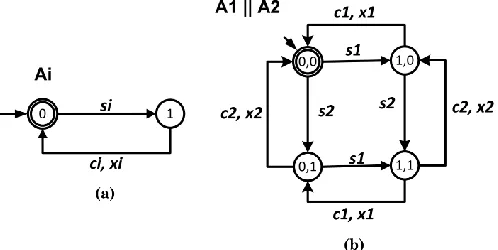
of index uniquely identifying each activity. We propose that each activity is modelled as a corresponding automatonAi= (ΣAi, QAi, δAi, q0Ai, Q
Ai
m), as shown in Fig. 1(a),
result-ing in set{Ai|i∈I}. States on this automaton mean that activity is being performed (state
1) or is not being performed (state 0). Transition from state 0 to state 1 is due to eventstart activity ai(si); transition from state 1 to state 0 is due to occurrence of eventsuccessfully complete activity ai(ci) orcancel activity ai(xi). In SCT marked states are those repre-senting accomplishment of tasks, a state represented with a double line is a marked state. In this modelsiis a controllable event whileciandxiare uncontrollable events. It means that starting an activity by a resource may be disabled by a supervisor. However, once it is under execution a supervisor is not allowed to avoid it to becancelledorcompleted suc-cessfully. The set of events of automatonAiisΣAi={si, ci, xi}. Considering the entire
set of activities, the whole set of events isΣ=S
∀i∈IΣAi. It can be seen that all pairs of
automata in{Ai|i∈ I}have disjoint alphabets of events(∀p, q∈I, ΣAp∩ΣAq =∅),
[18]. The modeler has to choose which states and events will be considered based on the relevant constraints to be imposed to the process under consideration.
Considering the whole set of activities, it is possible to have several activities being executed at the same time. Performing synchronous product of all automata in{Ai|i∈I},
it results on automatonAwhere the set of states represents all possible combinations of activities being performed over a certain process instance. It is a subset of the cartesian product of the set of states of all automata in{Ai|i∈I}. Since this set of automata is a
product system representation the number of states ofAis2n, wherenis the number of
automata. AutomatonArepresents the uncoordinated behaviour of activities. In automa-tonAan state is marked if and only if it corresponds to a combination of marked states of automata in{Ai|i ∈ I}. For instance, considering a process with only two activities
(A ={a1, a2}), the synchronous product of corresponding automata(A= A1||A2)is the one shown in Fig. 1. At this automaton each state is named as an ordered pair (state ofA1, state ofA2).
Fig. 1.Automata representing: (a)activity model and (b) uncoordinate behaviour model of two activities
4.
Modeling constraints
According to [1], three main categories of constraints may be identified. One category focuses on ensuring that each process instance is performed under specific ordering of activities. The second category focuses on managing the allocation or usage of resources that perform such activities. The third one focuses on the attributes of a process instance. SCT may be employed to synthesize supervisors to enforce these constraints. This paper is restricted on modelling activities compatible with constraints on the first category. In this section we describe the procedure to represent a constraint using automata.
Consider automatonArepresenting the uncoordinated behaviour of a set of activities
{ai|i∈ I}of a process. LanguageL(A)represents all sequences of events that may be performed by these activities without any constraint, andLm(A)is a subset ofL(A)
possible that certain states must be forbidden since they represent an unauthorized con-current execution of activities. These sequences and states must be avoided. Also, it is possible that a sequence of events inLm(A)does not correspond to an accomplished task
when the process instance is performed under supervision. Thus, that sequence needs to be unmarked by supervisor. Consider automatonS/A, such thatLm(S/A) = supC(C, A),
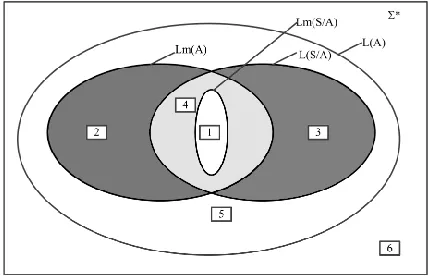
the one that recognizes the supremal controllable language of constraint activities. [16] define a supported traces as a sequence of events complying with all mandatory con-strains. This definition complies with the definition of a sequence of events belonging to Lm(S/A). Fig. 2 shows the languages relation: the region 1 includes sequences of events
belonging toLm(S/A)(or supported traces); the region 2 includes sequenceswsuch that
w∈L(A),w∈Lm(A),w63L(S/A),w63Lm(S/A); the region 3 includes sequences
w∈L(A),w63Lm(A),w∈L(S/A),w63Lm(S/A), the region 4 includes sequences
w∈L(A),w∈Lm(A),w∈L(S/A),w63Lm(S/A).
Fig. 2.Venn diagram of languages relation
To formally obtain the supervisor that restrains the uncoordinated behaviour of activ-ities it is necessary to express constraints in terms of automata. Usually, each constraint is represented as an automaton resulting in set {Cj|j ∈ J}, whereJ is a set of index
uniquely identifying each constraint. When a process instance is performed under super-vision of a set of supervisors obtained employing SCT, the related constraints will never be violated and there will always be at least one sequence of events leading to a marked state, i.e., there will always be the possibility of accomplishing a task.
Modelling constraints is based on sequence of events and unmarking states. Consider an automatonCz ∈ {Cj|j ∈ J}. Usually the alphabet of events ofCzis only a proper subset of the whole set of events. Such alphabet contains the events strictly necessary to represent the constraint and it is represented asΣCz. If the occurrence of an event inΣCz
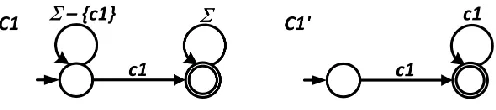
Theexistence(a1, 1)model requires thatactivity a1 must occur at least once at ev-ery trace[16][11]. In order to facilitate the understanding of our approach, we rewrite this constraint toactivity a1 is successfully completed at least once. Fig. 3 presents two possibilities of modelling this constraint. The first possibility is through automatonC1. Initial state ofC1has a self-loop labelled asΣ−c1, meaning that the occurrence of any event belonging toΣbutc1keeps this state as the active one. The active state is state 1 only after occurrence of eventc1. This remains the active state despite the occurrence of any event, as there is a self-loop labelled asΣ. Since the only marked stated is state 1 then accomplishing a task is recognized only after first occurrence of eventc1. Alphabet of events of this automaton is the whole set of eventsΣC1=Σ. Modelling a constraint through an automaton whose alphabet of events isΣ has the advantage of clearly pre-senting the occurrence of all possible events. In the case one employs this automaton as a constraint under the LMC approach, then the corresponding local plant is automaton Aand does not take advantage of this approach in reducing computational complexity to synthesize a corresponding local supervisor. Considering definition of synchronous prod-uct and algorithms for the synthesis of supremal controllable languagesupC((AkC1), A)
[26], a more efficient representation of a constraint is through an automaton employing only strictly necessary events.
Fig. 3.Automata representing constraintexistence(a1, 1)
The second possibility of representingexistence(a1, 1)model is through automaton
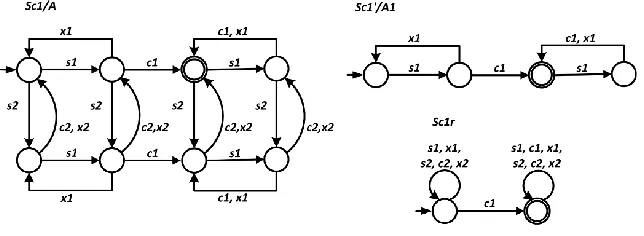
C1’, where the alphabet of events is ΣC10 = c1. In this case it is implicit that any event that does not belong to ΣC10 is always allowed to occur in accordance with au-tomaton representing the uncoordinated behaviour as auau-tomaton A. AdoptingC1’as a constraint, results that corresponding local plant is automatonA1alone. Thus computa-tional complexity on the synthesis of local supervisor and number of states of automa-ton representing it will be smaller than in the first possibility. Fig. 4 presents automata Sc1/AandSc10/A1, whereLm(Sc1/A) = supC((AkC1), A)andLm((Sc10/A1) =
supC((A1kC10), A1)may be employed as supervisors enforcing constraintexistence(a1, 1)over the set of activitiesA={a1, a2}. Control action of supervisors obtained in both possibilities will be equivalent. Such control action is only unmarking sequences of events (recognizing accomplished tasks), it will not disable events. Applying supervisor’s reduc-tion algorithms [26] on these supervisors results automatonSc1r, also shown in Fig. 4. It can be seen from automatonA(Fig. 1) that sequencesw1 =ε(the empty sequence of events),w2 =s1x1,w3 =s2c2,w4 =s1c1, among others, lead from initial state back to it and this is a marked state sow1,w2,w3,w4∈Lm(A). It can also be seen from
to Fig. 2). Whilew4is a supported trace, as defined by [16],w1,w2andw3are unsup-ported ones. LanguageLm(Sc1/A)contains all possible sequences of events recognized
as accomplished tasks under supervision. Thus, it contains all supported traces.
Fig. 4.Automata Sc1/A, Sc1’/A1 and Sc1r
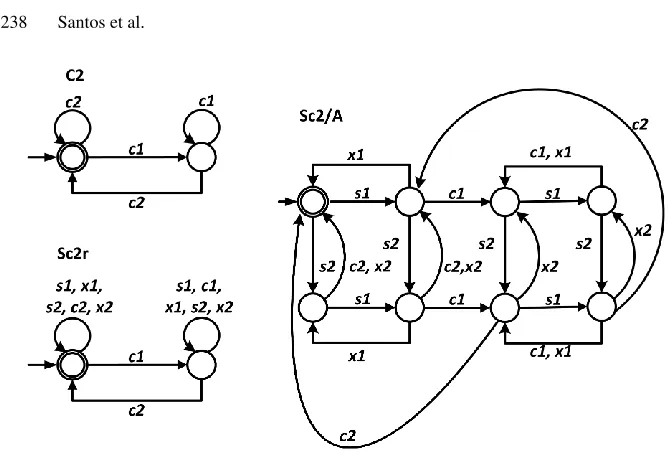
According to [16] and [11], the constraintresponse(a1, a2) states that if a1 is ex-ecuted, a2 needs to be executed afterwards (but not directly after). We may rewrite it replacingexecuted bycompleted. Fig. 5 shows the automatonC2 as a possible model for representing this constraint employing only strictly necessary events, whereΣC2 =
{c1, c2}. In this automaton the state transition function is defined with the occurrence of all events inΣC2 at every state meaning that they are always allowed to occur. While state 0 is a marked one, state 1 is not, meaning that sequences of events leading to state 1 are not considered as accomplished tasks because there has been at least one occur-rence ofc1that was not followed byc2. In this case automatonArepresents the local plant since that constraint employs events of every activities. AutomatonSc2/A, where Lm(Sc2/A) = supC((AkC2, A), is a possible supervisor’s representation of a
super-visor enforcing this constraint, and automaton Sc2r is a reduced representation of it. Again, supervisor’s control action is only unmarking sequences of events: the output map is always empty, i.e. ∀q ∈ QSc2/A → (Φ(q) = ∅). As shown in [16], < a1, a2 >, < a1, a1, a1, a2 >and< a2 >are supported traces while< a1 >is an unsupported trace. In these cases it is only considered an abstraction of activities, i.e., only consid-ered a single event representing the execution and completion of an activity. Also, it is not considered the overlapping of activities, i.e., activities are only sequentially executed. Sequences of events that may represent traces withstart andcomplete events, may be w5 =s1c1s2c2,w6 = s1c1s1c1s1c1s2c2,w7 =s2c2,w8 =s1c1. Considering trace < a1, a2 >there are many other sequences of events, including overlapping activities. For instancew9 = s1x1s1x1s1c1s2c2,w10 = s1s2c1c2,w11 = s1c1s2x2s2x2s2c2, all traces belonging toLm(Sc2/A). Whilew8is an unsupported trace (region 4 in Fig. 2),
w5,w6,w7,w9,w10and w11 are supported traces (region 1 in Fig. 2).
corre-Fig. 5.Automata C2, Sc2/A, and Sc2r
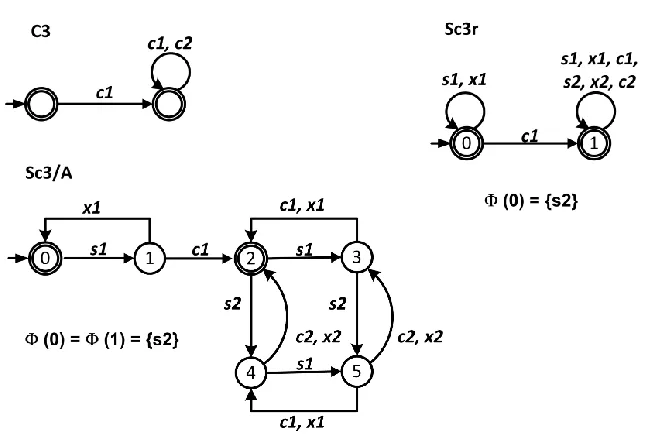
sponding supervisor will not unmark sequence of events. Since ΣC3 = {c1, c2} and state transition function is not defined with the occurrence ofc2at state 0 than this event cannot occur at this state, i.e. prior to first occurrence ofc1. AutomatonSc3/A, where Lm(Sc3/A) =supC((AkC3), A), is a possible supervisor’s representation. In this case
supervisor’s control action is only disabling controllable events, and corresponding out-put map specifies that events2is disabled at states 0 and 1 (Φ(0) =Φ(1) ={s2},(∀q∈
QSc3/A, q 6= 0, q= 1)6 →(Φ(q) =∅)). The aim of this supervisor is to avoid occurrence of eventc2 prior to the first occurrence ofc1. Since c2is considered to be an uncon-trollable event then the supervisor needs to take an anticipatory action disablings2 (a controllable event).
Fig. 7 presents automataSc3/A0 andSc3r0 consideringc2as a controllable event. Notice that automatonSc3/A0 has two extra states due to occurrence of events2 from state 0 and from state 1. Also, supervisor’s control action is disabling occurrence of event c2at these extra states (6 and 7) instead of events2at states 0 and 1. As shown in [16], < a1, a2 >,< a1, a2, a2, a2 >and< a1 >are supported traces while< a2 >is an unsupported trace. Sequences of events that may represent such traces are, respectively, w12 =s1c1s2c2,w13 =s1c1s2c2s2c2s2c2,w14 =s1c1,w15 =s2c2. Whilew15is an unsupported trace (region 2 in Fig. 2),w12,w13,w14are supported traces (region 1 in Fig. 2). Considering constraint precedence(a1, a2)andc2as an uncontrollable event, sequences in region 3 in Fig. 2 arew16 =s1andw17 =s1c1s2; a sequence in region 5 isw18 =s2and a sequence in region 6 isw19 =c1s1.
Fig. 6.Automata C3, Sc3/A, and Sc3r with c2 as an uncontrollable event
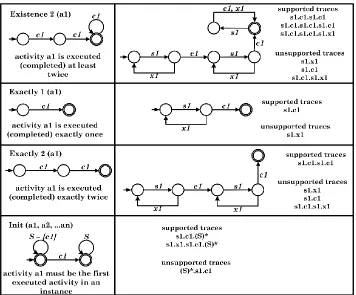
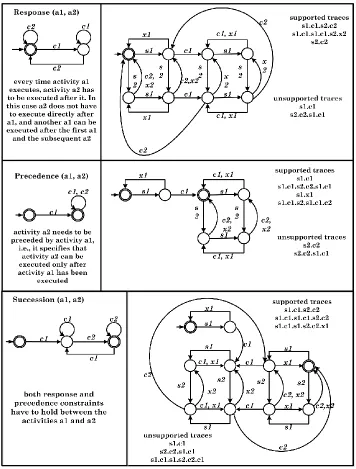
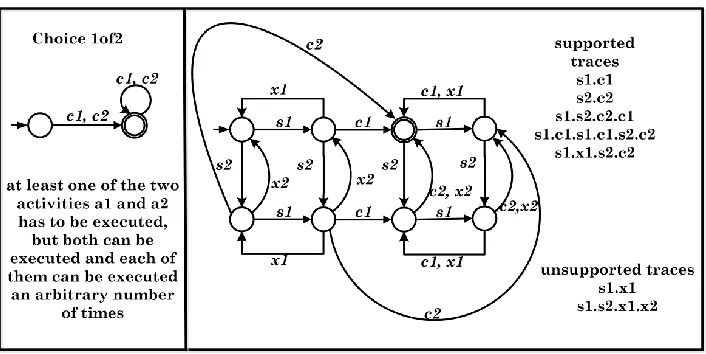
of constraints: (1) existence, (2) relation, (3) negation and (4) choice. Existence models specify how many times or when one activity may be executed. Relation models define some relation between two (or more) activities. Negation models define a negative relation between activities. Choice models can be used to specify that one must choose between activities. Because the space limitation of this paper, we only present some models of each group. Fig. 8 to Fig. 11 shows some constraint models using automata.
Fig. 8.Automata representing the group existence
5.
Application example
Fig. 10.Automata representing the group negation
ing techniques and illustration of the approaches presented here. The goal of this process is to identify the set of requirements of the final product of a project.
The PMBOK provides three stages for each process: Inputs, Tools and Techniques, and Outputs. The inputs to this process are the documents Project Charter (PC) and Stakeholder Register(SR). The tools and techniques adopted for implementing this model are: interviews, focus groups, facilitated workshops, questionnaires and surveys, proto-types and brainstorm. The outputs suggested by PMBOK areRequirements Documenta-tion(RD),Requirements Management Plan(RMP) andRequirements Traceability Matrix (RTM). For this work we selected the outputDocumentation Requirements. Thus, activi-ties under control areReview Project Charter and Stakeholders Register(a1),Brainstorm (a2),Focus Groups(a3),Facilitated Workshops(a4),Questionnaires and Surveys(a5), Interviews(a6),Prototypes(a7), andRequirements Documentation(a8). We assume each activityai(i=1,,8) is modeled as an automaton shown in Fig. 1 (a).
There are five constraints specified for this process: constraintC1defines thatReview Project Charter and Stakeholders Register(a1) must be the first executed activity in an instance; constraintC2 defines that at least one of the five activities Brainstorm (a2), Focus Groups (a3), Facilitated Workshops (a4), Questionnaires and Surveys (a5) and Interviews (a6) has to be executed, but all can be executed and each of them can be executed an arbitrary number of times; constraintC3defines that activitiesFocus Groups (a3) andFacilitated Workshops(a4) have a not coexistence relation - only one can occur in every trace; constraintC4defines that activityPrototype(a7) needs to be preceded by activityInterviews(a6); constraintC5defines that activityRequirements Documentation (a8) is executed at least once.
6.
Executing the supervisory control
Once an executable process model has been deployed to a run-time environment, new process instances can be created and executed according to this model. Generally, several instances of the same process model may exist representing different business cases (e.g., projects of different products). Our proposal is that the supervisory control coordinates the concurrent execution of these process instances.
When the preconditions for executing a particular activity are met during run-time, a new instance of this activity is created. Hence, an activity instance represents a single invocation of an activity during the execution of a particular process instance. Particularly, when a human activity becomes enabled during the execution of a process instance, the Process-Aware Information System (PAIS) first determines all resources qualifying for this activity instance. For each potential resource, a work item referring to the activity instance is created and added to his worklist. Work items related to a particular activity instance may be added to different user worklists. Generally, a worklist comprises all work items currently offered to, or processed by, a user [16].
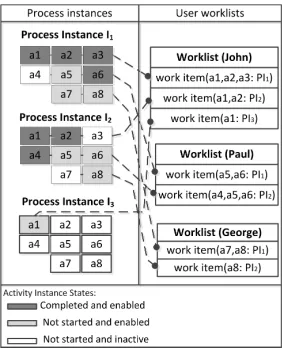
[16]. Fig. 12 shows three process instancesP I1,P I2andP I3running on the process presented in Section 5. The depicted worklists of resources John, Paul and George com-prises work items related to these three process instances.
– Process instanceP I1: Activitiesa1,a2,a3anda6have already been completed but they are still enabled. This is because they may be executed any number of times. Notice that these activities have been added to the worklists of John and Paul. Activity a4is disabled by the supervisory control and the activitiesa5,a7anda8are enabled and they have not been executed yet. These activities have been added to the worklists of John and George.
– Process instanceP I2: Activitiesa1,a2anda4have already been completed but they are still enabled. This is because they may be executed any number of times. Notice that these activities have been added to the worklists of John and Paul. Activitiesa3
anda7 are disabled by the supervisory control and the activitiesa5,a6 anda8are enabled and they have not been executed yet. These activities have been added to the worklists of Paul and George.
– Process instanceI3: Only activitya1 is enabled (and it has not been executed yet). Activitiesa2toa8 are disabled by the supervisory control. Notice that in this state the process has not been initiated. Activitya1has been added to the worklist of John.
Fig. 12.Project management process, process instances and users worlists
execution of the process shown in Section 5 considering overlapping activities for a spe-cific process instance.
After creating a new process instance, only activitya1 is enabled, as the supervisor disables the others to not violate the constraintC1. With the completion of activitya1, the supervisor disables only the activitya7(to not violate the constraintC4). This is followed by event s2 resulting in activity instance statea2 running. Next activitya3 is started resulting in activity instance statea2anda3running. Then activitya2is completed. The set of disabled activities remains unaffected until the activitya3has been completed. At this point the supervisor disables the activitya4, in order to not violate the constraintC3
(notice that the supervisor continues disabling the activitya7). After a while the activity a6is started, followed by the beginning of activitya8, resulting in activity instance state a6anda8running. When the activitya6is completed, the activitya7becomes enabled. However, the process instance is finished when the activitya8is completed.
Fig. 13.Executing the project management process under supervision
7.
Conclusion
References
1. Van der Aalst, W., Van Hee, K., Van der Werf, J.M., Kumar, A., Verdonk, M.: Conceptual model for online auditing. Decision Support Systems 50(3), 636–647 (2011)
2. Cassandras, C.G., Lafortune, S.: Introduction to discrete event systems. Springer (2008) 3. De Queiroz, M.H., Cury, J.E.: Modular supervisory control of large scale discrete event
sys-tems. In: Discrete Event Systems, pp. 103–110. Springer (2000)
4. van Der Aalst, W.M., Pesic, M., Schonenberg, H.: Declarative workflows: Balancing between flexibility and support. Computer Science-Research and Development 23(2), 99–113 (2009) 5. Diogo, R.A., Santos, E.A., Vieira, A.D., Loures, E.d.F., Busetti, M.A.: A computational control
implementation environment for automated manufacturing systems. International Journal of Production Research 50(22), 6272–6287 (2012)
6. Fahland, D., L¨ubke, D., Mendling, J., Reijers, H., Weber, B., Weidlich, M., Zugal, S.: Declar-ative versus imperDeclar-ative process modeling languages: The issue of understandability. In: Enter-prise, Business-Process and Information Systems Modeling, pp. 353–366. Springer (2009) 7. Fahland, D., Mendling, J., Reijers, H.A., Weber, B., Weidlich, M., Zugal, S.: Declarative
ver-sus imperative process modeling languages: the issue of maintainability. In: Business Process Management Workshops. pp. 477–488. Springer (2010)
8. Hildebrandt, T., Mukkamala, R.R., Slaats, T.: Safe distribution of declarative processes. In: Software Engineering and Formal Methods, pp. 237–252. Springer (2011)
9. Hildebrandt, T., Mukkamala, R.R., Slaats, T.: Declarative modelling and safe distribution of healthcare workflows. In: Foundations of Health Informatics Engineering and Systems, pp. 39–56. Springer (2012)
10. Minhas, R.S.: Complexity reduction in discrete event systems. Ph.D. thesis, University of Toronto (2002)
11. Pesic, M.: Constraint-based workflow management systems: shifting control to users. Ph.D. thesis (2008)
12. Pesic, M., van der Aalst, W.M.: A declarative approach for flexible business processes manage-ment. In: Business Process Management Workshops, pp. 169–180 (2006)
13. Pesic, M., Schonenberg, H., van der Aalst, W.M.: Declare: Full support for loosely-structured processes. In: Enterprise Distributed Object Computing Conference, 2007. EDOC 2007. 11th IEEE International. pp. 287–287. IEEE (2007)
14. Ramadge, P.J., Wonham, W.M.: Supervisory control of a class of discrete event processes. SIAM journal on control and optimization 25(1), 206–230 (1987)
15. Ramadge, P.J., Wonham, W.M.: The control of discrete event systems. Proceedings of the IEEE 77(1), 81–98 (1989)
16. Reichert, M.U., Weber, B.: Enabling flexibility in process-aware information systems: chal-lenges, methods, technologies. Springer (2012)
17. Santos, E.A., Francisco, R., Vieira, A.D., de FR Loures, E., Busetti, M.A.: Modeling busi-ness rules for supervisory control of process-aware information systems. In: Busibusi-ness Process Management Workshops. pp. 447–458. Springer (2012)
18. Santos, E.P., Francisco, R., Pesic, M., van der Aalst, W.: Supervisory control service for sup-porting flexible processes. Industrial Management & Data Systems 113(7), 1007–1024 (2013) 19. Schaidt, S., Vieira, A.D., Loures, E.d.F.R., Santos, E.A.P.: Dealing with constraint-based pro-cesses: Declare and supervisory control theory. In: Advances in Information Systems and Tech-nologies, pp. 227–236. Springer (2013)
20. Silva, D.B., Vieira, A.D., Loures, E.F., Busetti, M.A., Santos, E.A.: Dealing with routing in an automated manufacturing cell: a supervisory control theory application. International Journal of Production Research 49(16), 4979–4998 (2011)
22. Ter Hofstede, A., Hofstede, A.H., Aalst, W.M., Adams, M.: Modern Business Process Automa-tion: YAWL and its support environment. Springer (2010)
23. Vieira, A.D., Cury, J.E.R., de Queiroz, M.H.: A model for plc implementation of supervisory control of discrete event systems. In: Emerging Technologies and Factory Automation, 2006. ETFA’06. IEEE Conference on. pp. 225–232. IEEE (2006)
24. Westergaard, M.: Better algorithms for analyzing and enacting declarative workflow languages using ltl. In: Rinderle-Ma S., Toumani F., W.K. (ed.) Business Process Management LNCS, vol. 6896, pp. 83–98. Springer (2011)
25. Wong, K.C., Wonham, W.M.: Hierarchical control of discrete-event systems. Discrete Event Dynamic Systems 6(3), 241–273 (1996)
26. Wonham, W.M.: Design software: Xptct. Systems Control Group, Department of Electrical and Computer Engineering, University of Toronto (2011)
Eduardo Alves Portela Santosis an Associate Professor at Pontificia Universidade Catolica do Parano (PUCPR), Curitiba, Brazil, where he chairs the Information System Group. His research interest include business process management, monitoring and control of business process, process modeling and analysis. In 2009 he was visiting researcher at the Department of Mathematics and Computer Science at the Eindhoven University of Technology, The Netherlands, under the supervision of Prof. Wil van der Aalst. Ed-uardo Alves Portela Santos is the corresponding author and can be contacted at: [email protected]
Agnelo Denis Vieira is an Associate Professor at Pontificia Universidade Catolica do Parana - Health Technology Graduate Program, Curitiba, Brazil. He has earned degrees of Bachelor and Master in Mechanical Engineering as well as Doctor in Electrical En-gineering from Federal University of Santa Catarina, Brasil. His research interests are on Modelling and Control of Discrete Event Systems applied at Health Care Systems and Protocols as well as on Experimental Analysis and Computer Simulation of Human Movement.
Sauro Schaidtearned his Bachelor of Computer Science degree from Federal University of Parana in 2004. He received his Master of Science degree in Industrial and Systems Engineering from the Pontifical Catholic University of Parana, Curitiba, Brazil, in 2013. Currently, he is PhD student at Graduate Program in Industrial and Systems Engineer-ing. His research focus on supporting the execution of flexible processes by means of monitoring and control.
Eduardo de Freitas Rocha Louresis an Associate Professor at Pontificia Universidade Catolica do Parana (PUCPR) and an Associate Professor at the Federal University of Technology - Parana (UTFPR), both in Brazil. He is from 2010 the Education Chair of the International Society of Automation (ISA, District South America, Section Curitiba, Brazil). On 2012, he spent one year as a Visiting Academic at the Research Center for Automatic Control (CRAN) within the Ambient Manufacturing Group (SYMPA) of Uni-versity of Lorraine, France. His research and teaching is in business process management, process aware information systems, discrete event systems, systems integration and inter-operability.