Downloaded from: http://insight.cumbria.ac.uk/id/eprint/1984/
Usage of any items from the University of Cumbria’s institutional repository ‘Insight’ must conform to the following fair usage guidelines.
Any item and its associated metadata held in the University of Cumbria’s institutional repository Insight (unless stated otherwise on the metadata record) may be copied, displayed or performed, and stored in line with the JISC fair dealing guidelines (available here) for educational and notforprofit activities
provided that
• the authors, title and full bibliographic details of the item are cited clearly when any part of the work is referred to verbally or in the written form
• a hyperlink/URL to the original Insight record of that item is included in any citations of the work
• the content is not changed in any way
• all files required for usage of the item are kept together with the main item file.
You may not
• sell any part of an item
• refer to any part of an item without citation
• amend any item or contextualise it in a way that will impugn the creator’s reputation
• remove or alter the copyright statement on an item.
The full policy can be found here.
For Peer Review Only
Assessing grey squirrel dispersal patterns within the landscape using DNA sequence variation.
Journal: Landscape Research
Manuscript ID: Draft
Manuscript Type: Short Communication
Keywords: least cost, mtDNA, grey squirrel, Sciurus, dispersal
For Peer Review Only
Assessing grey squirrel dispersal patterns within the landscape using sequence variation. 1
2
ABSTRACT 3
The grey squirrel Sciurus carolinensis is thought to have contributed to the decline of 4
red squirrel S. vulgaris populations in the UK through resource competition and disease 5
spread. This study used mtDNA sequencing to assess patterns of grey squirrel dispersal in the 6
UK. Patterns of genetic variation within the dloop sequence were characterised for seven grey 7
squirrel populations. Infiltration directions and potential barriers to dispersal are identified 8
and discussed, with a focus on Cumbria, a county at the forefront of grey squirrel expansion. 9
Understanding the dynamics of grey squirrel dispersal will aid their management at a 10
landscape scale and enhance the conservation of red squirrels. 11
12
INTRODUCTION 13
The Eastern grey squirrel Sciurus carolinensis was first introduced to Britain between 14
1876 and 1929 (Middleton 1931; Shorten 1954; Lloyd 1983). Subsequent successful 15
introductions and translocations occurred within the UK and by the 1930’s populations were 16
established in southeast England and rapidly spreading through the country (Shorten 1954). 17
This expansion occurred simultaneously with the decline in native red squirrel Sciurus
18
vulgaris populations (Lloyd 1962; Lloyd 1983). Studies suggest that interspecific resource
19
competition occurs (Wauters et al. 2000; Gurnell et al. 2004) and that this, along with the 20
effects of a particularly virulent squirrelpox virus (SQPV), carried by the grey squirrel, has 21
caused the decline and extirpation of many red squirrel populations (Tompkins et al. 2003; 22
Gurnell et al. 2004; Carroll et al. 2009). 23
Cumbria in North West England has been found to hold genetically unique 24
populations of red squirrel which contain high levels of genetic diversity (Hale et al. 2004). 25
For Peer Review Only
Concerns have been raised over the impact of expanding grey squirrel populations are having 26
on red squirrel populations. Interspecific competition and SQPV transmission are thought to 27
be highest at times of grey squirrel dispersal (Sainsbury et al. 2008). An understanding of the 28
dispersal ecology and directional movements of the grey squirrel will aid grey squirrel 29
management decisions and red squirrel conservation. 30
Recent work (Stevenson et al., in review) has indicated that the Cumbrian Mountain 31
range is acting as a barrier to dispersal. Grey squirrel populations within Cumbria have been 32
derived from the infiltration of individuals from two directions; to south Cumbria from 33
Lancashire and to north Cumbria from Northumberland/ Scottish Borders. Hale et al. (2001) 34
and Trizio et al. (2005) both suggest genetic analysis has enabled the identification of land 35
cover types which either facilitate dispersal or provide barriers to red squirrels over large 36
geographic scales. In this paper we report on variation within Cytochrome b (Cytb) and Dloop 37
DNA sequences found within grey squirrel mtDNA, the first such report to date. 38
39
METHODOLOGY 40
Two grey squirrel accessions were collected from each of four known introduction 41
points (see Middleton, 1931); Balloch near Loch Long; Dalkeith in Edinburgh; Henbury in 42
Cheshire, and from Alice Holt Forest in Surrey. In addition, samples were collected from 43
three established/ emerging populations within the UK; Doune, in Stirlingshire; Millom, in 44
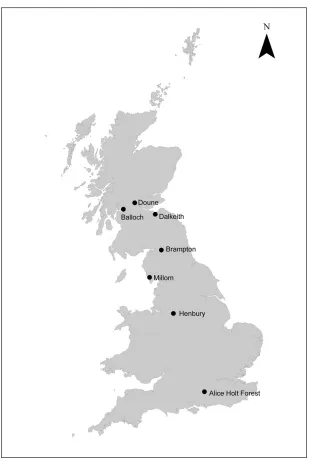
south Cumbria and Brampton, in north Cumbria (Figure 1). 45
DNA was extracted from the leg muscle tissue of 14 individuals using the QIAGEN 46
DNeasy blood and tissue extraction kit and following the manufactures instructions 47
(QIAGEN Ltd). Fragments of the two mtDNA sequence encoding Cytb and Dloop were 48
amplified by polymerase chain reaction (PCR). Primers for Sciurus carolinensis Cytb were 49
available from Meece et al. (2005), BM1 (5’-CCCCTCAGAATGATATTTGTCCTCA) and 50
For Peer Review Only
BM2 (5’-CCATCCAACATCTCAGCATGATGAAA). Each PCR reaction had a reaction 51
volume of 25 µl and containing 1 µl 1:10 mtDNA, 12.5 µl AmpliTaq Gold PCR master mix 52
(Roche, USA), 1 µl 1:10 BM1 primer to distilled water, 1 µl 1:10 BM2, 9.5 µl distilled water. 53
PCR amplification followed the protocol of Meece et al. (2005): denaturation of 3.5 min at 54
95ºC followed by 36 cycles of 30s at 95ºC, annealing 50s at 60 ºC, extension 40s at 72ºC, 55
final extension of 5min at 72 ºC. 56
Primers for Sciurus carolinensis Dloop were taken from the published sequence of the 57
Dloop (GenBank Accession no. AF111027; Barrett et al. 1999), Dloop forward primer 5’-58
GCCACCCCCAAGTTAAATGG-3’ and Dloop reverse primer 5’-59
ATTCGTGCATTAATGCACTATCC-3’.Each PCR reaction for Dloop contained the same 60
relative quantities of components as outlined above for cytb amplification apart from 5 µl of 61
each primer was used. PCR amplification for Dloop sequence followed the protocol of Trizio 62
et al. (2005), denaturation of 1 min at 94ºC followed by 40 cycles of 30s at 94ºC, annealing 63
30s at 52 ºC, extension 1min at 72ºC, final extension of 5min at 72 ºC. 64
Electrophoresis on 1% agarose gels were used to check the success of the PCR 65
reactions for each sample. All PCR products were then cleaned following the methodology of 66
the QIAquick PCR purification kit (QIAGEN Ltd). Sequencing of PCR products was carried 67
out (DBS Genomics, Durham, UK). 68
Sequences for cytb and Dloop from each individual were aligned manually using 69
BioEdit_R v7.0.4.1 Freeware (Ibis Therapeutics, California,USA) and Sequence Analysis 70
5.2.0 (Applied Biosystems) using the default settings within the programmes. A sequence 71
from S. vulgaris (GenBank Accession no. AJ238588) was also included as an outgroup 72
accession in the analysis. The sequences were entered into Paup 4.0 Beta 10 (Swofford, 73
Illinois Natural History Survey, Illinois, USA) for phylogeny reconstruction and a 50% 74
For Peer Review Only
majority rule consensus tree was created with 1000 bootstrap and jacknife replicates (Harrison 75
and Langdale 2006). 76
77
RESULTS 78
MtDNA was successfully extracted from 14 grey squirrel individuals from selected 79
locations around the UK. Cytb sequence data was analysed for all 14 accessions with no 80
sequence variation observed. The 325bp sequence generated, demonstrated a 99% similarity 81
match for grey squirrel cytochrome b gene in the Genbank BLAST search tool (Accession no. 82
AY509680). Similarly, the 329bp Dloop sequence generated showed a 98% similarity match 83
to that of grey squirrel (Accession no. AF111027). Dloop sequences were aligned in BioEdit 84
and discrete points of variation were detected at 16 unique sites, representing 4.9 % of the 85
overall sequence. 86
Parsimony analysis generated a 50% majority rule consensus tree from the grey 87
squirrel dloop sequence data which was rooted against red squirrel (GenBank Accession no. 88
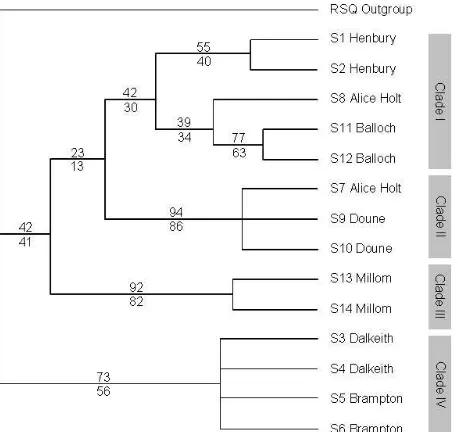
AJ238588). The consensus tree (Figure 2) indicated that the grey squirrel samples are 89
separated into four distinct clades; Clade I; Henbury, Balloch and accession S8 from Alice 90
Holt; Clade II; Doune and accession S7 from Alice Holt; Clade III; Dalkeith and Brampton 91
(north Cumbria); Clade IV; Millom (south Cumbria). The branching of samples from 92
Dalkeith and Brampton is strongly supported with bootstrap values of 73% and jacknife 93
values of 56%. 94
95
DISCUSSION 96
This study examines DNA sequence variation and its utility in assessing patterns of 97
grey squirrel dispersal in the UK. Cytb sequences generated in this study demonstrated no 98
detectable differences across the range of populations sampled. This may be due to the low 99
For Peer Review Only
mutation rate within the cytb coding sequence and the relatively short time frame of 100
introduction and dispersal within the UK. Conversely, sequence variation was detected 101
within the dloop sequence for these same accessions. Dloop sequence analysis showed 102
significant statistical support for the distinct separation of north and south Cumbria grey 103
squirrel populations. 104
Accessions from north Cumbria grouped with accessions from Dalkeith in Edinburgh. 105
Individual accessions within north Cumbria may not necessarily have been derived from 106
individuals dispersing south from Edinburgh. However, as they are both within the same 107
clade they may have been derived from the same progenitor individuals from another location 108
such as northeast England (Stevenson et al., in review). Similar patterns of dispersal have 109
been seen in red squirrels, mediated by the afforestation of woodland between Cumbria and 110
the Northeast (Hale & Lurz 2003). 111
The two samples taken from each population were generally grouped together within 112
the phylogenetic tree, however, samples from Alice Holt Forest did not follow this pattern and 113
were grouped separately with samples from elsewhere. David-Gray et al. (1998) study found 114
high levels of genetic diversity within grey squirrel populations from Alice Holt Forest and 115
attributed this to numerous introduction sites and translocations from different source 116
populations, which could explain the results demonstrated in Figure 2 in this study. 117
The initial findings presented here demonstrate support for the hypotheses that the 118
Cumbrian Mountain range is acting as a barrier to dispersal and that invasion into the area is 119
coming from multiple directions. If grey squirrels colonised Cumbria with a northerly 120
advance as suggested (Lowe 1993; Skelcher 1997) accessions from north and south Cumbria 121
should be grouped together within a phylogenetic reconstruction. However, this is not the 122
case, and the two populations separate out in the tree. This points towards separate 123
populations and the effectiveness of the Cumbrian Mountain range as a barrier. Whilst it is 124
For Peer Review Only
acknowledged that a small number of individuals may try to disperse over this mountain 125
barrier, the majority of individuals will choose a lower cost dispersal route. Further validation 126
of prospective incursion directions will require an increase in the sample size for each of the 127
seven locations and additional accessions from within Cumbria and adjoining areas. 128
This study has provided the first evidence of Dloop sequence variation within UK 129
grey squirrel populations. Despite the small sample size, it supports the suggestion that the 130
Cumbrian Mountains provide a barrier to grey squirrel dispersal and infers both northerly and 131
southerly grey squirrel incursion routes into the county. Ultimately, further knowledge of 132
dispersal and colonisation of grey squirrels will inform conservation policy and can be used to 133
target resources for grey squirrel control and enable better protection for vulnerable red 134
squirrel populations. We have shown here, that landscape genetics can provide evidence of 135
population origin and genetic differences. Although this study has focused on grey squirrels in 136
Cumbria, the techniques are equally applicable to other landscapes, validating and 137
highlighting dispersal routes of invasive species and species of conservation concern. 138
139
REFERENCES 140
141
Carroll, B., P. Russell, J. Gurnell, P. Nettleton, and A. W. Sainsbury. 2009. Epidemics of 142
squirrelpox virus disease in red squirrels (Sciurus vulgaris): Temporal and serological 143
findings. Epidemiology and Infection 137:257-265. 144
David-Gray, Z. K., J. Gurnell, and D. M. Hunt. 1998. DNA fingerprinting reveals high levels 145
of genetic diversity within British populations of the introduced non-native grey squirrel 146
(Sciurus carolinensis). Journal of zoology 246(4):443-445.
147
Felsenstein, J. 1985. Confidence limits on phylogenies: An approach using the bootstrap. 148
Evolution 39(4):783-791. 149
For Peer Review Only
Gurnell, J., L. A. Wauters, P. W. W. Lurz, and G. Tosi. 2004. Alien species and interspecific 150
competition: Effects of introduced eastern grey squirrels on red squirrel population dynamics. 151
Journal of Animal Ecology 73(1):26-35. 152
Hale, M. L., P. W. W. Lurz, and K. Wolff. 2004. Patterns of genetic diversity in the red 153
squirrel (Sciurus vulgaris L.): Footprints of biogeographic history and artificial introductions. 154
Conservation Genetics 5:167-179. 155
Hale, M. L., and P. W. W. Lurz. 2003. Morphological changes in a British mammal as a result 156
of introductions and changes in landscape management: The red squirrel (Sciurus vulgaris). 157
Journal of zoology 260(2):159-167. 158
Hale, M. L., P. W. W. Lurz, M. D. F. Shirley, S. Rushton, R. Fuller, and K. Wolff. 2001. 159
Impact of landscape management on the genetic structure of red squirrel populations. 160
Harrison, C. J., and J. A. Langdale. 2006. A step by step guide to phylogeny reconstruction. 161
The Plant Journal 45:561-572. 162
Hillis, D. M., and J. J. Bull. 1993. An empirical test of bootstrapping as a method for 163
assessing confidence in phylogenetic analysis. Systematic Biology 42(2):182. 164
Lloyd, H. G. 1962. The distribution of squirrels in England and Wales, 1959. Journal of 165
Animal Ecology 31:157-166. 166
Lloyd, H. G. 1983. Past and present distribution of red and grey squirrels. Mammal Review 167
13(2-4):69-80. 168
Lowe, V. P. W. 1993. The spread of the grey squirrel (Sciurus carolinensis) into Cumbria 169
since 1960 and its present distribution. Journal of Zoology 231:663-667. 170
Meece, J. K., C. E. Reynolds, P. J. Stockwell, T. A. Jenson, J. E. Christensen, and K. D. Reed. 171
2005. Identification of mosquito bloodmeal source by terminal restriction fragment length 172
polymorphism profile analysis of the cytochrome B gene. Journal of Medical Entomology 173
42(4):657-667. 174
For Peer Review Only
Middleton, A. D. 1931. The grey squirrel. The introduction and spread of the American grey 175
squirrel in the British Isles, its habits, food, and relations with the native fauna of the country. 176
Sidgwick and Jackson, London. 177
Sainsbury, A. W., R. Deaville, B. Lawson, W. A. Cooley, S. S. J. Farelly, M. J. Stack, P. 178
Duff, C. J. McInnes, J. Gurnell, P. H. Russell, S. P. Rushton, D. U. Pfeiffer, P. Nettleton, and 179
P. W. W. Lurz. 2008. Poxviral disease in red squirrels Sciurus vulgaris in the UK: Spatial and 180
temporal trends of an emerging threat. EcoHealth 5(3):305-316. 181
Shorten, M. 1954. Squirrels. Collins, London. 182
Skelcher, G. 1997. The ecological replacement of red by grey squirrels. Pages 67-78 in J. 183
Gurnell and P. Lurz, editors. The conservation of red squirrels, Sciurus vulgaris L. People's 184
Trust for Endangered Species, London. 185
Stevenson, C. D., Watts, K., Nevin, O.T., Ramsey, A. D. and S. Bailey. In review. Validation 186
and creation of a ‘best fit’ resistance set within a spatially explicit behaviourally-informed 187
landscape model using historical observations of species invasion and information theory. 188
Tompkins, D. M., A. R. White, and M. Boots. 2003. Ecological replacement of native red 189
squirrels by invasive greys driven by disease. Ecology Letters 6(3):189-196. 190
Trizio, I., B. Crestanello, P. Galbusera, L. A. Wauters, G. Tosi, E. Matthysen, N., and H. C. 191
Hauffe. 2005. Geographical distance and physical barriers shape the genetic structure of 192
Eurasian red squirrels (Sciurus vulgaris) in the Italian Alps. Molecular ecology 14(2): 469-193
481. 194
Wauters, L. A., P. W. W. Lurz, and J. Gurnell. 2000. Interspecific effects of grey squirrels 195
(Sciurus carolinensis) on the space use and population demography of red squirrels (Sciurus
196
vulgaris) in conifer plantations. Ecological Research 15(3):271-284.
197 3
For Peer Review Only
©Crown Copyright/database right 2010. An Ordnance Survey/EDINA supplied service
Figure 1. Geographical location of grey squirrel sample sites within the UK.
186x273mm (300 x 300 DPI)
For Peer Review Only
Figure 2. Phylogenetic tree showing Bootstrap and Jacknife analysis results above and below each group separation.
254x190mm (96 x 96 DPI)