World Maritime University
The Maritime Commons: Digital Repository of the World
Maritime University
World Maritime University Dissertations Dissertations
2015
Completion of the restructuring of China's coast
guard administration: challenges and opportunities
Wang HaozheWorld Maritime University
Follow this and additional works at:http://commons.wmu.se/all_dissertations Part of theDefense and Security Studies Commons
This Dissertation is brought to you courtesy of Maritime Commons. Open Access items may be downloaded for non-commercial, fair use academic purposes. No items may be hosted on another server or web site without express written permission from the World Maritime University. For more information, please [email protected].
Recommended Citation
Haozhe, Wang, "Completion of the restructuring of China's coast guard administration: challenges and opportunities" (2015).World Maritime University Dissertations. 491.
WORLD MARITIME UNIVERSITY
Malmö, Sweden
COMPLETION OF THE RESTRUCTURING OF
CHINA’S COAST GUARD ADMINISTRATION:
CHALLENGES AND OPPORTUNITIES
By
WANG HAOZHE
People’s Republic of China
A dissertation submitted to the World Maritime University in partial Fulfilment of the requirements for the award of the degree of
MASTER OF SCIENCE
In
MARITIME AFFAIRS
(MARITIME LAW AND POLICY)
2015
DECLARATION
I certify that all the material in this dissertation that is not my own work has been identified, and that no material is included for which a degree has previously been conferred on me.
The contents of this dissertation reflect my own personal views, and are not necessarily endorsed by the University.
22
Supervised by: Dr. Dimitrios Dalaklis
World Maritime University
Assessor: LCDR Jarrod DeWitz
Institution/organization: World Maritime University
Co-assessor: Dr. Ioannis Parisis
ACKNOWLEDGEMENTS
I would like to express the deepest appreciation to my supervisor, Assistant Professor Dimitrios Dalaklis, who has given me a lot of help during the writing of my dissertation. In the beginning phase, he had full confidence in my topic and encouraged me to overcome all the difficulties I was experiencing. Subsequently, he always gave me some constructive suggestions during each meeting we had, as well as shared his rich experience with me. Finally, he helped me to revise my dissertation thoroughly. Without his guidance and persistent help, this dissertation would not have been possible.
I am grateful for the work and effort made by professors and staff at World Maritime University. They provided me a happy learning and living environment, especially to the faculties of Maritime Law and Policy: Associate Professor Patrick Donner, Associate Professor Aref Fakhry, Associate Professor María Carolina Romero Lares and Adjunct Professor George Theocharidis, who provided me excellent lectures during my studies at World Maritime University. Herein, I also want to express my big thanks to my linguistic supervisor Inger Battista who helped me with my writing skills and linguistic revision of my dissertation.
colleagues at World Maritime University, Mr Nanditya Darma Wardhana and Ms Fatima Aleli ANGELES, who were writing a dissertation as well. We always shared our feelings during this tough but meaningful period and encouraged each other to work harder and harder.
ABSTRACT
Title of Dissertation: Completion of the Restructuring of China’s Coast Guard Administration: Challenges and Opportunities
Degree: MSc
The dissertation is a study of the restructuring activities of entities of China’s maritime law enforcement by focusing on the establishment of China’s Coast Guard Administration. Because China’s Coast Guard Administration was just established two years ago, the aim of this dissertation is to analyse the current situation of China’s Coast Guard Administration, and then identify and analyse challenges and opportunities in China’s Coast Guard Administration.
In order to provide a comprehensive cognition of the reasons for establishing China’s Coast Guard Administration, the dissertation initially provides a brief explanation of the drawbacks of the past situation of entities of maritime law enforcement in China. Then the current situation of China’s Coast Guard Administration is analysed by stating the framework and initial mandates of China’s Coast Guard Administration. Importantly, the legal foundations for previous departments are analysed and some of them are still available for China’s Coast Guard Administration. The legal analysis is divided into two levels, which are international laws and domestic laws. Significantly, a vast number of challenges faced by China’s Coast Guard Administration are identified and analysed by internal and external challenges. Besides, existing opportunities within China’s Coast Guard Administration are analysed as well as three different aspects.
The concluding chapter summarizes the discussion and analysis of this dissertation, as well as confirming the challenges and opportunities are fulfilling the aim of this dissertation. Finally, several feasible recommendations are put forward which are based on the analysis of challenges and opportunities to promote the development of China’s Coast Guard Administration.
Table of Contents
Declaration ··· ii
Acknowledgements ··· iii
Abstract ··· v
Table of Contents ··· vi
List of Tables ··· viii
List of Figures ··· ix
LIst of Abbreviations ··· x
1 Introduction ··· 1
1-1 Discussion of the Former Situation and Drawbacks ··· 1
1-1-1 The Past Situation ··· 1
1-1-2 Drawbacks of the Previous Situation ··· 4
1-2 Explanation of the Restructuring Activities ··· 7
1-3 Purpose and Structure of the Dissertation ··· 9
2 The Present Situation of China’s Coast Guard Administration ··· 11
2-1 Framework and Functions of China’s Coast Guard Administration ··· 11
2-1-1 Framework ··· 11
2-1-2 Functions of China’s Coast Guard Administration ··· 12
2-2 The Relation between CCGA and Other Relevant Departments ··· 14
2-2-1 Relation between CCGA and Other Policy-Making Departments 14 2-2-2 Relation between CCGA and PLA Navy ··· 16
2-2-3 Relation between CCGA and MSA ··· 18
2-3 Summary of the Present Situation ··· 19
3 Legal Foundations for China’s Coast Guard Administration ··· 22
3-2 International Laws ··· 26
3-2-1 Sovereignty and Sovereign Rights ··· 26
3-2-2 National Jurisdiction ··· 28
3-3 Domestic Laws ··· 30
3-3-1 Safeguarding Sovereignty and Marine Benefits ··· 31
3-3-2 Protection of the Marine Environment ··· 32
3-3-3 Development and Management of Marine Resource ··· 33
3-3-4 Substantial and Procedural Law of Law Enforcement ··· 34
3-4 Summary of Legal Foundations ··· 35
4 Challenges and Opportunities ··· 37
4-1 Challenges ··· 37
4-1-1 Internal Challenges ··· 38
4-1-2 External Challenges ··· 46
4-2 Opportunities··· 53
4-2-1 Improving efficiency of law enforcement ··· 54
4-2-2 Enhancing and improving maritime legislation ··· 57
4-2-3 Dealing with international affairs more effectively ··· 59
5 Conclusion and Recommendations for Further Improvement ··· 61
5-1 Conclusion ··· 61
5-2 Recommendations for the Future ··· 63
Lists of References ··· 71
LIST OF TABLES
Table 3.1 Laws and regulations regarding safeguarding 31 sovereignty and marine benefits
Table 3.2 Laws and regulations regarding protection 32 of marine environment
Table 3.3 Laws and regulations regarding development 33 and management of marine resource
LIST OF FIGURES
Figure 2.1 Framework of China’s Coast Guard Administration 12 Figure 2.2 Structures of the Maritime Administration and 21
LIST OF ABBREVIATIONS
MSA Maritime Safety Administration
FLEC China Fisheries Law Enforcement Command CMS China Marine Surveillance
CMPB China Maritime Police Bureau PSC Port State Control
MPS Ministry of Public Security EEZ(s) Exclusive Economic Zones SOA State Oceanic Administration SAR Search and Rescue
IISS 2013 Regulation on the Interior Institutions and Staffing of the State Ocean Administration (2013)
CCGA China’s Coast Guard Administration NPC The National People’s Congress
CPPCC Chinese People’s Political Consultative Conference PLA Navy People's Liberation Army Navy
UNCLOS United Nations Convention on the Law of the Sea
Tokyo MoU Memorandum of Understanding on Port State Control in the Asia-Pacific Region
PSC Port State Control US The United States
1
Introduction
1-1
Discussion of the Former Situation and Drawbacks
1-1-1 The Past Situation
Up until 2013, five different and independent departments held the responsibilities of enforcing Chinese maritime law simultaneously. They were: 1.Maritime Safety Administration (MSA), 2.China Fisheries Law Enforcement Command (FLEC), 3.China Marine Surveillance (CMS), 4.China Maritime Police Bureau (CMPB), and 5.Customs Police. In China, this situation was quite often described as the “five dragons that govern the Sea”. The “five dragons” carried out different responsibilities in order to deal with the maritime affairs by five various aspects, which was suitable for the previous situation because of the lack of experiences and resources. The Chinese government could not establish a powerful department to handle maritime affairs. Therefore, separation of powers was the best choice in that case. Specific affairs regarding maritime issues should be dealt with by specific departments in order to assure the overall effect. The specific departments and their responsibilities will be explained as follows.
The only one department that was not included in the restructuring activities was MSA. MSA was established in 1998 according to The Approval of the Main Responsibilities and Staffing on the People's Republic of China Maritime Safety
and changed at times. Today, the main responsibilities include the following points (http://en.msa.gov.cn/index.php?m=content&c=index&a=lists&catid=328):
Draft and implement guidance, policies, regulations and technological codes and standards in national water safety supervision;
Comprehensively supervise water safety and prevent marine pollution;
Responsible for the administration, certification and supervision of ship and offshore facilities check;
Administer seafarers and pilots’ training, examination and certification. Check
and supervise the qualification and quality system of training institutions for seafarers and pilots; responsible for the management of seafarers' documents;
Responsibilities for the survey and settlement of maritime accident, pollution incident of ships and water traffic violations;
Undertake the responsibilities of Port State Control (PSC).
In the previous regime, the oldest entity under discussion was the Fisheries Law Enforcement Command (FLEC). FLEC was established in 1958 as a division of the Fisheries Management Bureau under the Ministry of Agriculture. It held the responsibilities for the enforcement of laws concerning fishing and maritime resources in Chinese territorial waters and exclusive economic zones1 (EEZ). The main responsibilities included the following points (Liu, Yu & Wen, 2008, p.6):
Research the planning and development strategies, draft the laws or regulations related to fishing activities;
Protect the fishing resources, fishery ecological environment and other aquatic
1 Exclusive economic zone: With the term “exclusive economic zone” is described an area which beyond and adjacent to the
organisms;
Inspect, administrate and supervise fishing port, fishing vessel; manage and certificate fishing vessel and crews;
Deal with the international fisheries affairs.
Additionally, the entity dealing mainly with the domain of surveillance1 of the China Sea was China Marine Surveillance (CMS). The CMS was established in 1998, and was administered by the State Oceanic Administration (SOA) and held the supervisory responsibilities. Its primary responsibilities included the following points
(Zhang, X., 2013, p.58):
Protect marine benefits of China by patrolling and implement the right of hot pursuit2;
Supervise the marine infrastructure activities and scientific activities, assist the search and rescue (SAR as follows) activities at sea;
Supervise the activities of the marine environment at sea area in China.
In particular, the entity with the right to use violence during law enforcement activities before restructuring activities was China Maritime Police Bureau (CMPB). CMPB was the maritime branch of the Public Security Border Troops, a paramilitary3 police force under the leadership of the Ministry of Public Security (MPS as follows). CMPB normally carried out policing activities in accordance with
1
Surveillance: Longman English Dictionary Online defined surveillance as a term when the police, army etc. watch a person or place carefully because they may be connected with criminal activities.
2
Hot Pursuit: With the term “hot pursuit” is described the situation of a foreign ship may be undertaken when the competent authorities of the coastal State have good reason to believe that the ship has violated the laws and regulations of that State (Paragraph 1 of Article 111 of UNCLOS).
3 Paramilitary: Oxford advanced learner's dictionary of current English (Hornby, Wehmeier, McIntosh, Turnbull & Ashby, 2005)
the following detail of the main responsibilities (Yan & Sun, 2011, p.6):
Inspect the immigrant ships and persons;
Prevent and combat crime at sea including piracy and terrorism;
Seize the smuggling case and drug trafficking.
Finally, the department dealing with smuggling activities was the Customs Police. It was established in 1999 under the supervision of MPS and General Administration of Customs collectively. Significantly, the Customs Police had the power of investigating smuggling activities at sea. The main responsibilities included the following points (Qian, 2014, p.3):
Develop the plan of anti-smuggling and implement it;
Work with foreign authorities to combat smuggling.
1-1-2 Drawbacks of the Previous Situation
The most pressing and significant drawback was that each department just assumed their responsibilities, which caused the decentralization of the maritime jurisdiction as well as the lack of coordination. Therefore, maritime affairs could not be solved efficiently when two or more departments were involved because of the overlapping responsibilities (Sun, 2011, p.20). For example, the accident of “Dashun” happened in Bohai Bay on 24th of December 1999. From the beginning to the end, the process sustained almost 10 hours. Apart from the reasons such as bad weather condition, another driving cause for failure was the decentralization of the maritime jurisdiction resulting in the fact that the rescue activities could not be conducted immediately. Unfortunately, over 280 people died in that accident in the end (Fernandez, 1999).
Secondly, multiple departments, because of the decentralization of maritime law enforcement departments, certainly have a massive number of staff and equipment which wasted an enormous portion of financial resources, human resources and physical resources. For example, in 2009, the quantity of quays established by different law enforcement departments was 170, including more than 50 quays established by MSA, 78 quays established by FLEC and 25 quays established by CMPB. Most of these quays were overlapping establishment (Han, 2012, p.27). Therefore, the total amount of financial input was huge, but the allocation of finance to each department was limited. The money could not be used properly, which was the primary reason for the low-standard governmental ships and equipment operated by the “five dragons”. Also, based on the above examples, a maritime task could be in charged by two or more departments resulting in the waste of administrative resources and funding. To some extent, it was difficult to manage. In most unclear cases, such as the previous example when the Japanese vessel sunk a foreign vessel in China’s EEZ, all the relevant departments wanted to participate in that incident. It was a tough decision about which department is the best-qualified department to deal with that incident. Today, maritime affairs are handled by MSA and CCGA which only reduce the difficulty of management by the Chinese government.
Finally, due to its limited resources and capabilities, the “five dragons” were not able to shoulder the capability of maritime law enforcement of the Chinese government. In fact, most entities of maritime law enforcement just had the right of administrative law enforcement1. Except CMPB and Customs Police, Their jurisdictions were based on the policing law enforcement2. However, because of the reasons mentioned above,
the right of policing law enforcement carried out by CMPB and Customs Police could not be enforced properly. If the capability of law enforcement was restricted, the entities of maritime law enforcement could not safeguard China’s benefits in China’s maritime zones.
1-2
Explanation of the Restructuring Activities
In accordance with the above contents, a brief conclusion can be drawn. On the one hand, China’s entities of maritime law enforcement faced certain internal challenges, and reform activities were required to rectify the complicated situation, including issues about decentralization of the maritime jurisdiction, unwieldy organizations and the absence of the right of policing law enforcement at sea. On the other hand, external challenges have influenced China as well. For example, China has suffered from disputes with neighbouring countries, such as the dispute about maritime delimitation in the East China Sea between China and Japan, as well as in the South China Sea between China and the Philippines. Both at home and abroad, more and more attention has been paid to issues regarding maritime rights and interests. Ocean rights and interests are crucial to the development of a country and nation. Overall, the Chinese government took a series of reform activities to highlight the importance of protecting ocean interests and improve the efficiency of maritime law enforcement. One of these reform activities was to restructure SOA and establish China’s Coast Guard Administration (CCGA) with the purpose of improving the efficiency of maritime law enforcement.
China’s maritime rights and interests, and building China into a maritime power” should be prioritized. The concept of “build China into a maritime powerful country” was first proposed as an active response to the complicated situation and indicated the determination of the Communist Party of China Central Committee with the aim of guarding the “blue territory”1
.
During the National People’s Congress (NPC) and Chinese People’s Political Consultative Conference (CPPCC) in 2013, the introduction of “the Cabinet Reshuffle plan”2
put forward the integrated solutions of safeguarding maritime rights clearly, restructuring the State Oceanic Administration, establishing a Marine Committee, and establishing the China Coast Guard was also first proposed. On July 22, 2013, the new State Oceanic Administration and CCGA were established officially after the restructuring based on the Regulation on the Interior Institutions and Staffing of the State Ocean Administration 2013 (IISS 2013 as follows) which was published by the State Council. The State Oceanic Administration would carry out the right of protection and law enforcement at sea in the name of CCGA. In addition, CCGA receives professional guidance from MPS. The new CCGA is the result of integrating the departments mentioned above, except for the Maritime Safety Administration. Until now, China has three main pillars to maintain maritime rights that are the People's Liberation Army Navy (PLA Navy), CCGA and the MSA.
Establishing CCGA is just the beginning of optimizing China’s entities of maritime
1 Blue territory: With the term “blue territory” is described the joint name of the internal water, territorial sea and governing
maritime zones of one country. Governing maritime zones include contiguous zone, exclusive economic zone, continental shelf, historical waters, traditional ocean area and so forth. The country has fully sovereignty over internal water and territorial sea. With regarding to other governing maritime zones, the country has sovereign rights. (Zhang, X., 2013)
2 The Cabinet Reshuffle plan: With the term “cabinet reshuffle plan” is described the reform activities conducted among those
law enforcement because it is hard to achieve the target through one single restructuring action. In the beginning phase, CCGA needs a transitional period in order to harmonize the different functions and train or retrain the staff. After the establishment of CCGA, the hull number of governmental ships has been changed to China Coast Guard. However, the specific responsibilities have been carried out by former officers in the identical name of China Coast Guard. For example, the staff that belonged to CMS has continued to work in surveillance part, and the staff that belonged to FLEC has continued to deal with fishing affairs. The latter will be analysed in detail in chapter 4 that follows.
1-3
Purpose and Structure of the Dissertation
challenges are always accompanied by opportunities. These challenges and opportunities should be researched in more depth in order to optimize the further restructuring activities. With the purpose of solving the problems mentioned above, the research of this dissertation is important, necessary and qualitative in nature with the aim to promote the process of restructuring activities.
2
The Present Situation of China’s Coast Guard
Administration
Chapter 1 briefly discussed the situation of China’s maritime law enforcement in the near past. Today, MSA, CCGA and PLA Navy are the three main pillars of maritime law enforcement, all safeguarding China’s rights and interests on the ocean. These three entities will deal with maritime affairs within their responsibilities. Initially, the current chapter will describe the framework and functions of CCGA in order to provide a basic explanation of CCGA. Then, a comparison of the responsibilities of CCGA with other related departments will be provided. By doing this, the author is trying to provide a clear cognition of the present situation of CCGA.
2-1
Framework
and
Functions
of
China’s Coast Guard
Administration
2-1-1 Framework
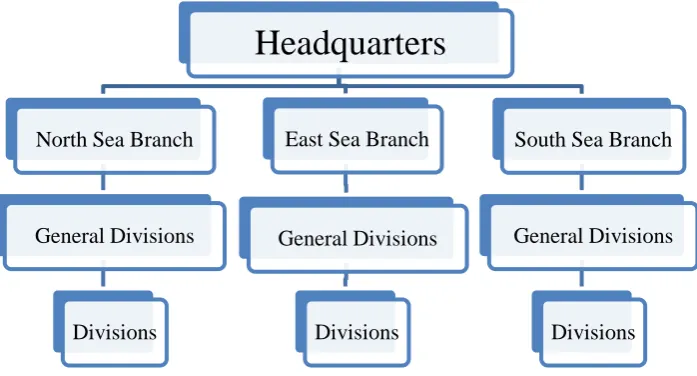
00In general, there are four levels in the framework of CCGA. The first level is the headquarters which consists of three internal departments of SOA called the Command of Coast Guard, the Political Department of Coast Guard and the General Logistics Department of Coast Guard. The second level is three Branches of SOA located in primary areas around coastal provinces which are the North Sea Branch, the East Sea Branch and the South Sea Branch. The third level is the General Division under Branch. The fourth level is the Division under the General Division. Figure 2.1 shows the detailed framework of CCGA.
2-1-2 Functions of China’s Coast Guard Administration
After the restructuring, CCGA integrated all the responsibilities conducted by the former departments. Overall, in accordance with IISS 2013, the responsibilities carried out by CCGA can be summarized as follows:
Draft regulations, procedure, measures and standards of enforcing maritime law;
Patrol of China’s ocean area;
Headquarters
North Sea Branch
General Divisions
Divisions
East Sea Branch
General Divisions
Divisions
South Sea Branch
General Divisions
Divisions
Anti-smuggling, anti-piracy, anti-drugs, anti-people smuggling, combat crime at sea;
Maritime policing, harbour and coastal security;
Research and survey, Search and Rescue coordinated with other departments;
Fisheries protection.
Regarding the headquarters, firstly, the Command Centre of Coast Guard is responsible for drafting regulations, measures, standards and procedures of enforcing maritime law. It is also responsible for commanding and organizing the specific missions regarding maritime law enforcement activities at sea. Secondly, the Political Department of the Coast Guard is responsible for the human resource management, and adjusting organizations or structures of CCGA. It is responsible for the training as well, including recruiting and training new staff as well as retraining incumbent staff. Thirdly, the Department of Logistics and Equipment of Coast Guard is responsible for budget and final account of the headquarters and subordinate divisions. It is also responsible for financing and managing all the state-owned assets. The website of SOA has information relating to this (http://www.soa.gov.cn/english/201409/t20140926_33679.html).
General Divisions, mainly exercising the functions of the on-scene administration under the orders issued by the higher authority. Overall, CCGA applies a vertical management system1. The order would be transmitted from superior authorities to subordinate authorities, which provides high control inside CCGA.
2-2
The Relation between CCGA and Other Relevant Departments
As it was mentioned before, there are three different main pillars of maritime law enforcement in China. However, maritime affairs are complicated and varying in nature. Maritime affairs involve safety, security and environmental protection at sea. Therefore, maritime affairs will be dealt with by all the related departments effectively. Besides CCGA, MSA and PLA Navy, MPS, the Ministry of Land and Resources, the Ministry of Agriculture, the General Administration of Customs and the Ministry of Environmental Protection have related duties mentioned before as well, such as providing professional advice on making policy and laws, protecting marine environment, developing ocean economic, and providing marine public service. Dealing with the relationship with these relevant departments is a challenge CCGA is facing and this will be analysed in Chapter 4.
2-2-1 Relation between CCGA and Other Policy-Making Departments
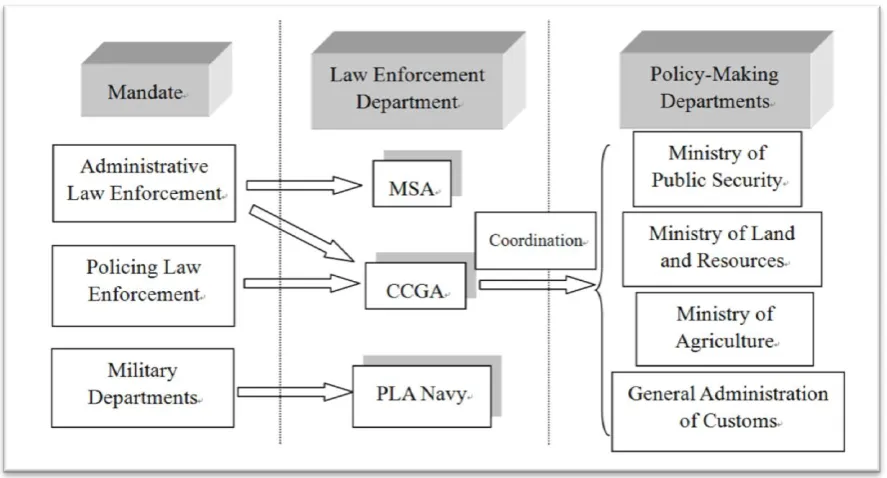
Regarding the relation between CCGA and MPS, CCGA follows professional guidance from MPS in terms of combating crime at sea and maintaining the order at sea. As it was mentioned earlier, CCGA is under a dual leadership of SOA and MPS. Because of the special leadership, CCGA could be defined as a paramilitary department, and CCGA has the right of policing law enforcement. This special status
1 Vertical Management System: With the term “vertical management system” is described that management or supervisors pass
of CCGA is very important for analysing the nature of CCGA and working measures conducted by CCGA. The issue about the leadership of CCGA will be analysed in chapter 4.
Then regarding the Ministry of Land and Resources, it is the direct superior authority of SOA. Meanwhile, it is the direct superior authority of CCGA. Therefore, CCGA should follow the guidelines from the Ministry of Land and Resources. In addition, the basic working rules followed by CCGA should be the administrative regulations of the Ministry of Land and Resources. In the future, the internal administrative rules of CCGA drafted by CCGA should get the permission of the Ministry of Land and Resources. Furthermore, all the significant decisions made by CCGA should take consideration of the opinions and instructions of the Ministry of Land and Resources.
As for the Ministry of Agriculture, firstly, it is responsible for making policy and strategy regarding fisheries affairs. CCGA will contribute to these policy-making activities. Secondly, CCGA is responsible for conducting the inspection of illegal fisheries activities at sea, and implementing administrative penalty about illegal fisheries activities. Thirdly, the Ministry of Agriculture is responsible for negotiating and enforcing bilateral and multilateral agreements about fisheries activities which are contributed by CCGA. Regarding the actual inspection and implementation, CCGA is responsible for cooperating with related foreign agencies to achieve the aim of bilateral and multilateral agreements.
activities. CCGA will conduct the specific law enforcement activities based on the information provided by the General Administration of Customs. To be clear, CCGA is responsible for combating smuggling activities at sea. The smuggling activities occurring in the internal waters1, boundary rivers and boundary lakes2 should be combatted by the General Administration of Customs and the Public Security Border Troops of MPS. In some special circumstances, the General Administration of Customs and CCGA should conduct the joint operation to combat serious smuggling activities at sea.
Overall, the benefit of separating policy-making departments and law enforcement departments is integrating the right of maritime law enforcement as much as possible. By doing this, it can eliminate the bad influence of decentralization of powers mentioned above at least. It can improve the efficiency of law enforcement as well. However, there is also a drawback of this system. It may cause the divergence between policy-making and practical work. That is why cooperation and communication between the policing-making departments and law enforcement departments are very important in the future, which is also a significant challenge faced by CCGA, which will be analysed in Chapter 4.
2-2-2 Relation between CCGA and PLA Navy
PLA Navy is the naval branch of the People's Liberation Army. In fact, the primary responsibility of the People's Liberation Army is to defend China’s territory with the aim of safeguarding sovereignty and territorial integrity. Hence, PLA Navy has the
1
Internal Waters: With the term “internal water” is described that waters on the landward side of the baseline of the territorial sea form part of the internal waters of the State, except as provided in Part IV (UNCLOS, Article 8)
2 Boundary Rivers, Boundary Lakes: Oxford advanced learner's dictionary of current English (Hornby, Wehmeier, McIntosh,
right to perform military tasks and defend maritime areas under Chinese sovereignty. However, CCGA has dual responsibilities which are the administrative duty and policing duty. Therefore, the mandates between CCGA and PLA Navy are totally different (Qian, 2014, p.5). In addition, there is a fundamental difference in the missions carried out by CCGA and PLA Navy. In maritime areas beyond national jurisdiction, such as the high seas1, only navies can legitimately exercise authority as flag states (Hong, 2015). In maritime zones within national jurisdiction, both PLA Navy and CCGA can carry out their duties. Appendix A provides the specific articles regarding this issue such as Article 107.
Currently, PLA Navy is a solid shield for CCGA with respect to safeguarding China’s marine interests. Obviously, both professional quality and equipment of PLA Navy has more advantages than CCGA, which is a new department. Meanwhile, as a paramilitary department, necessary military training and education is required by CCGA. Therefore, during the transitional period of the restructuring activities, PLA Navy can provide necessary assistance to CCGA by using their advantages, such as training staff, optimizing equipment and improving professional ability. In particular, information sharing, coordination during both peacetime and wartime is very important for both of them (Liu, 2014, p.53).
In the future, CCGA and PLA Navy will constitute two levels of support with the aim of safeguarding maritime benefits and interests. Along with the special status of CCGA and PLA Navy and their advantages, CCGA will be the soft support power in
1
the first level which represents the administrative law enforcement and policing power of China. Meanwhile, PLA Navy will be the hard support power in the second level representing the military power of China. Definitely, by implementing this system, it will have the positive impact on settling disputes and accidents at sea by peaceful measures.
2-2-3 Relation between CCGA and MSA
Paragraph 1-1-1 introduced the status and primary responsibilities of MSA. To begin with, both MSA and CCGA are entities of maritime law enforcement; they have the right to take administrative measures to regulate domestic and foreign ships which are sailing in the Chinese coastal waters. Obviously, they have the right of administrative law enforcement. In practice, the responsibilities of CCGA and MSA will be overlapping regarding some specific areas, such as inspecting ships with different aims, dealing with affairs about marine environment, as well as affairs related to marine security. Meanwhile, there are still some differences between CCGA and MSA discussed as follows:
On the other hand, the mandate is different. Firstly, MSA carries out the responsibilities of Port State Control (The Approval of the Main Responsibilities and Staffing on the People's Republic of China Maritime Safety Administration, 1998). MSA conducts port state control under the Memorandum of Understanding on Port State Control in the Asia-Pacific Region (Tokyo MoU) and relevant international instruments. CCGA does not have the right to conduct Port State Control operations. Secondly, because of the special status of CCGA, CCGA could use force during law enforcement operations. Although it is not clear according to Chinese legislation, this issue will be analysed in Chapter 3. As for MSA, it is just an administrative agency. Thirdly, MSA is mandated to be in charge of administration, certification and supervision of ships, and in charge of training, examining and certificating seafarers and pilots.
2-3
Summary of the Present Situation
China, because this structure makes the relationship between entities of maritime law enforcement clear and simple. In addition, the opportunities CCGA has are the significant advantage of this structure. These opportunities are chances for CCGA to develop better and better in the future.
Regarding entities of maritime law enforcement, firstly, CCGA is an entity which has the right to both administrative law enforcement and policing law enforcement, because CCGA has dual leadership and special status. Dual leadership means CCGA is commanded by SOA and follows the professional guidance from MPS which is a drawback of CCGA in the author’s opinion. This issue will be further analysed in Chapter 4. Special status means CCGA is a paramilitary department which has the right of policing law enforcement by using forces during a mission in specific situations. This issue will be analysed in Chapter 3. Secondly, MSA is an administrative department 1 carrying out the responsibilities to exercise administrative law enforcement regarding to paragraph 1-1-1. Thirdly, PLA Navy is a military force carrying out military missions.
It has to be mentioned that the status between a military department and a paramilitary department is different. According to the definition of paramilitary in paragraph 1-1-1, a paramilitary department should help the official army of a country. Herein, the status between CCGA and PLA Navy is different. In peacetime, the right of administrative law enforcement and policing law enforcement exercised by CCGA assure the legality of China’s regular maritime law enforcement activities.
1
Meanwhile, instead of PLA Navy, CCGA could mitigate conflicts between China and neighbouring countries in order to avoid further escalation if disputes or legal cases happen. PLA Navy only takes action under special emergency circumstances when CCGA has no jurisdiction, for example, if foreign warships sail into sea areas in China, or during wartime, or performing escort missions on the high seas.
Additionally, other policy-making departments also play critical roles in safeguarding China’s marine benefits. Their professional advice on maritime affairs could help maritime law enforcement departments improve the efficiency of law enforcement. Regarding the similar responsibilities between CCGA and General Administration of Customs mentioned before, necessary coordination should be conducted between them. Maritime law enforcement departments and policy-making departments should make efforts together with the aim of safeguarding China’s marine benefits and interests at practical and theoretical levels.
3
Legal
Foundations
for
China’s Coast Guard
Administration
Chapter 2 provided the physical structure of China’s Coast Guard Administration by discussing the framework, function and relations to other relevant departments of CCGA. This chapter will discuss the legal foundations of CCGA with the aim of providing a strong legal support for CCGA to fulfil its mandates. Firstly, section 3.1 will explain some basic definition of terms mentioned previously and afterwards discuss regarding law enforcement. Secondly, section 3.2 will discuss the influence of international laws on CCGA. Finally, section 3.3 will discuss the influence of domestic laws on CCGA. Analysing the legal foundations of CCGA could indicate the responsibilities and obligations undertaken by CCGA clearly and validly.
3-1
Explanation of Terms Cited by this Dissertation
Law enforcement
related to health, safety, welfare, and morals. However, the definition of law enforcement is a little different in China in a narrow sense. The right of law enforcement has a wider explanation, which is to implement the law to specific person or specific incident during the process of fulfilling functions and powers by government administrative departments or organizations legally in accordance with statutory authority and legal procedures (E, 2007, p.15). Law enforcement is made up of the right of administrative law enforcement and the right of policing law enforcement.
Maritime law enforcement
The right of maritime law enforcement is derived from a national maritime jurisdiction1, which is on the basis of state sovereignty2 and national jurisdiction3. Regarding maritime law enforcement specifically, it is the right to implement laws when the general entity of maritime administration fulfils its responsibilities and obligations in accordance with laws, regulations and international instruments; to regulate vessels, person, and activities at sovereign maritime area and other maritime area defined by international laws (Zhang, 2004, p.120). As mentioned before, the right of maritime law enforcement were decentralized by different entities of the maritime administration, which was an obstacle influencing the effectiveness of maritime law enforcement before the
1 National Maritime Jurisdiction: With the term “national maritime jurisdiction” is described that a sovereign state has the
rights to regulate various maritime affairs on the basis of national sovereignty and international conventions. National marine jurisdiction is a significant component of National jurisdiction (Song, 2009, p.14).
2 National Sovereignty: With the term “national sovereignty” is described the supreme, absolute, and uncontrollable power by
which an independent state is governed and from which all specific political powers are derived; the intentional independence of a state, combined with the right and power of regulating its internal affairs without foreign interference (Shao, 2012, pp.167-170).
3 National Jurisdiction: Encyclopedia Britannica defined the term “national jurisdiction” as a nation possesses supreme
restructuring activities. Currently, MSA and CCGA are principal entities to take the right of maritime law enforcement apart from PLA Navy, which has limited responsibilities for maritime law enforcement. The right of maritime law enforcement carried out by MSA is mainly related to ensuring the safety of transport. Other general contents of the right of maritime law enforcement are held by CCGA, such as maintaining security at sea, managing fishery activities, and protecting the marine environment. Additionally, the scope of the right of maritime law enforcement is not limited to a maritime area where China has full sovereignty; it also includes the contiguous zone1, EEZ, and the continental shelf2 where China has sovereign rights, even the high seas on the basis of UNCLOS. Appendix A provides the detailed provisions regarding this issue. It is obvious that the scope of maritime law enforcement is broad.
Administrative law enforcement
Administrative law enforcement is the power to administer or enforce a law. Administrative law enforcements can be executive, legislative, or judicial in nature. Administrative law enforcement intends to put the laws into effect, practical application of legislation and execution of the principles prescribed by the legislature. Administrative agencies exercise considerable discretion in implementing policy mandates from legislatures or other political authorities. The older idea that agencies are mere "transmission belts" that simply translate policies into action without exercising any independent judgment, is no longer
1 Contiguous Zone: With the term “contiguous zone” is described in a zone contiguous to its territorial sea, described as the
contiguous zone. The contiguous zone may not extend beyond 24 nautical miles from the baselines from which the breadth of the territorial sea is measured (Article 33 of UNCLOS).
2
accepted as accurate (Rosenbloom, 2009, p.4). The nature of administrative law enforcement is the performance of the national public authority in order to protect the public justice and the public order. Normally, administrative law enforcement is not mandated to use force in order to achieve the aim. If it is necessary, administrative agencies could call for judicial interference. The form of expression of administrative law enforcement is administrative measures applied by the administrative agency. For example, MSA has the right to inspect and detain domestic vessels or foreign vessels, and collect administrative fees based on Chinese domestic laws and regulations. Regarding MSA and CCGA, they both are administrative agencies. As mentioned before, the main difference between MSA and CCGA is the mandate authorized by laws. MSA only has the right to take administrative measures to fulfill its responsibilities, while CCGA has the right of policing law enforcement which can use forces in the course of law enforcement.
Policing law enforcement
hold the right of policing law enforcement as mentioned before (Cai, 2013). The inheritance relation provided CCGA the legal foundation for the right of policing law enforcement. However, the other two integrated departments, FLEC and CMS, only have the right of administrative law enforcement. There are no clear provisions of Chinese legislation regarding this issue whether CCGA has the right of policing law enforcement or not. Nevertheless, it was based on the fact that the right of policing law enforcement was carried out by CMPB and the Custom Police transferred to CCGA during the restructuring activities. It is appropriate and legitimate to deem that CCGA has the right of policing law enforcement.
3-2
International Laws
At the international law level, UNCLOS is the principal international convention providing the legal foundation for CCGA to carry out the right of maritime law enforcement. UNCLOS was ratified by the People’s Republic of China on May 15, 1996, and entered into force on July 7, 1996. UNCLOS provides the scope and legal status of internal waters, territory sea, contiguous zones, and archipelago, straits used for international navigation, exclusive economic zone, continental shelf, high sea and international seabed area1(Area), as well as the right of coastal states within these areas (Si, 2002, p.349).
3-2-1 Sovereignty and Sovereign Rights
As mentioned before, the right of maritime law enforcement are on the basis of national sovereignty and national jurisdiction. UNLCOS regulates sovereignty and jurisdictions enjoyed by Member States regarding the defined maritime areas.
1 International Seabed Area: With the term “international seabed area” is described the area that means the seabed and ocean
Appendix A provides detailed provisions of UNCLOS regarding this issue:
Internal waters and territorial sea: According to Article 2 of UNCLOS, the sovereignty of a coastal State extends, beyond its land territory, internal waters as well as the territorial sea.
Contiguous Zone: According to Article 33 of UNCLOS, in their contiguous zone, the coastal State may exercise the control necessary in specific situations which are provided in Appendix A.
Exclusive economic zone: The coastal State has sovereign rights and jurisdiction as provided for in the relevant provisions of UNCLOS within EEZ according to Article 56 of UNCLOS. Meanwhile, Article 73 of UNCLOS provides the coastal State may exercise their sovereign rights to explore, exploit, conserve and manage the living resources in the exclusive economic zone, take such measures, including boarding, inspection, arrest and judicial proceedings, as may be necessary to ensure compliance with the laws and regulations adopted by it in conformity with this Convention.
Continental Shelf: The coastal State exercises over the continental shelf sovereign rights for the purpose of exploring it and exploiting its natural resources according to Article 77 of UNCLOS.
administered by the Chinese government. These provisions are strong legal support and evidence for CCGA to conduct patrol activities at sea, to settle disputes with neighbouring countries, to maintain security at sea, and to carry out other relevant legal activities.
3-2-2 National Jurisdiction
On the international law level, apart from the legal foundation provided by sovereignty and sovereign rights, national jurisdiction could be another legal basis of the right of maritime law enforcement. The definition of national jurisdiction was mentioned before; it is a natural right enjoyed by a country. Furthermore, UNCLOS also provides some provisions related to national jurisdictions, such as the right of adopting laws and regulations to regulate certain marine affairs at certain maritime zones, the right of visit, as well as the right of hot pursuit. A coastal country can exercise its national jurisdiction by performing these rights.
other measures necessary to implement applicable international rules and standards established through competent international organizations or diplomatic conference to prevent, reduce and control pollution of the marine environment from land-based sources.
Secondly, regarding to the right of visit, Article 110 of UNCLOS provides that a warship or any other duly authorized ships or aircraft clearly marked and identifiable as being on government service have the right to board and inspect a foreign vessel on the high sea when there is reasonable ground for suspecting that in specific situations which are provided in Appendix A. (Zhao, 2009, p.21). Herein, besides the warship, the governmental ship of CCGA is satisfied with the definition of any other duly authorized ships or aircraft clearly marked and identifiable as being on government service. Therefore, the governmental ship of CCGA could certainly carry out this right.
should be with the hot pursuit operations. However, there is not a uniform standard of the good reason. Normally, it is believed that the identification of illegal activities of foreign vessels should be based on strong evidence. Any loss suffered by a foreign vessel should be compensated by the coastal State that conducts hot pursuit activities without justified reasons (Jiang, 2006, p.39).
The right of adopting laws and regulations, the right of visit and the right of hot pursuit constitute the national jurisdiction provided by UNCLOS. It covers all the maritime zones owned by China. These rights not only provide the legal foundation for maritime law enforcement but also measures of law enforcement to fulfil national jurisdictions. As mentioned before, CCGA is authorized as a maritime law enforcement department by the Chinese government. Therefore, CCGA has the right to fulfil its responsibilities and obligations provided by UNCLOS based on national jurisdiction.
3-3
Domestic Laws
develop and manage marine resources, as well as substantial and procedural law of law enforcement.
3-3-1 Safeguarding Sovereignty and Marine Benefits
Table 3.1 Laws and regulations regarding safeguarding sovereignty and marine benefits
Laws or Regulations Promulgation Date
Declaration of the Government of the People's Republic of China on the Territorial Sea of the People's Republic of China
September 04,1958
Law of the People's Republic of China on the Territorial Sea and the Contiguous Zone
February 25, 1992
Declaration of the Government of the People's Republic of China on the Baselines of the Territorial Sea of the People's
Republic of China
May 15,1996
Law on the Exclusive Economic Zone and the Continental Shelf of the People's Republic of China
June 26, 1998
Island Protection Law of the People's Republic of China December 26, 2009 Declaration of the Government of the People's Republic of
China on the Baselines of the Diaoyu Island and its affiliated islands
September 10, 2012
(Source: Li, 2014)
define various Chinese maritime zones legally, as well as lay the foundation of the scope of activities performed by entities of maritime law enforcement, which are MSA and CCGA. It is worth mentioning that three declarations listed in Table 3.1 indicate China’s attitude and stands regarding territory and jurisdictional maritime zones. Especially, Island Protection Law of the People's Republic of China indicates that China will take feasible measures to control the islands belonging to China since ancient times effectively in order to respond to the fact that some of China’s islands are illegally occupied by foreign countries.
3-3-2 Protection of the Marine Environment
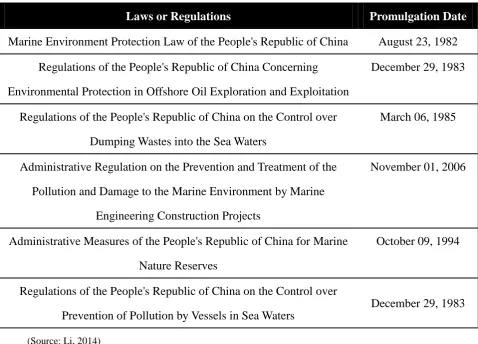
Table 3.2 Laws and regulations regarding protection of marine environment
(Source: Li, 2014)
Laws or Regulations Promulgation Date
Marine Environment Protection Law of the People's Republic of China August 23, 1982 Regulations of the People's Republic of China Concerning
Environmental Protection in Offshore Oil Exploration and Exploitation
December 29, 1983
Regulations of the People's Republic of China on the Control over Dumping Wastes into the Sea Waters
March 06, 1985
Administrative Regulation on the Prevention and Treatment of the Pollution and Damage to the Marine Environment by Marine
Engineering Construction Projects
November 01, 2006
Administrative Measures of the People's Republic of China for Marine Nature Reserves
October 09, 1994
Regulations of the People's Republic of China on the Control over Prevention of Pollution by Vessels in Sea Waters
Table 3.2 indicates main laws and regulations regarding the protection of the marine environment. These laws and regulations regulate emissions at sea and the standard of related marine operations with the aim of protecting the marine environment and keeping the seas clean. Among them, Marine Environment Protection Law of the People's Republic of China is one specific single law dealing with the marine environment. It provides the responsibilities and obligations of the national administration of the marine environment, as well as administrative measures that can be used by the national administration of the marine environment, which is CCGA. For example, the National Administration of the Marine Environment has the right to board and inspect foreign vessels which cause pollution in Chinese jurisdictional maritime zones according to Article 5 of Marine Environment Protection Law of the People's Republic of China.
3-3-3 Development and Management of Marine Resource
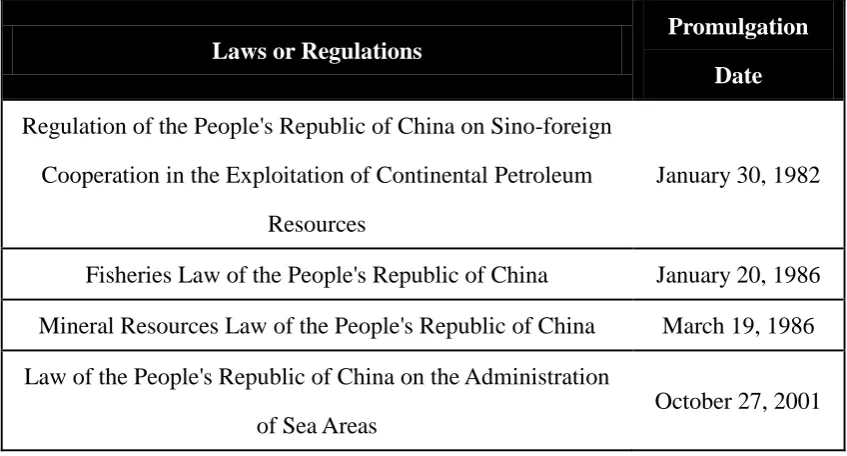
Table 3.3 Laws and regulations regarding development and management of marine resource
Laws or Regulations
Promulgation
Date
Regulation of the People's Republic of China on Sino-foreign Cooperation in the Exploitation of Continental Petroleum
Resources
January 30, 1982
Fisheries Law of the People's Republic of China January 20, 1986 Mineral Resources Law of the People's Republic of China March 19, 1986 Law of the People's Republic of China on the Administration
of Sea Areas
Maritime Traffic Safety Law of the People's Republic of China
September 02, 1983 Provisions Governing the Laying of Submarine Cables and
Pipelines
January 20, 1989
Provisions of the People's Republic of China on Administration of Foreign-related Marine Scientific Research
June 18, 1996
(Source: Li, 2014)
Table 3.3 indicates main laws and regulations regarding development and management of the marine resources. These laws and regulations provide a legal regime about how to develop, protect and manage natural resources in China’s jurisdictional maritime zones in order to achieve the goals of sustainable development of marine economy and sustainable utilization of marine resources. In the past, fisheries affairs were supervised by FLEC. Exploitation and exploration of mineral resources, as well as administration of sea areas, were overseen by SOA, Currently, SOA is a key department which is responsible for overseeing the development activities of marine resources and administration of maritime areas after restructuring activities, which means that it is CCGA’s responsibilities as well.
3-3-4 Substantial and Procedural Law of Law Enforcement
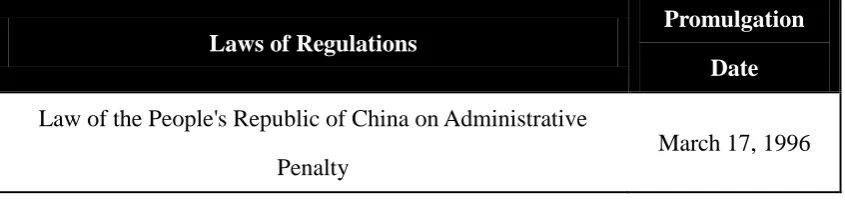
Table 3.4 Laws and regulations regarding substantial and procedural law of law enforcement
Laws of Regulations
Promulgation
Date
Law of the People's Republic of China on Administrative Penalty
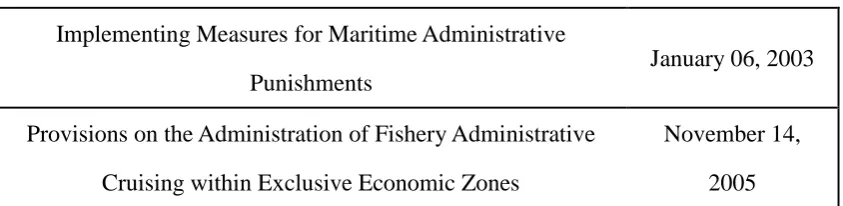
Implementing Measures for Maritime Administrative Punishments
January 06, 2003
Provisions on the Administration of Fishery Administrative Cruising within Exclusive Economic Zones
November 14, 2005 (Source: Li, 2014)
Table 3.4 indicates main laws and regulations regarding the substantial and procedural law of law enforcement. These laws and regulations provide the procedures should be followed by maritime law enforcement departments when they perform their responsibilities. It was pointed out before, that CCGA is a partial administrative department which has administrative responsibilities. Therefore, these legislation and regulations could be implemented by CCGA. Herein, the procedure of law enforcement mainly regulates administrative law enforcement. Regarding policing law enforcement, there are no specific laws or regulations providing the legal basis for CCGA. However, because of the dual leadership of CCGA, which is concurrently led by MPS, laws and regulations related to the police should be considered as legal foundations as well, such as People's Police Law of the People's Republic of China promulgated on February 28, 1995 and Law of the People's Republic of China on the People's Armed Police Force promulgated on August 27, 2009.
3-4
Summary of Legal Foundations
4
Challenges and Opportunities
The previous discussion covered the former situation of Chinese maritime law enforcement, the present situation of China’s Coast Guard Administration and the legal foundations for CCGA, which indicated that CCGA has solid organizational foundations and legal foundations. These organizational foundations and legal foundations can help CCGA to overcome many problems. For example, a great many former professional law enforcement personnel can work directly without too much training. Furthermore, all the original governmental vessels can be used by changing the hull number to China Coast Guard. However, theoretically and practically, a new department will still face considerable challenges and have many opportunities no matter how to solidify the foundations it has. Therefore, the author intends to identify the major challenges and significant opportunities CCGA will be facing in this chapter.
4-1
Challenges
of relevant departments, as well as the specific issues dealt with by CCGA. External challenges cannot be solved by CCGA unilaterally. It will change in times of special circumstances.
4-1-1 Internal Challenges
Challenges of the leadership of CCGA
Therefore, dual leadership is a principal challenge in the future.
Challenges of the management of staff
Restructuring activities put the former staff from different departments under CCGA’s administration. In the meantime, CCGA has recruited new staff who just graduated from university as reserve officers. These two parts of staff are the structure of the staff of CCGA. Among them, four main challenges can be summarized: 1. The coordination of the relationship among previous staff in order to make them work together effectively; 2. The quality of recruiting new staff; 3. The establishment of training and re-training mechanism in order to provide proper training for staff; 4. The management of the size of staff in order to carry out the responsibilities properly.
a. Coordinating previous staff
Previous staff is from different departments with different specialization and experiences. Currently, they are the main human resources in CCGA to perform missions of CCGA. During the transitional period, they have carried out their previous different responsibilities respectively in the name of CCGA, for example, during the patrol mission of islands that belong to China. The officers on board are mainly from CMS because the patrol mission of the islands belongs to China was carried out by CMS. Officers from FLEC are primarily sent to deal with the mission related to fishing.
be solved. One aim of establishing China’s Coast Guard Administration is to improve the efficiency of law enforcement by making one entity perform different missions as many as it possibly can. This requires the officers on board should have the ability to deal with all the missions they are assigned to perform. In fact, previous staff has only focused on their original responsibilities in the past; they have to be retrained to perform more duties in order to fulfil that aim in the future. Therefore, at the present stage, coordinating the working relationship between previous staff is one challenge faced by CCGA.
On the other hand, the problem about work status of previous staff is another important challenge. In the past, besides the staff of CMPB, who were in active service of armed police, the staff belong to other departments were civil servants. The official status of CCGA officers is related to the legitimacy of law enforcement activities when they perform their duties. However, the official status of CCGA officers does not have a specific status at present. Whether the official status of CCGA officer is defined as civil servant or active service officer, the change of official status among previous staff is related to procedure problems, law application problems and competent ability problems. Therefore, not only defining the official status of a CCGA officer is one challenge, but also the real work of changing the official status.
b. Recruiting new staff
general maritime law enforcement department. Therefore, even after training, they still need to accumulate experience in practice in order to make themselves competent. These new officers will be the first real generation CCGA commanders who have general practical experiences in the future. It is worth mentioning that, their training is consistent with the requirements of the active service officer at present. Their official status is not a significant challenge herein, because no matter what kind of official status is decided by the Chinese government eventually, they do not need to change their official status.
c. Establishing training and re-training mechanism
Yu, 2014, pp.53-54). Law enforcement ability and law enforcement experience of CCGA staff is an essential element, which influences the efficiency of law enforcement significantly. Therefore, establishing a feasible training and re-training mechanism is one major challenge.
d. The size of staff
China has eighteen thousand kilometres of land coastline, fourteen thousand kilometres of island coastline, and three million square kilometre maritime areas, which need to be safeguarded. Law enforcement activities performed by CCGA are arduous. The number of staff of CCGA is not enough to carry out the arduous work effectively (Han, 2014, p.27). According toIISS 2013, the number of staff of CCGA is 16,296. Correspondingly, the US Coast Guard had 42,190 military active officers, 7,899 military reserve officers, 8,722 civilians and 32,156 auxiliary staff in 2012 (Coast Guard Snapshot, 2012). The size of personnel of the US Coast Guard is obviously huger than CCGA. Taking into consideration the high risk of work in CCGA, as well as the dull work because of long time navigation, the size of CCGA staff will pose a negative impact on the efficiency of law enforcement activities. Therefore, the inadequate size of staff in CCGA is also an influential challenge.
Challenges of the management of equipment
governmental vessels with a displacement of more than 3000 tonnes. In addition, CMS had ten aircraft. Comparatively, CMPB had the advantages of weapons. However, the patrol vessels owned by CMPB had lower tonnage. They could not even proceed with patrol missions within the territorial sea independently. Regarding the Custom Police, most of their governmental vessels were lower than 300 tonnes (Dong, 2014, p.70). Resulting from the different mission carried out by different departments in the past, the design and equipment on board these governmental vessels were different. It is difficult to reconstruct all these governmental vessels to make them satisfy the working requirements in the future. Compared to CCGA, the US Coast Guard had 244 cutters, 1,776 boats and 198 aircraft in 2012 (Coast Guard Snapshot, 2012). The US Coast Guard is also equipped with adequate weapons. Whether it is technology or quantity, the US Coast Guard has appropriate and competent equipment to perform their duties. The military power of the US Coast Guard is even greater than a navy in some countries.
During the transitional period, all these previous governmental vessels have changed their hull number to China Coast Guard. However, CCGA needs professional vessels with applicable design and equipment, as well as auxiliary facilities to exercise their functions effectively. Especially, a reasonable number of helicopter and other shore-based equipment are needed. Therefore, problems about how to coordinate and improve current equipment, how to purchase new professional vessels and equipment, as well as how to maintain and update equipment are challenges.
Challenges of capability of law enforcement
missions. After the restructuring activities, as a new general maritime law enforcement department, CCGA requires a higher capability of law enforcement for CCGA staff, whether they are previous staff or new staff. One of the main aims of restructuring China’s maritime law enforcement forces is to optimize the structure of departments, improve the efficiency of law enforcement. Considering the challenges discussed above and the higher requirements now, challenges of capability of law enforcement to CCGA displays in the following two aspects apart from the capability of CCGA staff and the condition of equipment:
a. Lack of departmental rules
According to Article 90 of Constitution of the People's Republic of China: The ministries and commissions issue orders, directives and regulations within the jurisdiction of their respective departments and in accordance with the law and the administrative rules and regulations, decisions and orders issued by the State Council (Wu, 2005, p.74). Herein, each ministry can issue their departmental rules to enforce laws and regulations specifically, as well as the coordinate relation between internal departments and authorities. Departmental rules are a feasible way to solve real problems because they are formulated on the basis of industry realities (Jin, 2001, p.50).
Provisions on the Administration of Fishery Administrative Cruising within
Exclusive Economic Zones is one departmental rule promulgated by Fisheries Management Bureau under the authority of the Ministry of Agriculture. Presently, the previous departmental rules formulated by other ministries are not applicable to CCGA because of the subordinate relationship. In addition, previous departmental rules focused on a particular area, which does not apply to CCGA because of the synthetical responsibilities CCGA has. In addition, not only can departmental rules provide a legal basis for CCGA, but they can also guide and standardize law enforcement actions of CCGA. Given the previous reasons, CCGA needs new feasible departmental rules in the future to regulate and improve their capability of law enforcement. Therefore, formulating feasible departmental rules is a big challenge for CCGA.
b. Lack of foreign affairs experience
If considering the discussion before about the past situation in Chapter 1, the responsibilities of previous departments were mainly concentrated on domestic maritime affairs which do not involve international communication and cooperation too much. Especially, during the transitional period, CCGA should strengthen international communication in order to learn progressive and mature maritime law enforcement experience from other countries. In addition, crime at sea is an international issue which needs all countries to make an effort to combat. Combatting crime at sea also requires CCGA to cooperate with other countries. Maintaining maritime security at sea is a sig