A Review on Segmentation Problems on Gujarati
Handwritten Text Document
Mr. Rakesh R. Savant Ms. Preeti P. Bhatt
Lecturer Assistant Professor
Department of Computer Science & Technology Engineering Department of Computer Science & Technology Engineering Babu Madhav Institute of Information Technology, India Babu Madhav Institute of Information Technology, India
Abstract
Optical Character Recognition (OCR) on Gujarati handwritten text document is important area of research. OCR on handwritten text document is very difficult. The reason is different people having different writing styles. For Gujarati handwritten text document OCR a very less research is done till date and there are many challenges too in Gujarati handwritten text document OCR. The whole process of OCR having many steps to be perform. In this paper the focus on the segmentation phase of Gujarati handwritten text document OCR and segmentation problems in it. In this paper we discover the difficulties of segmentation on Gujarati hand written text document. Also discover the comparison of the various segmentation methods which is works effectively for other languages and may be suit for Gujarati handwritten text document OCR too. This review paper illustrate the overview of OCR, various techniques of segmentation phase on Gujarati hand written text document with comparative study and problems in segmentation.
Keywords: OCR, Gujarati, Handwritten Text Document, Segmentation, Methods
_______________________________________________________________________________________________________ I. INTRODUCTION
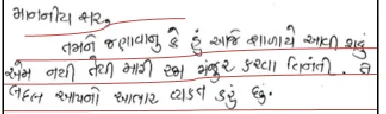
Gujarati language is popular language in Gujarat the state of India. The writing style in Gujarati is left to right side. In Gujarati language there are more curves and lower part of character or extension present. Gujarati language has sub-categories that is Surti Gujarati, Parsi Gujarati, kathiyawadi Gujarati etc. Languages are different so its writing style is also different for each language the people who speaks. And while you apply OCR on such handwritten language documents to recognize lines, word or characters the major problem is arise when you apply segmentation on that hand written document. For other Indian languages up to the good level of research work is done but for Gujarati language it is in preliminary phase. After study many research papers we conclude that they work on printed Gujarati text documents. The main problem they face is free handwriting style of people. Because of every human have different writing style, it is not an easy to identify the words or characters from such hand written text document. They also describe some methods for other languages.
II. OCR
In Optical Character Recognition (OCR), a process takes images as an input in a system and gives output as a text documents. OCR is an area of research in digital image processing. OCR takes image of handwritten or printed text document as input and after process on the image it will convert the image into text form. Basic applications of OCR is data entry for business documents, optical mask reader, electronic images of printed documents searchable, automatic number plate recognition etc.
Fig. 1: Block diagram of OCR [1]
Importance of Segmentation Phase in OCR
Process of Segmentation
Line Segmentation
Line segmentation apply on handwritten text documents to extract the lines.
Fig. 2: Line segmentation
Word Segmentation
Word segmentation apply on handwritten text documents to extract the words.
Fig. 3: Word segmentation
Character Segmentation
Character segmentation apply on handwritten text documents to extract the characters.
Fig. 4: Character segmentation
Gujarati Script
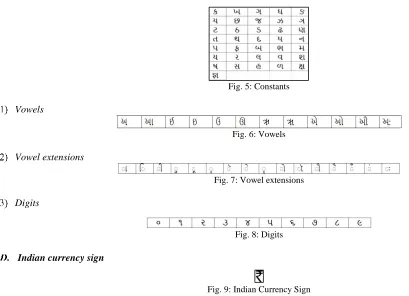
As every languages having its own character sets Gujarati language have the character set which consist of 35 consonants, 13 vowels, 13 dependent vowel signs, 6 signs, 10 digits and 1 sign for Indian currency. Consonants may connected with any of the vowel extensions.
Consonants
Fig. 5: Constants
Vowels
Fig. 6: Vowels
Vowel extensions
Fig. 7: Vowel extensions
Digits
Fig. 8: Digits
Indian currency sign
III. SEGMENTATION PROBLEMS IN HANDWRITTEN GUJARATI TEXT DOCUMENT [8] Line Segmentation
Modifier Overlapping
The lower modifier of one line overlaps with the upper modifiers of very next line.
Fig. 10: Modifier Overlapping
Unusual Line Spacing
Spacing is not proper between two or more than two lines
Fig. 11: Unusual Line Spacing
Zigzag Line/Word/Character
It creates curvature in the lines. Text is not in proper line.
Fig. 12: Zigzag Line/Word/Character
Word Segmentation
Unusual spacing in inter-word and intra-word
Spacing between two words are not proper because of that spacing problem occurs.
Fig. 13: Unusual spacing in inter-word and intra-word
Character Segmentation
Lower Region Problems Lower modifier problem
Fig. 14: Lower modifier problem
Touching of half character with full character
Fig. 15: Touching of half character with full character
Unusual size of lower modifier
Fig. 16: Unusual size of lower modifier
Skewed character
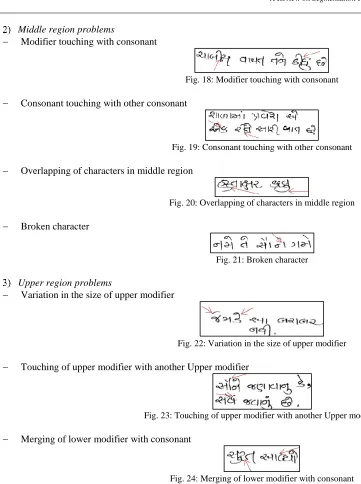
Middle region problems
Modifier touching with consonant
Fig. 18: Modifier touching with consonant
Consonant touching with other consonant
Fig. 19: Consonant touching with other consonant
Overlapping of characters in middle region
Fig. 20: Overlapping of characters in middle region
Broken character
Fig. 21: Broken character
Upper region problems
Variation in the size of upper modifier
Fig. 22: Variation in the size of upper modifier
Touching of upper modifier with another Upper modifier
Fig. 23: Touching of upper modifier with another Upper modifier
Merging of lower modifier with consonant
Fig. 24: Merging of lower modifier with consonant
IV. LITERATURE REVIEW
Plenty amount of research work is done in printed as well as hand written text document in languages like English, Arabic, Assamese, Oriya and Hindi. [1][3][5] Many researchers preferred projection based methods (vertical and horizontal projection) used in many languages for various types of segmentation.
The paper [8] presents many problems in handwritten text document segmentation process in Gujarati language. Major focus on segmentation like line, word and character then it increases recognition accuracy.
The paper [5] presents the segmentation process on Hindi handwritten document is described. Also applying various methods and algorithm to segment the upper and lower modifiers. The experiments and results are conclude based on the dataset consist of 15 different writer’s handwritten documents.
The paper [9] presents the OCR on Tamil script. Tamil script is non-heading based script and by applying horizontal projection on document to segment the line. Horizontal projection is most commonly used technique to segment the lines from document. Also conclude that the proposed algorithm is used for segment the non-heading based scripts like Telugu, Malayalam, Kanada, Gujarati, etc.
V. COMPARATIVE SUMMARY FOR SEGMENTATION METHODS
Table – 1
Sr.
No Ref. Methods Languages Useful May not useful
1 [2] Kalman filter English
This method is able to deal with overlapping text lines and various kinds of writing or noisy or damaged
character.
-
2 [3][4]
Projection based (horizontal projection) Bangla, Arabic, Gurmukhi, hindi, Tamil
This method suitable for straight lines.
Segmentation of overlapped or connected lines of text.
3 [2][5] Smearing method Hindi, English
It is used when gap between two word are proper in printed or
handwritten text document.
In handwritten text gap between two or more than
two words are proper.
4 [4][5] Hough transform based methods
Bangla, Arabic, Gurmukhi
The text line detection method for unconstrained handwritten
documents based.
This method is not suitable for variable skewed lines.
5 [5] Grouping method Gujarati, Hindi It is used for text line detection. -
6 [6][5] Graph based
method -
The graph based method is useful for
line segmentation. -
7 [7] Based line dictation method
Hindi, Devanagari
It is useful for line segmentation of various skew of handwritten text
In this method two consecutive lines touch or overlap each other due to
modifiers.
VI. CONCLUSION
Almost negligible work has been done up till now in segmentation for hand written Gujarati text document. Many challenges are there to segmentation on handwritten Guajarati document. From above literature review we conclude that there are many problems in OCR of handwritten Guajarati document to segment lines, words and characters. Mainly problems come in character segmentation phase. There is work done in segmentation of Guajarati language but that is for printed text document. There are many challenges and problems exist for handwritten Gujarati text document. Good accuracy in segmentation will lead to increase the good recognition rate.
REFERENCES
[1] prof s k shah, (2006) , “design and implementation of optical character recognition system to recognize gujarati script using template matching” ,ie (i) journal- et , vol 86.
[2] aurelie lemaitrea, (2011) , a perceptive method for handwritten text segmentation , document recognition and retrieval xvii – electronic imaging.
[3] a. Zahour, b. Taconet, p. Mercy, and s. Ramdane, (2001), “arabic hand-written text-line extraction”, proceedings of the sixth international. Conference on document analysis and recognition, icdar, pp. 281–285.
[4] n. Tripathy and u. Pal. (2004), “handwriting segmentation of unconstrained oriya text”, international workshop on frontiers in handwriting recognition, pp. 306–311.
[5] naresh kumar garg alt. (2010), “a new method for line segmentation of handwritten hindi text” ,seventh international conference on information technology. [6] Likforman-sulem and c. Faure, (1994), "extracting text lines in handwritten documents by perceptual grouping", advances in handwriting and drawing : a
multidisciplinary approach, pp. 21-38.
[7] i.s.i. abuhaiba, s. Datta and m.j.j. holt, (1995), ''line extraction and stroke ordering of text pages'', proceedings of the third international conference on document analysis and recognition, canada, pp. 390-393.
[8] shailesh chaudhari and dr. Ravi Gulati, (2014, January), “segmentation problems in handwritten gujarati text” international journal of engineering research & technology (ijert) vol. 3 issue 1.
![Fig. 1: Block diagram of OCR [1]](https://thumb-us.123doks.com/thumbv2/123dok_us/7803724.1661010/1.612.124.488.547.656/fig-block-diagram-of-ocr.webp)