e-ISSN: 2278-067X, p-ISSN : 2278-800X, www.ijerd.com
Volume 5, Issue 6 (December 2012), PP. 01-07
Break Even Analysis of a Mobile Crane and Maintenance:
a Case Study
1
Sankaraiah. M,
2Rambabu. E,
3Eswara Reddy. C
1Research Scholar, Dept. of Mech. Engg, S.V.U. College of Engg.,Tirupati-517502 A.P. India.
2General Manager, A. P. Rajiv Swagruha Corpn. Ltd., Jawahar Nagar, Hyderabad, A.P
3
Professor of Mech. Engineering, Sri Venkateswara University, Tirupati - 517502, A.P.
Abstract:- Productivity improvements are always of important aspect of any Industry. As a ressult, introducing the new materials and automated construction processes are always desirable as long as they are less expensive and consistent with desired performance. Mechanical handling and material handling go together as that of hand-in glove in the modern construction of the Dams, Roads, Bridges, Buildings, Over Head Water Tanks, Towers, Residential and Industrial buildings, High-rise buildings having many stories, etc. The manual handling of concrete remains commonplace in the construction of high-rise buildings despite obvious risks to operatives. As such, the construction of a multti-storeyed building is studied. The present paper concentrates on the usage of a Mobile Crane (Hydrau) for loading, mounting, carrying large loads and for work performed in the construction of multi-storeyed buildings. In the paper, the fundamental operations, utilization and maintenance of Mobile crane are analyzed for Break-Even analysis. The time, cost, reputations savings and safety of the manual handling is compared with Mechanical handling and established that the mechanical handling of materials is much better than manual handling in the construction of high-rise buildings.
Key words:- Material handling, Mechanical handling, Mobile crane, Construction, Concrete.
I.
INTRODUCTION
Construction is generally hard task and becomes hazardous in the construction of high-rise buildings. The literature states that working days are last due to injuries or illness or fatal deaths. The indirect costs like reduced worker productivity, delays in projects, administrative time, damage to equipment and the facility. In contrast, to most industrial accidents, innocent bystanders may also be injured by construction accidents. Several crane collapses from high rise buildings under construction have resulted in fatalities to passer-byes. Therefore, the Construction Cranes like Mobile Cranes are being used in a long useful working life that far exceeds the common values of their economic life. The manual material handling in the building constructions is very difficult and un-safe. The professional labours and skilled labours more in number is required for manual handling of RCC components in the building construction. It is also a major problem to involve the men for take up the heavy load duties repeatedly. Therefore, the mechanical equipment like Mobile Crane is more useful for lifting, loading, un-loading and carrying of heavy bodies like pre-casted RCC components and steel frames from one place to another. The study consists of the daily out put / usage of the mobile crane for a period of one week, considering regular manual labour charges. The average out-put interms of labour charges is estimated and compared with total expenditure on the vehicle and the Break-even point of Mobile crane is after 4 years from the date of commencement of utility.
II.
LITERATURE SURVEY AND OBJECTIVE
Technology Management is a process, which includes planning, directing, control and co-ordination. The implementation of Technological capabilities to shape and accomplish the strategic and operational objectives of the organization [1]. The Mechanical equipment is playing key role for material handling such as Tower Cranes in the construction of high-rise buildings.
The Tower cranes are used for lifting, loading and un-loading of RCC components, in the fixed area height at high-rise buildings construction [2]. The construction of Ground Floor and Stilt Floor is carried out in conventional methods in High-rise buildings [3]. The fundamental motions of a rotary crane are rotation, boom luffing, and load hoisting. Loads are transferred by a combination of these motions. Using a crane, a load can be transferred to any place within a limited area [4], and Break Even Analysis,[5].
regions such as Finland and Israel as well as in wider regions such as rebuilding of Europe after the destruction of the Second World War [6].
Due to the ennibaliation of valuable components for possible reuse in secondary markets is becoming a popular option. However, recovery processes are characterized by high levels of uncertainty regarding the quality of components returned at their end-of-life [7]. The volume of output at which neither profit nor loss is incurred is called as the Break-Even Point of the particular vehicle. It is also called minimum output to Break even the total cost incurred [8]. Therefore, construction of high-rise building with 14 Floors is taken -up in the present work.
Objective:
The objective of the paper is to find out the utilization of the Mobile Crane (Hydrau) with material handling and utilization charges so as to suggest a suitable Break-Even Analysis on the material handling system.
III.
LAY-OUT OF THE SITE
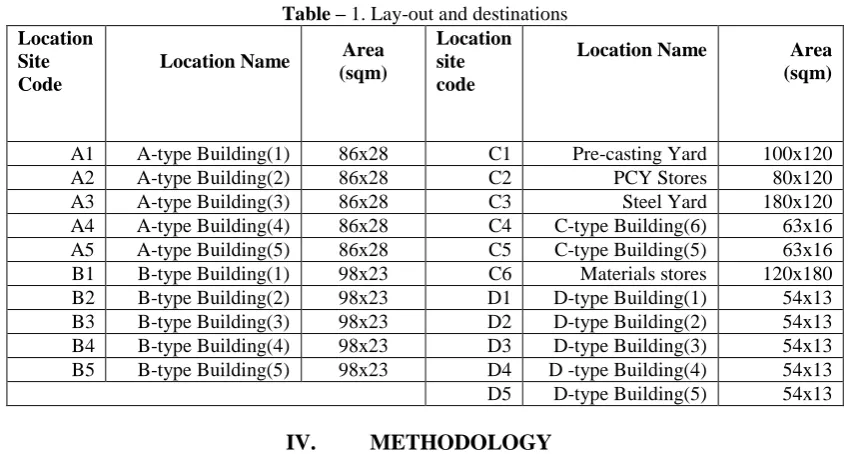
The lay-out of the site under study is shown in Figure – 1. The destinations of each area are shown in Table – 1.
Table – 1. Lay-out and destinations
Location Site Code
Location Name Area (sqm)
Location site code
Location Name Area (sqm)
A1 A-type Building(1) 86x28 C1 Pre-casting Yard 100x120
A2 A-type Building(2) 86x28 C2 PCY Stores 80x120
A3 A-type Building(3) 86x28 C3 Steel Yard 180x120
A4 A-type Building(4) 86x28 C4 C-type Building(6) 63x16
A5 A-type Building(5) 86x28 C5 C-type Building(5) 63x16
B1 B-type Building(1) 98x23 C6 Materials stores 120x180
B2 B-type Building(2) 98x23 D1 D-type Building(1) 54x13
B3 B-type Building(3) 98x23 D2 D-type Building(2) 54x13
B4 B-type Building(4) 98x23 D3 D-type Building(3) 54x13
B5 B-type Building(5) 98x23 D4 D -type Building(4) 54x13
D5 D-type Building(5) 54x13
IV.
METHODOLOGY
The Methodology in the construction of the floors is explained in the Flow Chart, Figure – 2, considering different operations. The experiments conducted on Mechanical Handling of materials by the Mobile crane and the destinations at the construction of multi-storeyed building of 17 blocks of each G + 14 floors in an extent of 52.00 Acres are as shown in detail in Table-1.
Job Description
Figure–2: Flow chart of construction Methodology
Table – 2: Job Description of manual construction and mechanical construction.
Manual Construction Mechanical Construction Sl.
No .
Job
Description
Trade Sl. No .
Job Description Trade Sl. No .
Job
Description
Trad e
1 Bar bending t1 1 Bar bending T1 11 De-moulding T11
2 Steel fabrication t2 2 Steel fabrication T2 12 Storing T12
3 Centering t3 3 Shifting of steel
frames
T3 13 Water Curing T13
4 Preparation of
CC
t4 4 Preparation of
Moulds
T4 14 Shift of RCC
components T14
5 CC
Transportation
t5 5 Reinforcement T5 15 Supply of
Siporex Slabs T15
6 Filling of CC t6 6 Preparation of CC T6 16 Columns,
beams, S. slabs erection
T16
Pre-casting yard
Crane Stationary
Erection
Crane fixed
Un-loading
Lifting pre-casting components Erection, Collection of SCC Lifting of SCC to top of columns Filling with SSC
Fixing of siporex slabs Grouting the components Stores
Crane Movable
Un-loadingRCC Components Storing Water curing Q.C. Testing Loading in Truck -II Moulding
Reinforcement with steel Filling with Concrete and Vibrating
De-moulding & finishing Lifting of component
7 CC Compaction t7 7 CC Transportation T7 17 SCC
Preparation T17
8 Finishing t8 8 Concreting T8 18 SCC
Transport’n T18
9 Water curing t9 9 Compaction T9 19 Grout with
SCC
T19
10 De-centering t10 10 Finish of Groves,
cores
T10 20 Screed with
CC
T20
Mobile Crane:
Mobile Crane used in the handling materials is shown in Figure -3 and the specifications are in the following followed by the handling of RCC Columns s shown in Figure – 4.
Escorts Construction Equipment Limited Model: F 15; Diesel Engine: No: 28 BK 5422. Cost of the Vehicle : Rs.21.90 Lakhs; Date of Purchase : 21.09.2009
Simple Interest on Capital : Rs.12%; Depreciation time: 15 years.
Figure-3: Conveyance of steel frames RCC columns Figure-4: Lifting of RCC columns
Output of the Mobile Crane:
The daily ouput of the Mobile Crane (Hydrau) is shown in Table – 3 followed by the daily expenditure on the Mobile Crane in Table -4. The total worth and cumulative output of the Mobile crane for 6 years ( Amount in Rs. Lakhs) is shown in Table – 5.
Table-3: Daily output of Mobile Crane on dt: 01-02-2010
Utilisation of the crane : Starting Time - Closing Time = 1662 – 1671 = 9 hrs
S. N o
Nature of handling
Quan - tity
Wt. (gs)
Transporta tion
Distance
travelled Manual requirement
From T o
Wit h load
With out load
Me n
Tim e (Hrs )
Labour Charges (Rs)
1 2 3 4 5 6 7 8 9 10 11
1 RCC columns
(1.20x0.30x2.535 m)
2 367
4
C1 C
2
180 - 26 208 3796
2 Return journey - - C2 C
1
- 180
3 RCC columns
(1.20x0.30x2.535 m)
2 367
4
C1 C
2
180 -
4 Return journey - - C2 C
1
- 180
5 RCC columns
(1.20x0.30x2.535 m)
2 367
4
C1 C
2
180 -
1
7 RCC columns
(1.20x0.30x2.535 m)
2 367
4
C1 C
2
180 -
8 Return journey - - C2 C
3
- 400
9 Steel Rods
shifting
1 160
0
C3 A
1 101
5
- 2 16 292
10 Return journey - - A1 C
3
- 1015
11 Steel Rods
shifting
1 200
0
C3 C
4
290 - 3 24 438
12 Return journey - - C4 C
6
- 290
13 Crane Materials
shifting
2 500 C6 A
3
503 - 4 32 584
14 Return journey - - A3 C
6
- 503
15 Crane Materials
shifting
2 500 C6 A
3
503 -
16 Return journey - - A3 A
1
- 41
17 Concrete Bucket
shifting
1 350 A1 A
5
217 - 2 16 292
18 Return journey - - A5 C
6
- 719
324 8
3508 37 296 5402
Table-4: Daily Expenditure and out put of the Mobile crane from 01-02-2010 to 06-02-2010
S. No. Date of working Expenditure Time taken (Hrs) Out put (Rs) Time taken (Hrs) Oil Consumption Labor involved
1 01.02.2010 450 780 9 5402 296
2 02.02.2010 400 780 8 5110 280
3 03.02.2010 300 780 6 5308 296
4 04.02.2010 450 780 9 4526 248
5 05.02.2010 400 780 8 6570 360
6 06.02.2010 400 780 8 5986 328
Total 2400 4680 48 32902 1808
Average 400 780 8 5484 301
Table-5: The total worth and cumulative out put of the Mobile crane for 6 years ( Amount in Rs. Lakhs)
Sl. No
.
Year Vehicle Worth Total Expenditu re Cumulati ve expendit ure Total worth of vehicle Total output of vehicle (Avg) Cumulative Output of vehicle
1 2 3 4 5 6 7 8
1 21.9.200
9 (Purchas e)
21.90 -- -- 21.90 -- --
2 1 year 24.53 4.30 -- 28.83 12.83 12.83
3 2 years 27.47 4.30 8.61 36.08 12.83 25.66
4 3 years 30.77 4.30 12.92 43.69 12.83 38.49
0 10 20 30 40 50 60 70 80 90
0 1 2 3 4 5 6 7
Duration (Years)
Cost
(In
Lakhs) Worth
Output
6 5 years 38.60 4.30 21.53 60.12 12.83 64.15
7 6 years 44.22 4.30 25.83 70.06 12.83 76.98
V.
RESULTS AND DISCUSSIONS
The results obtained from the Methodology are discussed in the following. The Mobile Crane ( Hydrau) is utilized for handling of different types of materials like, steel rods, steel frames, crane materials,
RCC components, etc., between steel yards, pre-casting yard, construction site, and stores as per the requirement. The mobile crane in action is shown in Figures -3 and 4. The daily out-put from the Mobile crane with different types of operations are measured and the results noted down in the Table 2 & 3 for a period of 6 days. The Mechanical handling of materials of the above are also converted into manual handling and noted the same in the Tables -2 & 3. The actual men engaged for Mechanical Handling and maintenance charges of the Mobile crane for the same period are noted down in Table-4.
Labour charges and expenditure on the Mobile Crane are calculated as shown below .
The maximum capacity of a man carrying at single time = 35 Kgs
The maximum working time per day by a man = 8 hrs
The cost of oil consumption for the Mobile crane per hr = Rs.50
The maximum weight of the RCC column per 1.00 Cum = 2400 Kgs
Maintenance charges of the Mobile crane =Rs. 1200 per week ( 6 days)
Aaverage expenditure on the Mobile crane = Maintenance cost in Rs. + Daily expenditure (Table – 3)
The expenditure . = Rs. 200 + 400 + 780 = Rs. 1380 per day
Annual expenditure on Mobile Crane= Rs. 1380 x 312 days = Rs.430560
The daily output from the Mobile Crane = Rs.5484
The fluctuations in the work out put i.e., 25% = Rs 1371 Therefore, the actual output of the Mobile crane per day = Rs.4113 The annual out put from by the Mobile crane = Rs.4113 x 312 days = Rs.1283256
Worth of the vehicle:
The worth of the crane is calculated using the formulae as follows. Let, P = Present worth, i = Rate of interest and F = Future worth of P after sometime At the end of 1 year ; F1 = P + iP = P(1 + i) (1)
At the end of second year; F2 = P(1 + i) + iP(1 + i) = P(1 + i)2 (2)
Similarly, for n years Fn = P(1 + i)n (3)
Break Even Point:
The total worth and total time taken-up by the Mobile crane as per the Table-4 are compared and found that the Break Even point of the crane is after 4 years as shown in Figurer– 5
Figure – 5: Break-Even Point of Hydrau
VI.
CONCLUSIONS
Mechanical Handling is 8 hrs per day, where as in manual handling it is 301 hrs for the same output of the work. Therefore, the time saving from the Mechanical handling is 38 times over manual handling. Transportation technique can be applied.
ACKNOWLEDGEMENT
The authors expresses their sense of gratitude for the help and cooperation extended by P. Rajiv Swagruha Corporation Limited, Jawahar Nagar, Hyderabad, India.
REFERENCES
[1]. Shu-hsien Liao Technology management methodologies and applications A Literature review from
1995 to 2003, Technovation, pp: 381-393, .2005.
[2]. Sankariah. M, Rambabu.E and Eswara Reddy.C., Role of Material Handling equipment in construction
of High-rise buildings. Proc. of 2nd A.P. Academy of Sciences: S.V. University, Tirupati, India, 2009.
[3]. Sankaraiah.M, Rambabu.E and Reddy.C.E, Mechanical Handling of Materials in the construction of
Multi-storeyed buildings – A Case Study; 3rd International Conf. Advances in Mech. Engineering, Surat – India, .Jan 4– 6, 2010.
[4]. Kazuhiko Terashima, Ying Shen and Kenichi YanoModeling an optimal control of a rotary crane using
the straight transfer transformations method: Journal of Science Direct: 1179-1192, 2007.
[5]. Sankaraiah.M, Rambabu. E and Eswara Reddy. C., Maintainability and Break Even Analysis of
Mobile Crane – A Case Study, Proc. of the National Conference on Recent Advances in Mechanical Engineering, RVR & JC Engineering College, Guntur, India, pp. 227 – 233, July, 7-8, 2011.
[6]. Tam,C.M., Deng.Z .M and Zeng. S.X), Evaluation of construction methods and performance for high
rise public housing construction in Hong Kong: Jl. of Building and environment, pp. 983-991, 2002.
[7]. Ajith Kumar Parlikad and Duncan McFarlane, Quantifying the impact of AIDC technologies for
vehicle component recovery: Journal of Computers and Industrial Engineering, 2010.
[8]. Kumar. B., National Institute of Technology, Jamshedpur, India, Industrial Engineering-Text Book for