Vol. 3, Issue 12 (December. 2013), ||V2|| PP 31-37
Optimization of textile scheduling problems using Ants colonies
algorithms
Jmali Mohamed
1; Hamdi Thouraya
2;Kordoghli Bessem
3and
Liouane Nourreddine
41
(Textile Engineering Laboratory, University of Monastir, ISET Ksar Hellal, Monastir-Ksar Hellal,Tunisia
2
(National Engineering School, Thermal and Energetic Systems Studies Laboratory ,University of Monastir, Ibn Aljazzar Street, Monastir 5019, Tunisia
3(Textile Engineering Laboratory, University of Monastir, ISET Ksar Hellal, Monastir-Ksar Hellal,Tunisia 4
(National Engineering School, Department of Electrical Engineering ;University of Monastir, Ibn Aljazzar Street, Monastir 5019, Tunisia
Abstract: - The purpose of this paper is to provide a method to solve the scheduling problem of a textile machine in a clothing workshop. The scheduling of the production in the textile sector clothing was the goal of many studies. The obvious interest of the mathematical approach is to guarantee the optimal solution. Unfortunately, for the real problems in the textile industry, these approaches became very complex. Thereafter, these procedures can be associated with heuristic methods or algorithms of local research; the purpose is to accelerate convergence towards the optimal result. In our work, we use optimization by the ants colonies to solve scheduling problems of the production in the textile clothing companies.
Keywords: - Heuristics, Ant Colony, Flow shop, Scheduling.
I.
INTRODUCTION
The complexity of the textile industrial problems, the computing times required and the lack of flexibility of the scheduling methods in the textile companies makes very difficult to use the exact methods for scheduling problem [1]. Consequently, to solve the scheduling problems, we use the heuristic methods. These approaches are based on the approximation and the selection by elimination. Consequently, we use these algorithms to solve the scheduling problems called NP-difficult which are difficult to be solved by the traditional methods. Indeed, in the case of textile industry where the size of the problem is large, these heuristic approaches become very used. Among the research tests, we quote that in [2]; the researchers proposed an approach which makes it possible to schedule a discontinuous workshop of fine chemistry. It consists in coupling a simulator of batch processes with a genetic algorithm. To solve the problems of scheduling of the job-shop type, certain researchers presented the genetic algorithms based on fuzzy logic [3] or only the genetic algorithms [4] and [5] or the tabu research [6].
Others studies present a platform of construction and tests of procedure by separation and evaluation (PSE) for the resolution of the hybrid scheduling problems [7]. Others papers presents a hybrid genetic algorithm for the Job Shop Scheduling problem [8] and the ant colony optimization [9].
We call technique of scheduling the method which allows the person in charge for the project to make the necessary decisions under the best possible conditions. The clothing textile field is characterized by a fast evolution in the time opposite the world circumstances and the market demands. In a workshop of clothes industry, to schedule different orders in the chain of production is to program the execution of a realization by allotting resources such as the materials and matters with the tasks and by fixing their dates of execution so as to reach the optimum of a criterion defined beforehand and while respecting the constraints of the realization.
II.
SCHEDULING
OPTIMIZATION
BY
ANTS
COLONIES
Research in the data-processing field indicates that the ants could bring us ideas to the optimization of the production. The ants activities are always the research of food. The management of the organization benefited from this method of effective research and the communication between the ants which represents an opportunity interesting. The algorithm of ants colonies makes it possible to solve a problem of scheduling. An ant chooses a task I2 after I1 according to the trace and the arc visibility of (I1, I2).
Fig. 1: The ants course.
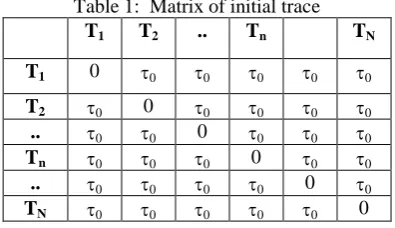
Each operation is noted by OiPjMk, where i, j and k represent respectively the operation number, product number and the machine number. We define the matrix of initial trace in the following way.
j= 1,…,J where J represents the products count.
i= 1,...,Ij where Ij represents the count of the operations in the product j. k= 1,...,K where K represents the machines count.
n= 1,...,N et
J jj
I
N
1
where N represents the tasks count. (Equation 1)
n1, n2= 0 if n1≠ n2 (Equation 2)
n1, n2= 0 if n1 = n2 (Equation 3)
n1, n2 represents the trace between the task Tn1 and the task Tn2.
N
n
1
1
and1
n
2
N
.Table 1: Matrix of initial trace
T1 T2 .. Tn TN
T1 0 0 0 0 0 0
T2 0 0 0 0 0 0 .. 0 0 0 0 0 0
Tn 0 0 0 0 0 0 .. 0 0 0 0 0 0 TN 0 0 0 0 0 0
After each cycle, a local trace is added for all the arcs followed by each ant. This modification is translated on the matrix of trace by the following rule:
n1, n2 (t+1) =ρl * n1, n2 (t) + (1- ρl) * n1, n2 (Equation 4)
n1, n2 = 0. (Equation 5)
ρl: constant which represents the local persistence of trace.
At the end of each cycle, the ant having the best quality of solution updates the trace matrix of pheromone according to the found solution. This best way is updated by a total trace according to the rule:
n1, n2 (t+1) =ρg * n1, n2 (t)+(1- ρg) * n1, n2 (Equation 6)
n1, n2 = Cmax (Equation 7)
Cmax: is the delivery date of the last operation.
ρg: constant which represents the global persistence of trace. The choice of the task Tn2 after the task Tn1 is according to Φn1, n2
Φn1, n2= (n1, n2α*η n1, n2β) is maximum. (Equation 8)
The visibility was calculated by the rule:
1 2
..1 2 ,
1 n n
N n
n n
n
(Equation 9)Ωn and N represent respectively the execution time of the task Tn and the total number of tasks.
In order to converge towards the results and to find the optimal result in a reduced computing time, we add another matrix called “Selection matrix” constituted by 1 or 0.
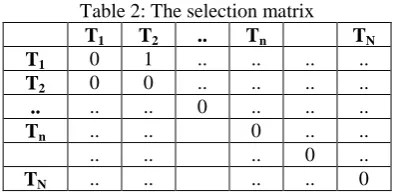
S (T n1, T n2) = 1 if we can pass from the task T n1 to the task T n2. S (T n1, T n2) = 0 if we can’t pass from the task T n1 to the task T n2. And this matrix changes as the ant moves.
Table 2: The selection matrix
T1 T2 .. Tn TN
T1 0 1 .. .. .. ..
T2 0 0 .. .. .. ..
.. .. .. 0 .. .. ..
Tn .. .. 0 .. ..
.. .. .. 0 ..
TN .. .. .. .. 0
To avoid the repetition of the selections, all the selected operations are recorded in a list to ensuring that an ant will not remain in the same operation.
Each ant m (
1
m
M
) must visit in its course all the N tasks.Table 3: The history of the ants
Position\ Ants A1 A2 .. Am .. AM
Position 1 T1,1 T2,1 Tm ,1 TM,1
Position 2 T1,2 T2,2 Tm,2 TM,2
.. .. .. .. ..
Position n T1,n T2,n Tm,n TM,n
.. .. .. .. ..
Position N T1,N T2,N Tm,N TM,N
With Tm,n : The nth task visited by the mth ant.
III.
PROBLEM
DESCRIPTION
3.1. Problem definition
The work consist to schedule J products {P1 .. PJ} having a different passage orders with K machines. Each product Pj (j: 1..J ) is composed by some operations OIj. Each operation is noted by OiPjMk where i, j and k represent respectively the operation number, the product number and the machine number. The execution time of each operation i of the product j is noted Ω i,j.
Table 4: Scheduling Problems
Product Task Machine The execution time
P1 O1 M1 Ω1,1
P1 O2 M2 Ω1,2
P1 O3 M3 Ω1,3
P2 O1 M1 Ω2,1
P2 O2 M2 Ω2,2
P2 O3 M3 Ω2,3
P3 O1 M1 Ω3,1
P3 O2 M2 Ω3,2
P3 O3 M3 Ω3,3
3.2. Constraints of problems
In the calculation program, each machine must have a history on the whole of the tasks affected with the beginning date (Db) and the finished date (Df) of each task.
Table 5: History of assignment
TASK\ MACH M1 .. Mk .. MK
N° TASK Db Df Db Df Db Df Db Df Db Df
1 2 .. TN
IV.
APPLICATION
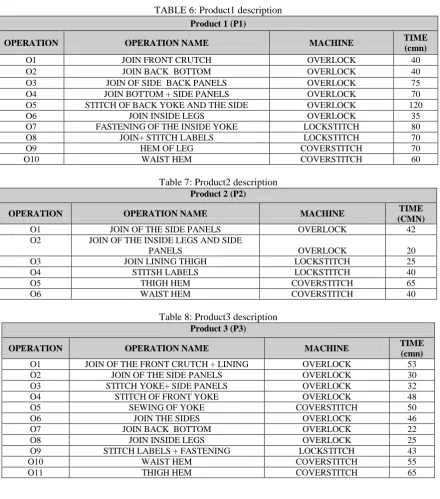
This example was took from one company specialized in the manufacturing of the knitted clothes pull-over for a little quantity. In fact, we make the scheduling of three products which the execution time of each operation is presented in the following tables (The unit of the time is cmn where cmn=1 minute/100).
TABLE 6: Product1 description
Product 1 (P1)
OPERATION OPERATION NAME MACHINE TIME
(cmn)
O1 JOIN FRONT CRUTCH OVERLOCK 40
O2 JOIN BACK BOTTOM OVERLOCK 40
O3 JOIN OF SIDE BACK PANELS OVERLOCK 75
O4 JOIN BOTTOM + SIDE PANELS OVERLOCK 70
O5 STITCH OF BACK YOKE AND THE SIDE OVERLOCK 120
O6 JOIN INSIDE LEGS OVERLOCK 35
O7 FASTENING OF THE INSIDE YOKE LOCKSTITCH 80
O8 JOIN+ STITCH LABELS LOCKSTITCH 70
O9 HEM OF LEG COVERSTITCH 70
O10 WAIST HEM COVERSTITCH 60
Table 7: Product2 description
Product 2 (P2)
OPERATION OPERATION NAME MACHINE TIME
(CMN)
O1 JOIN OF THE SIDE PANELS OVERLOCK 42
O2 JOIN OF THE INSIDE LEGS AND SIDE
PANELS OVERLOCK 20
O3 JOIN LINING THIGH LOCKSTITCH 25
O4 STITSH LABELS LOCKSTITCH 40
O5 THIGH HEM COVERSTITCH 65
O6 WAIST HEM COVERSTITCH 40
Table 8: Product3 description
Product 3 (P3)
OPERATION OPERATION NAME MACHINE TIME
(cmn)
O1 JOIN OF THE FRONT CRUTCH + LINING OVERLOCK 53
O2 JOIN OF THE SIDE PANELS OVERLOCK 30
O3 STITCH YOKE+ SIDE PANELS OVERLOCK 32
O4 STITCH OF FRONT YOKE OVERLOCK 48
O5 SEWING OF YOKE COVERSTITCH 50
O6 JOIN THE SIDES OVERLOCK 46
O7 JOIN BACK BOTTOM OVERLOCK 22
O8 JOIN INSIDE LEGS OVERLOCK 25
O9 STITCH LABELS + FASTENING LOCKSTITCH 43
O10 WAIST HEM COVERSTITCH 55
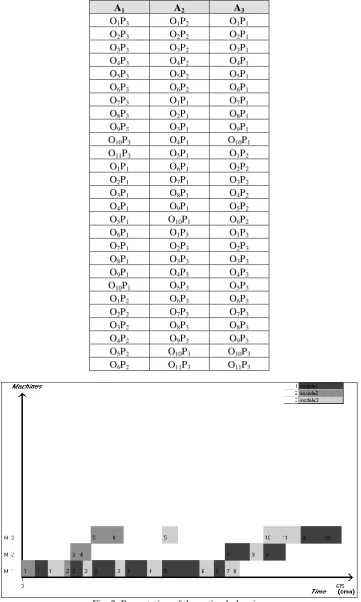
We make a random assignment of the starting operations for the three ants A1, A2 and A3. For example, in this case, we affect O1P1, O1P2 and O1P3 respectively for A3, A2 and A1.
Table 9: Results of the first iteration of three ants
A1 A2 A3
O1P3 O1P2 O1P1
O2P3 O2P2 O2P1
O3P3 O3P2 O3P1
O4P3 O4P2 O4P1
O5P3 O5P2 O5P1
O6P3 O6P2 O6P1
O7P3 O1P1 O7P1
O8P3 O2P1 O8P1
O9P3 O3P1 O9P1
O10P3 O4P1 O10P1
O11P3 O5P1 O1P2
O1P1 O6P1 O2P2
O2P1 O7P1 O3P2
O3P1 O8P1 O4P2
O4P1 O9P1 O5P2
O5P1 O10P1 O6P2
O6P1 O1P3 O1P3
O7P1 O2P3 O2P3
O8P1 O3P3 O3P3
O9P1 O4P3 O4P3
O10P1 O5P3 O5P3
O1P2 O6P3 O6P3
O2P2 O7P3 O7P3
O3P2 O8P3 O8P3
O4P2 O9P3 O9P3
O5P2 O10P3 O10P3
O6P2 O11P3 O11P3
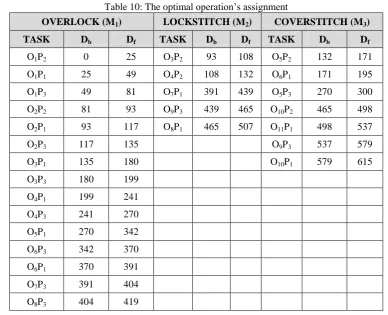
Table 10: The optimal operation’s assignment
OVERLOCK (M1) LOCKSTITCH (M2) COVERSTITCH (M3)
TASK Db Df TASK Db Df TASK Db Df
O1P2 0 25 O3P2 93 108 O5P2 132 171
O1P1 25 49 O4P2 108 132 O6P1 171 195
O1P3 49 81 O7P1 391 439 O5P3 270 300
O2P2 81 93 O9P3 439 465 O10P2 465 498
O2P1 93 117 O8P1 465 507 O11P1 498 537
O2P3 117 135 O9P3 537 579
O3P1 135 180 O10P1 579 615
O3P3 180 199
O4P1 199 241
O4P3 241 270
O5P1 270 342
O6P3 342 370
O6P1 370 391
O7P3 391 404
O8P3 404 419
After many cycles, we find that the optimal result is 615. In this application, the algorithm of ants colonies is characterized by:
- Number of cycles =10.
- Number of ants =3.
- The coefficient ρl=0.8. - The coefficient ρg =0.9.
V.
INTERPRETATIONS
AND
CHARACTERISTICS
The heuristic have many advantages but also a certain number of limitations. We summarize below the various characteristics of these methods:
- General information and possible application to a broad class of problems. - Effectiveness for many problems.
- Possibility of compromise between quality of the solutions and computing time. - Need for adjustment of the parameters.
- Difficulty in envisaging the performance.
VI.
CONCLUSION
The flow-shop scheduling problems optimization is very difficult especially in the case of textile industry clothing which is characterized by the presence of several constraints and the enormous size of the data (The real size of problem). To lead to optimal results, it is necessary to pass by the optimization of the ants algorithm data of colonies (cycles number, ants number, coefficients of the visibility matrices and trace).
REFERENCES
[1]: Gagné, C., Gravel, M. and Price, W. L. (2001), “ Optimisation par colonie de fourmis pour un problème d’ordonnancement industriel avec temps de réglages dépendants de la séquence ”, 3rd Francophone Conference of modeling and simulation, " Design, Analyze and Management of industrial Systems " MOSIM' 01 – Troyes (France).
[3]: Hajri, S., Liouane, N., Hammadi, S. and Borne, P. (2000), “A controlled genetic algorithm by fuzzy logic and belief functions for job-shop scheduling”, IEEE Transactions on Systems, Man, and Cybernetics, Vol. 30, Number 5, pp. 812-818.
[4]: Croce, F., Tadei, R. and Volta, G., (1995), “A Genetic Algorithm for the Job Shop Problem”, Computers and Operations Research, Vol. 22(1), pp. 15-24.
[5]: Cheng, R., Gen, M. and Tsujimura, Y. (1999). “A tutorial survey of job-shop scheduling problems using genetic algorithms, part II: hybrid genetic search strategies”, Computers & Industrial Engineering, Vol. 36, pp. 343-364.
[6]: Sevaux, M. and Thomin, P. (2001), “Recherche taboue améliorée pour l’ordonnancement sur machines parallèles”, 3 rd Francophone Conference of modeling and simulation, " Design, Analyze and Management of industrial Systems " MOSIM' 01 – Troyes (France).
[7]: Vignier, A., Goeuriot, P., Fouchereau, L. and Proust, C. (1997), “ Vers un outil générique de résolution des problèmes d'ordonnancement de type flow-shop hybride”, second international Franco-québécois conference of industrial engineering - ALBI.
[8]: Gonçalves, J. F., Mendes, J. J. and Resende, M. G. C. (2002), “A Hybrid Genetic Algorithm for the Job Shop Scheduling Problem”, AT&T Labs Research Technical Report TD-5EAL6J, September 2002.