Cooperative Enhancement Based Approach to
DSR using Genetic Algorithm
Er. Renu Er. Tarun Kumar
M. Tech Student Assistant Professor
Department of Computer Science & Engineering Department of Computer Science & Engineering
GIMT, Kanipla GIMT, Kanipla
Abstract
Maintaining the message continuity in a Mobile Ad Hoc network is the primary motive of a routing protocol designed to provide higher throughput. This paper provides the information about the new routing protocol proposed to provide continuity in the data packets and avoid resending of data packets from the source. Genetic Algorithm learns about new routes through the different process known as selection, crossover and mutation. This algorithm gives an alternative routing path for greater throughput and higher network efficiency.
Keywords: GA, MANET, Intelligent Routing, DSR
________________________________________________________________________________________________________
I.
INTRODUCTION
Performance has become a primary concern in order to provide protected communication in Wireless as well as wired environment. In recent years mobile ad hoc networks (MANETs) have received tremendous attention because of their self-configuration and self-maintenance capabilities. While early research effort assumed a friendly and cooperative environment and focused on problems such as wireless channel access and multi-hop routing, performance has become a primary concern in order to provide protected communication between nodes in a potentially hostile environment [4]. Although performance has long been an active research topic in wire line networks, the unique characteristics of MANETs present a new set of nontrivial challenges to performance design. These challenges include open network architecture, shared wireless medium, stringent resource constraints and highly dynamic network topology [6].
II.
RELATED WORK
III.
PROBLEM FORMULATION
Ad hoc network routing protocols are challenging to design, and secure ones are even more so. Wired network routing protocols such as BGP do not handle well the type of rapid node mobility and network topology changes that occur in ad hoc networks; such protocols also have high communication overhead because they send periodic routing messages even when the network is not changing. So far, researchers in ad hoc networking have generally studied the routing problem in a non-adversarial network setting, assuming a trusted environment; relatively little research has been done in a more realistic setting in which an adversary may attempt to disrupt the communication [8]. The characteristics of an ad hoc network demand new metrics for routing. Traditionally, distance (measured in hops) is used as the metric in most ad hoc route-discovery algorithms (e.g.,AODV, DSR , TORA etc.). The use of other metrics (e.g., geographic location , signal stability etc.) can improve the quality and the relevance of the routes discovered for particular applications and configurations [9]. Dynamic Source Routing (DSR) as a standard routing protocol in MANET has a simple and efficient routing algorithm. DSR finds a path by sending a Route Request packet and save the hop IPs during route request flooding. There is no doubt that DSR does not consider on QoS and the first found path will be used as packets route [1].
IV.
OBJECTIVES
The main objective of proposed protocol is the increase in protocol’s basic functionality to deliver data bits from one node to another. In other words, it seeks to improve the network connectivity between mobile nodes over potentially multihop wireless channels, which is the basis to support any network services. Multihop connectivity is provided in MANETs through two steps:
1) Ensuring one-hop connectivity through link-layer protocols (e.g., wireless medium access control, MAC); and 2) Extending connectivity to multiple hops through network layer routing and data forwarding protocols (e.g., ad hoc
routing).
So, the main objectives can be summarized as:
Inclusion of cooperative enforcement in to DSR routing Inclusion of Genetic algorithm into routing protocol. Increase in network efficiency
V.
METHODOLOGY
Proposed DSR is a DSR optimized routing protocol for Mobile Ad hoc Networks which uses Genetic algorithms to improve routing parameters. This optimized protocol sends and Route Request packet to find destination, same as standard DSR, when the source node doesn’t have route to the destination node. The difference is that this optimized protocol saves each link’s cost beside the IP addresses.When the destination node receives a RREQ packet, it saves received RREQ in its cache until the end of Route Request TTL. During this time, the destination node will save all other RREQs from same source node with same Route Request ID.When the Route Request TTL has been finished, the destination node adds all received RREQs in Genetic Algorithm and finds the two best routes from source node to destination node. At last the destination node creates a Route Reply packet, adds these two routes in it and sends the RREP packet for the source node.
VI.
RESULTS
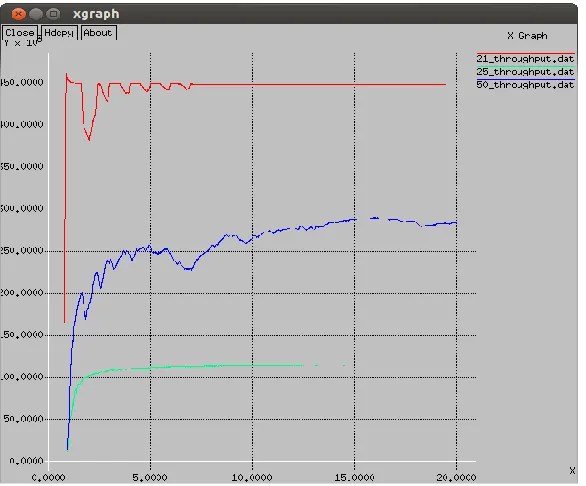
We compared the results of these simulations to understand the network and node behaviors. The results of the simulation show that the packet loss in the network with increasing the number of nodes increases beyond that dropped by the node. This is due to increased congestion in the routes towards the node. Mobile Ad hoc networks may also experience packet loss due to parameters employed. In our five simulations of network, we noticed that the variation of data loss due to network parameters such as the distribution of the nodes changed.
Throughput: A.
Fig. 1: Throughput Comparison of Three Different Networks for GADSR
Packet Delivery Ratio (PDR): B.
This is the ratio of total number of packets successfully received by the destination nodes to the number of packets sent by the source nodes throughout the simulation. It also describes the loss rate that of the packets, which in turn affects the maximum throughput that the network can support.
PDR= (Packets Received / Packets Sent)
Fig. 2: Packet Delivery Ratio Comparison for Three Different Networks under GADSR
Average End-to-End Delay (AED): C.
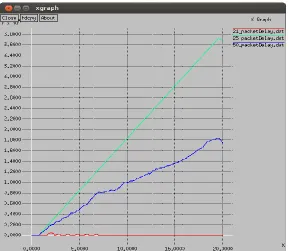
This is defined as the Average End to End Delay in transmission of a packet between two nodes and a higher value of end-to-end delay means that the network is congested and hence the routing protocol does not perform well Average end-to-end delay (AED) is calculated as follows:
Fig. 3: End– To –End Delay Comparison for Three Networks under GADSR
Packet Drop Ratio: D.
It is the ratio of the number of packet sent and the number of packets which are not received to the destinations.
Fig. 4: Packet Drop Comparison for Three Networks under GADSR
Table - 1 Parameters Summary
Parameters 21 Node Scenario 25 Node Scenario 50 Node Scenario Packeet Drop 0.26*103 3.7*103 4.6*103 Packet delivery Ratio 0.98 0.587 0.248
VII.
CONCLUSION
G.A. provides the dynamic behavior in case the network route changes . As this change in path occurs the G.A. tries to find out the optimal path for the network to have high data flow in the network. For this at the time of choosing the optimal path and evaluating them , an increase in packet delay and the drop is observed but after this process of route updation and optimization is completed the network performs better than the convential DSR protocol.The proposed changes in the DSR make it more efficient and the packet drop is reduced to a large extent. The approach searches for the convenient path that can be followed continuously as it progresses through. The three scenarios are analyzed in results. The scenarios are constituted by 21 nodes, 25 nodes and 50 nodes as the no. of nodes increases or decreases in the network the routing path options available for the source to destination increases or decreases as a result the performance of the network is affected. With this affect the changes which are proposed initially in the proposed work, are clearly relevant.
REFERENCES
[1] Sara Aliabadi and Mehdi Agha Saram, AN APPROACH TO DSR ROUTING QOS BY FUZZY-GENETIC ALGORITHMS, International Journal of Wireless & Mobile Networks (IJWMN) Vol. 6, No. 2, April 2014
[2] Anurag Porwal1, B.L.Pal, Rohit Maheshwari, Gaurav Kakhani, “Study and Design of New Reactive Routing Protocol Advance AODV for Mobile Ad hoc Networks” International Journal of Engineering Research and Applications (IJERA), Volume 2, Issue 3, May-Jun 2012.
[3] C. Siva Ram Murthy and B. S. Manoj, Ad hoc Wireless Networks: Architectures and Protocols, Prentice Hall PTR, May 2004.
[4] Dr.S.S.Dhenakaran, A.Parvathavarthini, “An Overview of Routing Protocols in Mobile Ad-Hoc Network” International Journal of Advanced Research in Computer Science and Software Engineering, Volume 3, Issue 2, February 2013.
[5] Er.Punardeep Singh, Er.Harpal Kaur, Er. Satinder Pal Ahuja, “Brief Description of Routing Protocols in MANETS And Performance And Analysis (AODV, AOMDV, TORA)” International Journal of Advanced Research in Computer Science and Software Engineering, Volume 2, Issue 1, January 2012.
[6] G.L. Saini, Dr. Deepak Dembla, “Modeling, Implementation and Performance Evaluation of E-AODV Routing Protocol in MANETs” International Journal of Advanced Research in Computer Science and Software Engineering, Volume 3, Issue 7, July 2013.
[7] Aarti, Dr. S. S. Tyagi, “Study of MANET: Characteristics, Challenges, Application and Security Attacks” Interntional Journal of Advanced Research in Computer Science and Software Engineering, Volume 3, Issue 5, May 2013.
[8] Y.C. Hu, A. Perrig and D.B. Johnson, “Ariadne: A secure on-demand routing protocol for wireless ad hoc networks”, Proceedings of the 8th Annual International Conference on Mobile Computing and Networking (MobiCom 2002) (September 2002) pp. 12–23.
[9] Yi, S, Naldurg, P., & Kravets, R. (2001), “Security-Aware Ad hoc Routing for Wireless Networks”, Second ACM Symposium on Mobile Ad Hoc Networking & Computing (MobiHoc'01), 2001.