ISSN (e): 2250-3021, ISSN (p): 2278-8719
Vol. 05, Issue 02 (February. 2015), ||V3|| PP 18-27
Study on energy efficiency in the rehabilitation of buildings
José Cunha* and José Coimbra
Department of Civil Engineering,School of Engineering, University Fernando Pessoa, Praça 9 de Abril, Porto 4249-004, Portugal
Author to whom correspondence should be Tel.: + 351-258-948-405;
Abstract: The existing housing stock is, at the moment, one of the major elements responsible for the environmental degradation.Nowadays, due to the depletion of natural resources, the efficiency levels of housing buildings is unsustainable, so that the levels of environmental comfort can be considered as satisfactory.It thus becomes necessary to discover which exact problems the existing housing stocks have, so that one may be able to contribute to their resolution.Therefore, if one possesses the knowledge of the main issues regarding the housing buildings’ energy efficiency and their origin, one may be able to adapt the traditional rehabilitation process to the concept of sustainable energy rehabilitation; consequently, it would be possible the existence of high-efficiency energy rehabilitated buildings, with a lower consumption of natural resources.
Keywords: energy-efficient rehabilitation; energy efficiency;controlled costs
I. INTRODUCTION
Over the past ten years, the construction sector has been faced with the apotheosis of concrete. The increase of environmental impact caused, in part, by the excesses of this new construction type, which uses much of the natural resources,can be controlled in a way where engineering plays a key role.
The most serious problem facing Earth is related to the depletion of natural resources and the increase in average air temperature. This boost in average air temperature is connected to the raise of CO2 concentration levels,leading to environmental consequences such as rising sea levels,increasing occurrence of severe weather events, and growing desertification worldwide.
CO2 concentration levels have been increasing due to energy production through the burning of fossil fuels.
Since the construction sectorconsumes much of the produced energy, it becomes urgent to findsolutions that mitigate and allow the rational and sustainable use of this energy.
Much of this energy consumption is due to the provision of comfort and well-being to its inhabitants, namely consumption with indoor heating, water heating, consumption systems and facilities, lighting and water consumption.
In the last few decades, housing dynamics in Portugalhave exceeded the number of families by far, leading to an excessive supply of houses. Currently, the Portuguese housing stock needs some major repairs and rehabilitation. This rehabilitation of buildings is one of the most important actions in order to achieve sustainability in the construction sector.
Therefore, it seems only appropriate to try and understand how is it possible to modernize buildings, keeping in sight their energy efficiency.
So that a proper conclusion about this issue may be determined, it was decided to carry out a study whosemain goal consists on measuring the average costs of living in a rehabilitated house with energy-efficient solutions, equipped with space heating and domestic hot water, or living in a traditional house. Thus, it may be possible to compare these different costs with their respective construction cost, keeping in mind the difference caused by introducing sustainable solutions.
By comparing the rehabilitation of a house equipped with energy-efficient solutions and a traditional house, it is possible to calculate how much time would be necessary for the payback of the initial investment.
II. CHALLENGES OF ENERGYEFFICIENCY IN BUILDING REHABILITATION
2.1. The Issue of Research
Since the construction industry uses much of the planet’s natural resources,it is mandatoryto promote policies that make possible the usage of renewable resources over non-renewable ones, as well as energy saving and the CO2reduction of emissions into the atmosphere.
An energy-efficient rehabilitation of buildings conveys the idea that it involves excessive costs, with avery limited choice of solutions. However, some techniques and some new knowledge allowing a deeper understanding about these very same techniques linked to this sort of rehabilitation and its costs are now being developed.
Based on these factors and the knowledge of the economic benefits, energy-efficient rehabilitation of buildings shows potential for:
Middle-aged people who want to return to the city, favoring high quality standards;
People who are unable to pay excessive energy consumption due to the poor energyefficiency of their buildings; The building systems with high energyefficiency andsome equipment are aimed to a reduction the costs associated with natural gas consumption, electricity and water.
This study intends to verify the difference between energy costs using a methodology case study. This analysis will be performed and quantified using data from case study projects, and aspects, such as the problematic of saving electricity and natural gas, will be analyzed.
The results will be analyzed, consideringthe implementation of solutions for energy-efficient rehabilitation, taking the operational costs into account.
2.2. Study of energy efficiency in the rehabilitation of buildings
So that it is possible to quantify and compare monthly savings, as far as costs reduction in energy consumption (electricity and natural gas) and vital resources (drinking water) is concerned, between energy sustainable buildings andbuildings with traditional features, a study is presentedcomparing a traditional house with the very same house, but rehabilitated in order to improve it in an energy efficiency point of view. These houses are located in the city of Porto, most specifically in Paranhos.
The traditional house was built accordingly to the building systems and normal characteristics at the time. It was then rehabilitated using up-to-date principles of energy efficiency.
The following studies show the energy efficiency of these houses, their energy demand and their costs.
2.2.1. Description of Campo Lindo’s housing, Porto
The rehabilitated house is a residential house located in the city of Porto, parish of Paranhos, and, as far as its typology is concerned, it is a T9. It is located in the parish’s inner urban zone at an altitude of 125m and its distance to coast is about 6 km. The house has a basement, a ground floor and an upper floor. The façades area, without glazing, is 92.95 m2 (79% of all enclosed area) and the glazed area is about 24.42 m2 (21%). It possesses an average thermal inertia, with thermal insulation on all exterior walls, walls in contact with non-heated areas, roofs and floors. The interior space heating is conducted through a natural gas boiler and it does not have any cooling system. Ventilation takes place naturally and the domestic hot water is heated using a wall gas boiler and some solar collectors.
2.2.2. Description of the traditional housing, Porto
The construction of the traditional housing assumes similar characteristics to the existing traditional buildings in the city of Porto, from the same era, such as façades coated with dark green tile, windows and doors painted with dark color, granite sills and wood cornices.
The house’s geometric characteristics are the same as those of the rehabilitated housing, since it is the same house and no changes were made.
Has an average thermal inertia, it does not have any insulation what-so-ever and it has no heating nor cooling system. The water is heated by an electric heater of about 25 years old and has no solar collectors.
2.2.3. Description of the Housing Envelope and Mechanical Systems
Table 1. Description of the housing envelope and equipment—Campo Lindo’s Housing
Envelope/Equipment Description Thermal
transmittance/efficiency
Façades 1 Single-wall masonry granite with 28 cm
thick plaster and a layer of
waterproofing 2 cm, thermal insulation with 3 cm of PUR, 1.5 cm gypsum plasterboards and 1.5 cm plates.
0.86W/m2·°C
Façades 2 Single wall of reinforced concrete 15
cm, mortar and plaster on one side with 2 cm, 3 cm of polystyrene XPS and plasterboards with 1.5 cm.
0,90 W/m2·°C
Façades 3 Mortar and grout sealing with 1.5 cm, 6
cm of polystyrene EPS, plate 1.2 cm, 3 cm of polystyrene XPS and double plasterboard with 1.3 cm.
0,38 W/m2·°C
Façades 4 Dual Wall with 28 cm granite, concrete
wall, 15 cm, 3 cm XPS polystyrene and plasterboard 1.5 cm plates.
0,83 W/m2·°C
Inner walls* Simple plasterboard wall with 1.5 cm
and 4 cm of rockwool.
0.72W/m2·°C
Exterior pavement Floating floors with 1.2 cm,
polyethylene film to 0.3 cm, dual card plasterboard 1.2 cm, 0.5 cm acoustic blanket, ceiling air tight with 4 cm box, 6 of rockwool and plasterboards to 1.3 cm.
0.43 W/m2·°C
Interior pavement** Floating wood floors with 1.2 cm,
polyethylene film to 0.3 cm, dual card plasterboard 1.2 cm, 0.5 cm acoustic blanket, ceiling-tight box with a 4-to-air cm, rock wool 6 cm and plasterboards with 1.3 cm.
0.41 W/m2·°C
Covering mat Floating wood floors with 1.2 cm, 0.3
cm polyethylene, double pane "plasterboard 1.2 cm, 0.5 cm acoustic blanket and waterproof false ceiling box with air-4cm.
0.44W/m2·°C
Horizontal roof Cobble layer of 5 cm, double geotextile
polypropylene with 0.3 cm, 6 cm polystyrene XPS screens waterproofing 0.3 cm layer of screed regularization with 3 cm slab lightens the beams and vaulted with ceramic 15 cm lower and finish gypsum plaster designed with 1.5 inches.
0,49 W/m2·°C
Glazing 1 Single glazed wooden window frames,
double glazing, oriented Southwest and Southeast, Class 2 air permeability and indoor protection consists of transparent curtain of light color.
2.50 W/m2·°C
Glazing 2 Single glazed aluminum window frames
with double colorless glass, oriented Southwest and Southeast, Class 2 air permeability and indoor sun protection consists of wooden shutters medium color.
3.00 W/m2·°C
with double colorless glass, oriented northwest, Class 2 air permeability and indoor sun protection consists of wooden shutters medium color.
Glazing 4 Single glazed aluminum window frames
with double colorless glass, oriented to the southwest, Class 2 air permeability and indoor sun protection consists of transparent curtain of light color.
3.30 W/m2·°C
Glazing 5 Single glazed wooden window frames
with double colorless glass, oriented to the southwest, Class 2 air permeability and indoor sun protection shutters made up of light-colored wood.
3.30 W/m2·°C
Glazing 6 Single glazed aluminum window frames
with double colorless glass, oriented northwest, Class 2 air permeability and indoor sun protection consists of transparent curtain of light color.
4.30 W/m2·°C
Ventilation The renovation of the indoor air is by
means of natural ventilation.
Airflow of 52 m³/h
Space heating Radiators with wall gas boiler. Efficiency = 0,909
Domestic Hot Water (DHW) preparation system
Set of three solar collectors "Baxiroca SOL 250" (total absorption area of 7.10 m2), efficiency of 0.814, a1 = 3,640 W / m² / K, a2 = 0,009 W / m² / K, facing south, with slope 35º, indoor heater "Vine Dual VSE" 599 Lts of internal storage with support from a natural gas boiler 'Junkers Euroline ZS23-1AE "with an efficiency of 0.86.
Solar energy of 4,642.00 kWh per year.
*Inner wall means wall separating heated spaces from non-heated spaces; ** Interior pavement means pavement separating heated spaces from non-heated spaces; XPS—expanded extruded polystyrene;
Table 2. Description of the housing envelope and equipment—Traditional Housing
Envelope/Equipment Description Thermal
transmittance/efficiency
Façades 1 Single-wall masonry granite with 28 cm thick and
two layers of plaster.
3.40W/m2·°C
Horizontal roof Consisting of line and hanger anchors, no insulation,
covered below by plaster lath
2.60W/m2·°C
Glazing 1 Single glazed wooden frames, plain glass, with inner
protection consists of sun protection dark inside.
4.3W/m2·°C
Ventilation The renovation of the indoor air is by means of
natural ventilation.
Airflow of120 m³/h
Space heating Fireplace installed in the room Efficiency = 1
DHW preparation system
Electric water heater with a capacity of 200Lts Efficiency = 0.85
Depending on the construction system, Tables 1 and 2 show its heat transfer (W/m2·°C). Energy efficiency of heating systems and indoor air solar collectors (kWh) for heating domestic hot water is also presented.
The heat transfer values listed in Tables 1 and 2 were calculated based on the thermal conductivity and resistance of the aforementioned materials.
2.2.4. Description of the Energy Performance of dwellings
In order to assess and describe the energy performance of these two cases, a study was conducted in order to determine the energy requirements of each case (room heating, space cooling and hot water).
The energy needs of the traditional housing were assigned based on its energy certificate, being these data referred to as standard values, while the energy needs of Campo Lindo’s housing were calculated using several parameters which fulfill the purpose of improving its energy efficiency, for instance as in the case of the deployment of solar panels.
Chart 1. Average annual needs for heating (Nic), cooling (Nvc) and DHW(Nac)
The items presented in Chart 1 have the following meaning:
Nic: Average annual heating needs of electricity to keep the house at 20 °C during the winter season (kWh/m2·year), per dwelling, for the total dwellings of the building;
Nvc: Average annual cooling needs of electricity to keep the house at 25 °C during the summer (kWh/m2·year), per dwelling, for the total dwellings of the building;
Nac: Average annual DHW energy needs to ensure a daily consumption of 40 liters of hot water per capita in the dwelling, in kWh/m2.year (T9 = 10 inhabitants).
Based on the data presented in Chart 1, we are able to conclude that Campo Lindo’s housing is prepared to spend 32% less energy for space heating, 11% for space cooling and 97% less energy for DHW per m2.
Given that both houses possess a floor area of approximately 130.64 m2, the annual needs of heating, cooling and hot water are presented in Table 3.
Table 3. Annual energy needs for the average dwelling
Building Average
floor area(m²)
Annual heating needs (kWh.year)
Annual cooling needs
(kWh.year)
Annual DHW needs(kWh.y
ear)
Traditional Housing 130,64 9,406 431,11 5,487
Campo Lindo’s housing
130,64 6,401 483,37 0,164
These results show that Campo Lindo’s housing can spend about three times less energy for space heating and about five times less energy for hot water than traditional housing.
The values of Nic, Nac and Nvc aforementioned in Chart 1 are quantified based onthe Portuguese regulations.
The following tables show, for each house, the values of annual energy needs as well as the maximum allowed values.
In order to calculate the CO2 emissions and the housing energy efficiency is made a link between the values of Ntc and Nt.
72
3.3
42 49
3.7 1.26
0 10 20 30 40 50 60 70 80
Nic Nvc Nac
K
W
h/
m
2
.y
e
a
r
Average annual needs for heating cooling and DHW per m2
Traditional housing
The classification of the energy class of each dwelling is performed by relating the value of the annual consumption of primary energy, with the maximum value of energy consumption per year, as it follows:
0.00<Ntc/Nt ≤ 0.25: “A +” Class; 0.25<Ntc/Nt ≤ 0.50: “A” Class; 0.50<Ntc/Nt ≤ 0.75: “B” Class; 0.75<Ntc/Nt ≤ 1.00: “B-“ Class;1.00<Ntc/Nt ≤ 1.50: “C” Class; 1.50<Ntc/Nt ≤ 2.00: “D” Class; 2.00 < Ntc/Nt ≤ 2.50:“E” Class; 2.50<Ntc/Nt ≤ 3.00: “F” Class; Ntc/Nt>3,00: G Class;
In which:
Ntc: Annual primary energy consumption, in kilogram(s) of oil equivalent (kgoe); Nt: Maximum allowable values of annual primary energy consumption (kgoe).
So, a comparison of values of CO2emissions from both housesis presented in Chart 2.Thus, analyzing this very same Chart,it is possible to verify that CO2 emissions of the traditional housing are about 35% higher compared to CO2 emissions from Campo Lindo’s housing.
Chart 2. Average CO2 annual emissions
According to the calculations related to energy needs for space heating, space cooling and hot water for each house, one may be able to present the values for annual global energy needs.
The obtained data are presented in Table 4, for the house of Campo Lindo and for the traditional house,and disclose themajor importance of some issues, such as the installation of thermal insulation, heating systems, solar collectors and high-efficiency gas boilers.
Table 4. Global annual energy needs
Building Heating needs in
winterkWh/year
Cooling needs in summerkWh/year
DHW needs kWh/year
Traditional housing 231,840 10,626 135,240
Campo Lindo’s housing 157,780 11,914 4,08
According to the table above, it is possible to conclude that the thermal insulation used in Campo Lindo’s housing is responsible for an energy reduction of 32% for space heating, during the winter season,as the wall gas boiler and the solar collectors are responsible for an energy reductionof 97% in hot water.
2.2.5. Energy Costs for Heating, Cooling and DHW
In order to determine each type of energy demands, based on the presented data in Chart 1, there were calculated annual costs (in Euros) for the traditional housing as well as to Campo Lindo’s housing, as it can be observed in Table 5.
The values of annual energy costs for heating, cooling and DHW were obtained by taking the prices for electricity and natural gas into account, at the time of the case study - September 2014 (0.20€/kWh of electricity and 0.12€/KWh of natural gas).
1.5
2.32
0 0.5 1 1.5 2 2.5
Campo Lindo housing Traditional housing
Average annual emissions of CO2
per dwelling
Table 5. Average expectable energy costs per dwelling
Building Average floor
area(m²)
Annual cost for heating(Euros)
Annual cost for cooling(Euros)
Annual cost for DWH(Euros)
Traditional housing 130,64 1881,23 86,22 658,43
Campo Lindo’s housing 130,64 1289,27 86,22 19,68
To determine the total amount of spent energy for both houses, estimated annual costs for heating, cooling and DHW are added. Therefore, it is possible to conclude that the total amount ofspent energy in heating, cooling and hot water for the traditional house is 2,625.88€ and for Campo Lindo’s house is 1,395.17€.
These costs are based on a maintained level of comfort which sets a comfort temperature of 20ºC during winter season, 25ºC during the summer season and a hot water consumption of 40 Liters per capita.
However, since these are the costs involved for this comfort level, it is possible to determine the actual energy cost for heating and hot water through a process of monitoring consumptions, as revealed in section 2.4. 2.3. Analysis of theEfficiency Studies Results
In order to analyze the differences in energy needs between traditional housing and Campo Lindo’s housing it is important to take into account the following aspects:
Campo Lindo’s housing presents, as far as the annual energy needs per m2
of floor are concerned, a cost of 53.1% less than the traditional housing (10.68€against20.10€). This gap between both houses shows that, when compared with the traditional housing, Campo Lindo’s housing allows an annual saving of 1,230.71€, equivalent to an average monthly saving of 102.56€.
The estimated annual energy demand for heating water, per capita, in the house of Campo Lindo, is 97% smaller than in the traditional housing (19.68€ to 658.43€). This gap reveals that the option of choosing more energy-efficient equipments, such as boilers with higher performances and the installation of solar collectors, allows energy savings that will, eventually, result into savings over the building’s lifetime. This disparity in energy costs translates into annual savings of about 638.75€, the equivalent to 53.23€ per month.
Table 6. Description of energy demands costs
Energy needs and costs Un Traditional Campo Lindo
Global energy needs kWh.year 15,324.11 6,884.53
Energy needs per m² of floor area kWh/m².year 117.30 52.70
Annual energy costs per building € 2,451.86 1101.52
Annual energy costs per m² of floor area €/m² 18.77 8.43
Annual energy cost for water heating per capita
€/person 65,84 1.97
Considering the calculations of global energy needs for space heating, space cooling and hot water for each house, it is possible to present the solar gains for each dwelling.
Table 7. Global annual energy needs and solar gains
Building Solar gains in
winterkWh/y ear
Heating needs kWh/ye
ar
Solar gains in summerkWh/
year
Cooling needs kWh/ye
ar
Solar gains in collectorskWh/
year
DHW needskWh/y
ear
Traditio nal housing
127,099 231,840 12,219 10,626 191,142 135,240
Campo Lindo’s housing
86,498 157,780 17,430 11,914 Not available 119,14
2.4. Monitoring Procedure of Costs in Energy in Housing
Both houses were monitored for a full year, with the aim of recording the average monthly consumption through monthly readings, as it is presented in Section 2.4.1.
These consumptions (electricity and gas) were recorded for laterstatistically analysis purpose. Moreover, this data collectionaimed to the actual averagecalculation of energy consumptions of both houses for space heating and domestic hot water. The correspondent results are presented in Table 8, expressed in kWh/m2.year.
As far as the cooling consumptions are concerned, they are not mentioned in Table 8 because there is notan actual cooling device in either house.
2.4.1. RealHeating and DWH Energy Consumptions in Housing
Asshowed in Table 8, the actual electricity consumption per square meter for indoor heating is lower in Campo Lindo’s housing compared to the traditional housing, as verified in the calculation ofthe estimated energy needs for each one.
This gap exists because the house of Campo Lindo has major differences asfar as thermal insulation is concerned, triggering a smaller investment in energy with heating purposes by the residents, as opposed to the traditional housing. So that the traditional housing is able to provide the same level of comfort, the residents need to use more energy.
On the other hand, as a traditional housing does not possess any solar collectors, residents need three times more energy (per square meter) than the residents of Campo Lindo’s housing, to heat water.
Table 8. Average annual consumptions for heating DHW per m²
Building Annual
consumption for heating (kWh/m².year)
Annual consumption
for
DHW(kWh/m².year)
Total annual consumption for
heating and DHW(kWh/m²·year)
Traditional housing 7,20 3,74 17,94
Campo Lindo’s housing 4,46 1,23 5,69
2.4.2. Heating and DHW Consumption Costs
Taking the data presented in Table 8 into account, there were calculated annual costs (in Euros), per m2, for each type of energy (heating and DHW environment), as presented in Table 9.
These energy costs were obtained based on the energy costs presented in Section 2.2.5. Thus, the results presented in Table 9 were calculated accordingly to the energy price (0.20€ per kWh of electricity; 0.12€ per kWh of natural gas), applied to the consumptions shown in Table 8.
Table 9. Average real energy costs per dwelling
Building Annual cost for
heating(euro/m².year)
Annual cost for DHW(euro/m².year)
Total annual cost for heating and DHW(euro/m²·year)
Traditional housing 1,44 0.75 2,15
Campo Lindo’s housing 0.89 0,25 0,68
Based on the results obtained by monitoring energy consumption in both houses,it is possible to verify that they are much lower than the energy needs presented above.
This situation is due to the fact that the actual level of comfort of the buildings is obtained with lower temperatures than the temperature of 20ºC, in winter season, and higher than 25ºC in summer season (temperature values used as reference for the calculation of the buildings energy needs).
III. PAYBACK PERIOD OF SUSTAINABLE CONSTRUCTION
This study conveys the idea that it is possible to verify and quantify the cost benefits on the rehabilitation of energy-efficient buildings. For instance, a dwelling of 70.0 m2 is expected to spend, on electricity and natural gas, per year, less 916.95 €[(20.10 to 14.97) x 70.0] than a traditionally rehabilitated house, with a similar size. This gap between the costs is due, mainly, to the option for efficient building systems and the implementation of efficient systems as solar panels and boilers with higher performance.
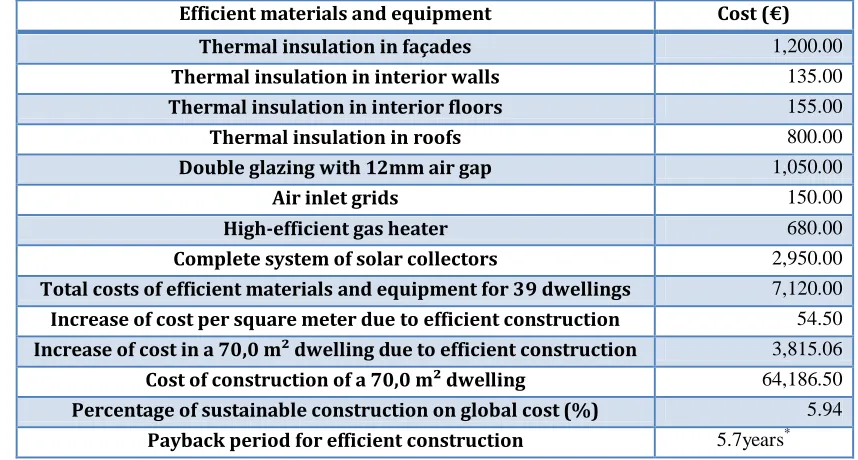
Through the consultation of the technical and financial data for Campo Lindo’s housing design, it is possible to enumerate all materials and equipment used, as well as their respective costs (Table 10). Since these construction systems and equipment were not used in the traditional housing, one can assume that foreseenraises in Table 10 are explained by the implementation of effective rehabilitation energy resources. The increased cost of the materials and equipment for the house of Campo Lindo were calculated in 7120€. Therefore, the cost of energy efficient rehabilitation, in Campo Lindo’s housing, is about 54.50€ per square meter, i.e., in a house with 70.0 m2, it would be spent 54.50€ x 70.0 m2 = 3,815.06€. Assuming that Campo Lindo’s housing spends less 670.18€ (2,625.86€ - 1,955.68€), per year, than the traditional housing, it is estimated that the payback period is about 5.7 years (3,815.00€/ 670.18€).
Table 10.Cost of efficient materials and equipment for Campo Lindo’s project and payback period for energy-efficient rehabilitation with standard comfort energy consumptions.
Efficient materials and equipment Cost (€)
Thermal insulation in façades 1,200.00
Thermal insulation in interior walls 135.00
Thermal insulation in interior floors 155.00
Thermal insulation in roofs 800.00
Double glazing with 12mm air gap 1,050.00
Air inlet grids 150.00
High-efficient gas heater 680.00
Complete system of solar collectors 2,950.00
Total costs of efficient materials and equipment for 39 dwellings 7,120.00
Increase of cost per square meter due to efficient construction 54.50
Increase of cost in a 70,0 m² dwelling due to efficient construction 3,815.06
Cost of construction of a 70,0 m² dwelling 64,186.50
Percentage of sustainable construction on global cost (%) 5.94
Payback period for efficient construction 5.7years*
So that the solution for heating domestic hot water could be considered an efficient one, it needs a shorter payback period. Table 10 shows the total cost of a full set of solar collectors for Campo Lindo’s housing, 2,950€. According to Table 5, section 2.2.5, the average cost, per year, for Campo Lindo’s housing is about 19.68€ and for the traditional housing is about 658.43€. Consequently, one is able to save 638.75€(658.43€ - 19.68€) thanks to the installation of solar collectors and a wall boiler energy-efficient gas. As a result, this savings allow a payback period of about 4.6 years (2,950€/638.75€). These efficient equipment and building systems led to an energy classificationwith the value “A”.
IV. CONCLUSIONS AND RECOMMENDATIONS
The presented results in this study convey a significant and positive impact of an energy-efficient rehabilitation. This positive impact is due to the following factors:
It is considered that the assigned reduction of heat loss, through the constructive elements, by the designers, is generally insufficient and it is recommended an efficient optimization of the indoor and outdoor environment. According to the data presented in Tables 8 to 10, the application of insulation in the opaque surroundings causes only a cost increase of 3.6% over the total cost of construction. Moreover, compared to a traditional house construction,the accomplished heat loss reduction varies from 54% (according to real consumptions) to 62% (according to estimated needs of energy);
house construction, the achieved cost varies from 52% (according to the actual consumption) to 77% (according to estimated needs of energy);
The implementation of building systems and equipment which are energy-efficient, such as the application of thermal insulation on the surroundings and the installation of efficient solar collectors, would achieve a payback period of 5.7 years. However, this return period varies depending on the comfort level adopted by its inhabitants.
This study is able to demonstrate that it is possible to rehabilitate a house using principles of energy efficiency at controlled costs. Thus, it also serves to refute the widespread idea that, in order to achieve a standard of high energy efficiency, it is necessary to incorporate efficient and sophisticated solutions with high costs.
This type of rehabilitation provides only an increase of 54.50€ per square meterover the total cost of traditional rehabilitation. However, despite these positive results, one must continue researching about maintenance quantification,the costs related to these construction techniques, and finally, about these techniques economic impact on the residents in the house during its lifetime.
REFERENCES
[1] AGUIAR, J .et al. (2005) Guidelines to Support Housing Rehabilitation of Buildings. Lisbon LNEC. [2] ALMEIDA, M. (2012). Perspective of Civil Engineering - Energy Rehabilitation of Buildings.
[3] APPLETON, J. (2009). Congress LiderA 09: New opportunities for sustainable construction. Sustainable rehabilitation. Lisbon, Higher Institute Technical.
[4] APPLETON, J.(2003). Rehabilitation of Old Buildings - Pathology and Intervention Technologies. 1st Edition, Orion Editions.
[5] DGGE / IP-3E. Energy Rehabilitation of Environment Residential Buildings. Brochure. Lisbon, Directorate General for Energy and Geology - DGGE / IP-3E, 2004
[6] DGE- Energy Efficiency in Buildings. [online], Directorate General for Energy - Ministry of Economy, 2002. [cited at 2/18/2014] Available at: http://www.adene.pt [Accessed on 02/25/2014]
[7] GONÇALVES, H.; GRAÇA, J.(2004). Bioclimatic concepts for buildings in Portugal. DGGE - General Directorate of Geology and Energy / IP - 3E
[8] ISOLANI, P. et al. (2008). Energy efficiency in residential buildings. Lisbon EnerBuildin.eu [9] LAURIA, A. Sustainability in Construction. Lisbon Verlag Dashofer.
[10] LISBON, J. (2012) Sustainable Construction: Thermal Comfort. available in
http://www.construcaosustentavel.pt/index.php?/O-Livro-%7C%7C-Construcao-Sustentavel/Conceitos/Valorizacao-Ambiental/Conforto-Termico [Accessed on 03/15/2014]
[11] LIVEIRA, P. e BRAGANÇA, L. Urban Rehabilitation: addressing sustainable practices. Guimaraes, University of Minho - Department of Civil Engineering
[12] PAIVA,J.; AGUIAR, J.; PINHO, A. (2006) Technical Guide Housing Rehabilitation. Lisbon LNEC-INH.
[13] PAIVA, J.V.et al. Technical Guide Housing Rehabilitation. Volume 2, INH, LNEC
[14] PINHEIRO, M.D. (2006). Environment and Sustainable Construction. Environment Institute, Amadora.