A Novel Control Algorithm for Maximum Power
Point Tracking of Photovoltaic
Xinsheng He, Chunfu Gao,Bin Wang and Zhiyong Luo
College of Engineering, Zhejiang Normal University, Jinhua,China
Email: {[email protected], [email protected], [email protected], [email protected]}
Abstract—The output power of PV module varies with module temperature, solar insolation and loads. And in order to quickly and accurately track the sun, it is necessary to track the maximum power point (MPP) all the time. After studying various algorithms, a new algorithm was presented in this paper based on online short-circuit current,open-circuit voltage, and variable step of perturbation and observation method. This algorithm could track MPP change rapidly and accurately without the disturbance of photovoltaic system, and also can reduce the power oscillation around MPP and the light mutation of the false judgement phenomenon. A theoretical analysis and the designed principle of the proposed algorithm are described in detail. And some experiment and simulation results are made to demonstrate that the effectiveness of the proposed algorithm and also the proposed could reach MPP which is faster than traditional P&O method about 0.2s. The system has a good dynamic and steady-state performance.
Index Terms—MPPT, short-circuit current, open-circuit voltage, perturbation and observation method, variable step
I. INTRODUCTION
Recently, with the development of economy and advancement of society, the need of energy will have an increasing. Photovoltaic power with the advantage of no pollution, no noise and easy maintaining is particularly predominant among other energy sources. It will convert solar energy directly to electrical energy. However, The output of photovoltaic(PV) has obvious characteristics of non-linear, which is effected by the external environment.In order to make the power output of PV maximize, the output of PV requires the maximum power point tracking(MPPT). There are many techniques that have been proposed for tracking the MPP of PV: open-circuit voltage method, short-open-circuit current method, perturbation and observation(P&O) method, incremental conductance (INC) method, and fuzzy control method[1].
Open-circuit voltage and short-circuit current method offer a simple and low-priced way to acquire the maximum power. Nevertheless, they have a larger steady-state error and low energy conversion efficiency. P&O method is widely applied in the MPPT controller due to its simplicity and easy implementation, but its accuracy is low in steady-state and the P&O method probably failed to track MPP when the insolation is changed rapidly. INC
method has the advantage of fast tracking and dynamic stability, but the steps are difficult to determine. Fuzzy control method does not need to study the specific characteristics of PV, but the shape of membership functions needs more experienced designers[2].
According to the characteristics of PV and various control algorithms, a new MPPT control algorithm was proposed which short-circuit current method was applied at the left of the MPP, variable step of P&O method was used near the MPP, open-circuit voltage method was applied at the right of the MPP. The short circuit current was calculated by on-line in order to avoid interfering with the system caused by the traditional short-circuit current method, which can enable the left point of MPP back to the maximum power soon and thus improve the efficiency of photovoltaic power generation [3,4]. Gradual approximation was used to search step around MPP which can eliminate the slow convergence of traditional P&O method and the phenomenon of oscillation around the MPP. Open circuit voltage method can make the right point of MPP quickly back to the maximum power point.
II. THE MPP TRACKING PRINCIPLE OF PV
Maximum power point tracking is a self-optimizing process. The output maximum power could be intelligently controlled by the PV terminal voltage U, the battery under a variety of sunlight and temperature conditions. Output power of PV are greatly influenced by the external environment, ambient temperature, sunlight intensity, and output voltage. The relationship of PV output current and voltage [5] are:
⎭ ⎬ ⎫ ⎩
⎨
⎧ −
−
= s 0 exp( ) 1 AkT
qU I
I
I (1)
⎥⎦ ⎤ ⎢⎣
⎡
− −
= 0 exp( ) 1
AkT qU U I U I
P s (2)
] 1 [ ] exp[
/ 0 0
AKT qU AKT
qU I
I I dU
dP = s− − ⋅ +
(3)
I,U is output current and voltage of PV cell respectively; Is is short-current under the condition of
25℃ and 1000w/m2; I
PV; T is the temperature of PV; k is Boltzmann’s
constant (k=1.38×10²³J/K); q is electronic
charge(q=1.6×10⁻¹⁹C); A is diode characteristic factors
(T=300K,A is approximately equal to 2.8).
Fig.1 shows the output power characteristics of P-U curve[6]. P-U curve is a single convex curve. When the
cell voltage is less than the maximum power point Umax,
the output power increases with the increasing U; when the operating voltage is greater than the maximum power point voltage Umax, the output power decreases with the
increaseing U.
Figure 1. PV output power characteristics of P-U curve
Ⅲ. CONTROL STRATEGY OF THE IMPROVED MPPT
Traditional P&O method is a commonly method in the MPP tracking.The thought of controlling algorithm is: measureing the current power output of photovoltaic cells P1, then at the initial output voltage U adding a small Δu,
the output power will be changed to P2,comparing P2
with P1. If the power increases, it will continue to use the
initial disturbance.If the power reduces, it will change the direction of the initial disturbance.This method is simple and easy to be implemented, but there will be oscillation around MPP and resulted a energy loss. The tracking accuracy and speed of response could not be taken into account [7]. This paper was proposed an improved
algorithm to solve above problems,. A. The Basic Ideas of Improvement
If MPPT control strategy was applied the open-circuit voltage method and short-circuit current method, it could not be tracked the MPP accurately. Because the Impp and
Is, the Umpp and Uoc of PV cells were approximately
existed linear relationship[8], so the output power could
not be reached the MPP under this control method, it can only work around the MPP. In order to enhance the efficiency of photovoltaic cells, after achieved the control objectives of system by short-circuit current method and open circuit voltage, P&O method could be used to detect disturbances around MPP in order to quickly and accurately track the maximum power point.
Fig.1 shows that dP/dU curve has the following characteristics.
. ,
0
, ,
0
, ,
0
MPPT of right dU
dP
MPPT at dU dP
MPPT of left dU
dP
< =
> (4)
Therefore, tracking algorithms could be divided into three sections. Short-circuit current method is used on the left of the MPP, variable step P&O method is used around MPP, and open-circuit voltage method is used on the right of the MPP. The test steps are followed as below:
(1) Detection of short-circuit current
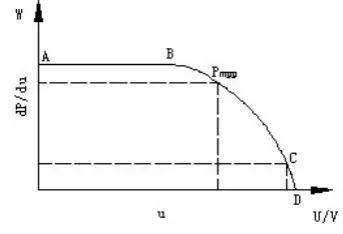
Fig.2 shows the MPPT characteristic curve of dP/dU-u. It could be seen from the figure that dP/du decreases monotonically with the PV cells output voltage increasing. The curve of photovoltaic cells is in the short circuit condition at A point , the battery output current is zero, dP/du is equal to the battery’s short circuit current. With the increase of output voltage, dP/du value is slowly declined which could be seen that the value is approximately equal to the short-circuit current in the AB Interval[9].
As the Impp and Is have a approximate linear
relationship, therefore, the output power of PV under the method can not reach the MPP and only work around the MPP. By this design, the algorithm could accelerate initial speed and rapidly approaching MPP.
Figure 2. The MPPT characteristic curve of dP/dU-u
(2) variable step P&O method--gradualapproximation search
The tracking algorithm could be realized by variable step P&O method around MPP which is carried out by the idea of gradual approximation step search[8]. The
algorithm has a high precision and small fluctuations in a steady state. First, a larger step is used to search the region where the maximum power is and then go on to search by narrowing it to half step, at this moment, searching area will be reduced to the half and the precision will be doubled till to the MPP. The specific steps are: detecting the voltage Upv and current Ipv around
the MPP and calculating the power P. Assuming that the initial operating point at the left of MPP, the system will be searched with the initial step Δu, until Pk+1<Pk. At that
time, the operating point is at the right of the MPP and should be changed the search direction, and reduce the step till Δu/2, then continue the search direction until the
second time changed, at this time the precision is doubled. Search direction will be changed again so that step is further reduced to Δu/4, and the precision is
doubled once again, and so on, until search to the MPP. The step will become Δu/(2i), i is search times, until
searched │Pk-1-Pk│<ε. From the above search process, It
the speed, combining the fixed step of rapid tracking speed and variable step of high tracking accuracy.
(3) Detection of open-circuit voltage
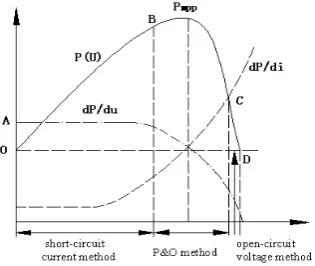
It could be seen from the Fig.3, dP/di increases monotonically with the PV output current increasing. The curve of PV is in a open state at D point, the battery output current is zero, dP/di is equal to the absolute value of the battery’s open circuit voltage.With the battery output current increasing, dP/di value is slowly risen which the value is approximately equal to the open circuit voltage in the DC Interval.
Open-circuit voltage method could make the right of MPP rapidly return to the MPP. As it is an approximate point, so it can only work around MPP.
Figure 3. The MPPT characteristic curve of dP/dI-i
Based on the above analysis, the short-circuit current method could be used when the system is worked on the left of MPP(AB section ), variable step P&O method could be used when worked around MPP(BC section )which the step is searched by the idea of gradual approximation, open-circuit voltage method could be used when worked on the right of MPP(CD section). The specific process is shown in Fig.4.
Figure 4.The whole process of the search improved algorithm
In the AB and CD section, dP/du and dP/di are respectively constant which are approximately equal to the short circuit current and open circuit voltage, only
around MPP the two values will be significantly changed. If the change of power in any of the two intervals was known in the period, short-circuit current or open circuit voltage of PV cells can be obtained, then the system could be controlled by the short-circuit current method and open circuit voltage method. With the short circuit current and open circuit voltage, the far away point from the left and right could be made soon to return to the MPP. Thus the interfering with the system under the normal operation by the traditional short-circuit current method and open-circuit voltage method is avoided.
B. Algorithm Flow
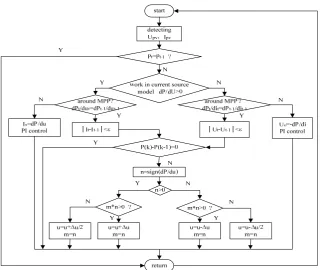
Flow chart of the improved algorithm is shown in Figure.5
Specific process: (1) Calculate the output power of PV at time t and compare it to the time t-1, judging whether the system is working in the current source or voltage source mode; (2) If the system is working in current source mode, then it can be calculated thatIt=dPt/dUt at time t and It−1=dPt−1/dUt−1 at time t-1 by output voltage and
current, and compared to It and It-1. If the absolute
difference between the two is less than ε (ε is a very small value), thus It could be realized that is equal to short
circuit current; (3) If Ut=dPt/dIt at time t and Ut−1=dPt−1/dIt−1
at time t-1 of the absolute difference value less than ε, thus Ut can be as a open circuit voltage; (4) If neither in
the short-circuit current nor open circuit voltage state, it could be infered that the system works around MPP. MPPT controlling method is achieved by the variable step P&O method which is adopted the ideal of gradual approximation method. Assumed that the system operating point is at the left of MPP, step will beΔu to
search.Where m and n are expressed dP/dU direction, m means the last direction, n means this direction,then compare the Pt -1 and Pt, until up to Pt +1<Pt. At this
Figure 5. Improved Algorithm flow char
IV. EXPERIMENT AND SIMULATION
A block diagram of the main circuit system is shown in Fig.6. The controlling algorithm is achieved by the MCU. The system is consisted by photovoltaic modules, DC-DC converter and load.
Figure 6. The main circuit diagram of the system
The experiment and simulation were conducted to verify the proposed control algorithm. Photovoltaic modules will adopt to solar panels, its parameters: open-circuit voltage Uoc=21.0V; short-circuit current Is=0.33A;
maximum power corresponding to the output voltage Umpp=17.0V; maximum power corresponding to the
output current Impp=0.29A; the maximum output power
Pm=5.0W. Then according to the PV output voltage,
temperature, illumination intensity, short-circuit current and open circuit voltage temperature coefficient calculate the output current. Compared to the experimental curves of the MPP, Fig.7 shows the MPP curve of the real
experiment and simulation results in Jinhua which are tracked from the day and night in two different weather conditions.
(a) Sunny
(b) Cloudy
It can be seen from Fig.7 (a) that improved method can be better tracked to the real maximum power curve when the weather is sunny, and the algorithm had a good steady-state performance, fast searching and small fluctuation. Fig.7(b) shows that the comparison curve of expriement and simulation in the cloudy weather. It can be obtained more accurate value of the maximum power from the initial value, and avoided the phenomenon of wrong judgments. Therfore it can be accurately tracked the real maximum power curve and improved the efficiency of PV. However, the curve shows that the simulation existes a certain error compared with experimental of the MPP, because the system is hard to respond in time and has a certain lag when the light changed suddenly. The average of the tracking error is 0.53%, therefore, the errors are allowed within the range.
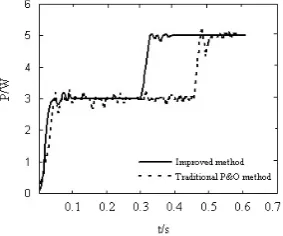
The traditional P&O method and improved method was simulated to verify the validity of the algorithm. The curves of obtaining the PV output power are shown in Fig.8 and Fig.9. Fig.8 shows the output power between traditional P&O method and improved method at 1000W/m2 and 25℃. Fig.9 shows the comparison of output power about the two algorithms due to solar insolation change from 600 W/m2 to 1000W/m2.
Figure 8. Comparison of two algorithmsfor output powe
Figure 9. Light mutation of two algorithm for output power
As can be seen from Fig.8, traditional P&O method power oscillates at the beginning of the process. After a period of time, the waveform gradually stabilized and oscillated in a small area. It will reach maximum power about 0.35s and oscillate largely around the MPP, conversely, the power of improvement has a small oscillation at the outset and achieves MPP about 0.15s. It could be drawn that the improved algorithm has a quick tracking speed, high precision, small fluctuations around the MPP. Fig.9 shows that the power of illumination
intensity mutates from 600 W/m2 to 1000W/m2 which the
traditional P&O method has a poor tracking accuracy, larger fluctuations and a bad responsion when the light suddenly changes. Nevertheless, the improved algorithm has a rapid responsion to light mutated, and be quickly stabilized at MPP. It is proved that the improved algorithm has a better stability and high efficiency in different illumination conditions.
V. CONCLUSION
The paper analyses the characteristics of the PV power system and proposed a new MPPT control algorithm by combining with various control algorithms. The voltage and current can be calculated by the open-circuit voltage, short-circuit current online testing, thus the disturbance of PV system with traditional detection method. In order to reduce the power oscillation around MPP and the “false judgement” phenomenon, variable step P&O method is adopted by the idea of gradual approximation method to search step, so the MPP can be rapidly and accurately tracked. Through the experiment and simulation, it demonstrates that the improved algorithm can quickly track the change of external environment according to the curves of two algorithms and also avoid the power fluctuation. The results also confirm that the proposed can reach MPP which is faster than traditional P&O method about 0.2s and can be better tracked to the real maximum power curve which the average of the tracking error is 0.53%. It reveals that the designed control method has a adequate performance and good practical value.
REFERENCES
[1] V. Salas, E. Olías, A. Barrado, A. Lázaro: Review of the
maximum power point tracking algorithms for stand-alone photovoltaic systems. Solar Energy Materials and Solar Cells, 90(11), 1555-1578 (2006)
[2] J.M. Enrique, J.M. Andújar, M.A. Bohórquez: A reliable, fast and low cost maximum power point tracker for photovoltaic applications. Solar Energy, 84(1),79-89(2010) [3] Zhang Chao, He Xiangning: Short-current Combined With Perturbation and Observation Maximum power point Tracking Method for Photovoltaic Power Systems. J. Proceedings of the CSEE, 26 ,98-102(2006)
[4] Petrone,Giovanni, Spagnuolo, et al.: A Multivariable Perturb-and-Observe Maximum Power Point Tracking Technique Applied to a Single-Stage Photovoltaic Inverter. IEEE Transactions on Industrial Electronics, 58(9), 76-84(2011)
[5] Zhao Gengshen, Wang Qingzhang: Research on Realization Means and Principle of Maximum Power Point Tracing. J. Acta Energiae Solaris Sinica. Vol.127, No.10(2006) [6] MasoumM A S,Dehbonei H,Fuchs E F: Theoretical and
experimental analyses of photovoltaic systems with voltage and current based maximum power point tracking. J. IEEE Transactions on Energy Conversion, 17 (4),5142-522(2002) [7] V. Salas, M. Alonso-Abellá, F. Chenlo, E. Olías: Analysis
of the maximum power point tracking in the photovoltaic grid inverters of 5 kW. Renewable Energy, 34(11), 2366-2372(2009)
[9] Kadri, Riad, Gaubert, et al.: An Improved Maximum Power Point Tracking for Photovoltaic Grid-Connected Inverter Based on Voltage-Oriented Control. IEEE Transactions on Industrial Electronics, 58(10), 66-75(2011)
Xinsheng He was born in zhengzhou
city of Henan province, China, in 1979. He obtained a Master degree and a Ph.D degree in Mechanical Manufacture and automation from school of mechanical engineering, Jilin University, Changchun city, China, in 2006 and 2009 respectively.
He is currently a instructor in Zhejiang Normal University, Jinhua city, China. He has published 12 articles in international journal and conferences. His current research interests include solar energy, power management Magnetorheological polishing. He has participated in National Natural Science Foundation of China, and has hosted Scientific Research Foundation Dr. of Zhejiang Normal University and Youth Fund of Zhejiang Normal University.
Chunfu Gao was born in Changchun city
of Jilin province, China, in 1965. He obtained a Master degree and a Ph.D degree in mechanical manufacture and automation from school of mechanical engineering, Jilin University, Changchun city, China, in 1993 and 2000 respectively.
He is currently a Professor and Master Advisor in Zhejiang Normal University, Jinhua city, China. He has published 50 articles in international journal and conferences. His main research interests focus on the robot drive technology, mechanical and electrical equipment
and automation. He has served as a reviewer for many
international journal and conferences.
Prof.Gao is currently a expert on bid evaluation with import and export company in Jilin province and a expert on import and export with FAW group company.
Bin Wang was born in tianshui city of
Gansu province, China, in 1985. He obtained a Bachelor degree in material forming and control engineering from college of mechanical and electrical engineering, Lanzhou jiaotong University in 2009, Lanzhou city, China.
He is currently a Master degree in Mechanical Manufacture and automation at college of mechanical and electrical engineering, Lanzhou jiaotong University, Lanzhou city, China. His main research interests focus on the solar energy, mechanical and electrical equipment and automation.