Seismic Analysis of Multi-Storied Building and
Critical Study of its Foundations
M Ragini B.Naidu Dr. S. D. Bhole
PG Student Professor
Department of Civil Engineering Department of Civil Engineering
Yeshwantrao Chavan College of Engineering, Nagpur Yeshwantrao Chavan College of Engineering, Nagpur
Abstract
The paper presents the study of building foundations of reinforced concrete multistoreyed buildings for G+5, G+10, G+15 designed for seismic forces in the various seismic zones of Indian subcontinent with varying SBC 100KN/m2, 150KN/m2, 200KN/m2.. The foundation types considered are; isolated footings, raft foundations under different allowable bearing pressure values of the supporting soils. The study provides the requirement of structural quantities of the building in different seismic zones. The result of the study is useful for the design professionals and cost engineers during early stages of design development and cost planning. The study also highlights the achievable economy in foundation costs through proper evaluation of allowable bearing pressure of soils through adequate geotechnical investigations of the building sites.
Keywords: Reinforced Concrete, Building Foundations, Quantity model, Seismic Design
________________________________________________________________________________________________________
I. INTRODUCTION
Building foundation, as an interface structural component between the building and the supporting ground, perform the important function of transmitting the building loads including the wind and earthquake effects to the supporting soil strata without its shear failure or excessive settlements. At sites with potential for soil liquefaction under earthquake motions, appropriate measures in terms of suitable selection and design of foundations and/or ground improvement techniques are considered based on detailed geotechnical investigations. The selection of suitable foundation systems for multi-storied buildings are governed by several factors like; building loads, wind and earthquake effects, ground profile and water table conditions, chemically aggressive ground conditions, allowable bearing pressure of soils at different depths, provision of basement stories, proximity to adjoining buildings and other project specific requirements.
For medium rise multi-storied developments with reinforced concrete framed superstructure, depending upon the building loads and allowable bearing pressure of soils, foundations with isolated footings under the individual columns or raft/mat foundations covering the entire footprint of the building are adopted.The paper presents the quantity of building material of building foundations of reinforced concrete
A multi-storied building G+5. G+10,G+15 are designed for seismic forces in the various seismic zones(zone II,zone III, zone IV, zone V) of Indian subcontinent and compared the quantity of reinforced concrete in various zone. The foundation types considered are; isolated footings and raft foundation with different allowable bearing pressure values of the supporting soils.The results of the study are useful for the design professionals and cost engineers during early stages of design development and cost planning. The study also highlights the achievable economy in foundation costs through proper evaluation of allowable bearing pressure of soils through adequate geotechnical investigations of the building sites.
Objective of this paper
- Methods of Seismic Analysis of tall RCC building
- Variation in design parameters by provision of foundation in the RCC building - Comparisons in the values of design parameters for different foundation
- Propose the structurally most efficient foundation for the multi-storey RCC building
II. WORK CARRIED OUT
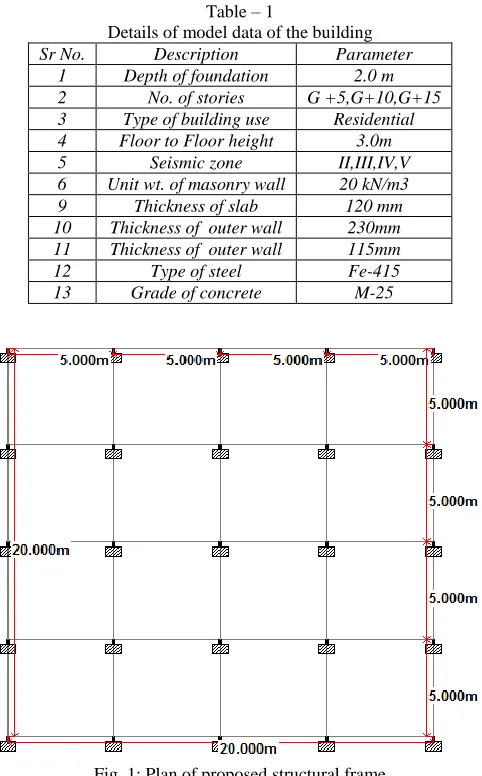
Table – 1
Details of model data of the building
Sr No. Description Parameter
1 Depth of foundation 2.0 m
2 No. of stories G +5,G+10,G+15
3 Type of building use Residential 4 Floor to Floor height 3.0m
5 Seismic zone II,III,IV,V
6 Unit wt. of masonry wall 20 kN/m3
9 Thickness of slab 120 mm
10 Thickness of outer wall 230mm 11 Thickness of outer wall 115mm
12 Type of steel Fe-415
13 Grade of concrete M-25
Fig. 1: Plan of proposed structural frame
Modelling:
Building frame with the following geometrical types are considered for analysis in 4 different seismic zones (Zone II, Zone III, Zone IV and Zone V) for seismic and gravity loading in each configurations of frames.
Fig. 3: Elevation of G+10 building
III. RESULT
Area of Steel Required for Isolated Footing for Different Sbc in G+5 Building:
SBC=100 KN/m2 SBC=150 KN/m2 SBC=200 KN/m2
ZONE AREA OF STEEL in mm2 AREA OF STEEL in mm2 AOS mm2 reduction % reduction %
II 163072.41 127518.17 103733.22 27.8817 57.2036
III 201810.93 162831.27 144659.30 23.9386 39.5077
IV 246430.19 192383.51 160357.01 28.0931 53.6759
V 247904.96 199920.29 174571.48 24.0019 42.0077
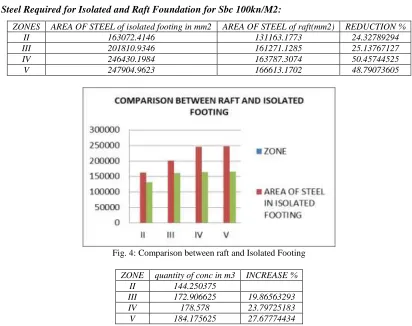
Area of Steel Required for Isolated and Raft Foundation for Sbc 100kn/M2:
ZONES AREA OF STEEL of isolated footing in mm2 AREA OF STEEL of raft(mm2) REDUCTION %
II 163072.4146 131163.1773 24.32789294
III 201810.9346 161271.1285 25.13767127
IV 246430.1984 163787.3074 50.45744525
V 247904.9623 166613.1702 48.79073605
Fig. 4: Comparison between raft and Isolated Footing
ZONE quantity of conc in m3 INCREASE %
II 144.250375
III 172.906625 19.86563293
IV 178.578 23.79725183
Fig. 5: Comparison with Different SBC
Quantity of Concrete in Raft Foundtion for G+5:
Fig. 6: Quantity of Concrete for G+5
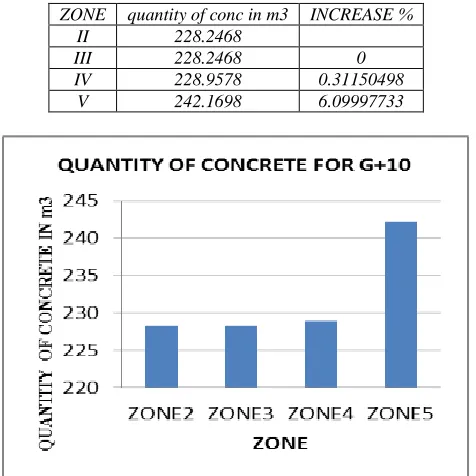
Quantity of Concrete in Raft Foundtion For G+10
ZONE quantity of conc in m3 INCREASE %
II 228.2468
III 228.2468 0
IV 228.9578 0.31150498
V 242.1698 6.09997733
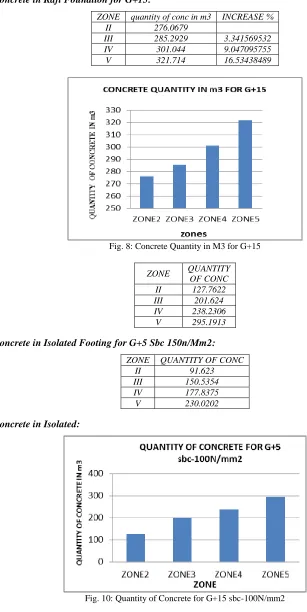
Quantity of Concrete in Raft Foundtion for G+15:
ZONE quantity of conc in m3 INCREASE %
II 276.0679
III 285.2929 3.341569532
IV 301.044 9.047095755
V 321.714 16.53438489
Fig. 8: Concrete Quantity in M3 for G+15
ZONE QUANTITY OF CONC II 127.7622 III 201.624 IV 238.2306
V 295.1913
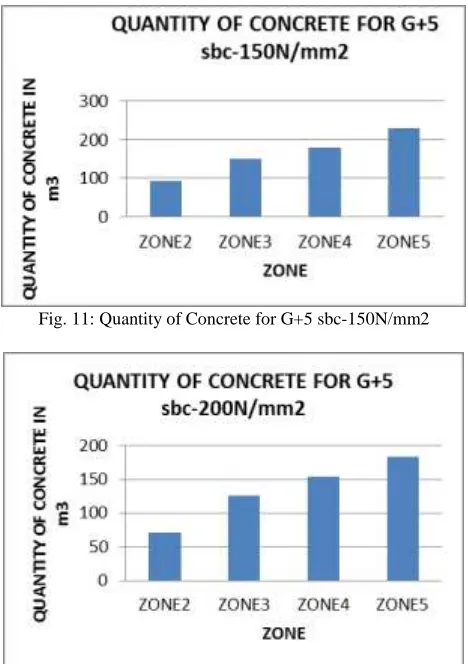
Quantity of Concrete in Isolated Footing for G+5 Sbc 150n/Mm2:
ZONE QUANTITY OF CONC
II 91.623
III 150.5354
IV 177.8375
V 230.0202
Quantity of Concrete in Isolated:
Fig. 10: Quantity of Concrete for G+15 sbc-100N/mm2
FOOTING FOR G+5 SBC 200N/mm2
ZONE QUANTITY OF CONC
II 71.7093
III 126.3104
IV 154.1572
Fig. 11: Quantity of Concrete for G+5 sbc-150N/mm2
Fig. 12: Quantity of Concrete for G+5 sbc-200N/mm2
IV. OBSERVATIONS & CONCLUSIONS
- Steel required for Isolated footing is increasing as zone is increasing for different storey
- For sbc=100N/mm2, steel required for isolated footing is increased 24% for zone 3, 51% for zone 4, 52% for zone 5 in compare to zone2.
- For sbc=150N/mm2, steel required for isolated footing is increased 28% for zone 3, 51% for zone 4, 57% for zone 5 in compare to zone2.
- For sbc=200N/mm2, steel required for isolated footing is increased 39% for zone 3, 59% for zone 4, 68% for zone 5 in compare to zone2.
- As sbc is inreasing from 100N/mm2 to 150N/mm2 the percentage of steel required is decreasing about 25%. - As sbc is inreasing from 100N/mm2 to 200N/mm2 the percentage of steel required is decreasing about 50%.
- Area of steel required for raft foundation G+5 is incrasing by 23% for zone 3, 25% for zone 4, 27% for zone 5 in comapare to zone 2.
- Area of steel required for raft foundation G+10 is incrasing by 2% for zone 4, 15% for zone 5 in comapare to zone 2. - Area of steel required for raft foundation G+15 is incrasing by 2% for zone 3, 3% for zone 4, 15% for zone 5 in comapare to
zone 2.
- It has been noted that area of steel for raft foundation is less than isolated footing.
- There is 25% reduction in area for zone 2, zone 3 and approximate 50% reduction in area for for zone 4, zone 5. - The quantity of concrete for isolated footing is increases as zone is changing from zone 2 to zone 5
- The quantity of concrete for isolated footing is reduces as the sbc is increses from 100n/mm2 to 200n/mm2. - The quantity of concrete for raft foundation is increses as zone is changing from zone 2 to zone
REFERENCES
[1] V.Thiruvengadam J.C.Wason Lakshmi Gayathri,”Cost Modeling Of Reinforced Concrete Buildings Designed For Seismic Effects” 13th World Conference
On Earthquake Engineering Vancouver, B.C., Canada August 1-6, 2004 Paper No. 1956
[2] V. Thiruvengadam, J. C. Wason and K. I. Praseeda,”Cost Modeling Of Foundations Of Reinforced Concrete Buildings Designed For Seismic Effects” ,
[3] S.K. Ahirwar, S.K. Jain And M. M. Pande,” Earthquake Loads On Multistorey Buildings As Per Is: 1893-1984 And Is: 1893-2002: A Comparative Study”
The 14th World Conference on Earthquake Engineering October 12-17, 2008, Beijing, China.