Comparative Study for the Analysis and Design
of Transmission Tower
Saurabh S. Aher Dr. Tushar Shende
M. Tech Student Project Associate
Department of Civil Engineering Department of Civil Engineering
G. H. Raisoni Academy of Engg&Tech., Nagpur G. H. Raisoni Academy of Engg&Tech., Nagpur
Abstract
In India large population is living all over the country and electricity supply demand need for this population makes recruitment of a large transmission and distribution system. Formulation of Transmission tower is proffered in assessment of confronting high voltage transmitting conductors and insulators to stance in need of altitude from ground level. Transmission Line Towers comprise of about 28 to 45 percent of the absolute cost of the Transmission Lines. The purpose of a transmission line tower is to support conductors booming electrical power and one or two ground wires at appropriate distances above the ground level and from each other. The observations from both structural and electrical fields are analysis in designing transmission line towers. There are various factors which influence the stability and performance of transmission tower are viewed in this paper. This Paper discussed and review the Methodology adopted for Analysis and Design of transmission towers. This paper can also be used for stud y of different parameters used in Analyzing and Designing of transmission towers.
Keywords: Transmission Line Tower, Geometry of Tower, Bracing System, Dynamic Analysis
________________________________________________________________________________________________________
I. INTRODUCTION
India has a huge population living all over the country and the electricity supply need of this population generates requirement of a large transmission and distribution system. Also, the disposition of the primary assets for electrical power generation viz., coal, hydro potential is quite jagged, thus again adding to the transmission requirements. Transmission line is an unified system encompassing of conductor subsystem, ground wire subsystem and one subsystem for each kind of support structure. A transmission line is a pair of electrical conductors hauling an electrical signal from one place to another. Suited examples are Coaxial cable and twisted pair cable. The two conductors have inductance per unit length, which can be found out from their respective size and shape. They have capacitance per unit length, which we can be assessed from the dielectric constant of the insulation. The purpose of a transmission line tower is to support conductors carrying electrical power and one or two ground wires at suitable distances above the ground level and from each other. The transmission line towers cost about 35 to 45 per cent of the total cost of the transmission line. A transmission tower is a space truss and is an indeterminate structure. For the design of Transmission tower different aspects are studied as in performing Seismic analysis of Transmission towers the towers and wires alarmed are modelled correspondingly by using proficient cable elements and the 3-D beam elements seeing both geometric and material nonlinearities. Wind load consideration is also a greatly influencing parameter affecting stability of transmission tower in terms of displacement, while the seismic load also distress the structure in terms of displacement far grander than design forces. However, in recent decades the increased demand in power supply distribution and changing global patterns mean that towers require exaltation to carry resultant heftier loading. There are number of works and studies carried for Analysis and design of Transition tower and the effect of influencing parameters on stability and effectivity of work. This paper mainly focus on review of methods used for the Analysis and Design of Transmission Tower.
II. LITERATURE SURVEY
There are number of studies which are carried for the Analysis and Design of Transmission Tower, effects of impact factors on the Analysis of Transmission Tower.
geometry (shape) and behavior (type) of transmission line structure. This goal is encountered by choosing a 220 kV single circuit transmission line booming square base self-supporting towers and are compared and analysed. Gopi Sudam Punse (2014) an attempt is made by author for making transmission line tower more cost effective by keeping in mind to provide optimal electrical supply for requisite area by keeping unique transmission line tower structure.
III. COMPARATIVE STUDY OF AUTHORS
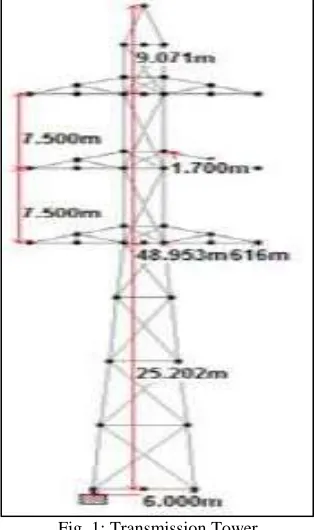
SAI AVINASH et.al. (2016): Analyse and design Transmission tower using Stadd.pro.The work is engrossed in optimizing the transmission tower with adopting the 'X' and 'K' bracings, and by diverging the sections, examined using Static analysis A Double Circuit Transmission line tower booming 220KV power capacity is analyzed and designed in STAAD.PRO. The total height of tower is 49m. Two towers are prepared by means of ‘X’ and ‘K’ Bracings by exploiting Indian angle sections with varying sectional properties in the tower elements. In order to design optimized transmission tower with erratic sections, IS: 802 (Part 1/ Sec 1): 1995 has been obeyed. By considering all necessities height of tower is resolved and shown in figure.
Fig. 1: Transmission Tower
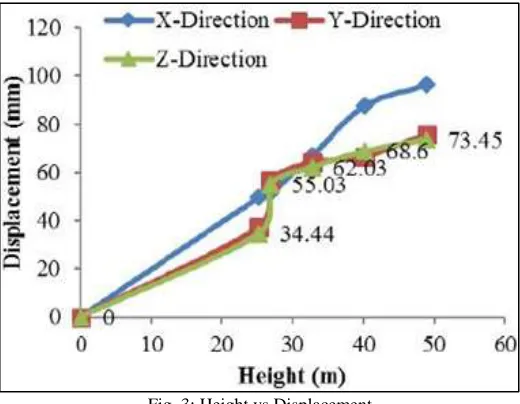
The member design and code scrutiny in STAAD.PRO are centered upon the allowable stress design method as per IS: 802: 1995. It is a method for choosing varying primary and secondary members under deliberation of design loads, allowable stresses and design limits. Figure 2 shows that the displacement of tower with reverence to the height of the tower. The result concludes displacement values increases rapidly in X-Direction, where wind force is prevailing at cross arms and peak of tower
Fig. 3: Height vs Displacement
Fig 3 typifies the increase in displacements of the tower. The global X-Direction displacements values are aggregating quickly due to the dynamic load.
The research concludes by providing unique sectional properties all through the transmission tower leads to uneconomical design and X-bracing compared to K-bracing is more advantageous with regard to all aspects.
Yusuf Mansur Hashim et.al. (2015) investigate the behavior of a three models of Transmission Towers imperiled to both static and dynamic analysis. A reliability appraisal was adept by using the “first Order Reliability Method, to obtain the securest possible angle sections and their corresponding safety indices. The Response Spectrum analysis was carried by the author for the dynamic analysis. The analysis was carry out by Stadd-pro and Indian standard was contemplated. For enactment of seismic analysis of transmission towers, the wires and the towers alarmed are modelled, respectively by taking into consideration both geometric and material nonlinearities.
The result concluded based on reliability analysis and response from the tower with regard to static and dynamic loading 1) Safest sections and their respective safety indices
2) Extreme Node Displacements. 3) Response Frequencies and Periods. 4) Spectral Acceleration.
5) Improved weight of Towers
Following Main Conclusions made by author:
Angle sections in table found in the reliability analysis should be espoused while analyzing a transmission tower of such configuration.
The nodal displacement as specified in above shows that the tower with angle sections has the least displacements as compared to that of tube and pipe sections.
The support reactions are more prevalent in the Y-dr., as a result of the weight of the tower interim downwards. The tube section shows the critical support reaction owing to weight. The maximum member end forces are mostly prevalent in the X-dr. as well as the tower with angle sections owing to its sunlit weight.
C. Preeti et.al. (2013) An effort has crafted by author to build the transmission line more cost operative by exchanging the geometry (shape) and behavior (type) of transmission line structure. This objective is encountered by electing a 220 kV single circuit transmission line booming square base self-supporting towers for the analysis one of these suspension towers is substituted by a triangular base self-supporting tower. Formerly, the structural behavior of existing tower is looked upon by developing a square base guyed mast. For the design of tower for weight optimization, below stated basic parameters are compelled on the basis for electrical requirements:
Base width. Height of the tower. Outline of the tower.
For enhancing the geometry, square base self-supporting type is substituted by a triangular base self-supporting tower. The following work has been ensured by author.
Towers are aligned with keeping in mind all the electrical and structural constrains
Loading format comprising reliability, security and wellbeing pattern is examined and all the towers are modeled using STAAD Pro.
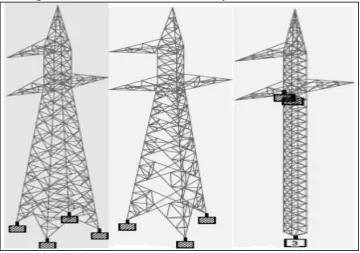
Square tower is found to have the maximum node deflection all over the tower height, tailed by the triangular tower and then the guyed mast. Guyed mast is having the minimum deflection at the lower cross arm level as of the connection points of the guy ropes. Figure 4 shows the diagram of Transmission towers used for the analysis.
Fig. 4: Representing Square Tower, Triangular Tower and Guyed Mast Following Conclusions are made by author-
Least weight of the tower result in greatest economy in the transmission line cost.
Reliability, security and safety conditions have been kept the identical for all the three towers. Wind loading is intended for each tower heading to the following results:
Square Tower 5571 kg Triangular Tower 5353 kg Guyed Mast 3708 kg Maximum Force
Square Tower 22945 kg Triangular Tower 31175 kg Guyed Mast 11302 kg
Design has been done with preserving every kg of steel possible. The economic design of towers has lead to the subsequent conclusion:
Square Tower 2775 kg Triangular Tower 2519 kg
Guyed Mast 1666 kg
Thus, Author concludes using triangular base self-supporting tower will fetch a saving of 9.23% in the weight of structural steel, and depleting square base guyed mast will fetch to a saving of 39.96% in the structural steel which leads to cost saving in each tower or the structural optimization of the transmission line.
Gopi Sudam Punse (2014) Analysis and Design of restricted base Transmission Tower (Use up Multi Voltage Multi Circuit) is done by source keeping in view to supply maximum utilization of electric supply with offered ROW and increasing population in the vicinity, in India. An attempt has been made by the author to make the transmission line more cost effective preserving in view to provide optimum electric supply for the requisite area by contemplating unique transmission line tower structure.
The analysis is carried out through Stadd-pro V8i and stresses on members and design with regard to wind load, wind pressure, Seismic consideration are all done and conclude the following result:-.
Narrow based steel lattice transmission tower contemplated in this paper can safely withstand the design wind load and actually load acting on tower.
The extremity tier members have more part in performance of the tower in captivating axial forces and the members assisting the cables are likely to have localized role.
IV. CONCLUSION
1) In the design aspect it divulges that by providing unique sectional property all through the transmission tower leads to uneconomical design.
2) Least weight of the tower entails greatest economy in the transmission line cost with regard to Reliability, Security and Safety condition.
3) Narrow based steel lattice transmission tower cogitated in the study can safely withstand the design wind load and actually load acting on tower and can be used for design of tower.
4) The geometry parameters of Transmission tower can be influences by wind loads, wind pressure and seismic loads thus should be effectively considered.
5) By using Stadd-pro Analysis and Design of Transmission tower can be done commendably with accuracy and quickly.
V. FUTURE SCOPE
1) Continuous demand due to increasing population in all sectors viz. residential, commercial and industrial leads to prerequisite of efficient, consistent and suitable amount of electric power supply which can only make happen by using the Conventional Guyed Transmission Towers.
2) Effective static loading on transmission line structure, conductor and ground wire can be supplanted with the actual dynamic loading and the results can be competed.
3) Attempt in changing the shape of cross arm can lead to ideal results.
4) Rapid urbanization and increasing demand for electric, availability of land leads to take in use of tubular shape pole structure.
REFERENCES
[1] SAI AVINASH et.al. “Analyse and design Transmission tower using Stadd.pro” International Journal of Earth Sciences and Engineering, ISSN 0974-5904, Volume 09, No. 03(2016)
[2] Yusuf Mansur Hashim et.al. “Reliability Assessment, Static And Dynamic Response Of Transmission Line Tower: A Comparative Study” International Journal of Advance Research in Science and Engineering Vol. No.4,(2015)
[3] Y. M. Ghugal, et.al. “Analysis and Design of Three and Four Legged 400KV Steel Transmission Line Towers: Comparative Study ” International Journal of Earth Sciences and Engineering 691 ISSN 0974-5904, Volume 04, No 06 SPL, October 2011, pp 691-694
[4] C. Preeti et.al. Analysis of Transmission Towers with Different Configurations (2013)
[5] Gopi Sudam Punse “Analysis and Design of Transmission Tower” International Journal of Modern Engineering Reasrch Vol 4 ISSN: 2249-6645 Jan-2014 pp 116
[6] Indian Standards, “Use of structural steel in overhead transmission line tower”, IS 802(part 1):1967, Bureau of Indian Standards, New Delhi. [7] Indian Standards, “General construction in steel” IS 800:2007, Bureau of Indian Standards, New Delhi.