APPLYING COLLABORATION SCRIPT
IN KNOWLEDGE BASED SESSIONS
AIMAN TURANI
Faculty of Computer Science and Engineering, Taibah University E-mail: [email protected]
ABSTRACT
Knowledge Based Processes, KBP, have been introduced to facilitate knowledge transfer among organizational and corporate employees. They stress on the key role of socialization and group meetings in promoting effective knowledge transfer. Meetings within virtual environment are becoming more and more used in today’s organizational settings. There are many conferencing tools that are used to facilitate such meetings. However, providing participants with a co nferencing or chatting tool and expecting them to transfer their knowledge to each other in a convenient way, could lead to many disappointments.
CSCL, Computer Support for Collaborative Learning, is relatively a new discipline within teaching and learning field. Applying CSCL techniques and technologies in Knowledge Base Systems, KBS, would be a reasonable option since teaching and learning is essentially a process of knowledge transfer between instructors and students or collaboratively between students themselves. In this research we are focusing on the usage of Collaboration Script, CS, as a way to support knowledge transfer sessions in a structured and formal way. It facilitates sharing tacit knowledge via guided interpersonal interactions and turning them to explicit knowledge by capturing and retrieving these interactions.
In this paper we are presenting the scripting structure of three common collaboration techniques used in Knowledge Base processes. As a proof of concept, two of these techniques are described using the collaboration scripting language, ColScript, that was introduced by us in an earlier research.
Keywords: Knowledge Base System, CSCL, Collaboration Script, Collaboration Script
1. INTRODUCTION
In today’s economy, knowledge is considered as an important asset for all organizations [1]. Reusing knowledge gained in the past projects tends to reduce the development costs and increase employees’ efficiency [2]. In addition, it increases employees’ satisfaction due to the high learning curve that they maintain.
Knowledge Base Systems facilitates the establishment of a proper organizational knowledge. It preserves the intellectual property and the valuable knowledge when key people depart [3] Knowledge is firstly created inside the employees’ heads where KBS support the elicitation, organization, and the reuse of knowledge [4]. In order for KBS to be successful, effective channels for knowledge transfer are needed [5]. Socialization for instance, is a key component of KBS where employees need to meet in face-to-face environment to socialize and transfer their experiences. Globalization has imposed an additional challenge due to its nature regarding employees’ geographical locations. Relaying on web-conferencing tools to connect these employees is not sufficient [6]. Usually, a meeting that is based on a web-conferencing tool suffers from the insufficiency of facilitator’s support, the easiness of diversion from meeting’s goals, and the numerous distractions due the weak presence feeling caused by the virtual distance. For these reason, there is a need for more supportive environment that is capable of facilitating knowledge transfer sessions within virtual environment.
KB sessions could be formal or informal depending on the type of knowledge that needs to be transferred. There are two types of knowledge: Explicit knowledge and Tacit knowledge. Explicit knowledge emphasizes on creating, recording and reusing documented knowledge. Several technologies are used to facilitate such knowledge, such as, Content management systems, lessons learnt databases, Wikis, etc. Tacit knowledge on the other hand, emphasizes on knowledge sharing using interpersonal interaction and face-to-face contacts. Social events such as, group meeting, communities of practice, events, seminars, asking experts, peer’s assist, etc., facilitate sharing such knowledge. Informal meetings are usually used to transfer tacit knowledge while formal meetings usually transfer explicit type of knowledge.
process are brainstorming, best practices’ meetings, telephone conversations, and conferences. Knowledge Capture is the process of retrieving knowledge that resides within people or organizational artifacts. Interviews, reviewing best practices sessions’ reports and customers’ requests logs are some examples of techniques that could be used to capture knowledge. Knowledge Sharing is the process where knowledge is communicated to other individuals. Conferences, workshops, presentation, and case-studies could be used for sharing knowledge. Knowledge Application is the process through which explicit or tacit knowledge is utilized, for instance, in help desks, support centers, etc.
CSCL has produced an effective support environment for teaching and learning [7]. It has been based on supporting students’ collaborations during learning sessions. The methodologies, techniques, and tools within CSCL could be applied not only in the teaching and learning environment but also in the corporate and organizational environment. CSCL systems should be integrated with KBS to provide the appropriate level of support that is needed to conduct successful knowledge transfer sessions. Collaboration Script is a recognized component in CSCL environment. It describes the session’s structure as a flow of activities that need to be performed by participants in a linear fashion [8].
2. MODELING THE INTEGRATION OF KBS AND CSCL
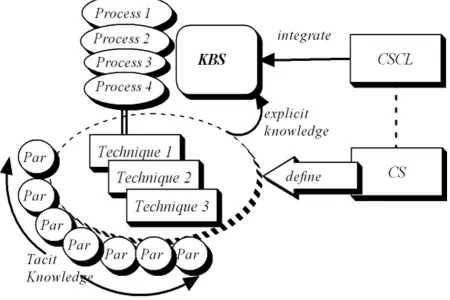
Figure 1 presents an overview scene of the integration of KBS and CSCL. It embodies the inner relationships between CSCL, CS, KBS, KB Process, KB Techniques, Participants, tacit knowledge, and explicit knowledge.
Figure 1: Modeling KBS and CSCL integration
In this model, the Collaboration script is used within CSCL to support the creation and implementation of KB techniques in a structured way. Collaboration script describes the nature of activities, group, roles associated with KB sessions and also it describes the environment that is needed to support such activities. In this research, we have used ColScript, which is a new approach of scripting collaborative learning session that was developed by us at an earlier research [9]. ColScript is an easy and flexible language that was built on a limited set of rules and commands. Its notation is similar to other scripting languages’ notation within software programming field.
retrieving records of the captured knowledge interactions within these KB techniques using a central KB repository.
3. KB COLLABORATION SESSIONS EXAMPLES
In this section, we are presenting the scripting structure of three samples of collaboration techniques that are used in the KB processes which are: the Case Study technique that is used in the Sharing process, the Round tables technique that is used in the Discovery process, and the Interview technique that is used in the Capture process. Furthermore, as a proof of concept, two of these techniques’ structures were described using ColScripts, to represent various levels of complexity.
3.1 Example I: Case-study technique
This technique is usually used to help participants to develop and share knowledge related to a problem. It consists of identifying, analyzing, and considering solutions of the targeted problem.
The scripting structure:
1. The facilitator provides a brief background regarding the case. 2. Each participant reads or watches the related material.
3. Each participant submits his own resolution of the proposed situation. 4. A general discussion to clarify issues related to these resolutions.
As noticed, the session’s structure is a simple linear structure. It is composed of four steps that are executed in a sequential nature.
ColScript for the Case-Study technique:
Participant1 as role ; Participant2 as role ; Participant3 as role ; Participant4 as role ; Facilitator as role ;
CaseGroup as group={1 Participant1, 1 Participant2, 1 Participant3, 1 Participant4, 1 Facilitator }; groupformation (CaseGroup);
t1 as time = 5m; textchat1 as textchat; audchat as audiochat;
doactivity (“provide a brief background about this case”, Facilitator , CaseGroup, audchat, time = t1 or Facilitator = “finished” );
output (" The case scenario….." , CaseGroup, ,time = t1); tv[] as feedback.inputtext
tv = input (" post your resolution ", CaseGroup, feedback.inputtext , time = t1 or Facilitator = “finish” or CaseGroup= “finish”);
doactivity (“all can participate in the discussion”, CaseGroup, CaseGroup, audchat textchat1, time = t1 or Facilitator = “finished” );
The first part of this script defines the roles that are involved in this session. There are 4 participants and one facilitator that compose the Case Study Group. The first activity that needs to be done is a brief presentation carried by the facilitator in front of CaseGroup members using an audio chat tool for 5 minutes or when he hits the “finish” button. The second activity is displaying a text description of the case study for all group members (CaseGroup) to read form for another 5 minutes. The third activity is asking all group members to send their solution’s text within 5 minutes or when the facilitator hit the “finish” or when all participants hit the “finish” button.
3.2 Example II: Lessons learnt (using Round Table Technique)
Lessons learnt session is usually conducted prior to a project’s closure. It involves a round table discussion to indentify lessons that have been learnt during the project so that future projects could benefit from. Round Table technique encourages balanced participation. It motivates the generation of knowledge by allowing balanced participations.
The session’s scripting structure is as follows:
4. This process continues until all participants finish.
5. The first participant starts talking about unwanted outcomes that happened, such as missing skills, obstacles, etc.
6. When the first participants finishes, the next participant starts. 7. This process continues until all participants finish.
8. The first participant starts talking about recommendations for the next project and what could be done to make it better.
9. When the first participants finishes, the next participant starts. 10. This process continues until all participants finish.
11. The session leader presents a brief summarization of all lessons that had been learnt in this session.
The session’s structure is more challenging than the previous one. It is composed of eleven steps but still has the linear flow structure.
3.3 Example II: Lessons learnt (using Round Table Technique)
Knowledge engineers typically start capturing the knowledge by first interviewing a domain expert. The interview session’s objective is to learn how the expert solves specific problems or answers questions in his domain. Typically there are three types of meetings that are conducted sequentially. The first meeting is usually the kickoff meeting. Its objective is to establish a good connection with the expert. The scripting structure of this meeting is as follows:
1. The Knowledge Engineer starts by explaining of the objectives of the elicitation process. 2. Knowledge Engineer explains what is expected of the expert.
3. The Expert suggests reading materials for the Knowledge Engineer to review. 4. They both agree on the next meeting date and time.
The structure of this meeting is a simple structure that has a linear flow of four activities.
The second meeting is usually the General Knowledge Gathering meeting where the objective of this meeting is to gain general knowledge about the domain from the expert.
The scripting structure is as follows:
1. The expert presents his opinions and viewpoints on the domains wide-ranging issues. 2. The KE asks to clarify any unclear item.
3. The Expert explains in detail that item.
4. Steps 2 to 3 are repeated until all items are clarified. 5. Both agreeing on the next meeting date and time.
This structure has a more challenging flow. The structure starts with a linear flow that is followed by a looping flow.
The third type of meetings is the Knowledge Gathering meeting. The objective of this meeting is to learn how the expert solves specific domain problems.
The scripting structure of this meeting is as follows: 1. The Knowledge Engineer states a problem.
2. The Expert identifies the answers or solutions to that problem.
3. The Expert identifies the input (source) of information that he uses to produce the solution.
4. The Knowledge Engineer summarizes the link between the input and the outputted problem (which represent the core of the expert’s knowledge).
5. The Knowledge Engineer asks the expert to confirm this link by using close-ended question. 6. If that link has a negative confirmation by the expert then steps 3-5 have to be repeated again. 7. Steps 3 - 6 are repeated until all other links are identified.
8. Steps 1 to 7 are repeated to all other problems and issues that need to be solved.
This flow is the most challenging flow among all pervious examples. It represents nested looping that has many steps within. The ColScript for the Knowledge Gathering meeting technique is shown below:
KE as role ; Expert as role;
KGroup[] as group = {1 KE,1 Expert }; groupformation (KGroup);
audchat as audiochat;
loop (KE = “finished”) {
doactivity (“state a problem”, KE, Expert, audchat, KE = “finished” );
doactivity (“identify the source of the answer of the problem”, Expert, audchat, Expert = “finished” );
loop (re2 = “true”) {
loop (re1 = “true”) {
doactivity (“identify the source of the problem”, Expert, KE, audchat, Expert = “finished” );
doactivity (“summarizes the link between the source and the problem”, KE, Expert, audchat, KE = “finished”);
re1 = input ("confirm KE
summarization", Expert,
feedback.option("yes", "no"), Expert= “finished”);
}
re2 = input ("is there is another
source for that problem", Expert, feedback.option("yes", "no"), Expert
= “finished”); }
}
4. CONCLUSION
In this paper we have pointed to the limitations of current meeting tools in providing the appropriate support that a knowledge based session usually requires. In order to KBS to facilitate the transfer of knowledge effectively and productively in the virtual environment, it should support all types of knowledge and all types of knowledge based techniques. In this research we have modeled the integration process between CSCL and KBS to accomplish such support. Collaboration Script was used in this paper to describe the knowledge transfer session in a formal and structured way to facilitate sharing both tacit and explicit knowledge.
We have presented the structure of three Knowledge Base techniques that represent various level of structure complexity. As a proof of concept two of these techniques (Use Case Technique, and Interview) were represented using ColScript notation. In the future we will conduct an evaluation study based on quantitative and qualitative methods to analyze the effectiveness of the usage of such script for supporting KB sessions
REFERENCES:
[1] Teece, David J., “Capturing value from knowledge assets: The new economy, markets for know-how, and intangible assets”, California management review, Vol. 40, 1998, 55-79.
[2] Warren, P., Kings, N., Thurlow, I., Davies, J., Buerger, T., Simperl, E., ... and Imtiaz, A., “Improving knowledge worker productivity-the Active integrated approach”, BT Technology Journal, Vol. 26, No. 2, 2009, pp. 165-176.
[3] Schreiber, Guus, “Knowledge engineering and management: the CommonKADS methodology”, MIT press. 2000.
[4] Shadbolt, Nigel, Enrico Motta, and Alain Rouge, “Constructing knowledge-based systems. Software”, IEEE, Vol. 10 , No. 6, 1993, pp. 34-38.
[5] Yew Wong, Kuan, “Critical success factors for implementing knowledge management in small and medium enterprises”, Industrial Management & Data Systems, Vol. 105, No. 3, 2005, pp. 261-279.
[6] Andriessen, J H Erik, “Working with groupware: understanding and evaluating collaboration technology”, Springer Science & Business Media. 2012
[7] Lehtinen, Erno, “Computer-supported collaborative learning: An approach to powerful learning environments”, Powerful learning environments: Unravelling basic components and dimensions, 2003, pp. 35-54.
[8] Stegmann, Karsten, Armin Weinberger, and Frank Fischer, “Facilitating argumentative knowledge construction with computer-supported collaboration scripts”, International journal of computer-supported collaborative learning, Vol. 2, No. 4, 2007, pp. 421-447. [9] Aiman Turani (2015): ColScript a new scripting language for Collaborative Learning, International Journal of Advanced Corporate