QUT Digital Repository:
http://eprints.qut.edu.au/
Hansford, Brian C. and Ehrich, Lisa C. and Tennent, Lee (2003) Does Mentoring
Deserve Another Look? In: Wiesner, Retha and Millett, Bruce, (eds.) Human Resource
Management: Challenges and Future Directions. John Wiley & Sons, Milton, Qld., pp. 219-228.
Does Mentoring Deserve Another Look?
Brian Hansford, Lisa Catherine Ehrich, Lee Tennent Queensland University of Technology
Introduction
In recent decades, mentoring has been identified as a worthwhile workplace learning activity for men, women and minority groups in a variety of organisational settings such as large and small corporations, government departments, hospitals, universities and schools. Mentoring has received enormous coverage in both the popular literature and academic literature. Some of these sources have hailed the mentoring process as a panacea for a variety of personal ills (Torrance 1984), while a smaller body of literature has cautioned about the 'dark side' of mentoring (Long 1997). The purpose of this chapter is to report on findings from empirical research conducted in the area of mentoring in order to draw more than tentative conclusions about its benefits and limitations, and its implications, challenges and future directions for human resource (HR) managers and other stakeholders affected by it.
We begin this chapter by defining mentoring and identifying the two types of mentoring arrangements that operate in organisations - formal and informal mentoring. Of the two, formal mentoring arrangements are most likely to be of interest to HR managers since they tend to influence the development and implementation of mentoring programs within organisations. The chapter then provides a brief discussion on some of the theories and conceptual models that have been proposed to explain the mentoring phenomenon. An analysis of the research literature identifies the benefits and drawbacks of mentoring for key stakeholders such as mentors, mentees (traditionally known as 'proteges') and the organisation. To assist us in identifying these benefits and difficulties, we draw upon findings from our structured analysis of 151 pieces of mentoring research (Hansford, Tennent and Ehrich 2001) that we conducted. Finally, the chapter discusses some important issues, implications, challenges, and future directions associated with mentoring for human resource management (HRM).
Definition
Two seminal studies that brought a great deal attention to the phenomenon of mentoring during the 1970s were conducted by Kanter (1977) and Levinson, Darrow, Klein, Levinson and McKee (1978). The authors of both studies proposed that mentoring was a beneficial process for the mentor and protégé alike. The mentor benefited from career rejuvenation and the satisfaction gained from helping another develop his or her abilities, while the protégé benefited from learning new skills and competencies and improved prospects for career development and promotion. Kanter’s (1977) ethnographic study of men and women in corporations revealed that individuals who were mentored secured the most desirable jobs and accessed the power structures within the organisation. The longitudinal study conducted by Levinson et al. (1978) found that mentoring was not only concerned with ‘sponsorship’ (Kanter 1977), but, more importantly, construed as a developmental phase in an adult’s life. Mentors were those important people who acted as ‘peer and parent’ and took on roles such as teacher, sponsor and friend. Since these analyses were first published, studies on the topic of mentoring has proliferated. Some of this work has been concerned with informal mentoring, while some has focused on formal mentoring. It is to these types of mentoring arrangements that we now direct our attention.
Types of Mentoring Relationships
In the studies by Kanter (1977) and Levinson et al. (1978), the mentoring relationship that developed between mentors and proteges could be distinguished as ‘informal’ or ‘traditional’ mentoring. This type of arrangement is typified by an experienced, older mentor initiating a relationship with a younger protégé who is recognised as having potential or talent. Informal or traditional mentorship can be a highly selective and elitist process since selection is dependent upon the mentor’s discretion and interest in the novice. As can be expected, mentors exhibit biases towards some potential proteges and not others (Odiorne 1985). For example, Odiorne (1985) suggests that some mentors have strong biases towards individuals of their own cultural background and religion. Kanter (1977) noted that in corporate settings it was not culture and religion that influenced choice of protégés, but gender. She used the term ‘homosocial reproduction’ to refer to the practice of male mentors selecting male protégés. Her study prompted research into the area of women and mentorship in the 1980s and early 1990s. Much of this research was concerned with the particular barriers women faced when thye sought mentoring relationships (see Bogat & Redner 1985; Byrne 1989; Marshall 1985; Noe 1988; Ragins & Cotton 1991) as well as some of the potential risks, such as sexual attraction, marital disruption and damaging gossip in male-female mentoring dyads (see, for example, Clawson & Kram 184; Bowen 1985; Henderson 1985). Thus, this literature revealed that informal mentoring can be problematic, particularly for women.
establishing, designing and implementing mentoring as a tool for learning in organisations.
Formal mentoring programs began to emerge in the 1970s in both private and public organisations in countries such as the United States, Australia and the United Kingdom. The movement by organisations towards institutionalising mentoring occurred, not only because organisations could see the benefits of mentoring for the mentor, mentee and organisations, but also because mentoring was seen as being an affirmative action strategy that ensured women and members of minority groups had access to the mentoring process (Sheridan, 1995). Formal mentoring arrangements have the advantage of giving a wider range of employees access to mentors, an opportunity often denied to them under informal mentoring arrangements. However, the success of the formalised mentoring program is not automatic; rather, its success is dependent on a range of factors that will be discussed later in the chapter.
Theoretical Underpinnings of Mentoring Research
The business literature abounds with exhortations for researchers, program developers and curriculum designers to underpin their work with a sound theoretical or conceptual framework. Yet a number of authors in the mentoring field (e.g. Gibb 1999; Jacobi 1991) have noted that very few studies locate mentoring within a wider theoretical framework. For example, Gibb (1999) commented that 'a substantive theoretical analyses of mentoring has been absent, implicit or underdeveloped' (p.1) while Jacobi (1991), in a comprehensive review on the research literature in mentoring, noted that a weakness in the literature relates to its 'lack of theoretical analysis' (p. 522). As Healy and Welchert (1990) caution, this absence of theoretical grounding has led to definitional problems for mentoring.
In light of this, a focus of our meta-analysis of the mentoring literature was use of theory in the 151 reviewed studies. Our review revealed no shortage of theoretical insight with 34.4per cent of studies espousing at least one theoretical perspective. These theories were derived from fields such as economics (i.e. human capital theory, exchange theory), philosophy (Foucoult's 1983 analysis of discipline and control; post-Confucian theory), organisational behaviour (contingency theory, competing values framework), sociology (structuration theory), and psychology (social learning theory, developmental theory). Interestingly, 42.4per cent of studies also referred to the seminal work of Kram (1985). An important contribution of Kram's (1985) work is her conceptualisation of the mentor role into two discrete functions. First, mentors provide career functions to mentees through sponsorship, protection, visibility, and exposure. Second, mentors provide psycho-social functions to mentees in the form of role modelling, counselling and friendship.
Outcomes of Mentoring
A further focus of our investigation was to examine the outcomes of mentoring from a variety of perspectives. MacCallum and Baltiman (1999:1) have argued that 'little of the research literature considers mentoring from the perspective of the different stakeholders'. Likewise, Lauland (1998, http://www.ed.gov/pubs/YesYouCan/) suggested that stakeholders’ expectations should be taken into consideration in mentoring programs. In our study (Hansford et al. 2001), we examined positive and negative outcomes as experienced by three of the major stakeholders, namely the mentors, the mentees and the business or organisation in which the mentoring program was offered. To achieve this, the 151 studies were coded and analysed according to descriptive and factual data. Descriptive data comprised the positive and negative outcomes of mentoring for all of the stakeholders; factual data included year of publication, source, sample size, data collection techniques employed, theoretical perspectives evident, country of study and from whom the data was collected (i.e. mentor or mentee or others). We felt it was important to code factual data so that we could obtain a profile of the type and nature of research carried out in this area. Some of the key findings from our structured analysis of the mentoring literature are now discussed.
Factual Data
Almost all (98 per cent) of the research studies in our structured analysis of the mentoring literature wee published in journals between 1986 and 2000. The remainder were derived from monographs, research reports and book chapters published during the same period. The majority of studies (70 per cent) came from the United States which was not surprising given that the US is the birthplace of formal mentoring programs in organisations. A further 13.6 per cent of studies came from the UK, 3.3 per cent from Canada, and only 2.6 per cent from Australia and Asia respectively. In terms of the study respondents, 53 per cent of the studies sought responses exclusively from mentees, while only 7.9 per cent of the studies sought responses exclusively from mentors. A further 23.8 per cent of studies sought information from both mentees and mentors. In the remaining studies, data were obtained from such sources as HR personnel, training consultants and executives in the business as well as mentors and mentees. In all, approximately 90 per cent of the database contained data from mentees while approximately 30 per cent contained data from mentors. This seems to indicate that business researchers or the personnel supporting the studies are more interested in the outcomes for mentees than mentors. We did not code the studies according to the type of mentoring arrangement used (i.e. formal or informal), because very few of them acknowledged this distinction.
Initial General Findings
In order to elaborate these general findings we will present data that relate to both positive and negative outcomes. The following sections discuss such outcomes specifically for mentors, mentees and the organisations involved.
Positive and Negative Outcomes for Mentors
It should be kept I mind from the outset that approximately two thirds of the studies did not elicit responses from mentors. Numerous positive and negative outcomes were reported; however, we have limited our discussion to the eight most frequently cited outcomes. As can be observed in Table 18.1, the most frequently cited positive outcome, reported in almost 8 percent of the studies, related to the mentors' belief that networking, collegiality and reciprocity were constructive outcomes from a mentoring experience. In 7.3 per cent of the studies, mentors indicated that their involvement in a program was associated with career satisfaction and even promotion. Mentors also perceived that their participation could be linked to improved skills and job performance (6.6 per cent of studies) and pride or personal satisfaction (6.6 per cent of studies). Table 18.1 also reports that the mentors considered that taking on the role potentially offered them the benefits of assistance and ideas (6.0 per cent), respect and empowerment (6.0 per cent), insight into other roles (6.0 per cent) and interpersonal development and confidence (6.0 per cent)
Negative outcomes were reported less frequently. As can be seen in Table 18.1, 6 per cent of the mentors reported lack of time to perform their mentoring role. Mentors also reported negative attitudes by the mentee in more than 5 per cent of the studies, a lack of training, knowledge and understanding (4.6 per cent), jealousy and negativity from others (4.0 per cent), pressure from other components of their workplace responsibilities (3.3 per cent), unrealistic expectations of the mentee (2.6 per cent), negative outcomes if the mentee is unsuccessful (2.6 per cent) and difficulties in ending the mentor-mentee relationship (2.6 per cent).
[Table 1 here]
Positive and Negative Outcomes for Mentees
socialization in the company (14.6 per cent of studies) and their sponsorship, protection and advocacy within the specific businesses (13.9 per cent).
In terms of negative mentoring outcomes, almost 8 percent of the studies, reported problems associated with gender and race differences. This is in keeping with Fulop and Linstead (1999), who argued that diversified mentoring, which involved personnel of differing power and status, can produce difficulties. They suggest that these power and status problems are frequently based in gender, sexuality, race, and ethnicity. In our study, other negative mentoring outcomes included cloning, conformity, limited autonomy and over-protection (7.3 per cent of the studies), mentors being untrained and ineffective (6.6 per cent), negative attitudes from others in the business (6.0 per cent of the studies), mentors taking the credit (5.3 per cent), careers being blocked by mentors (4.0 per cent), lack of interest and support from the mentor (4.0 per cent) and either lack of mentor time or lack of mentor availability (4.0 per cent).
[Table 18.2 here]
Positive and Negative Outcomes for Organisations
Involvement in a mentoring program may impact on the personnel involved, but it is suggested that there are also potential positive and negative outcomes that impact on the business organisation itself. Among the 151 research studies, 30.5 per cent of studies cited one or more positive outcomes for organisations, and only 8.8 per cent commented negatively concerning the impact on the business. The outcomes impacting on the organisation were more frequently described by the researcher or a participant other than the mentor or mentee. It seems appropriate to point out that the focus of the research in many of the studies was on mentors and mentees. It seems highly likely that studies with a more specific focus on the organisation would yield greater evidence of both negative and positive outcomes.
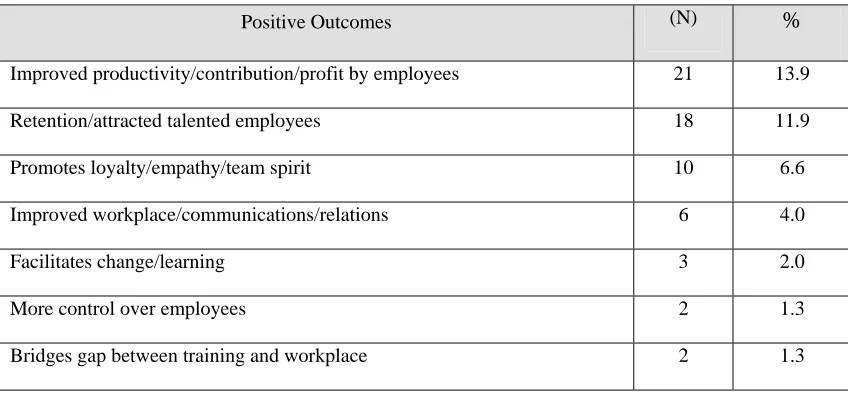
Table 18.3 indicates the positive outcomes that may accrue to a business as a consequence of a mentoring program. Negative outcomes are not included in this table as the percentages are so small.
[Table 18. 3 here]
It is no surprise that in a business setting the most significant positive outcome was identified as improved productivity, contribution or profit by employees. In total, 13.9 per cent of the studies from the business literature identified this as a positive outcome. The other positive organisational outcomes were grouped as retaining or attracting talented employees (11.9 per cent); promoting loyalty, empathy or team spirit (6.6 per cent); improving workplace communications and relations (4.0 per cent); facilitating change and learning (2.0 per cent); obtaining more control over employees (1.3 per cent); and bridging the gap between training and the workplace (1.3 per cent).
mentors were overburdened, a difficulty in controlling such programs, the financial outlay and the constant need to evaluate such programs.
Summary of Mentoring Outcomes from the business database
Based on the 151 studies examined in this analysis, mentoring in business settings is generally associated with positive outcomes. In fact, more than 90 per cent of the studies involved reported some evidence of positive and beneficial outcomes. However, there are enough studies mentioning negative outcomes to suggest that mentoring can have a 'dark side'.
From the mentors' point of view, involvement in a program can facilitate and foster networking and collegiality, career satisfaction, respect, empowerment, and new ideas. Performing the role of mentor can also facilitate greater confidence and personal growth. However, mentors also indicated that time restraints can minimise potential benefits, that they are not always fully trained, that others in the organisation may exhibit negative attitude towards them, and that mentees can develop unrealistic expectations about what the mentor can provide.
Mentees perceived that career satisfaction, increased motivation and possible promotion could arise from participation in a mentoring program. Mentees also contended that the feedback they received could result in the development of new ideas and strategies. Some mentees also benefited from interpersonal growth and being socialised into the organisation. The negative perceptions of mentees included those associated with gender and race differences, the need to conform to the mentor’s expectations, the lack of mentor training, and mentor time and negative attitudes expressed by others in the organisation.
For the organisation, the positive mentoring outcomes included improved productivity, attracting and retaining talented staff and the developing team spirit. Negative outcomes, on the other hand, included problems relating to gender and race, implementing costs and the danger of decreasing profits if mentors are overburdened.
Implications of Findings from the Meta-Analysis
An examination of the positive outcomes for mentors, mentees and organisations suggests that implementing a mentoring program can be a productive strategic decision for the business. The main positive mentoring outcomes include networking, greater collegiality and understanding, improved career satisfaction and workplace skills, more motivated and confident staff, enhanced interpersonal skills, and increased productivity and profit. Although such outcomes conjure up an image of the utopian workplace, they tend to be counterbalanced by the problems associated with mentoring, such as the overburdening of staff; lack of time and training of staff; conflict stemming from race and gender difficulties; unrealistic expectations of staff who may also believe that their careers have been blocked; pressure to conform; and the difficulties associated with developing and funding a worthwhile program.
seems likely to bring about at least some of the negative outcomes that we identified in our study since the design and implementation of programs requires considerable planning and preparation. Successful mentoring programs are more likely to be realised when HR management, in particular, include such programs in long-range strategic planning. Many texts and articles set out a range of developmental and implementation tasks for proposed mentoring programs. Before we outline what we consider to be vital aspects of a mentoring program, it seems appropriate to highlight an issue raised by Goodlad (1999). Goodlad (1999, p. 20) points out that peer tutoring and mentoring have 'exciting possibilities' but that 'we need to be careful not to claim too much…In short, we need to be aware of over-selling, and thereby discrediting, exciting and eminently useful ideas' (p.20). We have also made this point elsewhere in a paper entitled 'Mentoring: A panacea for all times' (Hansford and Ehrich 1999, p.1) it was suggested that 'much of the writing on mentoring provides an unproblematic view of its potential gains for mentors, mentees and organisations'. Managers need to fully appreciate the positive and negative outcomes reported here.
Challenges and Future Directions facing Human resource Managers
The following points highlight important challenges and future directions for HR managers and others in organisations who may be endeavouring to maximise the outcomes from mentoring. These challenges and important considerations include obtaining organisational support for mentoring; the clarification of aims, roles, expectation, and rules; the training of mentors; the selection of personnel and possible matching procedures; keeping logistics simple; and ongoing monitoring and evaluation.
Obtaining organisational support
It is difficult to imagine a mentoring program in a business functioning well without organisational support. Indeed, Douglas (1997, p. 91) indicates that 'the support of top managers is probably the most frequently mentioned success characteristic in the literature'. Furthermore, Douglas (1997) states
Organizational support is defined as encouragement and support of a program by the organization as a whole. More specifically, program-development efforts should be integrated into strategic needs, organizational systems (for example, performance-appraisal process, reward systems, and communication systems), and other management-development systems. (p.91)
Clarification of aims, roles, rules and expectations
At a very early stage of mentoring planning, there is a need to articulate the aims of the program, the roles that personnel are to perform and the rules operating during the program. The aims of a program should be outlined and discussed with mentees. Douglas (1997) recommends that program aims should not only be defined, they should be 'communicated to relevant individuals, potential mentors, top management, non-participants, and program coordinators' (p.95). Such communication would reduce the likelihood of misunderstandings surrounding roles and expectations of program participants. Similarly mentors and mentees should know exactly what their roles are in the program. Tovey (1998) argues that in order to minimise misunderstandings, a minimal set of rules should be developed. It is likely that such rules would differ from program to program, but Tovey suggests as a starting point the following:
• The mentee’s personal life and experiences will only be discussed by invitation of the mentee.
• Mentors will not make excessive demands on the time of mentees. • Mentees will not make excessive demands on the time of mentors.
• Mentors will assist mentees to obtain their goals but will let them run their own show.
• Knowledge of the mentee will only be passed on with the permission of the mentee.
Program rules would most likely be developed following discussion between participants, but individual mentors and mentees might need to agree on specific rules covering their association in the program.
There should be frank and open discussion about expectations for the program. Mentors and mentees need to spend time discussing their respective expectations. Jorgenson (1992) contends that there should be a no-fault exit clause in mentoring arrangements in order to minimise criticism of retaliation following a decision to exit a program.
Training of mentors
levels of individual mentees. At the same time, mentors must be aware of the need to fade or gradually remove the scaffolding as mentees become more accomplished.
Another issue that needs to be addressed in mentoring programs is whether or not mentees also require training. Certainly, they need to be included in discussions of rules and expectations. However, they should also be consulted/ briefed during the development and implementation of the program thereby facilitating an open and effective communication system.
Selection of participants and possible matching
In our preliminary reading relating to mentoring we were inclined to agree with MacCallum and Baltiman (1999) who suggested that there is an assumption 'that if anyone were to follow the guidelines then the mentoring program would be successful' (p.1). MacCallum and Baltiman (1999) also stress that mentoring 'is not always successful and unsuccessful matches can be worse than no mentoring at all' (p.1.). Dondero (1997) agrees with this view and talks about the dangers of 'drive-by mentoring' (p.22). The work of Long (1997) and Ehrich and Hansford (1999) confirm that there is a possible 'dark side' in mentoring. These views strengthened our resolve to explore the positive and negative outcomes of business mentoring.
It is unlikely that all experienced staff in an organisation would want to be mentors. Indeed, it is likely that some would not have the appropriate personal qualities to perform the role. Consequently, the selection of mentors can be a difficult task. Tovey (1998) has indicated that having relevant expertise in a field is not in itself sufficient qualification for the role of mentor. He recommends a number of characteristics for successful mentors. These characteristics include the ability to build and manage relationships, willingness to share knowledge, organisational knowledge, expertise in the field, a commitment to the facilitation of learning, and a willingness to commit the time and effort required.
Douglas (1997) suggests that participation by mentors and mentees should be voluntary and comments that if 'participation is not perceived as voluntary, the effectiveness of the initiative will be diminished by participant resistance' (p.97). Douglas (1997, pp. 96-7) goes further, arguing that the effectiveness of a program might well be linked to the extent that mentors, mentees and senior managers perceive that they have a sense of choice and a role in decision-making.
Antal (1993) has suggested that there are several possible methods for identifying and selecting participants. These include self-nomination, nomination of mentors by other potential mentors, nomination by senior managers and supervisors, and nomination of potential mentors by other participants.
Keeping logistics simple
As the organisation and program increase in size and complexity, the potential for difficulties also increases. Goodlad (1999) suggests that mentoring and peer tutoring programs should start small and simple. Freedman (1995) identified time as one of the major logistical problems. This view is in keeping with the findings of our structured analysis, which found that lack of time was perceived by mentors and mentees to be a significant impediment to the success of mentoring programs.
Freedman (1995) suggests that 'mentors are often better at signing up than showing up' (p.221). An important issue, then, is whether the mentor has the time to perform the role in a professional manner. How long should meetings be scheduled for, and has the mentee's line manager been informed about them? For both mentor and mentee there is a potential for work overload. There are also considerations regarding a suitable meeting place which Goodlad (1999:16) suggests 'must … be geographically accessible [and] must make both mentors and mentees comfortable – culturally as well as physically'.
Monitoring and evaluating
Monitoring and evaluation procedures must be clearly defined and articulated during the developmental stages of the program. Kram and Bragar (1991) encourage ongoing monitoring and assessment through the use of such procedures as interviews, focus groups and surveys. These authors also argue that the monitoring process should be linked to strategic challenges and requirements of the workplace.
Conclusion
An important implication of the findings from our analysis of the research literature discussed in this chapter is that mentoring has many spin-offs for mentors, mentees and the organisations concerned. Thus, we would argue that HR managers view mentoring as an important learning tool and professional development strategy in the workplace. This said, careful long-term planning and skilful and sensitive HR leadership will be needed to minimise the potentially negative elements of mentoring.
References
Antal, AB (1993) Odysseus' legacy to management development: mentoring. European Management Journal, 11(4) 448-454.
Bogat, GA, and Redner, RL (1985). How mentoring affects the development of women in psychology, Professional Psychology: Research and Practice, 16(6), 859-9.
Bowen, DD (1985) Were men meant to mentor women? Training and Development Journal,
February, 30-34.
Burke, RJ and McKeen, CA (1989) Developing formal mentoring programs in organisations.
Business Quarterly, 53(3) 76-79.
Byrne, RJ, and Mckeen, CA (1989) Developing formal mentoring programs in organisations.
Business Quarterly, 53(3) 76-9.
Chao, GT, Walz, PM and Gardner, PD (1992) Formal and informal mentorships: a comparison on mentoring functions and contrasts with nonmentored counterparts. Personnel Psychology, 45, Autumn 619-36.
Clawson, JG, and Kram, KE (1984) Managing cross-gender mentoring, Business Horizons,
27(3) 22-32.
Dondero, GM (1997) Mentors: beacons of hope. Adolescence, 32(128) 881-886.
Douglas, CA (1997) Formal Mentoring Programs in Organizations: An Annotated Bibliography. Greensboro: Centre for Creative Leadership.
Ehrich, LC and Hansford, BC (1999) Mentoring: pros and cons for HRM. Asia Pacific Journal of Human Resources. 37(3) 92-107.
Foucoult, M (1983) Afterword: the subject and power. In HL Dreyfus and P Rabinow (Eds).
Michel Foucault: Beyond Structuralism and Hermeneutics. Chicago: University of Chicago Press.
Freedman, M (1995) From friendly visiting to mentoring. A tale of two movements. In S Goodlad (ed.) Students as Tutors and mentors. London: Kogan Page.
Fulop, L and Linstead, S (1999) Management: a critical text. South Yarra: Macmillan.
Gibb, S (1999) The usefulness of theory: a case study in evaluating formal mentoring schemes. Human Relations, 52(8) 1055-1075.
Goodlad S (1999) Never knowingly oversold: a watchword for tutoring and mentoirng schemes? Second Regional conference on tutoring and mentoring. Perth, September 30-October 2 1999.
Hansford, BC and Ehrich, LC (1999) Mentoring: a panacea for all times? Queensland HR Practices Day, Australian Human Resources Institute, Brisbane, February 18.
Hansford, BC, Tennent, L and Ehrich, LC (2001) Business mentoring: help or hindrance? Unpublished paper.
Healy, CC and Welchert, AJ (1990) Mentoring relations: a definition to advance research and practice. Educational Researcher, 19(9) 17-21.
Henderson, DW (1985) Enlightened mentoring: a characteristic of public management professionalism, Public Administration Review, November-December, 857-63.
Jacobi, M (1991) Mentoring and undergraduate academic success: a literature review. Review of Educational Research, 61(4) 505-32.
Jorgenson, J (1992) Mentoring programs: an overview. Washington, D.C.: National Academy of Public Administration.
Kanter R. (1977) Men and women of the corporation. New York: Basic Books.
Kram, KE and Bragar, MC (1991) Development through mentoring: a strategic approach. In D. Montross & C. Shinkman, (Eds). Career Development: Theory and Practice. Springfield, Il: Charles C. Thomas.
Lauland A (1998) Yes you can. A guide for establishing programs to prepare youth for college. USA Department of Education (http://www.ed.gov/pubs/YesYouCan/). 9April 2001.
Levinson, DJ, Darrow, CN, Klein, EB, Levinson, MH & McKee, B (1978) The seasons of a man's life. New York: Ballantine Books.
Long, J (1997) The dark side of mentoring. Australian Educational Research, 24(2) 115-83. Macallum J and Baltiman S (1999) Mentoring: an old idea that works - or does it? Second
Regional Conference on Tutoring and Mentoring. Perth, September 30 - October 2 1999.
Marshall, C (1985) The stigmatised woman: the professional woman in a male sex-typed career. Journal of Educational Administration, 23 (2) 131-51.
Noe, RA (1988) Women and mentoring: a review and research agenda. Academy of Management Review, 13(1), 65-78.
Odiorne, GS (1985) Mentoring – An American management innovation. Personnel Administrator, 30(5) 63-70.
Ragins, BR, and Cotton, JL (1991) Easier said than done: gender differences in perceived barriers to gaining a mentor. Academy of Management Journal, 34, 939-51.
Sheridan, AJ (1995) Affirmative action in Australia - employment statistics can’t tell the whole story. Women in Management Review, 10(2) 26-34.
Torrance EP (1984) Mentor Relationships:How They Aid Creative Achievement, Endure, Change and Die. New York: Bearly Ltd.
Table 18.1
Nature of Outcomes for Mentors
Positive Outcomes (N) %
Networking/collegiality/reciprocity 12 7.9
Career satisfaction/motivation/promotion 11 7.3
Improved skills/job performance 10 6.6
Pride/personal satisfaction 10 6.6
Assistance/ideas/support/feedback 9 6.0
Respect/empowerment 9 6.0
Insight into other’s roles/divisions 9 6.0
Personal/interpersonal development/confidence 9 6.0
Negative Outcomes (N) %
Lack time 9 6.0
Negative mentee attitude/lack trust/cooperation 8 5.3
Lack training/knowledge/understanding 7 4.6
Jealousy/negative attitudes others 6 4.0
Pressure/conflicting demands/roles 5 3.3
Mentee expectations unrealistic 4 2.6
Negative exposure/failure if mentee unsuccessful 4 2.6
Table 18.2
Nature of Outcomes for Mentees
Positive Outcomes (N) %
Career satisfaction/motivation/plans/promotion 76 50.3
Coaching/ideas/feedback/strategies 46 30.5
Challenging assignments/improved skills/performance 35 23.2
Counseling/listening/support/understanding/encouragement 33 21.9
Access to resources/information/people 25 16.6
Self confidence/respect/personal/interpersonal growth 23 15.2
Company socialisation/involvement in policies/issues 22 14.6
Sponsorship/protection/advocacy 21 13.9
Negative Outcomes (N) %
Gender/race related problems 12 7.9
Cloning/conformity/limited autonomy/over-protection 11 7.3
Mentor untrained/ineffective 10 6.6
Negative attitude of others 9 6.0
Mentor competes/takes credit/exploits 8 5.3
Career blocked by mentor 6 4.0
Lack mentor interest/support/communication 6 4.0
Table 18.3
Nature of Positive Outcomes for Organisations
Positive Outcomes (N) %
Improved productivity/contribution/profit by employees 21 13.9
Retention/attracted talented employees 18 11.9
Promotes loyalty/empathy/team spirit 10 6.6
Improved workplace/communications/relations 6 4.0
Facilitates change/learning 3 2.0
More control over employees 2 1.3
AUTOBIOGRAPHICAL NOTES:
Brian Hansford (BCom BEd (Melb), MEd (Calg), PhD (NE) was Professor and Head of the School of Professional Studies, Faculty of Education, QUT from 1992 to 2000. He has had considerable experience in the supervision of staff and mentoring of new appointments. His Masters of Educational Administration focussed on decision-making in organisational settings and his PhD examined change in affective attributes during a structured training program. ([email protected]
.
Lisa Catherine Ehrich (DipT B.Ed (Brisbane CAE), MEd Admin (Qld), PhD (QUT) is a senior lecturer in the School of Professional Studies at Queensland University of Technology. She teaches in the areas of leadership and management, teacher education and adult and workplace education. Her research interests include human resource management in education, women in management, mentoring and adult learning theories and practices. ([email protected])
Lee Tennent (BA (CQU), GradDip Ed (QUT), MEd (Research) (QUT) is a PhD student and senior research sssistant in the Faculty of Education at Queensland University of Technology. Her research interests are in educational and business mentoring and the use of technology in teacher education, and early childhood care and education. ([email protected])