
ACCUMULATION PATTERN OF FATTY ACIDS IN INDIAN SOYBEAN GENOTYPES DURING SEED DEVELOPMENT
5
0
0
Full text
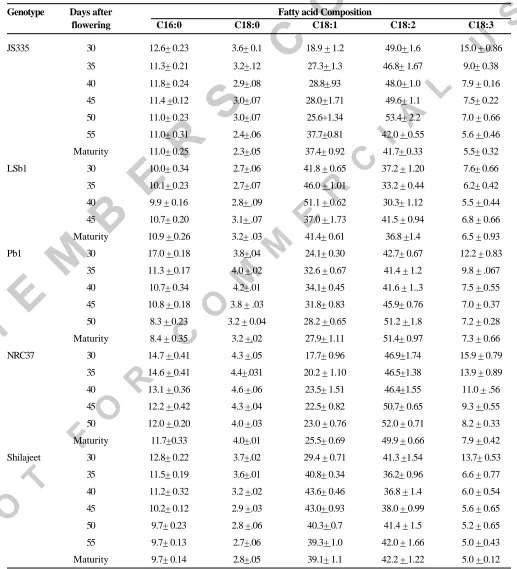
(2) VINEET KUMAR et al.. (Ishikawa et al. 2001). Such studies will be useful in elucidating the regulation system of enzymes involved in elongation and desaturation of fatty acids. Further, such variabity may help the plant breeder in pyramiding genes responsible for specific type of accumulation pattern with the view of developing a variety with desirable fatty acid composition. In the present investigation, accumulation pattern of fatty acid among five Indian soybean genotypes at various developmental stages has been studied to fathom the latent genetic variation in fatty acid composition. MATERIALS AND METHODS Five commercial genotypes of Indian soybean viz. NRC37, Pb1, Shilajeet, JS335 and LSb1 were grown in 3 meters rows with a spacing of 45 cms in the experimental fields of National Research Centre for Soybean (ICAR), Indore on 27th June 2003. Selection of the genotypes was based upon the fatty acid profile of mature seeds of all the released varieties analyzed earlier in our laboratory. LSb1, Shilajeet and JS335 are the genotypes with comparatively higher oleic acid than other released varieties. Pb1 and NRC37 are with normal fatty acid composition. At the time of 50% flowering, a sufficient number of flowers were tagged on each variety. Developing pods from the tagged flowers from each variety were removed at an interval of 5 days commencing from 30 DAF (days after flowering) till maturity. The shelled seeds from the pods were ovendried and oil was extracted using petroleum ether (bp 4060 o). Methyl esters were prepared from the oil by interesterification in methanol using sodium methoxide as the catalyst following the method of Luddy et al. (1968). Fatty acid methyl esters (FAMEs), thus prepared, were separated and analyzed in gas chromatograph, Shimadzu GC 17A, using capillary column with length and internal diameter of 30 meter and 0.32 millimeter, respectively. Oven temperature of gas chromatograph was programmed at 140o for 3.6 min, then increased to 170o at the rate of 13.5o per minute and maintained for 3.8 min and finally increased to 182o at the rate of 5o per minute for obtaining best resolution of methyl esters. The temperatures of flame ionization detector (FID) and injector were maintained at 240o. Nitrogen, the carrier gas used, was maintained at a flow rate of 15 ml/min 232. with column pressure at 90 kpa. Peaks for fatty acid methyl esters (FAMEs) were identified by comparing their retention times with those of standard methyl esters (procured from Sigma-Aldrich, India). Data presented for different fatty acids are means of independent determinations in three samples. RESULTS AND DISCUSSION Table 1 indicates the fatty acid composition of five genotypes in developing and mature seeds. Percent palmitic (C16:0), stearic (C18:0), oleic (C18:1), linoleic (C18:2) and linolenic acid (C18:3) contents in mature seeds ranged from 8.4 -11.7, 2.3-4.0, 25.5-41.4, 41.7-51.4 and 5.0-7.9 respectively. Accumulation pattern of saturated fatty acids, palmitic (C16:0) and stearic acid (C18:0), as indicated in Table 1, showed a continuous decrease in both the saturated fatty acids in JS 335 and Shilajeet till maturity. Pb1 and NRC37 also showed a continuous decrease in palmitic acid but stearic acid increased in these genotypes till 40 daf and thereafter it decreased till maturity. LSb1 didn’t exhibit any change in these fatty acids till 40 daf and thereafter increased at maturity. Genotypic variation for accumulation of different unsaturated fatty acids was also observed. Maximum amount of oleic acid content at 30 daf was observed in LSb1 while lowest amount was observed in NRC37. Oleic acid (C18:1) content increased from 30 daf to 40 daf in all the five genotypes. During this period percent increase of oleic acid was 5.8, 14.2,10, 9.9, 9.3 for NRC37, Shilajeet, Pb1, JS335 and LSb1 respectively. This increase in oleic acid content during initial stages of seed development is in consonance with the earlier report of Rubel et al. (1972). However, Sangwan et al. (1986) reported contrasting observations in comparison to these results. In the present study different genotypes followed different patterns for accumulation of oleic acid at 40-45 DAF and onwards. Oleic acid content in LSb1 decreased from 40-45 DAF followed by final shoot up at maturity while in NRC37 it remained stable from 40 to 50 DAF and increased slightly at the time of maturity. After 40 DAF, oleic acid content in Shilajeet and Pb1 showed continuous decrease though at a slow rate till. Indian J. Plant Physiol., Vol. 10, No. 3, (N.S.) pp. 231-235 (July-Sept., 2005).
(3) FATTY ACIDS IN SOYBEAN DURING SEED DEVELOPMENT. Table 1. Changes in per cent fatty acid composition of five soybean genotypes during seed development. Genotype. JS335. LSb1. Pb1. NRC37. Shilajeet. Days after flowering. C16:0. C18:0. Fatty acid Composition C18:1. C18:2. C18:3. 30. 12.6+ 0.23. 3.6+ 0.1. 18.9 + 1.2. 49.0+ 1.6. 15.0 + 0.86. 35. 11.3+ 0.21. 3.2+.12. 27.3+ 1.3. 46.8+ 1.67. 9.0+ 0.38. 40. 11.8+ 0.24. 2.9+.08. 28.8+.93. 48.0+ 1.0. 7.9 + 0.16. 45. 11.4 +0.12. 3.0+.07. 28.0+1.71. 49.6+ 1.1. 7.5+ 0.22. 50. 11.0+ 0.23. 3.0+.07. 25.6+1.34. 53.4+ 2.2. 7.0 + 0.66. 55. 11.0+ 0.31. 2.4+.06. 37.7+0.81. 42.0 + 0.55. 5.6 + 0.46. Maturity. 11.0+ 0.25. 2.3+.05. 37.4+ 0.92. 41.7+ 0.33. 5.5+ 0.32. 30. 10.0+ 0.34. 2.7+.06. 41.8 + 0.65. 37.2 + 1.20. 7.6+ 0.66. 35. 10.1+ 0.23. 2.7+.07. 46.0 + 1.01. 33.2 + 0.44. 6.2+ 0.42. 40. 9.9 + 0.16. 2.8+ .09. 51.1 + 0.62. 30.3+ 1.12. 5.5 + 0.44. 45. 10.7+ 0.20. 3.1+ .07. 37.0 + 1.73. 41.5 + 0.94. 6.8 + 0.66. Maturity. 10.9 + 0.26. 3.2+ .03. 41.4+ 0.61. 36.8 +1.4. 6.5 + 0.93. 30. 17.0 + 0.18. 3.8+.04. 24.1+ 0.30. 42.7+ 0.67. 12.2 + 0.83. 35. 11.3 + 0.17. 4.0 +.02. 32.6 + 0.67. 41.4 + 1.2. 9.8 + .067. 40. 10.7+ 0.34. 4.2+.01. 34.1+ 0.45. 41.6 + 1..3. 7.5 + 0.55. 45. 10.8 + 0.18. 3.8 + .03. 31.8+ 0.83. 45.9+ 0.76. 7.0 + 0.37. 50. 8.3 + 0.23. 3.2 + 0.04. 28.2 + 0.65. 51.2 + 1.8. 7.2 + 0.28. Maturity. 8.4 + 0.35. 3.2 +.02. 27.9+ 1.11. 51.4+ 0.97. 7.3 + 0.66. 30. 14.7 + 0.41. 4.3 +.05. 17.7+ 0.96. 46.9+1.74. 15.9 + 0.79. 35. 14.6 + 0.41. 4.4+.031. 20.2 + 1.10. 46.5+1.38. 13.9 + 0.89. 40. 13.1 + 0.36. 4.6 +.06. 23.5+ 1.51. 46.4+1.55. 11.0 + .56. 45. 12.2 + 0.42. 4.3 +.04. 22.5+ 0.82. 50.7+ 0.65. 9.3 + 0.55. 50. 12.0 + 0.20. 4.0 +.03. 23.0 + 0.76. 52.0 + 0.71. 8.2 + 0.33. Maturity. 11.7+0.33. 4.0+.01. 25.5+ 0.69. 49.9 + 0.66. 7.9 + 0.42. 30. 12.8+ 0.22. 3.7+.02. 29.4 + 0.71. 41.3 +1.54. 13.7+ 0.53. 35. 11.5+ 0.19. 3.6+.01. 40.8+ 0.34. 36.2+ 0.96. 6.6 + 0.77. 40. 11.2+ 0.32. 3.2 +.02. 43.6+ 0.46. 36.8 + 1.4. 6.0 + 0.54. 45. 10.2+ 0.12. 2.9 +.03. 43.0+ 0.93. 38.0 + 0.99. 5.6 + 0.65. 50. 9.7+ 0.23. 2.8 +.06. 40.3+ 0.7. 41.4 + 1.5. 5.2 + 0.65. 55. 9.7+ 0.13. 2.7+.06. 39.3+ 1.0. 42.0 + 1.66. 5.0 + 0.43. Maturity. 9.7+ 0.14. 2.8+.05. 39.1+ 1.1. 42.2 + 1.22. 5.0 + 0.12. *Values given are mean of three independent samples from each picking + standard deviation. Indian J. Plant Physiol., Vol. 10, No. 3, (N.S.) pp. 231-235 (July-Sept., 2005). 233.
(4) VINEET KUMAR et al.. maturity while JS335 during the same period exhibited an initial decrease and then increase in oleic acid content near maturity. Linoleic acid (C18:2) content of LSb1 and Shilajeet decreased continuously till 40 DAF while in NRC37, JS335 and Pb1 it changed little for the respective period. Thereafter, it increased till 45 DAF in LSb1 and till 45 daf in all other genotypes. JS335 and LSb1 exhibited decline for linoleic acid towards maturity while in Pb1 and Shilajeet it showed a continous increase till maturity. Linolenic acid (C18:3) content was found to be maximum at 30 DAF in all the genotypes and thereafter decreased continuously in all the genotypes till maturity though at varying rate. Maximum drop of 9.5 % in linolenic acid content was observed in JS335 followed by Shilajeet as the seed development stage advanced from 30 DAF to maturity. The continuous decline of linolenic acid during seed development is in contrast to earlier report of Sangwan et al. (1986) who observed an increase in the level of linolenic acid during seed development. However, the observations are in consonance with the results obtained by Dornbos and McDonald (1986) and Rubel et al. (1972). It was interesting to observe that the maximum decrease in linolenic acid content of all the five genotypes was between the developmental stage of 30 DAF and 35 DAF. The genotypes studied are divided into two groups based upon its oleic acid content in mature seeds. First group consisted of genotypes possessing comparatively higher oleic acid content viz. LSb1, Shilajeet and JS335 while the second group included Pb1 and NRC37 with normal oleic acid level in mature seeds as defined by Fehr and Curtiss (2004). The genotypes from the same group differed in accumulation pattern of different fatty acids. In the first group, oleic acid content remained almost constant in Shilajeet after initial increase in the early stages of seed development and fluctuated in JS335 and LSb1. In the second group, oleic acid content decreased at maturity in Pb1 while increased in NRC37. During seed development of soybean there is sequential desaturation of stearic acid to produce progressively the oleic acid, linoleic and eventually 234. linolenic acid. In developing soybean seeds, the second double bond is added to oleic acid at d-12 (omega -6 position) by a d-12 desaturase, encoded by the Gm Fad 2-1 gene. This latent genetic variation observed during developmental stage indicates the presence of more than one gene for desaturases leading to intervarietal differences in the regulation of activity of different desaturases during development. Involvement of more than one gene in biosynthesis of oleic acid has also been reported by Carver et al. (1987). Different accumulation pattern of oleic acid in LSb1 and Shilajeet, wherein comparatively higher level of oleic acid right from early stage of the seed development (30 and 35 daf respectively) was observed, may be because of poor expression of Fad 2-1 gene and hence the lower activity of omega-6 desaturase that converts oleic acid to linolenic acid by adding a second double bond to oleic acid. The sudden spurt observed in oleic acid in later stage of seed development in JS335 may be because of lower activity of omega-6 desaturase. The latent genetic variation for fatty acids among the genotype studied could eventually elucidate the regulation system of enzymes involved in the elongation and desaturation of fatty acids. Moreover, this latent genetic variation can be exploited in transgressive breeding by pyramiding all major and minor genes responsible for producing high oleic acid. A high oleic soybean line N78-2245 developed from mid-oleic parental lines through recurrent selection (Wilson et al. 1981) is one such instance of transgressive segregants. Genetic variants have been developed with 80 % oleic acid and 1% linolenic acid (Fehr and Curtiss, 2004). Soybean with 80% oleic acid has been produced by DuPont Agricultural Products by silencing of the Gm Fad 2-1 gene and thereby suppressing the addition of a second double bond to oleic acid in developing soybean seeds. Soybeans with 1% linolenic acid content have been produced by combination of fan 1, fan 2 and fan 3 alleles (Roiss et al. 2000). However, soybean lines with low linolenic (1-3%) and high oleic acid (55-60%) in India are not available. Development of transgenics for desirable fatty acids composition is yet to be undertaken and whether any such transgenic would serve the interest of Indian soybean in international market remains uncertain as Indian soybean is preferred in international market because of its non-transgenic nature. In this perspective, the gene pyramiding for high oleic and low Indian J. Plant Physiol., Vol. 10, No. 3, (N.S.) pp. 231-235 (July-Sept., 2005).
(5) FATTY ACIDS IN SOYBEAN DURING SEED DEVELOPMENT. linolenic lines through traditional breeding methods can be the effective tool for achieving soybean with improved oxidative stability. The present study involved only five genotypes. However, much more genetic material needs to be studied during seed filling stages to investigate the latent genetic variation in fatty acid composition among Indian soybean cultivars.. Luddy, F. E., Barford, R. A., Herb, S. E. and Magidman P. (1968). A Rapid and Quantitative Procedure for the preparation of methyl esters of butter oil and other fats. J Am. Oil Chemists Soc. 15: 549-552. Murphy, D.J. (1995) The use of conventional and molecular genetics to produce new diversity in seed oil composition for the use of plant breeders: progress, problem and future prospects. Euphytica 85: 443-440.. REFERENCES Applewhite, T.H. (1981). Nuritional effects of hydrogenated soybean oil. J American Oil Chemists Soc. 58: 260-269. Dornbos, Jr D.L. and McDonald, Jr M.B. (1986). Mass and composition of developing soybean seeds at five reproductive growth stages. Crop Sci. 26: 624-630. Carver, B.F., Burton, J.W. and Wilson, R.F. (1987). Grafttransmissible influence on fatty acid composition of soybean seed. Crop Sci. 27: 53-57. Fehr, W.R. and Curtiss, C.F. (2004). Breeding for fatty acid composition of soybean oil. Proc of 7th World Soybean Res. Conf. pp. 815-819. Foz do Iguassu, PR, Brazil, Harwood, J.L. (1996). Recent advances in the biosynthesis of plant fatty acids. Biochem Biophys. Acta 1301: 7-56. Hawkins, S.E., Fehr, W.R., Hammond, E.G. and Rodriguez de Cianzio (1983). Use of tropical environments in breeding for oil composition of soybean genotypes adapted to temperate climates. Crop Sci. 23: 897-899. Ishika, G., Hasegava, H., Takagi, Y. and Tanisaka, T. (2001). The accumulation pattern in developing seeds and its relation to fatty acid variation in soybean. Plant Breeding 120: 417-423.. Indian J. Plant Physiol., Vol. 10, No. 3, (N.S.) pp. 231-235 (July-Sept., 2005). Ohlrogge, J.B. and Jaworski, J.G. (1997) Regulation of fatty acid synthesis. Annu. Rev. Plant Physiol. Plant Mol. Biol. 48: 109-136. Rebetzke, G.J., Pantalone, J.W., Carver, B.F. and Wilson, R.F. (1997). Genotypic variation for fatty acid content in selected Glycine max x Glycine soja populations. Crop Sci. 37: 1637-1640. Roiss, A.J., Fehr, W.R., Welke, G.A. and Cianzio, S.R. (2000). Agronomic and seed traits of 1% linolenate soybean genotypes. Crop Sci. 40: 382-386. Rubel, A, Rinnie R.W. and Canvin, D.T. (1972). Protein, oil and fatty acid composition in developing soybean seeds. Crop Sci. 12: 739-741. Sangwan, N.K., Gupta, K. and Dhindsa, K. S. (1986). Fatty acid composition of developing soybeans. J Agric Food Chem. 34: 415-417. Wilson, R.F., Burton, J.W. and Brim, C.A. (1981). Progress in the selection for altered fatty acid composition in soybean. Crop Sci. 21: 788-791. Zock, P.L. and Katan, M.B. (1992). Hydrogenation alternatives: effects of trans fatty acids and stearic acid versus linoleic acid on serum lipids and lipoproteins in humans. Lipid Res. 33: 399-410.. 235.
(6)
Figure
Related documents
Despite a large amount of data and information confirming the positive impact Medicaid expansion can have on the health of low-income individ- uals, as well as on the fiscal
The validation work on the quality control of 68 Ga-DOTA-NOC in our specific con- figuration showed that based on a risk-based approach and the results from validation studies,
All ARIMA (0,0,0) model residuals were no different than white noise (see Table 2). The regression shows that prison admissions in the low usage county stayed relatively the same
Through in-depth interviews and fol- low-up conversations, six female chief academic officers (CAOs) discuss their community college employment, the issues and challenges
ponents of organizational culture and profession- al ethics in teachers. Beta coefficient is significant in components of flexibility, mission and stability. Therefore, teachers
Unless 15mm Gyproc Wallboard is used, timber noggings should be provided between joists at the perimeter to support board edges in the field of the boards (see Table 11). Boards
Thus, it appears that the model between exposure to sexually objectifying television and trait SO should be run for all par- ticipants, whereas the model between exposure to
