Indian I. Plant Physiol., Vol. XXVII, No.1 pp. 26-33 (January 1984)
PANICLE DEVELOPMENT AND ITS RELATIONSHIP WITH IN SORGHUM GENOTYPES·
K. PANDUSASTR Yl AND K. KRISHNA MURTHY Department of Agronomy
University of Agricultural Sciences, Hebbal, Bangalore-S6006S (Revised : November 10, 1983)
SUMMARY
Four genotypes of Sorghum (2077-B Early, 2017-B, CS-3S41 and CS-3S41 late) were sown round the year (January, 1978 through Dccember, 1979) to study their vegetative and reproductive phases and in turn the possible influence of these phases on yield. The panicle development from initiation (PI) to 50% flowering was divided into three phases for convenience viz., branch initiation phase, spikelet differen tiation phase and inflorescence elongation phase. Tbe grain yield was significantly higber in January, February. March and December sowings. followed by June to August sowings and September to November sowings. Vegetative phase was noted to exert a positive influeoce on yield. though not the major factor in determining yield. This study suggested that the final yield depends upon an interaction of spikelet development period, fate of spikelet initiation. dry matter production and temperature.
INTRODUCTION
All parts of the sorghum (Sorghum bieolor (L.) Moench) shoot develop from apical meristem, which at first initiates the leaf primordia and axillary buds at successive nodes. The panicle initiation marks shift from vegetative to repro ductive phase and the apical meristem initiates the inflorescence, which continues to develop till the end of growing season. The ontogeny and development of the panicle needs a clear understanding since the number and size of seeds are determined during this phase.
Further, the vegetative and reproductive phases exert significant influence on panicle development and yield. The importance of length of vegetative phase on yield in sorghum (Lee et. a/., 1974). on deciding spikelet number in wheat (Lucas. 1972), rate of spikelet initiation and spikelet number in
*A part of Ph.D dissertation by senior author.
~~
r .. . . •...
PANICLE DEVELOPMENT AND YIELD IN SORGHUM 27
wheat (Rahaman and wilson, 1977) have been discussed. But the information on panicle development and its influence on yield and the influence of environment on panicle development are meagre. This study was taken up to understand the panicle development as influenced by changes in environment and to study its influence on yield.
MATERIALS AND METHODS
The experiment was conducted during January, 1978 through December, 1980 under irrigated cropping on red sandy loam soil of moderate fertility with medium quantities of available nitrogen (421 kg/ha), P20S (31 kg/ha) and KaO (276 kg/ha) at Agronomy field unit, Main Research Station of the University of Agricultural Sciences, (Latitude 12° 58' North, longitude 77° 35' East and alti tude 899 m above MSL). There were four genotypes viz., 2077-B, 2077-B Early (2077-BE), CS-J541 and CS-J541 Late (CS-J54IL) and twelve monthly sowing dates (January, February, ... December). The sowings were undertaken in the first week of every month. The experiment was laid out in a split plot design with sowing dates as main plots and genotypes as sub plots. The gross and net plot sizes were 2.4mx3.0 and 1.8 m x2.7 m, respectively. A common spacing ofJOcm x 15 cm and fertilizer dose of 120 N, 75 P20 S and 25 KiO, kg/ha was supplied. Nitrogen was supplied in two equal splits i.e., at sowing and 30 days after sowing. There was no major incidence of pests and diseases.
Sampling techniqnes: A composite sample of five plants was collected for each genotype once in every three days starting from 20 days after sowing. The collected plants were dissected and the growing tips were transferred to sampling tubes containing Carnoy's B fixatvie for instant killing and Fixing. The samples were observed under dissecting microscope (stereozoom, x 10) and the stage of development identified vide Lee et. al.,1974. Wherever, it was difficult to identify. the samples were further processed and microtome sections of 8f' thickness were taken for easy identifiication.
RESULTS AND DISCUSSION
A. Grain Yield, (kg/ha): In all sowings 2077-B gave significantly higher yield, followed by 2077-BE, CS-3541L and CS-3541. The yield was significantly higher in February sowing in 2077-BE and CS-3541, while it was maximum in March sowing in 2377-B and CS-J54IL. There was significant decrease in yield with advancement in sowing from March to September in 2077-BE and CS-3541, while it decreased from April to September sowing in 2077-B and
28
I
::~~'~~34iit"c:);~;;:;;S:b""'~
jL.1
-'11
K. PANDUSASTRY AND K. KRISHNA MURTHY
Table I Grain yield (kg/ha) in the genotypes of sorghum in relation to drift in sowing dates during 1978 and 1979-pooled data
Genotypes
Sowing dates Mean
2077·B CS·3541
Early 2077-B CS-354 I Late
January 2141 2634 1340 1488 1901
February 2424 2781 1442 1708 2089
March 2413 2793 1435 1719 2090
April 1938 2489 llS.s 1333 1729
May 1938 2495 1109 1308 1713
June 1797 2311 1025 1192 1581
July 1718 2303 981 1185 1547
August 1703 2192 900 1080 1469
September 1590 1925 697 842 J263
October 1675 20S7 808 935 1368
November 1218 1739 682 871 1127
December 2095 2626 1219 1476 1854
Mean 1887 2362 1066 1261
:F'test S.EM.± C.D. (P=O.05) C.V.%
Sowing dates (D)
••
33 69 6.92Genotypes (G)
••
12 23 5.01Interaction (DXG)
••
'G' at fixed levels of 'D' 29 80
'D' at fixed or different levels
of'G' 31 90
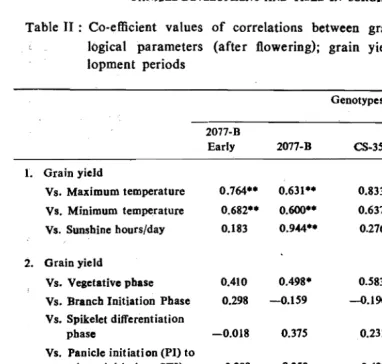
B. Vegetative pbase and grain yield: In all sowings, 2071·B was late to attain PI stage, follow~d by CS-354IL, CS-3S41 and 2077-BE (Fig. I). On an average of two years, this phase decreased from January to September sowings in 2077-BE and CS-3541, January to August sowing in 2077-B and from January to July sowings in CS-3541L. The higher yields in January to March and December sowings might be due to extended vegetative phase, which is sub stantiated by the positive correlation between vegetative phase and grain yield (0.4=. Table II). The morphological advantage associated with extended vege tative phase is larger p1ant size. since no leaves are laid out in the meristem after panicle initiation as opined by Quinby and Karper (1947). The dry matter production was high at maturity in January to March and December sowing (71.4 to 85.2g/plant) so also yield.
I
~'ww;'
PANICLE DEVELOPMENT AND YIELD IN SORGHUM 29
Table II : Co-efficient values of correlations between grain yield and meterio logical parameters (after flowering); grain yield and phasic deve lopment periods
Genotypes
Pooled
2071·B CS·3541
Early 2017-B CS-3S41 late l. Grain yield
Vs. Maximum temperature 0.764·· 0.631·· 0.833·· 0.791·. 0.693·· Vs. Minimum temperature 0.682·· 0.600·· 0.631·· 0.616·· 0.583·. , Vs. Sunsbine hours/day 0.183 0.944·· 0.276 0.269 0.282
r
2. Grain yieldVs. Vegetative pbase 0.410 0.498· 0.583·· 0.382 0.400*. Vs. Branch Initiation Phase 0.298 -0.159 -0.190 0.343 0.094 Vs. Spikelet differentiation
pbase -0.018 0.375 0.233 -0.244 0.199
Vs. Panic1e initiation (PI) to
stigma initiati on (STI) 0.300 0.350 0.439· 0.036 0.326·· Vs. Stigma initiation (STI)
to 50% flowering 0.180 0.042 0.086 0.676·· 0.310*· Vs. Spikelet initiation (SI)
to 50% flowering 0.239 0.338 0.398 0.377 0.375·· ·Sianificant at P = 0.05
··Significant at P 0.01
Though the vegetative phase was longer in October and November sowings, the grain yield wassignificantIy lower than January to August sowings. This indi cates that vegetative phase may not be the sole or main factor in determining the grain yield.
30 K. PANDUSASTRY AND K. KRISHNA MURTHY
C. Brancb initiation pbase (BIP) and grain yield : This phase (The period between panicle initiation and beginning of spikelet initiation) increased in Jan~ary to April sowings in 2077-B and CS-354 I , and from January to May sowings in 2077-BE and CS-3541L (Fig. I). In 2077-BE, this phase remained constant in June to December sowings except Julyand December. In 2077-B this phase remained constant in May to December sowings except July and August. In CS-3541, it decreased in May to July sowings and then increased upto December sowings. In CS-3541 L, it increased in June to December sowings except September. Though longer BIP may result in higher number of poten tial branches/branchlets formed in the top portion of the panicle, the BIP did not show any relationship with yield in the present study.
D. Spikelet differentia ton pbase and grain yield: The period between spikelet initiation (SI) and stigma initiation· in spikelets (STI), in 2077-BE .is less in March and April, medium in May and August to December sowings and more in January, June and July sowings. In 2077-B, this phase was less in April June and July sowings, medium in March, May and August to November sowings and was maximum in January and February (Fig
0.
In CS-3541, this phase was less in February to May, July and September to November sowings and more in January, June, August and December sowings. In CS-354IL, this phase was less in January, March, April and May sowings remained constant in.the rest of the sowings.The number of days taken to 50% flowering decreased progressively from January to July sowings in 2077-B .and 2077-BE and from January to August sowings in CS-3541 and CS-3541 L. The days to flowering increased with further advancement in sowings.
The durations between PI to STI and SI to 50% flowering were signifi' cantly and positively related with grain yield (Table II). The grain yield was more in January, February, March and December sowings, followed by June to August sowings and was less in September, October and November so wings. Conversely, the phasic development periods in general were I!!ore in January to March and December, followed by September to November and were less in June to August sowings.
40
35
30
]: :s::
o "0 0
;"1 : " ¥ ~
;<
CC.V,S
'.~r~ -.~
..
PANICLE DEVELOPMENT AND YIELD IN SORGHUM
90
8070
60
Period from initiation to stigma initiation
28
26
/ "
24
~/
22
20
18
20
15
1
11~1
45
Period between .panicle a.nd spikelet initiation
(SIP)Days to paniCle initiation
SOWING MONTHS
32
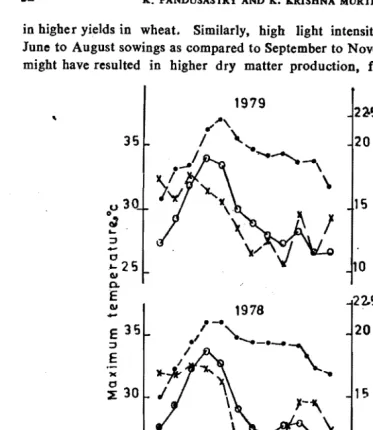
K. PANDUSASTllY AND K. KRISHNA MUllTHYin higher yields in wheat. Similarly. high light intensity and temperature in June to August sowings as compared to September to November sowings (Fig.2)
J FMAMJ JASONO
Fig. 2. Mean monthly maximum temperature (0-0), minimum temperature (e-e) and sunshine hours per day ( x - x) at the experimental stastion during
1978 and 1979.
initiation, which in turn might have resulted in higher yields- Similary, positive relation between spikelet number and dry matter production (Yoshida and Parao, 1976), spikelet number and incident solar ratiation (Yoshida, 1973), and negative relationship between spikelet and mean temperature during reproductive phase (Yoshida, 1973) in rice were reported earlier.
Thus, the present study suggest that the ultimate reduction or increase ingrain yield depend upon an interaction of spikelet development period, rate to spikelet initiation which are influenced by dry matter production. Tempera ture and sunshine hours per day directly influence dry matter production and dry
might have resulted
..
35
u 30
~
....
::J
o
.... 25
(II
0..
E
(II
-.
')(~
3025
in higher dry matter production. faster rate of spikelet
1979
1978
22-5
20 12
15 8 (J'l C
:J
_.
:J3 III
-:r
c:
4;
3 0
4Q
-
-:r22.53 c 0
PANeLS DllVELOPMllNT AND YIELD IN SORGHUM 33
mat~er in turn has a direct bearing upon spikelet number (which is due to dura tion and rate of spikelet initiation) and yield.
REFERENCES
Downes, R.W. (1972). Effect of temperature on the phenology and grain yield of Sorehum bic%r. "USI. J. aerie. Res., 23 : 585-95.
Lee, Kitwah., Lommasson, R.C. and Eastin, J.D. (1974). Developmental studies on the penicle initiation in sorghum. Crop Sci., 14 : 80-4.
Lucas, D. (1972). The effect of day length on primordia production of the wheat apex. "ust.
J. Bioi. Sci., 25 : 649-56.
Quinby, J.R. and Karper, R.E. (1947). The effect of short photoperiod on sorghum varieties and first generation hybrids. J. oeric. Res., 75: 295.
Rahaman, M.S. and Willson, J.H. (1977). Determination of spikelet number in wheat. I. Effect of varying photoperiod on ear development. "ust. J. orric. Red.,
21: 565-74.
Williams, W.T., Boundy, C.A.P. and Millington, A.J. (1977). The effect of sowing date on the growth and yield of three sorghum cuhivars in the Ord River Valley, II the components of growth and yield. "ust. J. QlJI'ic. Res., 28: 381-7.
Yoshida, S. (1973). Effect of temperature on growth of rice plant (OrYZQ sot/ra L.) in a controlled environment. Soil Sci. Plant Nutr., 317 : 299-310.